Category Archives: Home Movies

Brand New Plan

By Ed Staskus  

   The year my senior class graduated from St Joseph’s High School was a high point of the Vietnam War. It was a low point of the American War, which was what the North Vietnamese called it. It was 1968, the year nearly 600,000 American troops were battling Hanoi up and down the country and the year 80,000 of the enemy struck back during the Tet Offensive. They hoped to ignite a popular uprising. It didn’t happen. Their hopes were dashed. During the month-long battle for the city of Hue the city was destroyed in order save it. The residents fled in all directions.

   In 1964 the undeclared war got up to full speed with the Gulf of Tonkin Resolution. Just ten-some years after the end of the Korean War, the United States military began pouring back into Asia. By the time the war ended in 1975 nearly 60,000 American servicemen had lost their lives, along with 250,000 South Vietnamese troops, as well as a million Viet Cong and North Vietnamese combatants. More than two million civilians were killed. There was no use trying to count the maimed, shredded, and burned by napalm. Eight million tons of bombs, two-and-a-half times as much as were dropped on Europe from 1940 to 1945, were dropped by the United States Air Force down onto Vietnam. 

   I didn’t know the Gulf of Tonkin from the man in the moon the summer before my freshman year. I barely knew anything about Vietnam. I had a vague idea about where it might be, which was somewhere near China. I had never heard of the domino theory or the idea of dying for dominoes. Four years later I knew more. I knew enough to stay away from the principal’s office and the kind of trouble officialdom could bring to bear, which was at least something.

   Many of my friends at St. Joseph’s High School, on the east side of Cleveland, were Lithuanian Americans. The neighborhood was crawling with us. We were all Roman Catholic and the school was Roman Catholic, within walking distance for most of us. We were taught history, math and science, civics, religion, and English. There were vocational classes and there was an honors program. The football team was big and bad, playing for titles. We were taught to be good Catholics and good citizens for God and country.

   None of us worried about the Vietnam War as freshmen and sophomores. We had other things to worry about, like getting to the next class on time, homework, pep rallies, school assemblies, dances in the gym, our status and looks, part-time jobs, outside activities, and summer vacation. The greasers had cars and leather jackets and we could only look on in envy. The jocks had good looks and never mind getting a good look at their girlfriends. The honor students had brains and were looking towards the future.

   It changed fast our junior and senior years. President Lyndon Johnson’s State of the Union address in 1967 was bleak. It was bad no matter if you were the parent of a draft-age young man or if you were the young man. “I recommend to the Congress a surcharge of six percent on both corporate and individual income taxes, to last for two years or for so long as the unusual expenditures associated with our efforts in Vietnam continue,” LBJ said. “I wish I could report to you that the conflict is almost over. This I cannot do. We face more cost, more loss, and more agony.”

   My father didn’t like the cost part. The White House proposed a record-breaking $135 billion-dollar federal government budget. My father, an accountant, was shocked. I didn’t know how to count that high and kept quiet. I didn’t like the agony part and said so.

   Our last two years in high school nobody wanted to not be going to college. A student deferment wasn’t a sure thing, but it was better than nothing. In 1965 President Lyndon Johnson urged the country’s young men to get up, stand up, and fight. It didn’t matter that twenty-five years earlier LBJ had largely avoided World War Two except for a couple of months of make believe. What mattered was what he said now.

   Lewis Hershey, the head of the Selective Service, ordered draft boards to stop granting deferments so that more men would have to join up. College students found themselves being reclassified. When the Selective Service Qualifying Test came into play for anyone who wanted to keep their deferments, students took to the streets. The next year “Hershey’s Directives” ordered draft boards to punish anyone who protested against the Vietnam War. After that the proverbial crap hit the fan and kept hitting the fan until the Paris Peace Agreement was signed in 1973.

   The year after we graduated was the year the Selective Service started drawing lottery numbers determining who would or would not be drafted. The drawing was televised live. Everybody our age stayed glued to the tube. If you were born on September 14th then your number was number one and you were going to be drafted the next day, or sooner. If you were born on March 14th, like me, your number was 354 and you weren’t going to be drafted and weren’t going anywhere more dangerous than your own backyard. No Viet Cong with an AK-47 was going to be firing hot lead at you napping in your outdoor chaise.

   I was dismayed when I found out the lottery in 1969 didn’t apply to me. I had entered high school early and wasn’t quite 19 years old. I was going to have to wait another year for the sword of Damocles. I was worried lightning might not strike twice. Was it possible to replicate the good luck of landing a number like 354 out of 365?

   Two of my friends, John Degutis and Algis Karsokas, were shipped to Vietnam as infantrymen for tours of duty fighting commies in God-forsaken jungles. They didn’t know what they were getting into until they got there. When they came back, they weren’t the same, not by far.

   Joe Gibson, another friend of mine, came back in 1971. He came home with a Zippo lighter engraved with an epigram. The epigram said, “We the unwilling, led by the unqualified, to kill the unfortunate, die for the ungrateful.” His family had come up the hillbilly highway in the late 1940s to work in Cleveland’s steel mills. He stopped at home but was moving back to southern Ohio with a buddy he had served with. “We’re going to get into the business of Meigs County Gold. We learned one or two things in Viet Nam. The DEA best not send their helicopters to spray our crop.”

   From 1965 to 1972, 150,000-and-more men of draft age lived in Cleveland and within surrounding Cuyahoga County. About 60,000 of them served in the military, many of whom enlisted, while the others were drafted. More than 90,000 never served in the armed forces. Nearly 4,000 of them were draft dodgers and the rest deferred, exempted, or disqualified from service. Of those who served 47,000 never went to Vietnam, 3,000 were stationed in Vietnam but saw no fighting, while some 10,000 experienced combat. More than 400 of them were killed and more than 2,000 were wounded.

   The odds weren’t bad, but who wants to roll snake eyes in the crap game of a meaningless war? By 1970 slightly more than half of all Americans believed troops should be pulled out of Southeast Asia. Kent State happened in May 1970. The spring quarter was coming to an end. Warm weather was busting out all over and everybody wanted to be out in the sun. Some three hundred students were protesting the war when Jim Rhodes, the four-term “Get It Done” governor, had enough and ordered the Ohio National Guard to put down the disturbance. When the Guardsmen heard enough insults shouted in their direction they started shooting. Four students were killed and nine wounded. 

   Before the shooting the Tower of Rhodes said the protestors were “the worst type of people that we harbor in America.” After the shooting he said, “We deeply regret those events and are profoundly saddened by the deaths of four students and the wounding of nine others.” The bloodshed turned the mess into a place on the map busting out across the country. Crosby Stills Nash & Young wrote a song about it. “Tin soldiers and Nixon’s coming, we’re finally on our own, this summer I hear the drumming, four dead in Ohio.”

   Gerald Casale, who later became the lead singer and bassist for the alternative rock band Devo, was there. “All I can tell you is that it completely changed my life. Two of the four people who were killed, Jeff Miller and Allison Krause, were my friends. I was a hippie boy and then I saw exit wounds from M1 rifles on two people I knew. We were all running our asses off. It was total, utter bullshit. Live ammunition, none of us knew, none of us could have imagined. They shot into a crowd that was running away from them. I stopped being a hippie and started to develop the idea of devolution. I got real pissed off.”

   The shootings ignited outrage on campuses around the country. More than four million students participated in walk outs at hundreds of high schools, colleges, and universities. It was the largest student strike in the history of the United States. Everything at Cleveland State University, where I was a student, stopped dead in its tracks. We all thought it was a horrible thing. Everybody knew Kent State University, about thirty miles away, was a chill campus, and even though somebody had burned down the ROTC building the night before, the demonstration was civil as far as riots go. Some Billy clubs would have done the trick.

   I was dumbfounded the next week when a Gallup Poll revealed that 58% of respondents blamed the students. Many people confuse feeling with thinking. Only 11% blamed the National Guard and 31% expressed no opinion. I was surprised that one out of three people didn’t know what to think about what happened. What were they thinking?

   The tabloids sided with the military, but the national press didn’t agree. “It took thirteen terrifying seconds last week to convert the traditionally conformist campus into a bloodstained symbol of the rising student rebellion against the Nixon Administration and the war in Southeast Asia,” wrote Time Magazine. “When National Guardsmen fired indiscriminately into a crowd of unarmed civilians, killing four students, the bullets wounded the nation.”

   Newsweek Magazine was more analytical. “The National Guard insisted that their men fired as they were about to be overrun by the students. But if the troops were so closely surrounded, how was it that nobody closer than seventy five feet away was hit? And if the rocks and bricks presented such overwhelming danger, how did the troops avoid even one injury serious enough to require hospital treatment?”

   The average distance from the soldiers to those killed and wounded was the length of a football field. It was a turkey shoot, especially since the students didn’t have two toy guns to rub together. In the end, none of the National Guardsmen took a dead undergraduate home for their roasting pans, turkey shoot or not.

   Less than a week after the shootings 100,000 people demonstrated in Washington, D.C., protesting the war and the killing of unruly students. “The city was an armed camp,” said Ray Price, Richard Nixon’s chief speechwriter from 1969 to 1974. “Mobs were smashing windows, slashing tires, dragging parked cars into intersections, even throwing bedsprings off overpasses into the traffic down below. That was the student protest. That’s not student protest, that’s civil war.” President Nixon was whisked away to Camp David for two days for his own safety.

   When Mark Rudd, a national leader of the Weathermen, snuck into Cleveland for a February 1970 meeting with the local boys and girls, he said they were going underground for “strategic sabotage against all symbols of authority” according to an informer. He called for urban guerrilla warfare.

   A fellow Viking at St. Joseph’s High School, John Skardis, who was a National Honor Society student, enrolled in Columbia University and soon joined Students for a Democratic Society. He later joined the Weathermen and then the even more radical Weather Underground. He thought he knew the right approach for fighting the man, but he was wrong.

   He had to beat it out of town after he and a band of Weather Undergrounders rampaged through a gleaming new indoor mall in Cleveland Heights, smashing plate glass windows and terrorizing mid-day shoppers. He was arrested, but after his parents made bail he fled the state. The FBI got involved, naming him a fugitive charged with “Unlawful Flight to Avoid Prosecution.” 

  “Attended Columbia University in1968 and 1969 and was involved in student disorders,” the wanted poster said. “Joined the revolutionary Weatherman group and took part in several violent demonstrations in Chicago and Ohio. Entered the Weather Underground in early 1970. He has used the alias Jonas Rytis Skardis,”

   In 1975 he was named by United States Senate investigators as one of thirty seven members of the Weather Underground who the FBI were still looking for after nineteen politically motivated bombings since 1970. The year before the group had managed to plant a bomb in the State Department building in Washington. Although they avoided blowing anybody up, they scared the hell out of a lot of power suits. When John Skardis and a companion surrendered the following year, they had been globetrotting for months in several European countries with passports issued in false names based on false ID’s. After he was extradited he disappeared down the by-the-book rabbit hole. 

   Although I went to a couple of anti-war demonstrations on Public Square, I avoided the clouds of tear gas and confrontations with the Cleveland Police Department, especially the police on horseback. I bided my time until next December and the next Selective Service drawing. When the time came, I found my hopes for another draft-defying lottery number were fool’s gold. My number came up 12. I was going to Vietnam to fight in a failing war that most people, whether they said so or not, didn’t believe in anymore. In 1965 about 80% of the American public supported the war. Six years later it was down to 40%. By the end of the war, it was 30%.

   I had to appear at my draft board for a physical, which went well, thanks to my having been a Boy Scout for many years. But I was determined to not go to Vietnam. “Hell No! We Won’t Go!” was the handwriting on the wall. I was willing to volunteer if the Viet Cong invaded the United States, but I wasn’t willing to put myself in harm’s way in anybody else’s civil war, especially not nine thousand miles away in Southeast Asia where they had been fighting for self-determination since 1943. It didn’t seem like they were about to give up anytime soon. 

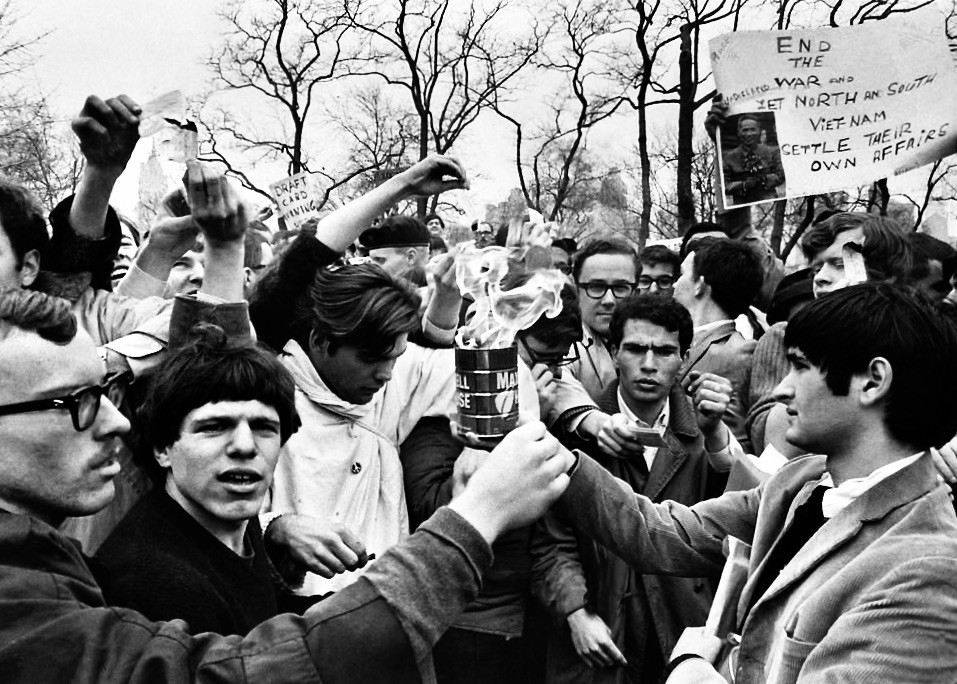
   Young men coast to coast were burning their draft cards. I was hoping it wouldn’t come to that. I didn’t even have a lighter. I had to pull out all the stops. First, I declared myself a conscientious objector. The draft board laughed it off. Then I told them I had been an altar boy and objected on religious grounds. They laughed that off, too. They were church-going men on Sundays but not any other time. Finally, I told them I would frag an officer the first chance I got if I was forced into poplin fatigues and sent to Vietnam. I wasn’t trying to be mutinous, but I wasn’t prepared to be crippled or killed keeping dominoes in place, no matter what dominoes they were.

   That was no laughing matter to them. They sent me to a Master Sergeant who chewed me out for being unpatriotic, who then sent me to a commissioned officer who chewed me out for being unpatriotic, and finally to an indifferent psychiatrist who wrote me up as hopeless. He gave me a 4F deferment, meaning I was “physically, mentally, or morally unfit to serve.” I was OK with the snub.

   In the meantime, my father, who was  a God-fearing Republican, and I got into several heated arguments and I moved out. I dropped out of Cleveland State University for half-a-year and discovered the Upper Prospect bohemian enclave on the city’s near east side. I had grown up going from one end of high school to the other, but I hadn’t grown up as much as I thought. Cooking and cleaning, making the rent, and meeting new kinds of people in a new place outside of my old world was a kind of coming of age.

   The war in Southeast Asia went on without me. I stopped reading the news about it. It was a dead letter. I hoped that when Johnny came marching home he came home in one piece, but got to thinking that marching in lockstep might not be the best and brightest way for me to make my way on the road ahead.

Ed Staskus posts monthly on 147 Stanley Street http://www.147stanleystreet.com, Made in Cleveland http://www.clevelandohiodaybook.com, Down East http://www.redroadpei.com, and Lithuanian Journal http://www.lithuanianjournal.com. To get the site’s monthly feature in your in-box click on “Follow.” His books are available on Amazon and Apple Books.

“Bomb City”

Cleveland, Ohio 1975. The John Scalish Crime Family and Danny Greene’s Irish Mob are at war. Car bombs are the weapon of choice. Two police detectives are assigned to find the bomb makers. It gets personal. Revenge is always personal.

A crying of Lot 49 Publication

Riding the Red Line

By Ed Staskus

   The last summer I lived in the Forest Hills neighborhood around Eddy Rd., where there were no forests or hills, although there were plenty of Eastern European immigrants, including me, was the last summer my friends and I took the Rapid Transit to mess around downtown and go to the movies. We went on Saturdays, rain or shine. It had been twenty-some years, before any of us were born, since the city-owned train system got rolling. Their motto was “This breakthrough is brought to you by the Cleveland Transit System.” We didn’t pay attention to mottos. We paid attention to the ten cents for the fare tucked in the coin pocket of our pants.

   The newspapers that summer were all about civil rights and Vietnam, two issues we hardly knew anything about and cared about even less. What we cared about was whatever was right in front of our eyes. The year was 1963. Beatlemania was on the way, although we didn’t know what it was, yet. Stevie Wonder released his first live album, “The 12 Year Old Genius,” and it shot to No. 1 on the Billboard Hot 100. We were all twelve and thirteen years old. None of us were geniuses, not by a long shot, although some of us went on to be able to think more or less clearly.

   A vaccine for measles was approved that year. It didn’t do me any good since I had gotten the measles a few years earlier. Push-button telephones were new and a yellow smiley face popped up out of nowhere. All of us had voted for John F. Kennedy three years earlier in a mock election at St. George’s Catholic School. He was young, energetic, and handsome, while Richard Nixon was old, slow, and looked shifty with a five o’clock shadow. After JFK visited West Berlin in 1963, delivering his famous “Ich bin ein Berliner” speech, we went around calling each other Berliners and saluting Nazi-style. Our nuns didn’t like it. They told us to stop horsing around and pay attention.

   The Rapid Transit was a light rail system, what we called the wagon train. Tens of millions of riders rode it every year, especially on Saturdays, when it seemed like all of them were riding the Red Line at once to go shopping. We had to stand most of the time. Even when we got a seat, we had to soon give it up to pregnant women and old folks. Standing and swaying and holding on to a pole was carefree. We were excited about roaming around downtown and seeing a big-time movie.

   All we had known in our youth was the neighborhood Shaw-Hayden Theater, which we could walk to. They showed monster movies, cowboy movies, and rocket ship movies on weekend afternoons. We ignored the Fox Movietone News. Cartoons and a double bill cost fifty cents. Popcorn cost fifteen cents, but since we were chronically short on cash, we usually brought our own in brown paper bags hidden under our jackets. We stopped at Mary’s Sweet Shoppe once in a while and bought some penny candy.

   There was a school playground around the corner behind the local fire station with Saturday Sandbox contests, but we never went, being too old for sandboxes. There were dances at the Shaw Pool every Saturday night, but we never went to those either, being too young to care much about girls and their goings-on.

   Before the movie matinee at the Shaw-Hayden there was sometimes a drawing for prizes. One of my friends won two thousand sheets of paper one winter afternoon. He was beside himself hauling the reams home in the snow. He complained about frostbite, but he was a griper at heart, so we ignored him. The movie house was big, more than a thousand seats. We always went early so we could sit in the front row, stretching our legs out, kicking each other, and whooping it up when the screen lit up.

   Going downtown meant hoofing it from where we lived off St. Clair Ave. down E. 128th St. to Shaw Ave. to Hayden Ave. and following a no-name foot path to the Windermere station. We scrambled up the embankment, crossed the tracks at the rear of the station, and waited on the platform for the downtown bound train. Windermere was the end of the line for the Red Line.

   The Red Line ran at ground level, alongside railroad rights-of-way. There were no grade crossings with streets or highways. All of the stations along the way had high platforms. Unlike most transit lines, it was powered by an overhead electric catenary instead of a third rail. We knew things were going well when we heard the corona discharges of the high voltage.

   When we finally rolled into the underground station downtown we dusted ourselves off and ran upstairs, running through the Terminal Tower lobby and overflowing outside. We made tracks around Public Square until there was nothing left to see. We liked walking to the movies on one of the three main avenues, which were Prospect, Euclid, and Superior. Our parents warned us to stay away from Prospect Ave. where there were prostitutes and burlesque houses. It was because of their words of wisdom that we took Prospect Ave. most of the time, although we never talked to the prostitutes and never went into the bars and strip clubs. We weren’t interested in smut, and besides, we wouldn’t have been able to pay for the cheap thrills. 

   There was a cluster of theaters between E. 14th and E. 17th. Four of them faced Euclid Ave. while one faced E. 14th St. The three blocks were known as Playhouse Square, although none of us were aware of that. We didn’t pay any mind to corporate branding unless it  had something to do with the movies. All of us had our own money, cobbled together from allowances, paper routes, altar boy service at weddings, and some thievery from our siblings if push came to shove and our Saturday was threatened.

   The Ohio and State theaters were built by New York City plutocrat Marcus Loew in the early 1920s, followed by Charles Platt’s Hanna Theater. The Hanna was named for Mark Hanna, Cleveland’s wheeler-dealer senator in Washington. He once said there were two things important in politics. “The first is money and I can’t remember what the second one is.” The Pompeiian-style Allen Theater opened at about the same time. 

   The Palace Theater got up and running at the end of the next year, in the Keith Building, the tallest skyscraper in the city at the time. The biggest electric sign in the world was fabricated and turned on the night of the Palace Theater’s grand opening. It was billed as the “Showplace of the World.” The opening night entertainment was headlined by a famous mimic and featured dancing monkeys. Everybody said it was “the swankiest theater in the country.” 

   It wasn’t the swankiest anymore when we started going to Saturday matinees there, but we didn’t notice the wasting away. It had wide seats and a gigantic screen and that was all that mattered. The movies cost seventy five cents and we were happy to pay it. It was where we saw “Son of Flubber” and afterwards pretended to defy gravity like Fred MacMurray. We saw “It’s a Mad, Mad, Mad, Mad World” and laughed until we cried. We loved stories about lost treasure. The movie was perpetual motion and shouting. Ethel Merman was the most likable loudmouth we ever heard. We saw it twice and it was just as good the second time around.

   We saw “Cleopatra” and agreed afterwards that we had all gotten sick and tired of Elizabeth Taylor. “Why is she even in the movie?” we wondered. Rex Harrison and Richard Burton were more like it. Thousands of Romans with swords, spears, and shields fighting each other were even more like it.

   We wanted to see “Psycho” but weren’t allowed. We were warned it was too intense and inappropriate for boys our age. We were offended, but when we heard what it was about, we asked each other what all the fuss was. It sounded like a sicko stabbing people, which was right up our alley. We had all seen plenty of horror movies, like “Carousel of Souls” and “Village of the Damned.”

   When “The Raven” was playing we saw it right away, even though none of us knew Edgar Allen Poe from the man in the moon. There’s a black bird. There’s a tapping at the door. The night is dark and the wind is howling. When the door is opened there’s nobody there. “Watch your back!” we shouted at the screen.

   The stars in that movie were Vincent Price, Boris Karloff, and Peter Lorre, even though Peter Lorre was a half-pint. He had a sinister voice, hooded eyes, and a dodgy way about him, which made up for his lack of height. Vincent Price was disappointing, despite being the tallest. He spoke and acted like a sissy, even though he was supposed to be a big bad magician. In the end the whole business was disappointing. It was more laughable than scary, and once we realized how it was going, we enjoyed it for the laughs. We took a chance and asked for our money back, claiming intense disappointment, but a grouch in a red jacket ushered us out and told us where to go.

   The movies were spellbinding to us. They were like a dreamland in waking life. It didn’t matter if the story was real or unreal. We were dazzled by the moving images and the music. It was disorienting stepping out of a dark auditorium after the motion picture magic into bright sunlight, like after a midday nap when daydreams had come fast and furious.

   We heard about “Seven Wonders of the World” on WERE-AM radio before we ever saw it on the marquee of the Palace Theater. We didn’t go see the movie, even though we saw the title on the marquee week after week and even though it was in Cinerama. We didn’t like being told what a wonder was, or wasn’t. We did our own wondering. We saw everything in a kind of Cinerama, anyway, since we always sat in the front row. A gigantic screen always made a bad movie twice as good.

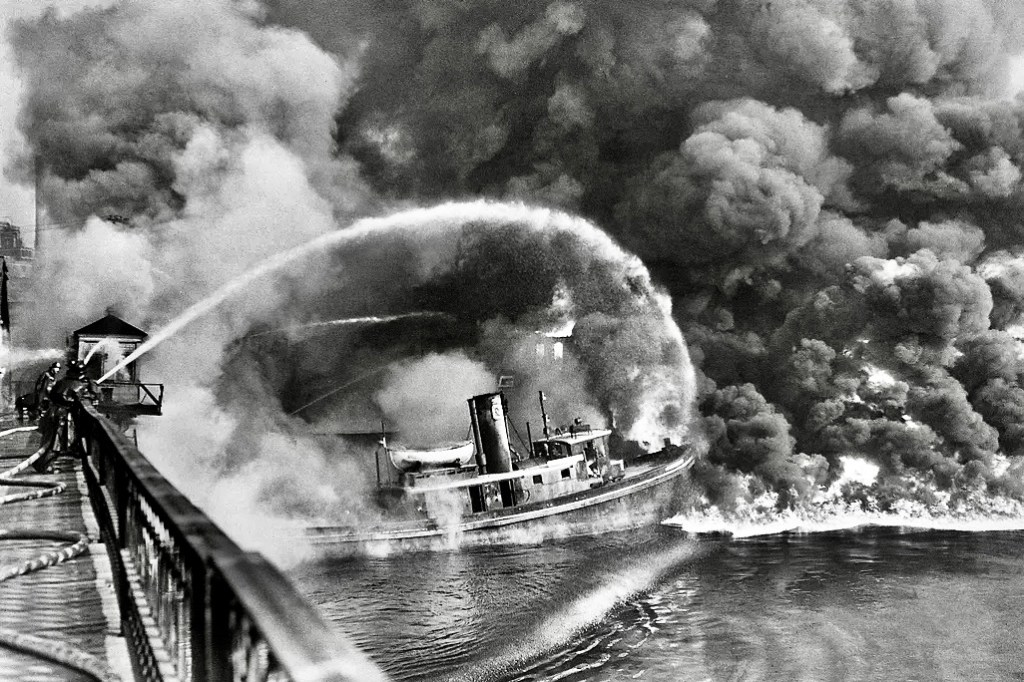
   Our real life hometown was where we went to see the wonders of the world. We stared at the skyscrapers, counting the windows. We sprinted the front steps of City Hall and the County Courthouse. We wandered around in the industrial valley, what everybody called the Flats, light-headed and amazed, gazing up at the steel plants, looking down on the Cuyahoga River, watching the up and down bridges go up and down as freighters hauling ore made their way. Six years later the river caught on fire, flames and greasy black smoke turning day to night. We walked along the shoreline of Lake Erie where fishermen pulled walleye and crappie out of the polluted water that nobody was supposed to swim in, much less eat out of. 

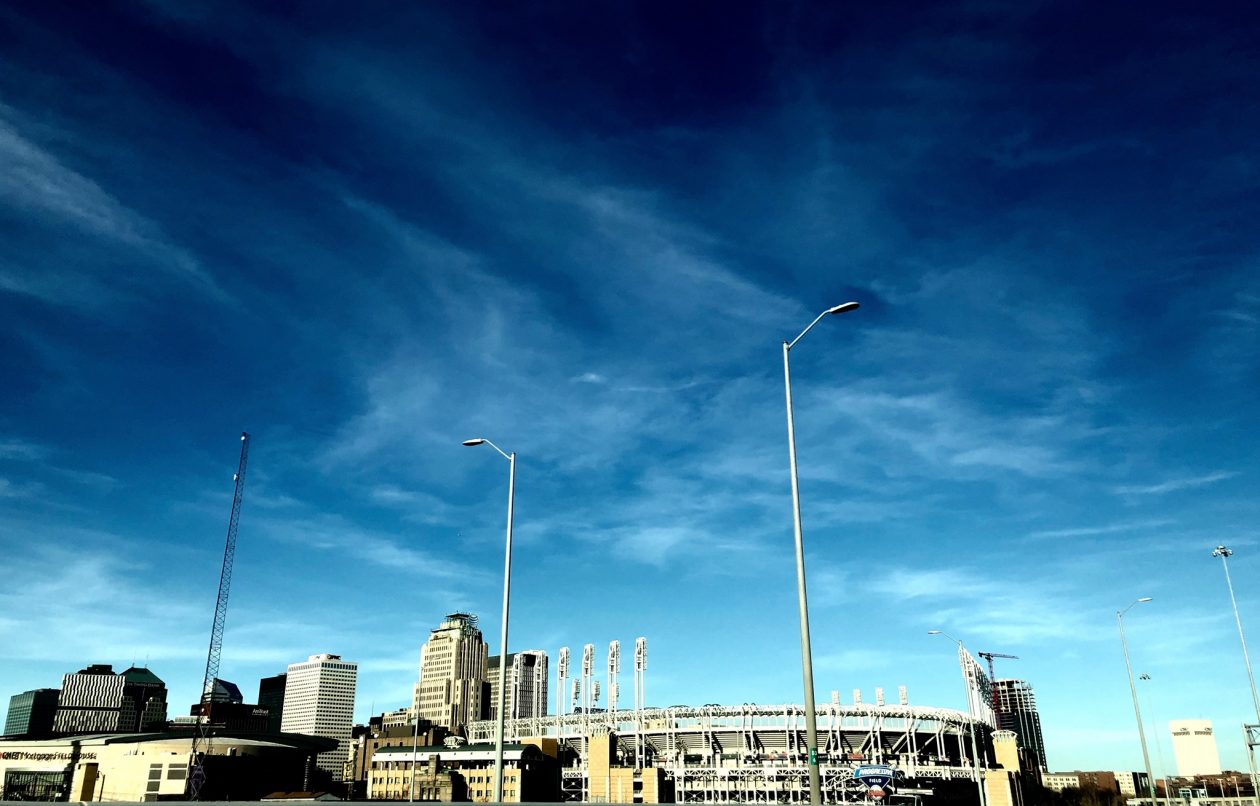
   We snuck into Municipal Stadium, called the Mistake on the Lake, whenever we knew the fire-balling Sam McDowell was pitching. He was twenty years old and tall as a tree. Hardly anybody went to see the back of the pack team and we often had most of the eighty thousand seat stadium to ourselves, cheering on the Tribe. We sat wherever we wanted. When ushers asked to see our ticket stubs, we hemmed and hawed and changed sections. Whenever we ended up in the bleachers there were never any ushers to roust us. If it was hot, we pulled our shirts off. We lobbed popcorn to the pigeons and threw pebbles at them when they were finished with their freebies.

   The weekend before our summer vacation was going to be over and we had to go back to school we saw our last movie at the Ohio Theater. It was “Lord of the Flies.” It was about boys our age who were marooned on a desert island. We knew what a boy’s life was all about. We didn’t know anybody our age who ever did the crazy things they did. We didn’t like grown-ups making up stories about us. We appreciated great trash but not great art. All of us wrote it off as high-brow hokum. 

   Going home on the Red Line after the movie we saw a fight break out. Two men had been talking, then shouting, then shoving each other in the aisle, until one of them pulled a knife and stabbed the other one in the arm. Real blood gushed and stained his clothes. A woman screamed. Two men grabbed the knifer and held him down, while another man took his own tie off and tied a tourniquet on the upper arm of the stabbed man. When we got to the Windermere station there were police cars and an ambulance there. We watched, fascinated, until a policeman told us “there’s nothing to see here, break it up and go home.” We went home more breathless than any movie had ever made us.

   President Kennedy was shot and killed that fall, which put a pall over everything. A fire broke out in the Ohio Theater the next year and the other theaters were hit by vandalism. All of them closed between the summers of 1968 and 1969 except for the Hanna. We were juniors and seniors at St. Joseph’s High School by then and the only movies we went to those years were at the LaSalle Theater in our North Collinwood neighborhood. 

   By then, when we went to the movies, we were more interested in girls than whatever was playing, although we soon found out horror movies were the way to go. There was never any doubt about what to do with your hands when you were with your main squeeze and the scary parts burst onto the screen.

   “Don’t worry, I’m right here,” we all said. “Don’t give another thought to the monster mash.”

Ed Staskus posts monthly on 147 Stanley Street http://www.147stanleystreet.com, Made in Cleveland http://www.clevelandohiodaybook.com, Down East http://www.redroadpei.com, and Lithuanian Journal http://www.lithuanianjournal.com. To get the site’s monthly feature in your in-box click on “Follow.” His books are available on Amazon and Apple Books.

“Bomb City”

Cleveland, Ohio 1975. The John Scalish Crime Family and Danny Greene’s Irish Mob are at war. Car bombs are the weapon of choice. Two police detectives are assigned to find the bomb makers. It gets personal. Revenge is always personal.

Raising the Roof

By Ed Staskus

   Arunas Petkus and I didn’t bother buying tickets to see Motorhead at the Variety Theater on the second day of December 1984. What would have been the point? They were going to be almost as loud outside the doors as inside. To that end we rustled up a pair of lawn chairs, a six pack of Pride of Cleveland, and a tin of Charles Chips. When night fell and the show started we parked ourselves on the lawn chairs in the portico behind the ticket booth. Arunas brought a flashlight and a small folding camp table for our beer and chips.

   We were there to hear the band, not see them. Thankfully, it was unseasonably warm, in the mid-40s, not raining or snowing. It probably wasn’t much warmer inside the theater. The place  was on its last legs. Who knew if the furnace even worked anymore? Who knew if the landlord had the wherewithal to pay for natural gas even if the furnace did work?  Who knew if Motorhead’s audience cared whether it was hot or cold? We layered up just in case and pulled on hats. Mine was a Chief Wahoo baseball cap. His was a Pablo Picasso sort of hat, lumpy and misshaped.

   Arunas and I had been friends since high school. He was a second generation Lithuanian like me and exchanging bona fides when we met as freshmen in our mandatory daily religion class at St. Joseph’s, an all-boys school, was easy. He was the same age as me. He lived in North Collinwood the same as me. He was an artist, however, unlike me. I could read and write but he could draw and paint. Later, when we were both attending Cleveland State University, he majored in fine arts and minored in pinocle.

   Pinocle was what we and our friends played all the time between classes in the cafeteria of CSU’s Stillwell Hall, the upper floors of which were where engineering students went and reappeared four years later with a degree. Pinocle is a card game played in partnerships, two to a side, using a specialized deck. The idea is to work together to reach a target score by bidding, melding combinations of cards, and winning tricks. If a game happened to be in the middle of an intense stretch we usually played on, nursing our lukewarm coffee, class or no class. Our grades suffered as a result.

   Going to the Motorhead show hadn’t been my idea. I didn’t know a single thing about them, not even that they existed. I suspected they were hard core. I knew what heavy metal was, although I avoided it, but didn’t know what thrash metal was. I wasn’t sure I liked the implications of thrashing. What I knew was that Arunas was keen on going.

   “They’re a band from England, kind of between rock and roll and heavy metal and punk,” he said. What Motorhead frontman Lemmy Kilmister said was, “We are Motorhead and we play rock and roll. There’s only two kinds of music I can’t stand, rap and opera. If you think you’re too old to rock, then you are.” 

   I wasn’t too old, yet, but I didn’t listen to much rock and roll. I never listened to rap after the first few times, but I liked opera, especially its gut-wrenching arias. Rock and roll seemed to be mostly a few chords about sex and romance and heartbreak, teenage rebellion and protesting the man. I did listen to some punk bands like the Clash and Social Distortion. Mike Ness of Social Distortion was a kind of roughhewn poet.

   “High school seemed like such a blur, the faces have all changed, there’s no one there left to talk to, and the pool hall I loved as a kid is now a 7-Eleven. Life goes by so fast, you only wanna do what you think is right, close your eyes and then it’s past.”

   Tickets for Motorhead were $7.00 in advance or $8.00 the day of the show. Since we were doing without tickets we used the money to pay for new flashlight batteries, the P. O. C. barely pop, and a family-sized batch of Charles Chips. The speckled brown and gold tin can was about a foot tall and full of kettle-style chips. Arunas had them delivered to his house every two weeks by the Charles Chip Man, who was like a milkman, dropping off a new tin while picking up the empty one.

   “Motorhead has been around for a while, but they’re different now, four of them instead of three, mostly new guys. ‘Fast Eddie’ Clarke on guitar and ‘Filthy Animal’ Taylor on drums are gone, but the new guys are just as good, if not better. I’ve heard they’re the loudest band in the world, although I haven’t actually ever heard them live. This will be my first time.”

   It was going to be my first time, too, as well as my first time at the Variety Theater. We didn’t actually go inside the place until it was all over and most of the crowd was gone. When we went inside it was to see what had happened to the ceiling, which was what everybody had been talking about as they left. 

   The Variety Theater was in a Spanish Gothic-style edifice that opened on Thanksgiving Day in 1927 in the Jefferson neighborhood on the west side of Cleveland. There were a dozen-or-so apartments attached to it and some retail space on both sides of the building. The theater had nearly two thousand seats, about four hundred of them in a balcony, and a Kimbal Organ to accompany silent movies. When they weren’t screening movies they staged live vaudeville shows. After Warner Bros. bought the theater vaudeville was out. The movie house was one of the busiest in Cleveland through the 1950s. Hollywood celebrities showed up now and then to plug their flicks. It was known for its double feature Sunday matinees, screening crowd-pleasers like “House of Dracula” and “I Shot Jesse James.” The matinees always included a newsreel and cartoons.

   By the time we went to hear Motorhead the Variety Theater was a pile of bricks. It had eventually become a second-run theater and finally mothballed its projectors in favor of live music. It was like they were going back to their vaudeville roots. UB40, R.E.M, the Dead Kennedys, and Stevie Ray Vaughan all played there. 

   Motorhead’s first song was “Iron Fist.”  We could hear it loud and clear. When it was over I wadded up some Kleenex and plugged my ears. I could still hear them loud and clear after that but my ears didn’t hurt. Their second song was “Stay Clean.” It seemed to be a bad girlfriend or slam the establishment tune. I couldn’t tell which.

   “I can tell, seen before, know the way, I know the law, I can’t believe, can’t obey, can’t agree with all the things I hear you say, oh no, ask me why, I can’t go on with all the filthy white lies.”

   It was just as loud as their first song. The band seemed to have one volume setting, which was twirl the dial as far to the right as it would go. “They are going to be deaf by the time they hang it up,” I said to Arunas during a sound of silence between songs. Years later Lemmy Kilmister said his hearing was “usually OK, although hearing loss does lead to a better marriage.”

   Motorhead was a high-octane force of nature. A year-or-so before they appeared in Cleveland they had won two polls, one for “heaviest band of the times” and the other for  “best worst band in the world.” Based on the first two songs we heard I awarded them the prize of “most thunderous barnstormers of the holiday season.”.”

   “What do you think?” Arunas asked.

   “Not too bad,” I said. “Kind of loud, though.” I didn’t know that some music critics had called the band “loathsome” for being discordant.

   “If we moved in next door to you, your lawn would die,” is what Lemmy Kilmister said. “If you’re going to be a rock star, go be one. People don’t want to see the guy next door on stage. They want to see a being from another planet, something that tears the heart out of you and gives it back better.”

   What he proclaimed on their song “Brotherhood of Man” was“Monsters rule your world, are you too scared to understand? You shall be forever judged and you shall surely hang.”

   The Variety Theater was on Lorain Ave. The Jefferson neighborhood was blue-collar, full of single family homes built during the building booms of post-WW1 and post-WW2 days. Cleveland was falling apart in the 1980s but Jefferson was still fair-to-middling. There was plenty of work and the neighborhood was spic and span. There were lots of Irish Americans. A flock of their children walked past, 14 and 15 year old boys and girls, then turned and came back, curious about the rowdy tunes. When they saw us camped out in the portico they asked what we were doing.

   “We’re freeloading,” Arunas said.

    “What’s that terrible music?” one of the girls asked. 

   “That’s a storm on stage, Motorhead.”

   “They sound dangerous, like they want to bite your head off.”

   “Who do you listen to?”

   “Madonna.”

   “Culture Club,” another one said.

   “Michael Jackson.”

   “I love the Eurythmics.”

   “Sweet dreams are made of this, who am I to disagree? I travel the world and the seven seas, everybody’s looking for somebody.”

   Arunas shared some of our Charles Chips with them. Our tin held a party-size pound of them so we had some to spare. He slapped the hand that reached for one of our P.O.C.’s.

   “Why don’t you like Motorhead?”

   “Weird.”

   “Lame.”

   “It’s just noise.”

   “I worry about the younger generation,” Arunas said when they were gone. “Noise? Kids don’t appreciate good music anymore.”

   Arunas was in his early 30s, like me, but I thought nothing dates a man like complaining about the younger generation. I laughed out loud, spraying potato chip shards. 

   “What are you laughing about?”

   “You sound like Aristophanes.”

   “Who’s he?”

   “A Greek guy from thousands of years ago.”

   “What did he say that sounds like me?”

   “Children now have bad manners and contempt for authority. They show disrespect for elders. Children are tyrants, not the servants of their households. They no longer rise when elders enter the room. They contradict their parents, chatter before company, gobble up dainties at the table, cross their legs, and tyrannize their teachers.”

   “Cross their legs?”

   “That’s what he said.” 

   Motorhead played about a dozen more songs, among them “Shoot You in the Back” and “Killed By Death” and “Ace of Spades.” It was like they were telling the underworld, “We’re getting there as fast as we can.”

   “Ace of Spades” had a thumping bass line and machine-gun drumming and a born to lose attitude. “If you like to gamble, I tell you, I’m your man, you win some, lose some, it’s all the same to me, playing for the high one, dancing with the devil, going with the flow, it’s all a game to me.” If it was possible it was even louder than the other songs.

   We didn’t hear much of the last two numbers, “Bomber” and “Overkill,” except for some quiet buzzing. The uproar of the band’s thrash metal had started cracking the  ceiling plaster halfway through the night. Near the end of the show so many chunks of aging plaster had crumbled and fallen down onto the crowd that the band found themselves playing unplugged. A janitor had been ordered to pull the plug. The bandmates were irate, but knew the breaker box was behind locked doors and there was nothing they could do. When the set was over it was over. They didn’t come back for an encore.

   Everybody coming out the front doors was talking about how great the band had been and laughing about the falling plaster. “They really are the loudest band in the world,” one of them said. “Shake, rattle, and roll.” When the stream of fans thinned out we slipped into the theater to see for ourselves about the plaster. There was white powdery debris and chunks of the stuff everywhere, along with the litter that is left behind at rock and roll concerts, plastic cups, aluminum beer cans, cigarette packs, food wrappers, crumpled paper bags, ticket stubs, empty nickel bags, some hats, a woman’s bra, and a pair of shoes. There was even a rusty abandoned portable barbeque. The aisles were sticky with spilled sugary drinks.

   The Motorhead extravaganza wasn’t the last rock and roll show at the Variety Theater, but the handwriting was on the wall. The neighborhood sued to stop the shows, irate about the brain-melting sound and raucous crowds. One homeowner who lived next to the theater taped some performances and played them in a court room to demonstrate how loud they were. Motorhead clocked in at 130 decibels, the loudest rock and roll concert ever recorded up to that time. That many decibels is like a shotgun going off right behind you or a jet taking off next door, except when it’s a concert it goes on for several hours. Megadeath played a couple of shows in 1985 until a judge slapped a restraining order on the theater. It closed for a few years, came back for a while as a wrestling gym, but went dark for good in 1990.

   Arunas lived nearby, just west of Gordon Square. He was a starving artist and didn’t have a car. I dropped him off and went home, where I slouched my way into bed and fell into a deep sleep. It felt good to be alive yet dead to the world, except for the echo of thrashing in my ears.

Ed Staskus posts monthly on 147 Stanley Street http://www.147stanleystreet.com, Made in Cleveland http://www.clevelandohiodaybook.com, Down East http://www.redroadpei.com, and Lithuanian Journal http://www.lithuanianjournal.com. To get the site’s monthly feature in your in-box click on “Follow.” His books are available on Amazon and Apple Books.

“Bomb City”

Cleveland, Ohio 1975. The John Scalish Crime Family and Danny Greene’s Irish Mob are at war. Car bombs are the weapon of choice. Two police detectives are assigned to find the bomb makers. It gets personal. Revenge is always personal.

Swimming With the Fish

By Ed Staskus

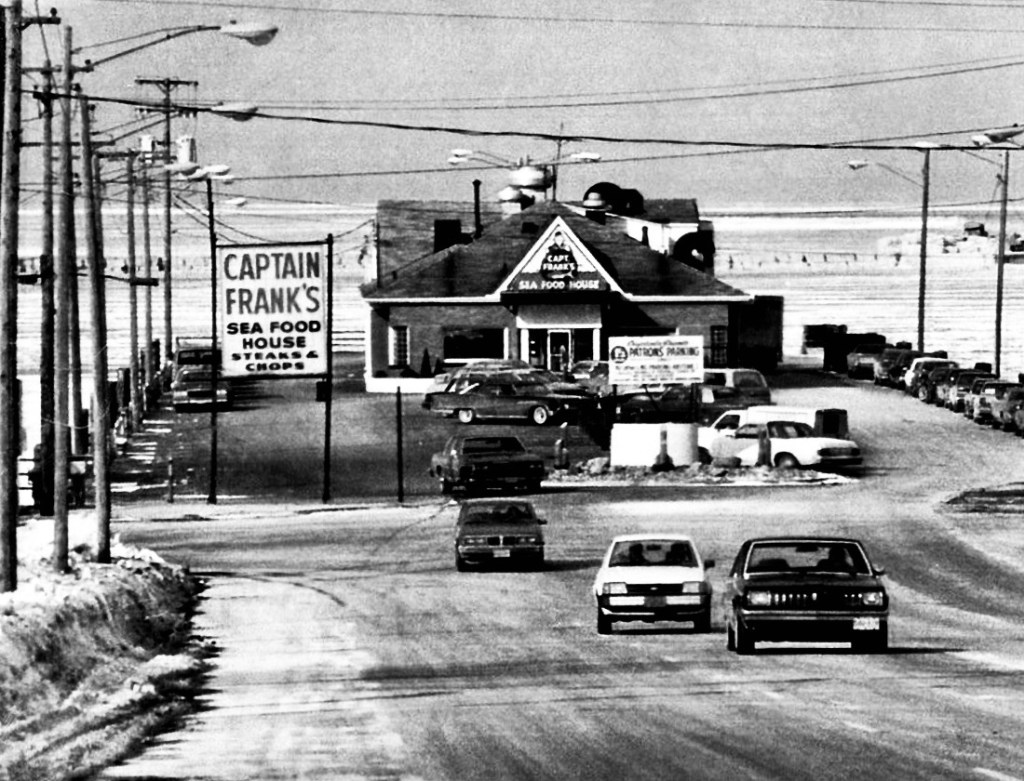
   There are thousands of restaurants in Cleveland, Ohio. Captain Frank’s isn’t one of them anymore. It used to be and when it was it was one of the best places to eat if you liked waves and wind shaking the building on the E. 9th St. pier sticking out into Lake Erie. Every so often somebody full of cheer and careless after a hearty meal, or simply drunk as a skunk, drove off the pier into the deep. 

   “It was always my last stop after a night of drinking in the Flats,” Nancy Wasen said. “Every night I was surprised no one fell off the pier and drowned.” It wasn’t for want of trying.

   Captain Frank’s was a “Lobster House” or a “Sea Food House” depending on the signage . It changed now and then. There was a panhandler who called himself Captain Frank who hung around outside the restaurant day and night, his hand stuck out. Policemen who had kept quiet about hidden rooms in gambling joints or pocketed cash in job-buying schemes were assigned to Seagull Patrol on the pier, usually in the dead of winter. They ignored the panhandler and did their best to walk the cold off. Sometimes they helped the innocent just to stay on the move.

   Francesco Visconti was the Captain Frank who ran the restaurant. He was a Sicilian from Palermo whose parents beat it out of Europe the year World War One started. At first, as soon as he could handle a horse, he sold fish from a wagon. After that he operated the Fulton Fish Market on E. 22nd St. He was forty years old in 1940 and lived with his wife, Rose, a son, and three daughters.

   He bought a beat-up passenger ferry building on the E. 9th pier in 1953 and opened Captain Frank’s. I was a small boy living the easy life in Sudbury, Ontario at the time and missed the grand opening. Kim Rifici Augustine’s grandfather was the original chef at Captain Frank’s. “The wax matches he used for flambé caused a fire back in the 1958,” she said. The fish shack burned down. Frank Visconti built it back bigger and better the next year. Kim’s grandfather was forbidden to handle matches of any kind from then on.

   By the late 1950s my family had emigrated from Canada to Cleveland, Ohio. We lived close enough, but never went to Captain Frank’s. My parents were from Lithuania and ate bowls of beetroot soup and plates of potato pancakes at their own table. They didn’t know an Italian-style diet from the man in the moon.

   In the Old Country they had feasted on pigs and crows. My mother’s father was a family farmer who kept a herd of swine, slaughtering them himself, and smoking them in a box he built in the attic of the house, the box built around their fireplace chimney. “It was the best bacon and sausage I ever had in my life,” my mother reminisced many years later.

   They hunted wild crows. “Those birds were tasty,” my mother said. The younger the birds the better. Those still in the nest and unable to get away were considered delicacies. Their crow cookouts involved breaking necks and boiling the birds in cooking oil over a bonfire. They served them with cabbage or whatever northern European vegetables they had at hand.

   Since I was part of the family, I ate with my parents, my brother, and sister. My mother prepared every meal. I ate whatever she made, even the fried liver and God-awful Lithuanian headcheese, although we never, thank God, ate carrion-loving crows. Even if I had wanted to go to the Lobster House, or anywhere else, I didn’t have a dime to my name.

   Captain Frank’s boomed in the 1960s and 1970s. There were views of the lake out every window. There was an indoor waterfall. If you had water on the brain, it was the place to be. The food was terrific. Judy Garland, Nelson Eddy, and Flip Wilson ate there whenever they were in town performing. The Shah of Iran and Mott the Hoople partied there, although not at the same time. They weren’t any which way on the same wavelength.

   There was a luncheonette behind the restaurant that doubled as a custard stand in the summer. When the Shah or Mott the Hoople stayed later than ever, they could sit in the back in the morning in the breezy sunshine with a cup of custard while iron ore boats went back-and-forth. “I never went inside Captain Frank’s, but I remember the ice cream shop in the back well,” recalled Bob Peake, a homegrown boy who was a frozen sweets savant.

   Frank Visconti was a made member of the Cleveland Crime Family. His criminal record dated back to 1931, including arrests for narcotics, bootlegging, and counterfeiting. The restaurant was frequented by high-echelon hoods and low-minded politicians alike. Many crime family meetings were held there. Many politicians filled their piggy banks there.

   Longshoremen went to Kindler’s and Dugan’s to drink before and after work, but between their double shifts went to Captain Frank’s for power shots. When they were done it was only a short walk back to the docks. When the weather was bad they were all warmed up by the time they clocked back in to work.

   The restaurant was a football field’s length from Lakefront Stadium, where Chief Wahoo and the NFL Browns played. The ballpark sat nearly 80,000 fans. The Indians were always limping along, their glory days long gone, but the Browns were exciting, and on game day crazy loud cheering rocked the windows of the restaurant. Cold biting winds blew into the stadium in spring, fall, and winter. In the summer, under the lights, swarms of midges and mayflies sometimes brought baseball games to a standstill.

   Mary Jane Jereb was sixteen years old in 1964. She didn’t know a single thing about Captain Frank’s. She was in a car with her cousin and a neighbor and a driver’s education trainer. “He took us downtown, to prepare for city driving. I wasn’t driving, my neighbor was. The instructor directed her to this particular parking lot.” It was Captain Frank’s parking lot. They drove straight to the edge of the slimy pier. Spray from a stormy Lake Erie obscured their windshield.

   “The instructor told my neighbor to turn around and head back to Parma. My short young life flashed before me as she pulled into a parking space and then backed out.” She did it by feel. None of them could see through the blurry washed-out windows. They carefully left the deep blue sea behind them.

   In 1966 the Beatles played the stadium and after that the Beach Boys, Pink Floyd, and the Rolling Stones showed up to rock the home of rock-n-roll. It was always a walloping paycheck for a night’s work. In the 1980s U2 brought its big show to town, raking in millions singing about love and lovesickness. Every so often they threw in something about social injustice.

   Even though I was grown-up by the 1970s I still didn’t dine out at Captain Frank’s. I was living in a rented house in a vague part of town and it was all I could do to feed myself at home. I didn’t have pocket money to eat out. Most of my friends were already racing to the top. I was starting at the bottom. When I finally joined the way of the world and could afford to go and wasn’t too tired from working all day, I ate out. 

   There was a kind of magic eating at Captain Frank’s at night. My friends and I watched the lights of freighters making their way slowly into Cleveland’s harbors while munching on scampi and warm dinner rolls swimming in garlic butter. They served steaks the cooks seared just right, but the seafood was usually just threatened with high heat. It was never overcooked and dried out. Students from St. John College on E. 9th and Superior Ave. walked there to have midnight breakfast because it was nearby and the plates were substantial.

   The Friday night in September 1984 my friend Matti Lavikka and I treated my brother to dinner at Captain Frank’s on his thirty first birthday was almost the last birthday he celebrated. We didn’t know Frank Visconti had died earlier that year, but in the car on the pier after dinner we thought my brother was dying. He was gasping for air. The dinner had been very good, but he looked very bad. We were afraid he might end up swimming with the fish.

   He was getting over a marriage to a Columbus girl that had lasted only fifty six days. He was singing the blues. It was his own fault, having used all the wedding’s wishing well money to pay off his gambling debts, but that was beside the point. We picked him up in Mentor, where he was living alone, and went downtown. It was a starry late summer evening. We ordered a bottle of Chianti, some pasta, and lots of shellfish. We didn’t know, and he didn’t know, that he was allergic to shellfish. 

   “I don’t know why, but I hardly ever eat fish,” he said. “It doesn’t always agree with me.” Nevertheless, he dug in. Our dinner at Frank’s that night included scallops, shrimp, and lobster. He might not have been allergic to all of them, but he was allergic to one of them, for sure.

   Halfway through coffee and dessert, which was sfogliatelle, layers of crispy puff pastry bundled together, he was itching, wheezing, and his head was puffing up. His lips, tongue, and throat looked like silly putty. He was breaking out into hives. He was getting dizzy and dizzier. It was like he had eaten a poisoned apple.

   Shellfish allergy is an abnormal response by the body’s immune system to proteins in all manner of marine animals. Among those are crustaceans and mollusks. Some people with the allergy react to all shellfish. Others react to only some of them. It ranges from mild symptoms, like a stuffy nose, to life-threatening.

   Matt was a fireman and paramedic in Bay Village. Looking at my brother he didn’t like what he was seeing. We hustled him to the car and made a beeline for the nearest hospital. Matti put the pedal to the metal. The Cleveland Clinic wasn’t far away and we had him at the front door of the emergency room in ten minutes. Five minutes later a doctor was injecting him with epinephrine and a half-hour later he was his old self.

   “Thanks, guys,” he said when we dropped him off at his bachelor pad in Mentor. He staggered away to bed. Matt and I agreed it had been a waste of good seafood.

   After Frank Visconti died the restaurant limped along. The service and food got worse and worse. The tables and chairs got old and the walls looked like they needed at least one new coat of paint. Fewer and fewer people were going downtown for any reason other than work. I was working downtown near the Cleveland State University campus, where Matt and I had started a small two-man business. One evening when I got off work I called my girlfriend and invited her to dinner at Captain Frank’s. I knew she wasn’t allergic to seafood. She had a hollow leg and generous portions were right up her alley. When we got there, however, the pier was dark in all directions. There were no parked cars in the lot and no lights in any of the windows.

   Rudolph Hubka, Jr., the new owner who had given it five years, had given up the ghost and declared bankruptcy in 1989. Nobody said a word. Hardly anybody noticed. The building was demolished in 1994. The only thing left was dust and litter blowing around in the lakeshore wind.

   We drove to Little Italy and snagged a table at Guarino’s. Sam Guarino had died two years earlier, but his wife Marilyn, who everybody called Mama Guarino, was carrying on with the aid of Sam’s sister Marie, who lived upstairs and helped with the cooking in the basement kitchen. “Marilyn sat in front, and she was like the captain on a ship, making sure everything was just right,” said Suzy Pacifico, who was a waitress at the eatery for fifty-two years.

   We had a farm-to-table dinner before there was farm-to-table, red wine, and coffee with tiramisu. We didn’t see any fishy characters, even though Little Italy was the home of the Cleveland Crime Family. Mama Guarino asked us how we liked the cake. We told her we liked it very much. When I drove my girlfriend home there were no piers to accidentally drive off of. We were both happy as clams all that night.

Ed Staskus posts monthly on 147 Stanley Street http://www.147stanleystreet.com, Made in Cleveland http://www.clevelandohiodaybook.com, Down East http://www.redroadpei.com, and Lithuanian Journal http://www.lithuanianjournal.com. To get the site’s monthly feature in your in-box click on “Follow.” His books are available on Amazon and Apple Books.

“Bomb City”

Cleveland, Ohio 1975. The John Scalish Crime Family and Danny Greene’s Irish Mob are at war. Car bombs are the weapon of choice. Two police detectives are assigned to find the bomb makers. It gets personal. Revenge is always personal.

Stand and Deliver

By Ed Staskus

   The law office’s front door was meant to be a ten-thousand-dollar door, but I got lucky, and got in and out for only two hundred fifty dollars. I never went back. One shake down is more than enough. I found out the door was the entrance to a dog and pony show. There weren’t that many apples on my tree that I could afford to give bushels of them away for flimflam in return. 

   I was at the law office to make sure, even though I had lived in the United States for decades, that I was a citizen. My immigrant parents had naturalized in the 1960s, but it was unclear, at least to me, whether their citizenship extended to me. My father, who knew how to read contracts like the back of his hand, said I was a full-fledged citizen, but I wanted to make sure.

   When I first started going to Toronto by myself in my late teens it was by Greyhound. I rode the bus to Buffalo and walked across the Peace Bridge. When I got to the Canadian side, the border police asked me where I was from and for identification. I showed them my driver’s license. They waved me through. When I went home I did the same thing. The American border police waved me through, the same as the Canadians.

   After I got married my wife and I often went to Canada, to Wasaga Beach, to Penetanguishene, to Nova Scotia, and finally to Prince Edward Island, which we liked and made a habit of returning to. We did, at least, until Osama bin Laden’s towelheads went jihad and flew jetliners into NYC’s Twin Towers. We had just gotten back from Prince Edward  Island a few days earlier. I was standing in line in a drug store when I saw it happening on a TV above the cash register. After that, crossing borders slowly but surely became more officious. We found out soon enough we would need passports to get into Canada and back into the USA.

   My wife applied for and got her passport in five weeks. I didn’t apply at first because I wasn’t absolutely certain of my status. I had never been sure, no matter how sure I sounded at the border, asserting I was an American citizen. My parents grew up in Lithuania, fled the Red Army to Germany in 1944, emigrated to Canada after the war, and finally settled in the United States in the late 1950s. They were naturalized in the mid-1960s. I knew my brother and sister were citizens, but was uncertain because of my age when my parents became citizens.

   When we decided the red sand beaches and blue water of Prince Edward Island was the place to go in the summer, I resolved to settle my body politic issue. Push came to shove and I asked one of our Lithuanian American community’s bigwigs if she knew anybody she could recommend to help me out. She told me about a friend of hers who was a lawyer. The lawyer had been in the resettlement business for more than 30 years and was herself an immigrant, she said.

   I made an appointment and went to the lawyer’s office. The lobby was sizable and almost full, full of worried-looking people sitting and waiting their turn. Some of them were Latino’s. The rest of them looked like they were from Asia or the Indian sub-continent. The citizenship business seemed to be booming. When my number was called I was shown into the boss’s office. That was my first surprise. I had not thought I would be talking to the main man, even though she was a woman. 

   The boss was a squat woman with a round face. Her hair was jet black. Her lips were dolled up in red. She glanced at the paperwork and documentation I had brought with me and said, “I will be your helping hand.” She shot me a cherry bomb smile. “Thanks,” I said. I thought she would be working on my behalf going forward. I found out later she was trying to work me over.

   She told me I had a big problem with my citizenship and might be deported at any minute. She said she wanted to get started right away before that happened. She explained the initial consultation fee was going to be $250.00 and the balance to resolve my problem was going to be $9,750.00. 

   “This is going to cost me ten thousand dollars?” I asked, incredulous. It was my second surprise. It was an unwelcome bombshell. Back in the day highwaymen stuck a gun in your back and hissed, “Stand and deliver, your money, or else.” Nowadays they tell you to sit down and stick a fountain pen in your face.

   I was in her office for five minutes before she ushered me out. “Time is money,” her red lips said. It took me fifteen minutes to drive home, where I mulled over the problem of finding ten thousand dollars. It was winter and we weren’t planning on going back to Canada until the next summer, so there was no rush on that account. But what she had said about being deported was worrisome. I had fond memories of my hometown of Sudbury, Ontario, but being uprooted was not what I wanted to happen. We had bought a house which we were renovating, and I had both full-time and part-time jobs. We had a mortgage and friends and family in town. We had a cat who would miss chasing birds in our backyard.

   I went back to the law office the next month. I was introduced to a young associate and escorted to a small room in the back. A table and two chairs were in the room. I sat down in one of the chairs and the associate sat down in the other chair. He handed me a contract for the work they were going to be doing. I handed him the same paperwork and documentation I had shown to the woman in the corner office. He started to peruse the contract. After a few minutes he looked up, cleared his throat, and said, “I don’t exactly know why you’re here. According to what I’m looking at, you already are a citizen.” 

That was my third surprise. “Are you sure?” I asked.

   “I think so, but I better doublecheck with my boss,” he said, quickly backtracking, but the cat was out of the bag.

   “All right,” I said, and as soon as I said it I made ready to be gone.

   “I can’t stay,” I said, lying and standing up. “I’ve got to get to work. Let me know what you find out and in the meantime I will read this contract.” We shook hands, I gave him a watery smile, got into my car, and drove the other way..

   The next day I drove to the Rocky River post office where I knew they processed passport applications. When the line in front of me inched forward and I finally found myself at the counter, I said I wanted to apply for a passport. A middle-aged woman in a drab uniform walked up from the back and motioned me towards a chair and a camera. She handed me an application and told me how much applying for safe conduct was going to cost. It was ninety-seven dollars.

   “All right, but would you look at my birth certificate and this other paper work first. I was born in Canada and I’m not sure I am actually an American citizen.” She spread everything out on the counter and looked it over. It didn’t take her long. Less than five minutes into it she said, “Sure, honey, you’re a citizen, no doubt about it.”

   I filled out the application, got my picture taken, paid the fee, and thanked the post office woman for her help. ”You’re welcome,” she said. I got my passport in the mail about a month and a half later. The passport had my stone-faced picture in it and was good for ten years. I could travel anywhere in the world with it.

   A week later the associate I had talked to called. He wanted to know if I had read the contract and was ready to go ahead with it. “No, I am going to pass on that,” I didn’t say I had thrown the contract in the trash long since.

   “That could mean a lot of problems for you,” he cautioned. “The State Department is cracking down, what with all this terrorism.”

   “I don’t think so,” I said. Nevertheless, he kept up his patter. I hung up.

   Somebody else from the law office called me the following week. I hung up the minute he started into his song and dance. After that the phone calls stopped. We went to Prince Edward Island for two weeks the following June. Except for the long lines at the border, everything went off without a hitch. The Canadian border police said, “Welcome to Canada.” Two weeks later the American border police said, “Welcome to the United States.”

   My wife and I bumped into our Lithuanian American bigwig at a get together a few years later. I mentioned my immigration lawyer travail. My wife tugged on my sleeve, urging me to be polite. I told my adviser how her legal beagle had tried to pull the wool over my eyes. I told her about getting my passport in the end with no run around. I told her ten grand was hard cash and how fortunate it was I hadn’t lost more than the consultation fee, never mind the lawyer’s vexing trickery. It is often the case that the only way to beat a lawyer deadest on your money is to die with nothing.

   “I know her well, she’s a friend, and she would never do anything like that,” the bigwig said, huffing and puffing. She might as well have called me a liar. “She’s nationally known for helping immigrants. She’s helped thousands of people and is one of our city’s leading citizens. Who do you think you are? Don’t say bad things about her.”

   She wasn’t somebody who ever listened to anything I said, so I didn’t argue. What would have been the point? It would have been in one ear and out the other. It was her way of letting you know you didn’t matter all that much. After that, though, I never took anything she said at face value, the same as I never took anything any lawyer ever said at face value.

Ed Staskus posts monthly on 147 Stanley Street http://www.147stanleystreet.com, Made in Cleveland http://www.clevelandohiodaybook.com, Down East http://www.redroadpei.com, and Lithuanian Journal http://www.lithuanianjournal.com. To get the site’s monthly feature in your in-box click on “Follow.” His books are available on Amazon and Apple Books.

“Bomb City”

Cleveland, Ohio 1975. The John Scalish Crime Family and Danny Greene’s Irish Mob are at war. Car bombs are the weapon of choice. Two police detectives are assigned to find the bomb makers. It gets personal. Revenge is always personal.

Breaking the Chains

By Ed Staskus

   My wife wasn’t especially interested in music, except for Russian composers and some movie soundtracks, so when she got me tickets for my birthday to see the Jesus and Mary Chain, I was surprised. I wasn’t sure she knew what she was doing. The band wasn’t Pyotr Tchaikovsky. I thought she might be all right with it since she didn’t know much about them, only that I liked the band, and wouldn’t have an opinion one way or another. To smooth the way I suggested we go to dinner at Maria’s Roman Room beforehand. I didn’t tell her how loud the band was going to be.

   “When is the show?” I asked.

   It was a sunny afternoon in late February1990. We were having coffee and toasted pastries at John’s Diner on the far west side of Lakewood. The hash house was in a former railroad passenger car. There wasn’t much snow but it was two degrees on the other side of our window. The window was Jack Frosted.

   “In two weeks at the Phantasy Theater.”

    “I’ve never been there.”

   “That’s where my brother used to drag me to see his favorite local bands. He always insisted we had to go an hour early to get the best seats, even though all the seats looked the same to me.”

   “Did you hear anybody good there?”

   “Maybe.”

   The  Phantasy Theater was on Detroit Ave. on the far east side of Lakewood, Ohio. When it opened in 1918 it was the Homestead Theater. They screened silent movies. A big organ was the soundtrack. When sound was introduced they sold the organ and screened talkies. Not long after they changed the name to the Last Picture Show they showed their last movie.

   John De Frasia bought the place in 1965. Three years later he opened a restaurant on the premises called Piccadilly Square. He built a pirate ship inside the eatery, inspired by the movie “Mutiny on the Bounty.” He worked with several shipbuilders for two-and-a-half months to get it done.  “We got the blueprints MGM Studios used for the movie ship.” He sliced the ship in half in 1973 when he decided to transform the restaurant into a music club. One half of it became a DJ booth and the other half a sound stage. In time they showcased punk, alternative, and industrial sounds. Devo, Lucky Pierre, and the Exotic Birds were some of the bands who got rolling there.

   “You can’t downplay the significance of the Phantasy to the Cleveland music scene,” Mike Hudson, lead singer of the Cleveland punk band the Pagans, said years later. “It all began with the De Frasia family. John was a nice guy and very open-minded and willing to let bands that others considered weird have a shot.”

   “You were the best,” said Brian Dempsey, the drummer for Lucky Pierre, when John De Frasia passed away in 2011. “Like an old shoe. No ego and just the coolest, most honest and real person I’d ever met in a business full of creeps. You kindness will always live on through the people you touched.”

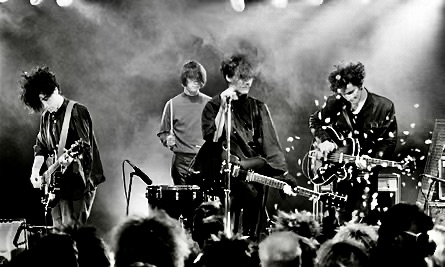
   The Jesus and Mary Chain were from Scotland. Jim and Bill Reid were the band, along with a bassist and a drummer. They were a post-punk rock band known for wistful melodies and guitar screeching feedback. They were one of the bands who pioneered noise rock. They were also known for their riot-inducing live shows. I kept that to myself, making a mental note to sit in the last row,

   “It was the crap coming out of the radio that made us want to be in a band,” Jim Reid said. “Everybody was making electronic pop music.” By 1983, when they formed the band, they had both been on unemployment for five years, writing and recording their songs at home. They called their band Death of Joey at first but changed it to the Jesus and Mary Chain. They got the name one morning from the back of a box of cereal. On the back was an offer to mail in some box tops and get a free Jesus and Mary chain necklace in return. They lost the chain necklace but kept the name.

   I had their first two LP’s, “Psychocandy” from 1985 and “Darklands” from 1987. The first LP was an ear-splitting wall of distortion. Their manager, Alan McGee, said the band’s style was “art as terrorism.” The second LP was less tempest and more mainstream. There were even some acoustic licks. Both LP’s were fine stuff.

   The Reid brothers were influenced by the Stooges, the New York Dolls, and the Velvet Underground, but with a difference. They were like the Stooges meet the Shangri-Las. In the event, they were determined to be new and original. “That’s why we started using noise and feedback,” Bill Reid said. “We wanted to make records that sounded different.” His guitar was deliberately tuned to be out of tune, while the drummer was limited to two drums, not the full kit. He played his two drums standing up like Moe Tucker had done with the Velvet Underground, although he didn’t use mallets like Moe Tucker did. He used drum sticks. The bass guitar was limited to two strings, as well. “That’s the two I use, the thick ones” said Doug Hart, the bassist. “I mean, what’s the point of spending money on another two? Two of them is enough.”

   The show at the Phantasy Theater was on Wednesday, March 15th, the day after my birthday. It was a partly cloudy day, in the high 70s. The weather in winter on the south coast of Lake Erie can be bad, but it is predictably unpredictable.

   Before my wife and I went to the show we went to Maria’s Roman Room. It was next door to the Phantasy Theatre. It was easy to find. We could smell garlic from about a block away and there was a red neon sign in the window in the shape of a fork.

   We had eaten there before with my wife’s family. Her stepfather was Sicilian and her mother was a chef. Maria’s was their favorite Italian restaurant. We ordered a bottle of the house Pinot Grigio and mozzarella fritto to start. The sticks were hand cut, made in house. The sauce and cheese were very good. The wine was more than drinkable. 

   Maria and Tony “Chick” Bastulli opened the restaurant in 1960. Over the course of time they had five children. All of them grew up working at the restaurant. Corporate squabbling is tough, but it is tame compared to working for your parents.

   “I did all the awe inspiring things that go on in the restaurant business, like cleaning toilets, washing dishes, and of course making two hundred pounds of pizza dough every day in a basement without any air conditioning,” said Maria’s son Peter. “You have not lived until you have to portion, roll, and refrigerate that much pizza dough before it raises to the level of your eyeballs when it is humid and ninety five degrees in summer.”

   My wife ordered pizza. “It’s the best thing they make. They mix grape juice in with the tomato sauce, so it’s less acidic and a little sweeter.” It was Maria’s secret recipe. The sauce was San Marzano tomatoes and the toppings were ham and black olives. I ordered a plate of Pesto alla Genovese. The green sauce tasted like pine nuts.

   “Have you ever listened to either of the Mary and Jesus Chain LP’s I have?”

   “No, but I’ve heard bits and pieces passing by. They seem nice enough, a little fuzzy, those guitars of theirs.”

   “Yeah, they’re big into feedback.”

   I kept the volume low on our record player when my wife was at home. I only turned it up when I was alone and our neighbors weren’t at home. The band’s sound was a reverb-heavy wall of sound.

   We lingered over coffee and dessert and missed Nine Inch Nails, who were the opening act. I wasn’t especially interested in them anyway, even though they were from Cleveland.  I knew they were a kind of metal band, dark and intense, but from what I had heard I thought they tried too hard.

   When we got our seats inside the Phantasy Theater we easily got seats in the last row. It wasn’t a big theater and we could see the stage well enough. When the lights went down and the band came on stage they were dressed in black. Neither the stage nor the lighting was dressed up. The stage was more dark than anything else. It was a bare bones look. I was good with that. The music was what mattered, not lasers, smoke, and mirrors.

   The Reid brothers were on guitars and Doug Hart, with his two strings, was on bass. The drummers were a Forat F16 behind the stage, playing pre-recorded drum sounds, and Steve Monti, who banged along with the pre-recorded sounds. Nobody on stage moved around much. The Reid brothers were prone to standing stock still while staring down at their shoes. Except for the singing neither of them said more than two words all show long.

   “Do you remember Calvin Coolidge?” I asked my wife between songs.

   “The president?”

   “The same. He was nicknamed Silent Cal.”

   “Because he didn’t talk much?” 

   “Not much, at all. One time at a state dinner a woman told him she had made a bet with her husband that she could get him to say more than two words.”

   “What did Calvin Coolidge say?”

    “He said, ‘You lose.’”

   Jim Reid did the singing and some of the guitar work. Bill Reid played lead guitar. Their playing was intertwined and crisp. Bill Reid played a Fender Twin Reverb  “It’s the one with the wee footswitch that gives you, what’s it called, vibrato,” he said. “I don’t remember what settings I use, but they’re different live from in the studio. The way we get our feedback is with a fuzz pedal. It’s not just a signal type feedback, it’s a feedback that bends and quavers. It’s a real cheap pedal, a Companion, I think, an old-fashioned one with one of those things that goes like this.” 

   He rocked his hand mimicking a wah-wah pedal.

   Jim Reed played a Vox Phantom. “The one with the built-in fuzz and echo and all those knobs on it.” The Vox Phantom went back to the British Invasion of the1960s. It had a Stratocaster-like sound to it.

   The band was tight as could be, even though they claimed to never rehearse.

   “We never rehearse,” Bill Reid said. “The main reason we don’t is that we’re lazy bastards.” When they went to record ‘Just Like Honey’ they only had a half-written song. ”On the Saturday night Jim and I sat up till three in the morning  trying to finish it, but we were just too tired. So we went to the session on Sunday and recorded it straight off. Doug and Bobby had never heard it before. I  was nodding my head telling Doug where to put his fingers.”

   They kicked off the show at the Phantasy Theater with ‘Rider’ from their 1988 “Barbed Wire Kisses” LP. I hadn’t heard it before. “Going on a motorbike, ride it to the beach, screaming at the sun for being out of reach.”  The guitars were fuzzy, the drums heavy, and the singing hypnotic. It was new to me but it was vintage Jesus and Mary Chain. They followed that with ‘Everything’s Alright When You’re Down’ and ‘The Hardest Walk’ and fourteen more songs. There wasn’t an intermission and no small talk between songs. They finished one song and went on to the next one.

   All of their songs had a dark aesthetic despite the Shangri La vibe of the singing. Their cover of Bo Didley’s song ‘Who Do You Love’ was terrific.” We don’t think about our music being accessible or alternative or any other category,” Bill Reid said. “If you start thinking like that, you’re lost.”

   Their last song was ‘Kill Surf City.’ It had a Beach Boys feel to it while being as unlike the Beach Boys as could possibly be.  “I’m gonna fight surf city, got to get it down, I hate honey and she hates me, but that’s the way it’s supposed to be, I’m gonna kill surf city.” When the song was over Jim Reid, the bassist, and the drummer left the stage. Bill Reid did some more work on his guitar. When he was done he put it down flat on the stage, strings up. He was done but the guitar wasn’t done. It lay on the floor of the stage keeping up a vigorous fuzzy whine for the next two or three minutes until the sound finally died away. When it did the audience, including my wife, applauded long and loud. The Jesus and Mary Chain didn’t come back for an encore, but then again, I don’t think anybody expected them to.

   “What did you think?” I asked my wife when we were walking back to our car.

   “I’m glad I saw them. They’re kind of raw but very cool on stage. I liked the contrast between their sugary melodies and the abrasive guitars. I couldn’t take a steady diet of them but I liked the show.”

   “That’s not just the Roman Room pizza talking, is it?”

   She laughed. “No, I had a good time, and I’m glad you enjoyed your birthday present.” I knew she was being sincere. Birthdays in general were special to her.

   By the weekend the weather changed again. It got cold and colder. I  had to pull my winter coat out of the closet one more time. It was no matter. Spring was only a week away.

Ed Staskus posts monthly on 147 Stanley Street http://www.147stanleystreet.com, Made in Cleveland http://www.clevelandohiodaybook.com, Down East http://www.redroadpei.com, and Lithuanian Journal http://www.lithuanianjournal.com. To get the site’s monthly feature in your in-box click on “Follow.” His books are available on Amazon and Apple Books.

“Bomb City”

Cleveland, Ohio 1975. The John Scalish Crime Family and Danny Greene’s Irish Mob are at war. Car bombs are the weapon of choice. Two police detectives are assigned to find the bomb makers. It gets personal. Revenge is always personal.

Long Shot

By Ed Staskus

   When I pulled into the parking lot of the Back Wall Racquetball Club in Solon and got out of my car I saw I was parked next to the Roselawn Cemetery. I needed some fresh air after the long drive so I went for a walk there. It wasn’t a big graveyard. I circled it and then took a hard-packed path through the middle of it. I almost tripped on the exposed roots of a large pin oak tree. “Watch your step,” I reminded myself.

   All of the headstones looked old. Some were leaning and others were nearly turned over. Two of the headstones next to one another were Abram and Eliza Garfield’s plots. They had been the parents of President James Garfield. Abram died in 1833 when his son was a baby. James Garfield was assassinated in 1881. His mother died in 1888 and was buried beside Abram. James got a large tomb elsewhere.

   It was a sunny summer day in 1980, the kind of day that made you glad to be alive. I went into the Back Wall. It was brand new, ten racquetball courts, three of them with glass back walls, a Nautilus physical training room, and large locker rooms on the second floor. I was there to apply for the job of Club Pro and Activities Director.

   Marty, who was the manager I had talked to on the telephone, came out of his office behind the front desk. We shook hands and introduced ourselves. He was about my age, but dressed much better than me. He was on the small side, trim and fit. He seemed smug, although I didn’t want to jump to conclusions. I found out later he was both smug and overweening.

   I filled out an application. The facts I wrote down were true as far as they went, although the rest of it was more sketchy than not. I played racquetball well enough to play in the Open class, but that was about it. I had no experience to speak of working in a sports club. In any case, Marty only glanced at the application. He asked me if I had time to play a game. I was wearing sneakers, but didn’t have anything else with me. He outfitted me with a pair of shorts and a ratty t-shirt. He handed me a racquet that looked like it had been manufactured in the Middle Ages.

   “Let’s see what you’re made of,” he said.

   He was natty in his Nike sportswear. He scored the first eight points. Those were the last points he scored. I got cracking and won the game 21 – 8.

   “Let’s play another one,” he said. “I’m just getting warmed up.”

   I won the second game by the score of 21 – 1.

   “All right, you seem to play the game well enough,” he said, more grudging than not. He told me I could start on Monday. “Get some better clothes. Make sure you look the part.”

   I bought an Adidas warm-up suit on Saturday and showed up for work on Monday. The Back Wall supplied me with monogrammed polo shirts. I checked myself out in the full-length mirror in the men’s locker room. I looked like I had just stepped out of the fridge. I was in business.

   The business was easier than I thought it was going to be. I started at ten in the morning, gave lessons to housewives most mornings, had a late lunch, gave lessons to children and more housewives in the afternoon, and got in a practice session on my own before the after-work crowd showed up. I didn’t work evenings unless an event, like an in-house competition of some kind, was going on. We hosted Ohio Racquetball Association tournaments now and then. It meant working weekends, but it was more of a good time than work. I strung racquets on the side, half of the remittance going to me, the other half going to the club. I filled in at the front desk whenever the need arose.

   I made friends with one of the daytime front desk receptionists. Rose was in her 30s, tall and gangly. She didn’t have much of a chin, but was  lively with a ready smile. I also made friends with the cleaning lady. Her name was Zala. One day I asked her what the name meant.

   “It’s Slovenian,” she said. “It means small castle.”

   She was built like a small castle, short and squat. One reason the club stayed clean was that everybody feared the ogress she became whenever somebody made a mess and she had to clean it up. She sewed headbands for me made from club towels. She hemmed them so they stayed neat. I always had a half dozen of them in my gym bag. 

   I played some of the club’s members occasionally. One of them was Wayne Godzich, who was a detective with  the Solon Police Department. He had wide set eyes, thin lips, and a great head of hair for a man his age. He rarely talked shop, but one day, sitting around in the lobby after a game, I asked him how it was that he became a policeman.

   “I got out of the army in the mid-60s. tried this and that, and finally filled out an application here,” he said. “I passed the basic physical and psychological tests and, just like that, I was on the force. I went to the academy nights, but I basically learned on the job. My first day on the job, that was in 1968, I was escorted into the office of the lieutenant, who handed me a badge, a gun, a box of bullets, and then told a sergeant to “take him down to the dump on Crocker Road” to see if I could shoot. I was a motorcycle officer, a narcotics officer, and finally made it onto the detective bureau.”

   Another member I played occasionally was Bo Natale. His name was actually Beauregard, but he went by Bo. He came to the club every day in the afternoon since he worked nights. He played racquetball and worked out on the Nautilus machines. He showered and shaved afterwards. He was a harness racing driver. He was a catch driver, which meant he was a hired hand. He didn’t train and drive his own horses. He was hired by trainers and owners to drive their horses. He was driving at the Northfield Park track that summer. The half-mile track was about fifteen minutes south of Solon.

   There were a couple of hundred dates at Northfield Park that year. Bo didn’t drive every date since he was only there for the three summer months, although he drove every date he was there. He lived in his own trailer, which he hauled around the country with a brand new red and white Ford F-150. He was a catch driver who followed the circuits and the weather. He lived in Oklahoma when he wasn’t racing.

   “I don’t get home much,” he said. “The wife likes it that way. We get along better.”

   Bo wasn’t a skinny man, like thoroughbred jockeys. He was closer to two hundred pounds than one hundred pounds. He wasn’t especially tall, either. “You don’t want to be too tall in the racebike,” he said. That was what he called the sulky. Taller drivers sit higher in the sulky, raising the overall center of gravity, impacting stability, particularly when rounding turns.

   He wasn’t a very good racquetball player, but he was strong and tireless. I usually hit passing shots, rather than kill shots, when playing him, or I kept him in the back corners with ceiling shots. He was affable enough. I started offering him advice. He didn’t mind it. He was a quick study and got better over the course of the summer.

    It was early September when he told me he was going to be moving on at the end of the week.

   “I’ve got something for you, in return for your pointers, if you’re interested,” he said.

   “What’s that?” I asked. 

   “A tip,” he said.

   “A tip on what?”

   “A race.”

   “A tip about who’s going to win?” 

   “That’s right.”

   “I don’t know,” I said. “I’m not big on gambling.”

   I never gambled on anything. I didn’t even play the new Ohio Lottery.  I didn’t have money I could afford to lose. I knew full almost everybody lost when betting on the horses. On top of that, tracks skimmed a takeout which made the odds even longer. Gambling businesses prey on psychological weaknesses and the excitement of winning and losing. I had been raised a Catholic and still believed gambling encouraged greed and vice.

   “Take it for what it’s worth,” Bo said. “The horse is Adios Harry in the seventh. Bet him to win.”

   In the event, I went to Northfield Park after work on Friday. I had never been there before. It went back to 1935 when it was built by Al Capone as a dog race track. When dog racing didn’t work out it was converted into a stock car racing track. Twenty years later the last car race was run and in 1957 it became Northfield Park.

   I got there after the first race. I had to hike from the far end of the parking lot to the grandstand. It was “Date Night” at the track. The place was overflowing with guys and gals. I found a seat and looked down at the oval dirt track. It was called “The Home of the Flying Turns.” I watched a couple of races.

   Horse racing is an ancient sport. It goes back to the chariot races of Greece and Rome. In the Middle Ages knights raced horses as part of their military training. In the 17th century racing horses became a formalized sport in England. It spread worldwide from there. The races I watched at Northfield Park were full of life. One of them was a down to the wire crapshoot. Before the seventh race came up I went to place my bet.

   The mutuel windows were in a dedicated betting hall. The windows were small, their openings recessed. A glass barrier separated the bettors from the clerks. When my turn in line came up I pushed $50.00 towards the clerk. It was more money than I earned in a day. He had a cash register kind of machine in front of him. There was a keypad. He punched in my $50.00 to win on Adios Harry. He handed me a printed ticket. I went back to my seat. Adios Harrry was going at ten to one at post time. He seemed like an unlikely contender.

   There were eight horses lined up at the starting gate. Bo wasn’t driving any of the sulkies. Adios Harry, despite the odds, was a fine looking horse. He was black with muscular hindquarters and large nostrils. He didn’t look like he was going to be lacking for air. The race began when a Cadillac Fleetwood, equipped with a pair of retractable wings that served as gates, pulled away from the horses at the starting line. 

   It was a one mile race. At the start Adios Harry slipped back into last place. It didn’t look good for my $50.00. At a quarter mile he was in fourth place. At the half mile mark he moved up to third place. When the sulkies hit  the stretch he was in first place. As the pack came around to the front of the grandstand their hooves were pounding. I found myself on my feet, encouraging my horse until I was out of breath. Adios Harry won going away. I whooped and started clapping. I rushed to the betting hall.

   At the mutuel window the clerk gave me $550.00 in cash.

   “I thought I won $500.00,” I said. 

   “You did,” the clerk said. “You also get your $50.00 bet back.”

   “Thanks, that’s white of you.” When he gave me a funny look I realized he was African American.

   The next Friday, my winnings from the week before tucked away, I was leaving work, walking to my car, when Wayne Godzich drove up. He had his gym bag with him. He gave me a wave.

   “I heard you went to the track,” he said.

   “I thought I would check it out.” I didn’t ask him how he knew. He was a detective, after all.

   “Did you have a good time?”

   “It was an experience.”

   “Win any money?”

   “You know, you win some, you lose some.”

   “You’re not going to make it a habit, are you?”

   “No, I don’t think so. It was more of a one-off than anything else.”

   “That’s good,” he said. “It’s the house that always wins. Gambling is a sure way of getting nothing for something.” He clapped me on the back and went inside the club.

   I never went back to Northfield Park and never saw Bo again. Without his insight, marching up to the mutuel windows would have just been taking a chance. Losing at race tracks happens when you don’t know what you’re doing. What I had won hit the spot, but I didn’t know what I was doing so it wasn’t worth taking another chance.

Ed Staskus posts monthly on 147 Stanley Street  http://www.147stanleystreet.com, Made in Cleveland http://www.clevelandohiodaybook.com, Down East http://www.redroadpei.com, and Lithuanian Journal http://www.lithuanianjournal.com. To get the site’s monthly feature in your in-box click on “Follow.”

“Bomb City” by Ed Staskus

“A police procedural when the Rust Belt was a mean street.” Sam Winchell, Beyond Books

Available on Amazon: https://www.amazon.com/dp/B0F1LM1WF9/ref=sr_1_1?crid=2MYAQAOZIC2U9&dib=eyJ2IjoiMSJ9.hTm7BGbiQbSe5ZapFwYPPfcwOpTe-Vdg6VLE4aGyTyk.Z0R-VNBWWEcvKcNaO9LdCOUnNIOOXgvYkRS_FXiXuHk&dib_tag=se&keywords=bomb+city+ed+status&qid=1742136726&sprefix=bomb+city+ed+staskus%2Caps%2C84&sr=8-1

Cleveland, Ohio 1975. The John Scalish Crime Family and Danny Greene’s Irish Mob are at war. Car bombs are the weapon of choice. Two police detectives are assigned to find the bomb makers. Revenge is always personal. It gets personal.

A Crying of Lot 49 Publication

Career Day

By Ed Staskus

   All through my junior and senior years at St. Joseph High School, which was within walking distance of where we lived, my father pressed me to focus on something that would lead to a career. He was big on the idea. He was himself a career man. During those two years I told him I didn’t know what I wanted to focus on. I didn’t tell him I wasn’t enthralled by guidance counselors. I was reading Charles Baudelaire, a mid-19th century French prose-poet, who had  told his parents, “I don’t feel I have a vocation for anything.”

   I wasn’t especially interested in seeing my picture on a baseball card or a wanted poster.  Photographs are full of lies and labels. I wanted to take my own picture and tuck it away somewhere private.

   I read Charles Baudelaire’s book “The Flowers of Evil” the winter of my senior year at St. Joseph’s. It wasn’t assigned reading, not by far. St. Joseph’s was a traditional college preparatory high school, focusing on core academic subjects like math and science, social studies, and English. Religious instruction was a required feature of every day. Our teachers, the Marianists, brothers of the Society of Mary, made sure it was an everyday thing. There was no arguing the divine with them. There were vocational courses, as well, but my father was determined that I go to college. He didn’t want to see me repairing cars or working a tool and die press.

   My favorite class was English. My favorite thing to do was read books. I always did my homework. I read assigned books like “The Great Gatsby” and “Of Mice and Men” and “To Kill a Mockingbird.” I wrote sincere essays and aced tests. I neglected my other classes, reading books that weren’t assigned. I read “Lord of the Flies” and “Nineteen Eighty-Four” and “The Catcher in the Rye.”

   “The Catcher in the Rye” wasn’t banned at St. Joseph’s, but reading it was strongly discouraged. The official explanation was we should stick to our program of studies. The unofficial explanation was the book was depraved, full of vulgar language, sexual references, and anti-establishment themes. The Marianists were concerned about the book’s morality, or lack of it.

   After graduation I opted to attend Cleveland State University. It was close to hand, a twenty minute bus ride away, and affordable. The school had been established as a state university in 1964, taking over the buildings, faculty, and curriculum of Fenn College, a private engineering and business school of several thousand students that had been founded in 1929.

   I spent my freshman year at Cleveland State University the same way I had spent my junior and senior years at St. Joseph’s, attending English classes without fail and neglecting my other classes. At the conclusion of the school year my father sat me down and read me the riot act. It led to a stinging argument, but in the end, since I was still living in my parent’s house and my father was paying part of my tuition, I agreed to participate in a kind of career day scheduled for the next month in the Flats, the city’s industrial valley.

   Most of my father’s friends were Lithuanians and most of them were professionals. They were doctors, lawyers, and engineers. My father was a certified public accountant. One of his friends was a mechanical engineer. He had a son my age who was majoring in engineering at Cleveland State University. One of his classes had a field trip to the Flats planned. They saved a seat for me.

   The day of the field trip I waited on our front steps for my ride. It was June 22, 1969, early on a Sunday morning. The factories in the Flats never closed, but slowed down somewhat on Sundays, which made it less demanding to accommodate college students wandering around. When my ride came down our street I saw it a mile away, it being a chrome yellow color. it was a 1965 Ford Econoline Club Wagon. It didn’t have a front end to speak of but there were plenty of windows. Half of the  family van was windows. There were two bucket seats up front and three rows of bench seating in the back. My father’s friend was driving and there were six engineering students in the van. They had saved the front passenger bucket for me. It was a lonesome seat, but I wasn’t one of the rank and file, anyway, so I didn’t mind.

   We got on I-90 and drove to the Flats. There was hardly any traffic. When we got downtown we drove into the industrial valley. It was a warm and sunny day. It was more warm and less sunny in the valley. The air smelled like sewage and rotten eggs. The A. W. Stadler Rendering Plant near the Harvard Ave. Bridge added the odor of rotting animal matter to the stench.

   The Flats were located along the Cuyahoga River where it snaked through the north side of the city and drained into Lake Erie. It is bottom land there, the floodplain for the river. The earliest settlers in Cleveland settled in the floodplain, but it was swampy and they soon moved to higher ground. The Ohio & Erie Canal spurred lake shipping in the 1830s and rail lines spurred commercial growth in the 1860s. The Flats became the cradle of heavy industry in Cleveland. Business boomed exponentially. After 1870 the Flats teemed with foundries, iron furnaces, rolling mills, oil refineries, and chemical factories. The river was where they dumped their waste. It was their liquid landfill.

   A century later the Flats was dank, begrimed, and very polluted. Nobody went there other than to work in the warehouses and steel mills. There were dive bars like the Harbor Inn and the Flat Iron that served greasy food and cheap booze to working men. The air was bad and the waterway was worse. No one had dared to swim in the Cuyahoga River for decades. A journalist described braving the water as “no person drowns in it, they decay.” All the fish in the reach from Akron to Cleveland had long ago died. Nothing except Japanese movie monsters could survive in the thick sludge that had once been water

   “The river was a scary thing,” Tim Donovan explained. He was a high school graduate that summer, saving up for college, working as a hatch tender unloading ore carriers. Dead rats floated past the dockside cranes, bloated to the size of dogs. “There was a general rule that if you fell in, God forbid, you would immediately go to the hospital.”

    We toured Republic Steel and Jones & Laughlin Steel. They were colossal enterprises. We could have saved time by just going to one of them since they were so much alike. There was an unbroken roar of loud machinery. The fires, furnaces, and molten metal made the factories hot. Dust and black soot covered everything. The gasses in the air didn’t make for garden variety air pollution. Breathing as we walked from one end to the other end of the factories was like breathing something poisonous.

   The reason the engineering students were on the field trip was to help them bridge the gap between classroom theory and real-world application. Manufacturing steel involved many engineering disciplines. Seeing it happen in real time gave them a chance to see complex machinery involved in large-scale processes. They got to see first-hand how their classes in mechanical design and material science applied to the steel industry. It was eye-opening to them, and me, too. I found out there and then that I wasn’t prepared be an engineer.

   It was mid-day when the field trip wrapped up. We piled back into the Ford Econoline Club Wagon, drove in one direction, and then another direction. The through streets in the Flats generally followed the Cuyahoga River, running parallel to its banks. The side streets connected to surrounding neighborhoods like Ohio City and Tremont. Nonetheless, we got lost. We finally found ourselves on the Campbell Rd. Bridge, 

   There was a Plymouth Barracuda at a dead stop ahead of us on the bridge. We stopped and waited. A police car, its lights flashing, pulled up behind us. We stayed sandwiched where we were between them.

   “What’s going on?” one of the engineering students asked.

   “There seems to be a small fire down there somewhere,” our driver parent said, peering over the dashboard. 

   There was a sudden whoosh. Oily clouds of heavy black smoke rose up. We got out of the family van and went to the railing to get a better look. The smoke became a sky-high wall obscuring everything beyond the opposite bank. A fire department tanker truck crept onto the bridge. A fireboat by the name of Anthony J. Celebrezze made its way under the bridge to the wall of smoke. 

   What was going on was the Cuyahoga River was on fire.  It wasn’t the first time it had caught fire. It had happened a dozen times since 1868. This was the thirteenth time it caught fire. A flare tossed from an overpassing train had ignited the  petroleum-covered water. 

   The worst of the earlier fires happened in 1952 when oil and industrial debris on the river’s surface ignited. The fire destroyed three tugboats, three buildings, and some ship repair shops. It damaged a railroad bridge. It caused over one and a half million dollars’ worth of damage. Nobody in Cleveland was shocked by the river catching fire. It didn’t flow as much as ooze. Everybody was resigned to the city being one of the most polluted cities in the United States. “It’s the cost of doing business,” city fathers and business moguls said.

   The fireboat crept close to the blaze, began drawing water directly from the river, and used its deck guns to try to smother the flames. It was like pouring gasoline on gasoline. The flames leapt higher. Three fire battalions drew water from hydrants and discharged it onto the fire from the river bank. They were far more effective. 

   We watched from the deck of the bridge, standing in a cluster behind a railing. The summer breeze was blowing our way, but from behind us, so we weren’t smothered by the smoke. It was still noxious. It was sharp and acrid, like burnt toast that had been buttered in sulfur compounds. We got back into the Ford Econoline Club Wagon and rolled up the windows. It didn’t help all that much.

   The inferno lasted thirty minutes. Once it was out a policeman waved us forward and we drove away. We drove along the river. As we went the water became orange from the pickling acid used by the steel mills. We got lost again and ended up on the Jennings Rd. Bridge, which connected Abbey Ave. to W. 25th St. Our driving parent knew W. 25th St. well because he shopped for fruits and vegetables at the West Side Market. He knew how to get home from there. Crossing the bridge I looked down. There was a slaughterhouse below us. I could see blood and animal parts streaming out of  outfalls and into the Cuyahoga River.

   “That was amazing,” one of the engineering students said.

   “Who ever heard of water catching fire?” another one said. “Somebody should do something about it.”

   “And put us out of a job?” a third one said.

   Once I got home I threw my clothes down the clothes chute and took a shower to wash away the smell. I put on a clean pair of jeans and a t-shirt. I combed my hair. My father was taking a Sunday late afternoon nap in the backyard. He woke up when I threw myself down in a lawn chair.

   “How was your career day?” he asked.

   “We toured a couple of steel mills and saw the Cuyahoga River catch fire,” I said.

   He seemed unfazed by the news. He had lived through World War Two as a teenager on his own. He had seen his share of bombs and fires. He fled Lithuania in 1944 and spent five years in and out of refugee camps, working black markets until he found steady work with a relief organization near Nuremberg. When he finally made it to North America he ended up in Canada, where he worked digging up nickel and copper in the Sudbury ore basin for eight years. We had been in the United States the past ten years.

   “Have you thought about getting into engineering?”  he asked.

   “I don’t think I have a talent for engineering, although I understand engineers make the world go round, at least our modern world,” I said. “But you’ve got to watch out for them. They start by making sewing machines and end with crazy hellfire.”

Ed Staskus posts monthly on 147 Stanley Street  http://www.147stanleystreet.com, Made in Cleveland http://www.clevelandohiodaybook.com, Down East http://www.redroadpei.com, and Lithuanian Journal http://www.lithuanianjournal.com. To get the site’s monthly feature in your in-box click on “Follow.”

“Cross Walk” by Ed Staskus

“A Cold War thriller that captures the vibe of mid-century NYC.” Sam Winchell, Beyond Books

Available on Amazonhttps://www.amazon.com/dp/B0CRPSFPKP

Late summer, New York City, 1956. The Mob on the make and the streets full of menace. President Eisenhower on his way to Brooklyn for the opening game of the World Series. A killer waits in the wings. Stan Riddman, a private eye working out of Hell’s Kitchen, scares up the shadows looking for a straight answer.

A Crying of Lot 49 Publication

Maybe Later Baby

By Ed Staskus

   “The end is always near,” Greg Smith said, sinking back into the firm as Jell-O bench seat. Flying bugs recently alive littered our windshield. One of them left a big yellow blob behind him the instant he hit the glass. It was a fine summer day. Jimi Hendrix’s song “Stone Free” was playing on the car radio.

   Greg’s driving hand was easy on the steering wheel. His other hand was wiggling in the outside air. He was driving well enough to keep us on the road, but his eyes were like pinwheels. The magic mushroom he had popped into his mouth a half hour earlier was working its magic. I couldn’t tell him to slow down because he was going slower than a horse-drawn buggy. I reached for the seatbelt, anyway. When I did I found out the top drop Chevrolet Impala SS didn’t have seatbelts. 

   I had taken a Greyhound bus from Cleveland down the hillbilly highway and hooked up with my friend Greg in Athens. It wasn’t Greece. It was southern Ohio in the northern Appalachians. I called him Jonesy for fun, even though he didn’t think it was funny. “I don’t like glibness,” he complained like an offended grade school teacher.

   SS stood for Super Sport. There was nothing super about the car anymore, which came off the assembly line in 1961, except for the engine. It was still super when it had to be. The rocker panels were rusting out, the front of the hood was gashed, and the tires were bald as baloney skins. The car was Roman Red on the outside while the interior was scuffed black leather. I reached for the grab bar attached to the padded dashboard.

   “Do you know this car was built by union labor right here in the United States?” Greg asked, apropos of the Japanese and German cars we had been seeing here and there.

   “No, I didn’t know that,” I said.

   “It’s got a V-8 engine. One of my uncles might have built it.”

   “Is that right? By the way, what do you mean the end is always near?”

   “Like they say,” he said, “the future’s uncertain and the end is always near.”

   At the moment the Chevy Impala SS was running on one of the V-8’s and none of Greg’s car-making relatives were in sight. What was in sight was the future. There was a flashing red light behind us. It was the kind of light that always looks makes you feel blue. The Meigs County policeman didn’t have any trouble getting on our tail. He had some trouble pulling us over, however, even though the road was straight and narrow as a preacher. The manual steering took several turns of the steering wheel to go from lock to lock. In the state he was in it took Greg a few minutes and a mile-or-so to master the mechanics of pulling off onto the shoulder.

   The policeman didn’t bother asking for his driver’s license. “Step out of the car, son, and let me smell your breath,” he said.

    Greg didn’t like being called son. He scowled patting himself down for his wallet. He huffed and puffed in the policeman’s direction.

   “You smell all right,” the policeman said. “It don’t seem like you been drinking or smoking stinkweed.” The Chevy had a vacuum powered ash tray that sucked ashes to a container in the trunk. “Why are you going so slow when you got that power horse under the hood?”

   “I know this road doesn’t go anywhere but I’m looking for the end of it,” Greg said. “I don’t want to miss it.” The policeman wasn’t fazed by the nonsense. “It don’t go nowhere but it always brings you back again,” he said. Greg was flummoxed for a minute. The policeman looked the Chevy Impala SS up and down. “This is the car the Beach Boys wrote a song about, son.”

   The song was a big hit in its day. “Nobody can catch her, nothing can touch my 409, giddy up, giddy up, my four speed dual quad 409,” Brian Wilson sang in his big falsetto while the rest of the boys layered the harmonies. The fired-up 409 was fitted with a 4-barrel carburetor and a solid lifter camshaft. The pistons were made from forged aluminum. The heads and engine block were made from cast-iron.

   “Those were the days, boys. Make no mistake, that Impala is a real fine car. Try to put some giddy up into your driving. And keep it on the yellow line.” He got back into his black and white Dodge Coronet patrol car and u-turned, going the way he had come. He drove away in good order.

   I was along for the ride on Greg’s ride that day. I had spent the spring, summer, and fall of the previous year in a nearby town called Carpenter living with Virginia Sustarsic in an abandoned general store. She wasn’t my girlfriend, but we got along, even though she was a dyed in the wool hippie and I wasn’t. She rolled her homegrown delicately and deliberately. We kept two goats, gleaned plenty of food, and brewed our own beer. I drank most of the beer. A stray kitten made us his crash pad. The town wasn’t a town so much as a whistle stop. The railroad had long since abandoned the place, though. There were maybe a dozen residents, including us. There were dust balls in all the corners of the crossroad. At night every star in the universe twinkled in the nighttime sky.

   Carpenter was in Meigs County. It was named after Return Meigs, Jr., who was the fourth governor of Ohio. The county is on the Appalachian Plateau in the southeast corner of the state. The Shade River and Leading Creek drain into the Ohio River. Leading Creek ran right through Carpenter. In the 1970s the county’s population was less than 20,000. As far as I could tell there were no Asians, Native Americans, or African Americans anywhere. There were trailer trash on every other hillside.

   Greg was a friend of John McGraw’s, who was Virginia’s on-again off-again boyfriend back home. They both lived on the bohemian near east side of downtown, near Cleveland State University. John was a part-time writer and drank whiskey straight from the bottle. Greg came from a more polite class and drank from a glass. He and John had planned on sight-seeing Meigs County, but at the last minute John bowed out. Greg went anyway, cruising all the way from one end of the state to the other in his big Chevy SS.

   Virginia dressed like it was still the Summer of Love while John more like the Age of Beatniks had never ended. Greg wasn’t any better off than them, living half on and half off the American Dream, but he dressed like a preppy. He read the classics. He was studying Latin so he could read Ovid and Seneca in the original. Nobody ever suspected he kept magic mushrooms in his wallet.

   Something came over him the minute the policeman was out of sight. He fired up the Chevy SS. He spun gravel getting back on the asphalt. The next minute we were doing eighty in a forty. The Doobie Brothers came on the radio belting out “Rockin’ Down the Highway.” I took a peek in the rearview. There was nobody behind us. I looked through the windshield at what was in front of us. All the danger was in front of us.

   “We should maybe slow down,” I calmly suggested as loud as I could. 

   The Chevy SS was a four on the floor. She wasn’t good on gas and burned some oil. Greg picked up speed. We were doing a hundred in no time. There were no more gears to shift up into. His eyes weren’t pinwheels anymore. They glinted like icepicks. He leaned over the steering wheel. The car wasn’t sloppy, nor was Greg’s handling of it sloppy, but we were headed for trouble. We were blasting down a back road. It was cracked and rough and more gravel than not. Meigs County didn’t have the tax base to keep its roads in any kind of Daytona 500 shape.

    “I’m not asking for a miracle, Lord, just a little bit of luck will do,” I whispered.

   “Every minute counts,” Greg shouted above the wind noise.

   “Keep your eyes on the road,” I shouted back. “You never can tell what’s around the corner.”

   He waved at the outdoors with his left arm. Southeastern Ohio on a sunny day in the summer is beautiful. When we roared around a blind curve there wasn’t anything there, to my relief, until there suddenly was. It was a roadhouse with some cars and pick-ups in the front, which was a small parking lot full of potholes. The sign said Frank’s Roadhouse. There were worn-out antlers nailed to the outside wall above the front windows. We pulled in, skidding in three or four different directions. A long-tailed weasel ran the other way. There were half a dozen bungalows in the back.

   Inside there was a bar, a kitchen, some tables, a dance floor, a riser protected by chicken wire, and a pool table. A man and a woman were having mashed potatoes with pulled pork at one of the tables. A bottle of BBQ sauce stood at the ready between their plates. There was some action going on at the pool table but none on the dance floor. Before I knew it Greg had found unexpected action at the bar, where a cute brunette was sitting, a lowball glass half full of red wine at her elbow and a paperback book in front of her.

   There was an oblong mirror on the wall behind the bar. It was too smudged to see into. There was a hand-written warning on a greasy piece of cardboard below it. It said, “Don’t eat the big white mint!” I didn’t ask what it meant. I didn’t want to know. What’s a simple man to do? I looked around for something to do. I put a dollar on the lip of the pool table marking my turn in line. There were two men playing nine ball. It was the middle of the day on a Thursday. Neither of them was on union soil. Neither of them was being especially efficient. There were seven or eight bottles of Burger Beer on a small round table behind them.

   One of the men looked me up and down. “I’m a pretty big man around these parts,” he said, flashing a Mighty Mouse grin. He had sharp yellow teeth. He was shorter than me, but I knew what he meant. “I thought you’d be bigger,” I said. He didn’t laugh. He had the sense of humor of a circus strongman. The other man laughed his head off. My man broke the rack. He was no Minnesota Fats. When my turn came I ran the rack and took my dollar back. I collected a dollar from the local yokel. He tried his luck two more times and paid me two more dollars. He didn’t know, and I didn’t tell him, that I spent more time than I wanted to admit, even to myself, shooting snooker at Joe Tuma’s Pool Hall back in Cleveland.

   I bought them both beers, they clapped me on the back, the circus strongman harder than he needed to, and I went back to the bar, joining my friend and his new friend. He wasn’t paying any attention to her book. He gave me a wink, suggesting the main drag from the eye to the heart doesn’t go through the intellect, or words to that effect.

   Her name was Annie. She was a third-year student at Ohio University in Athens, 20-some miles to the northwest of where we were. She was majoring in English. She wasn’t enrolled in classes that summer but had stayed in Athens instead of going home to Cincinnati. She spent her spare time exploring. She had found Frank’s Roadhouse by accident, liked the looks of it, and stopped in for the afternoon.

   “What do you like about this dump?” I asked.

   “It looks real,” she said.

   I was willing to grant her that. When the bartender approached I ordered a Vernors Ginger Soda. Between the earlier psychedelics and shots of roadhouse whiskey stirring up my tour guide, I knew one of us had to stay on the wagon. 

   “Who is Frank,” I asked the bartender. 

   “There ain’t no Frank, at least not no more,” he said. 

   “What happened to him?” 

   “Nobody knows,” he said.

    The middle of nowhere is as good a place to disappear as any.

   I reminded Greg we had promised our farmhouse friends where we were staying we would stop at the grocery store in Pomeroy and pick up milk, cheese, and toilet paper. Toilet paper was like gold where they lived. Greg’s eyes had gone soft and fuzzy in the meantime. He needed reminding. I had to remind him twice. He finally slid off the bar stool glowing like a full moon in a clear sky.

   Annie followed us out to the Chevy SS. “I like your car,” she said. Greg asked her if she wanted a ride back to college town. She pointed to a VW Beetle. “Fontasse postem infantem,” she said, jotting her name and phone number down on a  scrap of paper. She pressed it into his open hand. She rose up on her tiptoes and gave him a kiss on the cheek. I never saw a man go head over heels as fast as he did that day.

   Once we were in the car, humming along Route 143 on our way to Pomeroy, I asked him what Annie had said.

   “Maybe later baby,” he said. “That’s what she said.”

   The Milky Way was in his eyes. “Keep your eyes on the road and your hands on the wheel,” I reminded him for the last time. I didn’t have to remind him to keep his hands off the magic mushrooms in his wallet. He was riding high on a different kind of magic. Love may not make the world go round, although it can make the ride around the world more worthwhile.

Photograph by Elaine Mayes.

Ed Staskus posts monthly on 147 Stanley Street  http://www.147stanleystreet.com, Made in Cleveland http://www.clevelandohiodaybook.com, Down East http://www.redroadpei.com, and Lithuanian Journal http://www.lithuanianjournal.com. To get the site’s monthly feature in your in-box click on “Follow.”

“Bomb City” by Ed Staskus

“A police procedural when the Rust Belt was a mean street.” Sam Winchell, Beyond Books

Available on Amazon: https://www.amazon.com/dp/B0F1LM1WF9/ref=sr_1_1?crid=2MYAQAOZIC2U9&dib=eyJ2IjoiMSJ9.hTm7BGbiQbSe5ZapFwYPPfcwOpTe-Vdg6VLE4aGyTyk.Z0R-VNBWWEcvKcNaO9LdCOUnNIOOXgvYkRS_FXiXuHk&dib_tag=se&keywords=bomb+city+ed+status&qid=1742136726&sprefix=bomb+city+ed+staskus%2Caps%2C84&sr=8-1

Cleveland, Ohio 1975. The John Scalish Crime Family and Danny Greene’s Irish Mob are at war. Car bombs are the weapon of choice. Two police detectives are assigned to find the bomb makers. Revenge is always personal. It gets personal.

A Crying of Lot 49 Publication

Bomb City USA

By Ed Staskus

   When I went to work as the night clerk at the Versailles Motor Inn on E. 29th St. and Euclid Ave. in the mid-70s, Cleveland, Ohio was the bomb capital of the country. There were 21 bombings in the city in 1976 and 16 more in the surrounding county, carnage every ten days, making it tops in the United States, according to the Bureau of Alcohol, Tobacco, and Firearms. The federal lawmen christened Cleveland “Bomb City USA.”

   “A bombing sends a real message and it commands a lot of attention,” said Rick Porello, a northeast Ohio career police officer. “Danny Greene was said to have paid Art Sneperger, his main explosives guy, extra if the bombing generated news coverage. Art got paid a bonus if the thing got on television or in the newspapers.” If it bleeds it leads was and still is the leitmotif of newsmen everywhere.

   Art Sneperger made his own headlines in 1971 when, working at the behest of Danny Greene, he suddenly found himself engulfed by hellfire while planting explosives under the car of the Irishman’s old friend and new enemy Mike Frato. Fumble fingers don’t pay, although the fact of the matter was that Danny Greene set the bomb off from across the street. He had come to believe Art had ratted him out to the FBI.

   Six years later Danny Greene was himself blown up walking out of a dentist’s office in Lyndhurst. The gangster had paid cash, so the dentist ignored the sonic boom. Money was no good where the Irishman was going. Nobody outside his Celtic Club shed a tear.

   The bomb was in a Chevy Nova parked next to Danny Greene’s Lincoln Continental. It was a Trojan Horse. When it went off, set off by remote control, the Nova, the Continental, and the Irishman were reduced to scrap metal. The gangster usually wore all green clothes, wrote in green ink, and drove a green car. He wasn’t going incognito. It was easy to see it was him getting into the Lincoln. The bomb blew one of his arms one hundred feet across the parking lot. The lucky Celtic Cross he wore around his neck pierced and stuck into the asphalt. The coroner didn’t bother trying to put him back together.

   The used Chevy Nova came from Fairchild Chevrolet in Lakewood. “We heard the owner of the car lot might have been involved,” said Bob Gheen, a teenager at the time. The car had once been his father’s car. “They never transferred the title out of my dad’s name. Rick Porello from the Lyndhurst Police Department showed up at our door on Saturday morning and drove us to identify what was left of the car. We had to answer several questions and that’s pretty much the last we heard of it.”

   I was taking classes at Cleveland State University at the time but because I didn’t have a scholarship or any grants, and nobody would give me a loan to read old literature, I had to pay tuition fees and book costs myself. I was living in Asia Town, in a Polish double on East 34th St, upstairs in a two-bedroom with a roommate, but even though I knew how to live on next to nothing, I needed something to pay the bills and some more to pay for school. I was sick of Manpower and their stingy paychecks. I went looking for a steady job.

   The Versailles Motor Inn was built in the mid-60s, meant to piggyback on the Sahara Motor Inn a few blocks away at E. 32nd St., which was built a few years earlier. The Sahara wasn’t hiring, but the Versailles was, and I thought if it is anything like the Sahara, I was the young man for the job. I later found out I was the only young man to apply for the job.

   All the rooms at the four-story Sahara Motor Inn featured a television, air conditioning, piped-in music, and a dial phone, the first ones in rooms in northeast Ohio. There were three presidential suites and three bridal suites. There was a heated swimming pool, a dance floor, and a patio on the second floor. There was a continental dining room with velvet armchairs and a starlight ceiling. There were four cocktail lounges. The waitresses wore Egyptian outfits and the waiters wore fezzes. There were eight-foot paintings of Cleopatra, King Tut, and Queen Nefertiti in the lobby.

   Other than that the Versailles Motor Inn had 150 rooms, exactly the same as the Sahara Motor Inn, that is where the resemblance ended. My place of employment had a bar, a coffee shop, and a lobby. It featured sunken pit seating in the lobby where nobody ever went. The lighting was bad. The front doors facing Euclid Ave. were kept locked under penalty of death. Unlike the Sahara Motor Inn where the plants in the lobby were real geraniums, rhododendrons, and palm trees, everything at the Versailles Motor Inn was fake. The front desk was cheap veneer and the carpet was cheap, too, going threadbare. There was a drive-up side entrance at one end of the front desk and the door to the bar was at the other end of the desk. There were two elevators that made a racket going up and down.

   The Sahara Motor Inn attracted weddings, conventions, and business meetings. TV crews filming episodes for “Route 66” stayed there sometimes. The Versailles Motor Inn attracted business like peddlers on a tight budget, the sketchy who said hold all their calls, and the John and Jane trade. One weekend a flock of Baptist ministers booked all the rooms on three floors.

   I was glad to get the job since I could walk there from where I lived in Asia Town, it paid reasonably well, and I would have about half of my hours from 11 PM to 7 AM to do homework. I reconciled the day’s receipts before and after my shift. We had a floor safe bolted down in the back office. My responsibilities were mainly checking in guests and taking reservations. I gave directions to late-night callers, answered inquiries about our hotel services, which was easy enough since there were hardly any, and made recommendations to guests about nighttime dining and entertainment options, which was also easy.

   “In the 1970s downtown was dead,” said John Gorman, disc jockey and program director at radio station WMMS. “The Warehouse District and Playhouse Square weren’t happening yet. There was no reason to come.” The nickname of the progressive radio station was ‘The Buzzard.’ Downtown Cleveland’s nickname was ‘The Wasteland.’

   One night, while nothing much was happening on my side of downtown, and I was in the back office boning up for an exam the next week, Shondor Birns, Public Enemy No. 1 in Cleveland for a long time, strolled out of Christy’s Lounge, a strip club on Detroit Ave. on the near west side. It was across the street from St. Malachi Catholic Church. It was Holy Saturday, easing into Easter Sunday. As it happened, there wasn’t going to be any resurrection for the gangster after what was going to happen happened.

   During Prohibition the Birns family had turned to bootlegging, working a still in their basement for Cleveland Mafia boss Joe Lonardo. Mother Birns went up in smoke when the still exploded. After Shondor dropped out of high school, he was subsequently arrested 18 times in 12 years. After his 6th or 7th arrest a Cleveland prosecutor declared, “It is time the court put away this man whose reputation is one of rampant criminality.”

   He hooked up with the Maxie Diamond gang and got into the protection rackets. He muscled into the numbers and policy games. He opened restaurants like the Ten-Eleven and Alhambra. His big mistake was hiring Danny Greene as an enforcer. The relationship soured and Shondor Birns put a contract out on Greene. When the Irishman discovered a bomb attached to his car, he disarmed it himself and showed it to Cleveland Police Lieutenant Ed Kovacic, who offered him police protection. “No, for whatever it’s worth,” Danny Greene said, leaving the Central Station and taking the bomb with him. “I’m going to send this back to the old bastard that sent it to me.”

   When the old bastard left the girlie show, got comfortable behind the wheel of his Lincoln Mark IV, and turned the key in the ignition, a package of C-4 exploded underneath him. His head was blown through the roof of the car. The cigarette he had been meaning to light was still between his lips. His torso landed somewhere outside the passenger door. His legs landed somewhere farther away. 

   Mary Nags owned a print shop on Detroit Rd. It shared a common parking lot with the strip club. She got a call from the police telling her not to come to work on Monday. “They said a man had been blown up and parts of him were scattered around in our back lot.” The forensics men spent a day finding all the bits and pieces of the once infamous Shondor Birns.

   Police detectives focused on the numbers men in the ghetto with whom the gangster had been feuding. That turned out to be a dead end. “It’s dumb to talk about blacks doing Shondor,”one of the numbers men said.  “He wasn’t no bad fella. He was white but it didn’t make no difference. Shon had a black soul. He was black through and through.”

   Everybody knew Danny Greene had ordered it done, but charges were never brought after the actual bomber died. The Irishman had contracted Hells Angel Enis “Eagle” Crnic to do the job. The biker was later blown to bits while placing explosives to the underside of a car belonging to Johnny “Dell” Delzoppo. If the district attorney wanted to pursue the case, he would have to deliver his subpoena to the bottomless pit, where the Eagle was living next door to Art Sneperger.

   The first time I was robbed at the Versailles Motor Inn I wasn’t robbed, because I was surprised and reacted without thinking. A young black man filled out a registration card, handed me a twenty, and when I turned around to get him his key, started rifling the cash drawer. “Hey!” I shouted, lunging forward and smashing the drawer shut on his hand. He ran out yelping and cursing.

   The second time I was robbed I was robbed. The young black man didn’t bother registering. The bandit was wearing a jacket and suggested he had a gun in his jacket pocket by pointing the pocket at me. “Know what I mean?” he said. I had seen plenty of cops and robbers movies. I knew what he meant.

   “It’s not my money,” I said opening the drawer, stepping back, and raising my hands to the ceiling. What’s a simple man to do staring at the wrong end of a gun? He said I could put my hands down. “This ain’t no western movie matinee, but don’t mess around.” He took all of the night’s earnings except the loose change. I called the police, a patrol car pulled up, I made out a report, and they left. The men in blue seemed more indifferent than not.

   “Don’t let it happen again,” my boss said in the morning. He wasn’t indifferent about the missing money.

   “What do you suggest?”

   “Do you want to keep your job?”

   “I guess so,” I said, hedging my bets.

   “All right then,” he said, and that was the end of his words to the wise.

   My last night at the Versailles Motor Inn was the same as most nights, until it wasn’t. I was busy until 2:30, then it was slow as a shuttered orphanage. I sat in the back office reading until I got drowsy. I took a walk through the gloomy lobby to wake myself up and was standing behind the front desk doing nothing when in the next second there was a bright flash and a roaring bang. The doors of the bar flew off their hinges and every single bit of glass the length of the hallway was blown to smithereens.

   Other than the echo from the blast I couldn’t hear anything, slowly backing away from the desk and backing out the side door, sidling along the outside wall until I came to the front of the building. I stood outside until I was breathing again and my hearing started to come back. I decided I wasn’t hurt since nothing hurt. Back inside the dust was settling and it didn’t look like too much was on fire. The phone was still working. I called the police and they arrived in the matter of a minute, the fire department hard on their heels.

  The firemen hauled hoses inside and sprayed water on everything from one end of the bar to the other. The hardwood bar was split in half and the stools mangled. All the tables and chairs were helter-skelter. Many of them were splintered. All of the bottles and glasses and mirrors were shattered. It was a soggy mess when the firemen got done with it.

   There were forty or fifty guests tucked into their beds when the bomb went off. Some of them on the lower floors were woken up by the blast. A policeman stood by the elevator and whenever somebody came down asking what the noise had been told them to go back to bed.

   I went over what happened with a police detective. He asked me a hundred questions but finally told me to go home. It was five in the morning. I walked up E. 30th St. to Payne Ave, past Dave’s Grocery and Stan’s Deli, to my rented rooms on E. 34th St. I didn’t see another soul, although I saw thin ice in the shadows on every street. My roommate was dead asleep. Mr. Moto my Siamese cat followed me to my bed and jumped on top of me when I fell into it. He curled up while I lay awake.

   I quit my job by phone the next day. The only time I went back was to collect my last paycheck. My ex-boss looked at me sideways like I had something to do with the bombing. When I asked, he said the police had found a door forced at the back of the bar and believed that was how the intruder got in, taping two sticks of dynamite to the underside of the bar. He said I was lucky the wood was oak.

   “One stick can blow a 12-inch-thick tree right out of the ground, do you know?” he said.

   “I don’t know and I don’t care,” I said. There were sheets of plywood hammered up everywhere. A month later I heard talk that the bar’s proprietor, who leased the space from the Versailles Motor Inn, had fallen behind paying his protection money and the bombing was a way of settling accounts.

   The Mob was big in Cleveland in the 1970s. When John Scalish died after 30-odd years as the underworld’s power broker, Jack “King of the Hill” Licavoli took over. He lived in an unassuming house in Little Italy, up the hill towards Cleveland Heights. “Jack was the last of the old-school Cleveland mobsters,” said James Willis, his downtown lawyer. “Cleveland had the best burglars, thieves, and safe crackers in the country. I know, I represented a lot of them.”

   Jack White, another of his names, a play on his dark Sicilian complexion, got his start bootlegging in St. Louis. He came to Cleveland in 1938 and worked his way up. “A lot of the guys coming up were just out for themselves, but not Jack. He looked out for the operation and he was so good at his job that I thought it would never end,” James Willis said. “He was very secretive and not at all flamboyant. We would only ever talk in person.”

   “No one thought it would be Licavoli taking over,” Rick Porello said. “He was an old miser. One time he was caught by a store’s security for switching the price tag on a pair of trousers. When they found out who he was they dropped the charges.”

   I soon found work in the Communications Department at Cleveland State University, on the 16th floor of Rhodes Tower, working for their new film studies professor. I was an English major, but movies were close enough. They were becoming the new literature, anyway. My job was picking up whatever art house film my boss was screening from the mail room, roll the 16 mm projector out of storage, screen the movie to his class, and send it on to the next school that wanted it. In return I got free tuition and a closet that passed for an office.

   I watched many French New Wave movies, Japanese samurai movies, and 1940s Warner Brothers crime movies during my work-study year, films that the Cleveland State University library had tucked away in secret places. I projected them on my office wall at the end of the day. I didn’t have a TV at home, but the movies I watched were better than anything on TV, anyway.

   Two years after I left the Versailles Motor Inn, John Nardi, who was secretary-treasurer of Vending Machine Service Employees Local 410 and high up in the Mob’s chain of command, sauntered out of his office a couple of blocks away from where I had worked as a night clerk, stepped into his Oldsmobile 98, and turned the key. The small car parked next to him exploded. It was another Trojan Horse attack. The bomb, to make sure, was packed with nuts and bolts. John Nardi was blown to kingdom come. Bomb City USA was alive and well.

Ed Staskus posts monthly on 147 Stanley Street http://www.147stanleystreet.com, Made in Cleveland http://www.clevelandohiodaybook.com, Down East http://www.redroadpei.com, and Lithuanian Journal http://www.lithuanianjournal.com

“Cross Walk” by Ed Staskus

“A Cold War thriller that captures the vibe of mid-century NYC.” Sam Winchell, Beyond Books

Available on Amazonhttps://www.amazon.com/dp/B0CRPSFPKP

The end of summer, New York City, 1956. Times Square, Coney Island, and the Mob on the make. President Eisenhower on his way to Brooklyn for the opening game of the World Series. A killer waits in the wings. A Hell’s Kitchen private eye scares up the shadows.

A Crying of Lot 49 Publication