Tag Archives: Arunas Petkus

Raising the Roof

By Ed Staskus

   Arunas Petkus and I didn’t bother buying tickets to see Motorhead at the Variety Theater on the second day of December 1984. What would have been the point? They were going to be almost as loud outside the doors as inside. To that end we rustled up a pair of lawn chairs, a six pack of Pride of Cleveland, and a tin of Charles Chips. When night fell and the show started we parked ourselves on the lawn chairs in the portico behind the ticket booth. Arunas brought a flashlight and a small folding camp table for our beer and chips.

   We were there to hear the band, not see them. Thankfully, it was unseasonably warm, in the mid-40s, not raining or snowing. It probably wasn’t much warmer inside the theater. The place  was on its last legs. Who knew if the furnace even worked anymore? Who knew if the landlord had the wherewithal to pay for natural gas even if the furnace did work?  Who knew if Motorhead’s audience cared whether it was hot or cold? We layered up just in case and pulled on hats. Mine was a Chief Wahoo baseball cap. His was a Pablo Picasso sort of hat, lumpy and misshaped.

   Arunas and I had been friends since high school. He was a second generation Lithuanian like me and exchanging bona fides when we met as freshmen in our mandatory daily religion class at St. Joseph’s, an all-boys school, was easy. He was the same age as me. He lived in North Collinwood the same as me. He was an artist, however, unlike me. I could read and write but he could draw and paint. Later, when we were both attending Cleveland State University, he majored in fine arts and minored in pinocle.

   Pinocle was what we and our friends played all the time between classes in the cafeteria of CSU’s Stillwell Hall, the upper floors of which were where engineering students went and reappeared four years later with a degree. Pinocle is a card game played in partnerships, two to a side, using a specialized deck. The idea is to work together to reach a target score by bidding, melding combinations of cards, and winning tricks. If a game happened to be in the middle of an intense stretch we usually played on, nursing our lukewarm coffee, class or no class. Our grades suffered as a result.

   Going to the Motorhead show hadn’t been my idea. I didn’t know a single thing about them, not even that they existed. I suspected they were hard core. I knew what heavy metal was, although I avoided it, but didn’t know what thrash metal was. I wasn’t sure I liked the implications of thrashing. What I knew was that Arunas was keen on going.

   “They’re a band from England, kind of between rock and roll and heavy metal and punk,” he said. What Motorhead frontman Lemmy Kilmister said was, “We are Motorhead and we play rock and roll. There’s only two kinds of music I can’t stand, rap and opera. If you think you’re too old to rock, then you are.” 

   I wasn’t too old, yet, but I didn’t listen to much rock and roll. I never listened to rap after the first few times, but I liked opera, especially its gut-wrenching arias. Rock and roll seemed to be mostly a few chords about sex and romance and heartbreak, teenage rebellion and protesting the man. I did listen to some punk bands like the Clash and Social Distortion. Mike Ness of Social Distortion was a kind of roughhewn poet.

   “High school seemed like such a blur, the faces have all changed, there’s no one there left to talk to, and the pool hall I loved as a kid is now a 7-Eleven. Life goes by so fast, you only wanna do what you think is right, close your eyes and then it’s past.”

   Tickets for Motorhead were $7.00 in advance or $8.00 the day of the show. Since we were doing without tickets we used the money to pay for new flashlight batteries, the P. O. C. barely pop, and a family-sized batch of Charles Chips. The speckled brown and gold tin can was about a foot tall and full of kettle-style chips. Arunas had them delivered to his house every two weeks by the Charles Chip Man, who was like a milkman, dropping off a new tin while picking up the empty one.

   “Motorhead has been around for a while, but they’re different now, four of them instead of three, mostly new guys. ‘Fast Eddie’ Clarke on guitar and ‘Filthy Animal’ Taylor on drums are gone, but the new guys are just as good, if not better. I’ve heard they’re the loudest band in the world, although I haven’t actually ever heard them live. This will be my first time.”

   It was going to be my first time, too, as well as my first time at the Variety Theater. We didn’t actually go inside the place until it was all over and most of the crowd was gone. When we went inside it was to see what had happened to the ceiling, which was what everybody had been talking about as they left. 

   The Variety Theater was in a Spanish Gothic-style edifice that opened on Thanksgiving Day in 1927 in the Jefferson neighborhood on the west side of Cleveland. There were a dozen-or-so apartments attached to it and some retail space on both sides of the building. The theater had nearly two thousand seats, about four hundred of them in a balcony, and a Kimbal Organ to accompany silent movies. When they weren’t screening movies they staged live vaudeville shows. After Warner Bros. bought the theater vaudeville was out. The movie house was one of the busiest in Cleveland through the 1950s. Hollywood celebrities showed up now and then to plug their flicks. It was known for its double feature Sunday matinees, screening crowd-pleasers like “House of Dracula” and “I Shot Jesse James.” The matinees always included a newsreel and cartoons.

   By the time we went to hear Motorhead the Variety Theater was a pile of bricks. It had eventually become a second-run theater and finally mothballed its projectors in favor of live music. It was like they were going back to their vaudeville roots. UB40, R.E.M, the Dead Kennedys, and Stevie Ray Vaughan all played there. 

   Motorhead’s first song was “Iron Fist.”  We could hear it loud and clear. When it was over I wadded up some Kleenex and plugged my ears. I could still hear them loud and clear after that but my ears didn’t hurt. Their second song was “Stay Clean.” It seemed to be a bad girlfriend or slam the establishment tune. I couldn’t tell which.

   “I can tell, seen before, know the way, I know the law, I can’t believe, can’t obey, can’t agree with all the things I hear you say, oh no, ask me why, I can’t go on with all the filthy white lies.”

   It was just as loud as their first song. The band seemed to have one volume setting, which was twirl the dial as far to the right as it would go. “They are going to be deaf by the time they hang it up,” I said to Arunas during a sound of silence between songs. Years later Lemmy Kilmister said his hearing was “usually OK, although hearing loss does lead to a better marriage.”

   Motorhead was a high-octane force of nature. A year-or-so before they appeared in Cleveland they had won two polls, one for “heaviest band of the times” and the other for  “best worst band in the world.” Based on the first two songs we heard I awarded them the prize of “most thunderous barnstormers of the holiday season.”.”

   “What do you think?” Arunas asked.

   “Not too bad,” I said. “Kind of loud, though.” I didn’t know that some music critics had called the band “loathsome” for being discordant.

   “If we moved in next door to you, your lawn would die,” is what Lemmy Kilmister said. “If you’re going to be a rock star, go be one. People don’t want to see the guy next door on stage. They want to see a being from another planet, something that tears the heart out of you and gives it back better.”

   What he proclaimed on their song “Brotherhood of Man” was“Monsters rule your world, are you too scared to understand? You shall be forever judged and you shall surely hang.”

   The Variety Theater was on Lorain Ave. The Jefferson neighborhood was blue-collar, full of single family homes built during the building booms of post-WW1 and post-WW2 days. Cleveland was falling apart in the 1980s but Jefferson was still fair-to-middling. There was plenty of work and the neighborhood was spic and span. There were lots of Irish Americans. A flock of their children walked past, 14 and 15 year old boys and girls, then turned and came back, curious about the rowdy tunes. When they saw us camped out in the portico they asked what we were doing.

   “We’re freeloading,” Arunas said.

    “What’s that terrible music?” one of the girls asked. 

   “That’s a storm on stage, Motorhead.”

   “They sound dangerous, like they want to bite your head off.”

   “Who do you listen to?”

   “Madonna.”

   “Culture Club,” another one said.

   “Michael Jackson.”

   “I love the Eurythmics.”

   “Sweet dreams are made of this, who am I to disagree? I travel the world and the seven seas, everybody’s looking for somebody.”

   Arunas shared some of our Charles Chips with them. Our tin held a party-size pound of them so we had some to spare. He slapped the hand that reached for one of our P.O.C.’s.

   “Why don’t you like Motorhead?”

   “Weird.”

   “Lame.”

   “It’s just noise.”

   “I worry about the younger generation,” Arunas said when they were gone. “Noise? Kids don’t appreciate good music anymore.”

   Arunas was in his early 30s, like me, but I thought nothing dates a man like complaining about the younger generation. I laughed out loud, spraying potato chip shards. 

   “What are you laughing about?”

   “You sound like Aristophanes.”

   “Who’s he?”

   “A Greek guy from thousands of years ago.”

   “What did he say that sounds like me?”

   “Children now have bad manners and contempt for authority. They show disrespect for elders. Children are tyrants, not the servants of their households. They no longer rise when elders enter the room. They contradict their parents, chatter before company, gobble up dainties at the table, cross their legs, and tyrannize their teachers.”

   “Cross their legs?”

   “That’s what he said.” 

   Motorhead played about a dozen more songs, among them “Shoot You in the Back” and “Killed By Death” and “Ace of Spades.” It was like they were telling the underworld, “We’re getting there as fast as we can.”

   “Ace of Spades” had a thumping bass line and machine-gun drumming and a born to lose attitude. “If you like to gamble, I tell you, I’m your man, you win some, lose some, it’s all the same to me, playing for the high one, dancing with the devil, going with the flow, it’s all a game to me.” If it was possible it was even louder than the other songs.

   We didn’t hear much of the last two numbers, “Bomber” and “Overkill,” except for some quiet buzzing. The uproar of the band’s thrash metal had started cracking the  ceiling plaster halfway through the night. Near the end of the show so many chunks of aging plaster had crumbled and fallen down onto the crowd that the band found themselves playing unplugged. A janitor had been ordered to pull the plug. The bandmates were irate, but knew the breaker box was behind locked doors and there was nothing they could do. When the set was over it was over. They didn’t come back for an encore.

   Everybody coming out the front doors was talking about how great the band had been and laughing about the falling plaster. “They really are the loudest band in the world,” one of them said. “Shake, rattle, and roll.” When the stream of fans thinned out we slipped into the theater to see for ourselves about the plaster. There was white powdery debris and chunks of the stuff everywhere, along with the litter that is left behind at rock and roll concerts, plastic cups, aluminum beer cans, cigarette packs, food wrappers, crumpled paper bags, ticket stubs, empty nickel bags, some hats, a woman’s bra, and a pair of shoes. There was even a rusty abandoned portable barbeque. The aisles were sticky with spilled sugary drinks.

   The Motorhead extravaganza wasn’t the last rock and roll show at the Variety Theater, but the handwriting was on the wall. The neighborhood sued to stop the shows, irate about the brain-melting sound and raucous crowds. One homeowner who lived next to the theater taped some performances and played them in a court room to demonstrate how loud they were. Motorhead clocked in at 130 decibels, the loudest rock and roll concert ever recorded up to that time. That many decibels is like a shotgun going off right behind you or a jet taking off next door, except when it’s a concert it goes on for several hours. Megadeath played a couple of shows in 1985 until a judge slapped a restraining order on the theater. It closed for a few years, came back for a while as a wrestling gym, but went dark for good in 1990.

   Arunas lived nearby, just west of Gordon Square. He was a starving artist and didn’t have a car. I dropped him off and went home, where I slouched my way into bed and fell into a deep sleep. It felt good to be alive yet dead to the world, except for the echo of thrashing in my ears.

Ed Staskus posts monthly on 147 Stanley Street  http://www.147stanleystreet.com, Made in Cleveland http://www.clevelandohiodaybook.com, Down East http://www.redroadpei.com, and Lithuanian Journal http://www.lithuanianjournal.com. To get the site’s monthly feature in your in-box click on “Follow.”

“Cross Walk” by Ed Staskus

Late summer, New York City, 1956. Big city streets full of menace. A high profile contract killing in the works. A private eye working out of Hell’s Kitchen scares up the shadows.

Available on Amazon: https://www.amazon.com/dp/B0CRPSFPKP

A Crying of Lot 49 Publication

Up the Country

By Ed Staskus

   The morning Arunas Petkus and I left for California 2500-some miles from Cleveland, Ohio, the Summer of Love was a few years over. It had been a phenomenon in 1967 when as many as 100,000 people, mostly young, mostly hippies, converged on the neighborhood of Haight-Ashbury in San Francisco, hanging around, listening to music, dropping out, chasing infinity, and getting as much free love as they could.

   We were both in high school at the time and stumbled into the 1970s having missed the hoopla. The Mamas & the Papas released “San Francisco (Be Sure to Wear Flowers in Your Hair)” and it got to number four on the Billboard Hot 100. It stayed there for a month, a golden oldie in the making, while the parade across Golden Gate Bridge went on and on. The vinyl single sold more than 7 million copies worldwide. 

   Arunas found a bucket of bolts, a 1958 VW Karmann Ghia, somehow got it running, brush painted it parakeet green, and was determined to hit the open road to see what all the excitement had been about. He also wanted to visit the spot at Twin Peaks where Chocolate George’s ashes had been scattered.

   George Hendricks was a Hells Angel who was hit by a car while swerving around a stray cat on a quiet afternoon in as the Summer of Love was winding down, dying later that night from his injuries. He was known as Chocolate George because he was rarely seen without a quart of his favorite beverage, which was chocolate milk, usually spiked with whiskey. He was a favorite among the hippies because he was funny and friendly. His goatee was almost as long as his long hair, he wore a pot-shaped helmet when riding his Harley, and his denim vest was dotted with an assortment of  tinny pin badges.

   One of the badges said, “Go Easy on Kesey.” The writer Ken Kesey had been the de facto head of the Merry Pranksters. Much of the hippie aesthetic can be traced back to them and their Magic Bus. Arunas was an art student and liked the way the bus was decked out.

   The Karmann Ghia was a two-door four-speed manual with an air-cooled 36 horsepower engine in the back. The trunk was in the front. Unlike most cars it had curved glass all the way around and frameless one-piece door glass. My friend’s rust bucket barely ran, unlike most of the sporty Karmann Ghia’s on the road, but it ran. There was still some magic left in it.

   When Arunas asked me if I wanted to join him, I signed up on the spot. The two of us had gone to the same Catholic boy’s high school and were both at Cleveland State University. We threw our gear and backpacks in the front trunk of the car, sandwiches, apples, and pears in what passed for a rear seat, a bag of weed in the glove compartment, and waved goodbye to our friends at the Plaza Apartments.

   The Plaza was on Prospect Ave., on the near east side, near Cleveland State University. It was an old but built to last four-story apartment building. Secretaries, clerks, college students, bohemians, bikers, retirees, and musicians lived there. Arunas was still living with his parents in North Collinwood, while I was a part-time undergraduate and part-time manual laborer trying to keep my head above water in a one-bedroom on the second floor.

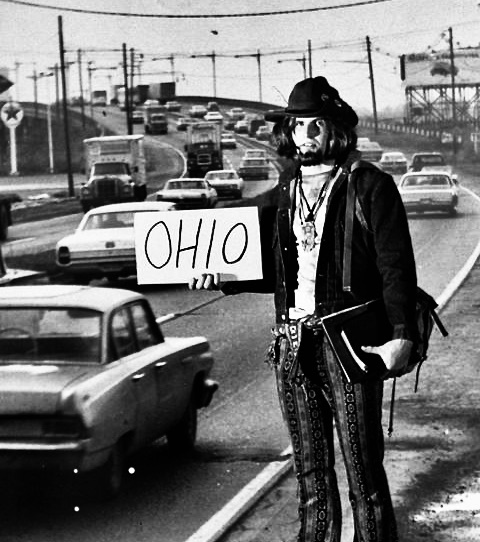
   We got almost as far as the Indiana border before an Ohio State Highway Patrolman stopped us. “Where do you think you’re going in that thing?” he asked after Arunas showed him his driver’s license. He wrinkled his nose looking at the car’s no-primer paint job.

   “California.”

   “Do you know you’re burning oil, lots of it?”

   We knew that full well. That was why we had a case-and-a half of Valvoline with us. We had worked out the loss of motor oil at about a quart every two hundred miles and thought our stockpile would get us out west before the engine seized up.

   “All right, either get this thing off the road or go back to Cleveland,” the patrolman said, waving us away with his ticket book.

   On the way back home, we decided to go to Kelly’s Island, since we had sleeping bags and could more-or-less camp out, staying under a picnic table in case of rain. We took the Challenger ferry out of Sandusky, leaving the Kharmann Ghia behind. We landed at East Harbor State Park and stayed here until the end of the week. There were a campground, beach, and trails at the park, which were all we needed. We bought homemade granola and a couple gallons of spring water at a small store and settled down on a patch of sunshine. We met some high-class girls from Case Western Reserve University and played volleyball with them.

   When we got back to Cleveland everybody marveled at our quick turnaround from the west coast and attractive tans. “We didn’t actually make it to California,” we had to explain to one-and-all.  “We didn’t even make it out of Ohio.” We had to endure many snarky comments. When Virginia Sustarsic, one of my neighbors at the Plaza, said she was going to San Francisco and invited me to try again, joining her, I jumped at the chance. My feet got tangled up coming down when she said she was hitchhiking there.

   “You’re going to thumb rides across the country?”

   “Yes,” she said, in her detached but friendly way. She was a writer, photographer, and cottage craftsman. Virginia was a raconteur when she wanted to be one. She made a living dabbling in what interested her. She lived alone. Her boyfriend was an unrepentant beatnik.

   “How about getting back?”

   She explained she had arranged a ride as far as Colorado Springs. She planned on going knockabout the rest of the way, stay a week-or-so with friends on the bay, and hitchhike back. When I looked it up on a map, she was planning on hitchhiking four thousand-some miles. I didn’t know anything about bumming my way on the highway. When I asked, she confessed to having never tried it.

   Our ride to Colorado Springs was a guy from Parma and his girlfriend in a nearly new T2 Microbus. Although it was unremarkable on the outside, the inside was vintage hippie music festival camper. It was comfortable and stocked. We stopped at a lake in Illinois and had lunch and went for a walk. I veered off the path and got lost, but spotted Virginia and our ride, and cut across a field to rejoin them. I tripped while running, fell flat on my face, but was unhurt.

   We got to Colorado Springs in two days. The next day I found out what I had fallen into in Illinois was poison ivy. An itchy rash was all over my calves, forearms, and face. I tried Calamine lotion, but all I accomplished was giving myself a pink badge that said, ‘Look at me, I’m suffering.’” Virginia’s friends where we were staying let me use their motorcycle to go to a clinic. The doctor prescribed prednisone, a steroid, and by the time we got to San Francisco I was cured.

   In the meantime, leaving the clinic, since it was a warm and sunny summer day, I went for a ride on the bike, which was a 1969 Triumph Tiger. I rode to the Pikes Peak Highway, 15 miles west, and about half the way up, until the bike started to dog it. What I didn’t know was at higher altitudes there wasn’t enough air for the carburetor. By that time, anyway, I had gotten cold in my shorts and t-shirt. It felt like the temperature had dropped thirty degrees. I turned around and rode down. There was a lot of grit and gravel on the road. I rode carefully. The last thing I wanted to happen was to dump the bike. I found out later that Colorado snowplows spread sand, not salt, in the winter. 

   All the way back to town, as dusk approached, I saw jumbo elk deer and walloping antelope. Even the racoons were enormous. I stayed slow and watchful, not wanting to bang into one of the beasts. We stayed a few days and hit the open road when my rash was better. There was no sense in scaring anybody off with my pink goo face. We had a cardboard sign saying “SF” and finally hit the jackpot when a tractor trailer going to Oakland picked us up.

   The Rocky Mountains, left behind when the glaciers went back to where they came from, were zero cool to see, although I wouldn’t want to be a snowplow driver assigned to them. The weather was fair but cold with a high easterly wind the day we crossed them. Every switchback opened onto a panorama.

   Virginia’s friends in San Francisco lived in Dogpatch, which was east of the Mission District and adjacent to the bay. It was a working class partly industrial partly residential neighborhood. They lived in a late nineteenth century house they were restoring. They went to work every day while we went exploring.

   We stayed away from downtown where there was an overflow of strip clubs, peep shows, and sex shops. Skyscrapers were going up, there were restaurants, offices, and department stores, but it still looked like the smut capital of the United States. Elsewhere, rock-n-roll, jazz fusion, and bongo drums were in the air, especially the Castro District and Haight-Ashbury. Dive bars seemed to be everywhere.

   Virginia went to Golden Gate Park and took pictures of winos, later entering one of them in a show at Cleveland State University. She had a high-tech 35mm Canon. When her photograph was rejected with the comment that it was blurry, she said, “That was the point.” I went to Twin Peaks and took a picture of the spot where Chocolate George’s ashes had been strewn. When Arunas saw it later on, he said there wasn’t much to see. I showed him some pictures from the summit facing northeast towards downtown and east towards the bay. “Those are nice,” he said, being polite. My camera was a Kodak Instamatic.

   Twin Peaks is two peaks known as “Eureka” and “Noe.” They are both about a thousand feet high. They are a barrier to the summer coastal fog pushed in from the ocean. The west-facing slopes get fog and strong winds while the east-facing slopes get more sun and warmth. The ground is thin and sandy. George was somewhere around there..

   We stayed for more than a week, riding Muni city  busses for 25 cents a ride. No matter where we went there seemed to be an anti-Vietnam War protest going on. We rode carousel horses at Playland-at-the-Beach and went to Monkey Island at the zoo. We ducked into Kerry’s Lounge and Restaurant to chow down on French fries. We stayed away from all the Doggie Diners. We listened to buskers singing for tips at Pier 45 on Fisherman’s Wharf. Jewelry makers were all over the place. Virginia was on Cloud 9, being an artisan herself.

   When we saw “The Human Jukebox” we went right over. Grimes Proznikoff kept himself out of sight in a cardboard refrigerator box until somebody gave him a donation and requested a song. Then he would pop out of the front flap and play the song on a trumpet. I asked him to play “Stone Free,” but he played “Ain’t Misbehavin’” instead.

   “I don’t know nothing about Jimi Hendrix,” he said.

   Everywhere we looked almost everybody was wearing groovy clothes made of bright polyester, which looked to be the material of choice. Tie-dye was on the way to the retirement home. Virginia dressed in classic hippie style while I dressed in classic Cleveland-style, jeans, t-shirt, and sneakers. I didn’t feel out of place in San Francisco, but I didn’t feel like I belonged, either. There were no steel mills and too many causes to worry about.

   When we left, we started at the Bay Bridge and got a ride right away. By the time we got to the other end of the bridge the man at the wheel had already come on to Virginia. We asked him to drop us off. When he stopped on the shoulder and I got out of the back seat, he pushed Virginia out the passenger door, grabbed her shoulder bag, and sped away. She didn’t keep her traveling money in it, but what did he know? We saw the bag go sailing out the car window before he disappeared from sight and retrieved it. We smelled a brewery on the breath of the next driver and turned him down. After that a pock-marked face stopped and  asked us if we were born again. When I said I had been raised a Catholic, he cursed and drove off.

   We liked talking to the people who gave us rides but avoided talking about race, religion, and politics. I carried a pocket jackknife but wasn’t sure what I would do with it if the occasion ever arose. We never hitchhiked once it got dark, because that was when lowlifes and imbeciles were most likely to come out.

   We went back the way we had come, to Nevada, through Utah, Nebraska, and Iowa to Chicago, and returning in the middle of the day to the south shore of Lake Erie. We thumbed rides at entrances to highways, at toll gates, and especially at off-the-ramp gas stations whenever we could. Gas stations were good for approaching people and asking them face-to-face if they were going our way. 

   One of the best things about hitchhiking is you can take any exit that you happen to feel is the right one. One of the worst things is running into somebody who says, “I can tell you’re not from around these parts.” We avoided big cities because getting out of them was time-consuming. We avoided small towns because we didn’t want to be the new counterculture archenemies in town. We got lucky when a shabby gentleman in a big orange Dodge with a cooler full of food and drink in the back seat picked us up outside of Omaha on his way to Kalamazoo. He listened to a border blaster on the radio all the way. We ate the sandwiches he offered us.

   Our last ride was in an unmarked Wood’s County sheriff’s car. He picked us up near Perrysburg on his way to Cleveland’s Central Police Station to pick up a criminal. It was the same station where Jane “Hanoi Jane” Fonda was put behind bars a couple of years earlier. She was famous and not a real criminal and so didn’t stay long.

   “They said they were getting orders from the White House, that would be the Nixon White House,” she said about the arrest. “I think they hoped the ‘scandal’ would cause my college speeches to be canceled and ruin my respectability. I was handcuffed and put in jail.” The day  she was arrested at Cleveland Hopkins Airport, she pushed Ed Matuszak, a special agent for the U. S. Customs Bureau, and kicked Cleveland Policeman Pieper in a sensitive place.

   The city policeman later sued Jane Fonda for $100,000 for the kick that made him “weak and sore.” The federal policeman shrugged off the shove. The charges and suit were eventually dropped.

   The Wood County sheriff was a friendly middle-aged man who warned us about the dangers of hitchhiking and drove us to near our home. When we got out of the car, he gave us ten dollars. “Get yourselves a square meal,” he said. We walked the half dozen blocks to the Plaza, dropped off our stuff, and walked the block and half to Hatton’s Deli on East 36th St. and Euclid Ave. where Virginia worked part-time. There was an eight-foot by eight-foot neon sign on the side of the three-story building. It said, “Corned Beef Best in Town.” We had waffles and scrambled eggs.

   The waitress lingered at our table pouring coffee, chatting it up while we dug into apple pie. We split the big slice. The butter knife was dull, so I used my jackknife. She asked how our cross-country trip had gone. I gave her the highlights while Virginia went into details. When the waitress asked why we hadn’t gone Greyhound, Virginia smiled like a cat, but I put my cards on the table.

   “I had an itch to go and the stone free way was the way to go.”

Ed Staskus posts monthly on 147 Stanley Street at http://www.147stanleystreet.com, Made in Cleveland http://www.clevelandohiodaybook.com, Down East http://www.redroadpei.com, and Lithuanian Journal http://www.lithuanianjournal.com. To get the site’s monthly feature in your in-box click on “Follow.”

“Bomb City” by Ed Staskus

“A police procedural when the Rust Belt was a mean street.” Sam Winchell, Beyond Books

Available on Amazon: https://www.amazon.com/dp/B0F1LM1WF9/ref=sr_1_1?crid=2MYAQAOZIC2U9&dib=eyJ2IjoiMSJ9.hTm7BGbiQbSe5ZapFwYPPfcwOpTe-Vdg6VLE4aGyTyk.Z0R-VNBWWEcvKcNaO9LdCOUnNIOOXgvYkRS_FXiXuHk&dib_tag=se&keywords=bomb+city+ed+status&qid=1742136726&sprefix=bomb+city+ed+staskus%2Caps%2C84&sr=8-1

Cleveland, Ohio 1975. The John Scalish Crime Family and Danny Greene’s Irish Mob are at war. Car bombs are the weapon of choice. Two police detectives are assigned to find the bomb makers. It gets personal.

A Crying of Lot 49 Publication