
Swimming With the Fish

By Ed Staskus

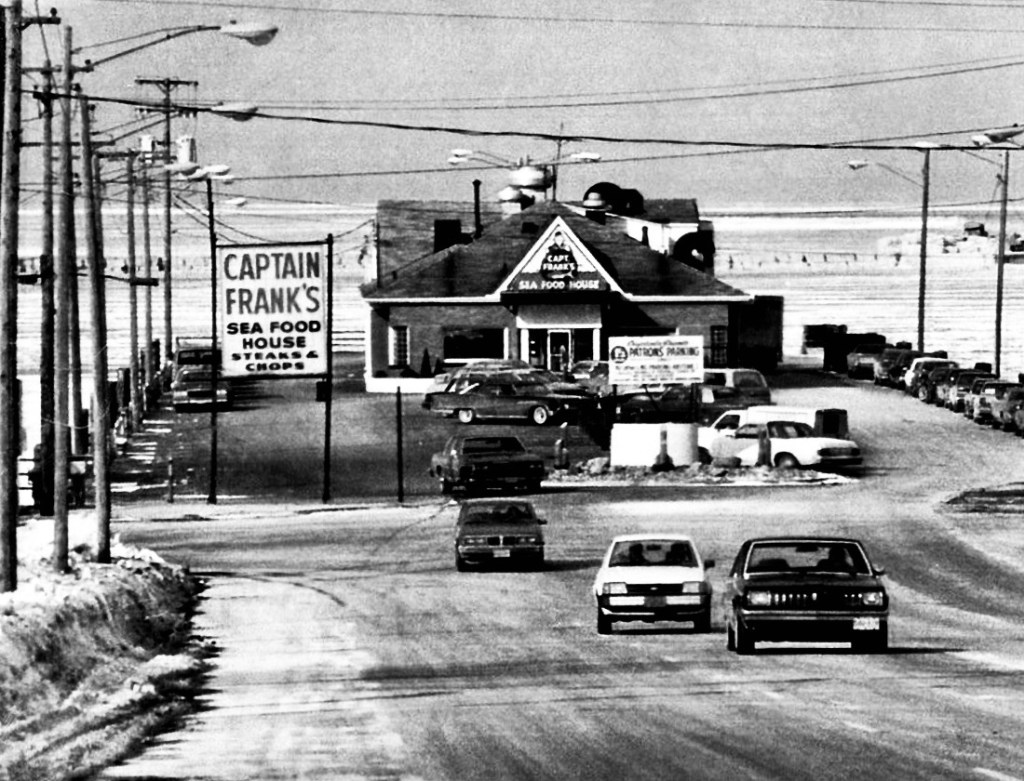
   There are thousands of restaurants in Cleveland, Ohio. Captain Frank’s isn’t one of them anymore. It used to be and when it was it was one of the best places to eat if you liked waves and wind shaking the building on the E. 9th St. pier sticking out into Lake Erie. Every so often somebody full of cheer and careless after a hearty meal, or simply drunk as a skunk, drove off the pier into the deep. 

   “It was always my last stop after a night of drinking in the Flats,” Nancy Wasen said. “Every night I was surprised no one fell off the pier and drowned.” It wasn’t for want of trying.

   Captain Frank’s was a “Lobster House” or a “Sea Food House” depending on the signage . It changed now and then. There was a panhandler who called himself Captain Frank who hung around outside the restaurant day and night, his hand stuck out. Policemen who had kept quiet about hidden rooms in gambling joints or pocketed cash in job-buying schemes were assigned to Seagull Patrol on the pier, usually in the dead of winter. They ignored the panhandler and did their best to walk the cold off. Sometimes they helped the innocent just to stay on the move.

   Francesco Visconti was the Captain Frank who ran the restaurant. He was a Sicilian from Palermo whose parents beat it out of Europe the year World War One started. At first, as soon as he could handle a horse, he sold fish from a wagon. After that he operated the Fulton Fish Market on E. 22nd St. He was forty years old in 1940 and lived with his wife, Rose, a son, and three daughters.

   He bought a beat-up passenger ferry building on the E. 9th pier in 1953 and opened Captain Frank’s. I was a small boy living the easy life in Sudbury, Ontario at the time and missed the grand opening. Kim Rifici Augustine’s grandfather was the original chef at Captain Frank’s. “The wax matches he used for flambé caused a fire back in the 1958,” she said. The fish shack burned down. Frank Visconti built it back bigger and better the next year. Kim’s grandfather was forbidden to handle matches of any kind from then on.

   By the late 1950s my family had emigrated from Canada to Cleveland, Ohio. We lived close enough, but never went to Captain Frank’s. My parents were from Lithuania and ate bowls of beetroot soup and plates of potato pancakes at their own table. They didn’t know an Italian-style diet from the man in the moon.

   In the Old Country they had feasted on pigs and crows. My mother’s father was a family farmer who kept a herd of swine, slaughtering them himself, and smoking them in a box he built in the attic of the house, the box built around their fireplace chimney. “It was the best bacon and sausage I ever had in my life,” my mother reminisced many years later.

   They hunted wild crows. “Those birds were tasty,” my mother said. The younger the birds the better. Those still in the nest and unable to get away were considered delicacies. Their crow cookouts involved breaking necks and boiling the birds in cooking oil over a bonfire. They served them with cabbage or whatever northern European vegetables they had at hand.

   Since I was part of the family, I ate with my parents, my brother, and sister. My mother prepared every meal. I ate whatever she made, even the fried liver and God-awful Lithuanian headcheese, although we never, thank God, ate carrion-loving crows. Even if I had wanted to go to the Lobster House, or anywhere else, I didn’t have a dime to my name.

   Captain Frank’s boomed in the 1960s and 1970s. There were views of the lake out every window. There was an indoor waterfall. If you had water on the brain, it was the place to be. The food was terrific. Judy Garland, Nelson Eddy, and Flip Wilson ate there whenever they were in town performing. The Shah of Iran and Mott the Hoople partied there, although not at the same time. They weren’t any which way on the same wavelength.

   There was a luncheonette behind the restaurant that doubled as a custard stand in the summer. When the Shah or Mott the Hoople stayed later than ever, they could sit in the back in the morning in the breezy sunshine with a cup of custard while iron ore boats went back-and-forth. “I never went inside Captain Frank’s, but I remember the ice cream shop in the back well,” recalled Bob Peake, a homegrown boy who was a frozen sweets savant.

   Frank Visconti was a made member of the Cleveland Crime Family. His criminal record dated back to 1931, including arrests for narcotics, bootlegging, and counterfeiting. The restaurant was frequented by high-echelon hoods and low-minded politicians alike. Many crime family meetings were held there. Many politicians filled their piggy banks there.

   Longshoremen went to Kindler’s and Dugan’s to drink before and after work, but between their double shifts went to Captain Frank’s for power shots. When they were done it was only a short walk back to the docks. When the weather was bad they were all warmed up by the time they clocked back in to work.

   The restaurant was a football field’s length from Lakefront Stadium, where Chief Wahoo and the NFL Browns played. The ballpark sat nearly 80,000 fans. The Indians were always limping along, their glory days long gone, but the Browns were exciting, and on game day crazy loud cheering rocked the windows of the restaurant. Cold biting winds blew into the stadium in spring, fall, and winter. In the summer, under the lights, swarms of midges and mayflies sometimes brought baseball games to a standstill.

   Mary Jane Jereb was sixteen years old in 1964. She didn’t know a single thing about Captain Frank’s. She was in a car with her cousin and a neighbor and a driver’s education trainer. “He took us downtown, to prepare for city driving. I wasn’t driving, my neighbor was. The instructor directed her to this particular parking lot.” It was Captain Frank’s parking lot. They drove straight to the edge of the slimy pier. Spray from a stormy Lake Erie obscured their windshield.

   “The instructor told my neighbor to turn around and head back to Parma. My short young life flashed before me as she pulled into a parking space and then backed out.” She did it by feel. None of them could see through the blurry washed-out windows. They carefully left the deep blue sea behind them.

   In 1966 the Beatles played the stadium and after that the Beach Boys, Pink Floyd, and the Rolling Stones showed up to rock the home of rock-n-roll. It was always a walloping paycheck for a night’s work. In the 1980s U2 brought its big show to town, raking in millions singing about love and lovesickness. Every so often they threw in something about social injustice.

   Even though I was grown-up by the 1970s I still didn’t dine out at Captain Frank’s. I was living in a rented house in a vague part of town and it was all I could do to feed myself at home. I didn’t have pocket money to eat out. Most of my friends were already racing to the top. I was starting at the bottom. When I finally joined the way of the world and could afford to go and wasn’t too tired from working all day, I ate out. 

   There was a kind of magic eating at Captain Frank’s at night. My friends and I watched the lights of freighters making their way slowly into Cleveland’s harbors while munching on scampi and warm dinner rolls swimming in garlic butter. They served steaks the cooks seared just right, but the seafood was usually just threatened with high heat. It was never overcooked and dried out. Students from St. John College on E. 9th and Superior Ave. walked there to have midnight breakfast because it was nearby and the plates were substantial.

   The Friday night in September 1984 my friend Matti Lavikka and I treated my brother to dinner at Captain Frank’s on his thirty first birthday was almost the last birthday he celebrated. We didn’t know Frank Visconti had died earlier that year, but in the car on the pier after dinner we thought my brother was dying. He was gasping for air. The dinner had been very good, but he looked very bad. We were afraid he might end up swimming with the fish.

   He was getting over a marriage to a Columbus girl that had lasted only fifty six days. He was singing the blues. It was his own fault, having used all the wedding’s wishing well money to pay off his gambling debts, but that was beside the point. We picked him up in Mentor, where he was living alone, and went downtown. It was a starry late summer evening. We ordered a bottle of Chianti, some pasta, and lots of shellfish. We didn’t know, and he didn’t know, that he was allergic to shellfish. 

   “I don’t know why, but I hardly ever eat fish,” he said. “It doesn’t always agree with me.” Nevertheless, he dug in. Our dinner at Frank’s that night included scallops, shrimp, and lobster. He might not have been allergic to all of them, but he was allergic to one of them, for sure.

   Halfway through coffee and dessert, which was sfogliatelle, layers of crispy puff pastry bundled together, he was itching, wheezing, and his head was puffing up. His lips, tongue, and throat looked like silly putty. He was breaking out into hives. He was getting dizzy and dizzier. It was like he had eaten a poisoned apple.

   Shellfish allergy is an abnormal response by the body’s immune system to proteins in all manner of marine animals. Among those are crustaceans and mollusks. Some people with the allergy react to all shellfish. Others react to only some of them. It ranges from mild symptoms, like a stuffy nose, to life-threatening.

   Matt was a fireman and paramedic in Bay Village. Looking at my brother he didn’t like what he was seeing. We hustled him to the car and made a beeline for the nearest hospital. Matti put the pedal to the metal. The Cleveland Clinic wasn’t far away and we had him at the front door of the emergency room in ten minutes. Five minutes later a doctor was injecting him with epinephrine and a half-hour later he was his old self.

   “Thanks, guys,” he said when we dropped him off at his bachelor pad in Mentor. He staggered away to bed. Matt and I agreed it had been a waste of good seafood.

   After Frank Visconti died the restaurant limped along. The service and food got worse and worse. The tables and chairs got old and the walls looked like they needed at least one new coat of paint. Fewer and fewer people were going downtown for any reason other than work. I was working downtown near the Cleveland State University campus, where Matt and I had started a small two-man business. One evening when I got off work I called my girlfriend and invited her to dinner at Captain Frank’s. I knew she wasn’t allergic to seafood. She had a hollow leg and generous portions were right up her alley. When we got there, however, the pier was dark in all directions. There were no parked cars in the lot and no lights in any of the windows.

   Rudolph Hubka, Jr., the new owner who had given it five years, had given up the ghost and declared bankruptcy in 1989. Nobody said a word. Hardly anybody noticed. The building was demolished in 1994. The only thing left was dust and litter blowing around in the lakeshore wind.

   We drove to Little Italy and snagged a table at Guarino’s. Sam Guarino had died two years earlier, but his wife Marilyn, who everybody called Mama Guarino, was carrying on with the aid of Sam’s sister Marie, who lived upstairs and helped with the cooking in the basement kitchen. “Marilyn sat in front, and she was like the captain on a ship, making sure everything was just right,” said Suzy Pacifico, who was a waitress at the eatery for fifty-two years.

   We had a farm-to-table dinner before there was farm-to-table, red wine, and coffee with tiramisu. We didn’t see any fishy characters, even though Little Italy was the home of the Cleveland Crime Family. Mama Guarino asked us how we liked the cake. We told her we liked it very much. When I drove my girlfriend home there were no piers to accidentally drive off of. We were both happy as clams all that night.

Ed Staskus posts monthly on 147 Stanley Street at http://www.147stanleystreet.com, Made in Cleveland http://www.clevelandohiodaybook.com, Down East http://www.redroadpei.com, and Lithuanian Journal http://www.lithuanianjournal.com. To get the site’s monthly feature in your in-box click on “Follow.”

“Bomb City” by Ed Staskus

Cleveland, Ohio 1975. The John Scalish Crime Family and Danny Greene’s Irish Mob are at war. Car bombs are the weapon of choice. A  police detective is assigned to find the bomb makers. Revenge is always personal. It gets personal.

Available on Amazon: https://www.amazon.com/dp/B0F1LM1WF9/ref=sr_1_1?crid=2MYAQAOZIC2U9&dib=eyJ2IjoiMSJ9.hTm7BGbiQbSe5ZapFwYPPfcwOpTe-Vdg6VLE4aGyTyk.Z0R-VNBWWEcvKcNaO9LdCOUnNIOOXgvYkRS_FXiXuHk&dib_tag=se&keywords=bomb+city+ed+status&qid=1742136726&sprefix=bomb+city+ed+staskus%2Caps%2C84&sr=8-1

A Crying of Lot 49 Publication

Shock and Awe

By Ed Staskus

   “You’re early,” Barron Cannon said.

   “I know, but I wanted to come in before class and ask if you would help me navigate my new electric yoga pants,” Zadie Wisniewski said. She flashed a pop tart smile. The pants were skin tight and cherry red.

   “I don’t think you need any help from me,” Barron said. “Your pants look high voltage enough to navigate themselves.”

   “What do you mean?”

   “The color, you can’t beat that cherry red.”

   “Oh, right, they are bright. They’re a special pair. They’re usually black.  No, what I mean is, they’re actually electric.”

   Barron Cannon was a freelance yoga teacher. He often taught classes at the border of Lakewood and the west side of Cleveland, near where he lived. Zadie was there for a Hot Yoga class. Her pants were hot looking enough to fit right in to the theme of the class.

   She was wearing spanking new Nadi X yoga pants. The X pants are high-tech high-performance yoga wear, trumping Perfect Moment, Lululemon, and Runderwear. They are up to date. They are like wearing the mind of somebody else.

   There is a battery attached to a port on the pants. Wires are woven into the fabric. Sensors sewn throughout the pants are synced to an app that collects data as the wearer practices yoga. If a pose is going wrong, the app makes that part of you that is getting it wrong vibrate with a low-voltage electrical charge. When you make an adjustment, the app pipes up with praise. If you keep getting it wrong, the app keeps buzzing you and saying, “Please try again.”

   “Are you pulling my leg?” Barron asked.

   “No, of course not,” Zadie said. “These pants cost me two hundred and fifty dollars.”

   “They’re cool,” said Folasade Adeoso, an influencer with 86,000 followers, the day she demonstrated the pants prancing on a pretend runway at her yoga studio.

   “That’s an arm and a leg,” Barron said about the bleeding-edge pants designed to make you bleed money.

   “So, I wonder if I can roll my mat out in front of you, and if you would handle my phone, keeping it next to you in case I need an adjustment?”

   “Sure,” Barron said. “I’ll do my best.”

   “Great!”

   “You said navigate. What does that mean?”

   “The app is supposed to do it all on its own, but I would feel better if you kept your eye on it.” She handed Barron her iPhone. It was an iPhone 16 Pro Max. It was the most phone Barron had ever seen.

   “It would be super if you would put it on your mat where both of us can see it.”

   “All right,” he said. “But I’m not sure I like this. You should be paying attention to what you’re doing, not relying on an app. Besides, when you come to my class, supervision is my responsibility.”

   “I know,” said Zadie, “but it’s a one-off. The pants are for home, for when I do yoga in my spare room.”

   Nadi X yoga pants are the brainchild of Billie Whitehouse, a fashion and tech designer. She has developed vibrating underwear that buzzes for its own reasons, never mind what’s going on with your private parts. She has developed a driving jacket that vibrates right side and left side to alert you to turn right or left. The latest thing she and her tech team thought up were the new vibrating yoga pants.

   “The vibrations on the body cue you about where to focus and the app lets you know how you went at the end of each pose. Get the smartest yoga experience!” is how the experience is described. Nadi X guides your yoga practice through the latest state-of-the-art technology based on your body’s alignment. Listen to the audio instructor on your phone and feel the guidance on your skin. The vibrations will guide your focus.”

    It is downstream to go modern, of course, taking mindfulness out of the equation, and go straight to machine learning, straight to the Big Brother of asana practice, the brother who has your best interests in mind and won’t mine any of the data it collects about your body.

“There’s a sucker born every minute,” the showman PT Barnum once said. He would have been delighted with the new age and gotten in fast on more of the action.

   “Wearable X is the future of wellness that brings together design and technology to create a better quality of life through experience and fashion,” declares Wearable X, the Australian cyber company behind the yoga pants device.

   “Putting electronics into garments is still so new and so difficult,” said Ben Moir, co-founder with Billie Whitehouse and chief technology officer. “Yoga pants get stretched, get sweated in. The sensors had to be invisible and the pants had to not be a tech-looking product. That’s kind of an engineer’s nightmare.”

   “We’re very proud that it is at its peak.” Billie Whitehouse said about their new attire device, proudly pointing the way to the future. She didn’t mention cow nose rings or anything else about the past.

   “I’ve got to bounce on that,” Barron said to himself. “I smell a rat.”

   “They make my butt look good,” Isabelle Chaput, half of a French performance-art duo, said a few months earlier during a demonstration of the pants in New York City. The high-waisted four-way stretch level one compression pants aren’t just for gals, either. “These leggings are extremely well made. The high waisted band is flattering, and these are honestly my go-to leggings for everyday wear,” said Justin Gong, reviewing the pants on Amazon. “Whether it’s a full 40-minute flow or a 5-minute session, my Nadi X allows me to flow whenever I want.”

   They were named Nadi X for a reason. “In Sanskrit, the nadi are the highways of communication that exist around the body when all your chakras are aligned,” Billie Whitehouse said, updating the long ago, eliding then and now. “As You Think You Vibrate” is one of the company’s mantras.

   Over the next twenty minutes the Hot Yoga class filled up, a quiet buzz and energy filling the room until there were thirty-some mats lined up in rows alongside and behind Zadie when the proceedings got started. Barron taught a one-hour flow class in a room heated to the mid-90s. His method was to start slow, pick up the pace, end slow, and encourage a five-minute corpse pose at the end.

   He didn’t like it when folks rolled their mats up after the last pose and bolted the room. “Hold your horses!” he demanded. “Lay down, close your eyes, and go inward. ”He could be imperious.

   Nadi X pants are manufactured in Sri Lanka, an island country off the southern coast of India. The nation is prosperous economically, has a strong military, and is the third most religious country in the world, with 99% of all Sri Lankans saying religion is an important part of their daily life. They are by all accounts proud to produce the vibrating pants for the spiritual practice of yoga. 

   Wearable X has designed several yoga sequences for travelers, making the pants and the app work with phones on airplane mode, assuming the flight attendants don’t mind a downward dog in the middle of an aisle at 38,000 feet.

   “Sitting is the new smoking,” Billie Whitehouse said. “It is a genuine epidemic. It’s not just because we’re at desks all day but because we’re constantly on airplanes.”

   Baron Cannon had never been on a jetliner, only a seaplane that flew 30-minute tours over Long Lake in the Adirondacks. He had been on it several times, whenever he went north to the High Peaks for a week of hiking, always flown by the same pilot, a stocky old man by the name of Bob, who if you saw him in the street you might mistake for a bum. He flew his battered Cessna with one hand, pointing out landmarks. Sometimes he flew the little plane with no hands, talking with both hands. He always safely landed it, fair or foul weather, like the lake was a baby’s bottom.

   Nadi X is a godsend for all the yogis who burn up the carbon, flying here there and everywhere, globe-trotting for profit and diversion. The pants are machine washable and powered by a rechargeable battery that lasts up to an hour-and-a half, which is as long as most yoga classes ever are. The battery connects by Bluetooth to a smartphone, letting one and all choose the level of effort they’re going to be putting into the practice.

   “Once you have set your vibration strength, you can place the phone next to your yoga mat during your session. Your pulse is monogamist to your phone. You can have different Nadi X pants, but your phone will always want to connect to your pulse.”

   Everyone knows that their smartphone never screws up and is always up to snuff. Silicon Valley would have a heart attack if it was otherwise. That would be the day a self-driving car runs down a cyberman directing traffic, sending both of them to the garbage dump.

   Inside of ten minutes it all fell into place for Zadie. She wasn’t an expert, but she wasn’t a novice either. In her mid-20s she was fit and smart, smart enough to catch the cues and act on them. By the middle of the class there were hardly any cues anymore. The class was flowing. She was deep into it and getting it just right.

   That’s when the trouble started.

   Even though she was going strong and was intuitively aware of how good it was all going, Barron not even glancing at her, she was getting zapped more and more frequently. The vibrations were rolling up and down her legs almost continuously. Was there something wrong with the device, she asked herself. Was there a ghost in the machine?  There must be! Maybe it’s all this sweat, she thought, mopping her brow. She looked up from the floor pose she was doing to ask Barron to turn her iPhone off, but he wasn’t at the front of the class.

   He was patrolling the room making hands-on adjustments, alignment-based assists for backbends and forward folds. Barron didn’t push anybody too deep into their poses, but he tried to get them into the integrity of it, within the constraints of what their flesh, tendons, ligaments, joints, and bones would bear.

   A young woman had once complained about it in one of his classes, saying that touching her was inappropriate and reminding him about the #MeToo movement, saying it was a real issue to her.

   “You’re doing it wrong,” he said. “You’re compromising your safety.”

   “I don’t care, hands-off. My husband’s a lawyer, just in case you’re a pervert.”

   “Oh, the hell with it, get out of here and don’t come back.”

   “What?” She glared at him. The class stopped and everyone watched the goings-on. Those who knew Barron better than others rolled their eyes heavenward. They knew trouble was coming. Barron didn’t believe in the customer is always right.

   “You heard me.” He fixed his hand firmly on her elbow and led her to the door.

   When they were outside, he leaned into her and said, “Tell your legal beagle the local Hells Angel chapter practices at my class Saturday mornings, so I don’t ever want to hear a word from him about anything litigious or see your face again, understand?”

   “You’re an ass,” she said.

   “Let’s leave it at that, sweet lips. Now drift.” 

   Love, peace, and understanding, he thought, were all well and good, except when it came to the empowered wallets from the better neighborhoods, especially on the nearby lakeshore, which was called the Gold Coast. He didn’t need a bloodhound to know she sprang from there.

   Barron was an anarchist at heart. He believed anarchism walked the walk and fit  best with the practice of yoga. Any other affiliation with anything else, capitalism, socialism, democracy, dictatorship, consumerism, left-wing, right-wing, high and mighty, and the lunatic fringe, was inimical to the practice. 

   Barron was an idealist, but practical enough to pay his taxes and not run red lights. He kept his anarchism to himself. He knew free speech was a given, as long as you weren’t crazy enough to try it.

   Zadie was close to the breaking point. The longer the class went on and the sweatier she got the more her pants shocked her. It was only 12 volts, she knew, but it was getting to be 12 volts every second. Maybe it was more voltage than she thought. Was it rising higher and higher? 

   “Yow, that stung! The hell with it.” She ripped her cherry red yoga pants off and  tossed them angrily into a corner. She was left wearing a pair of royal purple Under Armour stretch undies. Everyone behind Zadie gave them a good look.

   “Eyes on me, everyone, front and center,” Barron harrumphed. “Let’s get back to business.”

   “Those pants can kiss my butt,” Zadie said, getting back into the flow of the class.

   “And, no,” she said, looking straight at Barron, “I won’t need any adjustments for the rest of the class today, thank you very much.”

“Bomb City” by Ed Staskus

Cleveland, Ohio 1975. The John Scalish Crime Family and Danny Greene’s Irish Mob are at war. Car bombs are the weapon of choice. A  police detective is assigned to find the bomb makers. Revenge is always personal. It gets personal.

Available on Amazon: https://www.amazon.com/dp/B0F1LM1WF9/ref=sr_1_1?crid=2MYAQAOZIC2U9&dib=eyJ2IjoiMSJ9.hTm7BGbiQbSe5ZapFwYPPfcwOpTe-Vdg6VLE4aGyTyk.Z0R-VNBWWEcvKcNaO9LdCOUnNIOOXgvYkRS_FXiXuHk&dib_tag=se&keywords=bomb+city+ed+status&qid=1742136726&sprefix=bomb+city+ed+staskus%2Caps%2C84&sr=8-1

A Crying of Lot 49 Publication