Icing the Hood

By Ed Staskus

   Maggie Campbell got ice cream for her dogs all the time. It started when she started going to her sister Elaine’s house in West Park with their family’s Rottweiler, whose name was Chavez. She took Elaine’s Rottweiler, whose name was Wellington, with Chavez for walks in the neighborhood.

   The dogs and she went to the Dairy Queen on Riverside Dr. just north of Cleveland Hopkins Airport. It’s a Cone Zone now, but back then it was a DQ. She did that every weekend without fail. One Saturday, as they were strolling past the Shell gas station on their way to the DQ, she noticed some guys walking towards them. They were four young guys coming her way. She began to get a little nervous.

   “What the hey,” Maggie whispered. She knew how to take care of herself one-on-one. She didn’t like four against one.

   As they got closer they started getting obnoxious and making cat calls. She had two thoughts going. One was that she shouldn’t make eye contact with them, and the other was, at least I have my dogs with me. But, when she looked the teenaged posse over, it didn’t seem like the guys had even noticed the dogs.

   Finally, when they got closer, they stopped looking her up and down and focused on the Rottweilers. The Rottweilers focused on them. The posse stopped and Maggie stopped. The dogs stopped and started to bristle and snarl. Then, just like that, the guys all split.

   Thank God, she thought. One of them yelled back over his shoulder, “That’s some well-guarded piggybank, girlfriend.”

   “You two are getting some extra ice cream today,” she told Chavez and Wellington. “You’re getting a sundae, in fact, one big one for each of you.”

   Dogs know what’s up when they’re out in the hood. They have a sixth sense. They don’t like anything that the other five senses don’t declare as kosher. If you have something to worry about, then you have something to worry about. If you don’t, you’re fine. You don’t have to take the Fifth. If you have nothing to hide, then you have nothing to fear from dogs.

   Steve de Luca, her husband, and she had once had a Wolf Labrador who was her life when there had still been lots of life in him. He was the sweetest thing ever and she just loved that dog. His name was Blue. One night they ordered Chinese. The only time she ever saw Blue go after somebody was when the pale-faced Fu Manchu deliveryman came to their front door. The Wolf Lab chased him right back to his car. He barked at the car all the way down the street as it sped away.

   He never before or ever after did anything like that. Fu Manchu obviously had some bad intentions. If someone comes to the door and there’s ill will, or there are bad intentions, the hair on all dog necks goes up and their blood starts to run hot. A woman’s intuition is strong, but a dog’s is even stronger. They know when the feeling is just not right. There had been a few times in Maggie’s life when things had not been right. Every time she had a dog with her for protection, thank goodness.

   She and Steve usually had four or five dogs in the house, so a bad man would have to be out of his mind to try and come and rob their house. He would have to be absolutely nuts. Cats will offer you up as a sacrifice when push comes to shove, but a dog, it’s all about serve and protect.

   Steve came upon a King Charles who needed a new home. He and Maggie rescued dogs. He was going to move it to one of his cousins. But he private messaged Maggie, “My cousin’s not responsible.” After that she put the dog on Facebook. She had a client at the hair salon who had been pestering her for a King Charles, so she tagged her. She came back with, “When can I meet this dog?”

   “Let me find out what the scoop is,” Maggie told her.

   Her client had just built a house in Olmsted Township. The dog was from Olmsted Falls, and he loved children and other dogs, so everything was all right there. But then Steve called and said, “I think I’ve got someone else who wants that dog.”

   “Well, if the meet and greet doesn’t go well, you can have your shot, but remember, my client was first,” Maggie said.

   In the end, Maggie’s first in line was well off, had a big new home, and the family had had to put their own King Charles down a couple of months ago. They loved the new dog, the new dog loved them, and it all came together.

   Sometimes Steve and Maggie took dogs in for themselves, especially if they found them on the street. They found Gretel that way. Steve brought her in and when Maggie saw her, she said, “That’s it, I love her, she’s mine. She’s not going anywhere.” They kept Gretel, although too many dogs in the house can be a problem.

   One big problem at their house was dog hair, which was a problem because Maggie was a clean freak. Some dog lovers believe that if you’re not covered in dog hair your life is empty, but she wasn’t one of them. In the years Steve and she had been married they had always had Dysons. The last one broke when she accidentally dropped it and watched it fall down the stairs, bouncing one step at a time on its way all the way down to the first floor. When it stopped it was all over for it.

   “Damn it,” she thought, as it cracked and broke apart. It wasn’t the first time. Dyson wasn’t built for hostilities. Maggie went on Facebook and asked, “I’m really tired of giving Dyson my money, what do you guys got?”

   In the meantime, they bought an Electrolux. The new vacuum cleaner was the biggest joke of all time. She hated that piece of crap. Even Steve hated it. He used it once and cursed all day about it. Maggie took it back to Best Buy and told them how much she hated it. They bought a Miele with the refund. 

   Some people think not wanting to scare their dog is the perfect excuse for not vacuuming. Not Maggie. She loved her Miele. It was a godsend, especially since she loved to vacuum. She did it every day. The dogs thought it was a bad habit, but Maggie ignored their grousing.

   The other problem they had all the time was dog nose smudges all over their glass surfaces, which was mostly the doors when they pressed their noses against them. Whenever she came home from the grocery store, or the pet store, and was bringing in bags of food, they ganged up on the glass. Sometimes she thought they must think she was the greatest hunter in the world, judging by how much food she brought home. There were the two of them and a pack of the four-footers. That added up to not only a whole lot of food, but a whole lot of Windex, too.

   “I wonder where their sixth sense tells them I’m getting all that food from,” she asked Steve over bowls of Chunky Monkey ice cream. He wasn’t able to speak up about it. His mouth had freezer burn. As long as the chow kept coming through the door the dogs didn’t care and didn’t waste their time putting their sixth sense to work on it. They made eyes at the bowls of Chunky Monkey.

Ed Staskus posts monthly on 147 Stanley Street  http://www.147stanleystreet.com, Made in Cleveland http://www.clevelandohiodaybook.com, Down East http://www.redroadpei.com, and Lithuanian Journal http://www.lithuanianjournal.com. To get the site’s monthly feature in your in-box click on “Follow.”

“Cross Walk” by Ed Staskus

Late summer, New York City, 1956. Big city streets full of menace. A high profile contract killing in the works. A private eye working out of Hell’s Kitchen scares up the shadows.

Available on Amazon: https://www.amazon.com/dp/B0CRPSFPKP

A Crying of Lot 49 Publication

A Song is Born

By Ed Staskus

   The Terminal Tower on Public Square was all lit up the day it was dedicated in 1930. An oversized strobe light on top of the tower went round and round in circles. All through the decade the light helped ore freighters find their way to the Port of Cleveland. Airplane pilots used it as a beacon to locate the Cleveland Municipal Airport.

   All the external lights were turned off at the start of World War Two and not turned back on again until 1974, nearly thirty years after the war ended. Nobody knows why, although it was most likely to save money while the city’s post-war economy struggled. Today the landmark skyscraper’s lights are hundreds of LED’s that can be configured into all kinds of color schemes.  The week leading up the 11th International Lithuanian Song Festival the lights were configured in red, green, and yellow. They are the colors of the Lithuanian flag.

   The earliest Lithuanian flags were war flags in the 15th century. They were red banners usually depicting an armored knight on horseback. He bore a shield and an upraised sword. The tricolor flag goes back to 1918, during Lithuania’s first period of independence in the 20th century. After 1944, when the Russians again occupied the country, it was changed to a garden-variety Soviet flag. The tricolor was resurrected in 1988, two years before the re-establishment of the country’s independence. The Russians didn’t like it, but by then they couldn’t do much about it.

   The first Lithuanian Song Day was staged in 1924 in Kaunas, then the capital of the country. Choirs advertised for new members, stipulating that they “should have good voices so as not to take up unnecessary space.” They were instructed to pronounce sounds clearly and not tap their feet to the beat. Three thousand singers eventually sang and ten thousand listeners listened. 

   The event unfolded on the Square of Games and Parades, which was a field where units of the Lithuanian Army often marched around. Wooden towers resembling ancient castles were built. Two holes were dug and made into ponds so as to improve the acoustics. An Agricultural Fair was held the same weekend. There were plenty of cured sausages and there was plenty of vodka. When the singing was over men and women belted out the national anthem in the night while “walking away staggering and holding on to each other.”

   Afterwards one of the organizers said, “As long as I have been alive, and I have been alive for a very long time, I have not heard anyone sing the national anthem so perfectly.” It was unclear whether he meant the choristers or the late night revelers.

   Song Day moved to Vilnius in 1946, which had been restored as the capital, where it remains to this day. It has become a major cultural event known as the Lithuanian Song and Dance Festival. It is produced every four years. The event in 2024 featured twelve thousand singers in four hundred and fifty choirs. More than one hundred thousand people attended. The live stream was viewed by three hundred thousand people. It is on the UNESCO list of the Masterpieces of the Oral and Intangible Heritage of Humanity. 

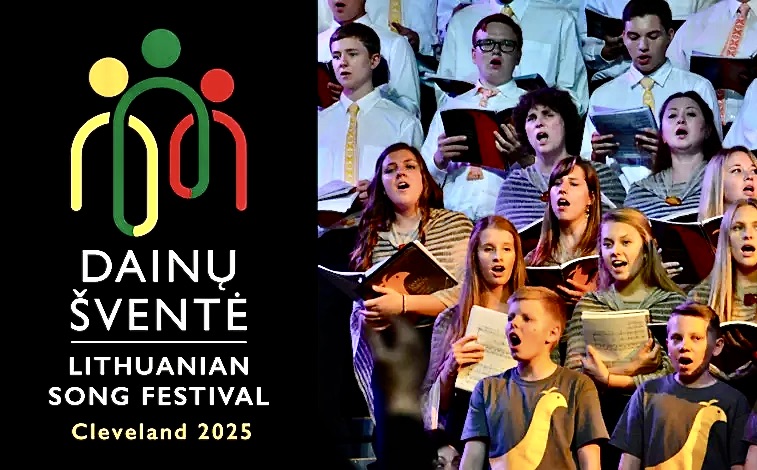
   The international version of the song festival continues the tradition among the diaspora in North America. It has been staged twice in Toronto and eight times in Chicago since the 1950s.The 2025 host city was Cleveland, after ten years of there not having been a festival. It was the first time the songfest was staged in northeastern Ohio.

    “It’s just amazing,” said Festival Artistic Director Kristina Kliorys. “I’m so proud as a native Clevelander that it’s finally come here. It’s very central to a lot of these Lithuanian communities in Chicago, Detroit, Pittsburgh, and Toronto.”

   The festival brought one thousand five hundred choristers in sixty five choirs together to celebrate Lithuanian musical heritage. They were joined by an orchestra of traditional Lithuanian folk instruments as well as performances by one hundred folk dancers. “Our song festival is the literal coming together of a nation in song,” said co-director Aleksandras Stankevicius. “Choirs of many ages gather to perform a single, coordinated repertoire, expressing their shared love of music and the vitality of their culture, nationality.”

   The choirs came from all over. “We come together in both small and large groups,” said Nijole Benotas, a Toronto-based media liaison. “We call ourselves a choir and we sing. Our soul feels a goodness, a peacefulness, as though through song we have returned home. Perhaps some outsiders will think it is strange to see a singing group with five members, or a choir where adults, youths, and children sing together as though they were a family. For those of us living in the North American diaspora, such groups are not uncommon and cause us no surprise. The festival organizers have welcomed everyone and are delighted to have enthusiastic performers and choir leaders. And especially important, our school and youth choir singers are the new generation. They will be the creators and singers of future Song Festivals, and, like us, will continue to carry the legacy – traditions, language, song, and Lithuanian identity – for many years to come.”

   The theme song of the Song Festival in the Rock ‘n’ Roll Capital of the World was “One Family – One Nation.” It was composed by native Clevelanders, the music by  Rita Cyvaite-Klioriene and the lyrics by Nijole Kernauskaite. The through line was “Our homeland will live on, across the seas the earth cries out to us to be strong.”

   “We’re very excited that Cleveland was chosen as the host for this Song Festival,” said Ingrid Bublys, a Clevelander who is an Honorary General Consul of the Republic of Lithuania. “Since 1993, Cleveland and Klaipeda, Lithuania’s seaport, are sister cities. Many Lithuanians in Cleveland contribute to the community’s artistic, cultural, and commercial scene. Song is the mother of all languages. Just to experience the voices of all those choristers and Lithuanian national instruments is a gift rarely available. We’re proud to showcase our culture and celebrate together in song. Our songs speak of the beauty of our country and the yearning to be free. Through song, we hope to introduce others to this ageless country by the Baltic Sea.”

   The festival ran for three days. There was a welcoming party at Windows on the River on Friday. There was a separate Voices of Lithuania concert on Saturday. There was a Roman Catholic mass performed at Public Auditorium on Sunday morning. When the festival closed there was dinner and dancing. Toasts were made and glasses hoisted. The festivities lasted past midnight.

   There were thirty seven songs sung during the culminating show on Sunday at Cleveland’s Public Auditorium. “We also had translations on screens and in a printed program so folks knew what we were singing about.” Kristina Kliorys said. The show started with a  prayer and the national anthems of Canada, the United States, and Lithuania. The program was in four parts. The parts were: We Were Born Lithuanian; The Place of My Dreams; And the Sun Rose, Again Awaking the World; and Let’s Open the Hope Chest of Song and Dance.

   “When the displaced people fled Lithuania, they hoped to return,” Ramute Kemežaitė-Kazlauskienė said. “They didn’t want to leave. But once they arrived in the United States or Canada, preserving their Lithuanian identity became paramount. I got chills from head to toe during the festival. Lithuanian song lives in my heart and in my home, passed down from my mother.” Songs can be a lifeline. They vibrate in memory, like time capsules.

   “I was born in Kaunas just before the end of the war. My family fled, and I grew up in America,” Sister Ignė Marijošiūtė said. “When you lose a part of your cultural identity, you long for it. In the diaspora, you must choose to preserve it. Song and dance are essential.”

   “This is the biggest event every Lithuanian chorister waits for,” Asta Vaičekonienė, director of the Seattle Lithuanian Choir, said. “We sing with deep emotion, because through song we touch the soul of Lithuania, even its very soil.” It’s been said that music and song are the speech of angels. The songs of Lithuania are songs of love for the land on the Baltic Sea.

   “People scattered across North America come together at these festivals, whether for song or dance, to celebrate and reconnect,” Darius Polikaitis, a conductor and choir master from Chicago, said. “There’s a kind of spiritual uplift in that shared experience.” 

   Kristina Kliorys said the Song Festival fit in perfectly among Cleveland’s melting pot of ethnic communities. There are more than a hundred such communities in Cleveland, from Hungarians and Armenians to Arabs and Puerto Ricans. The Cultural Gardens along a two-mile stretch of MLK Jr. Drive are one-of-a-kind, the only public garden system of their description in the country.

   “It is just so powerful and moving to have the synchronicity of that many people just making music together at the same time,” Kristina Kliorys said. “It’s just so uniting and so beautiful bringing us together. We really need peace, unity, and togetherness these days.”

   When people get together to celebrate togetherness, great things can happen.

Ed Staskus posts monthly on 147 Stanley Street  http://www.147stanleystreet.com, Made in Cleveland http://www.clevelandohiodaybook.com, Down East http://www.redroadpei.com, and Lithuanian Journal http://www.lithuanianjournal.com. To get the site’s monthly feature in your in-box click on “Follow.”

“Cross Walk” by Ed Staskus

Late summer, New York City, 1956. Big city streets full of menace. A high profile contract killing in the works. A private eye working out of Hell’s Kitchen scares up the shadows.

Available on Amazon: https://www.amazon.com/dp/B0CRPSFPKP

A Crying of Lot 49 Publication