
By Ed Staskus
The last summer I lived in the Forest Hills neighborhood around Eddy Rd., where there were no forests or hills, although there were plenty of Eastern European immigrants, including me, was the last summer my friends and I took the Rapid Transit to mess around downtown and go to the movies. We went on Saturdays, rain or shine. It had been twenty-some years, before any of us were born, since the city-owned train system got rolling. Their motto was “This breakthrough is brought to you by the Cleveland Transit System.” We didn’t pay attention to mottos. We paid attention to the ten cents for the fare tucked in the coin pocket of our pants.
The newspapers that summer were all about civil rights and Vietnam, two issues we hardly knew anything about and cared about even less. What we cared about was whatever was right in front of our eyes. The year was 1963. Beatlemania was on the way, although we didn’t know what it was, yet. Stevie Wonder released his first live album, “The 12 Year Old Genius,” and it shot to No. 1 on the Billboard Hot 100. We were all twelve and thirteen years old. None of us were geniuses, not by a long shot, although some of us went on to be able to think more or less clearly.
A vaccine for measles was approved that year. It didn’t do me any good since I had gotten the measles a few years earlier. Push-button telephones were new and a yellow smiley face popped up out of nowhere. All of us had voted for John F. Kennedy three years earlier in a mock election at St. George’s Catholic School. He was young, energetic, and handsome, while Richard Nixon was old, slow, and looked shifty with a five o’clock shadow. After JFK visited West Berlin in 1963, delivering his famous “Ich bin ein Berliner” speech, we went around calling each other Berliners and saluting Nazi-style. Our nuns didn’t like it. They told us to stop horsing around and pay attention.
The Rapid Transit was a light rail system, what we called the wagon train. Tens of millions of riders rode it every year, especially on Saturdays, when it seemed like all of them were riding the Red Line at once to go shopping. We had to stand most of the time. Even when we got a seat, we had to soon give it up to pregnant women and old folks. Standing and swaying and holding on to a pole was carefree. We were excited about roaming around downtown and seeing a big-time movie.
All we had known in our youth was the neighborhood Shaw-Hayden Theater, which we could walk to. They showed monster movies, cowboy movies, and rocket ship movies on weekend afternoons. We ignored the Fox Movietone News. Cartoons and a double bill cost fifty cents. Popcorn cost fifteen cents, but since we were chronically short on cash, we usually brought our own in brown paper bags hidden under our jackets. We stopped at Mary’s Sweet Shoppe once in a while and bought some penny candy.
There was a school playground around the corner behind the local fire station with Saturday Sandbox contests, but we never went, being too old for sandboxes. There were dances at the Shaw Pool every Saturday night, but we never went to those either, being too young to care much about girls and their goings-on.
Before the movie matinee at the Shaw-Hayden there was sometimes a drawing for prizes. One of my friends won two thousand sheets of paper one winter afternoon. He was beside himself hauling the reams home in the snow. He complained about frostbite, but he was a griper at heart, so we ignored him. The movie house was big, more than a thousand seats. We always went early so we could sit in the front row, stretching our legs out, kicking each other, and whooping it up when the screen lit up.
Going downtown meant hoofing it from where we lived off St. Clair Ave. down E. 128th St. to Shaw Ave. to Hayden Ave. and following a no-name foot path to the Windermere station. We scrambled up the embankment, crossed the tracks at the rear of the station, and waited on the platform for the downtown bound train. Windermere was the end of the line for the Red Line.
The Red Line ran at ground level, alongside railroad rights-of-way. There were no grade crossings with streets or highways. All of the stations along the way had high platforms. Unlike most transit lines, it was powered by an overhead electric catenary instead of a third rail. We knew things were going well when we heard the corona discharges of the high voltage.
When we finally rolled into the underground station downtown we dusted ourselves off and ran upstairs, running through the Terminal Tower lobby and overflowing outside. We made tracks around Public Square until there was nothing left to see. We liked walking to the movies on one of the three main avenues, which were Prospect, Euclid, and Superior. Our parents warned us to stay away from Prospect Ave. where there were prostitutes and burlesque houses. It was because of their words of wisdom that we took Prospect Ave. most of the time, although we never talked to the prostitutes and never went into the bars and strip clubs. We weren’t interested in smut, and besides, we wouldn’t have been able to pay for the cheap thrills.
There was a cluster of theaters between E. 14th and E. 17th. Four of them faced Euclid Ave. while one faced E. 14th St. The three blocks were known as Playhouse Square, although none of us were aware of that. We didn’t pay any mind to corporate branding unless it had something to do with the movies. All of us had our own money, cobbled together from allowances, paper routes, altar boy service at weddings, and some thievery from our siblings if push came to shove and our Saturday was threatened.
The Ohio and State theaters were built by New York City plutocrat Marcus Loew in the early 1920s, followed by Charles Platt’s Hanna Theater. The Hanna was named for Mark Hanna, Cleveland’s wheeler-dealer senator in Washington. He once said there were two things important in politics. “The first is money and I can’t remember what the second one is.” The Pompeiian-style Allen Theater opened at about the same time.
The Palace Theater got up and running at the end of the next year, in the Keith Building, the tallest skyscraper in the city at the time. The biggest electric sign in the world was fabricated and turned on the night of the Palace Theater’s grand opening. It was billed as the “Showplace of the World.” The opening night entertainment was headlined by a famous mimic and featured dancing monkeys. Everybody said it was “the swankiest theater in the country.”
It wasn’t the swankiest anymore when we started going to Saturday matinees there, but we didn’t notice the wasting away. It had wide seats and a gigantic screen and that was all that mattered. The movies cost seventy five cents and we were happy to pay it. It was where we saw “Son of Flubber” and afterwards pretended to defy gravity like Fred MacMurray. We saw “It’s a Mad, Mad, Mad, Mad World” and laughed until we cried. We loved stories about lost treasure. The movie was perpetual motion and shouting. Ethel Merman was the most likable loudmouth we ever heard. We saw it twice and it was just as good the second time around.
We saw “Cleopatra” and agreed afterwards that we had all gotten sick and tired of Elizabeth Taylor. “Why is she even in the movie?” we wondered. Rex Harrison and Richard Burton were more like it. Thousands of Romans with swords, spears, and shields fighting each other were even more like it.
We wanted to see “Psycho” but weren’t allowed. We were warned it was too intense and inappropriate for boys our age. We were offended, but when we heard what it was about, we asked each other what all the fuss was. It sounded like a sicko stabbing people, which was right up our alley. We had all seen plenty of horror movies, like “Carousel of Souls” and “Village of the Damned.”
When “The Raven” was playing we saw it right away, even though none of us knew Edgar Allen Poe from the man in the moon. There’s a black bird. There’s a tapping at the door. The night is dark and the wind is howling. When the door is opened there’s nobody there. “Watch your back!” we shouted at the screen.
The stars in that movie were Vincent Price, Boris Karloff, and Peter Lorre, even though Peter Lorre was a half-pint. He had a sinister voice, hooded eyes, and a dodgy way about him, which made up for his lack of height. Vincent Price was disappointing, despite being the tallest. He spoke and acted like a sissy, even though he was supposed to be a big bad magician. In the end the whole business was disappointing. It was more laughable than scary, and once we realized how it was going, we enjoyed it for the laughs. We took a chance and asked for our money back, claiming intense disappointment, but a grouch in a red jacket ushered us out and told us where to go.
The movies were spellbinding to us. They were like a dreamland in waking life. It didn’t matter if the story was real or unreal. We were dazzled by the moving images and the music. It was disorienting stepping out of a dark auditorium after the motion picture magic into bright sunlight, like after a midday nap when daydreams had come fast and furious.
We heard about “Seven Wonders of the World” on WERE-AM radio before we ever saw it on the marquee of the Palace Theater. We didn’t go see the movie, even though we saw the title on the marquee week after week and even though it was in Cinerama. We didn’t like being told what a wonder was, or wasn’t. We did our own wondering. We saw everything in a kind of Cinerama, anyway, since we always sat in the front row. A gigantic screen always made a bad movie twice as good.
Our real life hometown was where we went to see the wonders of the world. We stared at the skyscrapers, counting the windows. We sprinted the front steps of City Hall and the County Courthouse. We wandered around in the industrial valley, what everybody called the Flats, light-headed and amazed, gazing up at the steel plants, looking down on the Cuyahoga River, watching the up and down bridges go up and down as freighters hauling ore made their way. Six years later the river caught on fire, flames and greasy black smoke turning day to night. We walked along the shoreline of Lake Erie where fishermen pulled walleye and crappie out of the polluted water that nobody was supposed to swim in, much less eat out of.
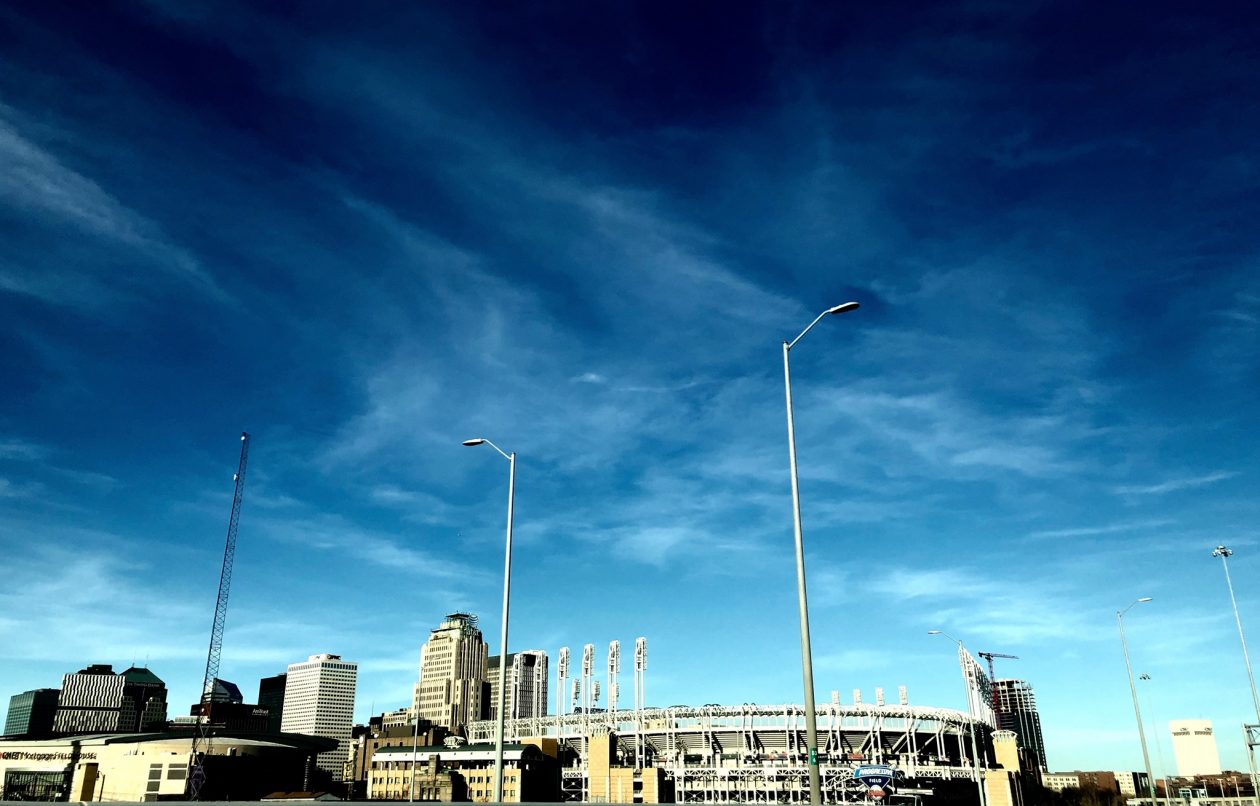
We snuck into Municipal Stadium, called the Mistake on the Lake, whenever we knew the fire-balling Sam McDowell was pitching. He was twenty years old and tall as a tree. Hardly anybody went to see the back of the pack team and we often had most of the eighty thousand seat stadium to ourselves, cheering on the Tribe. We sat wherever we wanted. When ushers asked to see our ticket stubs, we hemmed and hawed and changed sections. Whenever we ended up in the bleachers there were never any ushers to roust us. If it was hot, we pulled our shirts off. We lobbed popcorn to the pigeons and threw pebbles at them when they were finished with their freebies.
The weekend before our summer vacation was going to be over and we had to go back to school we saw our last movie at the Ohio Theater. It was “Lord of the Flies.” It was about boys our age who were marooned on a desert island. We knew what a boy’s life was all about. We didn’t know anybody our age who ever did the crazy things they did. We didn’t like grown-ups making up stories about us. We appreciated great trash but not great art. All of us wrote it off as high-brow hokum.
Going home on the Red Line after the movie we saw a fight break out. Two men had been talking, then shouting, then shoving each other in the aisle, until one of them pulled a knife and stabbed the other one in the arm. Real blood gushed and stained his clothes. A woman screamed. Two men grabbed the knifer and held him down, while another man took his own tie off and tied a tourniquet on the upper arm of the stabbed man. When we got to the Windermere station there were police cars and an ambulance there. We watched, fascinated, until a policeman told us “there’s nothing to see here, break it up and go home.” We went home more breathless than any movie had ever made us.
President Kennedy was shot and killed that fall, which put a pall over everything. A fire broke out in the Ohio Theater the next year and the other theaters were hit by vandalism. All of them closed between the summers of 1968 and 1969 except for the Hanna. We were juniors and seniors at St. Joseph’s High School by then and the only movies we went to those years were at the LaSalle Theater in our North Collinwood neighborhood.
By then, when we went to the movies, we were more interested in girls than whatever was playing, although we soon found out horror movies were the way to go. There was never any doubt about what to do with your hands when you were with your main squeeze and the scary parts burst onto the screen.
“Don’t worry, I’m right here,” we all said. “Don’t give another thought to the monster mash.”
Ed Staskus posts monthly on 147 Stanley Street http://www.147stanleystreet.com, Made in Cleveland http://www.clevelandohiodaybook.com, Down East http://www.redroadpei.com, and Lithuanian Journal http://www.lithuanianjournal.com. To get the site’s monthly feature in your in-box click on “Follow.” His books are available on Amazon and Apple Books.
“Bomb City”
Cleveland, Ohio 1975. The John Scalish Crime Family and Danny Greene’s Irish Mob are at war. Car bombs are the weapon of choice. Two police detectives are assigned to find the bomb makers. It gets personal. Revenge is always personal.

 Made in Cleveland