Legos on the Loose

By Ed Staskus

   The day Maryann Shelly got her Lego Creative Brick Box was the day she got to work. Her Lego Man started off small, less than an inch tall, when she started building him. He didn’t stay small for long. Every day Maryann made him bigger. By the end of the month he was as big as her, which was just shy of five foot tall. Less than a month later he was eight feet tall and wouldn’t fit in the house anymore. She moved him outside behind the garage, under an eave so he wouldn’t get wet.

   One day she noticed her supply of Lego plates, tiles, and bricks, the basic building blocks, was running low. She scratched her head in bewilderment. She hadn’t been working on anything lately. Where were all the pieces going?

   She found out where they were going on a Saturday morning. It was a fine sunny day. She and Amelia, a friend of hers, had gone for a walk along the railroad tracks as far as Lane Rd., went back on S. Ridge Rd., and cut through Canterbury Crossing to return to their housing development.

   “Do you want to see my Lego Man?” Maryann asked Amelia.

   “That would be fun.”

    When they got to where Lego Man was supposed to be behind the garage, he wasn’t there.

   “What happened to him?”

   “He couldn’t have just walked away,” Amelia said.

   They heard a car horn on Park Rd., tires screeching, and then another car horn. They ran down Trotter Ln. to Park Rd. and saw Lego Man tramping past the Cedar Glen Condominiums. He was nineteen feet tall.

   How did he get so big, Maryann wondered, and in a flash realized he was who had raided all her Lego building blocks. He was building himself. What she didn’t realize was that Lego Man had tapped into AI and was teaching himself how to make his own way in the world. Might Makes Right is what he had learned so far. After he found that out he decided it was all he needed to know. He shut off the modem that connected him to the internet.

   When Lego Man crossed Welch Rd. and got to the railroad tracks the gates were closing. He ignored them, lumbering through like they were matchsticks. When the train got to the crossing it stopped, the engineer took one look at Lego Man, and immediately turned the train around.

   Lego Man saw 1922 Coffee and Brew on the corner and stopped there for a take-out coffee. He ordered three gallons with lots of sugar. He had a sweet tooth. When it came time to pay for his drink he realized he didn’t have any money. He stomped the building flat.

   A Dollar General store was across the street. He needed more Lego building blocks if he was going to get bigger. When he found out Dollar General didn’t have any he flattened that building, too. He was learning to love Might Makes Right.

   He tramped down Madison Ave., watching cars swerve in all directions. Sirens sounded in the distance. The klaxonsdidn’t bother him overmuch, it was just hurley burley, but he needed to get bigger, regardless. He thought five hundred feet tall would be about right. When he got that big all bets would be off.

   Nothing was going to stop him. He thought he might get a red tie so everyone would know who he was. They would see the red tie and know he was the Great Lego Man. He went back to Dollar General and pawed through the rubble. He found a clip-on red tie. He also found an orangey wig in the style of a comb-over. He didn’t know what a comb-over was, but he knew what he liked. He slapped it on top of his head. He took a selfie and checked himself out. He thought he looked great. He felt great. He was great, no doubt about it.

   He plodded down S. Ridge Rd. He had grown so fast his balance was sketchy. He definitely didn’t want to fall down. If he did he would break apart into a million Lego pieces and his greatness would be all gone. He tightened the knot of his tie. He had to get bigger. He had to get so big that he would never fall.

   Lego Man slowed down when he saw the blockade ahead of him. It was the National Guard. They had taken a break from chasing immigrants. They were chasing him. He looked to his right. There was a forest. He wasn’t big enough yet to walk over the trees. He looked to his left. He saw a small church. It was the Church of Jesus Christ. Maybe if he knelt  down in front of the church and pretended to be saying his prayers they would leave him alone. 

   He put his hands together and signaled to the National Guard that he was going to church, but they sprayed him with a water cannon, taking him by surprise and almost knocking him over. Lego Man didn’t like that. He lumbered over to the water cannon truck and flattened it. 

   The National Guard sent for reinforcements, including flame throwers. Lego Man didn’t like flame throwers. Although he was made of ABS, a durable plastic that had clutch power and up-to-date SEBS, plastic was still plastic. It and flame throwers didn’t mix. He would melt in a flash.

   He retreated to the rear of the Church of Jesus Christ, but since he didn’t believe in the Ten Commandments, or anything like that. he flattened the house of worship instead of stopping in and repenting for the warpath he was on. Repentance was for suckers, anyway.

   He thought he might lose himself in the thick twelve foot high cattails behind the Canterbury Crossing Condominiums if he crouched down. He was doing just that when he saw the one hundred and twenty foot cell tower at the far end of the cattail field. Why was the cell tower so much bigger than him? He stomped over to it, pushed it with all his might, and pushed it over. When he did the internet went out all over the neighborhood, including Oliver and Emma’s house, whose back patio faced the flattened Church of Jesus Christ.

   Oliver and his sister Emma were the Monster Hunters of Lake County. The Lego Man didn’t know anything about them. He was going to have to face the consequences of his know nothingness.

   “What happened?” their father asked coming down from his home office on the second floor. “Did you kids do something to the internet?”

   Oliver and Emma had been having lunch, hashing out their plans for the rest of the day.

   “It wasn’t us. Maybe something happened to the tower.”

   The cell tower had been erected three years earlier, and although it was an eyesore, it made the internet reliable. Oliver looked out the sliding glass back door.

   “There’s some kind of gigantic Lego thing out there mashing the tower,” he said.

   “Oh, that’s just great. I’m in the middle of a project. Ollie, can you go out there and make it stop. In the meantime I’ll have to hotspot off my phone.”

   “OK, dad.”

   Oliver and Emma went outside. Lego Man was still on the warpath, throwing galvanized steel pieces of the ex-tower all over the place.

   “Who does he think is going to clean that up?” Emma asked.

   “And what’s with the weird hair?” Oliver asked. “We can’t let him do whatever he wants, like wrecking things.”

   “What can we do?”

   “Oh, that’s going to be easy” Oliver said. “The bigger they are the harder they fall.”

   Emma followed her brother as they approached Lego Man, who was breathing heavy from his labors. He didn’t notice them. Oliver snuck behind him and pulled a single Lego brick from the back of his right heel. When he did Lego Man begam to wobble. He swayed back and forth. His right foot disintegrated, Lego bricks littering the ground. When his foot was completely gone he completely lost his balance. He fell over and fell apart, Lego bricks scattering everywhere. Lego Man was no more. It took the National Guard the rest of the day to pick up all the pieces.

   “Why do you think he was wearing a red tie?” Oliver asked as they walked back to their house.

   Emma was two years older than him. She was his right hand man. He knew she knew almost everything.

   “Red is supposed to stand for power and authority,” she said. “Maybe he thought he didn’t have enough of it, so he wore a red tie to make himself believe he was powerful. It’s the kind of thing grown-ups do.”

   “Oh, right,” Oliver said. “What about the hair?”

   “I’m in the dark about that. Anyway, I don’t know that I want to know, although I do know that was the color of Lex Luthor’s hair before he went bald.”

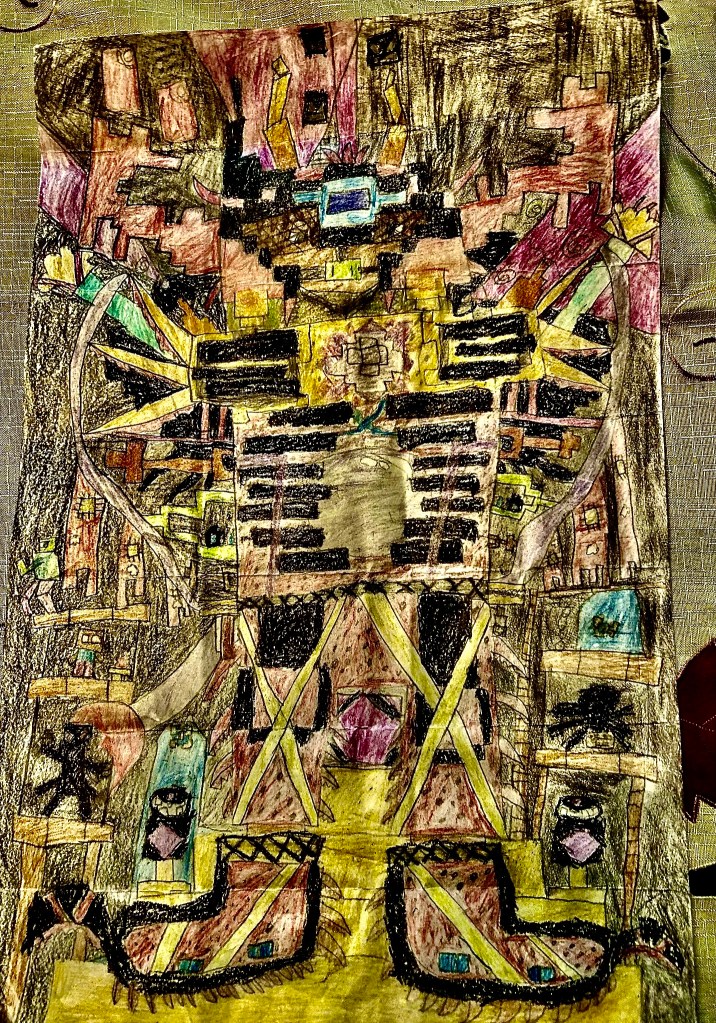
Illustration by Everett Schaser.

Ed Staskus posts monthly on 147 Stanley Street http://www.147stanleystreet.com, Made in Cleveland http://www.clevelandohiodaybook.com, Down East http://www.redroadpei.com, and Lithuanian Journal http://www.lithuanianjournal.com. To get the site’s monthly feature in your in-box click on “Follow.” His books are available on Amazon and Apple Books.

“Ebb Tide” 

Summer, 1989. North Rustico, a small town on the north coast of Prince Edward Island. Crooked money on the move gone missing. A double cross and muscle from Montreal. One RCMP constable working the back roads stands in the way.

A Crying of Lot 49 Publication

Jumping the Traces

By Ed Staskus

   Maggie Campbell’s father was a stockbroker, an investment advisor, and a vice president at Prudential Bache in the 1980s. He worked downtown with the other moneymakers. He believed in capitalism but didn’t let it go to his head. He was shrewd, keeping his greed engaged, although not always prudent. Sometimes he tripped over his sense of humor.

   Everybody called him the Margin King. His wife called him the King of Fools. When Fred and Alma got married, he was a gambling man, but Alma didn’t want him doing that after the wedding. She said it was time he became a family man. “The gambling stops now,” she declared, stamping her little feet.

   Fred Campbell decided to become a stockbroker. That way he could still gamble, except now it would be with other people’s money. He raked in a boatload of loot. He bought a house in Bay Village due west of Cleveland near Lake Erie. He wasn’t just one-sided about the almighty dollar, though. He told jokes all the time. He was a shaggy dog man. Getting a good laugh was like hitting the jackpot to him.

   He was a prankster as well as a jokester. He appeared on the “Hoolihan and Big Chuck” TV show now and then, doing skits with them. Hoolihan was Bob Wells. He was Hoolihan the Weatherman on the CBS affiliate. After Ghoulardi left Cleveland for Hollywood, Hoolihan still did the weather, but became the other half of the “Hoolihan and Big Chuck Show.” It was what replaced Ghoulardi’s “Shock Theater.” They showed low-budget science fiction and cheesy horror movies late at night and did comedy skits in between the commercials.

   The show always started with the Ray Charles song “Here We Go Again” and ended with the Peggy Lee song “Is That All There Is.” Hoolihan played a trumpet with a toilet plunger mute and Big Chuck played a small uke. That’s where Maggie’s dad came in. Fred couldn’t carry a tune, so was never invited to raise his voice in song. He brought his gorilla suit instead.

   The Soul Man, Lil’ John, and Mushmouth were on the show, too, more than Fred was. That’s how he met them. Once they met, they became fast friends in no time. Fred and Alma went to Hoolihan and Big Chuck’s house parties. They used to have Lil ‘John over to their house for spaghetti dinners. Lil’ John was a small man who could eat many plates of spaghetti. He was a hungry Hank.

   They did skits on the show like Ben Crazy, from the “Ben Casey” TV series, Parma Place, which was like “Peyton Place,” and the Kielbasa Kid, which was like a Polish cowboy misadventure. The skit Fred was most famous for was the “When You’re Hot You’re Hot” skit, which was based on a Jerry Reed song.

   “Well now me and Homer Jones and Big John Taley, had a big crap game goin’ back in the alley, and I kept rollin’ them sevens, winnin’ them pots,” was how the song went. “My luck was so good, I could do no wrong, I just kept on rollin’ and controllin’ them bones, and finally they just threw up their hands and said, when you hot, you hot.”

   They acted out the words to the song. Big Chuck rolled the dice. He had a Kirk Douglas face, if Kirk Douglas had been Polish. Fred was the sheriff. He had an honest face. The Hoolihan no-goods would be shooting craps on the street and Fred busts them. Later when they are in court the judge tells them he is going to throw the book at them, except when he throws the book, he hits Fred, who is the sheriff, in the head by mistake.

   “That hurt!” he shouts.

   “You’re out of order.” the judge declares, pounding his gavel like a madman. “Arrest that man immediately!”

   Shake and Bake Nights were when there were double features featuring first-class movies like “Earthquake” and “The Towering Inferno” back-to-back. That was when Alma got into the act. She was in a skit with Big Chuck. They are sitting on a park bench on a first date under a full moon and he turns into a werewolf. He reaches for her. She starts screaming and runs away, but falls face first into a cream pie. He shrugs and turns back into sheepish Chuck.

   Fred did most of his skits wearing a gorilla suit. But not all the skits were on the “Hoolihan and Big Chuck Show.” Some of the time it was unscripted. It was their own unreality show. He would wiggle into his suit and he and Big Chuck drove around Cleveland in a Buick Regal Sedan looking for hitchhikers. Big Chuck handled the wheel while Fred hid in the back seat. They would pick somebody up and after a few minutes Fred would suddenly pop up out of nowhere with a roar, reaching for their passenger’s neck.

   That always scared the hell out of the hitchhiker in the front seat. One of them passed out. Another one jumped out of the car while it was still moving. Maggie remembered being a youngster listening to their scarefest stories and thinking, “You guys are really strange.” It felt funny to say it about her own father.

   Sometimes they would go out at night and roof jump in Lakewood. The houses and apartments are close together, often separated only by a driveway. They would run across the roofs, swinging from the chimneys, jumping from one roof to the other. They whooped it up as householders in for the night wondered what the thumping above them was all about.

   As they got older and wiser the gang got more socially correct. They had mystery parties, which were parties on a bus on which they would have dinner and drinks with their friends, not knowing where they were going, and at the end of the night everyone would have to guess where they were. The winner got to be on the show. It was the Me Decade. Everybody wanted to be seen and heard.

   Maggie’s dad was a prankster even at home, which was quiet Bay Village. He played jokes on the neighbors on their street. He hired the Bay Village High School Marching Band to wake up one of their neighbors at five in the morning. They did it by marching up and down their driveway and playing a fight song. All the other neighbors for blocks around woke up, too. Some of them thought it was funny. Most of them didn’t. They called City Hall, even though City Hall wasn’t open for business that early in the morning.

   One of their neighbors had dogs like them and Maggie dog sat them when they were out for dinner or at a show. “Can you take care of our babies?” Mrs. Butler would ask. One day Fred took advantage of Maggie having the Butler family house keys. He snuck into their house and filled every glass, cup, vase, sink, whatever it was, with water and a single goldfish. When they got home there was a glut of goldfish waiting for them, even in the toilets.

    From then on it was buttheads on the loose at the Butler house every few months. Once when they were taking a walk on Huntington Beach after dinner, Fred and his friends got into their garage, picked up their car, and turned it sideways. The man of the house couldn’t go to work the next morning.  There wasn’t anything he could do. Everybody on the street thought he might have to tear the garage down.

   “I am going to sue that son-of-bitch,” he roared. He was a corporate lawyer. His funny bone was more along the lines of a crazy bone. He couldn’t prove who had done it and had to resort to fuming.

   Fred crept into their house late on a summer night wearing his gorilla suit and scared their kids so much they screamed their heads off and peed on the floor. He thought it was great laughs, giving them nightmares. That was fun to him. It didn’t matter what anybody thought or threatened. Whatever he thought of doing he did it. He was always pranking the poor Butlers. When they complained to the Bay Village Police Department, the cops just shrugged it off.

   Maggie and her sisters and little brother were never out of prankster range. Their father would crawl under their beds at night and wait silent as a snake until they got warm and cozy and dozed off. When he was good and ready, he reached up and around and suddenly grabbed their arms or legs, yanking.

   “Oh, yeah, while we were sleeping!” Maggie said. ”I found out your worst fears can come true at any minute. I’m a grown woman and I still can’t hang my feet out over the edge of my bed at night to this day.”

Ed Staskus posts monthly on 147 Stanley Street http://www.147stanleystreet.com, Made in Cleveland http://www.clevelandohiodaybook.com, Down East http://www.redroadpei.com, and Lithuanian Journal http://www.lithuanianjournal.com. To get the site’s monthly feature in your in-box click on “Follow.” His books are available on Amazon and Apple Books.

“Cross Walk” 

Late summer, New York City, 1956. Big city streets full of menace. A high profile contract killing in the works. A private eye working out of Hell’s Kitchen scares up the shadows.

A Crying of Lot 49 Publication