By Ed Staskus
My father was a firm believer in the harder you work the better your station. He meant better car, better house, more money in the bank, and basically better everything. He had become a refugee after WW2, getting out of Europe in 1949 with a duffel bag and twenty-five dollars in his pocket. By the time he got to Sudbury, Ontario he was down to five dollars, but found work in the nickel mines right away. That was what immigrants were for. Even though I wasn’t sure the long march to better was better, I was barely 15 years old the summer of 1966 and not about to argue with him.
When I came home that summer from what turned out to be my last two-week Lithuanian boys and girls camp on Wasaga Beach, I was immediately put to work. My father got a job for me on the chain gang of a landscaper who was redoing the grounds at Mt. Sinai Hospital. We trimmed trees, ripped out dead shrubs, replacing them with new ones, and planted flowers.
Mount Sinai Hospital began in 1892 as the Young Ladies’ Hebrew Association “caring for the needy and sick.” It opened as a hospital in 1903 on E. 32nd St., catering to east side Jews, then moved to a bigger building on E. 105th St. in 1916. It was still there. In time it became the healthcare provider to Cleveland’s urban poor. It was still there. The poor hadn’t gone anywhere.
My number one thankless task at the hospital was unloading heavy rolls of sod and laying them down to make new lawns. That meant removing the old grass and some of the worn-out soil beneath it, preparing the ground with a bow rake, breaking up large chunks, placing the sod, neatening the edges, and finally watering it. Handling the hose was easily the easiest part of the job. By the end of the first day I was dirty, soggy, and very tired.
I got a ride to work every morning from Val, a Lithuanian American like me, who was home from college. He drove a 1960 Plymouth Valiant with push-button transmission shifters. There was no button for park, but there was a lever for it. Flipping the lever to the top put the transmission into park and popped out whatever button was in gear. It was entertaining watching Val smack the buttons from first to second to drive and back as he fought the traffic.
We jumped on I-90 at E. 185th St. and took the Liberty Blvd. exit, driving along the winding road through Rockefeller Park to the work site. The 200-acre park was given to the city by John D. Ruthless in 1897. Four stone bridges carried traffic and trains over the boulevard, there was a lagoon for rowing, fishing, and ice skating at the southern end of it, and a couple dozen Cultural Gardens down the three-mile length of it.
The gardens are a series of landscaped green spots celebrating ethnic communities in Cleveland. The first green spot was the Shakespeare Garden in 1916, which later became the British Garden. The Cultural League carved out the next one, the Hebrew Garden, in 1926. After that it was off to the races. In the next ten years fourteen more gardens were created, including Italian, Hungarian, and Lithuanian. The idea was to dedicate a garden to each of the city’s immigrant groups, which at the time made up about a third of the population.
In 1936 the city unified the gardens with bordered paths. Busts and statues were installed in many of them. The first One World Day took place in 1946. A parade of nationality floats and bands blaring hometown favorites started at Public Square and marched four miles along Euclid Ave. to the Cultural Gardens, where there were speeches and a ceremony. Afterwards there was food, souvenir stands, hobnobbing, and dancing to more music. By the middle of the day Liberty Blvd. sounded like the Tower of Babel.
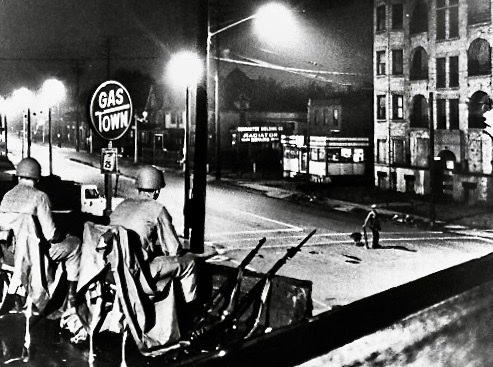
Val and I were listening to “Hanky Panky” by Tommy James and the Shondells on the car radio one Wednesday morning, curving down onto Liberty Blvd. on our way to work, when we were brought up short by a Jeep with a machine gun mounted on the back. It was blocking the road. We could see more Jeeps in the distance. “One of the Jeeps had a plastic lei hanging down from the .50 caliber gun,” said Wayne Baker, who lived in the adjacent St. Clair – Superior neighborhood. Cars were turning around and going the way they had come. Val pulled over to the side until a National Guardsman walked up to our car.
“You need to turn around,” he said. “This road is going to be closed today, maybe for the rest of the week.”
“Why, what’s going on?” Val asked.
“There’s a fire in the hole, boys. The coons are raising hell, busting into stores, burning them down.”
“What about the parade?” I asked. One World Day was scheduled for the coming weekend. My parents, brother, sister, and I always went. All my friends went, too. It was a big thing.
“I don’t know about no one world, but there ain’t going to be a parade until things cool down.”
The street fighting had started Monday when a Negro man walked into the white-owned Seventy-Niners Café at Hough Ave. and E. 79th St. He asked for a glass of cold water to cool himself down. It had been a hot day in a long hot summer. The bartender said no, get the hell out of here. Somebody got a magic marker and a piece of cardboard. He made a sign and posted it outside next to the front door. It said “No water for coloreds.”
One thing led to another and before long the Cleveland Police Department had a riot on its hands. The more policemen who showed up the bigger the mob got. By the next day there weren’t enough policemen in the city to handle the uproar. Mayor Ralph Locher asked Ohio Governor James Rhodes to send in the National Guard. They showed up through the night and deployed in the morning.
It was too late for many business owners. The Provenzano family got a call early that morning that all the windows in their restaurant on E. 97th St. and Euclid Ave. were broken and they should bring plywood pronto. The eatery was the family’s bread and butter. By the end of the day there was a run on sheets of plywood at hardware stores, although it often became just more tinder when buildings were torched.
“Why are you home so early,” my mother asked after Val dropped me off. “Did you do something wrong?”
“No, the colored people did, there’s a riot going on,” I said. “We couldn’t get to work.”
In the mid-1960s 60% of northern whites agreed that Negro students should be able to go to the same schools as everybody else. 70% agreed with residential integration. 80% agreed that they should be able to get the same jobs as whites and 90% agreed that they should enjoy public transportation without having to sit in the crappy seats in the back. All the agreeing sounded good, except when Negroes tried to take them up on it.
100% of Lithuanian Americans didn’t care what bus Negroes rode to whatever job, but the same 100% was opposed to Negro children in their schools and Negro families moving into their neighborhoods. When the moving in started was when the white flight started. My parents weren’t any different than any other Lithuanian American I ever heard say anything about it. They hated Russians, distrusted Jews, and looked down on Negroes. Their culture was one of religion, property, and community. They thought Negroes were slow-moving and shiftless, belonged to the wrong religion, and didn’t respect private property.
There were no Negroes where we lived, at all. I delivered the Cleveland Press, the city’s afternoon newspaper, door-to-door six days a week and collected money for it once a week. I knew the faces of who lived on our street of one hundred-some houses. There weren’t any black hands on my route handing me their weekly payment of fifty cents, and a tip if they wanted the rubber-banded newspaper to land securely on their front porch the following week.
Our parochial high school, St Joseph’s, was the same as my paper route. I might see a black face once in a blue moon, but not in any of my classes. They were the janitors. There were many sizable Catholic families in our neighborhood of North Collinwood and they were a solid wall of European stock.
With the Brown v. Board of Education of Topeka decision and the emerging Civil Rights movement, the times were slowly changing, but it was a bumpy change. Integration meant ill will and uproar. There had been some incidents at Collinwood High School, a few miles southwest of us, the year before. “With the passage of each year, the western fringes of the Collinwood area are being occupied by the Negro overflow from Glenville,” according to the Cleveland Plain Dealer, which was the morning paper.
The Five Points Riot happened a few years later. Four hundred white students and their sullen parents, milling around Collinwood High School one morning, started throwing rocks, smashing more than fifty windows. The two hundred newly enfranchised Negro students attending the school fled to the third-floor cafeteria. When the mob stormed the building the Negroes blocked the stairs to the third floor with tables and chairs, breaking off the legs to arm themselves. Cleveland police from three districts poured in, forming a cordon to keep the whites from attacking the blacks who were boarding buses.
“Be careful around them,” my mother warned, meaning Negroes. “They might have a knife.”
My mother and father believed Negroes were liable to go off at the drop of a hat. I took my parents at their word. It was always touch-and-go messing with their point-of-view. They survived three invasions while growing up in Lithuania, were in Germany during the convulsive last months of the Third Reich, emigrated to North America with just about nothing except willpower, and worked their way up to be devout Republicans in the New World. They were short-tempered about anybody questioning their beliefs.
Once, goofing around with my friends, I said, “And in this corner, still undefeated, my mom and dad and their long-held beliefs.” That was a big mistake, especially since my mother and father were within earshot.
Hough was a powder keg the summer of 1966. Downtown to the west was white, University Circle to the east was white, and in the middle was Hough, which was black. The housing was substandard and overcrowded. The area stores were dumpy and overcharged for their wares. The police were selective about who they served and protected. When the race riot got rolling there was rock throwing, looting, arson, and some gunfire. Four people were killed, all four of them Negroes. Two were caught in crossfires, one was killed by a white passerby while waiting at a bus stop, and one was shot by a Little Italy man who said it was self-defense. More than thirty were injured, close to three hundred were arrested, and hundreds of fires were set. There was an estimated $2 million in property damage. Many homes burned to the ground, most of them in Hough.
A friend’s grandmother, born before the turn of the century in Poland, lived on White Ave. north of Hough Ave. The big houses all around her small house had all been converted into boarding houses. They were overcrowded, but what could anybody do who needed a bed but was hopelessly short of cash? The grandmother had gone to stay with her children in Parma during the disturbance. She was upset and wanted to go home to “my own place,” which was her home.
Real family income rose rapidly in the 1960s. From 1960 to 1970 median family income, adjusted for inflation, rose to $20,939 from $15,637. It did, at least, if you were white. It didn’t if you were not. It went the other way. “It is a stark reality that the black communities are becoming more and more economically depressed,” Bayard Rustin observed in 1966. “There has been almost no change or change for the worse in the daily lives of most blacks,” Carmichael and Hamilton observed in 1967. “Although it is true that the income of middle-class Negroes has risen somewhat, the income of the great mass of Negroes is declining,” Martin Duberman observed in 1968.
You can only do so much with less. It’s smooth sailing when there’s money in the piggybank. It’s a hard slog when the piggybank is living lean. Living on bits and pieces is bitter and maddening. “The white man is reaping what he has sown. He is learning you can’t push people around. The trouble is here because the white man won’t treat the black man right,” the owner of a barber shop in Hough said.
A grand jury later concluded that the Communist Party, outside agitators, and black nationalists organized the uprising, but the finding was laughed off. No Communists had been seen in Cleveland for years and not even outside agitators nor black nationalists wanted to be caught dead in Hough, fearing for their health and safety.
An angry crowd started an overflowing fire on Cedar Ave. during the weekend, burning down most of a block of stores, but that was the high and low point of the lawlessness. Life in the ghetto returned to normal on Sunday and the next day merchants started reopening. The National Guard was released from duty. Val and I went back to work mid-week.
From where we stood on the grounds of Mt. Sinai Hospital it looked like nothing had happened. But there were two Cleveland Police patrol cars parked at the front, and one near the back, that whole week. There had always been police cars around the hospital, coming and going, but those three stayed around the clock.
Nobody wanted to talk overmuch about the riot, except to say “that was nuts, burning down where you live.” My parents and their friends said “it’s a damned shame about the parade.” Val and I shouldered on for another two-some weeks. When the project was done we were sent to Bratenahl, mowing lawns for the millionaires who lived in the east side lakefront mansions.
Our last day at Mt. Sinai, which was a Friday, driving home on Liberty Blvd., the Cultural Gardens looking great in the summer sun, Val said, “Have you noticed there isn’t an African American garden?” He didn’t call them Negroes for some reason.
“No,” I said.
“They were some of the first immigrants, not that they wanted to come here, but still, you would think there would be a garden for them, especially since this is all in their neighborhood.”
“I guess so,” I said.
Val was five years older and wiser than me. He was going to an east coast college, majoring in history. He called what he was studying ‘The Decline of Western Civilization.’ He knew all about foreign movies and writers like Jack Kerouac and Allen Ginsburg. He wore his hair long. Some in the community called him a dirty hippie, even though he worked like a sharecropper.
The idea of building a garden for Cleveland’s Negro community was brought up in 1961 by Cleveland councilman Leo Jackson. He proposed a “Negro Cultural Garden.” The mayor supported the proposal, but it was voted down by his finance committee. In 1968 the idea came back, including a statue of Martin Luther King, Jr., who had been assassinated that year. Nothing came of it until 1976, when Congressman Louis Stokes resurrected it. Ground for the garden was broken in 1977, but the project stalled until 2016, almost forty years later, when it was finally brought back to life and finished.
When we turned off Liberty Blvd., racing up the entrance ramp to I-90, Val punched the spunky Valiant’s push buttons through its gears and we rode the current of rush hour traffic back to North Collinwood. The weekend was coming up. We had our paychecks in our pockets. We were both ready as could be.
“I’m glad to be going home,” I said.
“You and me both, pilgrim,” Val said. “Shelter from the storm.”
Ed Staskus posts monthly on 147 Stanley Street http://www.147stanleystreet.com, Made in Cleveland http://www.clevelandohiodaybook.com, Down East http://www.redroadpei.com, and Lithuanian Journal http://www.lithuanianjournal.com. To get the site’s monthly feature in your in-box click on “Follow.”
“Bomb City” by Ed Staskus
Cleveland, Ohio 1975. The John Scalish Crime Family and Danny Greene’s Irish Mob are at war. Car bombs are the weapon of choice. Two police detectives are assigned to find the bomb makers. It gets personal. Revenge is always personal.
Available on Amazon and Apple Books
A Crying of Lot 49 Publication
 Made in Cleveland