Tag Archives: Made in Cleveland

One Way Ticket

By Ed Staskus

   “I don’t like this jacket, dad,” I said. “It’s too white.”

   “The first communicant has to wear special clothing,” my father said. “It’s white to symbolize purity.” He could be pontifical whenever he wanted to be. There was nothing I could do about it. I had to live with his pronouncements. He had grown up in northern Lithuania in the shadow of the Hill of Crosses. Unlike my mother, he was a true believer in Roman Catholism.

   “That’s right,” my younger brother piped up. “At least you’ll look like a saint.” I could tell from his face that he wanted to add “or a fag” but couldn’t with our father in the same room. I gave him a look we both knew meant we would settle that wisecrack later, when our parents were out of range of his cries for help. His time would come. When it did, his time would be up.

   First Communion was a big deal. Girls wore dresses passed down to them from their sisters or mothers. They sported a veil or a wreath. Boys wore a suit and tie, their Sunday best, or the national dress, with embroidered armbands and white gloves. Thank God all I had to wear were a sports jacket and a pressed pair of clean pants. A folk costume and white gloves in front of my relatives would have been mortifying, especially if they started nodding approvingly at one other. In front of my friends, it would have been unbearable.

   My father was devout and my brother wasn’t far behind, even though his guile was legendary among everybody except grown-ups. I was sure he would find some goofy jacket to wear the day of my First Communion, just to show me up. That is exactly what happened. I couldn’t do anything about it. I had to keep my JFK-style hairdo in place. Even though my parents voted Republican like playing Whac-A-Mole, my mother thought John F. Kennedy the envy of the Western world, new, vibrant, and handsome. She wasn’t going to vote for him, but that was beside the point.

   We lived on Bartfield Ave. at East 128th St. and St. Clair Ave. in the Forest Hills vicinity of the Glenville neighborhood. There were no forests, hills, or glens. Lake Erie wasn’t far away, though it was so polluted nobody but the reckless ever swam in it. Our church was St. George’s on E. 65th St. and Superior Ave. It was also our school. During the week my brother, sister, and I took two city busses, transferring while halfway there, a half-hour ride to get to school, but on Sunday mornings our father drove the family the ten minutes there.

   After the First Communion ceremony a photographer took portraits of us, a prayer book and rosary in our hands, looking pious and glowing in soft focus. Gifts were parceled out. Some parents gave their children holy cards, religious statues, and daily devotional books. My father and uncle were thankfully both accountants and gave me envelopes alive with cash.

   The next day was Jesus Day. We took a prayer walk around the school grounds, which was a big asphalt parking lot, were led on a tour of the church, which I knew full well since I was training to be an altar boy, created a personal bookmark, and sat through a special liturgy. We were reminded that Holy Communion was very special, a matter of life and death. St. Ignatius of Antioch called the Eucharist the “medicine of immortality.”

   The first dead man I ever saw happened the Sunday after my First Communion. It was before we went to church, when one of my friends ran past our front porch shouting something about life and death. I took off after him to St. Clair Ave. where on the corner was a Gulf gas station and repair shop. Police cars and an ambulance were scattered along the street. Their lights were flashing. One policeman was writing in a notebook. Another one was standing around doing nothing. A man was lying in the gutter akimbo all sprawled arms and legs. 

   We walked up to him and looked down. He was missing a shoe. There was a crusty puddle of red goo on the front of his white t-shirt. He looked asleep, except his head was bent sideways in a way I had never seen before. An ugly purple gash on his temple was getting crusty.

   “Run along boys, there’s nothing for you to see here,” a policeman said, prodding us to move along.

   “Did somebody shoot him?”

   The policeman gave my friend a push. We ran home and went to church. We forgot all about the dead man until Monday when we told everybody at school about it. We were the talk of the hallway. I could have run for class president and won handily.

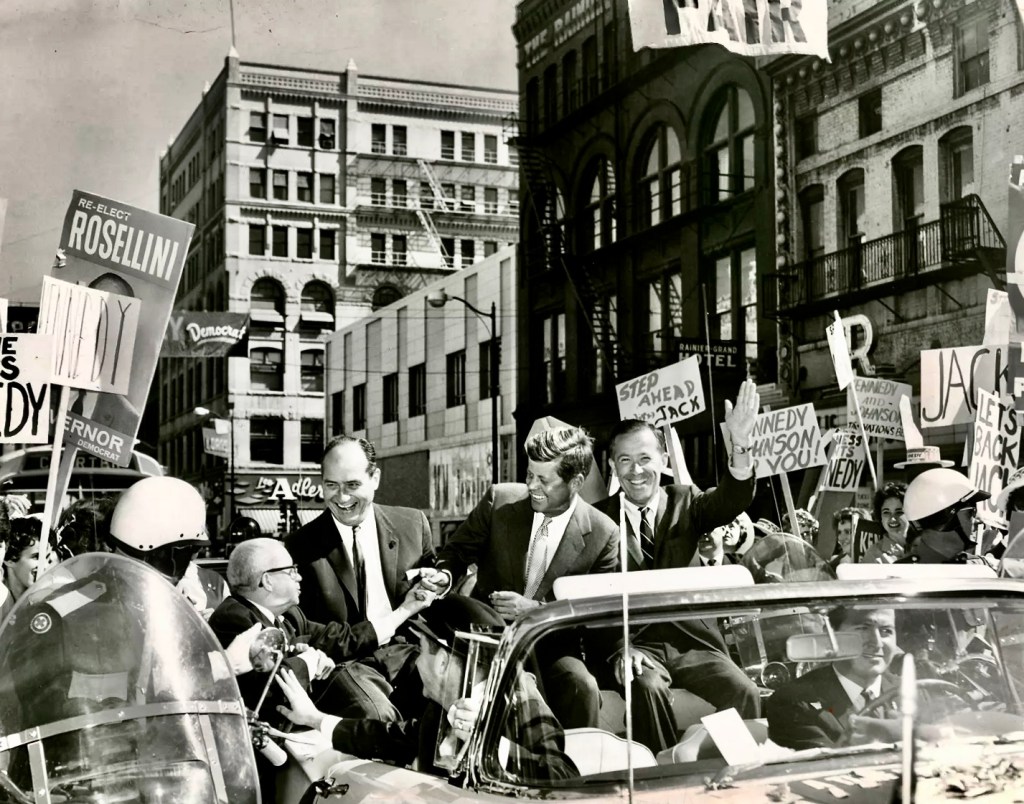
   Less than a year before I had seen John F. Kennedy when he campaigned for the presidency in Cleveland, smiling and waving from the back of a convertible crawling along Superior Ave. It was a sunny early fall day. A little more than two years later I saw reruns on TV over and over of him getting his head blown off in another convertible. Flags went half-mast. One of his children saluted his father during the memorial parade in Washington D. C.

   There were five houses on the north side of Bartfield Ave. where it met Coronado Ave. Our house was the second from the corner. A family of hillbillies who had migrated to Cleveland from West Virginia lived in the corner house. One of their boys my brother’s age and my brother were always wrestling and smacking each other. One day I saw him waving a rake at my brother.

   “Stop that!” I yelled. “Mom said dinner is ready.” It was nearly a mortal sin in our house to be late for dinner.

   A boy my age from South Carolina lived in a two-story brick apartment building on the corner opposite the Gulf gas station. He was one of the new Negro’s in our neighborhood. We were friends and played together but didn’t always get along. One day he called me a dirty DP. Both  of my parents had come to the United States after World War Two. One thing led to another. I called him a dirty nigger and he tried to hit me. I slapped him on the ear. He lunged at me and when I put my hands up, he clamped his teeth onto my right thumb. He wouldn’t let go no matter what. I had to say I was sorry. When he finally let go, he ran away up his back steps. My thumb hurt like the devil and I had to wipe tears out of my eyes.

   When John F. Kennedy debated Richard Nixon in late September 1960, it was the first televised presidential debate in the United States. The TV man Howard Smith moderated the debate. A pack of journalists faced off with the candidates. My mother and father watched it that Sunday evening, so we watched it. My brother, sister, and I were mad about missing our favorite weekend nighttime shows. We complained but our parents were long on civics and short with stir-crazy children. John F. Kennedy looked good. He had style and charisma. Richard Nixon was sweaty, shifty, and no match for his younger competitor.

   “He should have shaved,” my father, a lifelong Republican, lamented. “He looks bad.” He looked pasty and haggard is what he looked like. JFK looked fit and self-assured. He looked like a winner. After the debate he flew out of Chicago and flew to Cleveland. His plane landed at Lost Nation Airport at two in the morning. Students from Western Reserve University turned out to greet him and provide an “Honor Guard.” In the morning his motorcade rolled down Euclid Ave. and around University Circle to a cheering throng.

   On his way to a rally in Lorain Stadium, the motorcade wound its way west along city streets. I was 10 years old and waiting farther east on Superior Ave. with my South Carolina friend. We got one good look at JFK. We were behind everybody, trying to find a hole in the crowd to squeeze through to the front, when there he was, in a convertible, sitting on the back of the car with his feet on the seat. He was waving. We waved back and cheered. He wasn’t the only self-assured grown-up I had ever seen, but he was the youngest-looking best-looking grown-up. He looked like a movie star, baseball player, and war hero all rolled up in one.

   After the rally in Lorain, and lunch at the Moose Hall, John F. Kennedy went to the annual Democratic steer roast at Euclid Beach Park. More than 125,000 people heard him speak, more people than had ever assembled at the amusement park. Lakeshore Blvd. was a mess of cars and busses going nowhere. Drivers chewed the cud in the traffic jam, the smell of the steer roast in their noses.

   “The forgotten man of 1960 is the American consumer,” he said. “The forgotten woman is the American housewife. In 1952 they were promised lower prices. They heard endless Republican commercials about a stable dollar and a cheaper market basket. But under 8 years of Republican rule, the cost of living has gone up and they have done nothing about it. Families are concerned about the missile gap, but they are equally concerned about the gap between what they earn and what they have to spend.”

   It struck a chord with my mother and father, but they voted the GOP slate top to bottom., no matter what. Richard Nixon would have had to shoot Pope John XXIII stone cold dead in front of the Vatican’s Easter Sunday crowd to get my Catholic parents to vote for the Catholic on the ticket. John F. Kennedy wasn’t a Republican and that was that.

   Halloween was a month later. Time is candy was our motto. We knew our neighborhood forward and backward. We knew who handed out old fruit and who handed out new chocolate. We knew what houses to avoid because the householders were mean, stingy, or simply slow, and which houses were gold mines. My brother and I never wasted time with costumes, simply dressing like bums. The freeloader look was best because that is what we were.

   Once back home my sister hid her candy in the attic. The attic was as empty as the day we moved in. Our parents were immigrants and still scraping by, still buying only what we needed and were going to use, not things to forget about as soon as we bought them. My sister found a loose floorboard in a corner and hid her candy there. My brother had a sweet tooth and wasn’t to be trusted. No one knew or ever found out where he hid his candy. He believed loose lips sank ships and never told anybody. I hid mine in the basement, on a shelf behind a box of summer fun beach gear. 

   The next week John F. Kennedy won the White House, although he did it without winning Ohio. Tricky Dick defeated JFK, 53 percent to 47 percent, in the Buckeye State. He took all but 10 of Ohio’s 88 counties. The Democrat won the Cleveland area, though, to the displeasure of my Lithuanian kinfolk.

   That winter was cold although not a lot of snow fell. When it finally did, we built snow forts on Blind Man’s Hill. The hill was the side yard of a house on the other end of our short stretch of Bartfield Ave. A blind man lived alone in the house. We had an arrangement with him. In return for keeping an eye out for anybody messing with his house, he let us mess around on his side lawn. It was a knoll, inclining about four feet, but it was enough for us, especially when we were behind the walls of our fort hurling snowballs down on our enemies.

   The next summer on a rainy afternoon Romas Povilaitis and I almost killed my brother in the attic of our house. It wasn’t our fault, since we were only playing, but after my sister raised the roof there was no explaining it and we just had to take our lumps. We heaved a sigh of relief when my brother exonerated us, saying we were only playing, even though wrath then fell on his head, too.

   Our friend Romas lived in Chicago with his small-fry brother Viktoras, his mother Irma, and father Vytas. The man of the house was muscular and handsome. He was my sister’s godfather. He had wavy blonde hair shiny with Brylcreem. He was better looking even than his wife. Irma said she was glad he worked in a factory and wasn’t trying to better himself, because if he did, she was sure he would leave her. Even though he was blue collar, they lived in a big house in the Marquette Park neighborhood. Chicago has the largest Lithuanian community outside of the homeland. It is known as Little Lithuania among those in the know. 

   Whenever they visited us, we ran around like 10,000 maniacs. Romas was enamored of Spiderman, a new Marvel Comics superhero. He scuttled around our house pretending to squirt web fluid from his wrists. He tried to cling to walls but tumbled to the floor. We were in the attic arguing the merits of Superman, Batman,  and Spiderman when my brother insisted for the last time that Superman was the best of the three.

   “He could crush Batman and Spiderman with his little finger and besides, only he can fly,” he said.

   It finally drove us to distraction. We put a Superman cape on him and hung him by his heels out the third-floor window. He was all for it, except when the cape went flapping over his head and he complained he couldn’t see. It was then my sister walked through the door. Our brother almost nose-dived when she screamed and we were startled. We were pulling him back inside when our mother burst in.

   She dropped a dozen eggs and bum rushed the three of us downstairs. Thank God my father and Vytas Povilaitis were out. As it was, we had to listen to Irma and my mother lay down the law of the land. They seemed deadly serious, so we listened with grim attention.

   “Don’t ever do that again!” is what we heard over and over until we stopped paying attention.

   There were only two bedrooms in our Polish double on Bartfield Ave. Our sister shared a bedroom with my brother and me. Vytas and Irma slept on the living room sofa when visiting. Romas and Viktoras slept on the floor in sleeping bags between our beds. We read comic books by flashlight long into the night. We kept our sister up, but she had the good sense to keep her sleeplessness to herself. She knew she was no match for Superman, Batman, and Spiderman.

   The Friday John F. Kennedy was assassinated I was in my eighth-grade classroom at Holy Cross Catholic School in Euclid, where I had transferred after we moved from our old neighborhood that had gone civil rights to the white community of North Collinwood. My parents had said our house was becoming worthless and we had to leave. The school loudspeaker unexpectedly crackled to life. It was the principal on the broadcast system. She said the president had been shot.

   “Here is a flash from Dallas,” NBC Radio announced. “Two priests who were with President Kennedy say he is dead of bullet wounds suffered in the assassination attempt today. I repeat, a flash from Dallas, two priests say President Kennedy is dead of bullet wounds.”

   We were stunned. It wasn’t something any of us had ever thought about or expected to happen. Nobody knew what to do or say. Everybody was struck dumb. Our teacher asked us to stand and recite the rosary. We did until the principal came back on the PA and told us all to go home. Some kids were crying as they went through the door. 

   Everybody stayed glued to their TVs at home, watching the news. There wasn’t anything else to watch, anyway. The networks suspended their commercials and regular programming for the first time ever and ran coverage on a non-stop basis. The assassin was caught, but a few days later was shot in the stomach in the basement of Dallas Police headquarters. We saw it happen live on TV. It was unbelievable. Even more unbelievable was that the man who killed Lee Harvey Oswald was a strip club owner who went by the nickname of “Sparky.” I didn’t know what strip clubs were, but my father was incredulous.

   “What is this country coming to?” he asked. There was no love lost for John F. Kennedy in our house and community, but nobody wished him dead. They may not have believed in the man, but they believed in law and order. That was why they fled Europe, where law and order had fallen apart after World War Two.

   I started to wonder about God. Why did he want John F. Kennedy dead? Did he have a plan or was he just flipping a coin? When I asked our teacher why God had given him a one-way ticket to get halfway to where he was going, she started into chapter and verse, but then ran out of air. She sent me to the parish priest who told me God always has a plan and to not use words like one-way ticket.

   “Keep your mind clean and on track,” he said. “That way you will always have a one-way ticket to Heaven in your pocket.”

Ed Staskus posts stories on 147 Stanley Street http://www.147stanleystreet.com and Cleveland Daybook http://www.clevelandohiodaybook.com. To get the site’s monthly feature in your in-box click on “Follow.”


Bang a Gong

By Ed Staskus

The first day of spring will officially arrive in the West Park neighborhood of Cleveland, Ohio, in about six weeks, on Friday March 20th, shortly after noontime. The sun may or may not make an appearance. Whether Dawn Schroeder will be in her backyard practicing yoga depends more on its unofficial than official arrival. It can and will be cold cloudy wet in March April and into May.

High temperatures slowly go up to 51°F by the end of the month. How often the sky is mostly cloudy or completely overcast actually goes down from 62% to 56%. The chance of a rainy day over the course of March, however, goes up, starting the month at 23% and ending it at 30%.

It’s not that Dawn is a fair-weather yogi practitioner sadhak. She cleaves to it all year round, especially since she teaches the practice, too. But living in C-land is living four seasons, and some of those seasons are lived indoors, for the most part, for good reason.

Snowstorms in March and April are not uncommon in northern Ohio. The snowfall in April 2005 set a record at 19 inches. Two years later more than 13 inches fell in April. All the green and budding growing things had to take a break and wait it out, waiting for life.

“Yoga and meditation have served me well as I navigate and embrace my life,” says Dawn.

She describes herself as “an experienced vinyasa and Kundalini Yoga teacher, with over two decades of active teaching, a wife, mother, sister, friend, gardener, nature lover, curious seeker, and a gong and sound enthusiast.”

The gong is a metal disk with a turned rim, a large percussion instrument played by hitting it with a mallet. It makes a complex resonant echoing sound.

“The gong is the first and last instrument for the human mind,” said Yogi Bhajan, the man who brought Kundalini Yoga to America in the 1960s. “Vibrate the cosmos and the cosmos shall clear the path.”

Banging a gong is a kind of sound practice that involves using specific tones and vibrations to facilitate healing. It is sometimes called a gong bath, like being bathed in meditative sound waves. The goals of gong meditation are therapeutic, healing the mind and body, and expanding one’s awareness of the present.

“Becoming a certified and registered yoga teacher saved me when I was a stressed-out bond futures broker at the Chicago Board of Trading in the mid-’80s,” said Dawn. “It healed my body, soothed my soul and ignited my spiritual path. It is my faithful companion.”

Bond trading isn’t for everyone. It’s demanding and stressful, personally emotionally intellectually. There are times when you are on top of the world and other times when you’re the worst trader in the history of capital markets. It’s tough being a Bond Girl, especially when the action goes against you. It can be a lucrative job, but it can also be a job that drives you unglued out of your mind.

“There is only one thing that can supersede and command the human mind, the sound of the gong,” said Yogi Bhajan. “It is the first sound in the universe, the sound that created this universe. It is the basic creative sound. The sound of the gong is like a mother and father. The mind has no power to resist a gong that is well played.”

Dawn received her first yoga certification in 1986. “I have been learning ever since,” she says. Learning every day is living like what you did yesterday isn’t going to be enough for tomorrow.

“I completed my first Yoga Teacher Training in 1985 and being a life-long student, I continue to train today. I have been a Level One Kundalini Yoga and Meditation teacher since 2011, and I train with prominent teachers, attend immersions, retreats, and have begun my Level Two Training.”

Ten years later, she left Chicago, moved to Cleveland, able to spend more time with her family. and stepped into teaching yoga professionally.

“I actively study many styles of yoga by attending teacher trainings and workshops,” she said. “I am a Registered Yoga Teacher with the Yoga Alliance at the E-RYT 500 level, a KRI Certified Kundalini Yoga teacher, and I am trained in YogaEd. As Adjunct Faculty, I teach Yoga for Educators courses and Yoga courses at Baldwin-Wallace University.”

She is also an avid gongster.

I am a Gong Meditation Enthusiast.”

She and her husband Mark host Triple Gong and Mantra Meditations on weekends at the Unity Spiritual Center in Westlake, not far from their home. Get it on, bang a gong, or more.

A Roman gong from the 2nd century was excavated in Wiltshire in England and they were known in China since the 6th century. The word gong is Javanese, where they were used from the 9th century onwards. Flat gongs are found throughout Asia and knobbed gongs dominate in Southeast Asia.

On Thursday nights the Schroeder’s host yoga, pranayama, kriya, meditation, and gong savasana at the Schroasis. The Schroasis is at their house. In the winter the oasis is indoors, while in summer the oasis is outdoors.

“We absolutely love how the Kundalini Yoga and Meditation Immersions have grown and connected us,” she says. “It’s a way to practice consistently with a fun, welcoming group of yogis. The immersions and offerings are always open to students of all levels, true beginners to seasoned yogis,” she said.

“Filling ourselves up from the inside grows our gratitude. Choose to fill yourself up intentionally with meaningful experiences that create sustaining fullness, curiosity, growth, and contentment, while relying on both established experiences like on-going yoga classes and new experiences to fuel your inner glow.”

The gong is used in Kundalini Yoga as an instrument of healing, rejuvenation, and transformation. The sound waves ostensibly stimulate our cells. The idea is to increase prana, the vital life force, release tension and blocks in the body, encourage the glandular and nervous system, and improve circulation. It is also thought to work on the mental, emotional, and spiritual bodies, quieting the mind in the long run.The idea is to take the listener to their non-judgmental neural mind, to a state of quiet, of stillness.

“I see my dharma as sharing what I know, and supporting growth, expansion, connection, truth, and unity in this world,” said Dawn. “This clarity in my purpose led to the creation of our PranaVerdana, hosting, co-creating, and facilitating events that are joyful, uplifting and inspiring, creating vibrant life force energy, prana. Moving our prana toward a green, lush heart-centered world is what I generously offer.”

In Sanskrit, prana means primary energy. It is sometimes translated as breath or vital force. Although prana is the basic life-force, it can be considered the original creative power. It is the master form of all energy at every level. It has also been translated as bio-energetic motility, alive and moving, associated with maintaining the functioning of the mind and body. Kundalini, in its form as prana-kundalini, is identical to prana.

“The gong is very simple,” said Yogi Bhajan. “It is an inter-vibratory system. It is the sound of creativity itself. The gong is nothing more, nothing less. One who plays the gong plays the universe. The gong is not an ordinary thing to play. Out of it came all music, all sounds, and all words. The sound of the gong is the nucleus of the Word. “

In the beginning was the word, a sound, a vibration.

“The way I play it is my pleasure,” he added. “The gong is not a musical instrument, nor a drum. The gong is God, so it is said and so it is. The gong is a beautiful reinforced vibration. It is like a multitude of strings, as if you played with a million strings. The gong is the only tool with which you can produce this combination of space vibrations.”

Dawn teaches yoga at the Inner Bliss studios in both Rocky River and Westlake and freelances around town. She has completed Advanced Chakra Yoga Teacher Training and Lotus Palm Thai Yoga Massage trainings. “I am a polarity practitioner, and bring my exploration of Ayurveda, Reflexology, energy work, and essential oils to my client wellness services.”

She facilitates a variety of workshops, events, retreats, and trainings. “I have a playful, mature, empowering, eclectic style of teaching influenced by my trainings, personal experiences, and practice,” said Dawn. She inspires energizes networks collaborates. She fires it up.

“Necessity is the mother of invention,” says Cher Lukacs, founder and director of Sat Nam Studio. “Dawn Schroeder, my teacher, had been working tirelessly to bring the first Kundalini Yoga teacher training to Cleveland. After her Saturday morning classes, she would regularly report her steady progress toward making this dream a reality.

“A year earlier I had rented the space next to my law practice, planning to sublet to like-minded professionals. Despite some interest, it was not jelling. It was as if the space was quietly waiting.  One day when Dawn announced that a new space was needed for the training, I suddenly heard myself telling her, I have a space.”

“The studio was born as a school of Kundalini Yoga.”

“Gong is the only instrument that can create the vibration of affirming,” said Yogi Bhajan. “Life becomes yes to you and the word no is eliminated from your dictionary.”

Gongs are an integral traditional aspect of Kundalini Yoga. Every Kundalini ashram and yoga center and ashram is supposed to have a gong and use it faithfully., since it is felt to be more than a musical instrument, more in the realm of a healing tool. There are several mantras practitioners often chant out loud as a class before the playing of the gong. One of them is the Bhakti mantra and the other one is the Mangalacharan mantra. The one shows an appreciation for the moment and the gong while the other signals peace and centeredness.

“A gong bath truly is a transformative experience,” says Bridget Toomey, who teaches Kundalini Yoga at Heartland Yoga in Iowa City.

“To get a taste, start by imagining yourself lying in a dark room, on top of a yoga mat, covered in a blanket. The teacher directs you to relax each part of your body one muscle at a time, from your toes to your tongue. The sound begins quietly at first and then slowly becomes louder and more rhythmic and trance-inducing. The vibrations wash over your body. Time seems to slip away and what feels like five minutes can really be 30. That is the power of a gong bath.”

At about the same time Dawn Schroeder was transitioning out of bond trading in Chicago, the Philadelphia rock ‘n’ roll star Todd Rundgren was headlining the charts with his hit single ‘Bang the Drum All Day.’

“I don’t want to work, I want to bang on the drum all day, I don’t want to play, I just want to bang on the drum all day, I can do this all day.”

“You have no resistance against this sound, the gong,” said Yogi Bhajan “It is the master sound. Everything you think becomes zero. The gong prevails.”

“I am so grateful I found yoga and I love sharing it and watching students grow,” says Dawn. “I came to the mat seeking ease in my body and had no idea it would change my life. Yoga is the perfect complement to our hectic, stressful lifestyles.”

Dawn Schroeder isn’t a headbanger, but when she bangs her gong, she’s got her head in the right place.

Ed Staskus posts stories on 147 Stanley Street http://www.147stanleystreet.com and Cleveland Daybook http://www.clevelandohiodaybook.com. To get the site’s monthly feature in your in-box click on “Follow.”
Up in Smoke

By Ed Staskus

   When my father died the funeral service was at Our Lady of Perpetual Help, the Lithuanian church on Cleveland’s east side, the memorial service was at the Lithuanian Club up the street, and he was buried on the grounds of All Souls in Chardon, forty miles farther east, where many Lithuanian Catholics ending their days on the south shore of Lake Erie end up.

   All Souls Cemetery covers some 250 acres, features over 109 developed acres and 7 mausoleums, and could be a golf course if it wasn’t a boneyard. If someone’s got the blues, it’s where to go. It’s the place to bury your troubles.

   Two years later, paying my respects on a sunny summer day, visiting my father in the mausoleum where he is interned, and later wandering about the cemetery, I stumbled on the burial place of Antanas Smetona. The name rang a bell. When it came to me, I remembered he was the first and last president of Lithuania during the inter-war years.

   Walking back to my car I passed a headstone 50-some years old. Red and white artificial flowers lay on the ground. Engraved on the stone was a man’s name, his date of birth and death, and the inscription “He Done His Damnest.” It wasn’t the kind of epitaph I expected, which would have been more along the lines of “Always in Our Hearts” and “Gone but Not Forgotten.” Had the man gone to Heaven or Hell?

   Antanas Smetona did his damnest, too. 

   He was born into a family of farmers, former serfs, the eighth of nine children. Their homestead was near a small lake, almost dead center in the middle of Lithuania. His father died when he was eleven, making a last wish that his youngest son be sent to school. He was the only one of his brothers and sisters to ever get an education. The instruction was in Russian, because the Russians were in charge and Lithuanian talk was forbidden. Lithuanian literature was closed down. Lithuanian history was closed down.

   He was a top student and won a tuition waiver. He supported himself by superintending his dormitory and giving private lessons. After graduation he made his way to Latvia, got involved with the Lithuanian National Revival, got into trouble, made his way to St. Petersburg, got involved in the February 1899 student protests, and got deported back to Lithuania.

   After he was allowed to return, he got involved with Lithuanian book smugglers, got arrested, got thrown into a castle that doubled as a prison, somehow got acquitted, cracked his books, graduated university, and made his way out of Russia. He never went back. He went back to the homeland.

   Russia was like a cemetery with a big fence around it. Those inside couldn’t leave unless they were thrown out. Those outside didn’t want to scale the fence to get inside unless it was a matter of life and death.

   Antanas Smetona got married and went to work for the Vilnius Land Bank. When he wasn’t working, he was working with several Lithuanian nationalist groups and writing editing publishing circulating news and editorials advocating national unity and independence.

   When the First World War started, he chaired the Central Committee Relief Society and pressed demands on the Germans, who had pushed the Russians out of the country in 1915, that Lithuania be granted its independence. A year later he began editing and publishing the newspaper Lithuania’s Echo. His message, stated in the first issue, was the speedy establishment of an autonomous and sovereign Lithuanian state.

   Russia didn’t like that, since they had controlled the country for more than a hundred years, but they had their own problems, namely the Eastern Front, where they were busy suffering six million casualties and three-and-a-half million captured. On top of that more than a million civilians were dying of war-related causes. Adding to the anvil chorus, the Bolsheviks were breathing down their necks.

   When the Council of Lithuania was formed, Antanas Smetona was elected Chairman and in February 1918 he signed the Act of Independence of Lithuania. The next year he was elected the first President of the Republic of Lithuania. His tenure didn’t last long. The next year a new man was elected, and he was out. He taught classes at the University of Vilnius and got involved with the paramilitary group the Lithuanian Riflemen’s Union.

   Five years later he led a coup d’etat, deposing the then president and seizing the office for himself. A year later he suppressed the parliament. Two years later he assumed dictatorial powers. For all his editorializing about autocratic czars, he became an autocratic czar. For the next nine years he ruled by decree, his own new constitution vesting in him both executive and legislative powers. Whenever there were new elections he ran as the only candidate.

   He added his name to the rise of totalitarianism and dictatorship in the 1930s, joining Benito Mussolini, Francesco Franco, Joseph Stalin, and Adolf Hitler. He went from idealism and high-mindedness to cynicism and the inside track. Realpolitik is not about democracy and human rights. It is the struggle for power. It’s like Adolf Hitler said, “It is not truth that matters but victory. If you win, you need not have to explain. If you lose, you should not be there to explain.”

   Although there aren’t many children nowadays who would accept guidance counseling from Adolf Hitler, there were plenty of men and women eighty and ninety years ago who were all ears. That’s why cemeteries by 1945 were overflowing with indispensable people, not including the dictators. They make their own beds.

   Antanas Smetona may have been a patriot and a loyalist, doing his best to restore Lithuania to nation statehood, but he was nonetheless a dictator. He may have repressed the Iron Wolves, a radical rightist movement led by his former Prime Minister who he had earlier removed from office, but his own Lithuanian Nationalist Union took part in the 1934 Montreux Fascist Conference. He may have believed in political parties, but his was one-party rule and he was the host boss ringleader of the party. He styled himself as the Tautos Vadas, or Leader of the People.

   Under his rule Lithuania “moved decisively towards a dictatorship of what might be termed the ‘fascism from above’ variety,” according to Martin Blinkhorn, British historian and author of “Fascism and the Right in Europe 1919 – 1945.” The Russians, the Muddy Mississippi of Fascism themselves, said he was trying to “adapt Italian Fascist concepts to Lithuanian conditions.” He was more centrist and moderate in his authoritarianism than many others, but he also believed he was the most qualified and experienced person to run the country, and he rigged the elections to make sure it stayed that way.

   Not that it did him any good. By 1938 he was being squeezed by Nazi Germany and the Commies. He had never been able to get Vilnius back from the Poles. Now he had to surrender Memel to the Germans. When the Russians presented an ultimatum to his government in 1940, he urged armed resistance, but nobody agreed that Lithuania’s armed forces, numbering some twenty thousand, was up to the task of going toe to toe with the five-million-man Red Army.

   “I do not want to make Lithuania a Bolshevik country with my own hands,” he said from the steps of the Presidential Palace in Kaunas and left the country. A month later Lithuania was incorporated into the Soviet Union. He wasn’t on hand to try to stop it.

   When he got to the border Antanas Smetona and his bodyguard waded across the Liepona rivulet into Nazi Germany. When he did, he went from lightning rod to lightning bug. The next day his family convinced the Lithuanian crossing guards to let them go, too, since the big fish was already gone. The provisional government wanted him back, but what could they do?

   The Germans put him up in a hunting lodge in the Masurian Lake District. From there he was moved to Berlin, then traveled to Bern, Switzerland, and lastly to Rio de Janeiro. He finally landed on his feet in the United States where four hundred guests greeted him at New York City’s Pierre Hotel for dinner and an evening function. He briefly lived in Pittsburgh and Chicago before finally settling down on the east side of Cleveland.

   When I grew up on the east side in the late 1950s and 60s, Eastern Europe was right across the street. There were Serbs Slovenians Croatians, plenty of Poles, and lots of Lithuanians. Everybody had their own church and their own watering holes. Everybody had their own talk in their own language about the mother land and their new place new lives new future in the USA.

   Antanas Smetona and his wife Sofija moved in with their son Julius on Ablewhite Avenue on the northeast side of the city, off Eddy Road, near Lake Erie. Julius worked as a grinder for Standard Tool and was married to Birute Nasvytyte, a former concert pianist, raising their two children. The self-styled President-in-Exile worked on his memoirs and visited Lithuanian communities across America speaking about the plight of the mother country and his hopes for its post-war independence.

   “What the Magna Carta was to the English, what the rights of man of the French Revolution were to personal liberty, the Atlantic Charter is to nations, especially small nations like ours,” he said.

   When my parents bought a two-and-a-half story duplex with a backyard big enough for a pack of kids, their first house in the United States, doubling up with my father’s sister and her family in 1958, all of us recent immigrants, it was about a mile from the exile’s residence. When I attended the Iowa-Maple Elementary School my first school year in Cleveland I sat in a classroom a stone’s throw from the house. I wasn’t aware of it at the time, that the ex-president of Lithuania died in that house less than twenty years earlier.

  The day he died, Sunday January 9, 1944, he and his wife were in their upstairs bedroom relaxing. It had snowed lightly on Saturday and the windows were frosty, below freezing. They smelled something foul and saw smoke oozing into their room from under the door. 

   The furnace had been acting up lately. “The night before yesterday coal fumes made me dizzy. I could not think clearly. Now I have completely recovered,” he wrote in his journal two months earlier. This was worse. His thinking days were soon going to be over.

   The overheated furnace caught fire, leapt up the chimney, and swept through the house. The man and wife bolted out of the room and down the stairs, but he turned around, stepping back into the bedroom, grabbing a fur-lined overcoat to throw over his head. By the time he turned again to flee his wife was in the front yard. He never made it out of the house alive.

   Fire Battalion Chief Tom O’Brien said afterwards the fire had a “head start,” making it difficult to fight. The coal room was red-hot. By the time they extinguished the blaze and accounted for everyone, they went looking for Antanas Smetona. They saved the house but found him face down in the second-floor kitchen dead of suffocation. Police outlined in chalk where his body was found, and other policemen carried him out on a stiff board.

   The pull out the stops funeral was at the Cathedral of St. John the Evangelist and was presided over by Bishop Edward Hoban. The Cleveland Police Mounted Unit saluted as his coffin was carried out the front door. He was buried in Cleveland’s Knollwood Cemetery but in 1975 was moved to Chardon, next to his wife, who died in 1968.

   Although the inter-war years in Lithuania are often referred to as the Smetonian years, there is no monument to the man in Vilnius. “I really wouldn’t want to say whether I’d approve a monument to Smetona, or not,” Remigius Simasius the mayor of the city said. In the end he didn’t say. There is still some bad blood about the putsch and his authoritarianism.

   “Perhaps not so much for the coup itself than for disbanding political parties and essentially destroying the opposition,” said Vilnius University historian Alfredas Bumblauskas.

   When I went back the next summer to visit my father, I walked to where I knew Antanas Smetona was six feet up. The polished granite slabs are on a wall above Grace and Philip McGarry and below Michael and Anna Pula. Someone had fixed fresh flowers to both Antanas and Sofija’s facings. The sepulchral stone was spic-and-span.

   I thought of Blind Lemon Jefferson’s song, “There’s just one kind favor I’ll ask of you, see that my grave is kept clean.”

   No matter what, whether he had done the best he could, or not, whether he was a statesman or a tyrant, whether he was in Heaven or Hell, the earthly remains of the man were beyond reproach in his neat as a pin final resting place at All Souls. 

Ed Staskus posts feature stories on 147 Stanley Street http://www.147stanleystreet.com and Cleveland Daybook http://www.clevelandohiodaybook.com.. To get the site’s monthly feature in your in-box click on “Follow.”

Kid Blast

By Ed Staskus

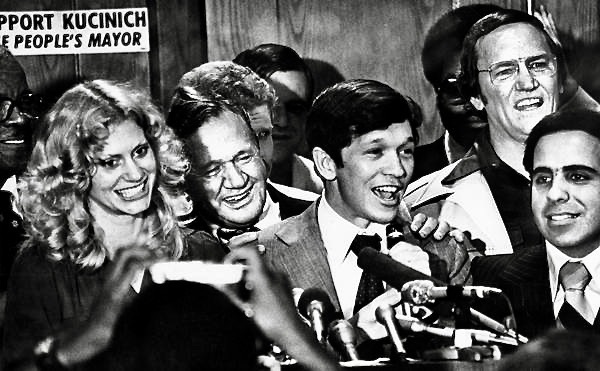
   I knew some bits and pieces about Dennis Kucinich, even though I had never met him. I knew what I knew because I was living in Cleveland, Ohio, and he was the mayor. He was the youngest mayor in the history of the city. He was the youngest mayor of any major American city. He was 31 years old but still looked milk-fed.

    I hadn’t voted for him. I never voted for anybody. I thought of myself as an anarchist. I wasn’t the bomb throwing kind though. I liked the idea of anarchism more than the risk-taking of anarchism. I wasn’t ready and willing to end up behind bars.

   The new mayor was born and bred in Cleveland, the oldest of seven children in a Catholic family. He was 23 years old when he won a seat on Cleveland’s city council. After he got a master’s degree from Case Western Reserve University, he ran for mayor in 1977. He surprised himself and everybody else when he won. When he did his troubles started and went on and on.

   Cleveland was a mess in 1977. A year earlier The Cleveland Plain Dealer splashed “Bombing Business Booming Here” across its front page. The old-school Italian families and the new-school Celtic Club were fighting it out for control of the rackets. Car bombs were the preferred ways and means of debate. All the evidence was usually blown to bits, which suited everybody involved, since they were all in. It didn’t suit the police, who were left out in the cold.

   The Bureau of Alcohol, Tobacco, and Firearms set up a new headquarters in town. When asked why they said since Cleveland was “Bomb City USA” they were obliged to do something about it. Within a year they doubled their staff.

   It wasn’t just bombs, either. Trash collection and street repairs were slipping fast. The parks were more litter and dopeheads than fun and games. Corporations and manufacturers were pulling up stakes. Racial polarization was staying put. Whites hated the busing that was coming and made sure everybody knew it. “We Say, No Way, No Bus for Us” is what their banners said. As the 1970s kicked off murders in the city set a record with 333 of them. Ten years earlier there had been 59. Environmentalists declared the Cuyahoga River dead and Lake Erie not far behind. The city lost a quarter of its population during the Me Decade. 

   The city didn’t lose me. I moved back to Cleveland after growing up in North Collinwood and Euclid. My parents didn’t like it. They believed in the American Dream and thought I was back tracking. They told me so from their suburban home. They thought the metropolis was a nightmare.

   I lived a block from Lakeshore Blvd. and two blocks from Lake Erie. Bratenahl was three blocks west. I rode the 39B bus through the posh village Monday through Friday on my way downtown to Cleveland State University. I always sat in the last row so that nobody could sit behind me. I didn’t have to worry about the swells, since they never rode the bus, but the same wasn’t true of some of my east side neighbors.

   Dennis Kucinich got started with a bang when he was elected in November. He championed the public good and made sure everybody understood he wasn’t going to auction off the city’s assets. He was sick and tired of corporate collusion and tax abatements. Everybody was sick and tired of the old mayor Ralph Perk. Dennis Kucinich was a breath of fresh air.

   It was snowing when he was inaugurated in January. It kept snowing and the new leader of the pack was forced to declare the metropolitan area a “disaster zone.” Before the month ended the city was hit with the worst blizzard in its history. Things went from bad to worse when he fired his police chief two months later.

   Dennis Kucinich had appointed Richard Hongisto, a former San Francisco sheriff, to be chief of police as soon as he became the mayor elect. It seemed like a smart choice, especially after the head honcho in blue saved a man from a snowbank during the Great Blizzard of 1978. He was acclaimed by the press and public as a man’s man.

   The mayor didn’t see it that way. When the police chief wouldn’t go along with his plans, which included rewarding his supporters with jobs, he charged him with insubordination. The chief responded by saying he wasn’t going to commit any “unethical acts.” On Easter weekend in front of live TV cameras the mayor fired his top cop. One thing led to another, and even though he was in a hole, he couldn’t stop digging. When business and civic leaders lost confidence in him, momentum grew for a recall election. When they started calling him Dennis the Menace the momentum became the real deal.

   I didn’t meet Terese Schaser until the late 1980s. It happened soon after I met her daughter, who was going to become my wife-to-be, although none of us knew it at the time. In 1978 Terese was living in Park Centre. She had left her husband and was making her way as a restaurateur. The twin 23-story downtown towers were less than ten years old, built with raw cement features in a Brutalist style, where the best people lived. Richard Hongisto lived in the same building as my mother-in-law in the making.

   She was in her mid-30s and getting on a roll. When she heard about the recall effort, she got behind it and helped roll the ball forward. She wasn’t much older than the boy mayor but believed he was an upstart, his inexperience getting in the way of his governing ability. Her friend the ex-police chief agreed with her. Neither of them gave a hoot about his populist philosophy.

   Cleveland was on the verge of default. Dennis Kucinich did the best he could to fend off his naysayers, but he was a Democrat, not a member of any intelligible political party. He shouldn’t have been allowed to deal with the devil in the first place. He was taking his lumps from all sides. Even his own city council was at his throat.

   He called them “a group of lunatics” and “a bunch of buffoons.” He said, “it’s hard to believe that so many people can be so stupid.” He added insult to injury by saying, “if they’re not stupid then they are crooked.” That summer he ordered more police patrols in the projects to counter rising crime. The police department refused to obey the order. Thirteen police were disciplined and suspended which led to a police strike. Among other things it was another first for the city.

   The Kucinich administration was making history right and left.

   When the weather warmed up Terese was in summer dresses and flat shoes helping with the recall petition. She had great legs from her dancing days. Towards the end of May the effort was short of the required signatures. She threw herself into the work explaining cajoling and demanding. She never got tired and wore people out. She had a big personality. Ten years later she wore me out. Her children ate cold cereal in the morning and cold leftovers at night. By the deadline of June 1st more than enough signatures had been gotten. 

   The mayor refused to resign, saying “Bring on the recall.” He handed out bumper stickers saying, “Support Kucinich, the Peoples’ Mayor.” The people would have their say soon enough. Terese’s kids breathed a sigh of relief, but the hot meals didn’t last long. The recall election was scheduled for mid-August. The canvasser redoubled her efforts.

   She had pizzazz to spare and didn’t spare any of it during the recall campaign. She didn’t just rub two sticks together. She made sure one of them was a match. The lady lit a fire under everybody she talked to. Working on a political campaign means about half the electorate is going to hate you day in day out. She didn’t let it get her down. She had an agenda and a bogeyman. At night she made her plans for the next day while singing along to lurid Italian operas. 

   “My mother was an enthusiastic but terrible singer,” her daughter said.

   When Dennis Kucinich stalled on demands to sell Municipal Power, the city’s publicly owned electric utility, not only did lawyers get involved the Cleveland Mob got involved, too. They brought in a hit man from Maryland to shoot him during a parade. Nothing came of it when the mayor was hospitalized for a few days and missed the event. He never really liked parades, anyway. 

   As the recall campaign got into full swing, Council President George Forbes and Dennis Kucinich argued about the merits of building a new ore dock for Republic Steel, except their arguments had nothing to do with the ore dock.

   “Stick to the issue,” George Forbes said.

   “Mr. Chairman, I determine the issue,” Dennis Kucinich said.

   “Not in this chamber,” George Forbes retorted.

   “You will permit me to continue my remarks,” Dennis Kucinich said.

   “Just one moment,” George Forbes complained. 

   “You have no ability to censor my remarks,” Dennis Kucinich explained.

   George Forbes didn’t like that. His dark face got darker. He ordered the mayor’s microphone shut off. Dennis Kucinich and his aides stormed out. When all the hot air was said and done, Republic Steel walked away from Cleveland and built a new ore dock in Lorain.

   “The best and longest running show in town isn’t at Playhouse Square,” Roldo Bartimole, who wrote the newsletter Point of View, said. “It’s at Cleveland City Hall. The admission is free.”

   When recall day arrived more than 120,000 Clevelanders voted. Dennis Kucinich took a nap. He knew staying up wasn’t going to change the result if he lost. He also knew if he won, he had another tough day in front of him, and needed the rest. He prevailed by a margin of 236 votes. Terese’s kids ate well the next day when it was all over.

   Towards the end of the year Cleveland s banks refused to roll over the city’s debts. They assured the mayor it would be business as usual if they could do what they wanted with Municipal Power. He refused, and the city went into default, the first city since the Great Depression to find itself unable to meet its financial obligations.

   He lost his reelection bid in 1979. It was one and done. He wasn’t going to be the jackass in a hailstorm anymore. Everybody was sick and tired of confrontational politics. George Voinovich took his place. He got Cleveland going on the road to ‘The Comeback City.’ When the century came to an end historian Melvin Hollis put Dennis Kucinich on his list of ten worst big-city mayors of all time in his book “The American Mayor: The Best & Worst of the Big-City Leaders.”

   Terese remarried and moved to a corner apartment on an upper floor of Park Centre. The family barbecued on the balcony and watched the air show over Lake Erie every September. The Blue Angels cut the corner across their roof pirouetting back to Burke Lakefront Airport. She gave up governmental enthusiasms, concentrating on foodstuffs. She opened a restaurant and then another one. She worked as a pastry chef on both sides of town. She catered weddings and served food at funerals.

   At the end of the day, kicking back, she liked to paraphrase Mark Twain. “Suppose you were an idiot, and suppose you were a politician, but I repeat myself.” It always got a big laugh over dessert, especially when she added, “Put them in charge of the Sahara Desert and in a couple of years there will be a shortage of sand.”

   I moved to Lakewood, Cleveland’s second-oldest suburb on its western border. The town’s mayor kept his nose to the grindstone, focusing on safety, schools, and city services.  They weren’t running out of sand anytime soon.

Ed Staskus posts stories on 147 Stanley Street http://www.147stanleystreet.com and Cleveland Daybook http://www.clevelandohiodaybook.com. To get the site’s monthly feature in your in-box click on “Follow.”

Ice Age Afternoon

By Ed Staskus

   “What are those for?” I asked watching my father-in-law pull two chunky copies of the Sunday edition of the Cleveland Plain Dealer out of a plastic bag.

   “These are to sit on,” he said. I didn’t bother asking. I was going to find out soon enough anyway.

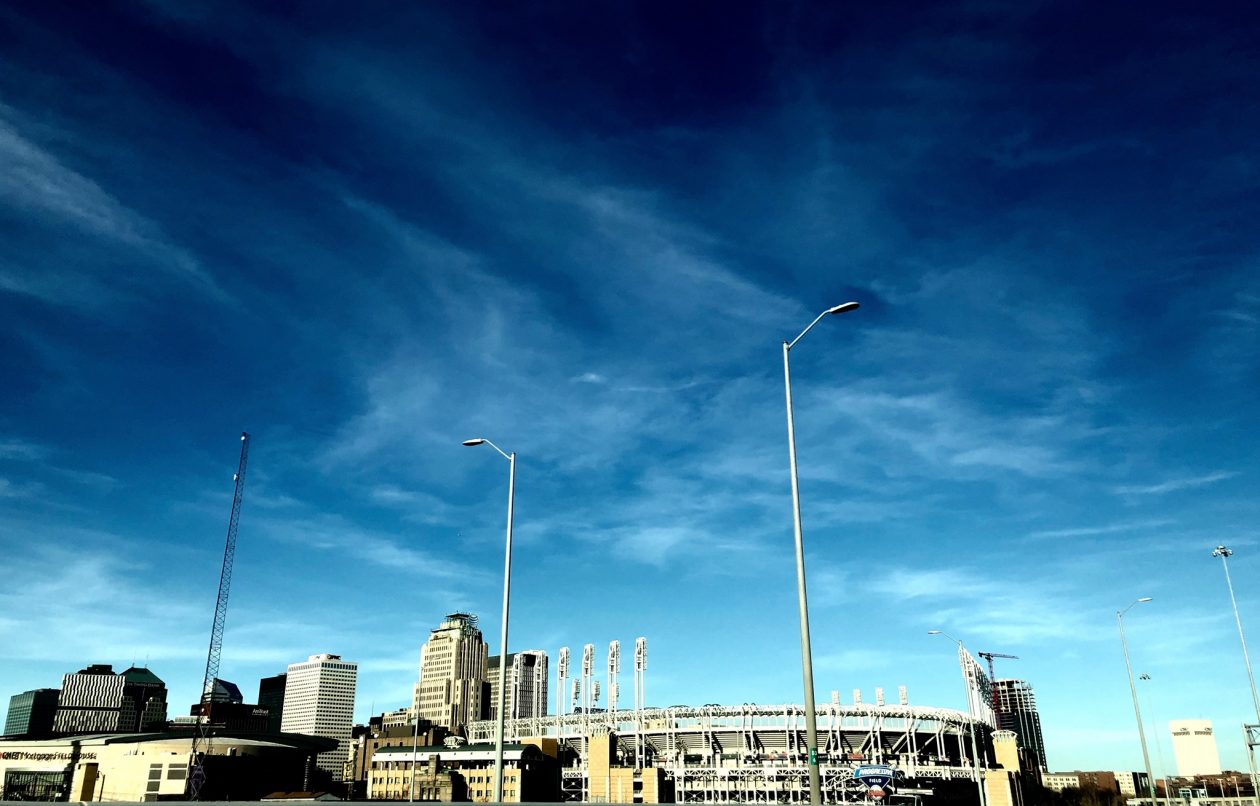
   It was December 15, 1991, and the temperature was somewhere in the mid-20s inside Municipal Stadium. Outside the lakefront stadium Lake Erie wasn’t frozen solid, yet, just frozen. The wind was brisk in the 25-mile range and the wind chill was too much to talk about. It was a quarter to one in the afternoon. Even though the sun had risen five hours earlier, it still hadn’t made an appearance. The Houston Oilers were warming up to play the Cleveland Browns. The home team was already warmed up. They knew what they were in for weatherwise. The Browns weren’t going anywhere behind Bernie Kosar, but the Oilers were going to the playoffs behind Warren Moon.

   Playoffs or no playoffs, they were all war horses. They were going to raise Cain to get the job done, no matter what. They put blinders on the minute they stepped on the field. The Oilers did their best to ignore the Dawg Pound.

   Dick Parello my father-in-law wasn’t a talkative man. His wife filled the silence. He was good at crosswords, doing them every day with a ballpoint pen, and devilishly clever at Scrabble. He scored points even when he had nothing, and I had all the good tiles. The Sunday newspaper was a good idea. I tossed the sports section down to put my day-to-day shoes on and fight off frostbite. Otherwise, my feet would have spent three and half hours on rock-hard ice-cold unforgiving concrete.

   The newspaper John Kupcik’s father-in-law brought to the game suffered a different fate. “He would tear off a page of the paper, crumble it up, and light it between his feet to keep warm. He did it the whole game, section by section. That and his homemade brandy kept us warm enough.”

   Even though I had lived in Cleveland since before the age of ten, watched NFL games on TV on Sundays and read recaps in the newspaper on Monday, I had never been to a Browns game. I had been to the stadium many times to see baseball games. The Indians were bad but tickets for day games were cheap, and the ball games were fun. We paid bargain basement prices and then sat wherever we wanted to. We liked sitting behind the dugouts, to encourage Chief Wahoo and abuse the other guys.

   Municipal Stadium was built in the early 1930s when the city was run by city managers. Walker and Weeks designed it and the Osborn Engineering Company built it. The stadium featured an early use of structural aluminum. Two days after the ballpark was dedicated on July 1, 1931, it hosted a boxing match for the World Heavyweight Championship between Max Schmeling and Young Stribling. There were 37,000 fans in attendance for the slugfest. Schmeling held on to the title by technical knockout in the 15th and last round. When it was all over Max sat back and lit up a cigar while Young spent days feeling years older than he was.

   The Cleveland Indians played their first game there on July 31, 1932, losing 1-0 to Lefty Grove and the Philadelphia Athletics, attracting a then-major-league-record crowd of 80,184. They played the rest of their home games at the ballpark the rest of the year and through the next year. But none of the Tribe players liked Municipal Stadium. They complained about the vast outfield and pulled muscles trying to muscle home runs over the faraway fences.

   It was 435 feet to the far corners of the stands in left-center and right-center, 463 feet to either corner of the bleachers, and 470 feet from home plate to the bleachers in straightaway center. No player ever hit a home run into the center field bleachers. Fly balls choked and died trying. 

   The team went back to the smaller League Park in 1934 and stayed for several years. They returned in 1937, playing some Sunday and holiday games at Municipal Stadium. League Park didn’t have any field lighting, so when night baseball got going in the 1930s and lights were finally installed at the stadium in 1939, the Indians started playing most of their home games there. They abandoned League Park entirely after 1946.

   Dick was from Rochester, New York. He grew up there and enlisted for the Vietnam War there. He was a stolid burly man. After he finished Charm School and got his legs under him as a military policeman, he kept things quiet in his neck of the woods. He didn’t mix it up much with Charlie, assigned to III Corps in the Saigon area where the fighting was spare, but never went anywhere without his Colt .45 Government sidearm.

   “Never trust a gook,” he said. He meant Charlie and ARVN and everybody in between.

   He came to Cleveland in the early 1970s with three friends who were putting a new restaurant together in Park Centre, which later became Reserve Square. When the Firehouse was ready to go, he became the bartender, and after that the manager. When he married Teressa my future mother-in-law in 1981, they set up shop in a three-bedroom apartment on the 17th floor of Park Centre. Dick and Teresa built the Park Pub, last call at the Firehouse having come and gone. They served food and drink. Teresa was a self-taught pro in the kitchen. She had the paring knife scars on her hands to prove it. Dick worked nights behind the bar and had the bags under his eyes to prove it.

   Even though Municipal Stadium was built for football as well as baseball, it was built for baseball. The football field was an awkward fit on a field designed for America’s pastime. Nobody wanted to sit on the home plate side. They were the best seats during a baseball game but the worst seats at a football game. The far end zone couldn’t have been farther away.

   As sparse as crowds were at Indians games was as big as crowds were at football games. When I looked around there might have been an empty seat somewhere. Otherwise, it looked sold out. The best seats were at the 50-yard line, but we sat in the bleachers. Going to the game was a last-minute idea, not mine, but Dick’s, who got free tickets from a barfly.

   I hadn’t been to Municipal Stadium for almost ten years. When we walked inside, I thought, “This place is a broken-down dump.” It looked bad. It smelled bad. There was a raw feeling in all directions.

   We sat behind four guys who had smuggled a keg of beer into the stadium. They were drunk as skunks sooner than later and spent the second half throwing things at Oilers players whenever they came within range. Their aim was bad, though. They hit more fellow fans than anybody else. A baldheaded older man behind us wearing a scarf smoked fat cigars all afternoon. Thank God the steady wind blew the smoke to the side. When I was tempted to tell the four guys with the keg to stop standing up towards the end of the tight game, Dick told me not to. “You’ll get a cup of hot piss thrown at you and told to get the hell out of our section.” We bought dirty water hot dogs smeared with Bertmans Ballpark Mustard. They were delicious.

   A tarp at the top of the bleachers was flapping mad as a hatter in the hard wind blowing in off the lake. “I sat second row from the top of the bleachers, next to some east side old timers who brought their own pulled pork sandwiches in foil and a thermos of special coffee,” said Todd Rejna. “Season ticket holders had the top row. As soon as they got there, they pulled out a cordless screwdriver and a rolled up blue tarp from under their bench. They screwed the tarp up to the bottom of the giant scoreboard as a wind block. When the game was over, they took it down, rolled it up, and stuffed it under the bench for the next week.”

   The Browns scored first when Leroy Hoard corralled a duck from Bernie Kosar and went eight yards for a touchdown. Matt Stover kicked the point. The Oilers came right back when Ernest Givens took a seven-yard pass from Warren Moon in for the score. Al Del Greco kicked the point. After Brian Brennan caught another eight-yard pass from Bernie Kosar for a score, the stadium shuddered with cheers whoops clapping seats being slammed up and down and stamping shoes and boots. “We’re done for sure,” I said to Dick, the concrete shaking beneath my feet. “This place is going to collapse any minute.” The feet were stamping to stay warm as much as they were to show appreciation for the offensive showing. Nobody worried overmuch when Del Greco kicked a late field goal. The Browns went into the locker room ahead 14-10.

   I headed for the bathroom, along with thousands of other men all at the same time. The bathrooms didn’t bother with urinals. Instead, there were troughs. By the time I found a spot they were overflowing. The sinks were overflowing with urine. The floor drains were fair game, too. Many of my fellow men were trashed on beer. The man taking a leak next to me was one handing his business and singlehanded rolling a joint. Everybody went with the flow. The only thing that saved the day was that many kidneys had frozen up and shut down. My shoes were sticky when I walked out of the bathroom. After the game, walking up East 9th St. back to the Park Centre on East 13th St. and Superior Ave, I could still smell pee and beer.

   The stadium was on the south shore of the lake and cold, even on the best of days. The wind never stopped whipping off the lake. Other than the bleachers, which were wide open, there were huge beams that blocked the view from many of the seats. The color scheme inside the stadium was gray under a gray sky. The grass on the field was mostly dirt and weeds. It looked like it was painted green. There were old bedsheets with bad words scrawled on them hanging over the rails.

   Both quarterbacks had aired the ball out in the first half, but ball control and field position became the name of the game after halftime. The third quarter was either a defensive struggle or it was getting darker colder windier and nobody wanted to be on the field too long. Browns coach Bill Belichick and Oilers coach Jack Pardee played it close to the vest. It was one punt after another. When the fourth quarter started it was back to the air. Bernie Kosar and Warren Moon both put the ball up 40 times that day. They both threw an interception. When Bernie Kosar did it an 80,000-man groan went up. After the turnover some guy dropped stink bombs from a catwalk. For a few minutes the stadium smelled like rotten eggs.

   The game went down to the wire, the Oilers finally winning when Warren Moon flipped a two-yarder to Haywood Jeffries for a 17-14 win. The air went out of the crowd. It all smelled flat and stale when the hands of the big clock spelled out the final score.

   The first Cleveland Browns game at Municipal Stadium was on September 6, 1946. They hosted the Miami Seahawks. The game drew 60,135 fans, at the time the biggest crowd to ever see a professional football crowd. It was a laugher. The Browns won 44–0. The bleachers became the Dawg Pound in the 1980s. Fans wore dog masks, barked and howled, and threw dog biscuits at opposing players. There wasn’t a lot of barking when Dick and I left the stadium after the loss, although stale biscuits were still flying high.

   Dick cleared off a table at the Park Pub, made hot toddies with whiskey lemon juice and cinnamon sticks for both of us, while Teresa came down and made grilled cheese sandwiches. We made small talk about the game, although to Dick a win was a win, and a loss was a loss. I found out later he had money on the Oilers. I didn’t have money on anybody because I didn’t have much money. The lowest paid player on both football teams was a rich man. The highest paid man on my one-man payroll was me, but my bank account was stuck in neutral. Teresa was a good egg and made me another sandwich.

   Five years later the stadium was torn down. The team moved to Baltimore and became the Ravens. The Browns bided their time. The debris from the stadium was dumped offshore to create an artificial reef. All the games the Indians and Browns played at Municipal Stadium for more than sixty years became food for the fish. The losses left a bad taste, but the wins were like yellow perch to the local walleye who fed on them.

Ed Staskus posts on 147 Stanley Street http://www.147stanleystreet.com and Made in Cleveland http://www.clevelandohiodaybook.com. To get the site’s monthly feature in your in-box click on “Follow.”

Sunny Side Up

By Ed Staskus

   The temperature was in the 90’s, like it had been for weeks, and the humidity was swampy, which it had been for weeks, too, when Frank and Betty Glass went for a walk on the multi-purpose track in the Rocky River Reservation, about a mile south of the mouth of the river and Lake Erie. Downtown Cleveland squats on the east bank of the Cuyahoga River ten miles to the east.

   The Cleveland Metroparks, more than a hundred years in the making, are a series of nature reservations within the urban landscape, more than 21,000 acres, which encircle the city and its suburbs. There are hundreds of miles of walking paths and horse trails, picnic areas and fishing spots, and eight golf courses. Steelhead trout abound in the river.

   Their home was on a side street on the east side of the valley park. If there were ever another Great Flood, the river would have to rise more than one hundred and fifty feet up the cliff to threaten them. Turkey vultures nested in the cliff face and soared all summer like gliders in wide circles on the currents rising up from the lowland. The Glass house, a dark gray Polish double, was ten minutes by foot from the park. It was always cooler mid-summer in the shade of the forest and along the riverbank.

   They walked down the Detroit Rd. entrance into the park, past the marina, the soccer fields, and as far as Tyler Field, before turning around. As they neared Hogsback Lane, the top of which was high above the near bank of the Rocky River, Frank suggested they walk up to see his friend Barron Cannon, whom they hadn’t seen recently. Betty wasn’t exactly Barron’s friend and had no great interest in seeing him.

   It was a month ago that they had gotten back from two weeks on Prince Edward Island off the coast of Canada. At the same time Barron had spent an extended weekend protesting on the American coast, in New York City, protesting the Donald Trump administration’s zero-tolerance immigration policy that was invested in the separation of migrant children from their parents at the southern border. Breaking up families was their big idea of the day. They had big ideas every day.

   “I thought Barron enjoys what he calls the antics of the clown car in the capital,” Betty said.

   “He does, but when he comes back down to earth he finds out the clown car is burning oil and he doesn’t like the consequences.”

   “Smoke and mirrors.”

   “That’s what he always says.”

   “You know I don’t want to go see him,” Betty said. She thought he was a smart man, but at the same time pontifical and smart-mouthed. She wanted to tell him her high school days were long over and she knew her ABC’s well enough.

   “I know,” Frank said, turning up Hogsback Lane.

   Barron Cannon was a trim young man in his 30s who lived in an orange Mongolian yurt he built in the backyard of his parent’s ranch-style house at the top of Hogsback Lane. He had a master’s degree in Comparative Philosophy and was a committed yogi, as well as a radical vegan. He owed a king’s ransom in student loans and was chronically unemployed. He never opened the urgent letters sent to him by the Dept. of Education, throwing them away in the trash instead.

   He practiced yoga for two hours a day and meditated for another half-hour. Sometimes he chanted or played his harmonium. He was thankful they had no nearby neighbors who might complain and the house was slightly off the edge of park land, so the park rangers couldn’t bother him. His parents had long since thrown up their hands. They prayed he would find a girlfriend and move away, but weren’t holding their breath. They suspected no woman of sound mind would have him.

   “He needs to be committed,” Betty had said to Frank on several occasions, usually right after they had visited him and were out of earshot.

   “Why couldn’t he stay in New York and occupy Wall Street instead of his mom’s backyard?” she added.

   Barron didn’t have a car or a television. He read books. He had never voted. ”Suppose I was an idiot, and suppose I was a congressman, but I repeat myself,” he said, laughing at his own joke.

   “I’ll vote when anarchists are on the ballot,” he told Frank.

   Frank wanted to remind him that anarchists who vote would be like atheists who pray, but he thought, what would be the point?

   They found Barron in his backyard, lying face-up in the sun on a Sesame Street blanket, on the south side of his yurt. He was naked except for a fig leaf covering his private parts. It was a literal fig leaf.

   Vera looked away when Barron propped himself up on his elbows and the fig leaf rolled away. She wasn’t a prude, but she was judgmental. She didn’t want to judge Barron’s private parts.

   “Sorry,” he said, pulling on a pair of cargo shorts. “I was getting my daily dose of sunshine here on the acropolis.” He was tan, from tip to toe. Frank could see he hadn’t been using an SPF lotion of any kind anywhere on himself.

   “You should be careful,” he suggested. “Too much sun isn’t good for you.”

   “That’s where you’re right, but even more wrong,” Barron replied. “Too much sun may be bad, depending on your skin and heredity, but avoiding the sun altogether is not good for anybody. Remember, we evolved in the sun, living outdoors for our two million years on this planet.”

   He flipped on a pair of Ray-Ban sunglasses and leaned towards Frank.

   “Then, not very long ago, we started messing with Mother Nature and started avoiding the sun. When you avoid the sun, you may not get rickets, because you can always take a pill, but all the pills in the world can’t replace the real thing.”

   He pointed up to the sky. ”When you avoid the sun, like it’s life and death on your skin, you increase the risk of dying from internal cancers,” he said solemnly.

   Frank must have looked skeptical, because Barron tilted his dark glasses down his nose Lolita-style and exhaled.

   “Look it up,” he said.

   It turned out, when Frank looked it up, Barron was right.

   “I really hate it when he’s right about anything,” Vera said.

   The Journal of Epidemiology, nearly forty years ago, reported that colon cancer rates are nearly three times higher in New York than in New Mexico. Since then many other studies have found solar UVB induced vitamin D is also associated with reduced risks of breast and rectal cancers.

   “When the government and our medical monopoly started telling us to avoid the sun, they forgot to remind us we would need to get our vitamin D somewhere else,” Barron said.

   Tired of Barron’s pronouncements, Vera wandered off and was commiserating with Barron’s mother about the flower garden her son had torn out, except for a small plot she had saved at the last minute after coming home from the grocery and discovering what he was about. He had thrown her flowers into a compost pit and replaced them with rows of root vegetables.

   “Vitamin D is a hormone,”  Barron said “and it’s produced naturally when skin is exposed to UVB in sunlight.”

   Frank noticed a yoga mat rolled up and leaning against the rough bark of a sweet gum tree. The bark was like an alligator’s hide.

   “You’re still doing yoga outside?”

   “I am.”

   “In the buff?”

   “You bet. It was good enough for the Greeks, it’s good enough for me.”

   Barron told Frank vitamin D sufficiency is linked to a reduction in 105 diseases, including heart disease and diabetes. Some researchers believe, he added, vitamin D deficiency contributes to nearly 400,000 premature deaths and adds a one hundred billion dollar burden to the health care system. By many estimates vitamin D deficiency is a worldwide epidemic, with some studies indicating greater than 50 percent of the global population at risk. Three out of four Americans are considered vitamin D deficient, according to government data.

   “Do you know why?” Barron asked him.

   “No,” Frank said.

   “It’s because of overzealous sun avoidance, which has led to a 50 percent increase in that figure in the past 20 years,” he said, slapping a fist into his palm for emphasis.

   “I take a vitamin D supplement every morning,” Frank said. “I don’t have to go out in the sun. Besides, it’s been unbearably hot and there are lots of bugs this year, since we had such a mild winter.”

   “You think our modern time is complete and we know everything,” he said. “You assume science understands all the benefits of sunlight and that the only good it does is make vitamin D.”

   “That’s right,” Frank said.

   “That isn’t true,” Barron said. “Let me give you an example.”

   He told Frank about a recent study at the University of Wisconsin and published in Proceedings of the National Academy of the SciencesThey discovered that something in ultraviolet light retarded progression in an animal model of multiple sclerosis, which is a painful neurological disease for which there is no cure. While vitamin D supplements suppressed progression in the animal model, ultraviolet light worked even better. The report concluded that UV light was having an effect independent of vitamin D production.

   “If it happens to be true in humans, it means that sunlight, or UV light, contains something good in addition to vitamin D,” he said. “We just don’t know what it is. Hey, our ancestors evolved naked, full frontal.” Barron waved his fig leaf like a battle flag.

   “The sun is directly overhead. We have a long evolutionary bond with it. Humans make thousands of units of vitamin D, and who knows what else, within minutes of exposure to sunlight. It is unlikely such a system evolved by chance. When we sever the relationship between ourselves and sunlight, we proceed at our own risk.” Barron gave Frank a sharp look and settled down on his elbows

   At a loss for words, Frank was grateful when his wife reappeared.

   “I’m getting a little toasty in all this sunlight,” she said.

   They agreed that they should be going. They bid Barron goodbye, Vera waved to Barron’s mother and they made their way down Riverside Dr. to home.

   After dinner that night, as Vera watched “Lawrence of Arabia” on Turner Classic Movies in the living room with a bowl of popcorn, sitting on the front porch in the orange-yellow light of a quiet sunset Frank skimmed a review of a paper in the British Medical Journal.

   “Some people are taking the safe sun message too far,” wrote Professor Simon Pearce. “Vitamin D levels are precarious in parts of the population. They stay at home on computer games. It’s good to have 20 to 30 minutes of exposure to the sun two to three times a week.”

   When he put his iPad down, Frank thought, I might give it a try in our backyard, without slathering on any sunscreen as I normally do, but I am definitely wearing a pair of shorts. Inside the living room, on the flat screen, Lawrence and his Arab allies were atop camels and charging across a sun-blasted desert outfitted from head-to-toe in long robes.

   Where did Barron get a fig leaf, anyway? Frank wondered.

Ed Staskus posts monthly on 147 Stanley Street at http://www.147stanleystreet.com, Made in Cleveland http://www.clevelandohiodaybook.com, Down East http://www.redroadpei.com, and Lithuanian Journa http://www.lithuanianjournal.com. To get the site’s monthly feature in your in-box click on “Follow.”

“Cross Walk” by Ed Staskus

A Cold War Thriller

“Captures the vibe of mid-century NYC.” Sam Winchell, Beyond Fiction

Available on Amazon: https://www.amazon.com/dp/B0CRPSFPKP

Late summer and early autumn, New York City, 1956. Stickball in the streets and the Mob on the make. President Eisenhower on his way to Ebbets Field for the opening game of the World Series. A killer waits in the wings. A Hell’s Kitchen private eye scares up the shadows.

A Crying of Lot 49 Publication

Shake and Bake

By Ed Staskus

  Maggie Campbell’s father was a stockbroker, an investment advisor, and a vice president at Prudential Bache. He worked in downtown Cleveland with the other moneymakers. He believed in capitalism but didn’t let it go to his head. He was shrewd, although not always prudent.

   Everybody called him the Margin King. His wife called him the King of Fools. When Fred and Alma got married, he was a gambling man, but Alma didn’t want him doing that after the wedding. She said it was time he became a family man.

   “The gambling stops now.”

   Fred Campbell became a stockbroker. That way he could still gamble, except now it would be with other people’s money. He made a boatload of money. He wasn’t just one-sided about raking in a ton of loot, though. He told jokes all the time. He was a shaggy dog man. Getting a laugh was like hitting the jackpot to him.

   He was a prankster as well as a jokester. He used to appear on the “Hoolihan and Big Chuck” TV show now and then, doing skits with them. Hoolihan was Bob Wells, but he was Hoolihan the Weatherman on the CBS affiliate. After Ghoulardi left Cleveland for Hollywood in 1966, Hoolihan still did the weather, but became the other half of the “Hoolihan and Big Chuck Show.” It was what replaced Ghoulardi’s Shock Theater. They showed cheesy z-grade science fiction and horror movies late at night and did comedy skits in between the commercials.

   That’s where Maggie’s dad came in.

   The show always started with the Ray Charles song “Here We Go Again” and ended with the Peggy Lee song “Is That All There Is.” Fred couldn’t carry a tune, so was never invited to raise his voice.

   Stash and Lil’ John were on the show, too, more than Fred was. That’s how he met them. Once they met, they became friends in no time. Fred and Alma went to Hoolihan and Big Chuck’s house parties. They used to have Lil ‘John over for spaghetti dinners. He was part of the troupe and a hungry Hank. Lil’ John was a small man who could eat a lot of spaghetti.

   They did skits on the show like Ben Crazy, from the “Ben Casey” TV series, Parma Place, which was like “Peyton Place,” and the Kielbasa Kid, which was like a Polish cowboy misadventure. The skit Fred was most famous for was the “When You’re Hot You’re Hot” skit, which was from a Jerry Reed song.

   “Well now me and Homer Jones and Big John Taley, had a big crap game goin’ back in the alley, and I kept rollin’ them sevens, winnin’ them pots,” was how the song went. “My luck was so good, I could do no wrong, I just kept on rollin’ and controllin’ them bones, and finally they just threw up their hands and said, when you hot, you hot, and I said, yeah.”

   They acted out the words to the song. Big Chuck rolled the dice. He had a Kirk Douglas chin. Fred was the sheriff. He had an honest face. The Hoolihan no-goods would be shooting craps on the street and Fred busts them. Later when they are in court the judge tells them he is going to throw the book at them, except when he throws the book, he hits Fred, who is the sheriff, in the head by mistake.

   “That hurt!” he shouts.

   “You’re out of order.” the judge says, pounding his gavel like a madman. “Arrest that man!”

   Shake and Bake Nights were when there were double features featuring movies like “Earthquake” and “The Towering Inferno” back-to-back.

   Alma was in a skit with Big Chuck. They are sitting on a park bench on a first date under a full moon and he turns into a werewolf. He reaches for her. She starts screaming and runs away. She falls face first into a cream pie. He turns back into sheepish Chuck.

   Fred did most of his skits wearing an old gorilla suit. But not all of the acts were on the “Hoolihan and Big Chuck Show.” Some of the time it was unscripted. It was their own reality show. He would wiggle into a gorilla suit and he and Big Chuck drove around the west side of Cleveland in a dark blue four-door Buick looking for hitchhikers. Big Chuck drove while Fred hid in the back seat. They would pick somebody up and after a few minutes Fred would suddenly pop up with a roar out of the back seat in his gorilla suit.

   That would scare the hell out of the hitchhiker in the front seat. One of them jumped out of the car while it was still moving. Maggie remembered being a little girl and listening to their adventure stories and thinking, “You guys are really weird.”

   Sometimes they would go out at night and roof jump. The houses in Lakewood are close together, often separated only by a driveway. They would run across the roofs, jumping from one to the other. They whooped it up as folks in their houses wondered what the thumping above their heads was all about.

   As they got older and wiser Big Chuck, Hoolihan, Stash and Lil’ John and Fred got a little more sophisticated restrained. They had mystery parties, which were parties on a bus on which they would have dinner and drinks with their friends, not knowing where they were going, and at the end of the night everyone would have to guess where they were. The winner got to be on the show. It was the Me Decade. Everybody wanted to be seen and heard.

   Maggie’s dad was a prankster even at home, which was staid quiet Bay Village. He played jokes on the neighbors on their street all the time. Fred once hired the Bay Village High School Marching Band to wake up one of their neighbors at five in the morning. They did it by marching up and down their driveway and playing a fight song. All the other neighbors for blocks around woke up, too. Some of them thought it was funny. Most of them didn’t. They called City Hall, even though City Hall wasn’t open for business that early in the morning.

   Another of their neighbors had dogs like them and Maggie babysat them when the Butlers were out for dinner or at a show. “Can you take care of our dogs?” Mrs. Butler would ask her.

   One day Fred took advantage of Maggie having the Butler family house keys. He snuck into their house and filled up every glass, cup, vase, sink, whatever it was, with water and a single goldfish. When they got home there were many hungry goldfish waiting for them, even in the toilets.

    From then on it was buttheads on the loose at the Butler house every few months. Once when they were strolling on Huntington Beach after dinner, Fred and his friends got into their garage, picked up their car, and turned it sideways. Mr. Butler couldn’t go to work the next morning.  There wasn’t anything he could do. Everybody on the street thought he might have to tear the garage down.

   Fred crept into their house late on a summer night wearing his gorilla suit and scared their kids so much they screamed their heads off and peed on the floor. He thought it was great laughs, giving them nightmares. That was fun to him. It didn’t matter what anybody thought. Whatever he thought of doing he did it. He was always pranking the poor Butlers. When they complained to the Bay Village police, the cops just laughed it off.

   Maggie and her sisters and little brother weren’t out of his stomping grounds. He would crawl under their bunks at night and wait quietly until they went to bed got cozy and dozed off. When he was good and ready, he reached up and around and abruptly grabbed their arms or legs, yanking.

   “Oh, yeah, while we were sleeping! I still can’t hang my foot out over the edge of my bed at night to this day,” she said. 

Ed Staskus posts stories on 147 Stanley Street http://www.147stanleystreet.com and Cleveland Daybook http://www.clevelandohiodaybook.com. To get the site’s monthly feature in your in-box click on “Follo

Three Blind Mice

   By Ed Staskus

   Monday morning, the 1st day of October, the weather was good, in the high 50s, with no rain predicted the rest of the week in the Ohio Valley or on the East Coast. In two weeks to the day, it would be Dwight Eisenhower’s birthday. In six weeks to the day, it would be Mamie Eisenhower’s birthday. The presidential election was coming up next month. “We Like Ike” was the word of the day.

   By the time the sun was up and running Dwight and Mamie Eisenhower had been awake more than two hours. They arrived at the underground Union Terminal Station in Cleveland, Ohio, riding a 12-car campaign train on an overnight run from Washington. The Terminal Tower office complex foundations were 250 feet deep. More than a thousand buildings were demolished finding space for it in 1924.  When it was done in 1927 it was the tallest building in the world outside of New York City. The first Nickel Plate Railroad train pulled into the station two years later to hurrahs.

   The station was in the prime of its life, but President Eisenhower was putting intercity train travel and the Cleveland Union Terminal, and all its kind, slowly but surely out of business by federally subsidizing a network of interstate highways.

   “Neither a wise man nor a brave man lies down on the tracks of history to wait for the train of the future to run over him,” he explained, without a doubt in his mind about the right-of-way of his road project. It had been in the back of his mind since the Louisiana Maneuvers before the war. It was when his U. S. Army trucks got stuck all over the place because of the country’s bad roads that he said to himself, “We need better roads.”

   The Soldiers and Sailors Monument on Public Square, across the street, glistened in the early autumn sun. The fire department had spray cleaned the monument over the weekend, showering it with hundreds of gallons of white vinegar, and then hosing off the bird droppings and grime. The hometown vermin didn’t appreciate it, but what could they do?

   The monument was built thirty years after the Civil War, a 125-foot granite shaft on top of a square base housing a memorial hall, larger than life bronzes lining the outside, and marble tablets inside with all the names of the more than nine thousand Union soldiers from Cuyahoga County, the county in which the city lay, who were shot dead during the war by Johnny Reb.

   “Good morning, Mr. President,” said Robert Bridle, manager of the hotel. “Good morning, Mr. Mayor,” he said again, turning to Anthony Celebrezze, the city’s mayor. The Hotel Cleveland was shaped like an “E” opening onto Superior Avenue. Mr. Brindle’s mouth puckered like an “O” when he said “morning.” The one thousand rooms were built in 1918 by the Van Sweringen brothers, who built the Union Terminal Station ten years later.

   Anthony Celebrezze was a Democrat, mayor of the fifth-largest city in the United States. He knew how to get things done. Dwight Eisenhower, a Republican, meant the keys to the federal purse-strings to him. He was going to try to loosen those strings. He knew how to roll with the punches if he had to. He knew it was a rat race.

   The mayor’s father had been a shepherd in Italy, and then a track laborer on the Wheeling and Lake Erie after he emigrated to the United States. Tony Celebrezze put himself through John Carroll College by working as a freight truck driver and a boxer, fighting it out for peanuts in bitter undercards.

   Dwight Eisenhower was giving a speech in the hotel to the faithful, taking a short break, and then giving a speech in front of Higbee’s beside the monument to friends enemies passersby loafers and the lunch crowd. Downtown Cleveland was spic and span. The commander-in-chief liked what he saw. The dummies in the window of a clothes shop on Euclid Ave. came to life and waved when he and Mamie passed by. Ike tipped his hat smiling broadly.

   It was noon on the dot when he greeted more than nine hundred invited guests to the Sales Executive Group Luncheon in the Main Ballroom. He spoke briefly, walked out of the hotel, and tossed at look at the Soldiers and Sailors Monument. He strode up some stairs to the speaker’s platform. He was giving his speech at twelve-thirty.

   He was in the middle of two months of pressing the flesh kissing babies and giving the same stump speech. His mouth had gone dry, and palms rubbed chapped. Flecks of baby spit littered his suits. He rubbed somebody’s dandruff out of his eyes. When he looked, a dozen black and white Cleveland Police cars blocked off Euclid Avenue, Superior Avenue, Ontario Street, and Rockwell Avenue.

   Bert Mert and Luke scampered out of the Memorial Room of the monument to the roof and to the base of the polished black stone column. The three rats could have climbed to the top, one hundred and twenty-five feet to the top, wending up the six foliated bronze bands listing the names of the thirty battles in which soldiers from Cuyahoga County fought, if they wanted to. Their eyesight wasn’t the best, not like their sense of smell, but their perch was more than view enough. 

   Since it was only a month to the election, President Eisenhower got right to the point.

   “The opposition say that they alone truly care for the working men and women of America, and that the Republican party is a vague kind of political conspiracy by big business to destroy organized labor and bring hunger and torment to every worker in America,” he told the overflow crowd. 

   “That’s right!” a loudmouth yelled from the crowd.

   Secret Service agents watched from the roofs of the May Company and Higbee’s, and from inside the twin steeples of the Old Stone Church. The Berea sandstone of the church had long since turned black from air pollution floating up from the Flats, the nearby industrial valley that sprawled on both sides of the Cuyahoga River. The sun gleamed on the terra cotta façade of the May Company. The faces of shoppers were pressed against upper story windows of the two department stores. 

   The pastor of the Presbyterian church sat in a lawn chair outside his front doors, his sleeves rolled up, warm in the warm October day. He had a ploughman’s sandwich, cheese and pickle, wrapped in wax paper in his lap. He unwrapped his sandwich. He took a bite and chewed, slowly, methodically. The sky above Public Square was dappled with small passing clouds. He stretched his legs out. 

   His father had been a pastor. He grew up in the church. He served on all the church committees, was a volunteer at all the events, and made all the hospital and home care visits. Thank God for Dwight D. Eisenhower, he thought, basking on a day off.

   Bert and Mert were Tremont twins. Luke was an orphan. He didn’t know where he came from. All his friends called him Eaka Mouse, even though he was a rat. They usually slept during the day and foraged at night, avoiding birds, but this was a special occasion. They had never seen the top man of the Grand Old Party up close. The birds were staying away because of the hullaballoo, but the rodents couldn’t contain their curiosity.

   “This is more than political bunk,” said President Eisenhower. “Those men are fretting fear and worried doubt. It is wicked nonsense. We have given to our nation the kind of government that is living witness to a basic virtue in a democracy, public morality, public service, and public trust. There is no special favoritism, cronyism, or laxity in our administration.”

   “That’s what they all say, “somebody bellowed.

   Luke had the best sense of smell of the three of them. He led the way when they went searching for food, which was fifteen, twenty times a day. Their favorite foods were seeds and grains, which made the monument an all-day dream diner for rats. It was visited by hundreds, sometimes thousands of people, many of whom left behind crumbs of whatever they were snacking on.

   The pickings today were going to be out of this world.

   In the wild they were vegetarians, but city life was different. They ate almost anything they could get. None of them liked cheese. No rat they knew liked cheese. They laughed at the traps filled with shavings of it. They weren’t looney tunes. Besides, they could smell the hand of the craft of man on carefully prepared cheese and knew to beware.

   “The men of the opposition know perfectly well that one of the main reasons they were thrown out of office four years ago was their tolerance of the fire of inflation,” said President Eisenhower. “Just in the final seven years of their tenure of office this economic fever had cut the value of the dollar by almost one-third, damaging the livelihood of the aged, the pensioned, all salaried workers.”

   “What about the Bonus Army?” a harsh voice called out. “Whadda ya got to say about that?”

   Luke had recently chewed up a front page of the Cleveland Press for bedding. He noticed a feature article about last month’s government index showing living costs had gone up to a record high point.

   “The cost of living has been remarkably stabilized,” the trim balding man in a brown suit below them earnestly proclaimed “During the previous Democratic administration, the cost-of-living increase was twenty times as great.”

   Mert gave Bert and Luke the high sign. They had heard the lying grift of the campaign trail wash over them before. They couldn’t go down to look for food, but the speechifying was making them sleepy. It was a lot of cutting corners and trying to corner the other guy. The three rats stretched, groomed themselves briefly, efficiently, curled up together, and were soon napping.

   President Eisenhower wrapped up his speech, stepped down from the platform, and was in his limo in his motorcade on its way to Cleveland Hopkins Airport by one o’clock. He and Mamie boarded the Columbine and were airborne to Lexington, Kentucky by one-thirty. In two days, at about the same time of day, Dwight Eisenhower would be tossing out the first pitch of the 1956 World Series at Ebbets Field instead of tossing out half-truths.

   The rodents ate almost anything but avoided ice cream. They loved Canadian bacon more than anything. Most days, Monday through Saturday, as long as the weather was good, they looked forward to the nut lady, the woman who looked more-or-less like Doris Day and Mammy Two Shoes all rolled up in one, a middle-aged Slovenian woman with dark skin dark hair dark eyes, taking their mid-day break on the steps of the monument. She worked across the square, at Morrow’s Nut House, near the revolving doors of the May Company. 

   She brought them bits of bacon mixed together with nuts.

   The nut lady worked behind the glass counter display case, selling fresh warm lightly salted cashews and redskin peanuts, Spanish peanuts, almonds, hazelnuts, pecans and oily rich walnuts. Morrow’s Nut House was on the corner, on the intersection, at a CTS bus stop where passengers lingered waiting for their ride. The shop pumped the smell of roasting nuts out onto the sidewalk all day long.

   Bert Mert and Luke weren’t waiting for her today. There was a horn of plenty waiting for them on all sides of the Sailors and Soldiers Monument. Who said the GOP never did anything for the little man? They were ready to vote for Ike at a minute’s notice.

   But they had better things to do with their time. They were their own men. The three rats had girlfriends, Mary, Suzy, and Perla waiting in the wings ready to make nice.

   “Hey guys, let’s rake it in, and go to the submarine races,” said Bert.

   The crowd had dispersed. The lunch time crowd went back to work. The shoppers went back to the stores. The loafers went back to loafing.

   Eaka Mouse knew exactly what Bert meant. It was juice it up and hanky-panky time. They weren’t three blind mice.

   “Come on, snake, let’s rattle.”

Excerpted from “Stickball” at http://www.stanriddman.com.

Ed Staskus posts stories on 147 Stanley Street http://www.147stanleystreet.com and Cleveland Daybook http://www.clevelandohiodaybook.com. To get the site’s monthly feature in your in-box click on “Follow.”

Just Like Honey

By Ed Staskus

   Steve De Luca’s cousin Clint had been an addict, gone through rehab, and everything seemed to be all right, until the night he decided to stick a needle into his arm again. The problem with smack is junkies think, since they’ve been clean, they can go back to using the same amount of it they had been using before. It tastes just like honey, except when it doesn’t. When it doesn’t it is trouble.

   It becomes the hard stuff.

   He wasn’t thinking straight. He went into the bathroom, sat down on the American Standard toilet, and stuck a needle in his arm like before. He was thinking less a few minutes later. The junk smacked him upside the head. He went down and out. The next morning his roommate awoke and found Clint curled up like a baby on the bathroom floor. He had been lying there all night, it turns out, on goose bump tile in the dark. It had been a long icy Lake Erie winter night.

   “Clint, my man, get up, I have to go pee,” the roommate said.

   When Clint didn’t move, the roommate, being the sleepy head that he was, went back to bed for an hour. When he woke up again Clint was still in the bathroom, still stone cold. Did he call an ambulance? No. Did he call the police? No. He called his girlfriend. She was almost out the door on her way to work.

   “What is it?” she asked, annoyed.

   “Hey, Clint’s on the floor of the bathroom and I need to get in there to wash up and stuff. I need to get to the grocery store. I’m out of coffee.”

   “Who is this genius?” Maggie Campbell asked her husband.

   “Boy wonder, disaster,” Steve said.

   When Maggie and Steve got married at the turn of the century Maggie kept her name and Steve kept his name. Steve came from Italian blood. Maggie came from Scottish blood. He had the oily hair and dark skin to prove it. She had the pale freckled skin to prove it. “There is no sense in trying to make you a Dago,” Steve said.

   The girlfriend rushed over to the drug den. While she was on the way she called the cops and Clint’s mom. She was thinking and reckoning. She knew Clint’s bad habits. EMS rushed him to the emergency room at the Cleveland Clinic in Fairview Park, where the roommate and Clint’s mom were told the bad news.

   “Here’s what is going on. This kid is not in good shape. He’s overdosed on heroin, his kidneys have shut down, and he’s got compartment syndrome. His whole body is shutting down. Before we can work on the kidneys, before we can work on the syndrome, before we can work on anything, he’s got to pull through the heroin overdose. He’s got to come through that first.”

   After forty-eight hours he was still alive, even though he had chased the dragon and lost. Nobody could believe it. It was like a miracle.

   The deadness is what happens when oxygen gets cut off to the muscles in the body. That’s what happened to Clint. It’s the same thing that happens when you fall asleep on your arm in the middle of the night and wake up with it numb and tingling. 

   You shake it off. It’s no big deal. You get up and have breakfast.

   But Clint had been lying on his face, arms and legs crushed beneath him, when he crumpled to the bathroom floor the night before. It was a big deal. He’d been unconscious for ten hours, circulation, and oxygen, everything, cut off. Everything fell into the big sleep. Then his muscles started dying, dying all night.

   In the hospital they slit his hands open at the palms and slit his hands open at the back. The doctors slit his arms all the way up on both sides and slit his legs down the middle. They manipulated his muscles to get them to start coming back to life.

   He was wide open, machines circulating his blood. They did nineteen surgeries over three months. They saved his arms, but both of his legs were gone. They had to be amputated. His leg on the left side was gone above the knee and his leg on the right side was gone below the knee. The Cleveland Clinic couldn’t bring the muscles back for anything. He lost taking a lazy walk to the corner store for smokes for good.

   His spoonful of fun had gone glum woebegone.

   They didn’t tell him they cut his legs off until he was almost done with all the surgeries and out of the recovery room because they needed him to fight and keep going. They didn’t need him down in the dumps. He was almost ready to leave his hospital room for rehab when they talked to him.

   “We have to tell you something,” they said.

   “Is it bad news?” he asked.

   “Yes,” they said.

   “All right, man, give it to me straight.”

   After he got home, he got a small, motorized wheelchair that he rambled around in. He couldn’t use prosthetics because the muscles in his upper thighs were ruined. They had to take some of them out because they were dying. If they had left them in, that might have made the other muscles die, too.

   The doctors had to take all the muscles that had the syndrome in them out of his legs. He had no strength in his upper leg muscles to support prosthetics, so he was going to be in his wheelchair until he went blue in the face. He was thirty-two years old. His fingers were locked up. They were almost like claws. When he talked and tried to gesture, he couldn’t unclench them.

   Clint took antibiotics anti-inflammatories and narcotic pain killers religiously for months. When his therapist’s care was over and done, he went cold turkey. If you can’t swim, you’re not saddled up. You’re only learning how to drown. He asked Maggie and Steve for a pet to keep him company. All his friends and dopehead pals had dropped him like a hot potato. His roommate had long since disappeared. Nobody wanted reminders of bad times.

   “I need a friend,” he said. “I need one bad. I don’t got nobody.”

   The friend they found for him was a puppy mill dog, a Parti Yorkie. They got her from a rescuer who put her up on Facebook. They didn’t even know what kind of dog she was. They thought she was a Maltipoo, but she was really a Parti dog. She was a kind of new-style designer dog.

   Steve and Maggie jumped the rescue by telling Facebook they had a desirable home for the dog. It was only partly a lie. The rest of it was a white lie. Facebook doesn’t know the difference between bona fide and groundless, anyway, no matter how pious the social site pretends to be. They took the dog, not knowing for sure if Clint would go for it. She was under seven pounds, not a family-sized Yorkie. Steve carried her around with him in his bathrobe pocket. That was a mistake, carrying her around, because Steve then started wanting to keep the dog. They cleaned her up before giving her to the lonely ex-junkie. 

   When they delivered the Yorkie to Clint’s apartment Steve told him if it didn’t work out it would be OK, and he would take the dog back. But Clint had nothing to do except sit in his wheelchair and dote on the dog. And the dog was the kind that needed nothing but being doted on. They were two peas in a pod.

   “I love this dog, man, and she loves me,” Clint said. “I am going to call her Honey. I’m keeping her, for sure.”

Ed Staskus posts stories on 147 Stanley Street http://www.147stanleystreet.com and Cleveland Daybook http://www.clevelandohiodaybook.com. To get the site’s monthly feature in your in-box click on “Follow.”

Law of the Land

By Ed Staskus

   When I moved from the near east side of downtown Cleveland to Carpenter, Ohio the post office there had been gone more than ten years. The Baptist church was still standing, but the minister didn’t live in the whistle-stop. He drove in on Sundays, performed his mission, and drove away after shaking a few hands. I went to the service one morning, but the minister looked like the talent scout for a graveyard, and it was the last time I went. The general store had closed even before the post office, which was good for Virginia Sustarsic and me, because that is what we moved into, staying the spring summer and into the early fall.

   The post office was opened in 1883 and stayed there until 1963. Nobody knew who the town was named for, although three men who had been natives of the place took credit. There was Amos Carpenter, an old geezer who talked too much, Jesse Carpenter, a farmer who hardly ever talked, and State Senator J. L. Carpenter, who only talked when it counted. He brought tracks and a railroad station to the town. Those were long gone, too.

   It wasn’t my idea to go live local yokel on the banks of Leading Creek, but Virginia argued living in the country was the way to go. She was a hippie and wore its ethos of going back to the roots on her sleeve. I countered that the hippies happened in coastal cities like San Francisco and New York, flowered in college towns like Austin and Ann Arbor, and were trucking along in cities like Omaha, Atlanta, and Cleveland. We were both from Cleveland, born of immigrant stock, she Slovenian and me Lithuanian.

   My reasoning fell on deaf ears.

   A friend of ours with a van drove us and our stuff to Carpenter, dropped us off, and waved goodbye. I had never been there before. Virginia had been there twice, having a friend who lived in that neck of the woods. It took less than ten seconds to look the town over. There wasn’t much to see. We stashed everything away in the sturdy but dilapidated 19th century-era store and walked up Carpenter Hill Rd. to Five Mile Run, detouring down what passed for a driveway to a small house where Virginia’s friend and his bloodhound lived.

   He was somewhere between not young and middle-aged, lean and scraggly, literate and friendly. He was the kind of man who was a hippie long before there were hippies. He read lots of books and smoked lots of weed. There was a Colt cap and ball pistol on his coffee table, laying there as relaxed as could be. It was a Walker .44. It was big, old as dirt, spic-n-span workable. 

   “That’s an imposing handgun,” I said.

   “They call it the Peacemaker,” he said. “Even though it can get you into a load of trouble the same as not. I call it the Devil’s Right Hand.”

   He shot rabbits with it for his stew pot. The large percussion revolver could have taken deer in season. He let me shoot it at a tree later that summer. It was heavy when I lifted it. I shot it stiff-armed expecting more recoil, which turned out to be modest. What I didn’t expect was the “BOOM!” at the end of my arm. I was glad I missed the tree. Even though it was a full-grown maple the ball hitting it might have put it on the woodpile.

   We spent a week sweeping dusting cleaning arranging the ground floor front room of the general store. There were two storerooms in the back and an upstairs we didn’t mess with. Two long broad oak tables served as platforms for working and preparing food. We ate in rocking chairs we set up at one of the windows. We found a braided round rug in a closet, beat the hell out of it, and rolled it out in the middle of the floor.

   After laying in a garden, we stuck a scarecrow of Grace Slick on a stick to guard the plot. The scarecrow, however, fell down on the job. Birds shat on her and rabbits ran riot. We ended up hunting and gathering.

   A kitten walked in out of the blue one morning, worn out and hungry as a horse. He was white with a black blob on his chest and a masked face. Virginia gave it a bowl of water, but we didn’t have cat food. “We should go into town, get some, and some food for us, too,” I said.

   Virginia was a genius at living off the land, but we still needed some store-bought stuff, salt pepper coffee pasta peanut butter and pancake mix, as well as toilet paper. The outhouse was bad enough without the comfort of Charmin.

   There were two municipalities within driving distance, Athens, which was 15 miles northeast of us, and Pomeroy, which was 17 miles southeast. Ohio University was in Athens, had several grocery stores, and plenty of citizens our own age. Pomeroy was on the Ohio River, was notorious for being repeatedly destroyed, and there was nobody our age there. We never went to Pomeroy except once to look around.

   The town was consumed by fire in 1851, 1856, 1884, and 1927. The floods of 1884, 1913, and 1937 were even more disastrous. 1884 was an especially bad year, what with fire and flood both. Why the residents kept rebuilding the place was beyond us, although we speculated they must have been plain stubborn.

   We stopped at the courthouse to lay eyes on the excitement. We had read in “Ripley’s Believe or Not!” that there is a ground floor entrance to each of its three stories, the only one of its kind in the world The sight of the phenomenon wasn’t all that exciting. A plaque explaining that the courthouse served as a jail for more than 200 of Morgan’s Raiders after their capture in the Battle of Buffington Island during the Civil War caught our attention. It was exciting to learn that Ohio boys had gotten the better of Johnny Reb when they ventured north.

   The county seat of Meigs County is mentioned in Ripley’s a second time for not having any cross streets. We took a stroll and didn’t see any. It didn’t seem deserving of mention in Ripley’s, but what did we know?

   Once he had a steady supply of food, out kitten got better and bigger. He spent his days outside and after sunset inside. He learned fast there were plenty of hungry owls, racoons, and coyotes in the dark. At first, when he was a tyke, he slept on top of my head at night. As he grew, I had to move him to the side. It was like wearing a Davey Crocket racoon hat to bed. 

   Meigs County, in which Carpenter lay, is 433 square miles with a population of around 20,000, or 54 people per square mile. Where we came from, Cuyahoga County, it was more like 3,000 people per square mile. At night in the middle of Meigs County it often seemed like 2 people per square mile, Virginia and me.

   There wasn’t much crime in the county, thank goodness, because the law enforcement amounted to one sheriff, one lieutenant, one sergeant, and six deputies. We had been in town a week-or-so when the sheriff stopped by to say hello. He was a pot-bellied man with fly belly blue eyes. He made sure we had the cop and fire department phone numbers even though we didn’t have a phone. He warned us not to mess around with the marijuana market. Virginia made roach clips for sale in head shops, but only smoked so much, and said so. 

   “No, I don’t mean that girlie,” he said. “I don’t care what you do on your own time. What I mean is, don’t mess with the growers. They’ve got it tucked in all around here. Some of them have been to Vietnam and back, and they learned a thing or two from Charlie. Even the DEA is careful when they chopper around these hills spraying their crop.”

   He pronounced Vietnam like scram.

   Meigs County is on the Allegheny Plateau. It is especially hilly where we were. The soil isn’t the greatest. The top crop by far is forage, followed by soybeans and corn. Layers and cattle are the top livestock. The marijuana growers hid their fruitage in corn fields, where it was hard to spot.

   Moonshine was made from the first day Meigs County was settled, for themselves and for whenever a farmer needed hard cash in a hurry, as long as they were near water and could haul a barrel of yeast and a hundred feet of copper line to the still. The yeast is stirred with sugar and cracked corn until it ripens. When the mash is ready it’s poured into an airtight still and heated. When it vaporizes it spirals through copper pipes, is shocked by cold water, returns to its original liquid form, and drips into a collection barrel.

   After that it is ready to go and all anyone needed was a fast Dodge to get it to market.

   The marijuana growers were mostly young, a loose-knit group known as the Meigs County Varmits, which was also the name of their championship softball team. They drove Chevy and Ford pick-ups. They stopped by and said hello, just like the sheriff. One of them told us to keep our heads down the middle of October.

   “What’s that all about?” I asked.

   “That’s when we harvest our green and that’s when the state cops and Feds get busy. You’ll see their cars and spotter planes. They ask you any questions, play dumb. You hear any noise, ignore it.”

   They had a hide-out in the woods where they had private stoner parties. Hardly anybody knew where it was, although everybody called it Desolation Row. It was some bench car seats thrown down on the ground and a rude shelter.

   Meigs County Gold was high quality highly sought weed. It was the strain of choice for the Grateful Dead and Willie Nelson when they toured Ohio and West Virginia. Meigs County folk learned to not lock their cars and to keep their windows partly rolled down when they went to the Ohio State Fairgrounds in Columbus or Kings Island near Cincinnati.

   When I asked why, a man said, “Because people see the Meigs County tag and it’s almost for sure you’ll have busted windows if you don’t. They will be looking for your pot.”

   Our pots and pans were always filled with grub Virginia gleaned in the forest lands where she found nuts greens fruits and tubers. She collected walnuts chestnuts papaws raspberries blueberries and strawberries. She dressed up salads with dandelions fiddleheads and cattails. In the late summer she hunted for ginseng, selling it to a health food store in Athens.

   She kept two goats in a shed. I fed them and cleaned up after them. They were more trouble than they were worth, especially after one of them head butted the minister who walked over late one Sunday morning inquiring about my spiritual frame of mind. The goat lowered his head and got him from behind, in the butt, knocking him down. He scuffed up his hands breaking his fall and got mad as the devil. He told the sheriff about it and the sheriff had to stop by and warn us to keep our goats civil.

   “Yes, sir,” I said.

   Carpenter was the kind of place where tomorrow wasn’t any different than a week ago. But it had its moments. A week-or-so after the sheriff paid us his official visit, we watched him drive slowly past our grocery store summer home on State Route 143 dragging an upright piano on rollers behind him, chained to his rear bumper. A deputy was walking beside the piano trying to keep it from falling over. It looked like a bad idea on the way to going wrong. We waved but didn’t ask any questions.

   Our nearest neighbor was Jack, his two brothers, and their mother, on the other side of Leading Creek, a quarter mile down the state route. Velma looked like she could have been their grandmother, but Jack Jerome and Jesse called her mam. It was a one-story house with a front porch. They had running water and a bathroom, but no cooking stove or furnace. Velma did the cooking in the fireplace and they heated the house with the fireplace and a cast-iron potbelly stove. It was more than we had, which was just the potbelly thing.

   “Food cooked in a fireplace tastes better than food cooked any other way, including charcoal grills,” Velma said. It was big talk, but she backed it up. She might not have been able to whip up a cake or a souffle, but she made just about everything else. We never turned down an invitation to dinner.

   There were always half-dozen-or-more barely alive cars and trucks in their backyard, which was more like a field. There was a chicken house and a pen for pigs. They slaughtered and smoked their own pork. There was a big deep pond near enough to the house and they let us go floating and swimming in it whenever we wanted. They had an arsenal of rifles and shotguns, even though they didn’t mess around with marijuana. Moonshine might have been a different matter. 

   “How come you’ve got all those guns?” I asked Jack.

   “That’s how our daddy raised us,” he said.

   They were born and bred right there. The folks in the ranch-style houses up Carpenter Hill Rd. avoided them. Sometimes when we went swimming the sheriff’s car was there. I had the impression he wasn’t there on lawman business, but rather visiting.

   By the end of summer, we realized we couldn’t stay. The Velma family already had enough cords of dried wood beside their house to keep themselves warm if winter went Siberian in Ohio. We didn’t even have a pile of twigs. We could have ordered coal, which was plentiful, but neither of us had ever started and stoked a coal furnace. We didn’t know anything about air vents. All we knew was dial-up thermostats for gas furnaces.

   Our friend returned with his van and helped us move back to the Plaza Apartment in Cleveland. Prospect Avenue was the Wild West, but winter was coming, and it would be quiet for a while. We wouldn’t need a Peacemaker. We said goodbye to Virginia’s hippie friend and his bloodhound, and to Jack up the hill. Jerome and Jesse had gone hunting waterfowl, the first day for it. Velma gave us an apple pie for the drive home.

   The cat, who was left-handed and so went by Lefty, decided to stay. He wasn’t a city boy. He wouldn’t have been able to make sense of the Cuyahoga River catching fire. Lefty had made friends with all the cats and dogs a half-mile in every direction, knew how to sneak into the grocery store closed doors or no doors, and had grown up enough to take care of himself. We slit open the 20-pound cat food bag and opened it like a book. We left it on the floor so he and his friends could have a party.

   When we drove away, he was sitting on his haunches on the gravel in front of the store’s double front doors. I watched him in the rearview mirror and Virginia waved goodbye through the open passenger window. The last I saw of him he was sauntering into the high Meigs County grass.

Ed Staskus posts stories on 147 Stanley Street http://www.147stanleystreet.com and Cleveland Daybook http://www.clevelandohiodaybook.com. To get the site’s monthly feature in your in-box click on “Follow.”