Tag Archives: Made in Cleveland

Brother from Another Planet

By Ed Staskus

   I wasn’t a sportswriter or a sports photographer at the time, but I had a media pass so I saw more Cleveland Cavalier games in the flesh during the 1980-81 season than I have ever seen in my life. I saw them from a better seat, too, even though I didn’t have a seat. I stood or sat cross-legged court side, under the baskets at the base of the stantions or beside the benches, and pretended to be doing something like taking notes. Nobody questioned my Kodak Instamatic Point & Shoot camera or schoolboy spiral notepad, even though the camera was rarely loaded with film and I often forgot to bring a pen.

   I got the media pass from my brother, who was a student at Lakeland Community College in Kirtland. He worked part-time for the school newspaper. He was their communications and media manager. It didn’t pay anything, but he got a nice business card to carry in his pocket. I had my pass laminated and wore it clipped on my belt. Whenever anybody bumped me jostling in or out of the arena I checked to make sure the pass was still on my belt. It was worth its weight in gold, getting me in to see the wine and gold whenever I wanted.

   The Cavaliers weren’t very good in 1980. Mike Mitchell was their best player. It was a sharp drop-off from there. Bill Musselman, who was the coach, didn’t have much to work with and it showed on his game face game after game. His face got longer as the season wore on. The team finished the year twenty four games out of first place.

   My drive to the Richfield Coliseum in Richfield Township, twenty-five miles south of where I lived near downtown Cleveland, was long and longer, especially whenever they were playing a league-leading team like the Boston Celtics or Philadelphia 76ers. I soon enough learned to go early or get stuck in traffic. The Richfield Coliseum was Larry Bird’s favorite basketball arena, but he didn’t have to drive there. An interstate and a turnpike both dumped cars onto a two-lane road in the middle of nowhere. It was a snail’s pace at the best of times. The traffic issues got worse the worse the weather got. In addition, the single level concourse made for bottlenecks among fans coming in all at once. Nobody liked that, shuffling their feet to get to their seats. I had to pay for parking, which I didn’t like, although I brushed it off. Once I flashed my pass at the turnstile and strolled in without a hitch I was happy again.

   A lot went on at the Richfield, Coliseum, including concerts, truck pulls, rodeos, circuses, ice shows, wrestling, hockey, and indoor soccer. The arena hosted a championship boxing match between Muhammad Ali and Chuck Wepner in the mid-70s. The fight went to the bitter end, the human punching bag holding on for dear life but going down before the final bell, losing in a TKO and inspiring Sylvester Stallone’s movie “Rocky.”

   The Cavaliers weren’t the first pro basketball team in Cleveland. The first three roundball teams, starting in 1924, were the Rosenblums, the Rebels, and the Pipers. When the “Miracle of Richfield” happened during the 1975 season, the Cavaliers advancing to the Eastern Conference Finals, everybody forgot about the team’s basketball pioneers, if they had ever thought about them in the first place.

   The Richfield Coliseum opened in October 1974 with Frank Sinatra doing the honors. When he sang “My Way” the sold-out crowd roared its approval. “My friend, I’ll make it clear, I’ll state my case, of which I am certain.” Nobody roared louder than Nick Mileti. He had been a lawyer in the inner-ring suburb of Lakewood, but then got the bug. “I want to have fun, make some dough, and leave a few footprints,” he told sportswriters asking about his origins.

   “Nick could sell you the Brooklyn Bridge, whether you wanted it or not,” said Bill Fitch, the Cavaliers coach from 1970 to 1979. The new arena in the middle of nowhere was the immigrant son’s Brooklyn Bridge to glory. “My daddy was a machinist who came over from Sicily as a teenager and had a dream that I was to wear a white shirt,” he said.

    He started by buying the Cleveland Arena and the city’s hockey team. He owned the Cleveland Indians baseball team for a while and then picked up the basketball team, too. He wasn’t using his own money, but he doctored it to look like it was his. After a while he took a good look at the Cleveland Arena, built in 1937, with its decrepit plumbing, lack of concessions, and a seating capacity of only 11,000 fans. What he saw was money flying out the window. 

   It was the venue for the first ever rock and roll concert in 1952, the Moondog Coronation Ball. The players slapping pucks and dunking basketballs called the place “The Black Hole of Calcutta.” They later called the new arena “The Palace on the Prairie.”

   “We met with the guy running the old arena,” Nick Mileti said. “There was a calendar on the wall and I asked, ‘Why is it all white?’ He said, ‘Because we don’t have any events.’ It was an incredible situation. I bought the Barons and the arena, and after that, the first call I made was to Walter Kennedy, the commissioner of the NBA, and said I wanted a basketball franchise. And two years later, I got one.”

   When in the early 1970s he decided on moving the basketball team halfway to Akron to do better business, every Cleveland politician and businessman was against the idea. They wanted to revitalize downtown, not vitalize someplace in the boondocks. They wanted the cash flow of twenty thousand fans driving in forty or fifty times a season. They wanted the countless concerts, circuses, and events the venue would host. They wanted the tax revenue. They didn’t get what they wanted. Brand new and bigger profits were what Nick Mileti wanted, and that was that.

   I didn’t get to know any radio or TV broadcasters doing the games, but I got to know some of the writers and photographers well enough to say hello. They were guys like Bill Nichols, Chuck Heaton, and Burt Graeff. One or the other of them was always giving me the fisheye. When I saw it happening I pretended to be taking a picture with my Instamatic. The only newshound I was on more than hello and goodbye terms was Pete Gaughan. He was a sportswriter for the SunMedia suburban papers, writing about high school, college, and pro sports and anything else that involved hitting, kicking, throwing, or catching a ball. I met him while refereeing flag football in Kirkland on Sunday mornings,

   The flag football league had started with four teams. By 1980 there were two fields and fourteen teams. The teams were mainly made up of former high school players. Another guy and I were the only two refs at first, but as more teams joined, a second and third two-man crew were needed. The brass paid $20.00 to each ref each game, but still had trouble recruiting and keeping crews for the Sunday morning games. When Pete Gaughan was taken on it was scraping the bottom of the barrel. Pete may have known all about local sports, but he didn’t know how to be on time and was indifferent about the rules.

   The first Sunday I met him he misjudged the parking space and brought his rust bucket to a stop on the wrong side of the curb. When the driver’s door swung open, the car still running, a half dozen empty Budweiser cans rolled out and he staggered out of the car in a cloud of cigarette smoke. He looked like hell, like he hadn’t slept in a week. I turned his car off while he struggled into ref’s clothes. I gave him a whistle and a penalty flag since he was assigned to me.

   Pete worked behind the offensive line while I worked downfield. He didn’t blow his whistle or throw his yellow rag once, not even when there was blood. One of the teams was made up of former Mentor High School players, and unlike most of the teams, they ran the ball more than they threw it. They were the number one team in the flag football league because they had played together in school and knew how to execute. One guy on the opposing team got tired of being battered by the relentless running attack, and when the halfback came through the line one more time, the ball tucked under his arm, and the other arm swatting hands away, he didn’t bother trying to reach for either of the flags dangling from the runner’s waist. He raised his forearm head high and let the halfback’s nose run into it. He went down like a shot and blood gushed out of his face. Pete spotted the ball at the spot and stepped to the side, lighting up a cigarette. 

   We called 911 and after an EMS truck showed up, taking care of business, they drove off with him, telling us his cheekbone was fractured along with his pulverized nose. We called the game. The Mentor boys were up by eight touchdowns anyway. Pete tossed his smoldering butt away popped a Budweiser while we waited on the gridiron for the next game to get going.

   By the 1980 season the “Miracle of Richfield” was five years in the dustbin and Nick Mileti had given up his title as president of the Cavaliers, sold his interest, and control of the team went to Ted Stepien, who was nicknamed the King of Errors. There weren’t going to be any miracles under his reign. The NBA stayed busy writing rules addressing some of the crazy things he was prone to doing. He traded away five consecutive first-round picks. The league wrote the Stepien Rule, which states no team can trade away consecutive first-round draft picks.

   In the meantime, I tried to see all the games involving the better teams in the league. The Cavaliers were a half-good team who could keep up with other half-bad teams. They had trouble with the cream of the crop. That year they went 1 and 4 against the Celtics, 1 and 5 against the Bulls, 0 and 5 against the Knicks, 0 and 6 against the Bucks, and 0 and 6 against the 76ers.

   The Philadelphia team was my favorite team. They were always in the hunt for the title. Maurice Cheeks and Doug Collins were the guards. Bobby “The Secretary of Defense” Jones cleaned up around the basket. Julius “Dr. J” Erving and Daryl “Dr. Dunkenstein” Dawkins led the scoring parade. When the doctors were in the house they were good for almost fifty points. Julius Erving was menacing enough, but Daryl Dawkins was a menace unto himself.

   A year earlier in a game against the Kansas City Kings, dunking the ball with enthusiasm, Daryl broke the backboard, sending both teams ducking. Three weeks later he did it again at home against the San Antonio Spurs. The next week the NBA wrote a new rule that smashing a backboard to smithereens was wrong, so wrong that it would result in a hefty fine and suspension.

   Daryl named his backboard-breaking dunks “The Chocolate-Thunder-Flying, Teeth-Shaking, Glass-Breaking, Rump-Roasting, Wham-Bam, Glass-Breaker-I-Am-Jams.” His other dunks earned their own names, like the Rim Wrecker, the In-Your-Face Disgrace, the Spine-Chiller Supreme, and the Greyhound Special, for when he went coast to coast. 

   “When I dunk, I want to go straight up, and put it down on somebody.” 

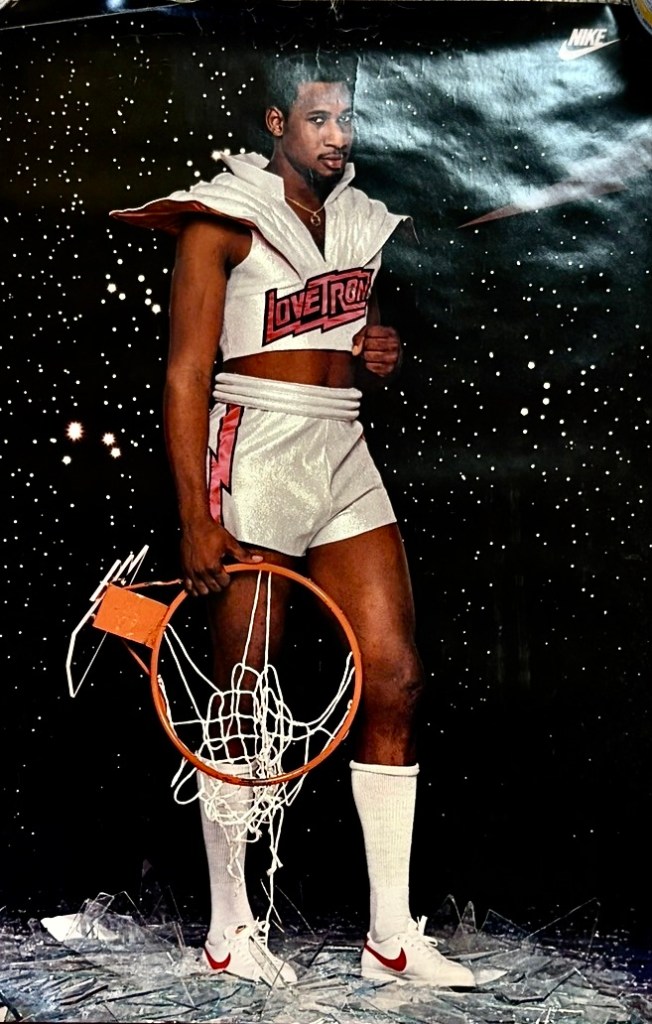
   His nicknames were Sir Slam, Chocolate Thunder, and Dr. Dunkenstein. He wore a LoveTron t-shirt while warming up. He told the Cleveland sportswriters he was an alien from the planet LoveTron, where he spent the off-season practicing “interplanetary funkmanship” with his girlfriend Juicy Lucy. The sports reporters scribbled it down like it was manna from Heaven.

   His coach asked him to tone it down. “All the talk and bravado, enough,” Billy Cunningham said. The next day at practice Daryl told his teammates, “I’m not talking today. Coach made me Thunder Down Under.” It didn’t last long. He went back to talking more than ever the next day.

   Daryl Dawkins was in his mid-20s, six foot eleven, and 260 pounds of beef, brawn, and swagger. The Cavalier centers were Kim Hughes and Bill Lambeer, both six eleven, but both slower than Daryl, who wore gold chains during games. One of them featured a cross while another one proclaimed Sir Slam in gold script. Sometimes, he would shave his head and oil it, along with wearing a pirate’s earring. 

   The year before he had averaged almost fifteen points and nine rebounds, helping the 76ers to the NBA Finals, which they lost in six games to the Los Angeles Lakers. I watched him go coast to coast against a back-pedaling Bill Lambeer one night. If it had been the other Cavalier center, Kim Hughes, about forty pounds lighter than Daryl, he wouldn’t have even bothered back-pedaling. He would have gotten out of the way. Bill Lambeer was more stubborn. All the way to the inevitable slam dunk Daryl’s gold chains swung one way and the other way slapping at Bill’s face until he finally ducked and covered. He wasn’t that stubborn. The next year the NBA forbade the wearing of any jewelry while playing ball.

   The last three games I saw at the Richfield Coliseum were the last three games of the season. The Cavaliers lost by 26 to the Bucks, by 21 to the 76ers, and by 35 to the Bullets. It had been a long year. The opening game of the next season boded another long year when the wine and gold lost to the 76ers by 24. But before that game was even played, I didn’t have a media pass anymore and wasn’t planning on going back to the Richfield Coliseum anytime soon. I didn’t have a dependable car and God forbid I break down in the cow pastures of Summit County in the middle of the night.

   I missed going out there, missed the lights and noise, groaning and cheering, being on the floor, the action and excitement, the coaches fuming and cursing, and the players putting up with unruly fans sitting behind them. Daryl Dawkins wasn’t big on putting up with anything. When he flaked on a dunk one night, hearing the catcalls, he kicked somebody’s extra-large Coke off the floor, sticky sugar water spraying on everybody in their top dollar front row seats. He didn’t look back and didn’t apologize. 

   After the Cleveland Cavaliers returned to Cleveland to the new Gund Arena the Palace on the Prairie closed and the parking lot bloomed with weeds and memories. I walked to games on Ontario Ave. a couple of times, but the atmosphere was more corporate than cutthroat and I didn’t go back. They were charging corporate prices for the tickets and I wasn’t about to bust the bank to cheer grown men in shorts bouncing a ball from one end of a hardwood floor to the other end. Besides, the last time I checked on Daryl Dawkins, he was playing for the Harlem Globetrotters. That was where the fun and games had gone.

Ed Staskus posts feature stories on 147 Stanley Street http://www.147stanleystreet.com and Cleveland Daybook http://www.clevelandohiodaybook.com.. To get the site’s monthly feature in your in-box click on “Follow.”

Poor Little Retard Kid

By Ed Staskus

   After Maggie Campbell was born family vacations became a sore point. “I have to drag those two around?” her mother Alma complained, pointing to Maggie and her older sister Elaine. Fred her husband took a slurp of his Manhattan. The day Bonnie and Brad came on board vacations came to a dead stop, except for once. When Elaine had been the one and only, she went all the time, mostly to Florida to see their grandparents, where she would ride fan boats and go fishing, and all her other fun stuff.

   Maggie screwed up the scheme of things, but still had her summer fun. When Bonnie and Brad rounded out the family her mother blew her top. “Too many kids,” she complained after they were born. “I never wanted you kids. You are all your father’s idea,” Alma told them their entire lives. She meant the children were a bad idea since they were her husband’s handiwork. “Why are you even here? You’ve ruined my life!”

   Her mom never wanted any of them, so she was sullen whenever one of them was in the house. Anytime one or the other of them walked into a room where she was kicking back she got irate that they wanted something. Whenever all of them walked in all at once she hit the roof, exasperated. 

   “It’s a good thing she doesn’t have a gas chamber in the basement,” Maggie told her brother and sisters. She didn’t know gas chambers were frowned on in Bay Village, Ohio. Even so, knowing wouldn’t have helped.

   Later, when they got older, Elaine was ostracized from the family, and Bonnie cut herself off. Elaine locked herself in her room and never came out. Bonnie was always fuming if she was within a mile of the house. 

   Whenever Brad made his parents mad, Maggie would jump in and take his punishment. She couldn’t stand to see him get it. None of them wanted to get hit. But the sisters were always throwing each other under the bus. “The bad part is your sisters then grow up hating you.” That’s how there was the mess between them and Maggie, a mess that wouldn’t go away. She wasn’t saying there weren’t good times, but it was tough sledding.

   The one and only all in the family vacation they went on her whole life was to Disneyland. Her mom was sullen about it, complaining that it was like corralling cats. One morning Maggie was with her. They were out searching for breakfast. No one knew where Elaine was. She had just walked off by herself. Bonnie took Brad with her, and their dad went to find tickets to see the Country Bears Jamboree.

  That’s the only reason he had agreed to go to Disneyland to begin with. He was a stockbroker and vice-president at Prudential Bache in downtown Cleveland where moneybags went every day but loved the Country Bears and couldn’t get enough of them. He laughed ear-splittingly at the mention of them.

   When her mom and she finally got trays of breakfast for everybody they couldn’t find anybody, so they sat down on a curb. A minute later, sitting on the curb, looking up, they saw Bonnie and Brad go slowly past, leaning back in a horse-drawn carriage, waving at them like movie stars

   Alma and Maggie looked at each other. Where were the rest of the lost and found? Their food was getting cold.

   They saw the Bear Jamboree later, and the next day Maggie spotted Donny Osmond riding the same monorail with them out of their hotel. Her sisters loved Donny Osmond but wouldn’t go up to him. They were scared skittish. Maggie was gun-shy, too, but her dad pushed her in Donny’s direction, anyway.

   “Go get his autograph,” Fred said.

   “No, no, no,” she said.

   Fred pushed her forward. She got a push in the small of the back running start, and the next thing she knew was standing in front of Donny Osmond. Maggie was just flabbergasted. She had seen him on TV and now she was standing less than a foot from him. She stammered and bumbled fumbled with her hands. She got his autograph, although she didn’t know how. Maybe he felt bad because he thought she was special needs.  

   “Poor little retard kid,” he probably thought and gave her his autograph. He could be cavalier, unless they were lookers, when he got even more cavalier. When the wheels of the monorail stopped, Maggie ran off the car as fast as she could. One of her shoes went flying. Donny Osmond ducked. It hit Micky Mouse who was behind him. Mickey gave Donny a dirty look.

   “Why would you do that to me?” she asked her dad. “Why me?”

   After the vacations stopped Maggie went to Bay Village High School. She was a lifeguard at the Bay Pool and a Bay Rockette on the kick line for two years. She had many friends growing up, but hardly ever had them over to her house. She went to their houses. She was always leery of having them over because she never knew if her dad would out of the blue lose his temper or her mom would out of the blue start something disastrous.

   If anybody liked something Alma was always going to find a way to not like it. After Maggie moved away, her sister Elaine, who had long since moved away, wanted a family heirloom their mom had, a bench that had been in their great grandparent’s house, but Alma wouldn’t let her take it.

   Her parents had the bench in their split-level family house in Bay Village, at the end of their bed, but when Fred passed away and Alma re-married in the blink of an eye, marrying her old high school sweetheart from Jersey Shore, and moving to a new house in North Ridgeville, she put it away in her garage.

   Elaine wanted the bench bad. Maggie told her mom over and over that she wanted it, but Alma said, “No, she can’t have it, and that’s final.” It was like talking to a blockhead of wood.

   “What are you doing with it?” Maggie asked. She knew the answer, which was nothing, but wanted to hear Alma say it. “No, no, no,” was all she said. It was because she knew Elaine wanted it that she wouldn’t give it to her. That’s the way Alma was. If someone loved something, then she hated it. She had always been like that. Their dad could be cool sometimes, at least. Maggie knew, even though he beat the tar out of them, that he cared about them. But, their mom, not so much, if at all.

   Maggie had a Rockette party at their house before her senior year, at the tail end of August. The party came out of left field. They were at practice and their coach said the first football game was coming up soon. It was on September such-and-such, but they didn’t have a place scheduled for their potluck, yet.

   “We can have it at our house,” Maggie blurted out. Just like that, thirty high school girls were going to be coming over to their house. She called her dad at work. He sounded happy to hear from her.

   “Hey, dad,” she said. “I just invited all my friends over for a potluck.”

   “Sweet,” Fred said. “We’ll make it work.” Maggie was amazed and hung up before he could say anything else. She didn’t say anything about the potluck party to her mom. It would have been like poking a hornet’s nest with a stick.

   Her dad came home early from work the day of the party, brought all the hot dogs hamburgers buns and pickles, and enjoyed having her friends in the backyard. He was all over the place with his camera and took a ton of pictures. It was a good time. Her mom stayed in the house and never came out. Fred loved it, but Alma was angry and sulking that her daughter had all her friends over.

   Maggie loved being a Rockette. She was one of the in crowd during her sophomore and junior years in high school until the night not long after the party when she tore her hamstring in three places. It was an act of God, but a misadventure that was going to take three or four months to mend. She had to give up being a Rockette her last year of high school because of her leg.

   It was terrible, like she had lost something special, something she could never get back.

Ed Staskus posts stories on 147 Stanley Street http://www.147stanleystreet.com and Cleveland Daybook http://www.clevelandohiodaybook.com. To get the site’s monthly feature in your in-box click on “Follow.”
The 4th OM

By Ed Staskus

   The brightest OM I ever heard was the one Kristen Zarzycki began and ended her ‘Follow the Yogi’ at Inner Bliss on Sunday afternoons, joined by many if not everybody in what was the biggest and most popular class of the week. It didn’t hurt that the class only cost $5.00 when most classes started at ten bucks and up. Kristen was a young teacher with a voice like the Queen Mary steaming into port through a fog. The first time I heard her I realized what the talk about the sound of OM being a classic vibration was all about. I could feel the buzz in the room, and I wasn’t even making a sound.

   I began thinking about yoga in my fifties when arthritis had gotten so my bad hip either hurt all the time or really hurt all the time. At first, I tried it at home, checking out videotapes about one style and another, checking the tapes out from our local library. I even bought a mat. After a year I felt stalemated, as though I had no idea what I knew. I was aware of studios and thought professional instruction was a good idea. But I was reluctant to go because of my impression classes were chock-full of lissome women who could do the impossible and the certainty I would be the oaf in the corner.

   One afternoon towards the end of summer, lounging around our company’s lunchroom, waiting for our marketing director Maria Kellem to free up the stove, yoga somehow came up as we talked. I was surprised to find out she not only practiced, but taught yoga part-time, as well. For the next several months she never tired of leaning into my cubicle and encouraging me to take a class.

  I finally did, partly to appease her, partly because I didn’t see any other way to learn more, but mostly just to do it, at least once. From the end of my first class on a Saturday morning, slapping my hand to my temple in the car as I drove away, surprised it had taken me so long, I was attracted to the practice, simply because I felt surprisingly good afterwards.

   The first two years I went at it was at a once-a-week beginner’s class, to which I eventually added a second class. Although my focus was on the physical postures, I noticed our classes often began with a homily and a chant, usually OM. Preferring my own postmodern skepticism, I ignored the spiritual advice. I was drawn to the chanting, but when I opened my mouth, which wasn’t often, it was with a small voice from the back of the room.

   After another year of moderate flow under my belt, I started taking more physically challenging classes, time-distorting vinyasa practices with unnerving names like ‘Hot Power Yoga Challenge’. One evening near the end of an especially hard class, after our teacher reminded us yet again to breathe with mindfulness, I asked her if it was the same as breathing desperately.

   She gave me a dirty look but was kind enough to say it was.

   I began to buy into the spirit of yoga, reading about its principles and way of life, and listening to our teachers with a newfound openness. I took a workshop about meditation and another about the chakras – to which I reacted with both incredulity and admiration for the teacher who tried with all her might to explain the fantastic and unexplainable. I was even chanting OM more often, but still with a small voice.

   When I began to OM with more than less frankness it was at the end of the first class that Kimberly Payne taught at Inner Bliss, the yoga studio in Rocky River, Ohio, where I had started and where I still practiced. By then I was emboldened by what I knew, which later turned out to be less than I thought, into trying new kinds of classes, like Kundalini, and diverse teachers. Kim Payne’s inaugural class, a different kind of powerful flow, turned out to be more than I bargained for.

   On the way to the studio that evening, storm clouds darkened my rearview mirror as I crossed the beam bridge over the Rocky River valley. A red-orange light from the setting sun over the lake slanted between the houses across the street onto the asphalt parking lot as I walked to the two-story loft-style brick building. The studio was on the second floor. There wasn’t much to it other than lots of empty space. Inside, I unrolled my mat, facing across the wide room towards the dusk. As we started our practice, I was quickly thrown off balance by the unfamiliar sequence and difficulty of the exercises. Then the noise started.

   First one and then another double-stacked freight train rumbled past on the CSX tracks on the abutment behind the building east towards Cleveland. At both public grade crossings, one block to the west and four blocks the other way, the diesel’s compressed air horns let loose blasts of 15-second warnings.

   When the trains were come and gone two men working late at Mason’s Auto Body next door started cutting sheet metal with what sounded like a Godzilla-style Sawzall, a high-pitched gnashing pouring in through the closed windows as though they weren’t closed at all. No sooner had they finished than the hard wind rain deluge started, a gusting thunderstorm that lasted through a long series of unsettling balancing poses and to the end of class.

   Coming out of corpse pose I suddenly noticed the studio was quiet, our windows no longer lashed by rain. We sat cross-legged in the dark, and chanted three long, slow OMs, the poses all done and the noise, too, and the only thing mattering just then and there being the chant. Our voices echoed in the soupy air when we finished. It was the first time I did OM with any sincerity.

   The loudest OM I ever heard was the one Kristen Zarzycki’s class chanted for her the Sunday before she ran her first marathon, in Chicago, in what turned out to be the unlikely tropics of Lake Michigan.

   Kristen described her flow classes as “funky and challenging.” Challenging they were, so much so I nicknamed her Kirby, after Jack Kirby, the Marvel Comics artist who created Sgt. Fury, the snarling but tenderhearted NCO who led the First Attack Squad known as the “Howling Commandos” in the short-lived 1960s comic book series. Although a head shorter and smaller by far than the cigar-chomping Sgt. Fury, she morphed into him as she led her classes centering on core poses, for what she insisted was our own good, and watched over us as we tried to survive her ruthless boot camp approach.

   At the end of her classes Kristen always invited everybody to a “big and huge” OM to seal the deal. That Sunday afternoon somebody impulsively interrupted and said, “Let’s chant for Kristen running the marathon next week.” So prompted the whole class did. The OM was loud and long and heartfelt. The chant was so long I almost ran out of breath. Kristen was flushed with emotion when we were finally done.

   The next Sunday she ran in record-setting heat and smothering humidity. More than ten thousand of the thirty-five thousand participants dropped out, hundreds more were treated by medical teams, and the organizers tried to shut the event down twenty miles into it. Kristen was one of the runners who finished, and sometimes I think what kept her safe and sound was the OM we chanted for her.

   The car repair OM happened on a mid-summer evening as we sat cross-legged at Inner Bliss, palms together, thumbs at the heart center, at the tail end of Tammy Lyons’s hot flow class. The casement windows overlooking the flat roof and cords of seasoned firewood stacked against the outside wall of Mason’s Auto Body were tilted open, and I could sense a breeze. We chanted OM once, breathed in, and chanted OM a second time.

   “There they go again,” said a body shop man unseen below us, taking a break at the umbrella table between our two buildings, more than loud enough to be heard throughout the studio.

   “Whatever floats your boat,” a second man said, louder.

   Tammy Lyons paused and paused again. She had the patience of a mother of two small boys and the forbearance of a small-business owner, namely the yoga studio. When she paused, I waited for the response. I reckoned it was inevitable, human nature being what it is. We chanted OM a third time. When the class over she thanked us for coming, told us it was privilege to share her practice with us, and updated everybody on the studio’s schedule.

  Then she said in a clear firm voice more than clear firm loud enough to be heard outside, “Yes, it does float our boats.”

   Later that night, nursing a can of cold PBR in my backyard, I thought about the sarcastic guys at Mason’s. They weren’t really all that different from Tammy Lyons, although maybe they thought they were. Just like she worked on our bodies by leading us in yoga sequences, they worked on the bodies of automobiles.

   Motor city and human bodies are not only in and of themselves, but they are carry-all’s, as well. Practicing yoga exercises is like taking care of your body in the same way a skilled mechanic will take care of your car, both with the same idea in mind, so our bodies and our cars will be better able to take us where we want to go, whether it’s a yoga studio or the corner bar. But, if the body shop men were different, maybe it was because they didn’t know where they were going.

   The 4th OM unfolded on a Sunday afternoon when Max Strom, an itinerant yoga teacher, came to Inner Bliss. Neither the workshop nor he were what I expected, even though I couldn’t have said what I expected. Dressed all in black with a grayish ponytail and a gregarious manner, Max was built more like a football player than a tightrope walker. Other than a few warm-up exercises and moving around now-and-then, we sat on our mats, and he devoted most of the sold-out two-hour workshop to breathing, both explaining his ideas about it and leading us in elements of it.

   He seemed to think yoga exercises alone were inadequate as a way of making a spiritual connection, which he defined as the goal of yoga. He thought yoga work outs could and did serve a purpose, but to arrive at some meaning beyond simple exercise the next step was to connect with one’s breath.

   He said the practice seemed to be mostly physical, but that it wasn’t. Rather, it was a practice meant to harmonize the body and mind. The mind was our inner body, which he formulated as mental focus and intention, and breath, which he further defined as emotional focus and concentration on spirit.

   We did a slew of breathing exercises, breathing fast, and breathing slow, holding our inhales and then our exhales, alternate nostril breathing, bellows breath and breath of fire, and long slow breathing until I ran out of breath. Max instructed us to breathe into the heart center, to breathe in the present and breathe out the past.

  After a break, when we were all back on our mats, he unfurled a 10-minute OM. He explained we were to all start together, but as we finished our own personal OM to go on to the next one, not waiting for the others in class. He said in a minute or so we would all be intoning separately, but it would in the long run resolve itself into a single continuous chant, which is exactly what happened. It turned into a long rolling OM with no beginning and no end.

   As we chanted, I found myself subsumed by the sound, and then midway through the chanting I suddenly had a distinct feeling of emptiness, from the sacrum to the collarbone. It wasn’t that I felt any kind of hunger or was filled with yearning. I just felt empty. As we chanted it seemed like I was hollow shell lit up from within by a bright diffuse light.

   I was conscious that my heart was beating slowly steady, and I was breathing rhythmically, and that the quiet, bright emptiness was only a feeling, but for all that it was a remarkable sensation. I didn’t feel better, or worse, I just felt light and lit up. It was an experience that lasted about a minute.

   Max’s message at the end of class was to breathe with intention, and he sent us on our way with a goodbye namaste and ringing endorsement for his new DVD being sold in the lobby.

   Since then, I have never again felt the same bright emptiness I did during his workshop, but as a result added some breath training and meditation to my increasingly stay at home practice. What surprised me in the long run is the patience it takes to learn to sit quietly, not thinking of anything something nothing, and breathing mindfully.

   There is no blowing the man down with OM. It is more like the hum of a big block V6 savoring its high octane, cruising down a newly asphalted country road, a ragtop on a bright summer day with no deadline on the bench seat. It is the glow of all in your head old-school energy.

Ed Staskus posts stories on 147 Stanley Street http://www.147stanleystreet.com and Cleveland Daybook http://www.clevelandohiodaybook.com. To get the site’s monthly feature in your in-box click on “Follow.”

Jesus and Mary Chain

By Ed Staskus

   Maggie Campbell and Steve de Luca’s good-hearted neighbors lived on the driveway side of them. They were elderly sisters. A woman who was mean-spirited lived on the other side of them. She was somebody who didn’t know how to laugh at herself. A Transylvanian man and his wife lived behind them, their backyards butting together. They were friendly and loved their dogs.

   Mariam and Josephine lived together in the two-story brick bungalow next door on the east end of West Park for more than sixty years. Neither of them ever married. Josephine cooked pigs in a blanket, brought them to the fence, and fed them to Maggie and Steve’s dogs every day. They hardly ever saw Mariam since she hardly ever came out of the house.

   After they departed this life Steve fixed up a timer and security light in their living room and mowed their lawn every Saturday. He parked Maggie’s Honda Element in their driveway to make it look like it wasn’t vacant, at least until the house was sold and being lived in. It wasn’t the kind of neighborhood where vacant houses were safe for long. If they stayed empty too long their world was brought down to earth. The angel sky was only so good for so long.

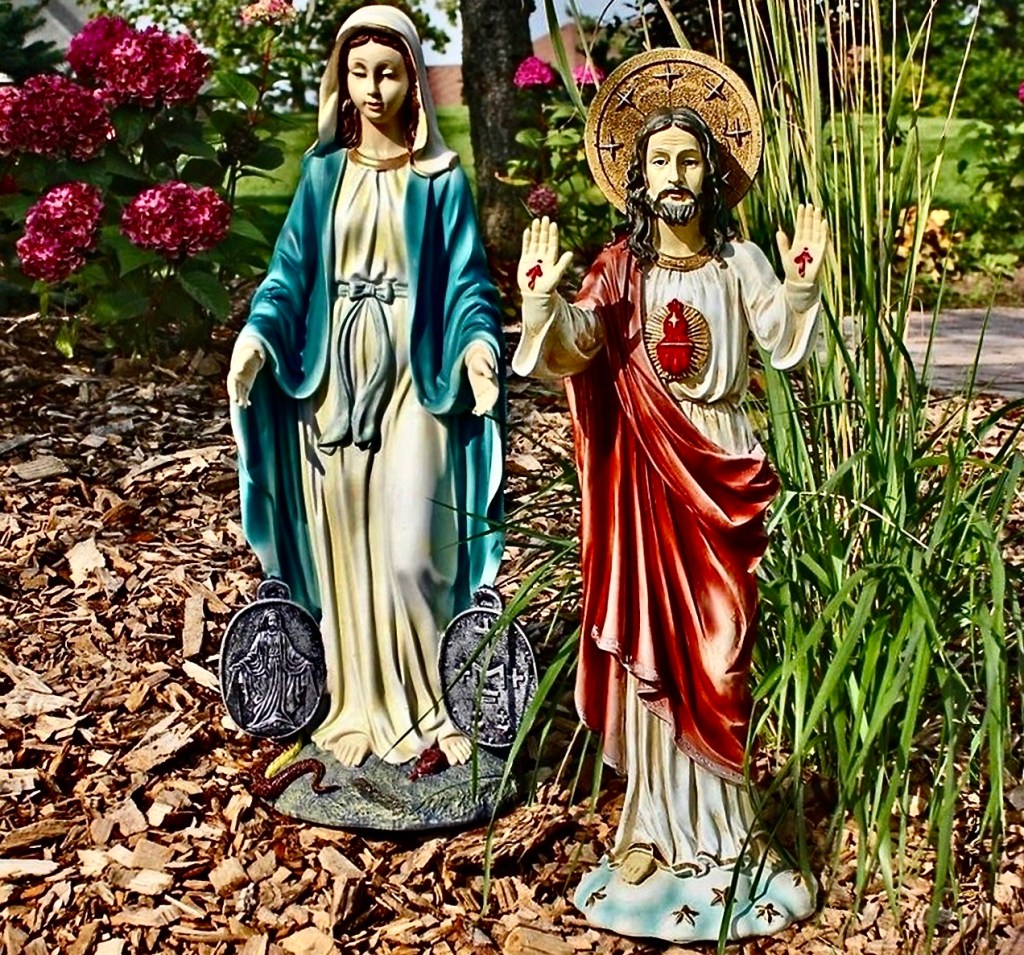
   There were statues of Jesus and Mary in front of a red hydrangea in the front yard of the brick bungalow. They were there for a long time, almost an eternity. There were chains attached to the bases of both statues. The chains were buried beneath mulch and led to a bolt fixed to the side of the house. Mary and Josephine were determined to keep the holy family where they were. They didn’t want them spirited away to a devilish place.

   Dolores lived with her husband Chuck. She was no Mr. Rogers. She was all about a million rainy days. Chuck bought his house before Maggie and Steve bought theirs. He had been a confirmed bachelor until he made a mistake and got married. Before Dolores moved in Chuck was their nice neighbor. She was not so nice, tense and quarrelsome.

   “She’s from New Jersey,” Maggie told Buster their Border Collie. He had memorized and understood hundreds of words. “She started in on us right at the start. Whenever we waved to her, she would never wave back. If she caught Chuck talking to either one of us, he had to pay the price. It got so he had to sneak over to say hello and chat. The things she says to him about us, I don’t even want to imagine.”

   “All my time in hell is spent right here with her,” Chuck said.

   Steve called her Cruella behind her back. After a while many of the neighbors on the street called her the same thing behind her back. The dogs thought the byname was fitting and would have called her that if they could. They growled at her instead.

   Dolores called the dog warden on Maggie and Steve every week-or-so, even when the dogs were sleeping in the heat of the summer. Her complaint was always about the dogs barking. It didn’t matter to her that they hardly ever did. She hated them for her own reasons. What she didn’t know was that the dogs were licensed and the licenses were renewed every year.

   “Here’s the thing, lady,” the dog warden finally told Dolores. “Those dogs are licensed, and everyone’s dogs bark sometimes, so stop barking us up.” She finally got tired of her fun and games and stopped calling the dog warden.

   “Most of the rest of our neighborhood loves it when our dogs are out,” Maggie said to Buster. “It is Dolores who gives us the most trouble. I don’t care if you’re from the bottomless pit, or not. It doesn’t give you the right to be a son of a bitch. But that’s all changed now that she needs me. When she couldn’t afford to have her hair done at the Charles Scott Salon in Rocky River anymore, I became good enough for her.” Maggie was a hairdresser in Lakewood.

   “Chuck doesn’t pay for anything for the kids,” Dolores complained bitterly. She had two children from an earlier marriage. Her ex-husband had killed himself. She never said why. “Everything falls on me. I have to pay for their school.” They went to the West Park Lutheran School, even though Dolores was an atheist. She didn’t have much money of her own anymore. She had blown through her dead husband’s life insurance in Las Vegas. She depended on whatever she could  squeeze out of Chuck.

   Then, when Maggie started doing her hair, knowing that she didn’t have kids herself, it was kids in her chatterbox all the time. “Do you think you could come over and watch them for a few minutes?”

   “No,” Maggie said. “That’s why I don’t have kids of my own. I don’t want to sit yours.” She might have done it to be a good neighbor, but she knew Dolores would have started taking advantage of her, so she put a stop to it right away.

   The old couple behind them bought their house the year Maggie was born. That had been almost fifty years ago. They were straight out of Transylvania, which was a part of Romania. Their English was sketchy. Maggie and Steve couldn’t always understand them, her less than him. His name was Anthony, but they had never been able to make out what her name was. They called her Mrs. Anthony.

   Their big back yard was like a farm. They grew everything they ate, except for animals, in the back yard during the summer. When Maggie and Steve first moved into the neighborhood they already had grandkids, who fed their dogs doggie cookies.

   They would hear the pack of grandkids while sitting on their back porch. “Can we go see the dogs?” they shouted. “Go, go,” their grandpa said.

   The children had become teenagers, but they still came to visit their grandparents. The dogs ran to the back fence and lined up, waiting. “You can’t stop filling the feedbag now. You have to keep giving them cookies,” Maggie told the teenagers.

    Steve walked their dogs every day. He stopped and talked to their neighbors. They asked him about their dogs, some of whom came and went, so a lot of them found out they rescued the animals, finding them better homes. That’s how they came to be called the Dog People. One day a distraught woman was walking up and down the street looking for her lost Dachshund.

   “Try the Dog People,” somebody suggested.

   “Have you seen my dog?” she asked Maggie.

   “No, but I’ll keep an eye out for the wiener,” Maggie said.

   Sometimes neighbors donated dog food to them. They found forty pound bags of it left on their front porch. It was nice to have a little community support.

   They started taking their canines to the Lakewood Dog Park in the Metropark instead of walking them in the neighborhood because Rudy their Husky was a screamer. The second they put a leash on him the wailing started. It sounded like somebody was ripping out his toenails. Neighbors came out to make sure they weren’t torturing their dogs. Explaining got to be so embarrassing that Steve put their walks to a stop. He drove them to the dog park, instead.

   It turned out Rudy hated it there, too. He didn’t like other people or other dogs coming up to him, or even up to Maggie or Steve. One day they thought they would hide from him so he would learn to run around with other dogs. They hid behind a tree. But what happened was unsettling. He ran around like a madman looking for them.

   “Steve, we can’t hide from him,” Maggie said. “He’s never going to relax.”

   When they came out from hiding and he saw them he ran over right away. “He’s back to guarding us again,” Maggie told Steve. “He’s giving us his warm glow.”

   One of their neighbors fell in love with Grayson, their silver Lab, after he sniffed out who had bolt cut and stolen the Jesus and Mary statues. When Steve retrieved them he set them in cement so it wouldn’t happen again. Grayson had a great nose and was a cutie patootie, too. Their neighbor did everything she could to get them to give Grayson to her.

   “He’s not for sale,” Maggie said. “He’s my dog.”

   “But I love him.”

   “We love him, too,” Maggie said.

   One morning they took Grayson to Project Runway on Whiskey Island to a fundraiser for dog shelters. From there, later in the afternoon, they did Doggies on the Patio, another fundraiser. Afterwards they took him out for gelato. He loved it, the whole day, and the gelato, too. Maggie could not sell him. She couldn’t see that ever happening. It didn’t matter that he had a gluttonous food drive and was always sneaking upstairs to sleep on their bed, which was against the rules

   Besides, Grayson was their early warning system, barking up a storm whenever Dolores came within smelling distance. He knew bad news when he smelled the newsprint. As soon as she was in range the Lab got going on the firing range. He could analyze people’s intentions immediately. He never said a prayer or spit out a curse beforehand, knowing he would get it done without any help from Jesus and Mary. Dolores always went the other way when Grayson raised the roof. She had heard many dogs were all bark and no bite, but she wasn’t taking any chances. 

   “Barking dogs never lie” is what Maggie said.

Ed Staskus posts stories on 147 Stanley Street http://www.147stanleystreet.com and Cleveland Daybook http://www.clevelandohiodaybook.com. To get the site’s monthly feature in your in-box click on “Follow.”

More short stories can be found at Ed Staskus/WordPress. His books are available on Amazon and Apple Books.

“Bomb City”

It is 1975 in Cleveland, OhioThe John Scalish Crime Family and Danny Greene’s Irish Mob are at war. Car bombs are the weapon of choice. Two police detectives are assigned to find the bomb makers. It gets personal. Revenge is always personal.

Thrills and Spills

By Ed Staskus

   Two days after we got married in the Lithuanian Roman Catholic church on Cleveland’s east side my wife and I drove over the Rainbow Bridge to the Canadian side of Niagara Falls. It used to be called the Honeymoon Bridge, but it collapsed in 1938. When the new one opened in 1941 a quote from the Book of Genesis about a “bow in the clouds” was engraved on the side of the bridge. A half century later the span was still standing, God willing.

   We must have looked happy as larks when we got to the other side of the crossing. After paying the toll, and showing the border patrol our driver’s licenses, we were told to join a line of cars off to the side. Ten minutes later German Shepherds and their handlers showed up, sniffing the cars up and down for drugs. One of the uniforms used a tactical mirror to inspect the underside of the cars. 

   When it was over and done with and they told us we were free to go, I said, “Love is the drug, man.” The lawman at my driver’s side window didn’t like it and scowled but Rin Tin Tin gave me a forty-two-tooth salute. He was glad to be going back to headquarters for grub. We were steps from the Honeymoon Capital of the World.

   After lunch we went to Goat Island, bought tickets, got outfitted in bright yellow ponchos, and were elevatored 18 stories down to the Niagara Gorge. The Cave of the Winds started life as a rock overhang that was like a cave. There used to be an overhanging ledge of Lockport Dolostone at the top of the gorge which stuck out more than 100 feet. The overhang wasn’t there anymore but the Hurricane Deck was. We followed a guide on a series of wood walkways to it, stopping standing staring at the thundering water 20 feet away. It sprayed us in the face. There was a rainbow right there. We could almost touch it.

   “Did you bring a camera?” my wife asked.

   “No,” I said.

   “That’s all right, better to remember it the way we want to,” she said.

   Since we were soggy already, we decided to go to the Journey Behind the Falls. An elevator went down 13 stories through bedrock to tunnels that led to the Cataract Portal and the Great Falls Portal. We walked to the Lower Observation Deck at the foot of the Falls and watched one-fifth of the world’s freshwater crash down at 40 MPH into the basin below. We left dripping freshwater behind us.

   There was still some daylight left in the day, and waterlogged as we were with nothing to lose, we boarded the Maid of the Mist. The first boat in 1846 was called Maid of the Mist and the name had never changed although the ships had. The first ones were steam powered. Ours was a diesel-powered vessel put into service in 1955. It was two years after Marilyn Monroe cuckolded and tried to murder her husband Joseph Cotton in the movie “Niagara.”

   The first Maid of the Mist was a barge-like steamer that was more ferry than anything else. It was a 72-foot-long side-wheeler powered by a wood-and coal-fired boiler. The ferrying only lasted two years, when a suspension bridge opened. Not knowing what to do with the boat, the owners finally decided to make it a sightseeing wheeler.

   We took the Incline Railway from street level down to the boat dock. The new Maid was looking good, having replaced the old Maid in 1983. The old boat was plying the Amazon River as a missionary ship under an assumed name. She had been a trooper in her day. In 1960 the Maid wheeled to the starboard and the crew rescued Roger Woodward, a seven-year-old who became the first person to survive going over the Horseshoe Falls wearing only a life jacket. Getting on the boat we were both handed blue ponchos and advised to wear them, or else.

   “Or else what?” I asked. 

   “You’re free to not wear it and soak in the experience,” the man said. We put our ponchos on and cinched the hoods.

   The boat chugged to the base of the American Falls. It started to rock and roll. We kept our balance hanging on to a rail. I never knew water droplets could pummel or that half a million gallons of water pouring out of the faucet at once could be so loud. The Maid went on to the basin of the Canadian Horseshoe Falls. We stood at the front of the boat on the upper level up close and personal. The captain took her closer and closer. We got as close as it gets. The waterfall was in our faces. We could barely keep our eyes open. It might as well have been raining, even though the sky was sunny and blue. When the boat turned to go back, she spun around in place, spray coming at us from every direction.

   There was a full moon that night. “When the moon hits your eye like a big pizza pie, that’s amore.” We had fun fooling around that night.

   The next day we went high and dry. We were done with getting wet and took a helicopter ride. The chopper was an Enstrom, operated by Pan-Air. They had a “Chapel in the Sky” service although since we were freshly minted, there was no need for more vows. The helicopter sat six, but my wife and I and two Japanese men were the only ones on the flight. We sat in the front with the pilot and the Japs sat in back, where they took a million pictures. The front of the chopper was plexiglass. When I looked down the sky was right under our feet. Rainbows shot up at us from the rapids and falls.

   The ride was only ten or fifteen minutes long, but we got an eyeful. The bird’s-eyeview was nothing if not breath-taking. We saw the American Falls, Bridal Veil Falls, Horseshoe Falls, Whirlpool Rapids, the Rainbow Bridge, and Queen Victoria Park.

   “Ooh-wee,” we both said when the helicopter landed. We got our land legs back and went back to the Howard Johnson’s for a nap and dinner. The Japs stayed behind taking pictures of the chopper.

   The next day we left Niagara Falls, messed around in Toronto, and drove to Ottawa in our VW Golf. The city is the capital of Canada, on the south bank of the Ottawa River, straddling the provinces of Ontario and Quebec. Brian Mulroney was the Prime Minister. He kept order by saying things like, “I am not denying anything I did not say.” The city had been there since 1826 and by 1989 was the fourth-largest one in the country. A big part of it burned down in 1900 and had to be re-built for the better. We stayed at a small motel near Pig Island. The drive to Byward Market and Lower Town was a short one up Colonel By Dr. along the Rideau Canal. We discovered a Portuguese bakery in Lower Town and pigged out.

   We visited the Notre-Dame Cathedral Basilica, Parliament Hill, which is the neo-Gothic home of the law of the land, checked out the Centennial Flame and the statue of Queen Victoria, took a stroll through Major’s Hill Park, and had dinner two nights back-to-back at two terrific restaurants near Confederation Park, walking the food and drink off afterwards, and tossing a Loonie in the fountain, the one-dollar coin introduced two years earlier.

   One afternoon we were standing on the Mackenzie King Bridge watching boats going to and from the locks when we noticed a houseboat coming our way. The canal was built starting in 1826. More than a thousand Irish, Scottish, and French laborers died of malaria digging it out. It opened in 1832. The idea behind the canal was a lifeline between Montreal and the naval base at Kingston in case Canada ever went to war with the United States. 

   The Pumper was the first steamboat to make the trip, carrying Colonel By and his family. John By was the man who made the canal happen. Canada and the United States never went to war and the canal became a thoroughfare for shipping grain, timber, and minerals from the hinterland to the east. Immigrants used it moving westward. After railroads appropriated the shipping trade, the canal was mostly used by pleasure craft.

   It was a pleasure watching the houseboat approach. A man was sitting in a folding chair at the bow. His legs were crossed, he was reading a newspaper, and smoking a cigar. A woman was standing at the stern with a long pole. She was slowly leaning into the pole and pushing the forty-foot flat bottomed houseboat forward. She kept her push pole lined up with the center line of the boat to keep it moving in a straight line. I could see they had an inboard motor but weren’t using it. Smoke from her husband’s cigar drifted back to her. She waved it away from her face.

   “Take notes,” I told my new bride. 

   “That’ll be the day,” she grumbled.

   After we got home from our honeymoon, we often went back to Canada, to Montreal and Quebec City, up the St Lawrence River, and to Nova Scotia and Prince Edward Island. We never went back to Ottawa, not for any especial reason. One morning while I was looking out our living room window at yet another winter storm blowing through town, my wife asked me if I had seen the news about the protests in Ottawa. I flipped an iPad open and read the news. Sure enough, protests were roiling the capital.

   A convoy of truckers had descended on the city three weeks earlier protesting a regulation requiring drivers moving goods across the USA Canada border to be vaccinated against the 19 virus. Other truckers were blocking bridges between Windsor and Detroit and another bridge linking Alberta to North Dakota. The federal police had already arrested more than a dozen drivers out west and seized all their guns and ammo. They had been planning on ambushing and shooting law enforcement officers.

   When the Ottawa camel train pulled into town to throw gasoline on the fire they rumbled straight to Wellington St. and Parliament Hill and surrounded it. Their $100,000 travel trailers, $150,000 recreational vehicles, and $200,000 heavy trucks brought traffic to a standstill. Businesses shut down for the duration. There wasn’t any money coming in, anyway. Flatbed trucks became stages. Organizers clapped themselves on the back and made misinformation speeches. DJ’s spun rap cranked up so everybody within miles could hear it. Bouncy castles were plopped down in the streets for kids playing hooky. Some drivers had brought their children with them. An inflatable hot tub was pumped up and set up for rest and recreation. They flew QAnon and Confederate flags, even though QAnon is a Whac-A-Mole, and Johnny Reb got his ass kicked a long time ago.

   Who flies slaveholder-or-die flags to prove how virtuous they are? Folks who want a slave of their own? Folks who live in caves? Folks who are far over the full moon? 

   Drivers put their air horns on autopilot 24/7. It didn’t take long for everybody living nearby to get sick of it. “You got vehicles laying on their horns for hours and hours at a time,” said Peter Simpson. “We don’t even live on Parliament Hill. It’s very difficult to work or relax or to do anything. All you can do is focus on calming yourself down.”

   The morning I read about the protests was the morning things were coming to a head. The police sat on their hands for weeks until the mayor got tired of it, fired the police chief, put a by the book man in charge, and a few days later the cops were showing up in force. “It’s horrific,” said Dagny Pawlak, a protestor spokeswoman. “It’s a dark moment in Canadian history. Never in my life would I have believed anyone if they told me that our own Prime Minister would refuse dialogue and choose violence against peaceful protesters instead.”

   “Look, I am a big, brassy guy who won and won big,” is what Brian Mulroney always said. “I do what I want.” But he wasn’t the Prime Minister anymore. Justin Trudeau was the man upstairs. He said the truckers were “an insult to memory and truth.” He did what he had to do.

   When I was student at Cleveland State University in the 1970s we went marching from our campus down Euclid Ave. to Public Square every spring to protest the Vietnam War. We never marched in wintertime because it was too cold and snowy. Nobody wanted to be plowed under by a snowplow. We wore buttons saying, “How Many More?” and “I’m a Viet Nam Dropout” and “Ship the GI’s Home Now!”  Many of the GI’s shooting it out with Charlie were true believers who volunteered. The rest were unlucky trailer trash. They were the ones who were always getting drafted first. We were college students with draft deferments and wanted to keep it that way.

   We carried banners and damp handkerchiefs in our pockets. Everybody wore sensible shoes. One springtime I noticed two coeds next to me wearing pumps with two-inch heels and straps that looked like they would snap at the slightest provocation.

   “You might want to change into flats,” I said. 

   “Why would we want to do that?” one of them asked.

   “In case you’ve got to run.” They giggled and skipped away. The last time I saw them they were skinning their knees trying to run and getting themselves easily arrested.

    When we got to the Sailors and Soldiers Monument, firebrands made fiery speeches, we chanted slogans, listened to more speeches about justice and freedom, half of us high on weed, and waited for the cops to show up. When they did and ordered us to disperse and we didn’t, they lobbed tear gas at us. We gave them the finger. They beat us with rubber batons. We threw cherry bombs at them. They sent in the mounted police. Nobody wanted to be trampled by a horse. We usually ran for the train station in the Terminal Tower trying to lose ourselves in the workaday crowd.

   I never went on a Civil Rights march. They had it worse. Vigilantes and police used whips, Billy clubs, guns, dogs, Cossack-style horses, fire hoses, and tear gas. When we were protesting the Vietnam War, we were white kids being corralled by white policemen. They didn’t like us but weren’t trying to kill us. 

    The Freedom Convoy in Ottawa had plenty of banners and slogans. Reading them was like trying to find meaning in a bowl of alphabet soup. Mandate Freedom 4 All. He Will Not Divide. Hold the Line. Take Back Our Freedom. We Will Not Acquiesce. Were they trying to dam up Niagara Falls with toothpicks? One of the signs said they were willing to take a bullet for their country. What about taking a shot for your neighbors?

   Matthew Wall, an electrician from Manitoba, joined the Freedom Convoy after popping psychedelics and having a vision. “I’m here for the rights of our kids, for parents’ rights, for everyone’s rights,” he said. “It is so kids can live in a future where they don’t have to have something covering their face. You don’t have the human connection, don’t see them smile anymore. It’s dehumanizing. They’re taking away the love!”

   Many of Ottawa’s residents had their own slogan: Make Ottawa Boring Again!

   “I wonder what would be going on if it was the 1340s and 1350s?” I wondered aloud to my wife, watching it snow in the meantime.

   “What do you mean?” she asked.

   “I mean, I wonder how long the lines would be to get vaccinated against the Bubonic Plague if it was the plague instead of the 19 virus,” I said.

   Five years into the pandemic at the beginning of the Middle Ages almost 50 million Europeans were dead, more than half of the population. They called it the Great Pestilence. They didn’t have vaccines. They resorted to mixing tree resin, roots of white lilies, and human excrement into a porridge and slathering it all over themselves. If you caught the Black Death, your chances of making it back alive were almost zero. Nobody died peacefully in an ICU. There were no ICU’s. They got crazy feverish, their joints on fire like a ten-alarm. They broke out in buboes, oozing pus and blood, vomiting non-stop, and got diarrhea to die for.. The suffering went on non-stop for a week-or-so. When it was over, they fell down dead in the streets, glad it was over.

   “I bet the spaghetti o’s with their portable spas in Ottawa would be the first ones pushing their way to the head of the vaccination line while crying there is a conspiracy to push them to the back. They would be going 100 MPH in their trucks and RV’s to get somewhere anywhere to snag a shot, not complaining about government overreach.”

   “Maybe you’re right,” she said. “Thank goodness we’re on the other side of the Middle Ages.”

   “Hats off to that, sugar, although now and then when there’s a full moon it’s back to the Dark Ages,” I said.

Ed Staskus posts on 147 Stanley Street http://www.147stanleystreet.com and Made in Cleveland http://www.clevelandohiodaybook.com. To get the site’s monthly feature in your in-box click on “Follow.”

Calling the Corner Pocket

By Ed Staskus

   Joe Tuma’s Billiard Club wasn’t a big place, although it was big enough. There were two snooker tables, two billiards tables, six straight pool tables, a scrappy ping pong table, and half a dozen mismatched beat-up stools at a beat-up front counter. There was an eight ball table in a corner for tourists. Nobody else ever went near it. All the tables were clean as a whistle except for the eight ball table. The floor was swept nightly but never mopped. The front windows were filthy. The bathroom was filthy. There was no bathroom for women. Nobody had ever seen a woman inside Joe Tuma’s anyway, so it didn’t matter.

   The pool hall was on the south side of Euclid Ave. at E. 19th St. on the second floor of a two-story building. Pool halls were usually in basements or on second floors to save on rent. The Morse Graphic Art Supply Co. was on the ground floor. Fine art students came and went. Cleveland State University was two blocks up the street. As many times as I went to Joe Tuma’s was as many times I didn’t go to the art supply store. I wasn’t interested in art.

   Cleveland State University was where I was a freshman, at least until I dropped out instead of getting flunked out. I spent more time at the pool hall than I did attending lectures in the humanities and sciences. My teachers were always asking me who I was and if I was in the right class.

   I wasn’t the only one in the thrall of pool. Ron Mabey graduated from the Cleveland Institute of Art, lost his student deferment, but was still waiting to be drafted. He and a cousin with the same 1-A ticket to Vietnam rented cheap office space in the nearby Corlett Building. They did odd jobs. “We started going to Joe Tuma’s and spent less and less time at the office,” Ron said. “We were killing time waiting for our letters from Uncle Sam. The billiard club was more enjoyable than the 3rd Platoon, D Company, 14th Battalion, 4th Brigade, where I eventually ended up, although by the time I ended up in the army  the war against the pajama’s was over.” The United States military had been killing the NVA and Viet Cong by the score, winning battles up and down Vietnam for more than a decade, until the day it suddenly lost the war.

   Joe Tuma’s called itself a “Billiard Club” and advertised “Bowling and Billiard Supplies” on its front window. I never saw anybody wearing a monogrammed club sweater and never saw supplies of anything except balls, chalk, and cue sticks. There were no bowling supplies of any kind. I never saw Joe Tuma,, either. After a few months I stopped looking for him.  Eventually I came to doubt his existence.

   Warmed over hot dogs and lukewarm beer were both twenty five cents at Joe Tuma’s. The wieners were cooked on a Carnival King rotisserie. The beer was P. O. C. out of a keg packed in not enough ice under the front counter. P. O. C. was Pride of Cleveland brewed by the Pilsener Brewing Company. It had been Cleveland-made ever since Wenzel Medlin from Bohemia founded the brewery in 1892, although it spent several aimless years in Pittsburgh in the 1960s before coming back. When it did it celebrated by giving away limited edition giant P. O. C. bottles. One of the giant beer bottles was behind the counter. It was where the quarters for the next keg went.

   The pool hall didn’t have slot machines, darts, or foosball, staying true to pool, billiards, and  snooker. When my father found out I was playing pool he said it would only lead to gambling, laziness, and philandering. He said it was a “social ill.” I told him I didn’t have any ready money to gamble with, learning to play was elbow grease not laziness, and I didn’t know what philandering meant, even though I did. My mother had just seen the movie “The Music Man” and referred me to the song “Trouble.”

   “You got trouble, folks, right here in River City, trouble with a capital ‘T’ and that rhymes with ‘P’ and that stands for pool.”

   The Cuyahoga River was right around the bend from the pool hall and it was always in trouble. It was always catching fire. My father was an accountant and said it was the price of progress. My mom didn’t say much about it. She was a cashier at a Pick-N-Pay supermarket, racing home to make dinner for my father, brother, and sister after work. By then I had already moved to the beatnik neighborhood on Upper Prospect and heated up my own pork and beans.

   The front door of Joe Tuma’s was at the side of the building and the front stairs were lit by a 40-watt light bulb on its last legs. Inside, most of what lights there were, were situated over the tables. There were no radios and no TV’s. It was always quiet, like a church, except for the clacking sound of balls hitting each other.

   Pool balls used to be made of stone, back in the 14th century when high society played a game that was a cross of croquet and billiards. When the game moved up to a table, balls were made of wood and clay. When the makers of balls discovered ivory, they started making them out of ivory. It was a slow go, though. One elephant tusk yielded only five or six of them. They were prone to discoloring and cracking if struck with too much force. A family of Waloons in Belgium hit the jackpot after World War Two when they developed a resin and plastic combination called phenolic resin. They became the biggest manufacturers of billiard balls in the world. Every ball racked and stacked at Joe Tuma’s was an Aramith branded ball that had been made and inspected at the Sulac family factory four thousand miles away.

   Nobody ever argued about anything at Joe Tuma’s. They didn’t give a damn about politics or society’s troubles. “Less talk and more chalk,” is what they said. Somebody might tap his cue stick on the wood frame of a table to show appreciation for a shot, but that was about as demonstrative as anybody ever got.

   One of the most soft-spoken men who came and went to Joe Tuma’s was Baby Face. “I was given that tag when I was 15 years old,” he said. “I had just played Buddy Wallace right here. Buddy played straight pool in championships where he ran large numbers to beat some world class players. I played him for money to 50 points and won decisively.” Life is a game of chance and money is to keep score. It’s draw for show and follow for the dough.

   “As I was going out the door with my winnings after I beat Buddy the man who covered the pool tables for Joe, who was named Butch, asked, ‘Who’s the baby face?’ When I got into my 30s, I was on the road busting everyone I ran up on. I busted Reid Pierce at the Office Lounge in Mississippi. I busted Tommy Sanders and Gabby in Texas. I busted Rich Geiler in Washington.”

   “Who is he talking about?” I wondered, even though I knew full well he was talking about Minnesota Fats kinds of guys.

   “I was pretty much undefeated except when I ran into Mike Siegal. He showed me what a world champion could do. I played him on the big table. It was painless. He only gave me a couple of opportunities. I started stalling with him the first rack out and he hit me with a 4 pack. I never came out of it. It was painless in the end.” 

   “The easiest way to win is to not let the other guy shoot,” is what road players say.

   I didn’t know much about pool when I started playing between classes. I had played eight ball on coin-operated bar tables with my friends, but it meant nothing except some fun. When I first saw the tables at Joe Tuma’s I knew for sure I knew nothing. There were always old timers hanging around, playing an occasional game on their social security money. One of them, Brooklyn Bob, who lived in Old Brooklyn near the Cleveland Zoo and took the bus downtown, helped me. He taught me how to play straight pool. I learned how to play billiards and snooker, too. I didn’t take to billiards, although I liked the caroms on the pocketless table.

   The first thing Brooklyn Bob told me was to “stroke it, don’t poke it. The ball will go where you look, but you don’t have to aim straight if you stroke straight. Let your cue stick do the work. Take what the table offers. Don’t try to get perfect shape when good shape will do.”

   The rules were simple enough and keeping score was even simpler. Every table had sliding scoring beads on a wire perpendicular to the table, using the light centered over the pool table as the middle string mount. The beads were made of wood. Fifty of them were dark and the other set of fifty were light colored. First color to fifty carried the day.

   At first my shooting was loose and clumsy, like I was shooting with a rope. I lost more games fifty to zero than I could count. I was on the hit and hope bandwagon. After I got a little better my nickname at the pool hall became One in a Row. It got so nobody wanted to play me, so I practiced by myself.

   “It’s not the cue, it’s you,” Brooklyn Bob said. “Hold the stick like you’re shaking a lady’s hand. Don’t crush it, but don’t be limp, either. Squat the rock. If you already have position, don’t play for it. Be steady.  Don’t cry in your beer about it, though.” Bob always had bottles of Blatz he brought with him in a Pan Am stewardess’s flight bag and always had a cigarette burning down in a tin ashtray on the table beside his stool. 

   The big open room on the second floor stank from years of incessant smoking. Everybody drank beer and smoked. I didn’t drink much but started tucking a cigarette behind my ear to stay in the swim of things. The sharks smoked Camels and Lucky Strikes. The tobacco was strong stuff. I tried to not breathe too much. After a while I had a pool hall tan like everybody else.

   The fewer school classes I went to and the more I practiced at Joe Tuma’s the worse I got at erudition and the better I got at pool. I started picking up games. I never played for money because the only loose change I ever had went to pay for table time. “Never gamble with a man named after a state or a city,” Brooklyn Bob told me. When he tried to get me to play him for money, I followed his advice.

   Some of the town players and lots of the road players had nicknames, all of them more flattering than mine. There were Frisco Jack, Rocket, Handsome Danny, Cadillac Ed, and Cue Ball Kelly. Before the movie “The Hustler” came out Minnesota Fats was simply Fats, even though his real name was Rudolf Wanderone.

   “Perhaps the most striking aspect of the pool hustler’s argot is the use of nicknames. The percentage of them who have nicknames is not only higher than among either professionals or hustlers in other sports but is higher than in any other adult group in America,” Ned Polsky wrote in “Hustlers, Beats and Others.” 

   Oklahoma Flash sounded good, and he was a good shooter, but his handle had nothing to do with pool. “I had a friend who started calling me that when we played softball together in Oklahoma,” he said. “Every time I ran to first base, he said a dust cloud could beat me there.”

    I learned how to handle the cue stick and how to stand in the right stance, keeping my head down on the ball with the cue below my chin. I got in the groove of gradually approaching the cue ball keeping my follow through straight and relaxed. I stayed down after the shot. I hit thousands of practice shots, then tens of thousands, until I realized getting to the level of guys like Baby Face was going to mean hitting practice shots until the end of time. “HAMB is the only fool-proof aiming system,” Brooklyn Bob said. HAMB meant ‘Hit a Million Balls.’ I didn’t think I had it in me.

   One afternoon after attending an occasional school class I stopped at Joe Tuma’s. A crowd was gathered around the ping pong table where a man was playing all comers with a small rusty garbage can lid. His off hand was tied behind his back. Nobody was having any luck scoring any points, even when he played two opponents with two balls in play at the same time. It was Danny Vegh, who was from Hungary, where he had been the country’s boy champion, junior champion, and adult champion. 

   He came to the United States after the Hungarian Uprising. “The border opened up and I ran like hell!” he said, landing at Camp Kilner Air Force Base in New Jersey. “I knew no one in this country.” Somebody on the base told him many Hungarians were going to Cleveland. He and his wife packed up and went to Cleveland. Four years later he was the USA Singles and Doubles Table Tennis Champion. It didn’t pay the bills, though, so he opened a ping pong center.

   “The business was a complete failure,” he said.

   Since he was a good pool player, too, he moved to the Hippodrome Building just west of E. 9th St. and opened Gaylord’s Pool Hall. It was a big success. He added four ping pong tables “just because I loved it.” He started staging pool tournaments with hundreds of players competing. The entry fees went to the Cleveland Plain Dealer Charities “so we had a lot of publicity.” Kids played in age divisions. “I was in the 9 to 10-year-old group and my cousin John was in the 8 and under,” Tim Goggin said. “He could barely see over the top of the table, but still made it to the quarterfinals.”

   Now and then, somebody would blow into town, do a demonstration at Gaylord’s, give some lessons, play whoever was up to it, and blow out of town better off than the day before. They didn’t usually come to Joe Tuma’s, but one morning when I walked in a road player was showing off trick shots. He was Jew Paul. He was from the Rack & Cue in Detroit. There were dark circles under his eyes. He looked like he had been up all night. 

   “He was here all night and he’s still here,” Butch said. “He ordered breakfast for everybody, should be here soon. Make sure you stay.”

   Paul Bruseloff was Jew Paul’s real name. He was in Cleveland with a friend of his by the name of Cornbread, whose real name was Billy Joe Burge. Jew Paul was from East New York City. The first time he played pool was in 1939 when he was 12 years old. The first time he played was also the first time he gambled on the game. It was for one cent. He needed three cents to pay for an 8-ball rack and twenty cents for an hour of straight pool. He won enough to play all he wanted.

   Jew Paul made a white-collar living selling kitchenware and a no-collar small fortune betting on his cue stick. He preferred one-pocket on a snooker table but played anything and everything. What he liked most was “come out a few games behind but win all the money.” One day he was doing just that, betting $300 a game in the center and $500 a game on the side. “But the hapless guy I was playing was running out of dough, so I accidentally dropped a couple of hundred on the floor so he could keep playing and I could find out just how hapless he was.”

   After breakfast somebody tried to take Jew Paul’s picture with an Instamatic. He pushed the man away. “Pictures are for movie stars,” he said.

   “That man don’t let nobody take his picture,” Butch said.

   He wasn’t the only one. I had started taking artsy black-and-white pictures, guided by Virginia Sustarsic, a friend of mine who was a hippie photographer and some-time writer. She had access to a dark room where we developed film and pictures ourselves. I borrowed her 35mm Nikon camera and brought it to the pool hall to take some character shots, but was firmly and not-so-politely told, “No pictures.”

   When I finally went back to school full-time, after dropping out came to seem like a bad idea, I dropped playing pool. I couldn’t do both. I was majoring in English literature and film studies and going to all my classes, reading and writing at night, and working part-time to keep the wolf away from the door. It took up all my time. Playing pool would have snookered me. 

   “All gents know how to play pool,” Brooklyn Bob told me one day when I was messing around with a friend during spring break, showing him how to put English on the cue ball. The old timer took a pull on a bottle of warm Blatz. “But any gent who plays too good, he ain’t no gentleman.”

Ed Staskus posts stories on 147 Stanley Street http://www.147stanleystreet.com and Cleveland Daybook http://www.clevelandohiodaybook.com. To get the site’s monthly feature in your in-box click on “Follow.”

Bumping Into Bigfoot

By Ed Staskus

   The week we went to our last Boy Scout camp at Lake Pymatuning State Park wasn’t any seven days longer than any other summer camp we had gone to, but since it was going to be our last camp, my friends and I were determined to make the most of it, stay up most of the time, lengthen the days and nights, mess around in the woods and water, raid the girl’s side, and play mumble the peg.

   We weren’t supposed to, even though all of us had jackknives and some of us had fixed-blade sheath knives. “No mumbledy peg,” our scoutmaster told us in no uncertain terms, in uncertain English, in his strong Lithuanian accent, speaking through his Chiclet teeth.

   One way we played mumble the peg was to first pound a twig, a peg, into the ground. We threw our knives at the ground, flipping from the palm, back of the hand, twist of the fist, and every which way. Whatever the other scout did, if he threw it backward over his head, and it stuck, you had to do it, too. If you failed, then you had to mumble the peg. You had to get on your hands and knees and pull the twig out of the ground with your teeth.

   The other way we played was to stand opposite each other with our legs shoulder-width. Taking turns, we would flip and try to stick our knife into the ground as close to our own foot as possible. The first toss was always in the middle, but when the other guy got closer, you had to get closer, and the closer and closer it went. Whoever stuck his knife closest to his own foot, and the other guy chickened out, was the winner.

   If you stuck the knife into your own foot you won on the spot, although nobody ever wanted to win that way. It was why everyone who had not gotten their first aid merit badge and was going to get in on mumble the peg at camp, took the class at the park ranger cabin a half mile away. It was taught by an older scout who wore leopard-print camouflage pants and shirt. One of us read from the only available Red Cross manual, while he was the hands-on guy.

   It was the only book-learning merit badge on the program. Sticking our noses in a book at summer camp was the last thing anybody except the bookworms wanted to do. They read what somebody else dreamed up about fun. We dreamed up our own fun.

   We were going to look for Bigfoot and nab him if we could. He was the hide and seek world champion, but we knew he was somewhere around the lake. What we were going to do with him once we got him, none of us knew. We thought, if we did find him, and he was friendly, we would ask him where he lived and what he did all day. 

   “His name is Sasquatch,” the cammo-clad scout told us, looking like he thought we were retards.

   There were more of us than Bigfoot, or whatever his name was, for sure. There were seven of us, first-generation immigrant children like all the boys and girls at the camp, and we were all Eagle Scouts. None of us had earned any Palms, though, since none of us had gotten more than the twenty-one merit badges needed to get to Eagle, but all of us were going for twenty-two, since Ginty’s dad had brought two canoes. We were looking forward to it after we heard what getting a canoeing badge was all about.

   What it was about was getting out of a canoe in deep water and getting back in without capsizing, then performing a controlled capsize, and swimming, towing, or pushing a swamped canoe fifty feet to shallow water. In the shallow water, empty the swamped canoe and reenter it. Back in deep water, rescue a swamped canoe and its paddlers by emptying it and helping the paddlers reenter their boat without capsizing.

   We were all about that.

   We had searched for Bigfoot at camp before, but sporadically, never having a plan. This time we had a plan. We brought flashlights, we had a map of the landscape north of our camp, and a compass, and we made sure all of us had sharpened our knives just in case Bigfoot tried to mess with us.

   It would put Troop 311 on the map.

   Seven years earlier Bigfoot had terrorized a weekend Cub Scout camp at the park in the middle of the night. The scoutmaster was jolted out of a sound sleep by the screams of his boys. He stumbled out of his tent to find the 11-year-olds crying and running around in circles. Using a whistle and a flashlight he got them to stop and form a line. He then asked them what was going on.

   It turned out four of the boys had been woken up suddenly by a loud noise. Their tent started to shake. They thought it was a prank being played by their friends, until the tent was ripped from the ground and thrown into a tree. A creature bellowed at them. It was Bigfoot. Two of the boys immediately shut their eyes. The other two were mesmerized by its glowing eyes. They couldn’t look away.

   The beast was satisfied with scaring them and left. The scoutmaster searched, but only found the tent high in the tree. He built a fire and gathered all the boys around him. In the morning he cut the camping weekend short.

   Troop 311 was the Lithuanian American scout troop on the east side of town. Our headquarters was the community hall at Our Lady of Perpetual Help Church, just off East 185th Street, the principal road, and the spine of Lithuanian life and culture in Cleveland. Our group was all 15 and 16 years old, and scouting was phasing out of our minds and lives. 

   The younger kids didn’t know anything. The older guys who were still scouts were Explorers, in it for life. We knew this was our last camp at Lake Pymatuning. Next year we were hoping to go out on a high note at the 12th World Scout Jamboree at Farragut State Park in the Rocky Mountains.

   “I will bust a gut if we make it there,” said Linas, our camel train’s crack wise.

    The first thing we did when we got to Lake Pymatuning late Sunday morning was haul our stuff, clothes, sleeping bags, tents, food and supplies out of the fleet of Ford station wagons, Chevy station wagons, and Pontiac station wagons our parents had driven us in to the camp site. We set up our tents in a perpendicular line to the lake, hoisted the communal tent, dug a fire pit and a latrine trench. We built a 30-foot-high abstract frame sculpture out of dead tree branches. Everybody went for a swim when we were done.

   The lake is partly in Ohio and partly in Pennsylvania, on land that used to be a swamp. It is named for Pihmtomink, the chief of the tribe who lived in the swamp. When the Indians were pushed off their land, and told to go somewhere else, the first farmers had a hell of a time. The swamp was infested by mosquitoes carrying yellow fever. Farm animals were eaten by bears and mountain lions or sank in quicksand. There was a massive flood in 1913. Finally, the Pymatuning Land Company bought all the land, thousands of men worked from 1931 to 1934, and built a dam. The lake they made is 17 miles long and 2 miles wide.

   There’s a spot called “Where the Ducks Walk on the Fish,” where people throw bread to thousands of carp and Canada geese and birds of a feather rush around on top of the fish to snag their share of it.

   Our scoutmaster’s tent was nearest to the lake. Vytautas Jokubaitis was a short barrel-chested man with blondish hair and a red face. He wore a wide-brimmed hat, the same kind that Robert Baden-Powell wore, to keep the sun off his face. But he usually had the front brim pushed up. That wasn’t why his face was red, anyway. He wasn’t a bad man, but he had a bad temper that boiled over at the drop of a hat. Nobody ever wanted to get on the wrong side of the scout oath, or scout motto, or scout code with him. 

   There was the devil to pay when that happened.

   He was our Scoutmaster, or Scouter, so we called him Scooter since we couldn’t call him Vito. He didn’t like that. He was a grown man, and we were kids. He didn’t like us calling him Scooter, either, but what could he do? Besides, we never called him that to his face. He was a “Yes, sir” and “No, sir” kind of man.

   He was from Alytus, the same town where my mother had been baby-sitting when the Russians stormed into Lithuania in 1944. She got out in the nick of time with her aunt and her aunt’s four kids on a horse drawn wagon with a cow tied to the back. By 1966 it had been 22 years since she had seen anyone from her family, who were all stuck behind the Iron Curtain.

   When he was young Vito weightlifted and wrestled. Nobody picked on him, but he beat it out of the Baltics when the Commies showed up like tens of thousands of others, met his wife Onute in Germany, got married, and emigrated to the United States in 1949. They had three children, Milda, who was older than us and ignored us, Ruta, who was our age and eye-catching, and who we pretended to ignore, and a boy who was small fry and ignored by everybody except his small fry friends.

   Vyto Jokubaitis organized Zaibas and the Lithuanian American Club in Cleveland, and had gotten medals, although he never wore them to camp. The CYO gave him the “Saint John Bosco Award.” We all went to Catholic schools, but none of knew who John Bosco was. He sounded like chocolate syrup.

   Ona was just as industrious, and not about to be outdone by her husband. She ran the camp as much as he did, although she stayed on the girl’s side. She was the head of the Parents Committee of Zaibas, raised mounds of money for the Lithuanian Relief Fund, and was Outstanding Citizen of the Year in 1960. Cleveland mayor Ralph Locher gave her the award and a handshake in person.

   They talked about Lithuania at the night-time campfire like it was the best place in the world, but none of had ever been there. Lithuania was like Bigfoot, something we heard about, but didn’t know if it was real or not.  When they talked about the Baltic and the dunes, all we could picture were the dunes at Mentor Headlands State Park on Lake Erie. That’s what we knew. We didn’t know Lithuania from the man in the moon.

   We got up early every morning, raised our flags on poles we had brought, did exercises in a field, made breakfast, and took a break after that. We washed out clothes in the lake and dried them on our tent lines. Scooter was focused on physical fitness, so before lunch we had to go on a forced march. We wore Lemon Squeezer campaign hats and uniform green knee socks and were burdened with backpacks full of responsibility. Our only consolation was being let loose afterwards to run and dive into the lake.

   The younger scouts worked on merit badges in the afternoon. We were free to drift off, which we did, fooling around, exploring the shoreline, and mumbling the peg in secluded top-secret spots.

   We did service projects, planting seedlings, and raking out the beach. We climbed trees and had our own “Big Time Wrestling” match with a Negro Scout Troop from Louisville. We went on more hikes before dinner. They were supposed to be short, two to three miles, but Scooter always took us out four and five miles. We hiked every day, rain or shine. We went on a night hike and got lost every which way.

   “It’s like training to be a mailman,” Linas grumbled.

   The last night of camp started after the campfire and lights out. A half hour later we snuck out of our sleeping bags, out of the campsite, and to the grove of crabapple trees on the other side of the girl’s side. There were plenty of last year’s old hard two-inch crabapples littering the ground that squirrels hadn’t gotten, and we filled our pockets with them. When we got close to the girl’s tents, we unleashed our barrage of missiles. They thunked the canvas and the girls woke up screaming. The next second, though, they were screaming mad. As soon as we were out of ammo, they rushed from their tents, led by the irate Milda, followed by the captivating Ruta, picked up the sour fruits, and started throwing them at us. We scattered and they ran after us, pelting us, but stopped when they ran out of fireworks. 

   Algis had a lump on his head where he got hit. We rubbed it to rub it away, but he said, “Cut it out, you’re making it hurt even more,” and that he was good to go. We went looking for Bigfoot, following the beams of our flashlights. We thought he had to be somewhere in the woods, away from the water, where there were tents and trailers all summer long. 

   Bigfoot was beyond any doubt a loner.

   We knew he was going to be hard to find in the dark even though he was probably nine feet tall. He was covered head-to-toe in swarthy hair. We were hoping to find footprints, which had to be enormous. We tramped around for hours looking for him, but all we found was a skunk, who raised his tail before we backed off, and two racoons on their hind legs, peering at us from behind their masks.

   “Maybe he avoids white people, since they chased off his ancestors,” Gediminas said.

   “You think he’s an Indian?” Andrius said . We called him Andy since calling him Andrius annoyed the crap out of him.

   “He’s got to be. Why would he live in the woods, all naked, no furniture or TV? Only Indians do that.” 

   “That makes sense to me,” Linas said.

   Looking for Bigfoot turned out to be a wild-goose chase. We stumbled into tree branches, tripped over roots, looked high and low, left no stone unturned, but he wasn’t anywhere to be found. We trudged back to camp, tired and disappointed.

   I don’t know what got into us. One minute we were sneaking back to our tents and the next minute we were sneaking up to Scooter’s car. It was a four-door Ford Country Sedan. After checking the driver’s door, it was unlocked, and quietly opening it, putting the manual gear into neutral, the next minute we were all at the back pushing the car down the slope toward the lake.

   Nobody said a word when it got stuck in the muck. The water slurped up to the front bumper. Nobody said a word when we slouched back to our tents and threw ourselves down on our sleeping bags.

   The next morning, we were woken up by ferocious bursts of anger and dismay. We were bum rushed out of our tents and lined up in a row. We could see the shipwrecked Ford down the bank. Scooter read us the riot act. 

  He gave each of us the third-degree, face to face, glaring, but nobody was talking.

   “I will give you one last chance,” he finally said. “Whoever did this step forward, apologize, know that you broke the code of scouting, and we will forgive.”

   We all knew that wasn’t possible. Scooter wasn’t one to ever forgive and forget. His face was getting redder and redder. It looked like he might explode. Then Linas stepped forward.

   It was hard to believe he was going to spill the beans. He was the least tame scout among us. He was no chicken, either. He proved that every day. He had thrown down the mumble the peg gauntlet the first day and fended off all challengers. Playing the peg was forbidden but he played it more than anyone else and played it best, yet there he was, ready to tell all about pushing the car into Lake Pymatuning.

   “Yes?” asked Scooter.

   “I think it was Bigfoot, sir,” Linas said.

A version of this story appeared in Lithuanian Heritage Magazine.

Ed Staskus posts stories on 147 Stanley Street http://www.147stanleystreet.com and Cleveland Daybook http://www.clevelandohiodaybook.com.

Ready to Rumble

By Ed Staskus

   When I went to work for Gene Weiss in the 1980s all I knew about him was that he owned a racquetball club in Euclid, Ohio and that he was a famous wrestler. The club was Racquettime, which also went by the name of Gene Weiss’s Place for Fitness. It was a boxy two-story building on Lakeland Blvd. with a big sign clearly visible from I-90. The front doors were on the second floor, the front desk was just inside, and the locker rooms were downstairs. There were lots of racquetball courts and a weight room. Gene sold workout equipment on the side. His other enterprises were top secret.

   I got the job because I had worked for the Back Wall, a Beachwood-based chain of clubs that had transformed its customer base into a cash cow by selling what they touted as lifetime memberships at a ridiculously low price. There was an initiation fee and monthly payments for a while but after that it was the gravy train for the members. At least, that was the pitch. After everybody’s money was safe and sound in the corporate vault, they went out of business and closed all their clubs.

   My job was to reproduce the cash cow. I got an office just inside the front door and was expected to sign up as many members to Gene’s new plan as possible. What he didn’t know was that I was barely an operational salesman. My job at the Back Wall had sort of involved sales, but my aim wasn’t true. I was a hapless peddler. 

   Gene went to Shaker Heights High School and won the state wrestling title. After he graduated, he won gold and silver medals for the USA at the Maccabiah Games. In 1961 he was named coach of the United States wrestling team. Four years later he was flag bearer for the USA at the opening ceremonies of the 7th World Maccabiah Games in Israel. He was named Ohio Amateur Athletic Union coach of the year and continued to coach with the United States wrestling teams. In the meantime, he became National Wrestling Chairman of the Maccabiah Games and a member of the United States Olympic Committee. 

   He was inducted into the Ohio Wrestling Hall of Fame in 1977 and in 1980 was inducted into both the Cleveland Sports Hall of Fame and the Shaker Heights High School Hall of Fame. In the 1970s he refereed pro rassling at the Cleveland Arena. He was running the Ohio School of Wrestling when I went to work for him. 

   He introduced himself and his accomplishments to me at some length. I listened dutifully, an attentive expression on my face. When he came up for air, I thought, I hope there isn’t a quiz on this tomorrow. I hadn’t taken notes and most of it went in one ear and out the other. I had gotten the gist of it, though. He was great guy. It was a great club. We were going to have a great time.

   Everybody loved Gene Weiss. “Gene is tough as nails on the outside, but a softie on the inside with a big heart of gold,” said Don Roskoph. “He’s a tough guy with a big heart,” said Bill Turk. “A friend like Gene comes along once in a lifetime. He’s always for the underdog and will give you the shirt off his back in a second,” said Angelo Amato.

   Gene loved unqualified praise. I found out later praise undeserved is satire in disguise. Acclaim for the bridge that got you over to the other side is deserved. Otherwise, it’s hot air.

   “Gene is a big bad dude. He could grab you and he could hurt you.” said Ryan Peters, the athletic director at Beachwood High School. At the same time, he’s a teddy bear, he hastily added. “You can’t help walking away from a meeting with Gene and not give him a big hug. He’s one of these guys that when you meet with him, he’d tell you a story that would change your life.”

   He never hugged me but was always punching my upper arms and slapping me on the back. Thank God he pulled his punches. I loved Gene for a few months until the day after day glad-handing got to be too much while his promises got smaller and smaller, finally fading away to nothing.


   Gene was the owner operator of Racquettime, although he wasn’t in the club overly much nor did it seem like he did over much. When he was there, he mostly mixed with the members and checked with the staff about how things were going. Several young women worked at the front desk and his right-hand man Katherine the Great was in some kind of supervisory position, although whether she was the manager or assistant manager or simply the all-seeing eye for Gene was never clear to me. What was clear was that everybody did what she told them to do, except me. 

   I knew Kathy Roach from racquetball tournaments. She was a good player, athletic fast strong. She didn’t like me, and I didn’t like her. I don’t know why, but there it was. As much as Gene led with smiles she led with scowls. I was forced to play racquetball with Gene every so often, which was literally a pain. He was a human hinder. He hated letting me hit open winners and would do his best to obstruct me. He was a man-sized slab of iron. I wasn’t. Running into him meant bouncing off him, while the ball went bouncing away and he won the point. 

   If I complained about it, he explained and explained, going on and on about why how where I was wrong. On top of that, he signed my paycheck, so I didn’t complain. Besides, his takedowns were accompanied by a full mouth smile full of sparkling Chiclet teeth. I wondered what candy store he got his choppers from.

   Sometimes in the locker room after games he talked about wrestlers, bringing up the names of stars like Mr. Fuji, Tarzan Tyler, Andre the Giant, Killer Kowakski, and the Iron Sheik. I didn’t know anything about wrestling and didn’t know any of them from the man in the moon. He seemed to be on a first name basis with torso twisters far and wide.

   Kathy was a better racquetball player than Gene. However, even though Gene necessarily won every game we played, she never won a single game. I disliked her so much my goal was to always shut her out, which I did. I slowed my serves and shots down against Gene but sped them up against Kathy. After goose-egging her several times she stopped asking me to play. I never asked her, so we stopped altogether, although she never stopped shooting me dark looks.

   She fawned over Gene as though he was the Great Sugar Daddy. After a while I looked the other way. Too much sugar. It wasn’t any of my business anyway. I had my eyes on Emily, a pretty dark-haired girl who worked at the front desk. Despite my best efforts, including charming her parents, I never got anywhere.

   I saw Gene every day because he was there more-or-less every day. I started work at 11 o’clock and worked until 7 o’clock. Gene was gone most afternoons and came back as the after-work surge got started. I made sure I was gone at seven, no matter what. By then I had long ago learned that going the extra mile for employers was giving up my time in a losing cause. When push came to shove it would mean nothing.

   Gene was paying me more than the Back Wall had, said he would spring for health insurance, and promised me a bonus when all was said and done. At first, selling the dream team memberships was easy. I sold them to the tried-and-true members, everybody who loved the club and loved Gene. After that the going got harder, especially with members who only came to the club occasionally sporadically. They wanted to pay for court time or workout time and leave it at that. They didn’t want to sign any contracts. They didn’t want to give me their bank account numbers for monthly withdrawals. It was even harder when it came to first timers. They always asked for a free one-time pass and usually never came back a second time. I was expected to get their phone numbers and follow up with them. I learned quickly enough what it felt like to have one person after another hang up on me.

   But the work wasn’t hard and I kept plugging away. I needed the paycheck since I was living paycheck to paycheck.

   One day at my desk I started experiencing discomfort in my right side. By the end of the day the discomfort had turned to pain. Gene noticed I was squirming during our daily meeting the next day and asked me what was wrong. When I told him he took me to the locker room and said a session in the whirlpool would take care of business. I said maybe I should go see a doctor. He said no, I didn’t need a doctor. He was big on saunas, steams, and whirlpools, and insisted I stay in the hot water tub until I couldn’t stand it anymore. After I got out, I felt better all over except for the pain in my side. It felt worse. That night I couldn’t sleep.

   The next morning, I went to Lakewood Hospital and found out I had kidney stones. The ER doctor gave me a small allowance of morphine-like pills and told me to drink as much water as my bladder could stand. “The pain of kidney stones is right up there with giving birth,” he said. I didn’t go to work that day and that night slept like a baby. In the morning I felt like a new man.

   When the bill for the hospital visit came a few weeks later I left it in Gene’s in-tray, which is when I found out I didn’t have health insurance after all. It was all hot air. He had never signed me up and never paid any premiums. I wasn’t sure what to do. If I confronted him about it, he might put me in a headlock. I heard through the grapevine that nobody, except for maybe Kathy Roach, had health insurance. 

   The last couple of months I worked at Racquettime I stayed busy discovering things weren’t going my way. I had been promising new members we were going to be putting an Olympic-size swimming pool in soon. When I pressed Gene about it, since members were pressing me about it, he hemmed and hawed. I realized there wasn’t any pool on the way.

   Gene wanted me to start giving racquetball lessons, but I didn’t want to. I had done lessons at the Back Wall. No matter how many times I told men, women, and teenagers to hit a thousand forehands backhands ceiling shots and to practice their serves, they never did. What they wanted to do was hit the ball around with me while I tried to correct their swings. Everybody thought there was one sure way to become a winner. When I tried to explain that everybody good went at it in their own way, and what they should do is practice and discover what worked for them, all the while grooving their swings, they weren’t interested. They wanted to know what the easy magic was.

   When I asked Gene about my bonus, the bonus he had promised me for selling his new memberships, he said I hadn’t sold enough of them to make paying me a bonus worth it. On top of that he was so disappointed in my performance that he was going to have to let me go, starting right now. It didn’t take me entirely by surprise, but it took me by surprise. I hadn’t planned on it and hadn’t gone looking for anything new. I didn’t bother arguing with him. I knew when I was down for the count.

   “Gene was on my paper route when I was a kid,” said Randy Harris. “He loved to show me a one-hundred-dollar bill when I’d ring his doorbell with my well-known motto, ‘Cleveland Plain Dealer .75 cents please’, thinking I’d wait until next week. I always told him I’d be right back while I rode my bike home and returned with $99.25.”

   On my way home I reminded myself, never trust the heavyweights. They didn’t get to be big cheeses by giving anybody anything unless they absolutely had to. They got rich by pinning suckers to the mat until they squealed. The only people they respect are others like them, and even that respect is provisional.

   The kingfish always say they got where they are through hard work. They get annoyed when asked whose hard work. They don’t care if they are rich, so long as they have a boat load of money, no matter where it came from. Top dogs make the rules. It’s the law of the land. My rule of thumb was to keep my distance, since when the mondo men make trouble it’s always the small fry who get beat on the anvil. 

   I had been thinking about going to work for myself. Hardly anybody gets much satisfaction other than bread and butter by being a wage slave. I wasn’t going to make it to Fort Knox with the modest plan I had in mind, but I moved the thought from the back of my mind to the front. I might still have to work part-time for somebody else to stay afloat, but I was going to make sure to be wary of whoever it was.

   Nobody quits when they’re wrestling the Iron Sheik and gets sick and tired of it. You quit when the Iron Sheik gets sick and tired of you. I was old enough to know the rules, but I was old enough to know the exception to the rules, as well.

Ed Staskus posts stories on 147 Stanley Street http://www.147stanleystreet.com and Cleveland Daybook http://www.clevelandohiodaybook.com. To get the site’s monthly feature in your in-box click on “Follow.”

Down to the Waterline

By Ed Staskus

   The summer Jeff Saghy and I went to New York City for a working weekend it is doubtful we would have gone to see the Twin Towers. They were just two more office skyscrapers in skyscraper city. We would not have gone to eat at Windows on the World, the restaurant on the 106th and 107th floors of the North Tower, either. But we were staying next door, at the Marriott, it had been a long Saturday, so we walked over and took one of the jumbo elevators up into the sky.

   The hotel had been collateral damage eight years earlier. Diehard towelheads parked a rental truck loaded with 1,500 pounds of explosives in the North Tower’s parking garage below the ballroom. They weren’t interested in being martyrs, so they set the timer and left for their jihadi snacks of halvah and qahvah. The explosion mangled the lower and sub levels of the World Trade Center complex. It was more than a year before the Marriott reopened. 

   The restaurant opened 25 years before we ever set foot in it, in 1976, as a private club. Everybody not a member had to pay $10.00 in dues on the spot before eating there. New York magazine called it the “most spectacular restaurant in the world.” They put the food makers on a pedestal and gushed about the view.

   “Every view is brand-new, a miracle. In the Statue of Liberty Lounge, the harbor’s heroic blue sweep makes you feel like the ruler of some extraordinary universe. All the bridges of Brooklyn and Queens and Staten Island stretch across the restaurant’s promenade. Even New Jersey looks good from here. Down below is all of Manhattan. Everything to hate and fear is invisible.”

   We were wearing pressed slacks and our monogrammed trade show shirts. The slacks were OK, but our shirts sans jackets were verboten. The maître d’ rustled up spare sports jackets for both of us. Mine was several sizes too small. It was loud checked, the kind a burlesque comedian might once have donated to Goodwill.

   “All you have to do is wear it walking to your table,” the front of the room man said when I gave him an unhappy look. “Once you’re in your seat you can take it off and your server will bring it back to me.”

   I squeezed into it, enduring the local yokel looks on the way to our table. It was set inside a curved half wall. The waiters wore white jackets and black pants. They were polite. The dining room was large and fancy. The charge we put on the company credit card would have paid most of my house mortgage for the month back in Lakewood, Ohio.

   We ordered a bottle of expensive wine and stepped over to the nearest window to take in the vaunted view. There wasn’t any panorama, however. All we saw was the inky sky above us and thick gray clouds below us, down ten-or-so floors. There wasn’t a gap in them for us to see any part of the world. We ate and drank. Jeff did most of the talking. He wasn’t interested in anything I had to say, although he was ladylike about it.

   I woke up in the middle of the night with an upset stomach. The booze at Windows on the World had been good, the dinner better, and dessert even better, but something wasn’t agreeing with me. It might have been something greasy I grazed on at the trade show. I dressed and went downstairs, where I drank a ginger ale. I went for a walk. It was big-city lukewarm dark. The streets smelled bad, but I felt better. I walked down to the waterline on Liberty St., ending up at Pumphouse Park. 

   It wasn’t listed in my New York City Parks Department guidebook. It was just there, next to a marina, lots of trees and flowers around an oval-shaped lawn. I walked to where there was a grove of shrubs and birch trees. I kicked back on one of the benches. In a city of eighteen million people, I didn’t see another person for the next hour, although a mean-looking black and white cat limped past without even giving me a sideways glance.

   Jeff and I and Chris Hayes and Doug Clarke, who was the big cheese at Efficient Lighting, landed at JFK International Airport in Queens on Thursday. Construction of the people-mover system was still going on, three years along, so we walked. We checked into the Marriot and took a cab to the Jacob Javits Convention Center in Hell’s Kitchen. It was enormous, more than three million square feet of floor space. We had come to New York City for the annual International Beauty Show.

   “Stock up on all your salon needs at show-special pricing. Top notch education to boost your skills and business. Products and tools that will boost your business and streamline your craft. Network with like-minded colleagues and professionals,” was the way the razzmatazz went.

   We were there to showcase a new tanning bed the branch of the business under the name of Ultraviolet Resources International had developed. Chris Hayes was the nominal brains behind the Sunsource. Doug Clarke was married to Kathy Hayes, second-in-command. She was the louder by far of the couple. Her other brothers Kevin and John Hayes, and sister Maggie Hayes, were the rest of the in-charge team. Maggie was sneaky mean and always bore watching. Some more brothers and sisters from the family of thirteen came and went, hardly making a dent, except when they were at each other’s throats.

   Doug Clarke had built a state-of-the-art 45,000 square-foot multi-million-dollar warehouse and offices on nearly three acres in Brook Park, next to Holy Cross Cemetery, the year before, after ten years of leasing and outgrowing space in the Lake Erie Screw building in Lakewood. It was a new building for a new millennium. The enterprise sold lots of stuff under lots of names, commercial lighting to restaurants and municipalities, saltwater fish lights, sign lights, disinfectant lighting, but its bread and butter was tanning bulbs. We sold gazillions of the fluorescent tubes every quarter, to dealers and end users. The phones never stopped ringing. Doug and Kathy built a McMansion in North Ridgeville on the back of the bronze look.

   Doug’s wine cellar at his mansion looked like it was worth more than he was willing to pay me in my lifetime if I continued working for him the rest of my life. I didn’t like it, but I bit my tongue. I was surprised the wine he poured wasn’t better. It tasted bitter to me.

   The trade show boomed, although we didn’t. Our last-minute space was near the back of a dead-end walkway. We spent more time talking to the other vendors around us than we did talking to prospects. The end of the day Friday didn’t come soon enough. Jeff could talk all day and night, but I had long since run out of anything to say to our neighboring nail and hair folks, who weren’t selling anything, either.

   Doug and Chris were busy with other big shots, the guys who called the shots at Wolff and Light Sources, so Jeff and I went to dinner in Greenwich Village by ourselves. We didn’t know one place from another. All of them were busy. We found a table at Pico, a Portuguese eatery. The inside of the place was exposed brick and beams. We sat next to a six-foot tall wire sculpture of a rooster. Our waiter told us it was a Portuguese good luck symbol. 

   We were staring at our pemeiro prato, which included bacalao cakes with blood orange-radish salad, steamed cockles, and foie gras, when our waiter came back. He asked if we would mind sharing our table with two young women, since space was at a premium. Jeff said he didn’t mind and the next thing I knew there were two more chairs squeezing in at our table. 

   The women were in their mid to late 20s, both blonde, one of them from London and the other one from South Africa. We shared our appetizer with them while we got acquainted. The gal from London was working in NYC and living at a YWCA and the other one was visiting her friend. The South African’s family had emigrated to Savannah, Georgia from the dark continent after the Afrikaners lost their argument with the African National Congress.

   The London native had been to Pico before and recommended the Segundo prato. I ordered the dish. It included duck braised in terra cotta and roast saddle of rabbit with chickpea cake. Our newfound friends told us more about themselves, and Jeff told them all about himself. Even though he and I had worked in the same office for about ten years some of it was new to me.

   We ordered another bottle of wine midway through dinner. Before I knew it, it was after eleven. We ordered coffee and sonhos, miniature doughnuts, cinnamon-dusted puffs of dough dipped into molten chocolate and fruit fondues, for dessert. Sonhos mean “beautiful little dream” in the lingo. Nobody needs to speak Portuguese to describe their goodness.

   Jeff had been looking and talking up the cutie-pies non-stop. I didn’t like the gleam in his eye, wondering if he was angling after a farmer’s daughter in the city that never sleeps. I wasn’t a back door man, though. Besides, tomorrow was another working man’s day. I hailed a cab and coaxed Jeff into the back seat. 

   Saturday was more of the same at the trade show. We finished up mid-afternoon on Sunday. We had brought our suitcases and were ready to go as soon as soon as the whistle blew. Unfortunately, everybody else had the same idea and by the time we were out the door the plaza in front of the convention center was swarming with people. There wasn’t a cab to be had for love or money.

   We were standing around like orphans when a black man with bloodshot eyes and wearing a black suit approached us. He was wearing a white shirt, a black tie, and a black newsboy cap. He was a gypsy cabbie, driving a four-door black Volvo. 

   “Airport?” he asked.

   “JFK,” I said. 

   “$50.00,” he said.

   “Let’s go,” I said, dragging a protesting Jeff behind me. He didn’t like the black man, the black car, and the black hole of no license no regulations no insurance of the pirate transport. The man was from Nigeria. “They call our kind of driving kabu kabu there,” he said. He drove more than sixty hours a week and drove fast. He stopped some distance from the cab stand at the airport and helped carry our bags. 

   “I got to be careful about the medallion guys,” he said.

   It was just getting dark when we took off, circling northwest back over Manhattan, the lights of the city twinkling in the dusk. We flew through a booming thunderstorm that had rumbled over Ohio hours earlier and landed at Cleveland Hopkins, where our wives picked us up.

   The summer heated up, getting ungodly hot and humid on Lake Erie. I went to the office Monday through Friday and did my service work catch-as-catch-can. I would have quit my day job long since if I could have, but I needed both jobs. The office work was easy enough, and so long as I kept to myself, I could put up with my salaried co-workers. The rest of the guys and girls who punched the clock were no problem.

   My job wasn’t especially high paying since I worked for a family firm, but it was steady. Their motto was “Family First.” We had first-class health insurance, though, and I was socking money slowly but surely away in a 401K. I got two weeks paid vacation. We went to Prince Edward Island in late August, chilling out on the north coast. Manhattan is 96 times smaller than PEI, but the borough is home to 12 times as many people as the province. We didn’t have any trouble keeping ourselves to ourselves on the ocean shore.

   We got back the second weekend of September. I took Monday off to unpack and unwind from the 22-hour drive home. The next morning, I was in line at a Drug Mart cash register when I looked up and saw the Twin Towers on a TV mounted on the opposite wall. One of the buildings was gushing smoke and the newscaster was gushing alarm.

   “Christ,” I thought. “How did that happen?”

   By the time I got to work everybody was crowded into the lunchroom eyes glued to the flat screen mounted on the wall. We found out what happened was that passenger jets slammed into both buildings. We watched the 110-floor towers collapse. The Marriott Hotel where Jeff and I stayed disappeared into a pile of rubble. It looked surreal to all of us, even those of us who didn’t know what surreal meant.

   Doug walked in looking somber and told everybody to go home. It was just after 11 o’clock in the morning. The last fires at the World Trade Center site were finally extinguished in December, exactly 100 days after the terrorist attacks.

   It was a sunny day, mild and pleasant. My wife and I watched the grim news on TV the rest of the day. We had never seen anything like the Twin Towers disaster happen. Even Snapper our cat sensed something wasn’t right and spent the day in the basement.

   The next day I rode my mountain bike on the all-purpose trail in the Rocky River Metropark. The only people I saw were an older couple chatting strolling aimlessly. There were no fitness walkers, baby carriages, rollerbladers, runners, or any other bikers besides me. There were no cars on the parkway. I could have ridden down the middle of the road blindfolded. I saw flashing red and blue lights of police cars on every bridge I rode under. There were military jets screaming overhead, not that it mattered. The horse was out of the barn.

   I stopped on the far side of Tyler Barn, on the other side of a small bridge, where I spotted a fisherman going after steelhead trout. I rode through the parking lot to where he was walking out of the river. He was wearing flesh-colored waders and carrying an eight-foot rod. I could see some big fish in the creel bag slung over his shoulder. He sat down at a picnic table and started cleaning them on yesterday’s newspaper. He was wearing a baseball cap, sunglasses, and a week’s worth of whiskers. We shot the bull for a minute and talked about the terror attacks in New York City. I told him about having stayed at the no more Marriott.

   “I’ll tell you what partner, if folks concentrated on the important things in life, there would be a shortage of fishing poles, not no shortage of skyscrapers,” he said, sucking on a Lucky Strike without taking it from his lips. An easy breeze wafted the ash into the sky of the suddenly early end of summer.

Ed Staskus posts stories on 147 Stanley Street http://www.147stanleystreet.com and Cleveland Daybook http://www.clevelandohiodaybook.com. To get the site’s monthly feature in your in-box click on “Follow.”

Throwing Down the Gauntlet

By Ed Staskus

   Maggie Campbell was a Bay Brat, which means she grew up in Bay Village, Ohio, where the well-off live west of Cleveland, while the not so-well-off live east in Cleveland. She lived there her whole life until her father died. When she was a girl, she picked up every lost bird and squirrel, every lost cat and dog, and every injured anything alive she found and brought it home to protect it.

   She was an animal lover from the get-go. She got it partly when she was born, in the blood, partly from her dad, Fred, but not from her mom. Alma her mom never liked any of the animals they ever had in the house basement garage backyard.

   Her parents met at Lycoming College in Williamsport, Pennsylvania, a few hours from Philadelphia. Her grandparents on her dad’s side had moved from Ohio to Philadelphia a few years earlier and he enrolled in college there after high school. Alma was working in the town library, which is how they met. He fell head over heels for her, swept her off her feet, or at least he thought so, and they got married.    

   “We’re out of here,” is what Fred said the minute they got married. They moved right back to Cleveland. Even though they were married for more than forty years it might have been the worst thing either of them ever did. But Fred was stubborn, and Alma could be mean as a junkyard dog.

   Maggie had a mom who didn’t love her dad, and a dad who was frustrated about it, and the way he tried to make his wife happy was to rough up their kids. So, it was a tough childhood. Either you were being totally ignored or you were being roughed up.

   There were four of them. First, there was Elaine, then two years later Maggie, and then Bonnie hard on her heels, and last, five years later, Brad. Alma always said Fred tricked her four times. He zipped it up and from then on kept his thoughts to himself.

   He was from Cleveland, from the west side of town, where he grew up almost rich for his time. Alma was from Jersey Shore, just a few miles from Williamsport, where she grew up poor for her time. Jersey Shore isn’t anywhere near New Jersey, the Jersey shoreline, or any big shoreline of any kind. There used to be silk mills and cigar factories in Jersey Shore. Later, factories made steel rails for train tracks there.

   During the Depression Maggie’s grandfather was the only teenager in his high school who had a car. He used to follow her grandmother down the street trying to get her to come in his car with him, saying he wanted to help carry her books, so along the way what happened was they got snug and got married.

   Her grandfather in Jersey Shore had three jobs the minute he stopped being a teenager. He was a coal miner, a school bus driver, and a milkman, but they were still down in the dumps. Even though they were always short on everything they built their own house on the Susquehanna River. Maggie didn’t know how they ever got it built since they were strapped for hard cash most of the time.

   The river was their front yard. Susquehanna means Oyster River and it was on the Susquehanna where the Mormons say they got their holy orders delivered to them by divine beings. It was a beautiful comfortable house. It’s still standing, although it’s not been taken care of, so it’s falling apart fast.

   Her grandmother lived in the house into her 80s, but then sold it and moved into a trailer, in a trailer park in the mountains above Jersey Shore. She started believing people in the other trailers were trying to shoot her with laser guns. She slept wrapped up in foam rubber holding an umbrella over her head for protection. Alma never wanted to talk about her mom because she thought she was crazy, and a Jesus freak, too.

   Maggie never knew her Jersey Shore grandfather. He died young. He had arthritis from tip to toe, and it finished him off. It didn’t help working in the damp underground looking for coal. She knew her grandmother well enough. Whenever her sisters and she visited her in their big house she taught them how to pull taffy and fudge. They played with her paper dolls. She didn’t have any real dolls. They sat on the front porch in the afternoon and waited for the bean truck.

   “Before dinnertime she sent my older sisters to the side of the road. When the bean truck, or sometimes the vegetable truck, went by on the unpaved pavement beans would bounce off the back of it and they would run and gather them up. My grandmother cooked them for dinner. If no beans fell off the truck, there was no dinner, although she usually had a little something else in the house.” Most of the time it was something cold she had canned months earlier.

   Fred went to Upper Darby High School, starting when he was a sophomore. His parents moved him to Philadelphia from Cleveland, and he never stopped saying he hated it. He was a Cleveland Browns fan and wore their colors, so he got into fights every day with the other kids who were Philadelphia Eagles fans.

   “My dad liked telling us stories when we were growing up, like the one about how one day he and his friends went to the second story of their high school and jumped up and down all at once all together until the second floor fell in on the first floor.” The school’s mascot is a lion, but when Fred was there it was a court jester.

   Fred’s parents were from Akron, and lived in Lakewood for a long time, but had to move when the new I-90 highway was being built. It was called the “Main Street of Northern Ohio.” When they were growing up Fred would drive them to a bridge over the highway and show them the exact spot below the bridge where their house used to be.

   It was when they had to sell the house to the state that they moved to Philadelphia. After Fred and Alma came back, they lived in Lakewood in a rented house for a few years. Maggie and her sisters were born there. By the time Brad came along they were living in Bay Village. The family moved to a short cul-de-sac street, five blocks south of Lake Erie. Her dad designed the house, and it was built just the way he wanted it. Maggie lived there on-and-off until the day he died. She was thirty-three years old. The next thing she did was get married.

   They all had our own rooms, although Brad and Maggie shared a room because the house was a room short. Her sisters had separate bedrooms down the half-story stairway from them, and her parents were at the other end of the hallway. They lived in the crow’s nest until Elaine moved out and got married and Maggie finally got her own room.

   It was at that time Brad brought hauled home a drum set somebody had thrown out on their tree lawn and set it up in the basement. He taught himself how to play. He called himself Ginger Boom after Ginger Baker, his favorite drummer. He had thrown down the gauntlet. After he did no animal nor human would go down to the basement. It was too damn noisy.

   It was in the crow’s nest where Maggie grew close to Brad, who when he was a small fry looked just like Bamm Bamm in the Flintstones cartoons. They even called him Bamm Bamm, although after he got his drum set, they called him Boom Boom. Maggie was his number one protector when he was growing up, like she was with all the neighborhood’s lost cats and dogs.

   But she could never protect him from Coco, their poodle, who bit and tore off his diapers when he was little. Brad could never crawl away fast enough, no matter how fast he scurried on his hands and knees. The dog was quick as the devil and cut him off.

   Sometimes Maggie didn’t try to stop Coco, even if she could have. She had some of her mom’s tough love in her. Other times Brad had done something she didn’t like, and it was just his too bad tough luck that Coco was on the rampage.

Ed Staskus posts stories on 147 Stanley Street http://www.147stanleystreet.com and Cleveland Daybook http://www.clevelandohiodaybook.com. To get the site’s monthly feature in your in-box click on “Follow.”