Tag Archives: Plaza Apartments Prospect Ave. Cleveland Ohio

Animal Crackers

By Ed Staskus

   Dave Bloomquist ran the show at the Plaza Apartments, trying to make it work on the near east side, on the fringe of downtown. The apartment building we called the house was on Prospect Ave., a $.25 fare on a rundown Cleveland Transportation System bus about five minutes from Public Square. The ghetto was uptown and all around us. Liquor, deadbeats, hookers, old cars, and  boarded-up windows were the order of the day. The house, however, was its own enclave.

   Dave was from Sandusky. “The town, which is sluggish and uninteresting, is something like an English watering-place out of season,” Charles Dickens wrote after visiting it. A hundred years later it was known for Cedar Point, an amusement park on a peninsula jutting out into Lake Erie. After high school Dave moved to Cleveland to study visual and fine arts at Cleveland State University.

   “Art held a natural attraction for me, and it was something I wanted to pursue,” he said. “My dad was an electrician. II helped him run wires and other simple tasks. I also worked during college, renovations, painting, things like that. After graduation, my business partner and I scraped together a down payment on the 48-unit Victorian-style Plaza. We decided to restore it ourselves.”

   Dave was always in in and around the building. Whenever anything went wrong, it didn’t take long to find him. He was the owner, superintendent, and maintenance man. If he wasn’t nearby, his ex-wife-to- be, Annie, tall and slim, her hair done up in braids, was right there cooking, cleaning, and taking care of their baby boy. Built in 1901 for middle-class residents, something was always making trouble at the Plaza.

   “We learned to sweat pipe, patch the roof, and fix windows,” Dave said. “We had to operate with just rent money. We couldn’t afford to call on anyone for help.”

   Back in the day Upper Prospect was the second most prestigious place to live in Cleveland, next to Millionaire’s Row on Euclid Ave. Prospect Ave. and Euclid Ave. were where to be, the smoking rooms of the city’s economic and social elite. Most of the homes on Prospect Ave. were brick two-story single-family houses in the Italianate style. The street was lined with elm trees.

   By the time I moved onto Prospect Ave., as the 1960s leaked into the 1970s, all the rich folks were long gone, and Dutch elm disease had killed most of the trees. It was killing most of the elms in all but two states east of the Missouri River. Those that hadn’t died were being sprayed with DDT or removed. The entry point for the bug was Northeast Ohio in 1929, on a train bringing in a shipment of elm veneer logs from France. The train stopped south of Cleveland to load up on coal and water. Not long afterwards elm trees along the railroad tracks started to die. The elm bark beetle doesn’t kill the tree, but the fungus it carries is deadly.

   There were rowhouses scattered among the single-family homes, which included the Prospect Ave. Rowhouses that Dave was throwing his eye on. He had more than enough work on his hands, but he was a no slouch go-getter. Preservation and restoration efforts on Upper Prospect were beginning to pick up steam.

   Before moving in I walked to Mecca Keys on Rockwell Ave. off East 9th St. and had a key for my apartment made. The Plaza was home to students, secretaries, both beatniks and hippies, machinists, artists, bikers, clerks, musicians, court reporters, dogsbody men, anarchists, and writers, some shaking and baking, others simply doing their best to keep the wolf away from the door. 

   “We were urban pioneers before the term was coined,” said Scott Krauss, a drummer for the art-rock band Pere Ubu. “Like the Jefferson Airplane and the Grateful Dead had their band houses, we had the Plaza.”

   “There were scores of wonderful community dinners, insipid and treacherous burglars,” Dave said years later when it was all over. “Innocence was lost. There were raucous outrageous parties. Families were formed and raised and there were tragic early deaths of close friends. But music, art, and life were in joyful abundance all the time.”

   There was plenty of old-fashioned seediness, too. “I remember coming home at four in the morning and there would still be people in the courtyard drinking beer and playing music,” said Larry Collins. “We would watch the hookers and their customers play hide-and-seek with the undercover vice cops.”

   One of the first friends I made there was Virginia Sustarsic. I had seen her around Dixon Hall up the street when I lived there before I moved to the Plaza. She was close to John McGraw, a trim bohemian who lived alone on the third floor, read obscure European poets, drank Jack Daniels from the bottle, and drove a 1950s windowless Chevy panel truck. It was a black panel truck.

   Virginia had interned at the Cleveland Press, worked on Cleveland State University’s’s student newspaper, and wrote for the school’s poetry magazine. Since she was settled in at the Plaza, was friendly, and worked for herself, she made friends easily, and I subsequently made friends at the Plaza by hanging around with her.

   She knew all about art. I didn’t know much about anything. When she showed me a reproduction of a Jackson Pollack painting, I thought, what a mess. When she showed me a picture of an American flag by Jasper Johns, I found a ragged old flag and thumbtacked it to the wall at the head of my bed. I thought I was being au courant.

   Virginia made candles, incense, and roach clips for a head shop on the near west side. The owner of the shop, Jamie, was a little older than us. He wore fake glasses to disguise a pear-shaped nose. He wore a red checked bandana and liked to go barefoot. He pulled up in a mid-60s VW T2 bus, Virginia delivered the goods, he would say he had a great idea for going someplace fun, as many people as could fit would pile into the Splittie, and he would drive to a park, a beach, or a grassy knoll somewhere.  

   Jamie always played The Who’s “Magic Bus” at least once every trip, there and back. “Thank you, driver, for getting me here, too much, Magic Bus, now I’ve got my Magic Bus.” The speakers were tinny, but the volume made up for it.

   We went to see “Woodstock” the movie at a drive-in, since none of us had gone to the music festival. Virginia’s roach clips came in handy. The Splittie’s back and middle seats could be pulled out. It was useful at drive-ins, backing the bus in to face the screen, some of us in the seats on the ground, others in the open rear of the bus, and Jamie with his gal on top of the VW, an umbrella at the ready. 

   Nobody wanted to be sitting behind Mike Cassidy, who was skinny enough, but had a massive head of long electrified red hair. Virginia got him a shower cap to keep his mop top under control, but he refused to wear it.

   Virginia was hooked on photography and showed me the ropes, letting me use her camera. When a photography contest was announced at Cleveland State University, she entered a picture she had taken in San Francisco. I entered a picture of Mr. Flood.

   Bob Flood lived on the second floor, like me. None of us knew what he did, exactly, although he wore a hat suggesting he was a locomotive engineer. Virginia thought he was a professor of some kind. Everybody called him Mr. Flood. Nobody knew why. He was a lanky careful man, sported a shaggy looking beard, was divorced, but had visitation rights to his two children, who came and played in his apartment on weekends.

   My picture was a portrait and Virginia’s a full-scale shot of two homeless men in San Francisco’s Golden Gate Park, passing a bottle of booze between them. The trees in the background disappeared into a triangle. After I won the blue ribbon, Virginia went to the Art Department and talked to one of the judges. She told him she had been trying to conjure the Pointillism of Georges Seurat.

   “Well,” he said. “The portrait and your picture were our top picks. But yours was kind of grainy.”

   “That was the whole point,” she groused. 

   Virginia’s best friend at the Plaza was Diane Straub. Diane had a straight job. She was a secretary downtown. She got up every morning, got on the bus, went to work, and came back at night. Monday through Friday she took care of her apartment and her cats. On weekends she got loose. She got dressed up as Bogie’s old lady.

   Bogie was Diane’s live-in boyfriend. He was fit and strong and always wore black, tip to toe. He had a Harley Davidson he kept in the back lot. Nobody ever tried to steal it, because everybody knew that would be a big mistake.

   He was one of the Animals, although he and the other Animals had been forced to go freelance. They used to have a clubhouse, its walls pockmarked with bullet holes, on Euclid Ave. in Willoughby, until the day the Willoughby police raided it. “The police couldn’t get anything on us, so they hot-wired the landlord to force us out,” one of the Animals, Gaby, told the Cleveland Press, which was the afternoon newspaper. “We never did anything worse than use the clubhouse walls for target practice.”

   Gaby knew full well there was more to the story. His biker clubmate Don Griswold had been arrested the day before for being involved in a shooting with members of Cleveland’s Hells Angels that left two dead. “The Angels were going to take care of me if the cops didn’t do it first,” he said. “Misery loves company.”

   The spring before my first full summer at the Plaza, Cleveland’s Breed and the Violators got into it at a motorcycle show at the Polish Women’s Hall southeast of the Flats. The 10‐minute riot with fists, clubs, knives, and chains left 5 men dead, 20 Injured, and 84 arrested. The dead were buried, the injured rushed to hospitals, and the arrested hauled away to the Central Police Station on Payne Ave. The Black Panthers were always demonstrating outside the front doors, but they had to make way that day. Armed guards were posted in the hallways of the station as a precaution. When the injured bikers recovered, they were arrested at the hospital’s exit door.

   Art Zaccone, headman of the Chosen Few, said the fight broke out because of trouble between the two groups going back to a rumble in Philadelphia two years earlier. The biker gangs didn’t ride on magic busses. They rode hogs. They made their own black magic. They had long memories and nursed never forgotten or forgiven grievances.

   After Bogie moved out, Diane took up with Igor, a math wizard. He was tall, had long wiry hair, and played air guitar. Even though he was egg-headed about numbers, he often looked like he was only half there. He was vivid but baffling.

   “We all thought he was tripping a lot,” Virginia said.

   I lived in a back apartment on the second floor, although I avoided the back stairs and porches. They were falling apart in their old age. Virginia lived in a courtyard-facing apartment on the same floor and an older Italian couple, Angeline and Charlie Beale, lived in the front. They always had their apartment door open. Charlie was short and stout, a retired mailman. He read newspapers and magazines all day long. Angie was short and stout, too. She stayed in the kitchen in a black slip cooking and drinking coffee from a Stone Age espresso machine. 

   They had an orange and green parrot. Whenever Angie spied Virginia walking by, she called out, “Oh, honey, come in, let me see if I can get him to talk to you.” She would coo and try to convince the bird to talk. He never did, even when she poked him with a stick. When she did, he whistled and squawked, sounding offended.

   “How long have you had that parrot?” Virginia asked, thinking they were still training him.

   “Oh, we’ve had him for sixteen years, honey.”

   Angie and Charlie went shopping for foodstuffs twice a week. They walked down Prospect Ave. to the Central Market. “They always started out together, but ended up a block or more apart,” Dave said. They both carried handmade cotton shopping bags, one in each hand.

   The Central Market was on E. 4th St., nearly two miles away by foot. The only people who went there were people who couldn’t get to the West Side Market. It was grimy and the roof leaked. “Some panels are out, and when it rains, we got to put plastic tarp down, which looks like hell,” said produce stall owner Tony LoSchiavo.

   “She always ended up walking twenty feet behind him,” Virginia said. “A couple of hours later, same thing, both of them their two bags full, he would be walking twenty feet ahead of her as they came back to the Plaza.”

   He waited at the front door, holding it open for her. She trudged up, he followed her, and the parrot every time said, “Welcome back!” when they stepped into their apartment. Angie returned with vegetables like asparagus and nuts like filberts for the thick billed brightly colored bird.

    Most of the tenants at the Plaza were on good terms with one another. Many of us were single and sought out company up and down the floors and down the hallways, especially in January and February when snow piled up unshovelled. We swung by unannounced and chewed the fat.

   “Friends would just drop in,” Virginia said. ”All the time.”

   One Siberian Sunday afternoon Mr. Flood’s children were visiting and went exploring in the basement. They found a Flexible Flyer. Their father bundled them up and carried the sled outside. When they got tired of pushing each other back and forth in the parking lot, they found a shovel and scooped snow onto the back stairs as far up as the first landing. They shoveled enough snow on the stairs to make a ramp and spent the rest of the day running across the landing, throwing themselves on the sled, racing down the ramp, and zooming across the icy lot.

   Mr. Flood and I watched them from the second-floor landing. “They’re up to snow good,” he said when they hit bottom, bumped upwards, and got some air under their sled. Mr. Flood was the kind of man who talked low, talked slow, and didn’t say too much. He wasn’t, for all that, above cracking a joke.

    “They’re on their own magic carpet ride,” I said.

   “Animal crackers!” the children whooped back at their father, living it up without a care in the world.

Ed Staskus posts monthly on 147 Stanley Street at http://www.147stanleystreet.com, Made in Cleveland http://www.clevelandohiodaybook.com, Down East http://www.redroadpei.com, and Lithuanian Journal http://www.lithuanianjournal.com. To get the site’s monthly feature in your in-box click on “Follow.”

“Bomb City” by Ed Staskus

“A police procedural when the Rust Belt was a mean street.” Sam Winchell, Beyond Books

Available on Amazon: https://www.amazon.com/dp/B0F1LM1WF9/ref=sr_1_1?crid=2MYAQAOZIC2U9&dib=eyJ2IjoiMSJ9.hTm7BGbiQbSe5ZapFwYPPfcwOpTe-Vdg6VLE4aGyTyk.Z0R-VNBWWEcvKcNaO9LdCOUnNIOOXgvYkRS_FXiXuHk&dib_tag=se&keywords=bomb+city+ed+status&qid=1742136726&sprefix=bomb+city+ed+staskus%2Caps%2C84&sr=8-1

Cleveland, Ohio 1975. The John Scalish Crime Family and Danny Greene’s Irish Mob are at war. Car bombs are the weapon of choice. Two police detectives are assigned to find the bomb makers. Nothing goes according to plan.

A Crying of Lot 49 Publication
Bust Up at White City

By Ed Staskus

   When Virginia Sustarsic asked me if I would be willing to feed and walk a dog once a day for a week, I said no problem because it was no problem. I was living on Upper Prospect at the Plaza Apartments. I didn’t have a 9 to 5 and had the time. I didn’t have to worry about the kind of time that makes sure everything doesn’t happen at once.

   I could take the CTS 39B bus, which was an express. The bus route was east on I-90 to Liberty Blvd, through the village of Bratenahl, and then the length of North Collinwood. Virginia’s friend lived on Lakeshore Blvd. on the border of Bratenahl and North Collinwood. The minute I passed through the rich man’s enclave, bordered on the north side by Lake Erie and on the south side by the ghetto, I would be at her friend’s doorstep.

   “She lives across the street from White City Park,” Virginia said. “That’s where she goes to walk the dog.”

   “What kind of a dog is it?” I asked. 

   “It’s a pit bull,” she said. 

   “Why a pit bull?”

   “It can be an unsafe neighborhood, especially for a single girl,” Virginia said. Her friend was an art student at Cleveland State University, the same as Virginia. “Bratenahl is safe as a prison. Where she lives is what goes on before prison.”

   “Is the dog a biter?”

   “Yes.”

   “Is it going to bite me?”

   “No.”

   “Why not?”

   “He’s really a sweet dog,”  Virginia said. “On top of that, my friend will tell you the magic words to keep that from happening.”

   The only magic I believed in was magic realism, but I went along with her assurance that the dog wouldn’t bite me. In the end, she was right. The dog didn’t bite me even once, although he tried to bite Danny Greene twice on the afternoon the Irishman shot and killed Mike Frato at White City Park. I had to be loud and clear with the magic words to keep him off the gangster.

   The shooting happened the day after Thanksgiving, 1971. It had to do with the gang war going on between the Italians and the Irish. The Italians were the John Scalish Crime Family in Little Italy and the Irish were the Celtic Club in North Collinwood.

   Agnes was Virginia’s friend. She lived downstairs in a Polish double on the south side of Lakeshore Blvd. She was going to some kind of meditation retreat in Michigan. I asked her what meditation was.

   “It’s a yoga thing,” she said.

   “What’s yoga?” I asked.

   “It’s exercise for your body and brain.”

   “Oh, I see,” I said, without seeing, although I could see she was healthy enough. The dog’s name was Harvey. He was healthy, too. He was an American Pit Bull Terrier, muscular with a short coat. He was caramel colored with patches of white. He might have weighed fifty pounds. He looked like he could hold his own.

   “Virginia said you would tell me the magic words to keep him from biting.”

   “No biting,” Agnes said. 

   “That’s it?” 

   “No biting,” she repeated. “That’s it.”

   “When will you be back?” I asked.

   “On the Saturday night after Thanksgiving.”

   I took the CTS 39B bus to her house every day that holiday week, taking Harvey to White City Park for a walk, and then feeding him. I made sure he had plenty of water. I cleaned up around his bowls and fluffed up his dog bed, which was a big fuzzy pillow. I tried to keep him from licking my face. His tongue was unusually gritty.

   White City Park, at E. 140th St. and Lakeshore Blvd., had been around a long time, although it started life as Manhattan Beach. The White City Amusement Park was built there around the turn of the century. It had a baseball field and a dance hall. There was a swimming pool, a boardwalk, and an observation tower. The rides included Shoot the Chutes and Bump-the-Bumps. Fraternal organizations and secret societies held meetings there. There was an incubator clinic where premature babies were displayed and cared for. The clinic was touted as the best hope in town for infant survival. Mr. Bonavita the lion trainer and Madame Morelli the leopard trainer kept their creatures away from the clinic.

   A gale blowing in from Lake Erie wrecked the amusement park with wind and rain ten years later and it was closed. National Guard troops trained there during World War One. The White City Yacht Club set up shop on the spot for many years. The U. S. Navy took it over during World War Two. After the war the city converted the land to a public swimming beach. By the 1970s, after years of neglect, nobody swam there anymore. The water was too polluted to set foot in.

   I liked White City Park because hardly anybody ever went there. The Bratenahl folks avoided it like the plague. The North Collinwood folks avoided it like the plague, too. As soon as we crossed the street and got to the park, I took Harvey’s leash off and let him run free. The park was mostly a big empty field with a few trees. I carried a bag of dog biscuits. Whenever I wanted Harvey to come back to me I raised the bag over my head and shook it. He always sprinted right back to me.

   On the day after Thanksgiving I was the only person in the park until another man with three dogs showed up. It was late morning. He was wearing flared polyester pants and a dark jacket. It was breezy and sunny, sunnier than it should have been in late November. I couldn’t make out exactly what kind of dogs they were. I thought one of them might be a Jack Russell.

   He didn’t have any of his dogs on a leash. I called Harvey over to me and put him back on his leash. The man had parked on the other side of the field and was walking on the shoreline. It looked like he was going to the entrance that led to the beach. I stayed on my side of the field.

   Then it happened. When it did it happened fast. I heard a car engine, looked, and saw a car bump over the curb. It was a big two-door sedan. It slowly went past me towards the other end of the field. There were two men in the car. They went past me like I was invisible. The passenger side window was open. The man with the dogs was walking towards the west and the car was going towards the east. The car was going slow. When it got to the far side it slowly circled around to the west.  When the car came abreast of the man with the dogs an arm suddenly stuck itself out the passenger side window. There was a handgun in the hand at the end of the arm. I heard three loud pops, saw the dogs run away in three different directions, and saw the man on the shoreline drop to one knee. When he did his arm was extended. There was a handgun in his hand. I heard two more loud pops.

   The car wobbled and then accelerated, ripping up grass. It sped past me, jumped the curb, and raced away on Lakeshore Blvd. I later found out the driver sped to Mt. Sinai Hospital, where he abandoned it, abandoning the dead man on the passenger side at the same time. An empty holster was under the dead man where he was slumped in the seat. The dead Mike Frato left fourteen children behind him.

   The man on the shoreline stood up. I ran over to him. Harvey was barking up a storm. He tried to bite the man, who stepped back. I pulled Harvey away. “No biting,” I said. I recognized the man from the newspapers. He was Danny Greene, the Irish gangster who was at war with the city’s Italian gangsters.

   Mike Frato was the operator of AAA Rubbish Service and Rubbish Systems. The mobs were big into garbage. He and Danny Greene had been fast friends, They each named one of their own children after the other man. He also owned Swan’s Auto Service. The car repair garage had been bombed and destroyed a month earlier after Mike Frato dropped out of a solid waste arrangement with Danny Greene. He formed his own association. That was when all the trouble started.

   “Are you all right?” I asked.

   “Yeah, yeah, I’m fine. I think I got him. I saw blood for sure.”

   “Were they shooting at you?”

   “You saw what happened, right?”

   “I didn’t really see much.”

   “They shot first. It was self-defense.”

   “That’s what it looked like to me, them shooting first.”

   “All right, the cops will be here soon, but I’m going to split. You tell them what happened. Make sure you tell them the guys in the car shot at me.”

   “Sure,” I said, even though I had no intention of waiting for the police and telling them what I had seen. The last thing I wanted to do was get mixed up in gangland doings. I knew for sure it wouldn’t be in my best interest.

   Danny Greene turned to gather his dogs and leave. Hervey tried to bite the Irishman again. “No biting,” I shouted and pulled him to the side with the leash.

   “Sorry,” I said to the Irishman’s back as he walked away.

   Even though I had said I would inform the police about what I had seen, I wasn’t exactly on their side, no matter that I had been a witness. I wasn’t on the side of the gangsters either. I wasn’t on anybody’s side, other than my friends at the Plaza Apartments.

   I walked Harvey back to Agnes’s house, fed him and got him settled, and took the CTS 39B bus downtown. I got a transfer and took a local up Euclid Ave. to E.30th St. I walked the rest of the way, which wasn’t far.

   Two days later Danny Greene called the Cleveland Police Department, said he was ready to turn himself in, and told them he was in a motel near Painesville. He said he had panicked and gone into hiding after he learned of Mike Frato’s death. He was arrested but never charged. He was released after the police put the pieces together and determined what had happened was self-defense.

   One day the following spring Danny Greene was again walking his dogs at White City Park. A sniper hiding behind a tree started shooting at him with a rifle. Instead of taking cover the Irishman pulled his handgun out and started sprinting at the sniper, shooting as he ran. The sniper ran away. Murder contracts had become a way of life in the Irishman’s life.

   It was the first of December before I saw Virginia again. She had been spending the holiday with her Slovenian mother in the St. Clair – Superior neighborhood. Her mother and aunt lived above a tavern. Her father was dead. Her mother served drinks in the tavern and her aunt served food. A Romanian woman did the cooking. The menu was a grab bag of hamburgers,  strukliji, and goulash. The goulash, a meat stew served with potatoes and parsley all together in the same bowl, was the best thing on the menu.

   “Agnes called and asked me to thank you for watching her dog,” Virginia said. She had a one bedroom apartment like mine, one floor above me. It was like mine but nicer. Mine looked like a monk lived there. Hers looked like a hippie postcard. She was a writer for an alternative weekly and a kind of artisan, making paraphernalia with which to smoke pot. She seemed to always have ready cash, unlike me.

   She lit up. When she passed the pipe to me I took a toke. I couldn’t smoke much of it because it put me to sleep much sooner than later. I passed the pipe back to her. I told her about Danny Greene and White City Park.

   “Holy cow!” she exclaimed. She was older than me and world-wise, but sometimes blurted out things like ‘Holy cow!’ especially when she was smoking. When she was she got less measured and more playful. Her hands joined the conversation.

   “I’ve heard about the mobsters but I’ve never seen one, much less met one,” she said.

   “I only saw him up close for a minute, Danny Greene, but he looked good, like he lifted weights,” I said. “He was almost handsome, too.”

   “I wonder why they’re always shooting each other,” she wondered.

   “You don’t want to be holding the ace of spades,” I said. 

   “It seems like they’re gun crazy but why do they do it?”

   “It’s probably about who’s king of the jungle and who gets the loot.”

  “You mean money?”

   “I think it’s most likely all about cash,” I said. “Sometimes money can cost too much.”

   “I’d rather be a poor girl with just enough money.”

   “Some green is better than poverty, if only because it pays the bills.”

   “What I don’t like is that ‘Time is Money’ thing,” Virginia said. “The more time you spend making it is the less time you have to do what you really want to do. Money is a thief of time.”

   We agreed about it being a thief of time and agreed Danny Greene’s days were numbered, which a few years later turned out to be the case when the wheel of fortune turned and he ran out of time.

Ed Staskus posts monthly on 147 Stanley Street at http://www.147stanleystreet.com, Made in Cleveland http://www.clevelandohiodaybook.com, Down East http://www.redroadpei.com, and Lithuanian Journal http://www.lithuanianjournal.com. To get the site’s monthly feature in your in-box click on “Follow.”

Help support these stories. $25 a year (7 cents a day). Contact edwardstaskus@gmail.com with “Contribution” in the subject line. Payments processed by Stripe.

“Bomb City” by Ed Staskus

“A Rust Belt police procedural when Cleveland was a mean street.” Sam Winchell, Beyond Fiction

Available on Amazon: https://www.amazon.com/dp/B0F1LM1WF9/ref=sr_1_1?crid=2MYAQAOZIC2U9&dib=eyJ2IjoiMSJ9.hTm7BGbiQbSe5ZapFwYPPfcwOpTe-Vdg6VLE4aGyTyk.Z0R-VNBWWEcvKcNaO9LdCOUnNIOOXgvYkRS_FXiXuHk&dib_tag=se&keywords=bomb+city+ed+status&qid=1742136726&sprefix=bomb+city+ed+staskus%2Caps%2C84&sr=8-1

Cleveland, Ohio 1975. The John Scalish Crime Family and Danny Greene’s Irish Mob are at war. Car bombs are the weapon of choice. Two police detectives are assigned to find the bomb makers. Nothing goes according to plan.

A Crying of Lot 49 Publication

Up the Country

By Ed Staskus

   The morning Arunas Petkus and I left for California 2500-some miles from Cleveland, Ohio, the Summer of Love was a few years over. It had been a phenomenon in 1967 when as many as 100,000 people, mostly young, mostly hippies, converged on the neighborhood of Haight-Ashbury in San Francisco, hanging around, listening to music, dropping out, chasing infinity, and getting as much free love as they could.

   We were both in high school at the time and stumbled into the 1970s having missed the hoopla. The Mamas & the Papas released “San Francisco (Be Sure to Wear Flowers in Your Hair)” and it got to number four on the Billboard Hot 100. It stayed there for a month, a golden oldie in the making, while the parade across Golden Gate Bridge went on and on. The vinyl single sold more than 7 million copies worldwide. 

   Arunas found a bucket of bolts, a 1958 VW Karmann Ghia, somehow got it running, brush painted it parakeet green, and was determined to hit the open road to see what all the excitement had been about. He also wanted to visit the spot at Twin Peaks where Chocolate George’s ashes had been scattered.

   George Hendricks was a Hells Angel who was hit by a car while swerving around a stray cat on a quiet afternoon in as the Summer of Love was winding down, dying later that night from his injuries. He was known as Chocolate George because he was rarely seen without a quart of his favorite beverage, which was chocolate milk, usually spiked with whiskey. He was a favorite among the hippies because he was funny and friendly. His goatee was almost as long as his long hair, he wore a pot-shaped helmet when riding his Harley, and his denim vest was dotted with an assortment of  tinny pin badges.

   One of the badges said, “Go Easy on Kesey.” The writer Ken Kesey had been the de facto head of the Merry Pranksters. Much of the hippie aesthetic can be traced back to them and their Magic Bus. Arunas was an art student and liked the way the bus was decked out.

   The Karmann Ghia was a two-door four-speed manual with an air-cooled 36 horsepower engine in the back. The trunk was in the front. Unlike most cars it had curved glass all the way around and frameless one-piece door glass. My friend’s rust bucket barely ran, unlike most of the sporty Karmann Ghia’s on the road, but it ran. There was still some magic left in it.

   When Arunas asked me if I wanted to join him, I signed up on the spot. The two of us had gone to the same Catholic boy’s high school and were both at Cleveland State University. We threw our gear and backpacks in the front trunk of the car, sandwiches, apples, and pears in what passed for a rear seat, a bag of weed in the glove compartment, and waved goodbye to our friends at the Plaza Apartments.

   The Plaza was on Prospect Ave., on the near east side, near Cleveland State University. It was an old but built to last four-story apartment building. Secretaries, clerks, college students, bohemians, bikers, retirees, and musicians lived there. Arunas was still living with his parents in North Collinwood, while I was a part-time undergraduate and part-time manual laborer trying to keep my head above water in a one-bedroom on the second floor.

   We got almost as far as the Indiana border before an Ohio State Highway Patrolman stopped us. “Where do you think you’re going in that thing?” he asked after Arunas showed him his driver’s license. He wrinkled his nose looking at the car’s no-primer paint job.

   “California.”

   “Do you know you’re burning oil, lots of it?”

   We knew that full well. That was why we had a case-and-a half of Valvoline with us. We had worked out the loss of motor oil at about a quart every two hundred miles and thought our stockpile would get us out west before the engine seized up.

   “All right, either get this thing off the road or go back to Cleveland,” the patrolman said, waving us away with his ticket book.

   On the way back home, we decided to go to Kelly’s Island, since we had sleeping bags and could more-or-less camp out, staying under a picnic table in case of rain. We took the Challenger ferry out of Sandusky, leaving the Kharmann Ghia behind. We landed at East Harbor State Park and stayed here until the end of the week. There were a campground, beach, and trails at the park, which were all we needed. We bought homemade granola and a couple gallons of spring water at a small store and settled down on a patch of sunshine. We met some high-class girls from Case Western Reserve University and played volleyball with them.

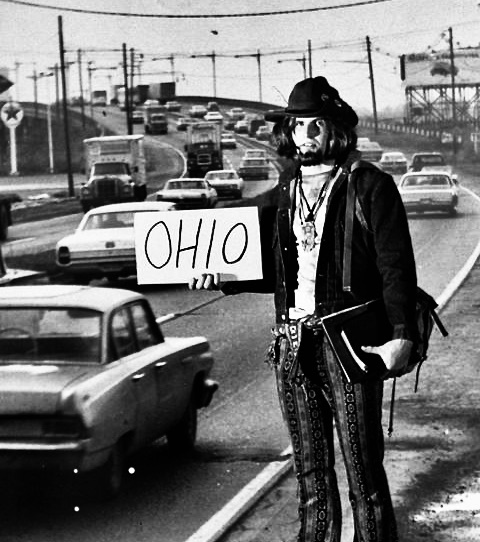
   When we got back to Cleveland everybody marveled at our quick turnaround from the west coast and attractive tans. “We didn’t actually make it to California,” we had to explain to one-and-all.  “We didn’t even make it out of Ohio.” We had to endure many snarky comments. When Virginia Sustarsic, one of my neighbors at the Plaza, said she was going to San Francisco and invited me to try again, joining her, I jumped at the chance. My feet got tangled up coming down when she said she was hitchhiking there.

   “You’re going to thumb rides across the country?”

   “Yes,” she said, in her detached but friendly way. She was a writer, photographer, and cottage craftsman. Virginia was a raconteur when she wanted to be one. She made a living dabbling in what interested her. She lived alone. Her boyfriend was an unrepentant beatnik.

   “How about getting back?”

   She explained she had arranged a ride as far as Colorado Springs. She planned on going knockabout the rest of the way, stay a week-or-so with friends on the bay, and hitchhike back. When I looked it up on a map, she was planning on hitchhiking four thousand-some miles. I didn’t know anything about bumming my way on the highway. When I asked, she confessed to having never tried it.

   Our ride to Colorado Springs was a guy from Parma and his girlfriend in a nearly new T2 Microbus. Although it was unremarkable on the outside, the inside was vintage hippie music festival camper. It was comfortable and stocked. We stopped at a lake in Illinois and had lunch and went for a walk. I veered off the path and got lost, but spotted Virginia and our ride, and cut across a field to rejoin them. I tripped while running, fell flat on my face, but was unhurt.

   We got to Colorado Springs in two days. The next day I found out what I had fallen into in Illinois was poison ivy. An itchy rash was all over my calves, forearms, and face. I tried Calamine lotion, but all I accomplished was giving myself a pink badge that said, ‘Look at me, I’m suffering.’” Virginia’s friends where we were staying let me use their motorcycle to go to a clinic. The doctor prescribed prednisone, a steroid, and by the time we got to San Francisco I was cured.

   In the meantime, leaving the clinic, since it was a warm and sunny summer day, I went for a ride on the bike, which was a 1969 Triumph Tiger. I rode to the Pikes Peak Highway, 15 miles west, and about half the way up, until the bike started to dog it. What I didn’t know was at higher altitudes there wasn’t enough air for the carburetor. By that time, anyway, I had gotten cold in my shorts and t-shirt. It felt like the temperature had dropped thirty degrees. I turned around and rode down. There was a lot of grit and gravel on the road. I rode carefully. The last thing I wanted to happen was to dump the bike. I found out later that Colorado snowplows spread sand, not salt, in the winter. 

   All the way back to town, as dusk approached, I saw jumbo elk deer and walloping antelope. Even the racoons were enormous. I stayed slow and watchful, not wanting to bang into one of the beasts. We stayed a few days and hit the open road when my rash was better. There was no sense in scaring anybody off with my pink goo face. We had a cardboard sign saying “SF” and finally hit the jackpot when a tractor trailer going to Oakland picked us up.

   The Rocky Mountains, left behind when the glaciers went back to where they came from, were zero cool to see, although I wouldn’t want to be a snowplow driver assigned to them. The weather was fair but cold with a high easterly wind the day we crossed them. Every switchback opened onto a panorama.

   Virginia’s friends in San Francisco lived in Dogpatch, which was east of the Mission District and adjacent to the bay. It was a working class partly industrial partly residential neighborhood. They lived in a late nineteenth century house they were restoring. They went to work every day while we went exploring.

   We stayed away from downtown where there was an overflow of strip clubs, peep shows, and sex shops. Skyscrapers were going up, there were restaurants, offices, and department stores, but it still looked like the smut capital of the United States. Elsewhere, rock-n-roll, jazz fusion, and bongo drums were in the air, especially the Castro District and Haight-Ashbury. Dive bars seemed to be everywhere.

   Virginia went to Golden Gate Park and took pictures of winos, later entering one of them in a show at Cleveland State University. She had a high-tech 35mm Canon. When her photograph was rejected with the comment that it was blurry, she said, “That was the point.” I went to Twin Peaks and took a picture of the spot where Chocolate George’s ashes had been strewn. When Arunas saw it later on, he said there wasn’t much to see. I showed him some pictures from the summit facing northeast towards downtown and east towards the bay. “Those are nice,” he said, being polite. My camera was a Kodak Instamatic.

   Twin Peaks is two peaks known as “Eureka” and “Noe.” They are both about a thousand feet high. They are a barrier to the summer coastal fog pushed in from the ocean. The west-facing slopes get fog and strong winds while the east-facing slopes get more sun and warmth. The ground is thin and sandy. George was somewhere around there..

   We stayed for more than a week, riding Muni city  busses for 25 cents a ride. No matter where we went there seemed to be an anti-Vietnam War protest going on. We rode carousel horses at Playland-at-the-Beach and went to Monkey Island at the zoo. We ducked into Kerry’s Lounge and Restaurant to chow down on French fries. We stayed away from all the Doggie Diners. We listened to buskers singing for tips at Pier 45 on Fisherman’s Wharf. Jewelry makers were all over the place. Virginia was on Cloud 9, being an artisan herself.

   When we saw “The Human Jukebox” we went right over. Grimes Proznikoff kept himself out of sight in a cardboard refrigerator box until somebody gave him a donation and requested a song. Then he would pop out of the front flap and play the song on a trumpet. I asked him to play “Stone Free,” but he played “Ain’t Misbehavin’” instead.

   “I don’t know nothing about Jimi Hendrix,” he said.

   Everywhere we looked almost everybody was wearing groovy clothes made of bright polyester, which looked to be the material of choice. Tie-dye was on the way to the retirement home. Virginia dressed in classic hippie style while I dressed in classic Cleveland-style, jeans, t-shirt, and sneakers. I didn’t feel out of place in San Francisco, but I didn’t feel like I belonged, either. There were no steel mills and too many causes to worry about.

   When we left, we started at the Bay Bridge and got a ride right away. By the time we got to the other end of the bridge the man at the wheel had already come on to Virginia. We asked him to drop us off. When he stopped on the shoulder and I got out of the back seat, he pushed Virginia out the passenger door, grabbed her shoulder bag, and sped away. She didn’t keep her traveling money in it, but what did he know? We saw the bag go sailing out the car window before he disappeared from sight and retrieved it. We smelled a brewery on the breath of the next driver and turned him down. After that a pock-marked face stopped and  asked us if we were born again. When I said I had been raised a Catholic, he cursed and drove off.

   We liked talking to the people who gave us rides but avoided talking about race, religion, and politics. I carried a pocket jackknife but wasn’t sure what I would do with it if the occasion ever arose. We never hitchhiked once it got dark, because that was when lowlifes and imbeciles were most likely to come out.

   We went back the way we had come, to Nevada, through Utah, Nebraska, and Iowa to Chicago, and returning in the middle of the day to the south shore of Lake Erie. We thumbed rides at entrances to highways, at toll gates, and especially at off-the-ramp gas stations whenever we could. Gas stations were good for approaching people and asking them face-to-face if they were going our way. 

   One of the best things about hitchhiking is you can take any exit that you happen to feel is the right one. One of the worst things is running into somebody who says, “I can tell you’re not from around these parts.” We avoided big cities because getting out of them was time-consuming. We avoided small towns because we didn’t want to be the new counterculture archenemies in town. We got lucky when a shabby gentleman in a big orange Dodge with a cooler full of food and drink in the back seat picked us up outside of Omaha on his way to Kalamazoo. He listened to a border blaster on the radio all the way. We ate the sandwiches he offered us.

   Our last ride was in an unmarked Wood’s County sheriff’s car. He picked us up near Perrysburg on his way to Cleveland’s Central Police Station to pick up a criminal. It was the same station where Jane “Hanoi Jane” Fonda was put behind bars a couple of years earlier. She was famous and not a real criminal and so didn’t stay long.

   “They said they were getting orders from the White House, that would be the Nixon White House,” she said about the arrest. “I think they hoped the ‘scandal’ would cause my college speeches to be canceled and ruin my respectability. I was handcuffed and put in jail.” The day  she was arrested at Cleveland Hopkins Airport, she pushed Ed Matuszak, a special agent for the U. S. Customs Bureau, and kicked Cleveland Policeman Pieper in a sensitive place.

   The city policeman later sued Jane Fonda for $100,000 for the kick that made him “weak and sore.” The federal policeman shrugged off the shove. The charges and suit were eventually dropped.

   The Wood County sheriff was a friendly middle-aged man who warned us about the dangers of hitchhiking and drove us to near our home. When we got out of the car, he gave us ten dollars. “Get yourselves a square meal,” he said. We walked the half dozen blocks to the Plaza, dropped off our stuff, and walked the block and half to Hatton’s Deli on East 36th St. and Euclid Ave. where Virginia worked part-time. There was an eight-foot by eight-foot neon sign on the side of the three-story building. It said, “Corned Beef Best in Town.” We had waffles and scrambled eggs.

   The waitress lingered at our table pouring coffee, chatting it up while we dug into apple pie. We split the big slice. The butter knife was dull, so I used my jackknife. She asked how our cross-country trip had gone. I gave her the highlights while Virginia went into details. When the waitress asked why we hadn’t gone Greyhound, Virginia smiled like a cat, but I put my cards on the table.

   “I had an itch to go and the stone free way was the way to go.”

Ed Staskus posts monthly on 147 Stanley Street at http://www.147stanleystreet.com, Made in Cleveland http://www.clevelandohiodaybook.com, Down East http://www.redroadpei.com, and Lithuanian Journal http://www.lithuanianjournal.com. To get the site’s monthly feature in your in-box click on “Follow.”

“Bomb City” by Ed Staskus

“A police procedural when the Rust Belt was a mean street.” Sam Winchell, Beyond Books

Available on Amazon: https://www.amazon.com/dp/B0F1LM1WF9/ref=sr_1_1?crid=2MYAQAOZIC2U9&dib=eyJ2IjoiMSJ9.hTm7BGbiQbSe5ZapFwYPPfcwOpTe-Vdg6VLE4aGyTyk.Z0R-VNBWWEcvKcNaO9LdCOUnNIOOXgvYkRS_FXiXuHk&dib_tag=se&keywords=bomb+city+ed+status&qid=1742136726&sprefix=bomb+city+ed+staskus%2Caps%2C84&sr=8-1

Cleveland, Ohio 1975. The John Scalish Crime Family and Danny Greene’s Irish Mob are at war. Car bombs are the weapon of choice. Two police detectives are assigned to find the bomb makers. It gets personal.

A Crying of Lot 49 Publication

Raise High the Roof Beam

By Ed Staskus

   When I moved into the Plaza Apartments on Prospect Ave. at the intersection of E. 32nd St., which wasn’t even a street since the other end of it dead-ended into a parking lot, it was by accident, including a car accident and bumping into Arunas Petkus a few days later.  The car accident happened when a flash of sunshine distracted me. Bumping into Arunas was simply by chance.

   I was living at Dixon Hall up the street near E. 40th St. A decade after I moved out it was designated a legacy building and historic location but when I lived there it was a rat’s nest, full of students, day laborers, and deadbeats. It was a solid four-story stone and brick building that had gone to seed. 

   Hookers and boozehounds roamed Prospect Ave. in the evening after the blue collars and shop owners went home. The junkies stayed in the shadows, hapless and harmless, mumbling and nodding off. I avoided roughnecks on the prowl, who were hoping to stumble on a sucker. Nobody from the suburbs ever came day-tripping, much less set foot on Upper Prospect at night.

   My roommate Gary was ten years older than me and was drinking himself to death, day by day, from the bottom of his heart. I first met him the day before moving in with him, when I answered a worse for wear note on a bulletin board at Cleveland State University, a ten-minute walk away. He was stocky, bearded, and sullen, but I needed a cheap room, and his second bedroom was available.

   It wasn’t any great shakes of an apartment, which was a living room, walk-in kitchen, and two small bedrooms. There were more cockroaches than crumbs in the kitchen. The sofa and upholstered chairs were a flop. Gary kept cases of beer stacked up by the back door and his whiskey under lock and key.

   I didn’t know much about spirits except that all the grown-ups I knew, who were most of them Lithuanian, drank lots of it, some more than others. I didn’t know why Gary was going breakneck down the river, but he was and wasn’t in in any kind of shape anymore to do much more than sit around and drink.

   The day he told me he was going out to pick up his car was a surprise, since he was living on some kind of inheritance and almost never went out. I didn’t even know he knew how to drive. I was even more surprised when he asked me if I wanted to go along.

   “Where is it?” I asked.

   “Down by 36th and Payne,” he said.

   We could walk there since it was a sunny day. E. 36th and Payne Ave. was only about twenty minutes away by foot.

   “All right,” I said, which was my first mistake.

   His car was a 1963 VW Beetle with a new engine block and repainted a glossy lime. He paid cash in hundred dollar bills and we drove off, down E. 55th St. to the lake, up E. 72nd St. to St. Clair Ave., and back to Dixon Hall. When he pulled up to the curb, he asked me if I knew how to drive a standard shift.

   “Sure,” I said.

   “Do you want to try it?”

   “Sure,” I said, which was my second mistake.

   I didn’t get far, about a quarter mile. As we were approaching the intersection of E. 30th St. and Prospect Ave. a flash of sunshine glancing off the glossy yellow-green hood of the car distracted me. I turned my head to the left. That was my third and last mistake.

   I didn’t see the four-door sedan going through the red light to my right and never touched the brake. He smashed into the front fender of the VW, sending us spinning, and a car behind us smashed into our rear engine compartment. The opposed 4 engine made a last gasp and went dead.

   When we came to a stop the VW Beetle was finished and I was finished as Gary’s roommate. I was just barely able to talk him into giving me a week to scare up another roof over my head. The fall quarter at Cleveland State University was rolling along and winter wasn’t far away.

   I was playing beggar-my-neighbor with friends in the Stillwell Hall ground floor cafeteria when Arunas Petkus joined us, snagging a card game in his free time. He was Lithuanian like me. We had gone to St. Joe’s together, a Catholic high school on the east side, and he was an art major at Cleveland State University. He had a deft hand drawing and painting. He piped up when he heard about my predicament.

   “Try the Plaza,” he said. “There’s a one bedroom on the second floor that’s come open. Somebody I know moved out in the middle of the night.”

   The Plaza was just down the street from Dixon Hall. I had never paid much attention to it, but when I gave it a closer look, I liked what I saw. It was built in 1901 in an eclectic style, on a stone foundation, with some blocks of the same stone in the exterior, and facing of yellow brick in front and around the courtyard. Some of the brick was sprouting ivy. The top of the five stories was crenellated. It had a cool vibe when I walked around it, eyeballing the stamping ground.

   Dave Bloomquist and Allen Ravenstine, who was the synthesizer player for the Cleveland-based art-rock band Pere Ubu, owned and operated the building.

   “I grew up at the Plaza. It’s where I became an adult,” Allen said. “I was a kid from the suburbs. When we bought this building in 1969, we did everything from paint to carpentry. When it was first built, it had 24 apartments. When we bought it in a land contract, there were 48 apartments. We tried to restore it unit by unit.”

   I knocked on Dave Bloomquist’s door. His apartment was at the crown, in the front, facing north, looking out across Chinatown, Burke Lakefront Airport, and out to Lake Erie. When he answered the door, I don’t know what I expected, but what I got was a tall young man, maybe six and a half feet of him, a thick mop of black hair, and an old-school beard.

   “I’m here about the apartment on the second floor,” I said.

   He led me through the kitchen, down a hallway, and into an office full of books, records, a big desk, and sat me down in a beat-up leather armchair.

   I didn’t blanch when he told me what the rent was because it wasn’t much, but I didn’t have much. I could make the first month, maybe the second. I hemmed and hawed until he finally asked me if I was short.

   “More or less,” I said.

   “Would you be willing to work some of it off?”

   “Yes, you bet.”

   “Good, we can work that out. Do you play chess, by any chance? You look like you might.”

   “I know how to play,” I said, but didn’t say anything about my reading chess how-to books.

   “Great, do you want to play a game?”

   “Sure.”

   He had a nice board and played a nice game, but I finished him off in less than twenty moves.

   “Beginner’s luck,” I said.

   “After you’ve moved in stop by, we’ll talk more about some work for you, and play again,” he said.

   I went down the front steps, out the door, and sat down on what passed for a stoop. A young woman stuck her head out of a basement window behind me. I looked at her. She was a looker.

   “I haven’t seen you around here before,” she said. “Are you moving in?”

   “Yes, in the next couple of days.”

   “Do you have a car?”

   “No.”

   “That’s good,” she said. “I’ve lost two cars living here.”

   “That’s too bad.”

   “I love living here, but it drives me crazy at night,” she said. Her name was Nancy and she was studying art. She wanted to be a teacher. “The junkies sit right here on this ledge and party all night long. They never see anything happening, like my cars being stolen.” The dopeheads didn’t have the smarts to steal cars. The making off happened when bad guys came down Cedar Rd. looking for easy pickings.

   I moved in over the course of one day, since I didn’t have much other than my clothes, bedsheets, kitchen dishes, utensils, pots and pans, schoolbooks, and a dining room table and chairs my parents bought for me. I lived on pancakes, pasta, and peanut butter. The apartment wasn’t furnished, but whoever had left in a hurry left a queen bed, a dresser, and a livable sofa. 

   A man by the name of Bob Flood, who lived on the same second floor like me, but in the front, not the back like me, helped me carry the table and chairs up. He was dressed in denim, wore a denim cap, making him look like a railroad engineer, had a little shaggy beard and bright eyes, and was on the rangy side. He walked in a purposeful way, like an older man, even though he wasn’t an old man. Everybody called him Mr. Flood.

   I found out later he was divorced and had two children who visited him, but I never found out if he worked for a railroad or what he did, at least not for a fact. He was either at home for days on end or he wasn’t. I had worked at Penn Central’s Collinwood Yards the winter before as a fill-in, sometimes unloading railcar wheels, sometimes walking the yard with a pencil and waybill clipboard. I didn’t remember ever seeing him there.

   “What kind of people live here?” I asked him.

   “All kinds,” he said. “There are a lot of musicians, artists, writers, some students and even a couple of professors.”

   “It’s an energy house,” said Scott Krause, who was the drummer for Pere Ubu.

   “Not everybody’s in the arts,” Mr. Flood said. “There are beauticians, bartenders, and bookstore clerks, too.” 

   “If you want to stick your head out the window and sing an aria, someone might listen, and someone might even applaud,” said Rich Clark from his open window. Nobody had window air conditioners.

   I found out almost everybody was more younger than older, except for an Italian couple and their parrot. The parrot never sang or spoke outside the family, no matter how much the Italians coaxed and cajoled him. The bird was as stubborn as a mule.

   Once winter was done and spring was busting out, I was reading a book for fun in the courtyard when Arunas Petkus stepped up to the bench I was sprawled out on. He wanted to know if I wanted to go to California with him once classes at Cleveland State University were done for the summer.

   “All that tie dye is finished there,” I said. “Even the hippies say so.”

   “I thought we could visit Chocolate George’s grave.”

   “Who’s Chocolate George?”

   George Hendricks was a Hells Angel in the San Francisco chapter who was hit by a car while swerving around a stray cat one August afternoon in 1967 as the Summer of Love was winding down. He was thrown from his motorcycle and died later that night from his injuries. He was known as Chocolate George because he was rarely seen without a quart of his favorite beverage, which was chocolate milk.

   “He drank chocolate milk because he had an ulcer,” explained Mary Handa, a friend of his. “He spiked it with whiskey from time to time.” He scored nips of the booze all day long.

   George Hendricks was a strapping 34-year-old when he died. He was a favorite among the hippies in Haight-Ashbury because he was funny and friendly. Sometimes he sported a Russian fur hat, making him look like a Cossack. His mustache and goatee were almost as long as his long hair, he wore a pot-shaped helmet when riding his Harley, and his denim vest was sprinkled with an assortment of round tinny pin badges. One of the badges said, “Go Easy on Kesey.”

   The writer Ken Kesey had been the de facto head of the Merry Pranksters. Much of the hippie aesthetic traced back to them and their Magic Bus.

   “I bought a used car,” Arunas said.

   It was parked in the back next to the nerve-wracking back stairs. The stairs were sketchy. Going up and down them always felt like it might be the last time as they twitched and shook and seemed on the verge of yanking themselves off the brick façade. I avoided them whenever I could.

   The car was a two-door 1958 VW Karmann Ghia. “You know how the Beetle has got a machine-welded body with bolt-on fenders,” Arunas said.

   I didn’t know, but I nodded agreement keeping my distance from the car. It looked like a soul mate to the stairs. It was pock-marked with rust and seemed like it might fall apart any second.

   “Well, the Karmann Ghia’s body panels are butt-welded, hand-shaped, and smoothed with English pewter.”

   I didn’t know what any of that meant, either, but nodded again.

   “Does it drive?”

   “It got me here.”

   “From where?”

   He bought the VW at a used car lot on E. 78th and Carnegie Ave.. It was two or three miles away, on the Misery Mile of used car lots.

   “Where is Chocolate George buried, exactly?” I asked.

   “He’s not buried, not exactly,” Arunas said.

   Five days after his death more than two hundred bikers followed a hearse up and down San Francisco’s narrow streets, pausing and revving their engines at the Straight Theater, near where the accident happened. Two quarts of chocolate milk were perched next to the cold body in the back of the hearse. The funeral ceremony was performed at the Cypress Lawn Cemetery, Chocolate George was cremated, and his ashes scattered over Twin Peaks, which are in the center of the city.

   The funeral procession became a motorcycle cavalcade, roaring to Golden Gate Park where, joined by hundreds of hippies from Haight-Ashbury, a daylong wake erupted. Big Brother & the Holding Company and the Grateful Dead were the live music send-offs. There was dancing and psychedelic merrymaking.   

   “Sometimes the lights all shining on me, other times I can barely see, lately it occurs to me, what a long, strange trip it’s been,” Jerry Garcia sang in his mid-western twang. There was free beer courtesy of the Hells Angels and free food supplied by the Diggers.

   The Haight Street Diggers were said to be a “hippie philanthropic organization.” They used the streets of San Francisco for theater, gatherings, and walkabouts. The organization fed the flock that made the scene in the Panhandle with surplus vegetables from the Farmer’s Market and meat they routinely stole from local stores.

   Two months after Chocolate George’s funeral the Diggers announced “The Death of the Hippie” by tearing down the store sign of the Psychedelic Shop and secretly burying it in the middle of the night.

   “So, do you want to go?” Arunas asked, his hand on the hood of the Karmann Ghia.

   “Sure,” I said, short on memory and long on summertime.

Ed Staskus posts monthly on 147 Stanley Street http://www.147stanleystreet.com, Made in Cleveland http://www.clevelandohiodaybook.com, Atlantic Canada http://www.redroadpei.com, and Lithuanian Journal http://www.lithuanianjournal.com

“Cross Walk” by Ed Staskus

“Captures the vibe of mid-century NYC, from stickball in the streets to the Mob on the make.” Sam Winchell, Beyond Fiction

Available on Amazon: https://www.amazon.com/dp/B0CRPSFPKP

Late summer and early autumn. New York City, 1956. Jackson Pollack opens a can of worms. President Eisenhower on his way to the opening game of the World Series where a hit man waits in the wings. A Hell’s Kitchen private eye scares up the shadows.

A Crying of Lot 49 Publication