Feed Your Head

By Ed Staskus

   I was in my early 20s in 1973 the first time I visited Lake View Cemetery. I was in the back seat of a 1964 Oldsmobile Jetstar 88 convertible. Bill Neubert was driving and his wife Bonnie was beside him. Everybody called Bonnie Buck, although I called her Bonnie. It was a mid-summer day, warm, bright, and breezy. The top of the car was down. Bill stopped in front of an old headstone. We got out of the car and walked over to it. The name on the grave was Louis Germain DeForest. The dates were 1838 – 1870. There was moss on the base of the stone.

   “He was the first guy buried here,” Bill said.

   Captain Louis Deforest was from Cleveland, Ohio, one of ten children, served in the Union Army during the Civil War, and went home after Johnny Reb gave up the fruitless struggle. He married Theresa Luidham before the war, got her pregnant during the war, and again after the war. Once back in Cleveland he went into the jewelry business. The sparkle didn’t last long. He died unexpectedly at the age of 31.

   Two sites in the graveyard were on the National Register of Historic Places, the second one added that year. I didn’t know much about places with a past. I had enough trouble making sense of the present. Bill filled me in, even though he wasn’t interested in historic places. He was more interested in the flow of history.

   Bill and Bonnie were mimes clowns comedians, putting on shows around town, working out of town when they got offers. They were a few years older than me, friends of my roommate Carl Poston. That Saturday morning Carl begged off messing around town, leaving me the odd man out. Bill and Bonnie made me feel at home. Bill didn’t act or look anything like Humphrey Bogart, but he talked just like him. We drove to Little Italy and had pastries and coffee. Back in the car they both dropped acid and asked me if I wanted to try it.

   “All right,” I said.

   They didn’t call it LSD. They called it Uncle Sid. It was the first time I took LSD. A half hour later I was finding it and everything else incredibly interesting. Everything seemed fresh and bright. Uncle Sid wasn’t the disheveled uncle with yesterday’s stogie trying to take your picture with his dime store camera. He was my best friend that day.

   The Jefferson Airplane released “White Rabbit” in 1967. “One pill makes you large and one pill makes you small, feed your head,” Grace Slick sang with her eyes full of stars.. My head was full to the brim the rest of the day. Everything was freaky but close and personal.. No matter what it was, it all felt, looked, smelled, and sounded new. My eyes stayed wide open like a baby’s all day long.

  “What’s it like to be a child?” asked Robin Carhart-Harris of Imperial College in London. “That sense of wonder, that sense of awe is what you certainly see with psychedelics. Sometimes it’s framed in a sort of mystical or spiritual way. But it’s interesting if you look at some literature, someone like William Wordsworth, who talks about the infant state as being a kind of heavenly state where we’re closer to what you would call God.”

   LSD was first synthesized in 1938 in Switzerland. It was introduced as a psychiatric drug in 1947 and marketed as a psychotropic panacea, in other words “a cure for everything from schizophrenia to criminal behavior, sexual perversions, and alcoholism.” The abbreviation LSD is from the mouthful of the German word lysergsäurediethylamid. The drug was brought to the United States by the CIA. The spy agency bought the world’s entire supply for a quarter million dollars and promoted its use in clinics, research centers, and prisons. They administered it to their own employees, soldiers, doctors, prostitutes, the fruity, the mentally ill, the down and out, and plain folks to study their reactions, usually without those given the drug knowing what they were taking. The idea was that LSD is like psychoanalytical Drano.

   Lake View Cemetery is a graveyard straddling Cleveland, East Cleveland, and Cleveland Heights. It was founded in 1869. It was where the city’s wealthy buried themselves during the Gilded Age. There are many lavish funerary monuments and mausoleums. Little Italy up and down Mayfield Rd. was settled by stone masons from Italy who came to the United States to make monuments for God’s 280 acres. Many of the monuments they made were symbols. It’s better to be a symbol than a monument. Pigeons do bad things to monuments.

   In the 1960s Aldous Huxley, Alan Watts, and Timothy Leary got their hands on LSD and started advocating its use to the counterculture. It was supposed to be the drug of choice for consciousness expansion. Owsley Stanley got the blotter rolling in San Francisco. Ken Kesey and the Merry Pranksters popularized it during their road trips, giving it away to anybody who wanted it. Nick Sands created Orange Sunshine, the most pure, highest-quality LSD made at the time, better than the CIA’s. In 1966 the Psychedelic Shop opened, selling acid over the counter. It was legal as cookies and milk. If you were a gal, wearing a pants suit was problematical, but not downing the hallucinogenic.

   Bill drove his Olds 88 to Section 9 on Lot 14, to the marble gravestone of Francis Haserot and his family. The bigger than life tomb marker was “The Angel of Death Victorious.” The angel’s wings were outstretched, and she held an extinguished torch upside-down. I stepped up to her and saw what looked like black tears dripping from her eyes and down her neck. I wasn’t unnerved, but rather impressed with the sculptor’s skill, until I realized the tears were a result of rain and aging bronze.

   W. H. Auden wasn’t impressed with LSD. “Highly articulate people under it talk absolute drivel,” he said. After he tried it, he reported, “Nothing much happened but I did get the distinct impression that some birds were trying to communicate with me.” The Beatles jumped on the bandwagon with “Day Tripper” in 1966 and “Lucy in the Sky with Diamonds” in 1967. “The first time I took LSD, it just blew everything away,” said George Harrison. “I had such an incredible feeling of well-being.”

   Not everybody was all in. “We don’t take trips on LSD in Muskogee, we are living right and free,” Merle Haggard sang on “Okie from Muskogee.” Living free in the home of the brave is one thing. Living right is in the eye of the beholder. The city is on the Arkansas River in Oklahoma. It is home to a museum of Native American history and the USS Batfish, a WWII submarine with an onboard museum. Between 1858 and 1872 the Texas Rangers and U. S. Cavalry battled Creeks, Kiowa, and Comanche Native Americans in more than a dozen major engagements, eventually wearing them down, rounding them up, and telling them to stay the hell on the reservation. In the 1970s the USS Batfish was becalmed bewildered on the river, many miles from its native ocean hunting grounds.

   After we left the angel we drove to the Garfield Memorial. It’s the final resting place of assassinated President James Garfield, who was from nearby Mentor. The memorial is built of Ohio sandstone in a combination of Gothic, Byzantine, and Romanesque styles. It took five years to build and was dedicated on Memorial Day, 1890. James Garfield, and his wife, Lucretia, are entombed in the crypt.

   The circular tower is 180 feet high. We stood on the broad front steps and looked up. Before we went in, we gave the once-over to the bas-reliefs depicting President Garfield’s life and death, which included more than one hundred life-size figures. Inside was a gold dome and a statue of the main man. Below the Memorial Hall were two bronze caskets and two urns, the urns holding the ashes of the presidential couple’s daughter and her husband. I followed Bill and Bonnie up a stairway to a balcony with a view of Lake Erie. We stayed for twenty minutes, taking a long look at the downtown skyline before we left. It was like IMAX a year before IMAX happened, but without the motion sickness.

   “My feelings about LSD are mixed,” said Jerry Garcia of the Grateful Dead. “It’s something that I both fear and love at the same time. I never take any psychedelic, have a psychedelic experience, without having that feeling of, I don’t know what’s going to happen. In that sense, it’s fundamentally an enigma and a mystery to me.” 

   “The function of the brain is to reduce available information and lock us into a limited experience of the world” said the Czechoslovakian psychiatrist Stanislav Grof. “LSD frees us from this restriction and opens us to a much larger experience.”

   When he was dying of cancer Aldous Huxley asked his wife to inject him with LSD. The drug has analgesic properties for the terminally ill. When the acid trip was over so was his trip on earth. He died that night. The doors of perception closed on the man who wrote “The Doors of Perception.” Two years later Jim Morrison and Ray Manzarek named their new band The Doors.

   In the United States LSD was scaring the bejesus out of Washington D. C. They thought it was undermining American values and undermining the war effort in Vietnam. The Air Force might have dropped puff powder bombs of it on Charlie instead of napalm to keep the dominoes in place, but they didn’t. It was made illegal in the late 1960s. It was classified as a substance with no legitimate medical use and a lack of accepted safety. The DEA said it had a high potential for abuse. Although the drug had never caused any documented deaths, that was that. If you wanted to be in the sky with diamonds, once you landed back on earth your next stop might be prison.

   After we left Garfield’s Memorial we left the Olds 88 where it was and set off on foot. The memorial is on a hill which is the boneyard’s high point. We rambled downhill in the sunshine, making our way on twisty paths, stopping at the graves of Charles Brush, Elroy Kulas, John D. Rockefeller, and Garrett Morgan.

   Charles Brush was an inventor with fifty patents to his name. His arc lights were the first to illuminate Cleveland’s Public Square. When he later sold his company, it merged with the Edison Electric Co. to form General Electric. Elroy Kulas was the president of Midland Steel from the day it was organized in 1923 until his death in 1952. He was one of the driving forces behind the city’s steelmaking. During World War Two he built hulls for tens of thousands of M4 Sherman Tanks. The Nazis had a low opinion of them, but in the end the Sherman’s played chin music with the Panzer’s, blasting them to kingdom come. The Kulas Auditorium at the Institute of Music is named after him.

   We found John D. Rockefeller’s grave without any problem. It was at the base of an almighty obelisk. We didn’t stay long, only long enough to pay our respects to the Age of Oil. John D. Rockefeller was a son-of-a-gun, bleeding anybody and everybody who crossed him bone dry. It was how he made it to the top of the world, making himself the richest man in the world. He gave it away at the end so people would stop spitting in the gutter when they heard his name. 

   Garrett Morgan founded the Cleveland Call newspaper for the Negro community. He patented a breathing device that was used in 1916 during a mining disaster in gas-filled tunnels under Lake Erie to rescue workers and bring back those who died. Twenty-one men died. He and his brother rescued two of them and recovered four dead. He developed the modern traffic light and was the first black man in town to own a car.

   We went flaneur hoofing it around the graveyard, spending all day there. By early evening we were dog tired and coming down from the LSD. We needed bread and water. We hopped into the Olds 88 and drove back own to Little Italy. Instead of bread and water we had espresso, ham sandwiches, and biscotti.

   When Bill and Bonnie dropped me off back home it was nighttime. I ignored the mail, fed Ollie my Siamese cat, who was meowing up a storm, brushed my teeth, and got into bed. Ollie jumped up and got comfortable beside me.

   I had spent the day with the dead but felt incredibly alive. More than one hundred thousand men women and children are buried in Lake View Cemetery, their eyes closed forever. My eyes had never been more open. I didn’t drop much LSD after that, and when I did stuck to small doses. I didn’t think it was especially dangerous, but it is unpredictable stuff that can go wrong, like children one minute are laughing their heads off and the next minute bawling their eyes out. 

   I thought maybe I would take it again when I was dying, like Aldous Huxley, and go out on a high note.

Ed Staskus posts monthly on 147 Stanley Street http://www.147stanleystreet.com, Made in Cleveland http://www.clevelandohiodaybook.com, Atlantic Canada http://www.redroadpei.com, and Lithuanian Journal http://www.lithuanianjournal.com

Help support these stories. $25 a year (7 cents a day). Contact edwardstaskus@gmail.com for details.

“Bomb City” by Ed Staskus

“A Rust Belt police procedural when Cleveland was a mean street.” Sam Winchell, Beyond Fiction

Available on Amazon: https://www.amazon.com/dp/B0F1LM1WF9/ref=sr_1_1?crid=2MYAQAOZIC2U9&dib=eyJ2IjoiMSJ9.hTm7BGbiQbSe5ZapFwYPPfcwOpTe-Vdg6VLE4aGyTyk.Z0R-VNBWWEcvKcNaO9LdCOUnNIOOXgvYkRS_FXiXuHk&dib_tag=se&keywords=bomb+city+ed+status&qid=1742136726&sprefix=bomb+city+ed+staskus%2Caps%2C84&sr=8-1

Cleveland, Ohio 1975. The John Scalish Crime Family and Danny Greene’s Irish Mob are at war. Car bombs are the weapon of choice. Two police detectives are assigned to find the bomb makers. Nothing goes according to plan.

A Crying of Lot 49 Publication

Stumbling On Barron Cannon

By Ed Staskus

   It was an early May morning when Frank and Betty Glass went visiting Barron Cannon, who they hadn’t seen much since they first ran into him picketing a vegan restaurant near where they lived in Lakewood, Ohio. They had dropped by his yurt, which was on a bluff overlooking the Rocky River Metropark Reservation, several times in October and November, but once winter got cold and snowy had not paid him a social call, not that Betty minded, or even gave it a thought.

   The first time they ever saw Barron had been the past September, when they were attracted by the flashing lights of two Ford Police Interceptors at the vegan eatery, and were greeted by the sight of a slender pony-tailed man in his early 30s bearing a picket sign on a stick. Faces peered through the plate glass windows. Passersby stopped to see what was going on. There was a single word scrawled on the placard.

   HYPOCRITES! It was in capital letters. It was written in blood red crayon. Barron was waving it around in circles.

   The policemen who had been called to the scene by one of the outraged waitresses were telling him he had to call it a day. They told him protesting without a permit wasn’t permitted. Although he maintained he had more than enough reason, and cited his first amendment rights, and made a speech about animal rights, he finally agreed to go home and strode off, his picket sign bouncing up and down on his shoulder.

   The bemused policemen walked away shaking their heads. “He’s like the cranky old guy who’s always on his front porch and yells at the neighborhood kids,” one of them said before they got into their separate Ford Police Interceptors.

   Barron was going the same way as Frank and Betty, up West Clifton Blvd., and after falling into step with him, they were astonished to learn he was himself a vegan. “Eating is an act of nourishing my body and soul,” he said. “I choose to do no harm to myself.”

   He did not eat animals, drink their milk, or wear their hides. He eschewed all animal products. He didn’t eat anything deep-fried and never snacked on refined sugar. He eschewed Worcestershire sauce because it contained anchovies. He considered eating honey exploitive and avoided it.

   “I don’t abide people who eat animals,” he said, “and since that’s just about everybody, and since that is not changing anytime soon, that’s that, and there I am, a lonely voice in the wilderness. At least I don’t have to live with them.” 

   At least as long as they weren’t his parents. Although he lived alone, he lived with his parents. He lived in their backyard.

   “My parents are among the worst,” he said. “They are always bringing chicken, pork, and ground beef home from the grocery. I see them in their kitchen every day, sticking forks into decomposing flesh and animal secretions. They chew on Slim Jim’s while they watch the news, which is full of lies and misery, on TV.”

   Barron lived in a yurt outside the kitchen window of his parent’s house overlooking the Rocky River Metropark Reservation, about a mile-and-a-half south of Lake Erie. He had built the orange Mongolian-style dwelling himself. He didn’t have a job, a car, a refrigerator, a TV, a wife, or any pets.

   “Don’t even get me started on pet slavery,” he said.

  Betty gave him a sharp glance. She and Frank had two house cats, who were Mr. Moto and Sky King, who slept with them on their bed most nights. The cats were rescues. She didn’t think of them as slaves and was sure they didn’t think of themselves as slaves, either.

   “Have we met before?” Frank asked as they stopped at the corner of their side street off Riverside Dr. while Barron was going to continue his ramble back to his lodgings.

   “I don’t think so,” said Barron. “I would know. I have an excellent memory.”

   A college graduate with a master’s degree in philosophy and a hundred thousand dollars in unpaid federal student debt, Barron was unqualified for nearly any job, even if he had been remotely interested in seeking employment. He didn’t vote, although he enjoyed political antics whenever he heard about them. “Whenever I hear about a grift, or I hear about a politician, but I repeat myself,” he said. He disdained pro sports, calling the athletes “millionaires throwing, catching, and kicking some kind of damn fool ball.”  He didn’t read best sellers or know anything about current trends. He dressed like the 21st century had never happened.

   He didn’t take any drugs, over or under the counter. “By FDA requirement,” he explained, “each and every pharmaceutical is tested on animals.” He was a vegan purist, pursuing his ideals to their logical conclusion. Betty thought of his pursuit as a dead end, but didn’t say so.

   Barron didn’t have a bank account or any credit cards. He had few friends, other than several bicycle-riding neo-hippies and a handful of retirees in the neighborhood for whom he did odd jobs on a cash basis. He only worked for them if they could prove they didn’t have cars and agreed never to talk about their problems, especially their health problems.

   “Insurance, HMO’s, meds, doctors, it’s all a racket,” he said.

   The few times Frank and Betty had visited Barron they always walked, because if he knew they had driven to see him, he would refuse to see them. Burning fossil fuels was anathema to him. “That is some queer duck who lives at the top of Hogsback Lane,” Betty said. Hogsback Ln. was an entry road down to the river valley.

   “Can’t we just drive and park a block away?” she asked, reminding Frank of the three-mile round-trip hike from their house.

   Barron lived on an allowance his parents begrudged him. He shopped at a once-a-week farmer’s market. He had recently gotten his yurt connected to his parent’s power supply. Unbeknownst to them, he had gone on-line at the Lakewood Library, read about the work he had in mind, and dug a trench from the back of their house to his yurt, into which he buried a transmission wire.

   “They got a solar roof last year and got off the butane and coal, which I will tell you is a blessing,” he said. “It gets dark and cold in this yurt in the middle of winter. I used to heat it with firewood from the park. I had to collect it at night, otherwise the park rangers gave me grief. I don’t think they like me.”

   He now heated his yurt with a 5,000 BTU infrared quartz heater and LED’s were strung in a kind of loopy chandelier. He put his vegan candles, made of plant-based wax, away. He cooked on a Cuisinart 2-burner cast iron hot plate. He had previously refused to employ either electricity or natural gas, on the premise that both are petroleum products, in which are mixed innumerable marine organisms.

   “That’s one of the things I can’t stand about those leaf-eaters at the restaurant, cooking their so-called vegan cuisine with gas made from the bodies of dead fish,” he said. “They’re too busy ringing up the cash register to know or care.”

   Vegetarians drew his ire, too, although he tolerated them. “I can put up with vegetarians if I have to,” he said, which Frank reluctantly admitted to being when Barron quizzed them. Barron gave Frank a mirthless grin. “At least they’re only half lying to themselves.”

   Betty, who described herself as an omnivore, on the side of free range and organic, directed a bright smile at Barron, keeping her eating habits to herself while gnashing her teeth at the same time. Frank knew his wife was a wise woman who knew when to bite her tongue.

   As they approached Hogsback Ln. they saw a sea of green treetops in the valley below, always a welcome sight after a long winter. Barron’s yurt was on the backside of a sprawling backyard on the edge of the valley, where the long downhill of the road intersects with Stinchcomb Hill, named after the founder of the park system. It is a bucolic spot in the middle of the big city.

   Frank was reluctant to mention that William Stinchcomb had been a pork roast and beef tenderloin man in his day, as well as president of the Cleveland Automobile Club, so he didn’t mention it.

   “Vegans are as bad as my parents, the whole lot of them,” Barron said.

   “Show me a vegan who isn’t an elitist, or someone who spouts veganism who is not a do-gooder, or making boatloads of money from it, explaining how it’s all one big happy equation, yoga and veganism and new-age capitalism, and flying to their immersions in the Bahamas, and everywhere else around the planet on their holiday retreats, never mind the carbon footprint, and I’ll show you the sanctimonious side of who’s burning up the planet.”

   Since Barron didn’t have a doorbell, they were glad to find him out of doors, although Betty was less happy about it than Frank. Barron was laying out rows of seeds and tubers outside his yurt. They joined him, sitting down on canvas field chairs. He had opened the flap over the roof hole of the yurt. Betty poked her head inside the yurt, remarking how pleasant and breezy it was inside his house.

   “Inside your tent, I mean,” she said.

   “It’s a yurt,” he said.

   It was round, orange, and fronted by a half-circle of large white stones, like what children do at summer camps in front of their tents.

   “Whatever,” Betty said under her breath.

   Frank was nonplussed to see a new Apple laptop on a small reading table.

   “I keep up, especially now that I have power,” Barron said. “It’s not like I’m a caveman.”

   Frank noticed a yoga mat rolled up.

   “Where do you practice yoga?” he asked.

   “Here in the backyard, every day, and sometimes at the studio on Lake Rd. in Rocky River. The owner and I trade cleaning the studio for classes.”

   “That’s probably where I’ve seen you before,” Frank said.

   “Maybe,” Barron said, not bothering trying to remember.

   “I thought you were down on yoga.”

   “I’m down on the phony’s who practice it, not the practice itself,” Barron said.

   He led them to his new garden. He had dug up most of his mother’s backyard, dislodging her wild roses and rhododendrons and was planting rows of root crops, including beets, onions, and potatoes. He was especially proud of his celery.

   “I cover my celery with paper, boards, and loose soil. They will have a nutty flavor when I dig them up at the end of the year. I don’t eat anything from factory farms. In fact, I am getting away from eating anything from any farms anymore, at all. Farms, whether big or small, are not good ideas. They make you a chattel to the supermarket. Freedom is the way to go, although it’s challenging trying to free fools from the chains they worship.”

   Neither Frank nor Betty knew what to say. As they got ready to leave, Barron scooped handfuls of birdseed from a large barrel into a brown paper bag and handed the bag to Frank. He was still unsure about Betty. She seemed to always be giving him the stink eye.

   “You should take every chance to feed the birds and other animals you see outside your house,” he said. “Give them good food, organic food, not processed. It will make such a difference in their lives.”

   On the driveway of his parent’s ranch-style house at the top of Hogsback Ln., looking across the valley towards the Hilliard Bridge, Barron tapped the brim of his Chief Wahoo baseball cap in farewell.

   “Be a real vegan,” he said. “That’s the best thing any of us can do.”

   Frank and Betty walked the long way around before circling back to home, first crossing the Hilliard Bridge to Rocky River, from where they would make for Lakewood. The nine hundred foot long concrete bridge wasn’t the first one at that spot. The earliest one was known as the “Swinging Bridge.” It was a rope bridge with wooden planks that was used by school children and pedestrians back then to cross the river. It hung thirty feet above the water and swayed in strong winds. Sometimes a child fell into the river and had to be saved.

   Betty was unusually quiet. She was usually a talkative woman. Frank gave her an inquisitive glance. As they passed the Erie Island Coffee Co. on Detroit Rd., where there was outdoor seating, she suggested they stop for refreshments, since Barron hadn’t offered them any.

   “Man, oh man, I know chocolate brownies have eggs in them,” Betty said, “and cappuccino has milk in it, and I know Barron would have a cow, but right now I think I need to sit down and enjoy myself for a few minutes, not thinking about that guy.”

   They agreed that the vegans they knew were ethical and compassionate, their lives complementing their health, humanitarian, and environmental concerns. They could not agree on whether Barron Cannon was a determined idealist, a mad ideologue, or simply lived in an alternate universe. Or maybe he was just his own incarnation of the cranky old guy on the porch.

   They sat at a table outside the entrance door. They had espresso and cappuccino, scones with gobs of butter, and chocolate brownies. They watched the sun slip in and out of the springtime clouds and walked the rest of the way home in the late afternoon in a sated buzzy state-of-mind.

Ed Staskus posts monthly on 147 Stanley Street http://www.147stanleystreet.com, Made in Cleveland http://www.clevelandohiodaybook.com, Atlantic Canada http://www.redroadpei.com, and Lithuanian Journal http://www.lithuanianjournal.com

“Bomb City” by Ed Staskus

“A Rust Belt police procedural when Cleveland was a mean street.” Sam Winchell, Beyond Fiction

Available on Amazon: https://www.amazon.com/dp/B0F1LM1WF9/ref=sr_1_1?crid=2MYAQAOZIC2U9&dib=eyJ2IjoiMSJ9.hTm7BGbiQbSe5ZapFwYPPfcwOpTe-Vdg6VLE4aGyTyk.Z0R-VNBWWEcvKcNaO9LdCOUnNIOOXgvYkRS_FXiXuHk&dib_tag=se&keywords=bomb+city+ed+status&qid=1742136726&sprefix=bomb+city+ed+staskus%2Caps%2C84&sr=8-1

Cleveland, Ohio 1975. The John Scalish Crime Family and Danny Greene’s Irish Mob are at war. Car bombs are the weapon of choice. Two police detectives are assigned to find the bomb makers. Nothing goes according to plan.

A Crying of Lot 49 Publication
Here and Now

By Ed Staskus

   It was in the middle of winter that Maggie Campbell started noticing her mother wasn’t herself. The middle of winter meant it was dark as could be before six o’clock. A blizzard had blown in over Lake Erie. It was icy cold and the forecast was for more cold.

   “Something’s wrong with mom,” Magie told her brother Brad.

   “What do you mean?” he asked. 

   “Something’s up, maybe she’s in another drug psychosis, because she’s got issues.”

   Steve de Luca, Maggie’s husband, and she had gone to Fort Lauderdale with her mother and Pete, her stepdad, to their house there. Alma got into a health problem and got put on steroids. They wreaked havoc with her. One thing led to another and she started overdoing and overdosing everything. It wasn’t exactly anything new, but she went into a psychosis. They got her out of the hospital in Florida and went back to Ohio. When they did they had to detox her.

   “Mom, you have to go back into care,” Maggie told her getting off the plane in Cleveland. “You have got to get clean.”

   “I’m not going back to the hospital, Jay,” she said. Her mother called Maggie the Jay Bird.

   “Yes, you are. You’re not done. There’s something seriously wrong. You have to go back and finish.”

   “If you think I’m going back to the hospital, you’re wrong, I’m not. I’m healthy as a horse.”

   When Maggie insisted, she got mad as a hornet and called her daughter everything but a cannibal. “I hope you’re having fun!”

   “If you think this is fun for me, you are seriously mistaken,” Maggie said. 

   “Go to hell, Jay,” she said.

   “Maybe later, mom, but right now, I’ve got to get you to a hospital.” 

   Even though Alma was angry up down and every which way, they got her there. Afterwards things got better, even though she wasn’t sleeping well at night. She tossed and turned and woke up exhausted. Then she fell and broke her back. Maggie told her she needed surgery. 

   “I don’t want to,” Alma said. “I’m going to go on pain management instead.”

   “Oh, great,” Maggie said to her brother. “She’s going to take more drugs.” Alma’s house was already a pharmacy. The whole family knew about it but nobody was willing to do anything about it.

   After a week of intense pain management Alma couldn’t walk. She had to have surgery because of the way her vertebra broke. It was poking into a nerve. After surgery she seemed better, but she was high all the time, even more than she had been. She would take an OxyContin and then a couple of Percocet’s and be gone like a kite in the sky. Maggie’s mother was 78 years-old and was tripping. It wasn’t anything new. She had taken drugs most of her life. It started when she became a nurse. After that it was going to the doctor, getting drugs, then seeing more doctors, and getting more drugs.

   Maggie began noticing that after her mother started getting better she started getting worse. At first, they thought she had a urinary tract infection, as though it was one thing after another. They thought she was looking, sounding, and acting crazy because of the infection. But the doctor ruled out a urinary tract infection.

   “I just have the flu,” Alma said.

   “Maybe it’s about missing her drugs,” Pete said. “She hasn’t taken any medication in three weeks.”

   “What? Why isn’t she taking her drugs?” Maggie asked. “She’s a major hypochondriac. I mean, she lives to take drugs.” All of a sudden, a woman who lived to take drugs wouldn’t take a single pill. She wouldn’t take her high blood pressure medicine, her thyroid medicine, or her asthma medicine. She had gone cold turkey.

   “You have to take these,” Maggie said.

   “I was a nurse,” Alma said. “You’re not a nurse, What do you know?”

   “Take your medicine.”

   “No.”

   On top of everything else Alma was diabetic and wouldn’t take her insulin. “Don’t you think it’s time to measure her sugar?” Pete asked Maggie.

   “She doesn’t seem to have any idea about what to do to take care of herself,” Maggie said. “It’s like she doesn’t know anymore that she needs insulin.”

   They took her back to the doctor’s office. She was diagnosed with Alzheimer’s. He said she might have had some mini strokes, which he was going to have to test for. When they finally got her to take her medications, she would only take them from Maggie. She had to put them in applesauce and feed them to Alma in the mush. She wouldn’t take any from her son Brad. He was like their father and that made Alma mad. She never liked her first husband Fred.

   “Do you want supper, mom?” Maggie asked.

   “’No, I already ate some.”

   “That’s what she says, even though she hasn’t,” Maggie told Pete. “You have to live in her world. There’s no reasoning with her. You have to take all reasoning out of the conversation. Suppose she wants to have her hair brushed? You learn to use little white lies and trade-offs. ‘You take your medicine, mom, and I’ll brush your hair.’ It’s hard to watch. It’s like seeing your mom revert back to childhood.” 

   Maggie started doing art projects with Alma, just to keep her mind occupied.

   “My brother helps a little, but my stepdad and I are who take care of her,” Maggie told Steve. “My sister Bonnie, who hasn’t talked to me in more than seven years, lives in a podunk somewhere. No one even knows the name of the town. My other sister, Elaine, has a hard time with it. It makes her depressed, even though she and my mom never got along. She can’t deal with it and just stays away.”

   Maggie went to her mother’s house on Mondays and Fridays. She gave her a bath every Monday. Fridays were usually a bad day all around, as though everything might come to an end at the end of the week. Home health care came in five days a week and made sure she took her medications. They wrote everything they did down in an iPad.

   “She’ll take pills from me, and sometimes from a stranger, although not always. One Thursday she slept for more than fourteen hours and when Friday morning got there still didn’t want to get up.”

   “I don’t want to,” Alma said.

   “But why, mom?”

   “I don’t know.”

   “I don’t want to make you upset, but Tiffany’s going to be here soon to give you your medicine. Do you remember Tiffany?”

   “I don’t forget, Jay. The doctor says I never forget. I was just there, so I know.”

   “OK, so that’s what he said?”

   “He says I don’t have a memory problem at all.”

   “Mom, that’s great,” Maggie said. “I’m glad you don’t have a memory problem,”

   “That nurse, whoever she is, she can come here, but I won’t get out of bed.”

   “I can guarantee you she will be here, so you be nice.”

   “Oh, I’m nice. I’m just not going to get up.”

   “That’s not being nice.”

   “I know what’s chirpy and what’s not.”

   There were many things Alma no longer knew. There were some things she knew full well but there were fewer and fewer of them. What she still knew was slowly becoming a pile of broken mirrors.

Ed Staskus posts monthly on 147 Stanley Street http://www.147stanleystreet.com, Made in Cleveland http://www.clevelandohiodaybook.com, Down East http://www.redroadpei.com, and Lithuanian Journal http://www.lithuanianjournal.com

Help support these stories. $25 a year (7 cents a day). Contact edwardstaskus@gmail.com for details.

“Bomb City” by Ed Staskus

“A Rust Belt police procedural when Cleveland was a mean street.” Sam Winchell, Beyond Fiction

Available on Amazon: https://www.amazon.com/dp/B0F1LM1WF9/ref=sr_1_1?crid=2MYAQAOZIC2U9&dib=eyJ2IjoiMSJ9.hTm7BGbiQbSe5ZapFwYPPfcwOpTe-Vdg6VLE4aGyTyk.Z0R-VNBWWEcvKcNaO9LdCOUnNIOOXgvYkRS_FXiXuHk&dib_tag=se&keywords=bomb+city+ed+status&qid=1742136726&sprefix=bomb+city+ed+staskus%2Caps%2C84&sr=8-1

Cleveland, Ohio 1975. The John Scalish Crime Family and Danny Greene’s Irish Mob are at war. Car bombs are the weapon of choice. Two police detectives are assigned to find the bomb makers. Nothing goes according to plan.

A Crying of Lot 49 Publication

Inside the Box

By Ed Staskus

   I started playing racquetball in my mid-20s, at Cleveland State University, while taking my mandatory physical education class. I got good enough to play on an intramural team and some small tournaments around town. By the time I had played enough and worked my way through the B and A divisions to the Open division, I was in my 30s and getting too old to play in the Open division. It took a year-or-so of beating my head against the wall, but when the discontent went away I started playing in the 30-plus division.

   Racquetball is played with a small rubber ball on an indoor 20-foot-wide by 40-foot-long court. It is basically a box made of concrete or laminate with a hardwood floor. A door is set flush in the back wall, the wall sometimes made of tempered glass. The floor, walls, and ceiling are legal playing surfaces, with the exception that the ball off the racquet must not hit the floor first. Hinders are interference. It happens when somebody gets in the way. Unlike tennis, there is no net to hit the ball over, and, unlike squash, there is no out of bounds tin at the bottom of the front wall requiring the ball be hit above it.

   The game’s roots are in handball and Squash 57, a British game sometimes called racketball. Joe Sobek invented what would become racquetball in 1950, adding a stringed racquet to the game of paddleball in order to increase velocity and control. At the start he called his new sport Paddle Rackets. He was the first person to be inducted into the Racquetball Hall of Fame.

   When I started playing, the school supplied racquets, which were warped antiques that generated little velocity. Controlling the ball with them was along the lines of magic realism. Playing a game took forever because nobody could score points, unless it was by accident. Fortunately, Ektelon was on the way.

   Founded by Frank “Bud” Held, it was one of the first manufacturers to go big in a still small sport. Working from his garage in San Diego, he got his start designing and patenting a new kind of stringing machine. Ektelon introduced their first racquetball racquet in 1970. The next year they made the first ever racquet of high-strength aluminum. Six years later they pioneered hand-laid composite racquets and six years after that the first oversized models. They became foremost in the hearts of racquetball players.

   Ektelon racquets made a fast game even faster. The leading amateurs and top pros regularly hit drive serves in the 130-and-up MPH range. Even club players hit serves and set-up shots at 90 MPH and better. There is no outrunning the ball. Fortunately, given the parameters of the court, there isn’t far for the ball to run.

   Not only is it a flat out fast game, it works every muscle group known to man. The arms and upper body are involved in hitting the ball, legs are involved in getting to remote spots where the opponent has sent the ball, and the core is involved in keeping legs and arms on the same page. The more I played the better my balance became as my hip and leg strength improved. I became more flexible, too, stretching before and after matches so I could contort and lunge for difficult shots. My hand-eye coordination got better. I developed some playmaking skills.

   They weren’t classic life skills like reading, writing, and arithmetic, but they were classic skills for staying relevant on the racquetball court. The game is good for staying trim, too, since it is aerobic involving constant motion, burning up to 800 calories an hour. On the other hand, burning a boatload of calories isn’t so great at tournaments, which require not only playmaking to get to Sunday’s semi-finals and finals, but stamina to endure the Friday and Saturday matches and so make it to Sunday.

   I asked Danny Clifford, a heavy hitting high seeded Open player from Cincinnati, how he did it, usually  making his way to Sundays. He was about the same age as me. He never looked the worse for wear at tournaments. Whenever I made it to a Sunday, I looked bedraggled for days afterward.

   “You don’t want to see me Monday mornings,” he said. “I usually have to roll out of bed and crawl on all fours to the bathroom, where I run a hot bath and soak for as long as I can before I need to go to work. If I didn’t have a cushy enough job, I wouldn’t be playing in tournaments.” 

   Playing in an age division was the best thing I could have done. It wasn’t that anyone’s shot making was any the worse, but they were slowly and surely becoming slower like me and got sore and achy just as fast as me. They recovered slower, too. They didn’t party hardy Saturday nights anymore, opting for a good night’s sleep, instead. Dave Scott, my doubles partner when I played doubles, was an exception. His motor was along the lines of his Oldsmobile’s V8.

   Dave was the student at Cleveland State University with whom I started playing racquetball. I was an English and film major and he was in the accounting program, not that anybody could tell by looking at him. He wore his clothes loose and his hair long and smoked marijuana. When we started playing doubles together racquetball was the fastest-growing sport in America. Entrepreneurs around the country were busy building courts. Back Wall clubs popped up like mushrooms around northeast Ohio. The sport expanded internationally thanks to its fast pace and high intensity. The first world championship was held in 1981.

   “It’s the hottest recreational sport in America, spearheading the whole fitness craze,” said Marty Hogan, the world’s top-ranked player at the time.

   We didn’t know it was happening, but something happened to the hottest recreational sport over the course of the 1980s. Even though there were more than 12 million participants in 1982, the boom was over.  Aerobics and body building “had a definite impact” on racquetball, said Chuck Leve, editor of National Racquetball Magazine. “You have to understand that a lot of people do things that are ‘in.’ There was a time when racquetball was the thing to do. The people who played racquetball because it was a fad are long gone.”

   The morning Dave and I were scheduled to play a semi-finals doubles match at the Hall of Fame in Canton was a sunny mid-spring Sunday morning. it was a men’s Open match at one of Ohio’s biggest racquetball clubs. I got up early, drove to his house, parked on the street, and knocked on his back door. With one thing and another, by the time we got into his Rocket 88 it was 10 minutes after 9. Dave drove big cars with plenty of legroom and beefy engines. The match was scheduled for 10 o’clock. The club in Canton was an hour away.

   “Don’t worry, we’ll be there with time to spare,” Dave said. When we pulled onto the highway I found out why he was so confident. He flattened the accelerator pedal and sped to Akron at 90 MPH. He slowed down going through Akron, but once we were just south of it, he picked it up a notch, hitting 100 MPH an hour. Even though there were few cars on the road that early in the morning I gnashed my teeth and hung on to the ‘Oh God!’ handle above the passenger door. My takeaway coffee got cold. We walked into the club with 5 minutes to spare.

   The Hall of Fame was a large club with 25 racquetball courts, among other things like tennis courts, basketball courts, and a swimming pool. We were at one of the glass back walled courts ringing the lobby, putting on our sweatbands and sticky gloves, when Kelvin Vantrease strolled in. He had two blondes with him, one on each arm. Heads swiveled as he strolled towards the locker room. Only Kevin Deighan, an Open player from Mentor who hit line drives and nothing but line drives, kept himself to himself. He was a staunch Republican and didn’t suffer rascals, unless they were good for his wallet.

    Kelvin Vantrease looked like he had been up all night. He was scheduled to play on one of the two center courts in an Open semi-final singles match at the same time as us. He looked like he needed a nap, a shower and shave, and a fisherman’s breakfast. He didn’t look like he was going to unleash his vaunted forehand anytime soon. I couldn’t have been more wrong. There was thunder in his shot-making that morning and it was all over before his opponent knew what hit him.

   I played Kelvin in an Open quarter-final match once. He crushed me in the first game. I eked out the second game, mostly because he was horsing around and I wasn’t. I scored the first point of the tie breaker. Feeling my oats, I served again, tempting him with a lob serve. He didn’t take the bait, we rallied, with Kelvin hitting the ball harder and harder and me trying to match him. I don’t know what got into me, but I started diving for the ball whenever I couldn’t get to it on my feet. I finally left a  floater that hung around the front of the court. He attacked it, taking it out of the air hip-high, hitting a splat shot, and barking, “Return that!” I didn’t return it and didn’t score another point.

   A couple of years later the four-time Ohio junior racquetball state champion and 1984 United States doubles champion needed surgery. “When I had back surgery for a ruptured disc, the doctor told me I would never play sports again,” Kelvin said. ”I had never planned to go pro or even play much on the amateur level, but when someone tells you that you can’t do something, it makes you want to do it more.”

   He bought a motor home and supported himself giving lessons, churning out up to 40 of them a week. ”I’m like a rat,” he said. ”I can adapt. If I can live in a motor home for three years, I can live anywhere.” Half-Dutch, half-Cherokee Indian, he trimmed his Samson locks and cut down on the cornpone, like playing with a frying pan instead of a racquet and wearing swimming flippers instead of sneakers. He started playing tournaments again and by 1986 stood second in the men’s Open national rankings.

   Our doubles match turned out to be the match of the day. The men’s and women’s single’s finals were scheduled for the early afternoon. Other matches were going on, but ours went on and on and drew a crowd, in part because of the commotion.

   Our opponents were a lefty righty team, making it tough on us. Right from the start Dave did not like the lefty, who was a walking rule book. Hinders are inevitable when playing doubles and the rule book and his partner were no exception to the rule. They were worse. They were both hefty men and phlegmatic. They had no problem with never giving way. There were hinders galore. Dave took it in stride in the beginning. Then he started to seethe and smolder. Then he went off. He argued with them and started harping on the referee about blown calls. The referee put up with it for a while but finally ripped up the score sheet and tossed the crumbs down on the court, walking away. Another referee was rustled up.

   Refereeing was voluntary although the losers of the previous match on the same court were expected to referee the next match. The second referee did the best he could but wasn’t able to control or put up with the repeated flare ups, by now involving all four of us on the court. The crowd grew when a third referee had to be recruited. It was standing room only. There was cheering and catcalls, clapping and jeering, hoorays and laughter.

   We went to a tiebreaker game before finally losing by one point. It was an exciting match. The walking rule book was smug about their victory. Dave was gracious except on the ride home when he vented spleen for ten minutes before lighting up a blunt and calming down. I drank a bottle of Gatorade to keep from cramping up and took a toke to be companiable.

   I continued to practice and play and got a job at the Back Wall in Solon as an Activities Director so I could practice and play for free. I met others around town who were willing to play practice matches with me. Kevin Deighan and Gaylon Finch played in Mentor. Bobby Sanders and Jerry Davis played in Cleveland Heights. Steve Schade and Dominic Palmieri played in Middleburg Heights. At my home club I gave lessons, although there was no need to give lessons to local boy Doug Ganim, who was half my age and twice the playmaker. His t-shirts were emblazoned with “Eye of the Tiger” on the back. His backhand was already a rally killer. 

    Over the years he reached the finals of the National Doubles Championships eight times with four different partners, winning the national title four times. He is considered one of the best right-handed left-side players to have ever played the game, all the while promoting the sport as an executive for Head/Penn Racquetball for 28 years and as the President of the Ohio Racquetball Association for almost as long.

   I played racquetball through most of the 1980s, although not as much and not nearly as many tournaments as I had earlier in the decade. I started riding a mountain bike and was thinking of trying yoga. I began playing squash and one day put my racquetball gear away for good. Dave continued to play the game and play well with his old-school all-steel Dayton racquet. After a time it became the only one of its kind left in existence.

   My wife and I bought a house in Lakewood and I put my nose to the grindstone. I played squash whenever I could at the 13th Street Racquet Club in downtown Cleveland and found more than enough competition because many of the better players in the city played there. It was only a 10-minute drive from home instead of driving all over town looking for a skirmish inside the box. They had a Nautilus circuit and a running track. They had a sauna. They had food and drink at the bar for afterwards. It was a one-stop shop.

   The only thing squash didn’t have was a kill shot or a rollout. A kill shot in racquetball is hit low and bounces twice in the blink of an eye coming off the front wall. It is nearly impossible for an opponent to return. A rollout is hit so low that it rolls back flat after hitting the front wall, never bouncing at all. It is like a fingertip touchdown catch in the back corner of the end zone, irremediable and final.

   Although squash is a gentleman’s game, gentlemen with squash racquets can be hardhearted at the drop of a top hat. Some of them are patient wolves, the most dangerous in the animal world. The game has its own pleasures, like long rallies vying for position, but nothing like the pleasure of ending a rally with a perfect kill shot, rolling it out, and going Foghorn Leghorn.

   “Try and return that, son!”

Ed Staskus posts monthly on 147 Stanley Street http://www.147stanleystreet.com, Made in Cleveland http://www.clevelandohiodaybook.com, Atlantic Canada http://www.redroadpei.com, and Lithuanian Journal http://www.lithuanianjournal.com

“Bomb City” by Ed Staskus

“A Rust Belt police procedural when Cleveland was a mean street.” Sam Winchell, Beyond Fiction

Available on Amazon: https://www.amazon.com/dp/B0F1LM1WF9/ref=sr_1_1?crid=2MYAQAOZIC2U9&dib=eyJ2IjoiMSJ9.hTm7BGbiQbSe5ZapFwYPPfcwOpTe-Vdg6VLE4aGyTyk.Z0R-VNBWWEcvKcNaO9LdCOUnNIOOXgvYkRS_FXiXuHk&dib_tag=se&keywords=bomb+city+ed+status&qid=1742136726&sprefix=bomb+city+ed+staskus%2Caps%2C84&sr=8-1

Cleveland, Ohio 1975. The John Scalish Crime Family and Danny Greene’s Irish Mob are at war. Car bombs are the weapon of choice. Two police detectives are assigned to find the bomb makers. Nothing goes according to plan.

A Crying of Lot 49 Publication

Up the Country

By Ed Staskus

   The morning Arunas Petkus and I left for California 2500-some miles from Cleveland, Ohio, the Summer of Love was a few years over. It had been a phenomenon in 1967 when as many as 100,000 people, mostly young, mostly hippies, converged on the neighborhood of Haight-Ashbury in San Francisco, hanging around, listening to music, dropping out, chasing infinity, and getting as much free love as they could.

   We were both in high school at the time and stumbled into the 1970s having missed the hoopla. The Mamas & the Papas released “San Francisco (Be Sure to Wear Flowers in Your Hair)” and it got to number four on the Billboard Hot 100. It stayed there for a month, a golden oldie in the making, while the parade across Golden Gate Bridge went on and on. The vinyl single sold more than 7 million copies worldwide. 

   Arunas found a bucket of bolts, a 1958 VW Karmann Ghia, somehow got it running, brush painted it parakeet green, and was determined to hit the open road to see what all the excitement had been about. He also wanted to visit the spot at Twin Peaks where Chocolate George’s ashes had been scattered.

   George Hendricks was a Hells Angel who was hit by a car while swerving around a stray cat on a quiet afternoon in as the Summer of Love was winding down, dying later that night from his injuries. He was known as Chocolate George because he was rarely seen without a quart of his favorite beverage, which was chocolate milk, usually spiked with whiskey. He was a favorite among the hippies because he was funny and friendly. His goatee was almost as long as his long hair, he wore a pot-shaped helmet when riding his Harley, and his denim vest was dotted with an assortment of  tinny pin badges.

   One of the badges said, “Go Easy on Kesey.” The writer Ken Kesey had been the de facto head of the Merry Pranksters. Much of the hippie aesthetic can be traced back to them and their Magic Bus. Arunas was an art student and liked the way the bus was decked out.

   The Karmann Ghia was a two-door four-speed manual with an air-cooled 36 horsepower engine in the back. The trunk was in the front. Unlike most cars it had curved glass all the way around and frameless one-piece door glass. My friend’s rust bucket barely ran, unlike most of the sporty Karmann Ghia’s on the road, but it ran. There was still some magic left in it.

   When Arunas asked me if I wanted to join him, I signed up on the spot. The two of us had gone to the same Catholic boy’s high school and were both at Cleveland State University. We threw our gear and backpacks in the front trunk of the car, sandwiches, apples, and pears in what passed for a rear seat, a bag of weed in the glove compartment, and waved goodbye to our friends at the Plaza Apartments.

   The Plaza was on Prospect Ave., on the near east side, near Cleveland State University. It was an old but built to last four-story apartment building. Secretaries, clerks, college students, bohemians, bikers, retirees, and musicians lived there. Arunas was still living with his parents in North Collinwood, while I was a part-time undergraduate and part-time manual laborer trying to keep my head above water in a one-bedroom on the second floor.

   We got almost as far as the Indiana border before an Ohio State Highway Patrolman stopped us. “Where do you think you’re going in that thing?” he asked after Arunas showed him his driver’s license. He wrinkled his nose looking at the car’s no-primer paint job.

   “California.”

   “Do you know you’re burning oil, lots of it?”

   We knew that full well. That was why we had a case-and-a half of Valvoline with us. We had worked out the loss of motor oil at about a quart every two hundred miles and thought our stockpile would get us out west before the engine seized up.

   “All right, either get this thing off the road or go back to Cleveland,” the patrolman said, waving us away with his ticket book.

   On the way back home, we decided to go to Kelly’s Island, since we had sleeping bags and could more-or-less camp out, staying under a picnic table in case of rain. We took the Challenger ferry out of Sandusky, leaving the Kharmann Ghia behind. We landed at East Harbor State Park and stayed here until the end of the week. There were a campground, beach, and trails at the park, which were all we needed. We bought homemade granola and a couple gallons of spring water at a small store and settled down on a patch of sunshine. We met some high-class girls from Case Western Reserve University and played volleyball with them.

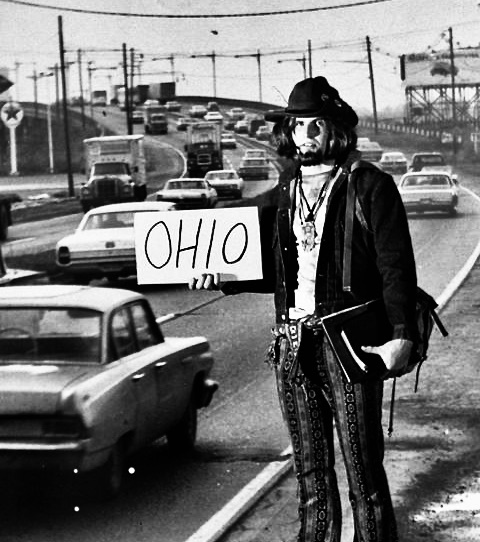
   When we got back to Cleveland everybody marveled at our quick turnaround from the west coast and attractive tans. “We didn’t actually make it to California,” we had to explain to one-and-all.  “We didn’t even make it out of Ohio.” We had to endure many snarky comments. When Virginia Sustarsic, one of my neighbors at the Plaza, said she was going to San Francisco and invited me to try again, joining her, I jumped at the chance. My feet got tangled up coming down when she said she was hitchhiking there.

   “You’re going to thumb rides across the country?”

   “Yes,” she said, in her detached but friendly way. She was a writer, photographer, and cottage craftsman. Virginia was a raconteur when she wanted to be one. She made a living dabbling in what interested her. She lived alone. Her boyfriend was an unrepentant beatnik.

   “How about getting back?”

   She explained she had arranged a ride as far as Colorado Springs. She planned on going knockabout the rest of the way, stay a week-or-so with friends on the bay, and hitchhike back. When I looked it up on a map, she was planning on hitchhiking four thousand-some miles. I didn’t know anything about bumming my way on the highway. When I asked, she confessed to having never tried it.

   Our ride to Colorado Springs was a guy from Parma and his girlfriend in a nearly new T2 Microbus. Although it was unremarkable on the outside, the inside was vintage hippie music festival camper. It was comfortable and stocked. We stopped at a lake in Illinois and had lunch and went for a walk. I veered off the path and got lost, but spotted Virginia and our ride, and cut across a field to rejoin them. I tripped while running, fell flat on my face, but was unhurt.

   We got to Colorado Springs in two days. The next day I found out what I had fallen into in Illinois was poison ivy. An itchy rash was all over my calves, forearms, and face. I tried Calamine lotion, but all I accomplished was giving myself a pink badge that said, ‘Look at me, I’m suffering.’” Virginia’s friends where we were staying let me use their motorcycle to go to a clinic. The doctor prescribed prednisone, a steroid, and by the time we got to San Francisco I was cured.

   In the meantime, leaving the clinic, since it was a warm and sunny summer day, I went for a ride on the bike, which was a 1969 Triumph Tiger. I rode to the Pikes Peak Highway, 15 miles west, and about half the way up, until the bike started to dog it. What I didn’t know was at higher altitudes there wasn’t enough air for the carburetor. By that time, anyway, I had gotten cold in my shorts and t-shirt. It felt like the temperature had dropped thirty degrees. I turned around and rode down. There was a lot of grit and gravel on the road. I rode carefully. The last thing I wanted to happen was to dump the bike. I found out later that Colorado snowplows spread sand, not salt, in the winter. 

   All the way back to town, as dusk approached, I saw jumbo elk deer and walloping antelope. Even the racoons were enormous. I stayed slow and watchful, not wanting to bang into one of the beasts. We stayed a few days and hit the open road when my rash was better. There was no sense in scaring anybody off with my pink goo face. We had a cardboard sign saying “SF” and finally hit the jackpot when a tractor trailer going to Oakland picked us up.

   The Rocky Mountains, left behind when the glaciers went back to where they came from, were zero cool to see, although I wouldn’t want to be a snowplow driver assigned to them. The weather was fair but cold with a high easterly wind the day we crossed them. Every switchback opened onto a panorama.

   Virginia’s friends in San Francisco lived in Dogpatch, which was east of the Mission District and adjacent to the bay. It was a working class partly industrial partly residential neighborhood. They lived in a late nineteenth century house they were restoring. They went to work every day while we went exploring.

   We stayed away from downtown where there was an overflow of strip clubs, peep shows, and sex shops. Skyscrapers were going up, there were restaurants, offices, and department stores, but it still looked like the smut capital of the United States. Elsewhere, rock-n-roll, jazz fusion, and bongo drums were in the air, especially the Castro District and Haight-Ashbury. Dive bars seemed to be everywhere.

   Virginia went to Golden Gate Park and took pictures of winos, later entering one of them in a show at Cleveland State University. She had a high-tech 35mm Canon. When her photograph was rejected with the comment that it was blurry, she said, “That was the point.” I went to Twin Peaks and took a picture of the spot where Chocolate George’s ashes had been strewn. When Arunas saw it later on, he said there wasn’t much to see. I showed him some pictures from the summit facing northeast towards downtown and east towards the bay. “Those are nice,” he said, being polite. My camera was a Kodak Instamatic.

   Twin Peaks is two peaks known as “Eureka” and “Noe.” They are both about a thousand feet high. They are a barrier to the summer coastal fog pushed in from the ocean. The west-facing slopes get fog and strong winds while the east-facing slopes get more sun and warmth. The ground is thin and sandy. George was somewhere around there..

   We stayed for more than a week, riding Muni city  busses for 25 cents a ride. No matter where we went there seemed to be an anti-Vietnam War protest going on. We rode carousel horses at Playland-at-the-Beach and went to Monkey Island at the zoo. We ducked into Kerry’s Lounge and Restaurant to chow down on French fries. We stayed away from all the Doggie Diners. We listened to buskers singing for tips at Pier 45 on Fisherman’s Wharf. Jewelry makers were all over the place. Virginia was on Cloud 9, being an artisan herself.

   When we saw “The Human Jukebox” we went right over. Grimes Proznikoff kept himself out of sight in a cardboard refrigerator box until somebody gave him a donation and requested a song. Then he would pop out of the front flap and play the song on a trumpet. I asked him to play “Stone Free,” but he played “Ain’t Misbehavin’” instead.

   “I don’t know nothing about Jimi Hendrix,” he said.

   Everywhere we looked almost everybody was wearing groovy clothes made of bright polyester, which looked to be the material of choice. Tie-dye was on the way to the retirement home. Virginia dressed in classic hippie style while I dressed in classic Cleveland-style, jeans, t-shirt, and sneakers. I didn’t feel out of place in San Francisco, but I didn’t feel like I belonged, either. There were no steel mills and too many causes to worry about.

   When we left, we started at the Bay Bridge and got a ride right away. By the time we got to the other end of the bridge the man at the wheel had already come on to Virginia. We asked him to drop us off. When he stopped on the shoulder and I got out of the back seat, he pushed Virginia out the passenger door, grabbed her shoulder bag, and sped away. She didn’t keep her traveling money in it, but what did he know? We saw the bag go sailing out the car window before he disappeared from sight and retrieved it. We smelled a brewery on the breath of the next driver and turned him down. After that a pock-marked face stopped and  asked us if we were born again. When I said I had been raised a Catholic, he cursed and drove off.

   We liked talking to the people who gave us rides but avoided talking about race, religion, and politics. I carried a pocket jackknife but wasn’t sure what I would do with it if the occasion ever arose. We never hitchhiked once it got dark, because that was when lowlifes and imbeciles were most likely to come out.

   We went back the way we had come, to Nevada, through Utah, Nebraska, and Iowa to Chicago, and returning in the middle of the day to the south shore of Lake Erie. We thumbed rides at entrances to highways, at toll gates, and especially at off-the-ramp gas stations whenever we could. Gas stations were good for approaching people and asking them face-to-face if they were going our way. 

   One of the best things about hitchhiking is you can take any exit that you happen to feel is the right one. One of the worst things is running into somebody who says, “I can tell you’re not from around these parts.” We avoided big cities because getting out of them was time-consuming. We avoided small towns because we didn’t want to be the new counterculture archenemies in town. We got lucky when a shabby gentleman in a big orange Dodge with a cooler full of food and drink in the back seat picked us up outside of Omaha on his way to Kalamazoo. He listened to a border blaster on the radio all the way. We ate the sandwiches he offered us.

   Our last ride was in an unmarked Wood’s County sheriff’s car. He picked us up near Perrysburg on his way to Cleveland’s Central Police Station to pick up a criminal. It was the same station where Jane “Hanoi Jane” Fonda was put behind bars a couple of years earlier. She was famous and not a real criminal and so didn’t stay long.

   “They said they were getting orders from the White House, that would be the Nixon White House,” she said about the arrest. “I think they hoped the ‘scandal’ would cause my college speeches to be canceled and ruin my respectability. I was handcuffed and put in jail.” The day  she was arrested at Cleveland Hopkins Airport, she pushed Ed Matuszak, a special agent for the U. S. Customs Bureau, and kicked Cleveland Policeman Pieper in a sensitive place.

   The city policeman later sued Jane Fonda for $100,000 for the kick that made him “weak and sore.” The federal policeman shrugged off the shove. The charges and suit were eventually dropped.

   The Wood County sheriff was a friendly middle-aged man who warned us about the dangers of hitchhiking and drove us to near our home. When we got out of the car, he gave us ten dollars. “Get yourselves a square meal,” he said. We walked the half dozen blocks to the Plaza, dropped off our stuff, and walked the block and half to Hatton’s Deli on East 36th St. and Euclid Ave. where Virginia worked part-time. There was an eight-foot by eight-foot neon sign on the side of the three-story building. It said, “Corned Beef Best in Town.” We had waffles and scrambled eggs.

   The waitress lingered at our table pouring coffee, chatting it up while we dug into apple pie. We split the big slice. The butter knife was dull, so I used my jackknife. She asked how our cross-country trip had gone. I gave her the highlights while Virginia went into details. When the waitress asked why we hadn’t gone Greyhound, Virginia smiled like a cat, but I put my cards on the table.

   “I had an itch to go and the stone free way was the way to go.”

Ed Staskus posts monthly on 147 Stanley Street at http://www.147stanleystreet.com, Made in Cleveland http://www.clevelandohiodaybook.com, Down East http://www.redroadpei.com, and Lithuanian Journal http://www.lithuanianjournal.com. To get the site’s monthly feature in your in-box click on “Follow.”

“Bomb City” by Ed Staskus

“A police procedural when the Rust Belt was a mean street.” Sam Winchell, Beyond Books

Available on Amazon: https://www.amazon.com/dp/B0F1LM1WF9/ref=sr_1_1?crid=2MYAQAOZIC2U9&dib=eyJ2IjoiMSJ9.hTm7BGbiQbSe5ZapFwYPPfcwOpTe-Vdg6VLE4aGyTyk.Z0R-VNBWWEcvKcNaO9LdCOUnNIOOXgvYkRS_FXiXuHk&dib_tag=se&keywords=bomb+city+ed+status&qid=1742136726&sprefix=bomb+city+ed+staskus%2Caps%2C84&sr=8-1

Cleveland, Ohio 1975. The John Scalish Crime Family and Danny Greene’s Irish Mob are at war. Car bombs are the weapon of choice. Two police detectives are assigned to find the bomb makers. It gets personal.

A Crying of Lot 49 Publication

Jimmy Crack Corn

By Ed Staskus

   When Layla told Jimmy she had called the police, he hustled to his pick-up truck and started scrounging, searching for his paraphernalia and drugs, especially the crack. He took a garbage bag full of narcotics into the big house and hid it. Afterwards he couldn’t remember where he had put it.

   “The devil knows where I stashed it!” he said. He was so mad about what had happened he could barely talk, which for him was spitting mad, since he talked at ninety miles an hour.

   “The pony run, he jumped, he pitched, he threw the master in the ditch, Jimmy, crack corn and I don’t care.”

   Layla and Jimmy had gotten into a knockdown fight a month earlier and he had left the big house in Florida, going to work in Pennsylvania. He was a heavy machine operator. When she called him after a month he high-tailed it back to her. But it wasn’t what he thought it was going to be.

   “Do you know this could put me back in prison?” Jimmy asked.

   “I’m sorry, I didn’t mean to, but my lawyer said I had to.” She was already regretting it.

   The police arrived and before he knew it slapped handcuffs on him. 

   “Whoa, whoa, whoa,” he said. “What are you arresting me for?”

   “You stole that pick-up truck,” one of the policemen said, pointing at the truck.

   “That is bullcrap,” Jimmy said. “I’ve been making payments every month to her for it. I was just in Pennsylvania for a month with it. She was fine with that. I can show you our text messages, where she always says, your truck, your truck, not my truck, yours.”

   “Let me see those text messages,” the policeman said.

   He went to their squad car. He scrolled through the texts. He fiddled with his vehicle’s mobile radio. When he came back he returned the cell phone to Jimmy.

   “I’d say it’s his pick-up truck,”  the policeman said to Layla. “That’s what you’ve been saying in all your text messages.”

   They took the cuffs off. They had to work out a few more details but finally drove away. Jimmy heaved a sigh of relief

   “You called the police on me,” he said to Layla, glaring at her.

   “We can work this out,” she said. She gave him a piece of paper, signed and dated, saying, this is my truck, in my name, but I have given Jimmy full power over it. 

   “There’s no working this out, night and day” he said. “You ruined everything.” 

   “No, Jimmy,” I told him later. “You ruined everything by going out and having a crack weekend. Maybe you shouldn’t have been that stupid.” He didn’t like that. “Don’t blame Layla because she called the cops. Yeah, it’s a crappy thing to do, but it gets to the point where you don’t give people too much choice. It’s always your way or the highway, and if they don’t like it, they can go, so, honestly, I can see where she’s coming from.”

   “Hey, I’m paying her every month for the pick-up,” he said.  “I’m not going to go back on my word. I’m never going back to her, either. She ruined everything.”

   He was talking on his cell phone. I could tell he was driving. I asked him where he was going. “I packed my stuff and I’m going to Colorado,” he said. His boys lived in Colorado. One of them was a Marine. The other one wanted to be a pilot, but his eyes were bad. 

   “Are you high?” I asked him. 

   “I don’t want to answer that,” he said.

   “You’re a special kind of stupid,” I said. “Getting high and drinking and driving, putting yourself and others at risk, you selfish bastard. What’s wrong with you?” 

   “They can’t nail me. I’m not drunk enough.” He had a forever taste for drink and cocaine. I was at a loss for words.

   “Your brother was an addict,” he said.

   “What’s that got to do with anything?”

   “He’s fat, too.” 

   “What? Are you two?” 

   “He replaced drugs with food.” 

   “I have no idea why you’re bringing Brian into this. And he’s not fat, not by far.” 

   “Don’t bother defending your fatso brother,” he said. He hung up and blocked me. He unblocked me a few days later. I sent him a text.

   “This friendship has reached its end. There’s nowhere for it to go.” 

   A month later I got an oversized letter in the mail. It was addressed to Jimmy. He had lived in our house for the best part of a year, getting back on his feet. Some of his mail was still being delivered to our home. He never bothered going to the post office to set up a forwarding address.

   He doesn’t want to hear how he used Shirley and me and never paid us back for everything we paid for while he was living in our house. He doesn’t want to acknowledge we took him in when no one else would, fed him, clothed him, and got him on his feet. What we got in return was nothing, not even a thank you.

   Inside the oversized letter were his new heavy machinery training certificate and new union membership card. Jimmy is notorious for ignoring people. I wasn’t like him. I texted him about the letter.

   “I got your working stuff, where do I mail them to? If I don’t hear from you, they’re in the trash tomorrow.”  He sent me his new address right away.

   We weren’t friends anymore, but we were still friends on Facebook. He posted things about me, playing the victim. “When people throw you out of your life” are the kinds of things he posted. He became a drama queen. 

   I admit when I’m wrong, and I would say to Jimmy, don’t be a dirtbag your whole life. I didn’t know what to do with him. He was constantly pretending he never did anything  wrong, no matter what side of the truth he was on.

   Jimmy and my brother Brian were once best friends, better friends than Jimmy and me, but not anymore.

   “I don’t want to see you again,” he said. “You bent over backwards for your brother but you’re always laying into me. This is the end of the road.”

   But Jimmy is a bad penny and bad pennies always turn up. He complains and explains night and day. “Inside of me are two dogs. One is mean and the other one is good. They fight each other all the time. When asked which one wins, I answer, the one I feed the most.” I expected Jimmy to resurface someday soon.

   When I couldn’t find my favorite suitcase a few days before Shirley and I were going down to Mexico for a week, I called him.

   “Do you have my suitcase?” I asked.

    “I’ve had it for three years,” he said.

   “We take it to Mexico every year. You haven’t had it for three years.”

   “Yes, I have, you’re wrong,” he said.

   “No, you’re wrong,” I said. 

   “No, I’m not.” 

   “Are you ever wrong, Jimmy?” 

   “No.”

   “You sound like you’ve had a few drinks,” I said.

   “Yeah, a few, but I work hard and I need recreation. After this I’m off to see the smoke  wizard. I’m not telling you for fun. I’m telling you because you want me to be honest. I don’t need any judgement from friends.”

   “I’m sorry, but you can’t have it both ways,” I said. “Either you have friends who care about you, or not, so I’m going to say you’re a good for nothing for smoking crack.”

   “I work hard all week. Layla knows what I’m doing,” he said. He was back in Florida in the big house.

   “Then she’s a bigger fool than I thought she was, for letting you smoke crack while you’re supposedly taking care of her.” Layla had more than one health issue. On top of that, she liked watching horror movies on TV and liked being disturbed by them.

   “What are you doing this weekend?” he asked, out of the blue.

   “It’s a blizzard outside, so I’m in the house cooking.”

   I did the cooking at home, although Shirley boiled water, peeled potatoes, and washed the dishes. I like to cook when it’s storming.

   “What are you making?”

   “I’m making spanakopita. It’s a Greek spinach pie, with onions, cheese, and herbs. It’s folded up in a flaky crispy dough.”

   “Oh, you mean spanakapita.”

   “I’m pretty sure it’s pronounced with an O,” I said. 

   “You’re a dimwit,” he said. “You never admit when you’re wrong, do you?” 

   “OK, you’re right. I’m making spanakapita. Happy now?” Why do I talk to Jimmy, I asked myself. Shirley refuses to speak to him.

   “Why do you even talk to that jackass?” she asks me.

   “Why are we even friends?” I asked Jimmy.

   “Are you going to tell me you’re not my friend anymore?”

   “Unfortunately, Jimmy, you and I have been friends since the 3rd grade. There’s just no getting rid of you.”

   “I took Layla to a French restaurant last week.”

   “So, you’re back in her good graces?”

   “Yeah.” 

   “How’s your dad? Is he still alive and kicking?”

   “Yeah.”

   I didn’t ask if his father hung out at Layla’s house anymore. For a while Jimmy’s father, an ex-Cleveland cop who retired south and lived nearby, had tried to get Layla for himself, before Jimmy finally won her over.

   “I heard Layla’s dad has showed up again down there.”

   “Yeah.”

  Layla’s father was a rich man with a twisted mind. like many rich men. Last year, when Jimmy started seeing Layla, he had a fit. In the first place, he hated Jimmy. He called him a loser. He said he was going to shoot him, although he never did. He was a coward at heart. He had an undying love for his daughter, but not the right kind of love.

   “I’m not allowed to be there when he comes over,” Jimmy  said. “I take off.”

   He knows it’s weird, but he makes himself scarce when Layla’s father comes over. She has a big spread, what with her polo ponies, so there’s a lot of landscape to lose yourself in. He didn’t lose himself on horseback. He couldn’t ride to save his life.

   “I don’t understand your life,” I said.

    “I’m being honest,” he said.

   “That doesn’t mean I have to like it. It doesn’t mean I don’t worry about you. You’re romancing a woman 20-some years older than you, who has a father who’s like a hundred, and who, we won’t even talk about that, and you are smoking crack every chance you get.”

   “Everybody has a few drinks. Why can’t I have some crack?”

   “They don’t serve crack at bars in this country, not even Florida, that’s why,” I said.

   “I can control it,” he said.

   “Right, says every crackhead and none ever did,” I said.

   “When I was young I used to wait on master and give him his plate, and pass him the bottle when he got dry, and brush away the blue tail fly, Jimmy, crack corn and I don’t care.”

   “I do my work, then I chill, hang out, be myself,” Jimmy said. He works construction all week, and had started working for Layla, too, doing small jobs, in her house and around her property.

   “Why shouldn’t I do the work, instead of the wetbacks?” he said. “Why shouldn’t I earn the money?”

   What Jimmy likes is Layla has got money and a big house. What she likes is the fun, games, and sex. They are both getting what they think they want. They don’t care about rain as long as they get their rainbows.

   “Basically, you’re doing whatever the hell you want, and she’s doing whatever the hell she wants,” I said. “You’re both femme fatales.”

   That didn’t go over well. Jimmy says he’s being honest whenever he says whatever he says, but he doesn’t want any trueness in return. He thinks you’re getting in his face. Every time we talk, he tells me why he’s the greatest and why Shirley and I are idiots. 

   “Why won’t your wife talk to me?” he asked. 

   “Because you ran out on us after we took care of you when you were down and out,” I said. 

   “That’s not true,” he said.

   “How do you see it in your world?”

   The crack he’s smoked for years hasn’t changed Jimmy all that much. He’s still as selfish and self-righteous as he always was. Shirley says that he will never grow up because he thinks he’s not wrong and will never be wrong, 

   When I told him Shirley’s new business had turned the corner and was doing well, he didn’t want to hear it. When I first told him about it, what she was planning, he told me she would fail, for sure. Nothing is what Jimmy said when I told him her business was growing. For once, he had nothing dismissive to say.

   When Jimmy broke up with Layla the second time it was because, when she got fussy about his drug use, he told her that her addiction to pain medicines and her drinking weren’t any different than his smoking crack and drinking. He told her he was going to smoke crack every day, and that was that. When Jimmy gets it into his head that something is going to be, there’s no changing his mind. Layla thought he was crazy. They got into a knockdown fight.

   “I’m never coming back,” he said at the end of the fight. He walked out of the big house and gave his pick-up truck back to her, but before he did he went mud bog racing with it. .When he was done, the first place trophy in his lap, the pick-up truck wasn’t good for anything anymore. He left with his suitcase, his phone, and his wallet. He walked to the bus station.

   “I dropped a truth bomb on her,” he said.

   “I’m going to drop a truth bomb on you,” I said. “You’re homeless, you’re living out of your son’s van, and you don’t have a job.”

   “I’m trying to find work,” he said.

    JJ and Alex, his sons, had a house in Colorado. They invited him to visit them, with the intention of doing an intervention on their father. He got stoned and stayed stoned the whole way, hitching rides with truckers, lost his phone, lost his wallet, and lost his way, but somehow made it there. When he found out what they were up to, he got his hands on Alex’s new van one night and beat feet. 

   “How dare they pull that bullcrap on me!” he fumed.

   Trying to get Jimmy to do something he doesn’t want to do is like trying to dam up Niagara Falls with toothpicks. He drove to Oklahoma where he drove the van into a ditch. He stole two old tires and got back on the road. He made it to Georgia. He called me. He had gotten another phone, somehow.

   “I’m coming to Cleveland.”

   “Why?”

   He showed up a week later. He didn’t have any money. He had stolen his way from Atlanta to Cleveland. He would go to a Walmart, steal bread and cold cuts, go to gas stations, and steal gasoline and snacks. When he had to, he found a backyard bird feeder and ate all the seeds.

   “I have a Home Depot gift card,” he said. “Can you buy it off me?”

   “I’ll think about it.” 

   “You know it’s stolen, don’t you?” Shirley asked me.

   “Yes.”

   Jimmy steals merchandise from big box stores, returns it later for a refund, claiming he has lost the receipt, and gets gift cards in return. He can be slick when he’s beggared.

   We met him for breakfast when he got to Cleveland.

   “I don’t have any gas,” he said, wolfing down ham and eggs and a plate of pancakes.

   “I’ll fill your tank up,” I said.

   He was hoping we would ask him to stay at our house. I could tell. I brought it up to Shirley later at home. But, buying him breakfast and filling up his gas tank was as far as it was going to go.

   “He’s not sitting on our sofa, much less staying at our house,” she said.

   Jimmy called me again about buying the Home Depot card.

   “How much is it?” I asked.

   “It’s $186.00, but you can have it for a hundred.”

   I knew it was throwing money away. We would never use it. It would just be something to help Jimmy out.

   “I have to get out of Cleveland,” he said.

   “Who did you piss off?”

   “Nobody,” he said. 

   “Did you steal some drugs?”

   “I just need to go,” he said.

   “You are such an asshole.”

   “All right, but are you going to buy this gift card, or not?” 

   “OK, I’ll come and get it. I just need to stop at an ATM.”

   “No, I’ll come and get you,” he said.

   Like a fool, when he came over, I got into his van to go to the ATM. He went flying down Detroit Rd. in Lakewood and sideswiped a parked car. He didn’t stop. He just kept going.

   “Stop the car,” I yelled. He stopped some blocks later when he ran into a fire hydrant. It began to spay water.

   The side of his son’s new van, on the passenger side, where I was sitting, was potholed from bumper to bumper. The front bumper had fallen off when he hit the hydrant. Trash and empty cans of Mountain Dew were scattered everywhere inside the van.

   “Do you know you just smashed your kid’s new van? And you drove away. You could have killed me.”

   “I know, but I promise I’ll be good.”

   “Did you steal all that food?” I asked. There were loaves of white bread, jars of Jiffy peanut butter, and half-eaten candy bars a gogo.

   “A guy’s got to eat,” he said.

   The next day JJ called.

   “Alex is in Cleveland,” he said. “He’s gone there to get the van back from our dad.”

   “JJ, why didn’t you tell me he was coming? Jimmy was here yesterday, but now he’s gone.”

   “We called him yesterday and said Alex was coming.”  

   “That was a mistake,” I said. “He’s gone to Canton.”

   “Why Canton?”

   “Because Alex isn’t in Canton, that’s why. He’s hiding from you.”

   They finally located him and Alex went to see him. They met in Canton behind a bowling alley. But Jimmy parked the van a couple of blocks away, so Alex wouldn’t see it and take it away from him. They talked, but Alex never got the van back. He went back to Colorado and Jimmy went back to living in parking lots.

   “When he’d ride in the afternoon, I’d follow after with a hickory broom, the pony being rather shy when bitten by blue tail fly, Jimmy, crack corn and I don’t care.”

   Jimmy thought I had led his sons to him. He thought I was conspiring with them to take the van away from him. He called me on the phone and called me every name in the book.

   “Even though you do what you do to your kids?”

   “That’s right,” he said.

   “You treat them worse than junk yards treat their dogs.”

   He barked like a dog, trying to get under my skin.

   “The only way you’ll ever get that van back is if you report it stolen,” I told JJ when I talked to him later.

   “No, I can’t do that,” he said. “My dad would go to jail if I turned him in.”

    “Maybe that’s what he needs,” I said. “Maybe he needs to be behind bars for a while breaking rocks and thinking things through.” JJ and I both knew he would end up behind bars sooner or later, but whether he would turn things over was anybody’s guess. Jimmy was not especially a thinking kind of man. He was a cracking the corn kind of man.

Ed Staskus posts monthly on 147 Stanley Street http://www.147stanleystreet.com, Made in Cleveland http://www.clevelandohiodaybook.com, Down East http://www.redroadpei.com, and Lithuanian Journal http://www.lithuanianjournal.com

“Cross Walk” by Ed Staskus

“Captures the vibe of mid-century NYC, from stickball in the streets to the Mob on the make.” Sam Winchell, Beyond Fiction

Available on Amazon: https://www.amazon.com/dp/B0CRPSFPKP

Late summer and early autumn. New York City, 1956. President Eisenhower on his way to the opening game of the World Series. A hit man waits in the wings. A Hell’s Kitchen private eye scares up the Cold War shadows.

A Crying of Lot 49 Publication

Cat and Mouse

By Ed Staskus

   When Frank Gwozdz and Tyrone Walker sat down in front of Lieutenant Ed Kovacic’s desk, Tyrone had a thick sheaf of files with him. Their ranking officer behind the desk looked at them. Tyrone looked at his ranking officer. Frank looked at the windows. It was windy and raining hard. The Central Station wasn’t what it used to be. Frank watched rain leaking in through the windows. He believed in keeping the out of doors where it belonged, which was out of doors. It wasn’t his problem, though. The city’s solution to  problems was often as bad as the problem. He turned his attention back to the matter at hand.

   “These are files of all the bombings the past five years in northeast Ohio, including the Youngstown bombings, which are almost as everyday as ours,” Tyrone said. Youngstown had long since been dubbed “Crime Town USA” by the Saturday Evening Post. Their gang wars had been going on as long as those in Cleveland. 

   “You can keep those on your lap for now, son,” Lieutenant Kovacic said. “Never mind about northeast Ohio. Forget about Youngstown. Concentrate on Cleveland.” A close second to Tyrone not liking being called nigger was not liking being called son. He did a slow burn but didn’t say anything. Saying something would have been a mistake. He bit his tongue.

   Ed Kovacic wasn’t born a police officer. He was born a Slovenian and baptized at St. Vitus Catholic Church, but everybody knew he was going to die a police officer. When he did the funeral mass was going to be at St. Vitus. Whenever anybody called him a cop, he reminded them with a stern look that he was a police officer. He hardly ever had to say it twice. When he did have to say it twice, his fellow police officers took a step away from whoever had called him a cop one too many times.

   “We don’t mind the Irish and Italian mobs blowing each other up, it keeps our cells spick and span, but they’ve started killing bystanders,” he said. “We can’t stand for that, which is why we are adding men to this investigation.”

   When Ed Kovacic graduated the police academy the first assignment he had was to walk a beat in the 6th District. He worked his way up to the Decoy Squad, the Detective Bureau, and finally the Bomb Squad. He married his high school sweetheart in 1951 before shipping off to the Korean War. When he got back he and his wife got busy in bed making six children. After that his wife stayed busy raising them. They lived in North Collinwood. 

   “We want to get them before they get more civilians. That’s your number one job from now on. When you’ve got the goods on one of them report to me. Make sure the charges are tight as a drum so we don’t wind up wasting our time. If you apprehend somebody red-handed, do what you have to do. Try to get him back here in one piece so we can question him.” He gave his police detectives a sharp look. 

   “Are we clear about that?”

   “Yes, sir,” Tyrone said. He knew his rulebook inside and out. Frank nodded. He had his own rule book spelling out what one piece meant. It meant still breathing.

   “The first thing I want you to do is go over to Lakewood. I talked to the chief there and he’s expecting you. After you see him, I want you to find Richie Drake and find out what he knows, or at least what he’s willing to tell you. He’s one of our on-again off-again informers. He’s a west side man. I understand he spends most of his life at the Tam O’Shanter there in Lakewood.”

   “I know the man and I know the place,” Frank said. He knew every stoolie in town, just like he knew every bar on every side of town that served food and drink to wrongdoers.

   “Which reminds me, the Plain Dealer boy who saw it happen, his father called, said the boy has something to tell us. Here’s the address.” He handed Frank a slip of paper.  “Stop there while you’re on that side of town and find out what he has to say.”

   Lakewood City Hall, its courtroom, and the police department, were on Detroit Ave., closer to Cleveland than the rest of the near west side suburb. Frank parked in the back. He and Tyrone went inside and waited. When they met with the police chief there wasn’t much he could tell them, other than to say his department would do all it could do to help. 

    “We believe in law and order here,” he said. “You point them out, we’ll lock them up.”

   Lakewood’s first jail was in the Halfway House, which was a bar on Detroit Ave., in one of the back rooms that had a locking door. It was soon relocated to a barn where lawbreakers were kept in two steel cages. After that they were kept in the basement of a sprawling house at the corner of Detroit Ave. and Warren Rd.

   After World War One Lakewood’s main streets, like Detroit Ave. and Clifton Blvd., began to be paved. When they were, speeding problems surfaced. The police force grew, adding two motorcycle men, to patrol Clifton Blvd. and Lake Ave., the streets where the better half lived. A Friday Night Burglar plied his trade on those streets, forcing the police to work overtime while those they were protecting were out on the town. The burglar was never caught. The better half bought more valuables to replace those that went missing.

   When Frank and Tyrone walked into the Tam O’Shanter the late afternoon crowd was starting to fill it up. They made their way to the bar. The bartender asked them what they would have.

   “Don’t I know you?” Frank asked.

   Jimmy Stamper was the bartender. “Maybe, but I don’t know you,” he said, wiping his hands with a damp rag.

   “Are you in a band?”

   “I’m a drummer, been in plenty of bands,” Jimmy said.

    “Are you in a band called Standing Room Only.”

   “You have a good memory,” Jimmy said. “That would have been around 1969, maybe 1970. It sounds like you liked our sound.”

   Frank didn’t tell Jimmy he had been tailing a suspect who was at a bar the band was playing at. The man stayed there until closing time which meant Frank stayed there until closing time. Surveillance was the easiest but most time-consuming part of his job. He had never liked rock and roll and after that night he disliked it even more. Standing Room Only played rock and roll covers. The only one Frank liked was their cover of the Venture’s tune “Hawaii Five-O.”

   “We’re looking for Richie,” Frank said, flashing his badge just long enough for Jimmy to get a peek of it. The bartender hitched his thumb over his left shoulder. “Last booth over there by the men’s toilets. He’s got a blonde with him. He should still be sober. At least he’s still doing all the sweet talking.”

   Frank sat down on the other side of Richie Drake after giving the blonde the thumb. “Drift” is what he said to her. She sat at the bar sulking. Tyrone stood to the side, neither near nor far, but close enough so that Richie knew he was between him and the door. Pinball machines and their pinball wizards were making a racket opposite the booth.

   “What can I do for you?” Richie Drake asked.  He didn’t bother asking who they were.

   Somebody slid a dime into the Rock-Ola jukebox. “It’s just your jive talkin’, you’re telling me lies, yeah, jive talkin’” the Bee Gees sang in their trademark falsetto style. Frank thought they sounded like pansies.

   “That business last Sunday down the street,” Frank said.

   “What business?”

   “You can either tell me here or out back while my partner has a Ginger Ale.”

   “Hold your horses,” Richie said. “Everybody knows it was the Italians.”

  Why?”

   “I don’t know, exactly, but it had something to do with the Irishman. The guy who got it was a bog hopper. They can’t get to the main man, but they got to him.”

   “One more time, why?”

   “So far as I know, it was a message more than anything else.”

   “A message from who exactly?”

   “The way I hear it, it was Jack White.”

   Frank let it go at that. It seemed to him that Richie Drake didn’t know a hell of a whole lot. The police detective stood up and walked away. He stopped at the Rock-Ola jukebox and glanced at the playlist. He walked back to the booth. “I need a dime,” he said. Richie gave him a dime. He selected a song by B. J. Thomas. The juke box was playing the tune when he and Tyrone left.

   “Hey, wontcha play another somebody done somebody wrong song, so sad that it makes somebody cry, and make me feel at home.”

   Frank and Tyrone drove to Ethel Ave. They stopped and looked at Lorcan Sullivan’s corner house but didn’t bother getting out of the car. They drove to Tommy Monk’s house, parking across the street. Frank pressed the doorbell. When nobody answered they walked up the driveway to the backyard. The family was grilling out and having burgers and corn at a picnic table. A sweet gum tree kept them shaded. Chain link fencing and Japanese yews kept the yard private. Tommy’s father Einar invited them to sit down, bringing two lawn chairs out from the garage. Einar had changed the Old World family name but kept his given name. For all that, everybody and his wife called him Eddie.

   “How did you know the man in the corner house?” Frank asked Tommy. 

   “I delivered his paper every day,” Tommy said. “I knew him better than most because he tipped me better than most.”

   “Did you see anything before it happened?”

   “No, it was like any other Sunday morning, except it wasn’t raining or snowing.”

   “Did you see anything special after it happened?”

   “No.”

   “What is it you have to tell us?”

   “Mr. Sullivan asked me to keep an eye out for anybody prowling our street who didn’t look right. He always gave me a big bonus at Christmas. He told me what to look for. I never saw anybody until yesterday. The man I saw was just like what Mr. Sullivan said he might be. I memorized his license plate.”

   “What is it?”

   “Wait a minute,” Tommy said. “I need a copy of the newspaper.”

   He ran to the back door. A minute later he burst back through the door and ran to the picnic table. He had the front page of yesterday’s Cleveland Plain Dealer with him. He crossed out the headline and in its place wrote down the license plate number. He handed it to Frank.

   “Are you sure this is the number?”

   “I never make a mistake whenever I memorize anything this way.”

   “Good work, son,” Frank said. “If you see that man again, be careful. Don’t draw any attention to yourself. Tell your father right away.”

   He gave Eddie Monk his number. “Call me if your son spots anything else. I don’t think there’s any danger to him, but you never can tell. Make sure he knows not to talk to strangers.”

   “All my children already know that,” Eddie Monk said.

   “Good,” Frank said.

   The police detectives walked back to their car. Tyrone called in the license plate number. Frank smoked a cigarette while they waited. Tyrone had already formed  the impression Frank wasn’t big on small talk. He seemed to keep most talk to himself. When they got the license plate’s street address, Tyrone wrote it down and handed it to his partner.

   “That’s in South Collinwood,” Frank said. “Let’s go there and pay Earnest Coote a visit.”

Excerpted from the crime novel “Bomb City.”

Ed Staskus posts monthly on 147 Stanley Street http://www.147stanleystreet.com, Made in Cleveland http://www.clevelandohiodaybook.com, Down East http://www.redroadpei.com, and Lithuanian Journal http://www.lithuanianjournal.com

“Bomb City” by Ed Staskus

“A police procedural when the Rust Belt was a mean street.” Sam Winchell, Beyond Books

Available on Amazon: https://www.amazon.com/dp/B0F1LM1WF9/ref=sr_1_1?crid=2MYAQAOZIC2U9&dib=eyJ2IjoiMSJ9.hTm7BGbiQbSe5ZapFwYPPfcwOpTe-Vdg6VLE4aGyTyk.Z0R-VNBWWEcvKcNaO9LdCOUnNIOOXgvYkRS_FXiXuHk&dib_tag=se&keywords=bomb+city+ed+status&qid=1742136726&sprefix=bomb+city+ed+staskus%2Caps%2C84&sr=8-1

Cleveland, Ohio 1975. The John Scalish Crime Family and Danny Greene’s Irish Mob are at war. Car bombs are the weapon of choice. Two police detectives are assigned to find the bomb makers. It gets personal.

A Crying of Lot 49 Publication

Mystery Street

By Ed Staskus

   I was ten years old the first time I saw a dead man. It was the morning of Holy Saturday. The sky was low and thick with clouds. It looked like it might rain any minute. My best friend Feliksas, a Lithuanian kid like me who everybody called Felix, and I had walked to the VFW hall behind the Gulf gas station at the corner of Coronado Ave. and St. Clair Ave.  It was a log cabin-like building with dusty windows. We didn’t have anything in mind except seeing the sights and messing around. We liked to slip behind the steering wheels of unlocked cars waiting to be repaired in the lot next to the gas station and pretend adventures on dangerous roads.

   When Felix noticed flashing lights on St. Clair Ave. we went around the corner to the front of the gas station. There were two black and white Cleveland Police Department prowl cars and an ambulance there. We called their rotating lights gumball machines. We called the sirens growlers. The black and white ambulance was a Ford station wagon that was both a police car and an ambulance. A policeman was standing around doing nothing while another one kept the crawling traffic on the other side of the street on the move. The traffic on our side was filtering down side streets. The ambulance men were standing beside their black and white station wagon smoking cigarettes.

   We stood to the side of a cluster of grown-ups who were tossing glances at the dead man on the ground. Nobody was saying much. We stepped closer to the man until we were standing over him. We looked down at him. He was lying on his back, partly on the sidewalk and partly in the street. He was wearing a white shirt and a plaid jacket. One of his shoes was missing. The other one was a tasseled loafer. One of his front teeth was cracked from when his face hit the concrete going down.

   The front of his white shirt, open at the neck, was a blob of red. Some of the red was damp while the edges of the blob were going lifeless. Flies were buzzing around him. We  jumped when the dead man moaned.

   “Do you need some help?” Felix asked

   “Getting bumped off is the only help for being alive,” the dead man said in a low tone of voice.

    Felix stepped up to the stone-faced policeman doing nothing. “That man is trying to say something,” he said.

   “That man is dead,” the policeman said. “Leave him alone.”

   “Who is he?” I asked. I had never seen him in our neighborhood before.

   “He was a hoodlum.”

   “Did you shoot him?”

   “No, not us. He spun the big wheel and lost.”

   “What’s the big wheel?”

   “Never mind kid.”

   There was a dark green car parked between the gas pumps and the station. It had white wall tires. We went over to look at it. The windshield was smashed, like somebody had thrown a rock through it. We looked inside. There was dried blood on the front seat. When I looked up I saw ‘Happy Motoring!’ stenciled on the plate glass windows of the station. We turned back to the street.

   “Tell them not to bury me in the Glenville Cemetery,” the dead man said.

   Glenville Cemetery was a graveyard next to the New York Central railroad tracks not far away. It lay in a triangle of land between St. Clair Ave. and Shaw Ave.  We could walk there down E. 129th St. in ten minutes. We always passed it on our way to the Shaw Hayden Theater where we went to see  monster movie matinees.

   “Too many Jews,” the dead man said. “And now they’re burying niggers there.”

   What does it matter, I thought, even though I didn’t know very much about Jews or niggers. I didn’t know much about graveyards, either.  I always wondered what my father meant  when he said he had to work the graveyard shift. How much work do the dead need done for them? I had never been to a funeral, except for two funerals at St. George Catholic Church, where I was training to be an altar boy. I had sat in a back pew those two times and observed the goings-on as part of my training. I dozed off during the second service.

   I noticed the knot of grown-ups was gone. The stone-faced policeman and the ambulance men were still standing around waiting for something. The other policeman was standing on the corner waiting for the traffic light to change, except there weren’t any more cars. There wasn’t anybody in sight. There wasn’t a single person going into a single store even though it was shopping day. St. Clair Ave. was usually busy with women shopping at the A & P and all the other stores. Nobody seemed to be going home with a ham for Easter. Where was everybody? 

   A young woman came running down the street, pushed past the policemen, and threw herself on top of the dead man. Her hair rolled down her shoulders. The curls of her hair smelled like wet ashes. She started to cry, quietly rubbing the tears off her face with the sleeve of her dress.

   The dead man wiggled a forefinger and motioned for me to come closer.

   “Do a pal a favor, kid,” he said. “I don’t want her to cry over me and I don’t want her asking me for anything. Get her off me and help her home. It’s just around the corner. I was on my way there when I got mine.”

   The two ambulance men lifted her off him, got her steady on her feet, and Felix and I helped her back to her apartment. She lived on the second floor of a two story brick building on Dedman Ct. a block away on the other side of Lancelot Ave. It looked like nobody lived there. Most of the windows and the front door were broken. The roof was partly caved in. The lawn was choked with weeds.

   “Nobody lives here except me,” she said.

   “Was that man your boyfriend?” Felix asked.

   “No, my boyfriend disappeared two years ago, on the second day of 1959. I heard he joined the merchant marine, hauling ore on the Edmund Fitzgerald.” The Edmund Fitzgerald was the biggest boat on the Great Lakes. “Whoever that is lying on the cement over there looks like he’s got a free pass to the graveyard down the street.”

   “He asked us to make sure he wasn’t buried there.”

   “I don’t know why. He always said he was Italian, but he was half Jewish and half Negro, too.” 

   She turned to Felix. “Isn’t your name Feliksas?” she asked.

   “Yes, how did you know?”

   “Do you know your name means lucky?”

   “No, I didn’t know, nobody ever told me. How do you know my name?”

   “I know everybody’s names, everybody in this neighborhood, everybody on their way to the boneyard, where everybody is going, sooner or later, trying to not hear their own hollow footsteps. Forgiveness of sins and resurrection of the flesh.” Felix’s eyes got wide. I was getting spooked. A crow on top of the roof cawed three times.

  “What was your boyfriend’s name?” Felix asked.

   “I don’t know,” she said. “I think it was Frankie Paramo, but I’m not sure anymore. I’m starting to forget what he looked like.” She leaned against a shadow. Her face was going limpid. “May he rest in peace,” she said. Her voice was a thin lament. We went down the front walk to the sidewalk. When we turned to wave goodbye she wasn’t there anymore, like she had never existed.

   The gas station was in front of us before we knew it. I felt torpid and restless at the same time. The dead man was where we had left him. We took a step over to where he was. He looked up at the sky and said, “Life, what did you ever do for me? It’s my turn now. I’m not going to do anything for you anymore.”

   His words were muffled. His eyes were like dull marbles. Felix yawned like he was nervous. When we glanced at the dead man again he was blurry like there was an eclipse of wet moths around him flapping their wings. A dog barked monotonously in a backyard on Coronado Ave.

   A four-door Oldsmobile raced down St. Clair Ave. “What the hell does he think he’s doing,” one of the policemen groused. Not everybody saw the big car go past. It was like trying to see a falling star during the day. Felix said it was his Uncle Gediminas. Most of the Lithuanians in Cleveland lived in Glenville, although all of them were moving to North Collinwood. I had heard my father tell my mother one night they would have to start looking for a new house soon, or urban renewal would make our family home worthless. I didn’t know what urban renewal meant, although it sounded bad. I knew worthless meant bad. 

   Uncle Gediminas was an middle-aged undersized man with an old man’s turkey neck. He was an accountant and could afford a new car whenever he wanted one, even though he unfailingly bought used cars that burned oil. “He’s always staring down his kids,” Felix said. “All his kids are afraid of him. He bosses them around day and night.” 

   The street was full of echoes, even though the few people on the street weren’t saying anything. It felt like somebody was following us. We looked everywhere but couldn’t spot anybody.

   “Do you want to wait for him to die?” Felix asked.

   “I don’t think he has much time left even though the policeman said he’s already dead.”:

   “Not dead enough,” said a man walking past. His hair was shiny with Brylcreem and he was wearing a bowling alley shirt. He spit in the gutter before crossing St. Clair Ave.

   “Let’s wait,” I said to Felix.” I don’t want to just sneak away.”

   “You found out I’m not long for this world?” the dead man said. “I’ve known that for a while now, since the beginning. I don’t like it when people talk about me like I’m not here. You kids should go home where you belong.”

   “Is your name Frankie?” Felix asked.

   “Yeah.”

   “Do you believe in Heaven?”

   “I believe in Hell.”

   The sky got dark. It started to rain. It was a steady rain. The ground got full of worms. The dead man started to melt. When he started melting there was no stopping him. Five minutes later he had come undone and was a pile of mud. One of the policemen stepped up to him. “There’s no sense in getting worked up about it. Call off the pathologist. Call the fire department instead. They can hose him down the drain. It will save the taxpayers the trouble of an autopsy and a burial.”

   We were soaking wet after a minute of rain. We got chilled and goosebumps popped up on our arms and legs. Felix ran home down Coronado Ave. and I ran home down Bartfield Ave. Even though it was storming and had gotten darker, none of the houses were lit up. They were all shade and shape. We lived in a side-by-side Polish double that my parents bought on the cheap with my father’s sister and her family when they had emigrated to the United States.

   Our front door was locked. I ran to the back door. It was locked. I knocked but nobody came to the door. I kicked at it but still nobody came to let me in. I went into the backyard to the tornado doors. They were never locked. One of the doors had a handle. I pulled on the handle. The doors were locked.

   A German widow lived next door to us. Her husband was dead and her children had moved away. She was alone in the world. In a week she would be one hundred years old and her solitude would be full-fledged. I ran to her house. She was sitting on a lawn chair in the middle of her basement. A small storage room was where she kept her canned goods. She kept carrots, radishes, and potatoes in bins. She was writing in a spiral-bound memo pad. 

   Her memory was on the fritz. She wrote notes and Scotch taped pictures in her pad. There were pictures of my father, mother, brother, sister, and me, and our names in the pad. There were pictures of her fridge and stove and what they were called, which was fridge and stove. There were diagrams of all her rooms and everything in the rooms, what they were for and what they were called. There was a scrap of paper pinned to the front of her house dress. Her name, Agatha, was written on the paper in block letters.

   “My stomach is shriveled up from hunger,” she said, even though she had enough food stored in the basement to last a year. She often forgot to eat. My parents checked up on her every few days.

   “Where is everybody?” I asked.

   “Your family is all in the house. They are watching the TV. They will be sorry if a tornado comes. I told them so, but they wouldn’t listen.”

   “Can I borrow the key to get into our basement?”

   She had it in a pocket of her apron. She handed it to me. I unlocked the doors and swung them open. The concrete steps led to the cellar. They were slippery with slime. It was where our father told us we had to go whenever there was a tornado. He told us about the last one in Cleveland in 1953 that killed nine people, injured three hundred, and left two hundred homeless when their homes were blown away. “The cellar will protect us from high-speed winds and flying debris,” he said.

   I ran up the stairs to our kitchen. All the lights in the house were on. My  brother and sister were arguing on the living room floor while my parents watched the weatherman on the TV. We had an old Zenith. The only time it worked right was when there was a clear sky. There was a clap of faraway thunder. The TV went fuzzy. I couldn’t understand a word the weatherman was saying.

   “Where have you been?” my mother demanded. “You’re all wet. Go change your clothes before you catch your death of cold. And don’t touch the Easter ham. That’s for tomorrow.”

   “I didn’t know you were home,” I said. “The house was dark and locked up.”

   “What do you mean dark and locked up? Your father and I went grocery shopping but got back an hour ago. It was so busy out there. What with this gloom in the middle of the day, the house has been lit up since we got home.”

   My brother, sister, and I slept upstairs in the front bedroom. Our sister slept in a corner. Our parents slept in the back bedroom. They needed privacy by night. There was a bathroom and a linen closet. I dried off with a bath towel. I changed my clothes and sat on my bed looking out on Bartfield Ave. All the houses on the street were suddenly bright in new sunshine. The police cars and ambulance in front of the Gulf gas station were gone. The pile of mud that had been the dead man was gone. A firemen had a hose on the ground, where he had flattened it, and was rolling it up to put back on the pumper. 

   I ran up the street and found Felix on his way to meet me. We got our bikes and rode down Eddy Rd. and through the village of Bratenahl to Gordon Park on the Lake Erie shoreline. The sun made the mist in the air sparkle and bent the light. We sat on the edge of an overhang on a steep bank of the lake and watched a rainbow hover in the sky until it vanished off the face of the earth.

Photograph by Fred Lyon.

Ed Staskus posts monthly on 147 Stanley Street http://www.147stanleystreet.com, Made in Cleveland http://www.clevelandohiodaybook.com, Down East http://www.redroadpei.com, and Lithuanian Journal http://www.lithuanianjournal.com

“Cross Walk” by Ed Staskus

“Captures the vibe of mid-century NYC, from stickball in the streets to the Mob on the make.” Sam Winchell, Beyond Fiction

Available on Amazon: https://www.amazon.com/dp/B0CRPSFPKP

Late summer and early autumn. New York City, 1956. President Eisenhower on his way to the opening game of the World Series. A hit man waits in the wings. A Hell’s Kitchen private eye scares up the shadows.

A Crying of Lot 49 Publication

Mexican Stand Off

By Ed Staskus

   The day my nephew, who was going to be known by the name of Ike from that day on, told me he was changing his name to Wyatt, all I could think of saying was, “Why?” He looked up from his Xbox. He was sitting in a special gaming chair. There was carnage all over the big screen. The game was called Streets of Rage. It looked like everybody was losing.

   “What do you mean, why?” he asked.

   It turned out he had watched the horse opera “Tombstone” the night before and been enchanted by Wyatt Earp.

   “That might not work,” I said. 

   “Why not?”

   “Wyatt Earp was a lawman through and through. Your law-abiding ways are sketchy at best.”

   “Oh, right, I see what you mean. How about Doc, like Doc Holliday? He was smack.”

   “He was that, but he’s more along the lines of a Greek tragedy. I don’t see you as tragic.”

   “Hell no, I’m not tragic. The girls wouldn’t like that.”

   “How about Ike?” I suggested.

   “Who’s that?”

   “He was one of the cowboys in the movie, fast with a gun.”

   “OK, that sounds good. Ike it is from now on.”

   I didn’t tell him Ike was one of the bad cowboys who had tried to kill Wyatt Earp at the OK Corral.

   Ike was smart enough to make the grade and get admitted into St. Edward High School but scatterbrained enough to get suspended. St Ed’s is a Catholic school in Lakewood, Ohio in the Holy Cross tradition. Thousands of teenage boys apply to get in every year. A couple of hundred make it. Ike  had enough applesauce in him to not get expelled. He made it to graduation day by the skin of his teeth.

   He wasn’t so lucky at Cleveland State University. CSU is a state school. So long as your high school grades are somewhere near consciousness there is no problem getting admitted. After one thing and another he was told in no uncertain terms he had to find another school. When he left CSU, leaving his student housing apartment in need of disaster relief, he started looking for another place to live.

   His problem was no landlord with even a grade school education would rent to him. He camped out at his sister’s apartment until she said he had to go. His father suggested his uncles. He stayed with one after another until the last one told him he had to go. He stayed at my mother’s house, throwing parties for his friends whenever she broke a leg and was recovering at the Cleveland Clinic or had a stroke and was recovering at the Welsh Home in Rocky River. 

   When my brother asked me to throw some work his son’s way, I was of a mind to say no. It was almost the first thing I said. It was what I should have said. I had already hired Ike to waterproof our basement walls and repaint the concrete floor some months earlier. Every time I looked, he was easing himself down onto one of our lawn chairs and lighting up. He liked to smoke reefer rather than attend to the job at hand. When he wasn’t blazing, he was talking on his cell phone. In the end it was such a makeshift effort that I spent almost as much time in the basement as he had done, following up on his no effort work.

   I thought, that’s the last time. What I said, though, when my brother asked, was OK. I could have kicked myself.

   I worked more-or-less full-time for Light Bulb Supply in Brook Park. There were no brooks or parks anywhere in Brook Park. The biggest greenspace was Holy Cross Cemetery, 240 acres of it, across the street. I went there for walks instead of taking lunch whenever the day was dry and sunny. The office work more-or-less paid the bills. It was a family business, however, and I wasn’t a part of the family. I wasn’t going to get anywhere by relying on their good will, of which there was little. It was like my paycheck, on the stingy side.

   I got ahead by repairing tanning equipment part-time, on my own time, stand-ups and lay-downs, at tanning salons, beauty salons, gyms, and people’s homes. Indoor tanning was booming. I bought a tool box and electrical tools. I taught myself how to do it. My hourly rate was more, by far, than what Light Bulb Supply paid me. If it was an insurance job, I raised the price. If the insurance agent protested, I hung up.

   Allstate Insurance sent me to Dearborn, Michigan to inspect a tanning bed that had been under water for a few days in a family’s basement rec room. They found out their sump pump had failed when they got home from vacation. I drove there on a Saturday morning. It was going to be an all-day job getting there and back.

   Dearborn is just west of Detroit. and home to the most Muslims in the United States. It is also home to the largest mosque in the country. I thought I would stop and check it out. I got my signals crossed, missed the turn-off off I-75,  and missed the mosque. When I got to Detroit what I saw was an exit for Dearborn St. I took it. It was the wring exit. When all I saw were bars, funeral parlors, beauty shops, empty lots, and no white faces, I parked, found a phone booth, and called the folks with the soggy tanning bed. I told them where I thought I was.

   There was a pause. “Get back in your car and drive away from there right now,” the man of the house said. “It’s not safe.” There was no sense in tempting fate by sightseeing. I got back into my car and followed the Rouge River to Dearborn.

   I told Ike I had a job at a big tanning salon in North Royalton south of Cleveland. There were some repairs involved and re-lamping 9 or 10 tanning beds. It was going to take Ike and me a weekend and two or three nights. In the end it took me closer to a weekend and a week of nights. Ike was supposed to re-lamp during the day, since he was unemployed and had the free time, while I did the repairs at night, except he only showed up once and didn’t finish even one of the tanning beds.

   One day he wasn’t feeling well. His stomach hurt. Another day his garage door broke with his car inside it. Another day he didn’t bother to call to say he needed a mental health day. The last time before I told him not to bother anymore, he said the laundromat was closed and he didn’t have any clean clothes to wear to work. In the end I chalked it up to experience.

   “Nobody wants to hire me,” he complained, one of his many complaints. He seemed to think he could get the job done without going to work. He liked to say, “I don’t want to be tied down.” He didn’t want to be another cog in the wheel. There was little chance of that. Who wants a buzzkill of a cog?

   My brother asked my sister to let Ike move into her house. She lived nearby, had the space, but was reluctant. There was finally some peace and quiet in her house. She and her husband had split up. He had moved out and was on the road most of the time working as a long-haul trucker. Her daughter had graduated from Miami University and struck out on her own. There were two empty bedrooms. She could use the rent money. I suggested she get it up front.

   She told my brother she had reservations, especially since everybody knew Ike wasn’t just smoking reefer. He was selling reefer and branching out into fun pills. She didn’t want a drug dealer in her house.

   “He doesn’t have anywhere else to go,” my brother said.

   “What about your house?”

   “My wife doesn’t want him in our house.” His wife was Ike’s foster mother. She was a schoolteacher. Ike had been a student in her class during middle school. She probably knew what he was up to, although she was quiet as a mole snake about it.

   Ike was arrested one night in the middle of the night strolling down Detroit Rd. on the Cleveland side of its west side border. He was puffing on a stogie-sized spliff. It was the Dark Ages. Reefer was illegal. He was packing pills and cash in his pockets and having a high old time. A year later he appeared in court and was rewarded with intervention instead of jail time. My brother spent a small fortune sending him to assessment counseling treatment and prevention classes. I drove Ike to the classes now and then. He was like a honey badger talking trash.

   When he moved into my sister’s house, he brought clothes, shoes, and a safe with him. He kept the key to the safe on his person at all times. He moved into one of the vacant bedrooms. My brother paid his rent occasionally. Ike kept his clothes within easy reach and his shoes on display. “He thought nothing about buying $150.00 tennis shoes,” my sister said. “He had lots of them.”

   She didn’t ask what he kept in the safe. She didn’t want to know. One day she noticed one of the floorboards in his bedroom had been pried up and put back in place. When she looked under the board, she saw a green stash. She put the board back in its place. Boys and girls drove up to her house day and night, leaving their cars running at the curb. When they did, Ike ran outside, handed them something through their open car windows, and they gave him something in return.

   He texted his girlfriend a photograph of tens, twenties, and fifties fanned out across his bed cover. “Top of the world,” he seemed to be saying. When he was done with the display, he neatly packed the dough up and put it back in his safe. He was feeding the crocodile, hoping it would eat him last.

   My sister had told Ike, “No friends in the house.” A week later, pulling into her driveway after work, she saw more than a dozen boys and girls on her front porch and front steps. Two of them were sprawled over a railing. They were waiting for Ike. My sister called my brother.

   “Get over here right now and tell your son’s friends to leave.” 

   I happened to be driving by and stopped to see what was going on with the crowd on the front porch. When I asked if they were waiting for somebody, one of the youngsters on the railing said, “We are the ones we’re waiting for.” I assumed it was a smarmy Millennial trope. “Never talk to the monkey when the organ grinder is out of the room,” I said. “I understand,” the youngster said, which surprised me. I barely understood it myself. I left when I saw my brother’s car coming down the street and my sister storming down the driveway

   When Ike showed up, she asked him, “What do you not understand about no friends?”

   He was fluent when it came to complaining and explaining. Before he was done my sister cried uncle. “Just don’t let it happen again,” she said. He promised it wouldn’t happen again. It happened again and again. Ike could be sincerely insincere when he had to be.

   The driveway was delineated by the two houses on its sides. It wasn’t a wide driveway by any means. There was a grass strip on one side of the driveway but no buffer on her house’s side. Fortunately, Ike drove a compact car. Unfortunately, he had forgotten what he learned in driver’s education. He bounced off the house several times, denting his car, and ripping vinyl siding off the house.

   He liked to text my sister, asking if she needed anything done around his crash pad. When he wiggled down the driveway and hit the house he texted her, promising to fix it right away. He never did. He never did anything else, either, except breaking into the house through the back kitchen window whenever he locked himself out. Every time he did my sister had to replace the screen. A neighbor called the Lakewood Police Department when they noticed one of the break-ins, but Ike was able to explain it away. 

   After the intervention went bust, he was arrested again and charged with drug possession, possessing criminal tools, and a trafficking offense. He pled guilty since law enforcement had the goods on him. His charm, good looks, and a silver tongued lawyer carried the day. He was ordered to be drug tested on a week-to-week basis. 

   Something needed to save the day for my sister. She wanted Ike gone but didn’t know how to get it done. He was a blood relative and needed a place to live, even though he wasn’t willing to do what it takes to civilize an apartment and stock the shelves. It was a stand-off. My brother insisted there wasn’t anywhere else Ike could go. He had burned one bridge too many. She bit the bullet, but it tasted bitter.

   The magic bullet turned out to be the court-mandated drug-testing Ike was obliged to undergo. When spring turned to summer and summer turned to fall, he fell over his up-market tennis shoe laces and tested positive. Boys just want to have fun, even though I had told him not to squat with his spurs on. It meant the slammer. It meant he was packing up, shoes and safe and all. It meant my sister could slam and lock the door behind him the minute he left, which is what she did.

   The state of Ohio has the power to seize cash and property involved in drug trafficking. Asset seizures and forfeitures are a deterrent and a tool to take down criminal activity. “We generally seize assets that are believed to be the fruits of drug trafficking or used to facilitate the crime of drug trafficking,” Paul Saunders, a senior police official, said. “The courts have a litany of rules that are applied to each case to determine whether assets will be forfeited.”

   The last thing my sister needed was to have her home seized and taken away from her because of somebody else’s bad behavior. Fortunately, no searchlights were searching for her. She went back to mowing her lawn, walking her dogs, and watching “Law and Order” on TV.  When the crime drama wrapped everything up on a happy note, she went to bed snug as a bug with nothing bristling in her bonnet.

   I chewed on the idea of telling Ike who Ike really was, but never got around to it. It’s been said the truth will set you free. Sometimes it can feel good. Other times it can feel bad. I wasn’t in the advice business, however. I thought it best that Ike take whatever fork in the road he thought best.

Ed Staskus posts monthly on 147 Stanley Street http://www.147stanleystreet.com, Made in Cleveland http://www.clevelandohiodaybook.com, Down East http://www.redroadpei.com, and Lithuanian Journal http://www.lithuanianjournal.com.

“Cross Walk” by Ed Staskus

“Captures the vibe of mid-century NYC, from stickball in the streets to the Mob on the make.” Sam Winchell, Beyond Fiction

Available on Amazon: https://www.amazon.com/dp/B0CRPSFPKP

Late summer and early autumn. New York City, 1956. President Eisenhower on his way to the opening game of the World Series. A hit man waits in the wings. A Hell’s Kitchen private eye scares up the shadows.

A Crying of Lot 49 Publication

Hard Landing

By Ed Staskus

   “My grandmother Agnes lived with my father and mother after they were married, before I was born,” Vanessa said. Agnes’s son Harold Schaser had married Terese Stasas. They were Vanessa’s parents. Terese eventually put her foot down and Agnes had to move in with a daughter instead of a daughter-in-law. “After she moved, she visited us sometimes. One morning when I was three years old, she was making eggs for me. I was standing on a stool next to her telling her exactly how I wanted them done. I told her the whites should be cooked, and the yolks should be soft and pink, not orange. But I must have said too much because she suddenly turned, looked down at me, and said, ‘Halt die klappe!’”

   Vanessa didn’t know German but knew exactly what her grandmother meant. Agnes had raised four children and buried two husbands in her time. She didn’t need or want a three-year-old telling her how to fry eggs. She had done all the cooking in her own home all her years and wasn’t in the mood for a food critic.

   Two years later Agnes died. She was 60 years old. She had lived in Cleveland, Ohio for 38 years. When she came to the United States from Transylvania in 1931 she was 22 years old. She came on the arm of Mathias Schaser, her new husband. Both of them were Transylvanian Saxons. When she walked up the gangway to the deck of the ocean liner in Bremen, Germany that was going to take them to North America she had a bun in the oven. The voyage took seven days. She was seasick seven days in a row..

   Mathias had brown eyes, brown hair, and was five foot five. Agnes had blue eyes, brown hair, and was five foot three. He had emigrated to the United States some years before and was naturalized in 1929. He did well for himself and when the day came went back to his hometown Hamlesch to fetch the girl he had been waiting for to grow up. He was born in 1888. She was born in 1909. He was twice her age. It didn’t matter to either of them. They were second cousins. It didn’t matter to their Lutheran brethren. After a few months of romance, they exchanged vows in the big church in Hermannstadt near their hometown. He wore a dark suit. She wore a white dress. Agnes Kloos became Agnes Schaser on that day. She was ready for a new life no matter how hard it might be.

   Hermannstadt was one of the original seven Transylvanian Saxon towns. According to legend, the Pied Piper brought about the towns with his flute. Fate leads everyone who follows it. He lured 130 children from the German town of Hamelin with his tunes, led them into a mountain, guided them underground the length of Europe, until they finally emerged from a cave in Transylvania. The children separated into groups and founded the first seven Saxon towns in the land.

   All the towns in the Saxon lands of Transylvania were fortified. On top of that, all the churches were equally fortified. There were more than three hundred of them throughout Transylvania, both Romanesque and Gothic, built of brick and stone and most of them featuring a red tile roof. The village hall, school, and grain storage barns were always clustered around the church. The churches were usually built in the middle of town, often on a mound or a hill, with water tranches, multiple walls, and at least one tower The tower was for a bell, for observation, and for throwing rocks and pouring boiling oil on invaders. The fortified churches were the last resort and refuge. 

   The Saxons, even though they weren’t all Saxons, came from the Low Countries and Germany starting in the mid-12th century, before there was a Romania. It wouldn’t become a country until the late 19th century. When the Saxons arrived, it was a part of the Kingdom of Hungary. The colonization of Transylvania by Central Europeans, who later became known as Transylvanian Saxons, began during the reign of King Geza II in the 1140s. He recruited them as migrants to farm the valleys and exploit copper and iron ore mining in the northeast. They were also expected to help defend against marauding steppe tribes. They weren’t successful against the Mongols, but learned their lesson. When the Ottoman Turks showed up, they were ready for them. They made their stand in their fortified churches. It was every man for himself and God against all.

   Mathias and Agnes took a train from Bucharest to Berlin, made their way to Bremen, steamed up the Weser River, and crossed the Atlantic Ocean. Whenever Agnes wasn’t throwing up over the side, Mathias sat her down teaching her the English language. They landed in New York City in mid-May, where they spent the rest of the week seeing the sights, going to the top of the newly built Empire State Building, strolling the length of Central Park, and feasting on Nathan’s hot dogs at Coney Island. On the Monday of the next week, they took the Empire State Express to Cleveland’s Union Terminal.

   Until she arrived in Berlin, Agnes had never seen a train station bigger than a platform. Berlin was big, but she had been struck dumb by New York City’s Grand Central Terminal. When she got to Cleveland she was struck dumb again by the size of the train station there. More than 2,000 buildings had been demolished in the early 1920s to make room for the underground station and the 52 story Terminal Tower skyscraper built on top of it. It had been the second-largest excavation project in the world after the Panama Canal. The Terminal Tower, the tallest building in North America outside of New York City, opened to its first tenants in 1928. Everything was new as well as being new to Agnes. The United States she had come to was colossal, beyond anything she had ever imagined.

   Although she realized she might never see her family again, she was relieved to be gone from Transylvania, where trouble was brewing. The problem was, Transylvanian Saxons weren’t Romanians. The ethnic minority was one of the oldest German-speaking groups of the German diaspora. Before 1867 Transylvania had sometimes been autonomous and sometimes in union with Hungary. After the Compromise of 1867 it was incorporated into the Austro-Hungarian dual monarchy. After the uneasy royal alliance came to an end at the end of World War One, the Romanian majority in Transylvania clamored for unification with the Kingdom of Romania. The Treaty of Trianon in 1920 ratified it. The nationalist aspirations of the Romanians, however, ate away at the independence of the Transylvanian Saxons. The writing was on the wall.

   Saxons had been leaving Transylvania in large numbers since the late 19th century. Many of them went to Cleveland, where they formed a fraternal organization called Erster Siebenburgen Sachsen Kranken Untersteutszung Verein, which meant First Transylvanian Saxon Sick Benefit Society. It was a mouthful no matter the language. The immigrants were determined to take care of their own. They purchased a sprawling old house on Denison Ave. in 1907 and converted it into what they called the Sachsenheim. They expanded and renovated it in 1925, adding two bowling alleys, a ballroom, a music room, a dining room, and a restaurant.

   The married couple settled down on the west side of Cleveland, which was the side of town where most of the city’s Transylvanian Saxons lived. Mathias operated a confectionary shop on Clark Ave., a fifteen minute walk from the Sachsenheim. He sold Big Hunks, Tootsie Rolls, and Chick-O-Sticks. There was chocolate galore. There was a soda counter. Agnes gave birth to their first son Harold at City Hospital. Everybody called the boy Hal. Mathias and Agnes scrimped and saved, setting money aside for a new family home. She gave birth to their second son William in November 1933. Everybody called the boy Willie. Two days later, after the baby was safely delivered, her husband Mathias was shot twice at point-blank range. He died in the middle of the night in City Hospital where Agnes was still recovering from Willie’s birth.

   “You mustn’t stay here any longer,” Agnes had told her husband when he visited her earlier that day at City Hospital. She was supposed to stay in the hospital a few days more. “You go back to the store. We will have to have more money now.” He went back to the store. He planned to return for his wife and child by the end of the week.

   Two teenagers, Pete Wanach and Pete Hansinger, walked in when Mathias was closing his shop, and demanded the day’s receipts. It was a hold up. When Mathias refused to give it to them, balling up his fists, one of them pulled a handgun and shot him dead. They scooped up all the one dollar bills and change in the till and fled. The Cleveland Police apprehended them soon enough. They were tried, found guilty of murder, and sentenced to life imprisonment in the Ohio State Penitentiary. Pete Hansinger had a teenage wife who was pregnant. She gave birth soon after he started serving his life sentence,

   Pete Wanach offered Agnes a one hundred dollar bond after his conviction. She refused to accept it. “I told him, maybe you have a mother or a sister who needs it more.” Pete Hansinger sent her a Christmas card from the penitentiary. She returned the favor. “Maybe it will make him feel better,” she said.

   Agnes soon married again, tying the knot with Joe Levak, a Slovak from the east side. They moved to that side of town and rented a small house. She decorated the house with cheap landscapes and Bavarian China. She gave birth to two daughters one right after the other. The house was filled to the gills with life. She and her husband had their hands full. After five years of marriage, Joe Levak suddenly died in 1940. Agnes never remarried. She raised her family on a Mother’s Pension, which was $90.00 a month.

   “I taught my sons to be forgiving, not to be bitter,” she said. “We got along all right. They started delivering newspapers when they were 10 years old. They finished high school even though they always worked part-time at a bakery.” On top of that, her sons had to play the violin. Agnes played it and her sons had to learn the instrument at her insistence, although Willie threw a temper tantrum and was soon excused.

   “You can’t carry a tune, anyway,” Hal told his younger brother.

   Hal was 13 years old in 1944. His middle name was Mathias, the same as his father’s given name. It was an Indian summer day in October. He was walking home from his 7th grade class at Wilson Junior High. He was looking forward to a bowl of potato tarragon soup. Agnes had brought the recipe from Transylvania. She made it with smoked ham. Hal was nearing his house when he was almost knocked off his feet by a thunderous blast. When he steadied himself and looked around, he saw roofs on fire.

   “It was like the sky blew up all at once, like blood and guts,” he said. Thick black smoke turned the day to night. Hal’s dog Buddy ran up the front steps and pawed at the door. Agnes bolted out of the house. Buddy ran into the house and down to the basement. Agnes’s daughters stood in the doorway bawling. Willie came running from the backyard. Hal ran to his mother on the front lawn. They all looked up at the red sky.

   The explosion and subsequent fires far and wide were caused when an East Ohio Gas liquefied natural gas storage tank started leaking. The gas flowed onto the concrete lot below the tank and began to vaporize. It turned into a thick white fog. It somehow ignited. It might have been a spark from a passing railcar or somebody lighting a cigarette. The deafening blast blew the tank and everything near it to smithereens, starting with the two men working on top of it. 

   It happened at the foot of East 61st St .near the New York Central Railroad tracks. When the gas exploded it blew up at about 25 million horsepower, the same as the combined output of all the hydroelectric plants west of the Mississippi River in 1944. One hundred year old oak trees were knocked down instantly. Cleveland streets convulsed four miles away. Flames reached 3,000 feet high and the heat reached 3,000 degrees Fahrenheit. Birds were turned to charcoal and fell out of the sky.

   Agnes and her brood lived on East 66th St. and Lexington Ave., less than a mile from the East Ohio Gas tank farm. White ash trees on their street were on fire. Agnes was dead set on not losing her house. She started spraying garden hose water on it. From the front lawn she watched a tangled mass of cars, busses, and Clevelanders on foot slogging away from the fire. Police, fire, and civil defense cars and trucks raced towards the fire, which was spewing gas, molten steel, and rock wool into the sky. 

   Housewives were caught unaware as flames spread through sewers and up their drains. When that happened, homes were suddenly on fire. “I was getting ready to do some housework” said Alice Janos, one of Agnes’s neighbors. “Suddenly it seems like the walls turn all red. I look at the windows and the shades are on fire. The house fills with smoke. I think the furnace has blown up, but then I see smoke all around the neighborhood.”

   Less than a half hour after the first explosion, a second tank exploded. It knocked Agnes down, but she got back on her feet right away. Whenever things were going to hell she kept going. She had lost two husbands. She was determined to not lose her house. She sprayed it with the garden hose until the water pressure turned to nothing. Gas ran into the streets, into the gutters, and down catch basins, igniting and blowing up wherever it pooled. Manhole covers were sent flying like bottle rockets. Utility poles bent in the heat. Fire trucks fell into sinkholes. The land of dreams had turned into bad dreams, but Agnes’s house was saved. The family didn’t have to shelter at Wilson Junior High. It was one of the schools where the Red Cross ended up taking in thousands of suddenly homeless men, women, and children. It was more than a week before children were able to go back to school.

   By Saturday morning the fire department had the conflagration under control. In the afternoon, even though Agnes had told them to stay near the house, Hal and Willie went exploring. All the stop signs and traffic lights were destroyed, but there was no traffic, anyway. Soggy hulks of cars and trucks were pell-mell everywhere. Dogs sniffed at flotsam. Fire hoses littered every intersection.

   “What happened to this place?” Willie asked. “It’s a mess. Do you think it was the Martians?”

   “I don’t think it was the Martians,” Hal said. “Why would they come all this way to blow things up? Mom said it must have been Nazi sabotage.”

   “This wouldn’t have happened if Superman had been here,” Willie said.

   “Yeah, him and Captain America, too,” Hal said. “They got the moxie.”

   Agnes spent the weekend airing out the house, washing the curtains, beating the rugs, and clearing the front and back yards of debris. She swept clumps of ash into the street. When she was done it looked like not much had happened. Her framed wedding picture, Mathias and her, taken in a photography studio in Hermannstadt in 1931, had fallen off the fireplace mantle. The glass was broken. She walked nine blocks to an open hardware store and replaced the glass. When she got home she gave her long-gone first husband a kiss and put the picture back on the mantle.

   Pete Wanach and Pete Hansinger, who had shot and killed Mathias Schaser, were paroled in 1955. They were middle-aged men by the time they were released. When Agnes was told the news she wished them well. “I have a happy life and my four children. I hope these men, too, can find good jobs and become good citizens.” She forgave them.

   In the meantime, she kept her eyes open for good husbands for her daughters and good wives for her sons. The future was coming up fast. She prayed that when they walked up the aisle and took the plunge they would land softly and not get hurt.

Photograph: Mathias Schaser and Agnes Kloos, 1931, Transylvania

Ed Staskus posts monthly on 147 Stanley Street http://www.147stanleystreet.com, Made in Cleveland http://www.clevelandohiodaybook.com, Down East http://www.redroadpei.com, and Lithuanian Journal http://www.lithuanianjournal.com.

“Cross Walk” by Ed Staskus

“Captures the vibe of mid-century NYC, from stickball in the streets to the Mob on the make.” Sam Winchell, Beyond Fiction

Available on Amazon: https://www.amazon.com/dp/B0CRPSFPKP

Late summer and early autumn. New York City, 1956. President Eisenhower on his way to the opening game of the World Series. A hit man waits in the wings. A Hell’s Kitchen private eye scares up the shadows.

A Crying of Lot 49 Publication