Category Archives: Home Movies

Ice Age Afternoon

By Ed Staskus

   “What are those for?” I asked watching my father-in-law pull two chunky copies of the Sunday edition of the Cleveland Plain Dealer out of a plastic bag.

   “These are to sit on,” he said. I didn’t bother asking. I was going to find out soon enough anyway.

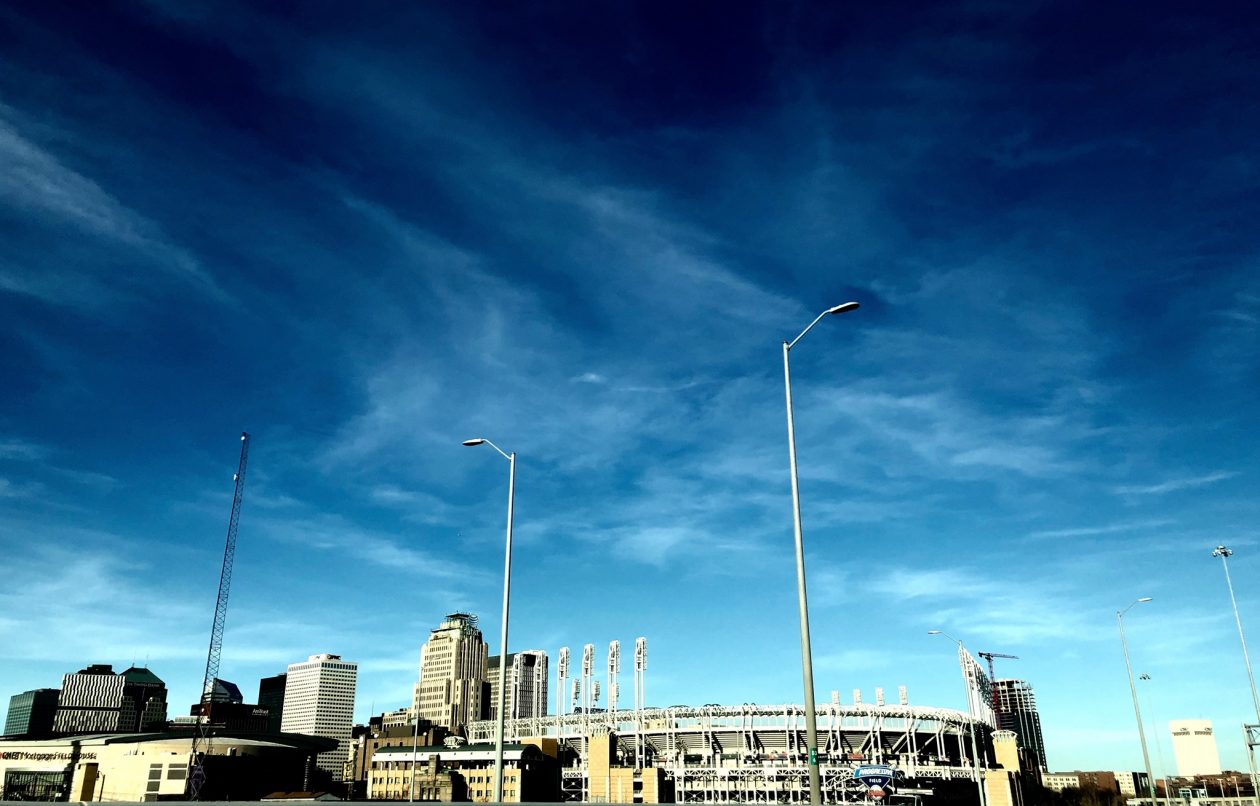
   It was December 15, 1991, and the temperature was somewhere in the mid-20s inside Municipal Stadium. Outside the lakefront stadium Lake Erie wasn’t frozen solid, yet, just frozen. The wind was brisk in the 25-mile range and the wind chill was too much to talk about. It was a quarter to one in the afternoon. Even though the sun had risen five hours earlier, it still hadn’t made an appearance. The Houston Oilers were warming up to play the Cleveland Browns. The home team was already warmed up. They knew what they were in for weatherwise. The Browns weren’t going anywhere behind Bernie Kosar, but the Oilers were going to the playoffs behind Warren Moon.

   Playoffs or no playoffs, they were all war horses. They were going to raise Cain to get the job done, no matter what. They put blinders on the minute they stepped on the field. The Oilers did their best to ignore the Dawg Pound.

   Dick Parello my father-in-law wasn’t a talkative man. His wife filled the silence. He was good at crosswords, doing them every day with a ballpoint pen, and devilishly clever at Scrabble. He scored points even when he had nothing, and I had all the good tiles. The Sunday newspaper was a good idea. I tossed the sports section down to put my day-to-day shoes on and fight off frostbite. Otherwise, my feet would have spent three and half hours on rock-hard ice-cold unforgiving concrete.

   The newspaper John Kupcik’s father-in-law brought to the game suffered a different fate. “He would tear off a page of the paper, crumble it up, and light it between his feet to keep warm. He did it the whole game, section by section. That and his homemade brandy kept us warm enough.”

   Even though I had lived in Cleveland since before the age of ten, watched NFL games on TV on Sundays and read recaps in the newspaper on Monday, I had never been to a Browns game. I had been to the stadium many times to see baseball games. The Indians were bad but tickets for day games were cheap, and the ball games were fun. We paid bargain basement prices and then sat wherever we wanted to. We liked sitting behind the dugouts, to encourage Chief Wahoo and abuse the other guys.

   Municipal Stadium was built in the early 1930s when the city was run by city managers. Walker and Weeks designed it and the Osborn Engineering Company built it. The stadium featured an early use of structural aluminum. Two days after the ballpark was dedicated on July 1, 1931, it hosted a boxing match for the World Heavyweight Championship between Max Schmeling and Young Stribling. There were 37,000 fans in attendance for the slugfest. Schmeling held on to the title by technical knockout in the 15th and last round. When it was all over Max sat back and lit up a cigar while Young spent days feeling years older than he was.

   The Cleveland Indians played their first game there on July 31, 1932, losing 1-0 to Lefty Grove and the Philadelphia Athletics, attracting a then-major-league-record crowd of 80,184. They played the rest of their home games at the ballpark the rest of the year and through the next year. But none of the Tribe players liked Municipal Stadium. They complained about the vast outfield and pulled muscles trying to muscle home runs over the faraway fences.

   It was 435 feet to the far corners of the stands in left-center and right-center, 463 feet to either corner of the bleachers, and 470 feet from home plate to the bleachers in straightaway center. No player ever hit a home run into the center field bleachers. Fly balls choked and died trying. 

   The team went back to the smaller League Park in 1934 and stayed for several years. They returned in 1937, playing some Sunday and holiday games at Municipal Stadium. League Park didn’t have any field lighting, so when night baseball got going in the 1930s and lights were finally installed at the stadium in 1939, the Indians started playing most of their home games there. They abandoned League Park entirely after 1946.

   Dick was from Rochester, New York. He grew up there and enlisted for the Vietnam War there. He was a stolid burly man. After he finished Charm School and got his legs under him as a military policeman, he kept things quiet in his neck of the woods. He didn’t mix it up much with Charlie, assigned to III Corps in the Saigon area where the fighting was spare, but never went anywhere without his Colt .45 Government sidearm.

   “Never trust a gook,” he said. He meant Charlie and ARVN and everybody in between.

   He came to Cleveland in the early 1970s with three friends who were putting a new restaurant together in Park Centre, which later became Reserve Square. When the Firehouse was ready to go, he became the bartender, and after that the manager. When he married Teressa my future mother-in-law in 1981, they set up shop in a three-bedroom apartment on the 17th floor of Park Centre. Dick and Teresa built the Park Pub, last call at the Firehouse having come and gone. They served food and drink. Teresa was a self-taught pro in the kitchen. She had the paring knife scars on her hands to prove it. Dick worked nights behind the bar and had the bags under his eyes to prove it.

   Even though Municipal Stadium was built for football as well as baseball, it was built for baseball. The football field was an awkward fit on a field designed for America’s pastime. Nobody wanted to sit on the home plate side. They were the best seats during a baseball game but the worst seats at a football game. The far end zone couldn’t have been farther away.

   As sparse as crowds were at Indians games was as big as crowds were at football games. When I looked around there might have been an empty seat somewhere. Otherwise, it looked sold out. The best seats were at the 50-yard line, but we sat in the bleachers. Going to the game was a last-minute idea, not mine, but Dick’s, who got free tickets from a barfly.

   I hadn’t been to Municipal Stadium for almost ten years. When we walked inside, I thought, “This place is a broken-down dump.” It looked bad. It smelled bad. There was a raw feeling in all directions.

   We sat behind four guys who had smuggled a keg of beer into the stadium. They were drunk as skunks sooner than later and spent the second half throwing things at Oilers players whenever they came within range. Their aim was bad, though. They hit more fellow fans than anybody else. A baldheaded older man behind us wearing a scarf smoked fat cigars all afternoon. Thank God the steady wind blew the smoke to the side. When I was tempted to tell the four guys with the keg to stop standing up towards the end of the tight game, Dick told me not to. “You’ll get a cup of hot piss thrown at you and told to get the hell out of our section.” We bought dirty water hot dogs smeared with Bertmans Ballpark Mustard. They were delicious.

   A tarp at the top of the bleachers was flapping mad as a hatter in the hard wind blowing in off the lake. “I sat second row from the top of the bleachers, next to some east side old timers who brought their own pulled pork sandwiches in foil and a thermos of special coffee,” said Todd Rejna. “Season ticket holders had the top row. As soon as they got there, they pulled out a cordless screwdriver and a rolled up blue tarp from under their bench. They screwed the tarp up to the bottom of the giant scoreboard as a wind block. When the game was over, they took it down, rolled it up, and stuffed it under the bench for the next week.”

   The Browns scored first when Leroy Hoard corralled a duck from Bernie Kosar and went eight yards for a touchdown. Matt Stover kicked the point. The Oilers came right back when Ernest Givens took a seven-yard pass from Warren Moon in for the score. Al Del Greco kicked the point. After Brian Brennan caught another eight-yard pass from Bernie Kosar for a score, the stadium shuddered with cheers whoops clapping seats being slammed up and down and stamping shoes and boots. “We’re done for sure,” I said to Dick, the concrete shaking beneath my feet. “This place is going to collapse any minute.” The feet were stamping to stay warm as much as they were to show appreciation for the offensive showing. Nobody worried overmuch when Del Greco kicked a late field goal. The Browns went into the locker room ahead 14-10.

   I headed for the bathroom, along with thousands of other men all at the same time. The bathrooms didn’t bother with urinals. Instead, there were troughs. By the time I found a spot they were overflowing. The sinks were overflowing with urine. The floor drains were fair game, too. Many of my fellow men were trashed on beer. The man taking a leak next to me was one handing his business and singlehanded rolling a joint. Everybody went with the flow. The only thing that saved the day was that many kidneys had frozen up and shut down. My shoes were sticky when I walked out of the bathroom. After the game, walking up East 9th St. back to the Park Centre on East 13th St. and Superior Ave, I could still smell pee and beer.

   The stadium was on the south shore of the lake and cold, even on the best of days. The wind never stopped whipping off the lake. Other than the bleachers, which were wide open, there were huge beams that blocked the view from many of the seats. The color scheme inside the stadium was gray under a gray sky. The grass on the field was mostly dirt and weeds. It looked like it was painted green. There were old bedsheets with bad words scrawled on them hanging over the rails.

   Both quarterbacks had aired the ball out in the first half, but ball control and field position became the name of the game after halftime. The third quarter was either a defensive struggle or it was getting darker colder windier and nobody wanted to be on the field too long. Browns coach Bill Belichick and Oilers coach Jack Pardee played it close to the vest. It was one punt after another. When the fourth quarter started it was back to the air. Bernie Kosar and Warren Moon both put the ball up 40 times that day. They both threw an interception. When Bernie Kosar did it an 80,000-man groan went up. After the turnover some guy dropped stink bombs from a catwalk. For a few minutes the stadium smelled like rotten eggs.

   The game went down to the wire, the Oilers finally winning when Warren Moon flipped a two-yarder to Haywood Jeffries for a 17-14 win. The air went out of the crowd. It all smelled flat and stale when the hands of the big clock spelled out the final score.

   The first Cleveland Browns game at Municipal Stadium was on September 6, 1946. They hosted the Miami Seahawks. The game drew 60,135 fans, at the time the biggest crowd to ever see a professional football crowd. It was a laugher. The Browns won 44–0. The bleachers became the Dawg Pound in the 1980s. Fans wore dog masks, barked and howled, and threw dog biscuits at opposing players. There wasn’t a lot of barking when Dick and I left the stadium after the loss, although stale biscuits were still flying high.

   Dick cleared off a table at the Park Pub, made hot toddies with whiskey lemon juice and cinnamon sticks for both of us, while Teresa came down and made grilled cheese sandwiches. We made small talk about the game, although to Dick a win was a win, and a loss was a loss. I found out later he had money on the Oilers. I didn’t have money on anybody because I didn’t have much money. The lowest paid player on both football teams was a rich man. The highest paid man on my one-man payroll was me, but my bank account was stuck in neutral. Teresa was a good egg and made me another sandwich.

   Five years later the stadium was torn down. The team moved to Baltimore and became the Ravens. The Browns bided their time. The debris from the stadium was dumped offshore to create an artificial reef. All the games the Indians and Browns played at Municipal Stadium for more than sixty years became food for the fish. The losses left a bad taste, but the wins were like yellow perch to the local walleye who fed on them.

Ed Staskus posts on 147 Stanley Street http://www.147stanleystreet.com and Made in Cleveland http://www.clevelandohiodaybook.com. To get the site’s monthly feature in your in-box click on “Follow.”
Three Blind Mice

   By Ed Staskus

   Monday morning, the 1st day of October, the weather was good, in the high 50s, with no rain predicted the rest of the week in the Ohio Valley or on the East Coast. In two weeks to the day, it would be Dwight Eisenhower’s birthday. In six weeks to the day, it would be Mamie Eisenhower’s birthday. The presidential election was coming up next month. “We Like Ike” was the word of the day.

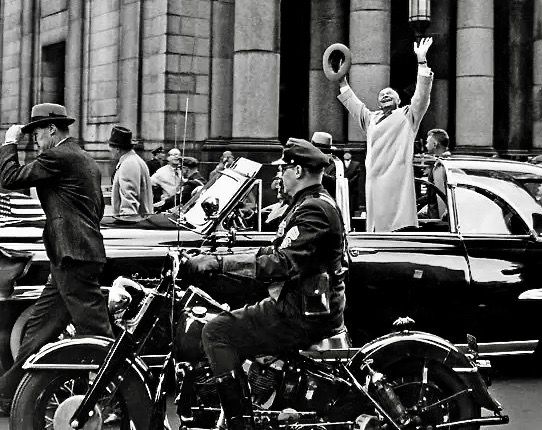
   By the time the sun was up and running Dwight and Mamie Eisenhower had been awake more than two hours. They arrived at the underground Union Terminal Station in Cleveland, Ohio, riding a 12-car campaign train on an overnight run from Washington. The Terminal Tower office complex foundations were 250 feet deep. More than a thousand buildings were demolished finding space for it in 1924.  When it was done in 1927 it was the tallest building in the world outside of New York City. The first Nickel Plate Railroad train pulled into the station two years later to hurrahs.

   The station was in the prime of its life, but President Eisenhower was putting intercity train travel and the Cleveland Union Terminal, and all its kind, slowly but surely out of business by federally subsidizing a network of interstate highways.

   “Neither a wise man nor a brave man lies down on the tracks of history to wait for the train of the future to run over him,” he explained, without a doubt in his mind about the right-of-way of his road project. It had been in the back of his mind since the Louisiana Maneuvers before the war. It was when his U. S. Army trucks got stuck all over the place because of the country’s bad roads that he said to himself, “We need better roads.”

   The Soldiers and Sailors Monument on Public Square, across the street, glistened in the early autumn sun. The fire department had spray cleaned the monument over the weekend, showering it with hundreds of gallons of white vinegar, and then hosing off the bird droppings and grime. The hometown vermin didn’t appreciate it, but what could they do?

   The monument was built thirty years after the Civil War, a 125-foot granite shaft on top of a square base housing a memorial hall, larger than life bronzes lining the outside, and marble tablets inside with all the names of the more than nine thousand Union soldiers from Cuyahoga County, the county in which the city lay, who were shot dead during the war by Johnny Reb.

   “Good morning, Mr. President,” said Robert Bridle, manager of the hotel. “Good morning, Mr. Mayor,” he said again, turning to Anthony Celebrezze, the city’s mayor. The Hotel Cleveland was shaped like an “E” opening onto Superior Avenue. Mr. Brindle’s mouth puckered like an “O” when he said “morning.” The one thousand rooms were built in 1918 by the Van Sweringen brothers, who built the Union Terminal Station ten years later.

   Anthony Celebrezze was a Democrat, mayor of the fifth-largest city in the United States. He knew how to get things done. Dwight Eisenhower, a Republican, meant the keys to the federal purse-strings to him. He was going to try to loosen those strings. He knew how to roll with the punches if he had to. He knew it was a rat race.

   The mayor’s father had been a shepherd in Italy, and then a track laborer on the Wheeling and Lake Erie after he emigrated to the United States. Tony Celebrezze put himself through John Carroll College by working as a freight truck driver and a boxer, fighting it out for peanuts in bitter undercards.

   Dwight Eisenhower was giving a speech in the hotel to the faithful, taking a short break, and then giving a speech in front of Higbee’s beside the monument to friends enemies passersby loafers and the lunch crowd. Downtown Cleveland was spic and span. The commander-in-chief liked what he saw. The dummies in the window of a clothes shop on Euclid Ave. came to life and waved when he and Mamie passed by. Ike tipped his hat smiling broadly.

   It was noon on the dot when he greeted more than nine hundred invited guests to the Sales Executive Group Luncheon in the Main Ballroom. He spoke briefly, walked out of the hotel, and tossed at look at the Soldiers and Sailors Monument. He strode up some stairs to the speaker’s platform. He was giving his speech at twelve-thirty.

   He was in the middle of two months of pressing the flesh kissing babies and giving the same stump speech. His mouth had gone dry, and palms rubbed chapped. Flecks of baby spit littered his suits. He rubbed somebody’s dandruff out of his eyes. When he looked, a dozen black and white Cleveland Police cars blocked off Euclid Avenue, Superior Avenue, Ontario Street, and Rockwell Avenue.

   Bert Mert and Luke scampered out of the Memorial Room of the monument to the roof and to the base of the polished black stone column. The three rats could have climbed to the top, one hundred and twenty-five feet to the top, wending up the six foliated bronze bands listing the names of the thirty battles in which soldiers from Cuyahoga County fought, if they wanted to. Their eyesight wasn’t the best, not like their sense of smell, but their perch was more than view enough. 

   Since it was only a month to the election, President Eisenhower got right to the point.

   “The opposition say that they alone truly care for the working men and women of America, and that the Republican party is a vague kind of political conspiracy by big business to destroy organized labor and bring hunger and torment to every worker in America,” he told the overflow crowd. 

   “That’s right!” a loudmouth yelled from the crowd.

   Secret Service agents watched from the roofs of the May Company and Higbee’s, and from inside the twin steeples of the Old Stone Church. The Berea sandstone of the church had long since turned black from air pollution floating up from the Flats, the nearby industrial valley that sprawled on both sides of the Cuyahoga River. The sun gleamed on the terra cotta façade of the May Company. The faces of shoppers were pressed against upper story windows of the two department stores. 

   The pastor of the Presbyterian church sat in a lawn chair outside his front doors, his sleeves rolled up, warm in the warm October day. He had a ploughman’s sandwich, cheese and pickle, wrapped in wax paper in his lap. He unwrapped his sandwich. He took a bite and chewed, slowly, methodically. The sky above Public Square was dappled with small passing clouds. He stretched his legs out. 

   His father had been a pastor. He grew up in the church. He served on all the church committees, was a volunteer at all the events, and made all the hospital and home care visits. Thank God for Dwight D. Eisenhower, he thought, basking on a day off.

   Bert and Mert were Tremont twins. Luke was an orphan. He didn’t know where he came from. All his friends called him Eaka Mouse, even though he was a rat. They usually slept during the day and foraged at night, avoiding birds, but this was a special occasion. They had never seen the top man of the Grand Old Party up close. The birds were staying away because of the hullaballoo, but the rodents couldn’t contain their curiosity.

   “This is more than political bunk,” said President Eisenhower. “Those men are fretting fear and worried doubt. It is wicked nonsense. We have given to our nation the kind of government that is living witness to a basic virtue in a democracy, public morality, public service, and public trust. There is no special favoritism, cronyism, or laxity in our administration.”

   “That’s what they all say, “somebody bellowed.

   Luke had the best sense of smell of the three of them. He led the way when they went searching for food, which was fifteen, twenty times a day. Their favorite foods were seeds and grains, which made the monument an all-day dream diner for rats. It was visited by hundreds, sometimes thousands of people, many of whom left behind crumbs of whatever they were snacking on.

   The pickings today were going to be out of this world.

   In the wild they were vegetarians, but city life was different. They ate almost anything they could get. None of them liked cheese. No rat they knew liked cheese. They laughed at the traps filled with shavings of it. They weren’t looney tunes. Besides, they could smell the hand of the craft of man on carefully prepared cheese and knew to beware.

   “The men of the opposition know perfectly well that one of the main reasons they were thrown out of office four years ago was their tolerance of the fire of inflation,” said President Eisenhower. “Just in the final seven years of their tenure of office this economic fever had cut the value of the dollar by almost one-third, damaging the livelihood of the aged, the pensioned, all salaried workers.”

   “What about the Bonus Army?” a harsh voice called out. “Whadda ya got to say about that?”

   Luke had recently chewed up a front page of the Cleveland Press for bedding. He noticed a feature article about last month’s government index showing living costs had gone up to a record high point.

   “The cost of living has been remarkably stabilized,” the trim balding man in a brown suit below them earnestly proclaimed “During the previous Democratic administration, the cost-of-living increase was twenty times as great.”

   Mert gave Bert and Luke the high sign. They had heard the lying grift of the campaign trail wash over them before. They couldn’t go down to look for food, but the speechifying was making them sleepy. It was a lot of cutting corners and trying to corner the other guy. The three rats stretched, groomed themselves briefly, efficiently, curled up together, and were soon napping.

   President Eisenhower wrapped up his speech, stepped down from the platform, and was in his limo in his motorcade on its way to Cleveland Hopkins Airport by one o’clock. He and Mamie boarded the Columbine and were airborne to Lexington, Kentucky by one-thirty. In two days, at about the same time of day, Dwight Eisenhower would be tossing out the first pitch of the 1956 World Series at Ebbets Field instead of tossing out half-truths.

   The rodents ate almost anything but avoided ice cream. They loved Canadian bacon more than anything. Most days, Monday through Saturday, as long as the weather was good, they looked forward to the nut lady, the woman who looked more-or-less like Doris Day and Mammy Two Shoes all rolled up in one, a middle-aged Slovenian woman with dark skin dark hair dark eyes, taking their mid-day break on the steps of the monument. She worked across the square, at Morrow’s Nut House, near the revolving doors of the May Company. 

   She brought them bits of bacon mixed together with nuts.

   The nut lady worked behind the glass counter display case, selling fresh warm lightly salted cashews and redskin peanuts, Spanish peanuts, almonds, hazelnuts, pecans and oily rich walnuts. Morrow’s Nut House was on the corner, on the intersection, at a CTS bus stop where passengers lingered waiting for their ride. The shop pumped the smell of roasting nuts out onto the sidewalk all day long.

   Bert Mert and Luke weren’t waiting for her today. There was a horn of plenty waiting for them on all sides of the Sailors and Soldiers Monument. Who said the GOP never did anything for the little man? They were ready to vote for Ike at a minute’s notice.

   But they had better things to do with their time. They were their own men. The three rats had girlfriends, Mary, Suzy, and Perla waiting in the wings ready to make nice.

   “Hey guys, let’s rake it in, and go to the submarine races,” said Bert.

   The crowd had dispersed. The lunch time crowd went back to work. The shoppers went back to the stores. The loafers went back to loafing.

   Eaka Mouse knew exactly what Bert meant. It was juice it up and hanky-panky time. They weren’t three blind mice.

   “Come on, snake, let’s rattle.”

Excerpted from “Stickball” at http://www.stanriddman.com.

Ed Staskus posts stories on 147 Stanley Street http://www.147stanleystreet.com and Cleveland Daybook http://www.clevelandohiodaybook.com. To get the site’s monthly feature in your in-box click on “Follow.”
Law of the Land

By Ed Staskus

   When I moved from the near east side of downtown Cleveland to Carpenter, Ohio the post office there had been gone more than ten years. The Baptist church was still standing, but the minister didn’t live in the whistle-stop. He drove in on Sundays, performed his mission, and drove away after shaking a few hands. I went to the service one morning, but the minister looked like the talent scout for a graveyard, and it was the last time I went. The general store had closed even before the post office, which was good for Virginia Sustarsic and me, because that is what we moved into, staying the spring summer and into the early fall.

   The post office was opened in 1883 and stayed there until 1963. Nobody knew who the town was named for, although three men who had been natives of the place took credit. There was Amos Carpenter, an old geezer who talked too much, Jesse Carpenter, a farmer who hardly ever talked, and State Senator J. L. Carpenter, who only talked when it counted. He brought tracks and a railroad station to the town. Those were long gone, too.

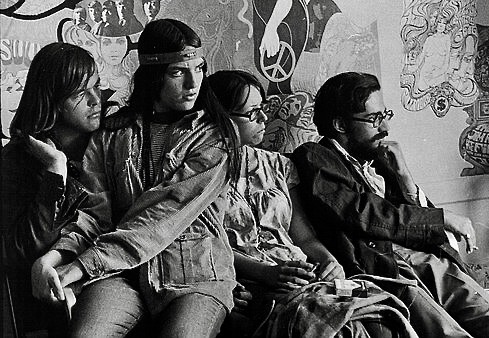
   It wasn’t my idea to go live local yokel on the banks of Leading Creek, but Virginia argued living in the country was the way to go. She was a hippie and wore its ethos of going back to the roots on her sleeve. I countered that the hippies happened in coastal cities like San Francisco and New York, flowered in college towns like Austin and Ann Arbor, and were trucking along in cities like Omaha, Atlanta, and Cleveland. We were both from Cleveland, born of immigrant stock, she Slovenian and me Lithuanian.

   My reasoning fell on deaf ears.

   A friend of ours with a van drove us and our stuff to Carpenter, dropped us off, and waved goodbye. I had never been there before. Virginia had been there twice, having a friend who lived in that neck of the woods. It took less than ten seconds to look the town over. There wasn’t much to see. We stashed everything away in the sturdy but dilapidated 19th century-era store and walked up Carpenter Hill Rd. to Five Mile Run, detouring down what passed for a driveway to a small house where Virginia’s friend and his bloodhound lived.

   He was somewhere between not young and middle-aged, lean and scraggly, literate and friendly. He was the kind of man who was a hippie long before there were hippies. He read lots of books and smoked lots of weed. There was a Colt cap and ball pistol on his coffee table, laying there as relaxed as could be. It was a Walker .44. It was big, old as dirt, spic-n-span workable. 

   “That’s an imposing handgun,” I said.

   “They call it the Peacemaker,” he said. “Even though it can get you into a load of trouble the same as not. I call it the Devil’s Right Hand.”

   He shot rabbits with it for his stew pot. The large percussion revolver could have taken deer in season. He let me shoot it at a tree later that summer. It was heavy when I lifted it. I shot it stiff-armed expecting more recoil, which turned out to be modest. What I didn’t expect was the “BOOM!” at the end of my arm. I was glad I missed the tree. Even though it was a full-grown maple the ball hitting it might have put it on the woodpile.

   We spent a week sweeping dusting cleaning arranging the ground floor front room of the general store. There were two storerooms in the back and an upstairs we didn’t mess with. Two long broad oak tables served as platforms for working and preparing food. We ate in rocking chairs we set up at one of the windows. We found a braided round rug in a closet, beat the hell out of it, and rolled it out in the middle of the floor.

   After laying in a garden, we stuck a scarecrow of Grace Slick on a stick to guard the plot. The scarecrow, however, fell down on the job. Birds shat on her and rabbits ran riot. We ended up hunting and gathering.

   A kitten walked in out of the blue one morning, worn out and hungry as a horse. He was white with a black blob on his chest and a masked face. Virginia gave it a bowl of water, but we didn’t have cat food. “We should go into town, get some, and some food for us, too,” I said.

   Virginia was a genius at living off the land, but we still needed some store-bought stuff, salt pepper coffee pasta peanut butter and pancake mix, as well as toilet paper. The outhouse was bad enough without the comfort of Charmin.

   There were two municipalities within driving distance, Athens, which was 15 miles northeast of us, and Pomeroy, which was 17 miles southeast. Ohio University was in Athens, had several grocery stores, and plenty of citizens our own age. Pomeroy was on the Ohio River, was notorious for being repeatedly destroyed, and there was nobody our age there. We never went to Pomeroy except once to look around.

   The town was consumed by fire in 1851, 1856, 1884, and 1927. The floods of 1884, 1913, and 1937 were even more disastrous. 1884 was an especially bad year, what with fire and flood both. Why the residents kept rebuilding the place was beyond us, although we speculated they must have been plain stubborn.

   We stopped at the courthouse to lay eyes on the excitement. We had read in “Ripley’s Believe or Not!” that there is a ground floor entrance to each of its three stories, the only one of its kind in the world The sight of the phenomenon wasn’t all that exciting. A plaque explaining that the courthouse served as a jail for more than 200 of Morgan’s Raiders after their capture in the Battle of Buffington Island during the Civil War caught our attention. It was exciting to learn that Ohio boys had gotten the better of Johnny Reb when they ventured north.

   The county seat of Meigs County is mentioned in Ripley’s a second time for not having any cross streets. We took a stroll and didn’t see any. It didn’t seem deserving of mention in Ripley’s, but what did we know?

   Once he had a steady supply of food, out kitten got better and bigger. He spent his days outside and after sunset inside. He learned fast there were plenty of hungry owls, racoons, and coyotes in the dark. At first, when he was a tyke, he slept on top of my head at night. As he grew, I had to move him to the side. It was like wearing a Davey Crocket racoon hat to bed. 

   Meigs County, in which Carpenter lay, is 433 square miles with a population of around 20,000, or 54 people per square mile. Where we came from, Cuyahoga County, it was more like 3,000 people per square mile. At night in the middle of Meigs County it often seemed like 2 people per square mile, Virginia and me.

   There wasn’t much crime in the county, thank goodness, because the law enforcement amounted to one sheriff, one lieutenant, one sergeant, and six deputies. We had been in town a week-or-so when the sheriff stopped by to say hello. He was a pot-bellied man with fly belly blue eyes. He made sure we had the cop and fire department phone numbers even though we didn’t have a phone. He warned us not to mess around with the marijuana market. Virginia made roach clips for sale in head shops, but only smoked so much, and said so. 

   “No, I don’t mean that girlie,” he said. “I don’t care what you do on your own time. What I mean is, don’t mess with the growers. They’ve got it tucked in all around here. Some of them have been to Vietnam and back, and they learned a thing or two from Charlie. Even the DEA is careful when they chopper around these hills spraying their crop.”

   He pronounced Vietnam like scram.

   Meigs County is on the Allegheny Plateau. It is especially hilly where we were. The soil isn’t the greatest. The top crop by far is forage, followed by soybeans and corn. Layers and cattle are the top livestock. The marijuana growers hid their fruitage in corn fields, where it was hard to spot.

   Moonshine was made from the first day Meigs County was settled, for themselves and for whenever a farmer needed hard cash in a hurry, as long as they were near water and could haul a barrel of yeast and a hundred feet of copper line to the still. The yeast is stirred with sugar and cracked corn until it ripens. When the mash is ready it’s poured into an airtight still and heated. When it vaporizes it spirals through copper pipes, is shocked by cold water, returns to its original liquid form, and drips into a collection barrel.

   After that it is ready to go and all anyone needed was a fast Dodge to get it to market.

   The marijuana growers were mostly young, a loose-knit group known as the Meigs County Varmits, which was also the name of their championship softball team. They drove Chevy and Ford pick-ups. They stopped by and said hello, just like the sheriff. One of them told us to keep our heads down the middle of October.

   “What’s that all about?” I asked.

   “That’s when we harvest our green and that’s when the state cops and Feds get busy. You’ll see their cars and spotter planes. They ask you any questions, play dumb. You hear any noise, ignore it.”

   They had a hide-out in the woods where they had private stoner parties. Hardly anybody knew where it was, although everybody called it Desolation Row. It was some bench car seats thrown down on the ground and a rude shelter.

   Meigs County Gold was high quality highly sought weed. It was the strain of choice for the Grateful Dead and Willie Nelson when they toured Ohio and West Virginia. Meigs County folk learned to not lock their cars and to keep their windows partly rolled down when they went to the Ohio State Fairgrounds in Columbus or Kings Island near Cincinnati.

   When I asked why, a man said, “Because people see the Meigs County tag and it’s almost for sure you’ll have busted windows if you don’t. They will be looking for your pot.”

   Our pots and pans were always filled with grub Virginia gleaned in the forest lands where she found nuts greens fruits and tubers. She collected walnuts chestnuts papaws raspberries blueberries and strawberries. She dressed up salads with dandelions fiddleheads and cattails. In the late summer she hunted for ginseng, selling it to a health food store in Athens.

   She kept two goats in a shed. I fed them and cleaned up after them. They were more trouble than they were worth, especially after one of them head butted the minister who walked over late one Sunday morning inquiring about my spiritual frame of mind. The goat lowered his head and got him from behind, in the butt, knocking him down. He scuffed up his hands breaking his fall and got mad as the devil. He told the sheriff about it and the sheriff had to stop by and warn us to keep our goats civil.

   “Yes, sir,” I said.

   Carpenter was the kind of place where tomorrow wasn’t any different than a week ago. But it had its moments. A week-or-so after the sheriff paid us his official visit, we watched him drive slowly past our grocery store summer home on State Route 143 dragging an upright piano on rollers behind him, chained to his rear bumper. A deputy was walking beside the piano trying to keep it from falling over. It looked like a bad idea on the way to going wrong. We waved but didn’t ask any questions.

   Our nearest neighbor was Jack, his two brothers, and their mother, on the other side of Leading Creek, a quarter mile down the state route. Velma looked like she could have been their grandmother, but Jack Jerome and Jesse called her mam. It was a one-story house with a front porch. They had running water and a bathroom, but no cooking stove or furnace. Velma did the cooking in the fireplace and they heated the house with the fireplace and a cast-iron potbelly stove. It was more than we had, which was just the potbelly thing.

   “Food cooked in a fireplace tastes better than food cooked any other way, including charcoal grills,” Velma said. It was big talk, but she backed it up. She might not have been able to whip up a cake or a souffle, but she made just about everything else. We never turned down an invitation to dinner.

   There were always half-dozen-or-more barely alive cars and trucks in their backyard, which was more like a field. There was a chicken house and a pen for pigs. They slaughtered and smoked their own pork. There was a big deep pond near enough to the house and they let us go floating and swimming in it whenever we wanted. They had an arsenal of rifles and shotguns, even though they didn’t mess around with marijuana. Moonshine might have been a different matter. 

   “How come you’ve got all those guns?” I asked Jack.

   “That’s how our daddy raised us,” he said.

   They were born and bred right there. The folks in the ranch-style houses up Carpenter Hill Rd. avoided them. Sometimes when we went swimming the sheriff’s car was there. I had the impression he wasn’t there on lawman business, but rather visiting.

   By the end of summer, we realized we couldn’t stay. The Velma family already had enough cords of dried wood beside their house to keep themselves warm if winter went Siberian in Ohio. We didn’t even have a pile of twigs. We could have ordered coal, which was plentiful, but neither of us had ever started and stoked a coal furnace. We didn’t know anything about air vents. All we knew was dial-up thermostats for gas furnaces.

   Our friend returned with his van and helped us move back to the Plaza Apartment in Cleveland. Prospect Avenue was the Wild West, but winter was coming, and it would be quiet for a while. We wouldn’t need a Peacemaker. We said goodbye to Virginia’s hippie friend and his bloodhound, and to Jack up the hill. Jerome and Jesse had gone hunting waterfowl, the first day for it. Velma gave us an apple pie for the drive home.

   The cat, who was left-handed and so went by Lefty, decided to stay. He wasn’t a city boy. He wouldn’t have been able to make sense of the Cuyahoga River catching fire. Lefty had made friends with all the cats and dogs a half-mile in every direction, knew how to sneak into the grocery store closed doors or no doors, and had grown up enough to take care of himself. We slit open the 20-pound cat food bag and opened it like a book. We left it on the floor so he and his friends could have a party.

   When we drove away, he was sitting on his haunches on the gravel in front of the store’s double front doors. I watched him in the rearview mirror and Virginia waved goodbye through the open passenger window. The last I saw of him he was sauntering into the high Meigs County grass.

Ed Staskus posts stories on 147 Stanley Street http://www.147stanleystreet.com and Cleveland Daybook http://www.clevelandohiodaybook.com. To get the site’s monthly feature in your in-box click on “Follow.”

Flower Power

By Ed Staskus

   My father was a firm believer in the harder you work the better your station. He meant better car, better house, more money in the bank, and basically better everything. He was a refugee from Lithuania, getting out of Europe in 1949 with a duffel bag and twenty-five dollars in his pocket. By the time he got to Sudbury, Ontario he was down to five dollars, but found employment at a cement factory the next day. Even though I wasn’t sure the long march to better was better, I was barely 15 years old the summer of 1966 and not about to argue with him.

   When I came home from my last two-week Lithuanian boys and girls summer camp on Wasaga Beach I was immediately put to work. My father got a job for me on the chain gang of a landscaper who was redoing the grounds at Mt. Sinai Hospital. We trimmed trees, ripped out dead shrubs, replacing them with new ones, buried bulbs, and planted flowers.

   Mount Sinai Hospital began in 1892 as the Young Ladies’ Hebrew Association “caring for the needy and sick.” It opened as a hospital in 1903 on E. 32nd St., catering to east side Jews, then moved to a bigger building on E. 105th  St. in 1916. In time it became the healthcare provider to Cleveland’s urban poor.

   My number one thankless assignment was helping unload soggy clods of rolled-up sod and laying them down to make new lawns. That meant removing the old grass and some of the worn-out soil beneath it, preparing the ground with a bow rake, breaking up large chunks, laying the sod, neatening the edges, and finally watering it. Handling the hose was the easiest best part of the job. By the end of the first day, I was damp, dirty, tired, and underpaid. 

   I got a ride to work every morning from Val, a Lithuanian American like me home from college. He drove a 1960 Plymouth Valiant with push-button transmission shifters. There was no button for park, but there was a lever for it. Moving the lever to the end put the transmission into park and popped out whatever button was in gear. It was for laughs watching him smack the buttons from first to second to drive.

   We hopped on I-90 at E. 185th St. and took the Liberty Blvd. exit, driving along the winding road through Rockefeller Park to the work site. The 200-acre park was given to the city by John D. Ruthless in 1897. Four stone bridges carried traffic and trains over the road, there was a lagoon for rowing, fishing, and ice skating at the end of it, and a couple dozen Cultural Gardens down the three-mile length of it.

   The gardens are a series of landscaped green spots honoring ethnic communities in Cleveland, set up from the south shore of Lake Erie to University Circle. The first one was the Shakespeare Garden in 1916, which later became the British Garden. The Cultural Garden League carved out the next one, the Hebrew Garden, in 1926. After that they were off to the races. In the next ten years 14 more gardens were created, including the Italian, Hungarian, and Lithuanian. The idea was to rave on the city’s immigrant groups, which at the time made up about a third of the population.

   In 1936 the city unified the gardens with bordered paths. Busts and statues were installed in many of them. The first One World Day took place in 1946. A parade of nationality floats and bands blaring old hometown tunes started downtown at Public Square, crept six miles along Euclid Ave. to the Cultural Gardens, where there were speeches and a ceremony. Afterwards there was food, souvenir stands, strolling around the gardens, hobnobbing, and dancing to more music. By the middle of the day it sounded like the Tower of Babel.

   We were listening to “Hanky Panky” by Tommy James and the Shondells on the car radio one Wednesday morning, curving down onto Liberty Blvd. on our way to work, when we were brought up short by a Jeep with a machine gun mounted on the back. It was blocking the road. There were more Jeeps scattered in the distance. “One of the Jeeps had a plastic lei hanging down from the .50 caliber gun,” said Wayne Baker, who lived in the St. Clair – Superior neighborhood. A line of cars was backing up and going the way they had come. Val pulled over to the side until a National Guardsman walked up to our car. 

   “Turn around fellas,” he said. “This road is going to be closed today, maybe the rest of the week.”

   “Why, what’s going on?” Val asked.

   “The niggers are raising hell, busting into stores, burning them down.”

   “What about the parade?” I asked. One World Day was scheduled for the weekend. My parents, brother, sister, and I always went. All my friends went. It was a big thing.

   “I don’t know about no parade, but there ain’t going to be one until things cool down.”

   The street fighting had started Monday when a black man walked into the white-owned Seventy-Niners Café at Hough Ave. and E. 79th St. He asked for a glass of cold water to cool down. It had been a hot day in a long hot summer. The bartender said no, get the hell out of here. Somebody else posted a hand-written sign. It said “No water for niggers.” 

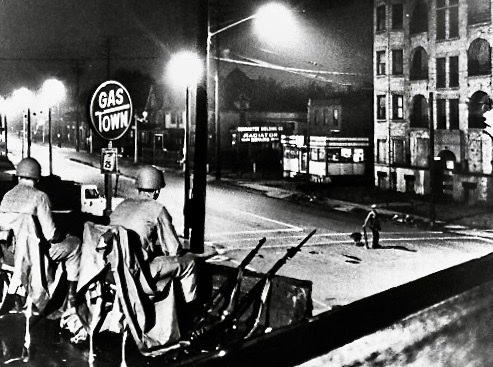
   One thing led to another and before long the Cleveland Police Department had a riot on its hands. The more policemen who showed up the bigger the mob got. By the next day there weren’t enough policemen in the city to handle the uproar. Mayor Ralph Locher asked Ohio Governor James Rhodes to send in the National Guard. They showed up through the night and deployed in the morning.

   Helen Provenzano’s father got a call early that morning that all the windows in his restaurant on E. 97th St. and Euclid Ave. were broken and he should bring plywood pronto. The eatery was the family’s bread and butter. By the end of the day there was a run on sheets of plywood at hardware stores.

    “Why are you home so early,” my mother asked after Val dropped me off. “Did you do something wrong?”

   “No, the colored people did, there’s a riot going on and we couldn’t get to work,” I said.

   In the mid-1960s 60% of northern whites agreed that Negro students should be able to go to the same schools.70% agreed with residential integration. 80% agreed that they should be able to get the same jobs as white folks. 90% agreed that they should enjoy public transportation just like everybody else. 100% of Lithuanian Americans didn’t care what bus Negroes rode to whatever job, but the same 100% was opposed to colored kids in their schools and colored families moving into their neighborhoods. When the moving started was when the white flight started.

   My parents weren’t any different than any other Lithuanian I ever heard say anything about it. They hated Russians, disliked Jews, and looked down on Negroes. Their culture was one of religion, property, and community. They thought Negroes were bad Americans, slow-moving and shiftless, belonged to the wrong religion, and didn’t respect private property.

   Where we lived there were no Negroes, at all. I delivered the Cleveland Press afternoon newspaper door-to-door six days a week and collected money for it once a week. I knew the faces of who lived on our street of one hundred-some houses. There weren’t any black hands on my route handing me their payment of 50 cents and a tip if they wanted the rubber-banded paper to land securely on their front porch the following week.

   Our high school, St Joseph’s, was the same as my paper route. I might see a black face once in a blue moon, but not in any of my classes. They were the janitors. There were lots of big Catholic families in our neighborhood of North Collinwood, and they were a solid block of European stock.

   After Brown v. Board of Education of Topeka and the emerging Civil Rights movement, the times were slowly changing, but it was a bumpy change. Integration meant ill will and uproar. There had been a couple of incidents at Collinwood High School, a few miles southwest of us, the year before. “With the passage of each year, the western fringes of the Collinwood area are being occupied by the Negro overflow from Glenville,” according to the Cleveland Plain Dealer, which was the morning paper.

   The Five Points riot happened four years later. Four hundred white students and their parents milling around Collinwood High School in the morning started throwing rocks, smashing more than 50 windows. The 200 newly enfranchised Negro students attending the school fled to the third-floor cafeteria. When the mob stormed into the building the Negroes blocked the stairs to the third floor with tables and chairs, breaking off the legs to arm themselves. Cleveland police from the 3rd, 4th and 5th Districts poured in, forming a cordon to keep the whites from attacking the blacks who were boarding buses. 

   “Always be careful around them,” my mother said, meaning Negroes. “They might have a knife.”

   My mother and father believed Negroes went nuts at the drop of a hat. I took my parents at their word. It was always touch-and-go messing with their point-of-view. They survived three invasions while growing up in Lithuania, were in Germany during the convulsive last months of the Third Reich, emigrated to North America with just about nothing except willpower, and worked their way up to be devout Republicans in the New World. They were short-tempered about anybody questioning their beliefs.

   Once, goofing around, I said, “And in this corner, still undefeated, my mom and dad and their long-held beliefs.” That was a big mistake, especially since they were within earshot.

   Hough was a powder keg the summer of 1966. Downtown was white, University Circle to the east was white, and in the middle was Hough, which was black. The housing was substandard and overcrowded. The area stores were crappy and overcharged for their wares. The police were surly about who they were serving and protecting. When the race riot got rolling, there was rock throwing, looting, arson, and some gunfire. Four people were killed, all four of them Negroes. Two were caught in crossfires, one was killed by a white passerby while waiting at a bus stop, and one was shot by a Little Italy man who said it was self-defense. More than 30 were injured, close to 300 were arrested, and 240-some fires were set. There was an estimated $2 million in property damage. Many homes burned to the ground, most of them in Hough. 

   A friend of mine’s grandmother, born at the turn of the century in Lithuania, was upset and wanted to go home to “my own place,” which was her home on White Ave. north of Hough Ave. She was staying with the family in the meantime. The big houses all around her small house had all been made into boarding houses. They were overcrowded, but what could anybody do who was chronically short of hard cash?

   Real family income rose rapidly in the 1960s. From 1960 to 1970, median family income, adjusted for inflation, rose to $20,939 from $15,637. It did, at least, if you were white. It didn’t if you were black. It went the other way.

   “It is a stark reality that the black communities are becoming more and more economically depressed,” Bayard Rustin wrote in 1966. “There has been almost no change or change for the worse in the daily lives of most blacks,” Carmichael and Hamilton wrote in 1967. “Although it is true that the income of middle-class Negroes has risen somewhat, the income of the great mass of Negroes is declining,” Martin Duberman wrote in 1968.

   You can only do so much with less. It’s smooth sailing when there’s money in the piggybank. It’s a hard slog when the piggybank is starving. Living on bits and pieces is bitter and maddening.

   “The white man is reaping what he has sown. He is learning you can’t push people around. The trouble is here because the white man won’t treat the black man right,” the owner of a barber shop in Hough said. 

   A grand jury later concluded that the Communist Party, outside agitators, and black nationalists organized the uprising, but the finding was laughed off. No Communists had been seen in Cleveland for years and not even outside agitators nor black nationalists wanted to be caught dead in Hough, fearing for their health and safety.

   An angry crowd started a big fire at Cedar Ave. and E. 106th St. at the start of the weekend, burning down most of a block of stores, but that was the high and low point of the disturbance. Life in the ghetto returned to normal on Sunday and the next day merchants started reopening. The National Guard was released from duty. Val and I went back to work mid-week.

   From where we stood on the grounds of Mt. Sinai Hospital it looked like nothing had happened. But there were two Cleveland Police cars parked at the front, and one near the back, that whole week. There had always been police cars around the hospital, but those three stayed around the clock.

   Nobody talked much about the riot, except to say, “those spades are crazy.” My parents and their friends said, “it’s a damned shame about the parade.” Val and I shouldered on for another two-some weeks. When the project was done, we were sent out to Bratenahl, mowing lawns for the millionaires who lived in the east side village’s lakeside mansions.

   Our last day at Mt. Sinai, which was a Friday and payday, driving home on Liberty Blvd, the Cultural Gardens looking great in the summer sun, Val said, “Have you noticed there isn’t an African American garden?”

   “No,” I said.

   “They were some of the first immigrants, not that they wanted to come here, but still, you would think there would be a garden for them, especially since this is all in their neighborhood.”

   “I guess so,” I said.

    Val was five years older and much wiser than me. He was going to an east coast college, majoring in philosophy. He wore his hair long. Some Lithuanians called him a dirty hippie, even though he worked like a sharecropper.

   The idea of building a garden for Cleveland’s Negro community was brought up in 1961 by Cleveland councilman Leo Jackson. He proposed a “Negro Cultural Garden.”  The mayor supported the proposal, but it was voted down by his finance committee. In 1968 the idea came back, including a statue of Martin Luther King, Jr., who had been assassinated that year. Nothing came of the comeback until 1976, when Congressman Louis Stokes brought it to life again. Ground for the garden was broken and dedicated in 1977, but the project remained unfinished until 2016, almost forty years later, when it was finally finished.

   When we turned off Liberty Blvd., racing up the entrance ramp to I-90, Val punched the spunky Valiant’s push buttons through its gears, and we rode the current of rush hour traffic back to North Collinwood. The weekend was coming up. We were both ready as could be.

   “I’m glad to be going home,” I said.

   “You and me both, man,” Val said. “Shelter from the storm.”

Ed Staskus posts stories on 147 Stanley Street http://www.147stanleystreet.com and Cleveland Daybook http://www.clevelandohiodaybook.com. To get the site’s monthly feature in your in-box click on “Follow.”

Champing at the Bit

By Ed Staskus

   By 1984 many bands had strutted their stuff at the Richfield Coliseum. It was built for basketball and anything else that could be booked between games. Everybody called the venue the Palace on the Prairie. It was in Richfield, Ohio. The bands included Led Zeppelin in 1975, Bruce Springsteen and the E-Street Band in 1978, the Rolling Stones in 1981, and Queen in 1982. The Bee Gees drove girls to screaming, crying, and pleading.

   Frank Sinatra opened the place with a show in October 1974. “The crisscross of lights, mirroring the animation of 21,000 stylish people packed from floor to roof, transformed the gray amphitheater in the hills of Richfield Township into a huge first-night bouquet of green and blue,” is how The Cleveland Plain Dealer splashed Old Blue Eye’s show across its front page. We called him Slacksey because, no matter what, his slacks were always neatly pressed. Roger Daltrey gone solo closed the doors and shut off the lights for good in 1994. His show drew fewer than 5,000 fans. Nobody wrote a word about it or how he was dressed. Over the years there were might have been a thousand musical events at the Richfield Coliseum. 

   Vann Halen opened for Black Sabbath in 1978 and came back as headliners in 1984. When they did, they had to sit on their hands waiting for ice to melt. Walt Disney’s Magic Kingdom on Ice had just skated out of the building. When Van Halen came to town it was the one and only time I saw the band and the one and only time I went to a show at the Richfield Coliseum. 

   It wasn’t that I didn’t go to rock ‘n roll shows. It was that the few I went to were closer to home, like at the Allen Theater, the Agora, and Engineer’s Hall, where it was standing room only. There were no seats there. Downtown was nearby but Richfield was a long way for my long-suffering car. Besides, I was by necessity a scrooge. Big shows charged big bucks. First things came first, like food and shelter. 

   I saw the Doors at the Allen Theater in 1970, the Clash at the Agora in 1979, and the Dead Kennedys at Engineer’s Hall in 1983. The Dead Kennedys blew into town during a heat wave. The air conditioning at the Engineer’s Hall was non-existent and there were no windows. Everybody sweated up a storm and everybody stayed through the encore. Six years later the Brotherhood of Locomotive Engineers sold their building. It was demolished and replaced by a posh hotel.

   The Doors opened their sold-out Friday night show in 1970 with ‘Roadhouse Blues’ followed by ‘Break on Through’ and ‘Backdoor Man’. They covered Bo Diddley’s ‘Who Do You Love?’ That was a surprise. “I walk 47 miles of barbed wire, I use a cobra snake for a necktie, I got a brand new house on the roadside, made from rattlesnake hide.” They sounded much better live than on carefully managed vinyl. They were more than worth the six dollars for my orchestra seat ticket. My girlfriend paid her own way. We had an even-steven relationship. Eli Radish, a local band, opened, and were funky and fun, but all through their set everybody was antsy waiting for Jim Morrison.

   “He worked the crowd with his staring sneers and sexy leather posing, witch doctor mumbling and slouching about,” said Jim Brite, who was in the crowd. “The lighting and sound were dramatic. The band was great, with extended solos and workmanlike professionalism, delivering the music behind the shaman. No one could take their eyes off Jim. It was one of the best concerts I ever saw and I’ll never forget it.”

   The Doors were banned in Miami for Jim Morrison’s obscene language and lewd behavior. He suggested the city fathers call him the Lizard King. They had been banned from performing in Cincinnati and Dayton the year before. None of it mattered to the three thousand of us filling every seat at the Allen Theater.

   “Jim Morrison swigged beer and smiled a lot between numbers,” Dick Wooten wrote in The Cleveland Press the nest day. “When he performs, he closes his eyes, cups his hand over his right ear, and clutches the mike. His voice is pleasant, but his style also involves shouts and screams that hammer your nervous system.”

   When it was over we whistled, roared, and clapped until the house lights came on. We were disappointed there was no encore. Everybody was getting to their feet when Jim Morrison suddenly came back on stage. “Somebody stole my leather jacket, he bellowed. “Thanks a lot Cleveland!” He flipped us the finger. Then he said, “Nobody leaves until I get it back!” Nobody knew what to do. A half-dozen rough-looking bikers jogged to the back of the hall and blocked the doors. When my girlfriend and I looked to the side for another way out, Jim Morrison had left the stage, but then a minute later came back.

   “Sorry, that was a mistake. I found my jacket.” 

   He said the band wanted to play some more songs to make up for the mistake, but that John Densmore’s hands were messed up. He was the group’s drummer. The beat couldn’t go on without a beat, except it could and did.

   “John their drummer was walking around backstage and holding up his hands which seemed bloody in the creases of his fingers,” said Skip Heil, the drummer for Eli Radish. “I felt all warmed up since we played before them, so I said I’ll do it. I wasn’t sure of the songs, but I thought they were simple shuffles.” 

   After two encores, and telling everybody how much he loved Cleveland, Jim Morrison accidentally locked himself in an old bathroom backstage. One of the band’s roadies said, “Stand back Jim.” He knocked the door down and set him free.

   The band toured non-stop after they left Cleveland. They had been touring non-stop for several years. Jim Morrison died in Paris of a heroin overdose the next year and the door shut forever on the band. It was a shame.

   The Richfield Coliseum was an arena in the middle of nowhere, halfway between Akron and Cleveland. It was built to be the home of the Cleveland Cavaliers, the local NBA team, although indoor soccer, indoor football, and hockey were played there, too. Larry Bird of the Boston Celtics said it was his favorite place to shoot hoops. He played his last pro game there. Muhammed Ali fought Chuck Wepner there in 1975. Dave Jones, Ali’s nutritionist, could never get the boxer to try soy burgers. He had to have his red meat. Chuck Wepner was his red meat that night. There were rodeos and monster trucks. There were high wire acts and hallelujah choruses. The WWF Survivor Series came and went and came back.

   I had a friend who had gotten free tickets to see Van Halen. Two other friends of ours went with us but had to fork over $10.75 apiece for the privilege. I didn’t know much about the band, except that they were as loud as two or three jet engines, but free is free and since I had the free time I went. 

   The headbangers were from Pasadena California. They were Eddie Van Halen on guitar, Eddie’s brother Alex Van Halen on drums, Mike Anthony on bass, and David Lee Roth belting it out up front. Mike Anthony sang some back-up while keeping the low pitch going.  

   “It wasn’t until the fourth or fifth Van Halen record that people would go, ‘Wow! You’re singing backgrounds on those records. We thought it was David Lee Roth doing that, too,’” the bass player said. “And I go, Hell, no! That’s not David Lee Roth.”

   The word among aficionado’s was that the band was “restoring hard rock to the forefront of the music scene,” whatever that meant. I was listening to lots of John Lee Hooker and the Balfa Brothers. The rock ‘n roll parade was largely passing me by. I didn’t have a clue who was at the front of the parade.

    Everybody I asked said Van Halen’s live shows were crazy energetic and Eddie Van Halen was a crazy virtuoso on the electric guitar. He was always champing at the bit. During the show he switched guitars right and left, but more-or-less stuck to a Stratocaster, except it wasn’t exactly a Stratocaster. Eddie Van Halen called it a Frankenstrat.

   “I wanted a Fender vibrato and a Stratocaster body style with a humbucker in it, and it did not exist,” he said. “People looked at me like I was crazy when I said that’s what I want. Where could I go to have someone make me one? Well, no one would, so I built one myself.” He wasn’t trying to find himself. He was creating himself.

   His homemade six-string was almost ten years old in 1984, made of odds and ends, a two-piece maple neck stuck onto a Stratocaster-style body. He used a chisel to gouge a hole in the body where he stuck a humbucking pickup taken out of a 1958 Gibson. He used black electrical tape to wrap up the loose ends and a can of red spray paint to get the look he wanted. When he met Kramer Guitar boss Dennis Berardi in 1982 Eddie showed him his Frankenstrat. It was his prize possession. 

   “We went up to his house and he got it out,” Dennis said. “It looked like something you’d throw in the garbage. That was his famous guitar.” 

   Van Halen released their first LP in 1978. By 1982 they had released four more LP’s. When they came to northeast Ohio they were one of the most successful rock acts of the day, if not the most successful. Their album “1984” sold ten million copies and generated four hit singles. “Jump” jumped the charts to become a number one single.

   When the lights went down and the stage lights went up, the band took their spots. Eddie Van Halen wore tiger striped camo pants and a matching open jacket over no shirt. He sported a white bandana and his hair was long. Mike Anthony wore a dark short-sleeved shirt and red pants. He wore his hair long, too. David Lee Roth wore a sleeveless vest, leather pants ripped and stitched every which way, and hula hoop bracelets on his wrists. He wore his hair even longer. Alex Van Halen wore a headband. The headband was all I could see of him behind his Wall of Drums. There were speakers galore stacked on top of each other on both sides of the drum set.

   When they launched into “Running with the Devil” Mike Anthony ran across the stage and slid on his knees playing the opening notes. David Lee Roth was a wild man, swinging a sword around like Zorro and doing acrobatics like the Olympian Kurt Thomas. He did Radio City Rockette kicks and jumped over the drum set while singing “Jump.” 

   Taylor Swift would have flipped out if she had been alive, but she wasn’t going to be alive for another five years. When she came into her own years later she got very good at strutting on stage, but she never jumped a drum set. The audience at the Palace on the Prairie was alive as they were ever going to be that night. David Lee Roth’s high flying got a standing ovation.

   In the middle of one song David Lee Roth stopped singing. The band played on but slowly dropped out, one instrument at a time. “I say fuck the show, let’s all go across the street and get drunk,” he shouted into his handheld microphone. The crowd hooted, hollered, and cheered, forgetting for a moment they were in the middle of nowhere and the closest bar was miles away. 

   One of the best parts of the show was when Alex Van Halen and Mike Anthony did a long bass and drum duet. Eddie Van Halen did some good work on keyboards, doing the opener for “I’ll Wait.” He did his best work, however, on his guitar. He had a way of playing with two hands on the fretboard. He learned it from Jimmy Page of Led Zeppelin. 

   “I think I got the idea of tapping by watching him do his “Heartbreaker” solo back in 1971. He was doing a pull-off to an open string, and I thought wait a minute, open string and pull off? I can do that, but what if I use my finger as the nut and move it around? I just kind of took it and ran with it.” He filed for and got a patent for a device that attaches to the back of an electric guitar. It allows the musician to employ the tapping technique by playing the guitar like a piano with the face upward instead of forward.

   Most of us stayed in our seats during most of the show, only coming to our feet to applaud, but there was an undulating crowd squished like sardines at the front of the stage, where they stayed from beginning to end. They never left their feet. It was more than loud enough where we were up near the rafters. It had to be deafening being at the lip of the speakers.

   By the time the show ended Eddie Van Halen and David Lee Roth had long since stripped off their shirts. They came back for several encores and then the music was over. It took a half hour to shuffle out of the arena, a half hour to find our car, and another half hour to inch along the traffic jam the half mile to the highway. My sense of hearing came back somewhere along I-271 on the way home.

   After the concert I went back to listening to the blues and zydeco. I didn’t rush out to buy any records by Van Halen. My cat and the neighbors, not to mention my peace and quiet roommate, would have complained about the noise. I tried explaining to my cat that one man’s noise was another man’s symphony, but he wasn’t having any of it. 

   Six years later, after the excitement of being pushed and pulled into existence had died down, when Taylor Swift was in her crib in the living room, she took a peek at a film clip on MTV of the 1984 Van Halen concert at the Richfield Coliseum. She went bananas over the sold-out crowd. She made a vow then and there that she would do the sure thing. She wasn’t going to invite 20,000 fans to hit the bottle. She was going to schmooze them into buying the bottle for her.

    The first thing she would do when she was ready to sing her way to stardom was head to Nashville. It would be a baby step, but she had her sights set. It was going to be the hillbilly highway first and then the superhighway. Her father was a stockbroker at Merrill Lynch and her mother was a marketing manager at an advertising agency. She already knew the way to the teller’s window at the bank. She was determined to be a rich girl when she was grown up. 

   She was sure as shooting not going to strum a Frankenstrat or bust out any freaky Mighty Mouse moves, with or without a sword, with or without a shirt, although her legs were fair game. They were shapely legs made for boots that were made for walking. She was going to belt out her break-up ballads and march her way to the front of the hit parade. She was going to blend Frank Sinatra’s pressed pants with some tried-and-true country, add a dash of spicy pop, mix in lots of love and heartache, and deliver it with catchy melodies. 

   Van Halen’s intention during their time at the top of the charts seemed to be to die of exhaustion rather than boredom. Their aim was true. Taylor Swift’s aim was different. She was going to the top of the charts but she wasn’t going to die of exhaustion getting there. She wasn’t going to take any chances, no matter how along for the ride it might be. Van Halen’s ride was a rocket ship.

Ed Staskus posts feature stories on 147 Stanley Street http://www.147stanleystreet.com and Cleveland Daybook http://www.clevelandohiodaybook.com. To get the site’s monthly feature in your in-box click on “Follow.”

Breaking Away

By Ed Staskus

   Over the river and through the woods, crossing the border from the north at Buffalo, New York, and going west in the 1950s meant crossing the Niagara River on the Peace Bridge and driving down Route 5 along the lakeshore to Athol Springs, and then jumping onto Route 20. They are state routes and were then heavily wooded on both sides of the two-lane roads.

   Route 20 parallels the borderlands, running along the south shore of Lake Erie. The real frontier is in the middle of the lake. Hardly anybody pays any attention to it. Walleye, carp, yellow perch, rainbow trout, and bigmouth buffalo fish crisscross the border every minute of every day.

   The Peace Bridge is the international overpass between Canada and the United States at the east end of Lake Erie at the source of the river, about 12 miles up the river from Niagara Falls. It connects Fort Erie to Buffalo.

   When my mother Angele, father Vytas, brother and sister and I crossed the bridge in early fall 1957, thirty years after it was built, we crossed the busiest entry from Canada into the United States. We were within weeks of being the fifty millionth car going that way. We were a family of immigrants on the road from Sudbury, Ontario on our way to Cleveland, Ohio, by way of Lithuania.

   “Vytas bought an old Buick in Cleveland, drove back to Sudbury, and picked us up,” said Angele. “We shipped everything else by train, our Connor washing machine, fridge and range, beds, dressers and tables and chairs.”

   Construction on the Peace Bridge started in 1925 and was finished in 1927. A major problem building the bridge was the swift river current. Edward Lupfer, the chief engineer, drove the first test car carefully across it. When it didn’t collapse, they were hurrahed and three months later it opened to everybody in both directions. The official opening ceremony had almost 100,000 in attendance. The festivities were transmitted by radio in the first ever international coast-to-coast broadcast. 

   “We stopped in Hamilton with friends for a short while, picking up our mail from Customs. We all had Canadian passports but only Vytas had a visa, for him, not his wife and kids, but in the end, nobody said anything at the crossing,” my mother said.

   When her husband went to the United States looking for work, Angele stayed behind in Sudbury all spring and most of the summer. She couldn’t call him those months because long distance calls were too expensive. Instead, they wrote each other, waiting a week-and-more for a reply.

   “The kids have been good. I forgot to call the lawyer about the house. I have to go buy food tomorrow,” she wrote.

   He wrote back that he was working but making less than half what he had been making in Sudbury’s nickel mines. “There are many Lithuanians here and I have been meeting some of them.” He went looking for a second job.

   “I had almost no money,” she said. “Vytas was gone and there were no paychecks. I sold the house while he was gone and sent him the money. I spent all the rent money from the room upstairs and was waiting to go as soon as possible. When Rita’s birthday came, we couldn’t have anybody over for a party, but she was so young, anyway. Edvardas was mad that I didn’t invite all the neighborhood kids, but Richardas didn’t care, thank goodness.”

   We drove through Buffalo in mid-morning, passing a junkman driving a beat-up truck, a milkman in a new white truck, and a sweet-smelling bread truck delivering door to door. Wash was hanging in yards and kids were on the streets walking running riding bikes and scooters, jumping rope and kicking the can and fighting with rubber band guns made out of used tire tubes.

   “Ziurek, jis yra juodas!” I exclaimed pointing out the back window of the car at a boy. “He’s all black, his skin is black!”

   Neither I, my brother, or sister had ever seen a Negro in Sudbury. Sixty years later there were about a thousand blacks in Sudbury, but sixty years earlier there weren’t even a handful. Visible minorities of all kinds even nowadays have a small share in the city, less than 4%. Back then the share was close to zero.

   Leaving Buffalo, the houses thinning out, we idled over to the curb to listen to a man playing an accordion, wearing a red shirt and black shorts with a white belt and argyle socks, sitting on a wooden folding chair in the front frame of his garage the door open, his two friends drinking from cans of Stein Beer, and body bobbing foot peddling.

   South of the city my father pulled his bucket of bolts over at Minerva’s Red Top in Athol Springs and got ice cream cones for us at the refreshment stand. He and Angele had sausage dogs and kraut. It was a short jog from there to Route 20, the road they drove the rest of the way the rest of the day to Cleveland.

   We rented a two-bedroom second floor suite on East 61st Street between Superior and St. Clair Avenues from a fellow Lithuanian and stayed for two months, living out of suitcases, sleeping on metal platform beds, and cooking on a hot plate.

   I cut my leg on the metal leg of my cot one morning and had to get stitches. My mom stopped the bleeding, since she had been a nurse before I was born. Everybody in Germany in the late 1940s needed a nurse.

   “I don’t remember a thing about that,” Rita my sister recalled.

   “There was a candy store on the corner,” said my brother Rick, who had a sweet tooth. “When you cut your foot I went there.”

   “I liked it here until summertime,” Vytas said. “My God, it got hot!” The weather was hot hazy humid. There were no fans in the house. We took care of business by eating in the backyard and drinking ice water.

   The months of July August September in Cleveland are sultry. It gets into the 80s and 90s and stays there. My father was from Siauliai, Lithuania, where it stays in the low 70s. He had lived in Sudbury for eight years after World War Two, where it stays in the mid-70s.

   “We visited Vytas’s sister Genute and her husband Andrius,” Angele said. “They had moved here earlier and had three daughters. We decided to buy a house together.”

   They bought a duplex on Bartfield Ave., a two-block stretch of street between East 129th Street and Coronado Ave. with nineteen houses on it. There were coal sheds in the basement and a set of tornado doors in the back. There were two bedrooms in both units of the duplex, one for bedding the children and the other the grown-ups. 

   “It was horrible,” Rita said. “I didn’t have my own room. I had to sleep in the corner. My brothers fought all the time.”

   A blind man’s house on a knoll anchored one end of the street, a three-pump two-bay Gulf gas station anchored Coronado and St. Clair, and a broad one-story log house building behind the gas station doubled as a home for the Veterans of Foreign Wars and the Boy Scouts. It was fronted by a weedy tree-filled lot.

   We messed around there all the time, in the old cars behind the gas station, pretending to be gangsters, and on the field in front of the log cabin, playing red light green light. We played kickball in the street, and in the winter, we built snow forts on the blind man’s knoll, since he had a big yard, and if you ruled the fort, you could throw snowballs down at everybody while they had to throw up. They had no chance.

   I went to first grade and Rick went to kindergarten at the Iowa-Maple public school that winter, walking the fifteen minutes up East 127th St. to Maple Ave. The first school there was demolished in 1951. Our school was brand spanking new.

   We didn’t know that a stone’s throw away across Eddy Road, the thoroughfare north to Bratenahl, the city’s wealthy lakeside suburb, was the footprint of the house where the last president of Lithuania, Antanas Smetona, lived and died on January 9, 1944, when the house caught fire. Five years later, when we moved out of the neighborhood, my mother took Rita to see Birute Nasvytyte, who had been a concert pianist in Europe before the war, from whom she started taking lessons. Birute was married to Julius Smetona, one of the ex-president’s sons.

   I woke up one day after the New Year 1963 and found out we were going to be moving in the spring. My parents told us we were living in a bad neighborhood and had to move. Until that day I didn’t know that where we were living was a bad place. I liked our neighborhood and my friends. 

   But by then our neck of the woods had become a borderland.

   New interstate highways, slum clearance, and urban renewal were changing Cleveland in ways I didn’t know anything about. Some large parts of downtown and tracts of the east side were being torn down. Entire neighborhoods disappeared. Blacks started moving east. Whites started moving farther east. Everybody was saying, “The niggers are coming.” They made it sound like the plague. Everybody was asking, “When are they going to get here?”

   Whenever a real estate sign went up everybody was suddenly afraid there would be a dozen signs inside of a month and that property values would fall to next to nothing. Nobody wanted to be the white face in a sea of black, not if they could help it. Nobody wanted to be the last man standing. All the ethnics, Ukrainians and Romanians, Slovenes, Slavs, and Balts, started moving out.

   “I felt threatened that my neighborhood was being invaded by these people,” said Walt Zielinski, a local Polish boy. “I made it tough for one new black kid. We had a big fight. I beat the crap out of him, and that was it. But, as time went on, we became best friends. Then as the neighborhood started to change the first black families moved away just like the white families did, and they started to be replaced by a lower class of black people, and it started to get rough. I got beat up a lot. I was the little white kid. I was really intimidated. All my friends were gone. I felt very alone.”

   Most of the African Americans who moved to Cleveland during the Great Migration lived in the Cedar-Central neighborhood, bounded by Euclid Avenue to the north, East 71st Street to the east, Woodland Avenue to the south, and East 22nd Street to the west. Those frontiers were rapidly changing. The dynamics weren’t the same.

   There were some hillbillies who lived next door to us, and one of their kids hit my brother with a rake one day. My friends and I had to rescue him. But I hardly ever saw any black people, except on the bus. We were only in the Iowa-Maple school for a year. After that we went to the St. George Catholic School on East 67thStreet and Superior Ave. We had to take two city buses there and back every day. Everybody was going to work at the same time we were going to school, white and colored all mixed together.

   There were nearly 900,000 people living in Cleveland in 1960, a quarter million of them black. Twenty years later there were only 570,000 residents. All the black people were still, for the most part, living in the city, but more than 300,000 white people had moved away.

   In the summer we rounded up what bikes we could find, balls and bats and mitts and rode up Eddy Road to Glenview Park where we played all day. We could see Lake Erie and it was windy a lot. If somebody hit a pop-up into the wind, catching it got tricky. Bobby Noga, who lived on the other side of us from the hillbillies, caught a pop-up with the top of his head one day. It popped into his hands, and he hung on to it.

   Tens of thousands of refugees from Europe settled in Cleveland after 1949. They all wanted to assimilate with the Anglo Americans. Nobody wanted to assimilate with the African Americans. In 1964 picketers at a segregated school in Little Italy were attacked by a mob of more than 400 white men wielding knives and clubs. Nearly a hundred policemen on foot and horseback tried to keep the riot in check.

   “You would have to be crazy to picket,” CPD Inspector Jerry Rademacker said.

   After the mid-50s immigrants on the east side started moving to the East 185th Street, Lakeshore Boulevard, and Euclid neighborhoods. They moved to Parma, which by 1960 was the fastest-growing city in the United States. Ukrainians filled up State Rd. and Poles filled up Ridge Rd. Jews moved up the hill, filling up Cleveland Heights. The Cleveland metropolitan area became one of the most segregated in the country. 

   After the white flight was over it was all over.

   When we lived on Bartfield Ave. my brother and I and our friends walked to the Shaw-Hayden Theater on Saturday afternoons to see double features, paper bags of popcorn our moms had popped hidden under sweaters and jackets. Scary comedy and tragedy masks lit up lurid in purple led the way. The movie house sat 1200, but we always sat as close as we could, the better to see the monsters and cowboys and spacemen. It’s where we saw the B & W 3D “Creature from the Black Lagoon” on the newly installed CinemaScope screen. The auditorium was dark, but the lobby was all white wood, a kind of knotty pine. We liked to touch the knots.

   In the wintertime we went to Forest Hill Park to skate on the frozen lagoon, lacing up in the boathouse, teettering down to the ice. We went sledding on Sledgehammer Hill, scaring ourselves silly going as fast as we could, screaming hitting the bump near the bottom of the long downhill and going airborne. After we moved, we didn’t do that anymore. 

   Rita, Rick, and I had to go to a new school, Holy Cross, where we didn’t know anybody. It took twice as long to walk there, too. Everywhere else all of a sudden was too far to go. My parents bought a single house on a street starting at East 185th St. on the border of Cleveland and ending at East 200th St. on the border of Euclid. There were more than a hundred houses from one end of the street to the other. I got a Cleveland Press paper route. The new Lithuanian Community Center and the new Lithuanian church and school were nearby. There weren’t any tornado doors leading into the basement from the back yard, but it had three bedrooms on the second floor.

   “I was so happy,” my sister said. “I finally had my own bedroom.”

Ed Staskus posts feature stories on 147 Stanley Street http://www.147stanleystreet.com and Cleveland Ohio Daybook http://www.clevelandohiodaybook.com.. To get the site’s monthly feature in your in-box click on “Follow.”