Category Archives: Home Movies

City on Fire

By Ed Staskus

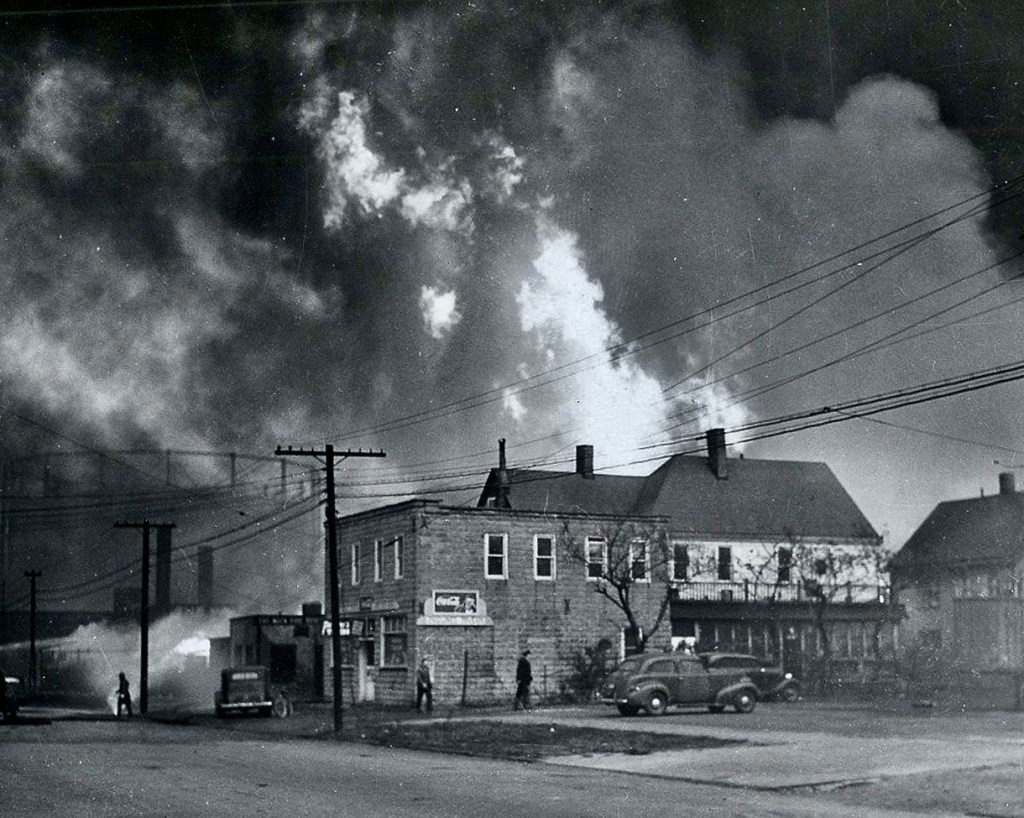
   The Friday afternoon that Cleveland’s St. Clair neighborhood blew up Hal Schaser was walking home from his seventh grade class at Wilson Junior High on East 55th St. He was thirteen years old on an Indian summer day on October 20, 1944. He was looking forward to a bowl of soup and salt crackers. He was nearing his house at three in the afternoon when he was suddenly knocked off his feet by a thunderous blast. When he jumped up and looked around he saw roofs on fire as far as he could see.

   “It was like the sky blew up all at once with lightning bolts and thunder,” he said. Thick black smoke turned day to night. His dog Buddy bolted up the front steps and pawed at the door. It was every dog for himself. “Only the pen of a Dante could do justice to the sights and sounds that occurred in the St. Clair neighborhood that hellish afternoon,” recalled local writer John Bellamy.

   Hal’s mother ran out of the house. Buddy ran into the house. Hal ran to his mother on the front lawn. They looked up at the burning sky until there was no more sky to see.

   “Captain Albert Zahler of the Cleveland Fire Department, Engine Company No. 19, was in his quarters at East 55th Street,” said Cleveland Police Inspector Tim Costello. “Suddenly the windows rattled, and the building began to shake. He ran outside and was met by a blast of extremely hot air. He observed hundreds of people running toward him and could see flames up over the tops of the buildings between himself and the fire. He hastened to the telephone in his quarters and caused a two-alarm to be sounded. Then with his men and apparatus he started out of the station and got as far as the apron in front but found the fire shooting up the street as though coming from a flame thrower such as is used by our armed forces.”

   The firemen ran back onto the station. Captain Zahler got on his telephone again and revised the SOS to a five-alarm. When the flames moved away from the front of the station house he and his men started out again. They didn’t get far.

   “They had gone but a short distance when they were met by more flame. They jumped from their apparatus and threw themselves on the ground until it had passed over. When they arose, they were tossed about as feathers in a wind, due to the brisance of the explosion creating a vacuum. One man sustained a broken leg and others received severe burns.”  

   The explosion and subsequent fires were caused when an East Ohio Gas liquefied gas tank started leaking. The gas flowed into the street and began to vaporize. It turned into a thick white fog. Nobody knows how it happened, but it ignited. It might have been a spark from a passing railcar or somebody lighting a cigarette. The thunderous blast wiped out the tank and everything else in the surrounds, starting with two roofers. They had been replacing slates on top of the tank. They were blown to kingdom come. Not a fragment of them was ever found, not even ashes.

   It happened at the foot of East 61st St near the New York Central Railroad tracks. When the gas blew up it blew up at about 25 million horsepower, the same as the combined output of all the hydroelectric plants west of the Mississippi River in 1944. Streets shook four miles away. Flames reached 3,000 feet high, and the heat reached 3,000 degrees Fahrenheit. After the war, a nuclear scientist estimated that the explosion released energy the equivalent of two and a half kilotons of dynamite, or about one-sixth the yield of the atomic bomb that destroyed Hiroshima.

   Hal’s friend Tim Kelley lived nearby. His father was home on leave from the armed forces after finishing basic training. He and a pal were messing around the neighborhood when the big bang happened. “They took shelter under a box car until they realized the steel wheels had gotten too hot to touch,” Tim said. They quickly agreed It was time to go. They beat a hasty retreat.

   When the storage tank, holding ninety million cubic feet of liquid natural gas in reserve for local war production, exploded, fire engulfed more than a square mile of city life, from St. Clair Ave. to the Shoreway, from East 55th St. to East 67th St. The sky went red and orange then squid ink black. Fire boats poured water on factories along the shoreline of Lake Erie to keep them from burning down. 

   Hal, his younger brother Willie, and mother Agnes lived on East 66th St. and Lexington Ave., just a mile-or-so from the East Ohio tank farm. Agnes sprayed garden hose water on their house until the water pressure dropped to nothing. Standing on the front porch they watched a tangled mass of cars, busses, and townsfolk on foot going the other way. Police, fire, and civil defense cars and trucks raced towards the fire, which was spewing gas, molten steel, and rock wool into the sky. Birds turned to charcoal and fell out of trees. Hal’s dog Buddy snuck into the basement and didn’t come out for three days.

   Sandy “Candy Man” Drago was checking a shipment of pipes at the tank depot that day. His bag of candy was on his desk. His car was parked in a nearby lot. When the tank ruptured and exploded, he was knocked flat and the paperwork in his hands turned to smudges. When he looked himself over for damage, his clothes were gone. He was left wearing underpants with melted elastic. The candy on his desk and the office were on fire. He ran for his life. His Chevy coupe caught fire, as did every other car in the lot.

   Mary Kolar was in her kitchen when a fireball smashed through the window, landing on her linoleum floor.  Her first thought was, “My God, the Nazis are here.” She swept up her children and ran for her life. Her house caught on fire. They passed a charred man caught on top of a fence. He was dead. “All that was left were his shoes.” When teenager Josie Mivsek rushed to her house, it was just in time to see it collapse. She later retrieved her marbles, being a marble-shooting champion, but found they had all melted together into a lump.

   The smell of burning whiskey hung over streets as taverns and home stills went up in smoke. The copper lines and buckets of yeast in backyards melted. Cash money tucked away into drawers and under mattresses was set alight and lost forever. Some lost their life’s savings.

   Eleanore Karlinger was working on the Sunday bulletin at St. Vitus Catholic Church. When she was knocked off her feet she stayed there. It can’t be an air raid, she thought. She cradled her head just in case. Then she thought it must have been the devil. When she came to her senses, she thought about getting the hell out of the church. She started to run but went back to man the phones in case the house of God was needed for shelter. Mothers dragged their children into the church, which was still standing safe and sound, for safety.

   Hal’s house didn’t catch fire after Agnes drenched it with her garden hose. His mother, brother, and he didn’t have to shelter at Wilson School. It was where the Red Cross ended up taking in nearly seven hundred suddenly homeless men, women, and children. It was more than a week before anybody went back to school.

   Housewives were caught unaware as flames raced through sewers and up their drains and their homes were suddenly on fire. “I was going to plug in my sweeper,” said Mrs. Charles Flickinger. “Suddenly it seems like the walls turned all red. I looked at the windows and the shades were on fire. The house filled with smoke. I think the furnace had blown up, then I see the fire all around.”

   Less than a half hour after the first explosion, a second tank exploded. Gas ran into the streets, into the gutters, and down catch basins into sewers, igniting and blowing up wherever it pooled. Telephone poles bent in the heat and cracked in half. Pavement was blasted into chunks and manhole covers sent flying. Fire trucks fell into sinkholes.  

   “Manhole covers were being blown up into the air like flipping pennies heads or tails,” Hal said. One of them was found in Glenville, miles away. One fell from the sky onto the heads of two men. All that day and the next day sirens never stopped wailing. More explosions followed, seven in all, smaller in scope but each one unleashing a fireball. When things died down “it looked like the end of the world,” one dismayed man said.

   Hal’s world had already been turned upside down twice. He was two years old when his father, who operated a corner store, was robbed, shot, and killed by young hoodlums. His mother found out while in the hospital giving birth to his brother Willie. After she re-married, within a few short years Hal’s stepfather died after a brief illness. Agnes Schaser never married again, going it alone, raising her two boys with no help from anybody. She was from Romania and would have gone back except for the war. The land of dreams had turned into bad dreams. 

   When Albert Kotnik’s house shook like it was going to fall apart, he grabbed his two children and ran outside, followed by his wife. They looked towards the east side where it looked like hell had suddenly become real. They turned around when they heard all the windows of their house cracking and shattering. The house was on fire all at once. It burned down to the ground in ten minutes. 

   Marcella Reichard’s house on Lake Court burned down to the ground. So did every one of the other twenty-three houses on her cul-de-sac. “I grabbed my mother and my little sister and we knelt and prayed. Mother went out the back way, but I told her she would be running right into the flames. I told them to hold their hands over their eyes and run toward the lake. Then we just ran as fast as we could.” More than ten thousand people were evacuated from the neighborhood.

   Jack McLaughlin’s father died at the tank farm trying to rescue a great-uncle who worked for East Ohio Gas. Jack was the same age as Hal and all their friends. “This was in God’s plans,” was all he could say. Many who died worked for East Ohio Gas. Some of them were never identified, burnt so badly as to make identification impossible. Others were never found, their flesh and bone vaporized. Anthony Greenway worked for East Ohio Gas. He was killed almost immediately. “Uncle Anthony’s damaged watch was located and returned to the family. It was all they ever found of him,” said Kathy Chamberlain.

   Fatality figures for the burned are hard to come by eighty years later, although it is certain many of the severely burned subsequently died. “They didn’t have the tools and treatments in the 1940s we have today,” explained Cleveland dermatologist William Camp. “They would have died of electrolyte loss, body heat loss, and infection.”

   All of Cleveland’s fire companies and policemen attacked the immense blaze, as well as military personnel, utility workers, and civilian volunteer groups. Auxiliary police, auxiliary firemen, and air-raid wardens showed up by the hundreds. The Coast Guard and National Guard showed up. It was all hands on deck. Firemen and policemen worked non-stop shifts, grabbing a few minutes of shut eye when they could. They surrounded the fire and tried to keep it from getting away from them. They fought it all day and night, dealing with consuming heat, explosions, and pumpers sinking into melting ground. Fire Engine No. 7 disappeared into a hole in the ground.

   Cindy Greenwald’s father was working at a nearby war plant. “They were all let out of work to fight the fires,” she said. “He and some other guys worked all night long hosing down buildings on St. Clair. When daylight came, they found out what they’d had their backs to the whole time. It was a gas station that was behind them.” They thanked their lucky stars that morning.

   By the end of Saturday morning the fire departments and scores of volunteers had almost all the fires under control. In the afternoon. Hal and his brother Willie went exploring. All the stop signs and traffic lights were gone, but there was no traffic, anyway. Burnt up hulks of cars and trucks lined the curbs. Fire hoses littered every intersection. Still smoking small fires lurked on every other front yard.

   “What happened to this place?” Willie asked. “It’s a mess. Was it the devil? Was it the Nazis? Do you think it was the Martians?”

   “Before yesterday happened this mess was our place,” Hal said. “I don’t think it was the Martians. Why would they come all this way to do that? Mom said it must have been sabotage by the black Nazis.”

   “This wouldn’t have happened if Superman had been here,” Willie said.

   “Yeah, him and Captain America, too,” Hal said. “They got the moxie.”

   Most of their friends, schoolmates, and relatives in the neighborhood had bolted. They had gone anywhere somewhere safe. St Clair was like a ghost town. The fire destroyed homes, apartments and boarding houses, factories, delicatessens and grocery stores, delivery trucks, and too many cars to count. The death toll reached into the hundreds while the injured reached into the thousands.

   Hal and Willie slouched home, there being little to see except destruction. Besides, they had already been told twice by policemen to go home. Their mother always said three times is the charm. They didn’t want to tempt fate. When they got home they checked on Buddy, who told them in no uncertain terms he was going to stay in the basement for another day or two, just in case.

   A month later there was a mass funeral at Highland Park Cemetery for the unidentified dead. Florists donated flowers and funeral parlors donated caskets. Many thousands watched silently, wondering which one of the coffins held their missing father, mother, brother, or sister. The dead were lowered one by one into a concrete vault. The mayor ordered that no other funerals take place that day.

   “We want the nation to know that Cleveland looks after its own,” said Edward Sexton of the committee supervising the mass burial. “Usually, such victims would go to a potter’s field. That is not for Cleveland.” Rebuilding was the only way for the living to recover from the disaster.

After the dead were buried the city began to rebuild.

Ed Staskus posts monthly on 147 Stanley Street http://www.147stanleystreet.com, Made in Cleveland http://www.clevelandohiodaybook.com, Atlantic Canada http://www.redroadpei.com, and Lithuanian Journal http://www.lithuanianjournal.com

“Cross Walk” by Ed Staskus

“A once upon a crime whodunit.” Barron Cannon, Adventure Books

“Captures the vibe of 1950s NYC.” Sam Winchell, Beyond Fiction

Available on Amazon: https://www.amazon.com/dp/B0CRPSFPKP

Late summer and early autumn. New York City. A Hell’s Kitchen private eye. The 1956 World Series. President Eisenhower at the opening game. A killer in the Brooklyn Dodger dugout.

Smoke Signals

By Ed Staskus

   Not everybody was too big at Born to Travel, but except for Sally, the office secretary, and my sister Rita, they were either full to the brim or getting close to it. Sharon, Karen, and Vivian were in love with the feedbag. Gino had a hankering for the beefy mixed with gravy. Sandy Eisen and Sima Zucker had fallen into the trough a long time ago and weren’t coming up for air.

   The travel agency was in Beachwood, a far east side suburb of Cleveland. The office wasn’t the biggest to begin with, making it a tight fit. It was a squeeze coming and going to the desks. The staff of six and the two boss women had to wiggle sideways to make their way around the cramped space.

   Everybody except Rita and Gino were Jewish. Gino was Italian, a gay man, and hated Sandy and Sima. Even so, he was there before Rita started working at the agency and he was still there when she gave notice after a gasoline tanker truck flipped over outside their doors. She had had enough by then and called it quits.

   Rita was the goy blonde girl who was good for business. Before she went to work at Born to Travel, she worked at another travel agency on Fairmount Circle, not far from John Carroll University. A jug-eared man who lived down the street owned the business. He put her desk in the window. He wasn’t hiding it. He thought she would attract whitish waspy people from the college.

   “Oh, look, they have a Christian girl there,” is what he hoped all the Christians would say.

   Sandy Eisen and Sima Zucker were sisters. They owned the agency. They were from Israel, like their cousin, who was Orthodox. Sandy and Sima were on the lighter side of Reformed. They didn’t take it seriously, although they could get serious in a second, if need be. They came to the United States when they were children. By the time they were teenagers it was as though they had always lived in McMansions in Beachwood. They only ever talked about the homeland when one of their tour groups was going there.

   In the 1970s Sandy was a dancer in downtown Cleveland. She worked at a disco bar serving drinks and dancing in a cage. The place was the Mad Hatter. It had a bubble machine, a strobed multi-colored dance floor, and sticky red-shag carpeting. She wore white go-go boots. Twenty-five years and 200 pounds later she showed Rita a picture of herself, in a shimmering sleeveless fringe dress, doing the funky chicken.

   Rita could hardly believe it and said so. Sandy didn’t like her tone. She lit a Virginia Slim cigarette and puffed on it, vexed, smoke coming out of her ears.

   Sandy and Sima’s world revolved around food. They loved all-you-can-eat buffets. Their favorite time of day was breakfast lunch dinner. They weren’t food snobs. Their motto was, eat up now. They were supposed to fast during the Jewish holidays, but because they were fat, they were diabetic and had to take medication. They had to take their pills with food, so they couldn’t fast. But they were sticklers about breaking the fast. Sandy would rush home right away and make a batch of potato latkes.

   Sima had two sons in high school. Her husband worked at a grocery store. He was the head butcher. He brought kosher beef and lamb home. Sandy had three daughters and her husband, a tall balding man with a nice smile, was a porno movie wholesaler. He sold them to video stores around the state. He made a good living selling glossy naked girls.

   All of Sandy’s daughters were pudgy-cheeked fat and fluffy. The youngest one was 22 years old and clocked in at close to three hundred pounds. The middle gal never went anywhere without her portable fridge. The oldest one’s neck was turning black because oxygen was being blocked by blubber. When they started hunting for husbands all three got gastric bypass surgery and lost weight by the boat load.

   No one ever knew what got into her, but Sima went to Weight Watchers for a month. She kept a journal and wrote down what she ate morning, noon, night, and snacks. But she lied to her journal. She made it all up.

   “I’m not going to say I ate all that,” she explained.

   “They’re not going to be checking up on you,” Rita said. “You’re just lying to yourself.”

   Gino didn’t believe she was going to lose any weight. “It’s a pipe dream,” he said. He chewed his cud about it. Rita encouraged her to keep it up, but Sima didn’t lose any weight, not that anybody thought she would.

   Sandy went on the Adkins Diet. She loved meat and started eating a slab of bacon every day. She brought it to the office in the morning. There was a microwave in the fax machine room. She tossed slices of bacon into it every morning, heated them up, and ate all of it. The office smelled like a fry shop for hours.

   “I don’t know about all that bacon,” Rita said. “It can’t be good for you.”

   “I’m on the Adkins Diet,” Sandy said. “I’m allowed to eat as much of it as I want.”

   “She’s double-crossing herself,” Gino said. Everybody looked the other way. Sandy didn’t lose any weight, the same as Sima.

   Whenever Sandy had to go to the bathroom, she would hoist herself up from the desk. It took a slow minute. She could have used a lift-o-matic. “Oy, vey” she complained. Her knees were giving out. When she came back from the bathroom and flopped down in her chair, it bounced, the hydraulic hissing and groaning.

   Every year, two or three times a year, Sandy and Sima went on cruises. They loved cruises for two reasons, which were food and gambling. They didn’t care what cruise line it was, so long as it was the cheapest. No matter how cut-rate it was, you could still eat all you wanted, and they all had casinos. They loved to gamble. The nightlife didn’t matter, either. The ports they stopped at didn’t matter. The only thing that mattered was that it was a floating chuck wagon with one-armed bandits.

   Rita went on one of their dime-a-dozen cruises. The ship was creaky old but not yet rusty. It sailed out of Miami into the Caribbean for a week. Sandy and Sima spent every waking minute eating and betting. Rita got sun poisoning at the pool the first day and couldn’t sit on the sunny side of the street after that. The rest of the trip she had to stay on the shady side of the street with the 70-year-olds. She was bitter about it every minute of the cruise.

   When gambling started showing up on computers, Sandy started gambling at work. She played winning and losing games at her desk and made Sima do all the work. She bossed Sima around most of the time, anyway. Sandy was the older of the two, although Sima was the harder worker, so Sandy could throw everything at her without caring too much about it.

   They bought clothes by remote control because they couldn’t find their sizes at department stores. Catalogs arrived at the office every day. Their clothes were XXL, but nice looking. They didn’t wear sack dresses. Most of the clothes were sets, coordinated stretchy pants and a top, like turquoise pants and a turquoise blouse.

   Sandy and Sima were both top-heavy, even though both had skinny legs. Sandy talked about her legs all the time. “Look how thin I am,” she said, pulling up her pants. “My legs are so thin.” But from the waist up she was huge. She never pulled her top up or down. It would have been indecent.

   It was when Sima got false teeth that she finally lost weight. Her real teeth were a mess from smoking and eating sugary greasy processed food and not brushing and flossing nearly enough. She was in pain for months because of the new teeth and hardly ate anything. Her dentist told her to stop smoking, too. She wasn’t happy about it, but she lost weight for a while.

   She didn’t like having to buy new shoes before their time, but she had to. Her fat feet had gotten skinnier, and she needed them. She only ever had one pair of shoes, a kind of basic black loafer. When they were worn out, she would buy another pair the same as before. “I can’t live with sore feet,” she said.

   Sandy wasn’t happy about the change in her sister. She didn’t like Sima losing weight, especially whenever she sprang out of her chair like a spring chicken to go to the bathroom. Sima started saying, “Oh, I can’t stand that smell,” whenever Sandy lit up, since she had stopped smoking. They were sisters, but they bickered most of the time, arguing about whoever did whatever it was they were doing better than the other.

   Everybody in the office smoked, except for Rita. Sima went back to blazing. They were always blowing smoke out of their mouths and noses. They were in a non-smoking building, but nobody cared. They were all addicted to tobacco. Besides opening the windows to air out the office, they bought devices that supposedly sucked smoke out of the air. One was next to Rita’s desk, although she was never sure it did any good.

   One day after work she met one of her friends for dinner. When they got to the restaurant her friend said, “We can sit in the smoking section if you want to.”

   “Have you ever seen me smoke?” Rita asked.

   “No,” she said.

   “OK then.”

   Gadi Galilli, Rita’s boyfriend, made her change her clothes the minute she stepped into the house after work. He didn’t smoke and didn’t like the smell. “I know they are well off, but it smells like poverty,” he said.

   She always smelled like smoke, since she sat in the office all day, an office where somebody was always lighting up. Gino’s desk faced hers, which made it worse. She had a cloud of smoke in her face most of the day. It wasn’t just them, either. Most of their clients had the same bad habit, as though the agency specialized in people who smoked cigarettes.

   If Sandy wasn’t lighting up a Virginia Slims, Sima was lighting one up. One or the other was always huffing and puffing. They were a pair of choo-choo’s. Sandy’s wastebasket under her desk caught fire one afternoon. She absentmindedly flicked a butt into it instead of stubbing it out in the ashtray. They had to call the building’s security guard, who had to find a fire extinguisher, and by the time he got it under control the fire burned the underside of the desk and all the wires to her computer.

   She never said she hadn’t done it, at least not to anyone in the office. She never said anything about it. But she denied it to the insurance company. She didn’t want to pay for a new desk and a new computer. She didn’t start the fire purposely, which made it all right in her mind, and she got her settlement in the end.

   One day a few days before Halloween a gasoline tanker truck overturned on Chagrin Blvd., turning too fast on the ramp coming up I-271, just outside the office building. The street slopes downward for a quarter mile as it wends east. The gasoline from the ruptured tanker ran down the road like smeary water. None of them knew anything about it until a fireman with all his gear burst in.

   “Everybody out!” he said. “We’re evacuating the building.”

   Gino, Sally, and Rita grabbed their coats. Sandy leaned halfway up from her chair.

   “Nobody takes their car,” the fireman said. “The ignition could spark the gas. If anybody even tries to start a car, you’re going to get arrested.”

   Sandy and Sima wrestled themselves up to their feet. They all went into the hallway, everybody from the upstairs offices coming down the emergency stairs, shuffling towards the front door, stopping, and waiting their turn to go outside. Standing in line, rocking back and forth, Sandy pulled out her box pack of cigarettes, her BIC lighter, shook out a Virginia Slims Luxury Light 120, flicked the lighter, and lit up.

   The fireman came running over to them. “Stop!” he yelled. “What the hell do you think you’re doing?”

   He pulled the cigarette out from Sandy’s lips and crushed it between his gloved fingers. “Give me that lighter,” he said. Sandy gave it to him. She was furious but didn’t say anything. Rita thought she was going to burst, but she gave the fireman the stink eye, instead. 

   He didn’t give the look a thought. He threw the BIC lighter in the trash. He kept his eyes on her.

   When they got outside everybody was walking up the road, up to the bridge over the highway, away from the gasoline. Sandy and Sima turned the other way. The office followed them. As they walked past the gas pooling on Chagrin Boulevard where it levels off, splashing down into the storm drains, Rita realized why they were walking in the opposite direction from everybody else. Sandy and Sima couldn’t walk far and besides, they had trouble walking uphill. They could walk farther if they were going downhill. They were also going towards the stretch of fast-food restaurants where all the fire trucks and emergency vehicles, their lights flashing, were blocking the road.

   They stopped at Burger King and had burgers and fries. Firemen tramped in and evacuated everybody. They had to move on. They stopped at Taco Bell and had chicken tacos. The next thing they knew firemen were evacuating everybody again. They stopped at Wendy’s, and everybody had a frosty.

   The gas smelled like more gasoline than Rita had ever smelled in her life. She didn’t have an appetite, although she had a strawberry frosty to pass the time. Sally had one, too. The rest of the office had the empty feeling, a hunger that got bigger and bigger, and scarfed up.

   Sandy called her husband from the phone booth outside Wendy’s, and he came and picked them up in his family van. He deposited Sandy and Sima at home, drove the rest to their residences, and dropped Rita off in Cleveland Heights.

   While parked in front of Rita’s up and down double, the engine running, he turned in his seat and said, “You’re a very pretty girl, have you ever thought about being in dirty pictures?” He flashed her a warm smile.

   “No,” she said.

   “You could make a lot of money,” he said. “We’re always looking for sick minds in healthy bodies.”

   “No thanks,” she said.

   He looked down in the mouth for a minute but took it like a man.

   Walking up the sidewalk to her front door, as Sandy’s husband drove away, she thought, “I’m going to have to quit my job soon. Who needs a sex maniac, and all those stinky butts? That can’t be good for me.” That’s what she did, finally, the week after New Year’s. “Where there’s smoke, there’s smoke blowing in my face,” she said to Gadi. She was peeved. “They don’t even pay me hazard pay.” 

   They never asked her, “Do you mind if we have a cigarette?” She was just the blonde girl to get the goys to cough up. They were topping off the tank, Virginia Slimming, rolling in the dough, while she was saving every spare penny to get ahead.

   “I don’t care if they are spoiled rotten, or not,” she told Gadi after clearing her throat and breaking the news. “They don’t pay me enough to stay. I’m not bringing home the bacon I need. I’ve got to go.” 

   Gadi waved his hand, brushing away imaginary smoke. “Go change your clothes,” he said.

Ed Staskus posts monthly on 147 Stanley Street http://www.147stanleystreet.com, Made in Cleveland http://www.clevelandohiodaybook.com, Atlantic Canada http://www.redroadpei.com, and Lithuanian Journal http://www.lithuanianjournal.com

A New Thriller by Ed Staskus

Cross Walk

“A once upon a crime whodunit.” Barron Cannon, Adventure Books

“Captures the vibe of mid-century NYC.” Sam Winchell, Beyond Fiction

Available on Amazon: https://www.amazon.com/dp/B0CRPSFPKP

Late summer and early autumn. New York City. A Hell’s Kitchen private eye. The 1956 World Series. President Eisenhower at the opening game. A killer in the dugout.

King of the Surf Guitar

By Ed Staskus

   When I saw Dick Dale at the Beachland Ballroom in 2003 I didn’t know he was dying. If somebody had told me that after the show, I would have said they were crazy. By the time he was done with the encore he had put on a set piece of steel string twang. He had a bass player and a drummer with him but he was essentially a one man band. I had to stand in a shoulder-to-shoulder crowd from beginning to end. I was tired of standing by the end of the night. He was more than fifteen years older than me and spent the show the same as me, standing, except he did it while putting on a three ring circus on his Stratocaster.

   “I’ve been performing since 1955 and I’m going to keep performing until I die because I’m not hoping to die in some rocking chair with a beer belly,” he said. “I’ll never die, not that way. I’ll just explode, right before your eyes, onstage.” He spent 60-some years performing before he went kingdom come.

   What I didn’t know was he had been diagnosed with cancer more than thirty years earlier. When that happened, he went to Hawaii for sunshine and treatments. It sidelined him for years. “You know what the doctors call me to this day? They call me ‘The Cancer Warrior.’” He stayed in trim through thick and thin, playing his guitar upside down and backwards. He was born a lefty.

   Before Jimi Hendrix was the Jimi Hendrix Experience, he was the bass player for Little Richard. He was in Little Richard’s back-up band the Upsetters. “We were both left-handed, Jimi and me, but we would use a right-handed guitar held upside down and backwards. He developed my slides and my riffs. He used to say, ‘I patterned my style after Dick Dale.’”

   Dick Dale cut his teeth and made a name for himself at the Rendezvous Ballroom in Orange County. The ballroom was built in 1928 and had long been a swing and big band music hall. He started playing there in 1961. Seventeen people showed up at his first show, all of them surfer friends of his. Less than a year later thousands of fans were attending his nightly gigs. The shows were called “The Surfer Stomp.”

   The Rendezvous Ballroom burned down in 1966. It happened the day after the Fresno band the Cindermen performed there. Although it was a suspicious coincidence, nobody blamed them. When the surf guitar craze died down in the mid-60s, Capital Records declined to renew their contract with Dick Dale. His father Jim and he went back to pressing their own singles. The British Invasion was in full swing. The Beatles were on the throne. The Monkees were on the horizon. Dick Dale took a back seat. “You’ll never hear surf music again,” Jimi Hendrix sang on his 1967 song “Third Stone from the Sun.”

   In the 1970s Dick Dale suffered an accident on his surfboard that almost cost him a leg. It took him a long time to recover. He stopped performing, trying to get his feet back under him. He scored his first comeback in the 1980s when he was nominated for a Grammy alongside Stevie Ray Vaughn for their cover of the Chantay’s “Pipeline.” It was back to the beach and his Stratocaster.

   Satan’s Satellites opened for him when he came to Cleveland. When they were done stirring the pot it was time for the mainline. Dick Dale was dressed like a cowboy, mostly in black. He had an aquiline nose and his hair had gone white. The Stratocaster being driven to a reverb-heavy frenzy in his hands was yellow. The guitar was nicknamed “The Beast.” It was fitted up to be played loud, with thick gauge strings. “I call them cables,’’ he said. “That’s what gives me my fat sound.’’ He was compelled to use heavy picks to make an impact on the strings. His staccato picking led to him breaking dozens of picks every show. He kept many of them in his back pocket. The Stratocaster didn’t have tone controls. What it had was a master volume and a toggle that activated the neck and middle pickups.

   “My philosophy is the thicker the wood, the thicker the sound,” he said. “The bigger the string, the bigger the sound. My smallest string is a 14 gauge.”

   Dick Dale wasn’t born “The King of the Surf Guitar.” He was born Richard Mansour, the son of a Lebanese father and a Polish mother. He learned to play the piano at an early age and moved on to the ukulele. His uncle played the oud and the tarabaki and taught them to his nephew. In his teens he bought a used guitar and it was off to the races. He blended tarabaki drumming with guitar playing, developing a picking technique he called “the pulsation.” When his family moved to southern California, he learned to surf on weekends. He took his board to the beach from sunup to sundown. One thing led to another and the Middle Eastern music he had grown up with became the emerging genre of surf music.

   Surf music popped up seemingly out of nowhere in the late 1950s. It didn’t morph out of anybody else’s sound. The first wave was instrumental surf, played by the likes of Manuel and the Renegades, Eddie and the Showmen, and Dick Dale and His Del-Tones. Dick Dale pioneered the surf sound, folding his boyhood influences in with rock-n-roll, a spring reverb, and rapid alternate picking. His 1961 song “Let’s Go Trippin’” was a big hit and launched the popularity of the new beat.

   The second wave was vocal surf, coming out of the mouths of bands like the Beach Boys, Jan & Dean, and Ronny and the Daytona’s. It was the kind of music meant to stir the hearts of teenage girls and get them to buy records. “Little surfer little one, made my heart come all undone, do you love me, do you surfer girl, surfer girl my little surfer girl,” is how the Beach Boys put it. They weren’t above repeating “surfer girl” four times in one verse.

   Dick Dale wasn’t an old geezer, but he wasn’t a young geezer, either, the night I saw him perform. He was in his mid-60s, an inch or two shorter than six foot, and looked fit as a fiddle, although a little thick around the middle. He wasn’t fiddling around, though. He looked like the kind of guy who knew his way around. He looked like he might have a switchblade somewhere on his person. He looked like the kind of guy you wouldn’t want to get into a knife fight with in a phone booth.

   “I can be a mean maniac,” he said. “Someone once threw a firecracker at a show and I jumped off the side of the stage and whacked them on the side of the head.” He knew how to whack hotheads, having raised wild animals for many years on his ranch. “When I was surfing, I would get a rumble sound,” he said. It was the sound he tried to capture on his guitar. “At the same time, I was raising forty different exotic animals. So, when my mountain lion, he’d go, ‘Waaah!’ I’d imitate that on my guitar. When my African lion wanted his dinner, he’d go, ‘Ooowwwahhhhrrrgh!’ They were matching the sounds of what you go through when on a 15-foot wave.”

   He started the show at the Beachland Ballroom with “Misirlou,” an old Middle Eastern song originally known as “Egyptian Girl.” It was from where his father and uncle came from. He learned it as a boy from his uncle who played it on the oud. “I started playing it,” Dick Dale said, “but I said, ‘Oh no, that’s too slow.’ And I thought of Gene Krupa’s drumming, his staccato drumming. When we moved to California, I got my first guitar, but I was using this rocket-attack, Gene Krupa rhythm on the guitar.”

   The reason Dick Dale was in Cleveland was the movie “Pulp Fiction.” The director Quentin Tarantino used the song “Misirlou” in his mid-90s movie and just like that surf music was back in the spotlight. He released a new album and hit the road again. He announced from the stage he had another new album out called “Spatial Disorientation.” It sounded just about right.

   The Beachland Ballroom hadn’t always been home to the most wide-ranging rock ‘n roll on Lake Erie’s south coast. The building was built in Cleveland’s North Collinwood neighborhood in 1950 as the Croatian Liberty Home. It came with a ballroom and a bar. It was where local Croatians celebrated weddings and lamented deaths. After a shot and a beer, it was time to live it up on the dance floor grooving to the gajde. A kitchen and back bar were added in 1976. During the Age of White Flight most of the Croatians moved farther east to suburban Eastlake and built a new National Home. The old building was boarded up. It became the Beachland Ballroom in 2000. 

   Surf music is usually played on electric guitars in straight 4/4 time with a medium to fast tempo. It is known for its use of a spring reverb incorporated into Fender amps. The Fender Reverb Unit developed in 1961 was the first to feature a wet surf reverb tone. It is the effect heard on Dick Dale recordings from that time on. 

   “People just loved the sound,” he said.

   They loved the sound in California, for sure. “Kids called it surf music, although I didn’t call it that,” he said. “I didn’t go to Julliard. I’m into just chopping, chopping at the strings. That’s the sound, the sound of the waves chopping. The surfing sound is not the reverb. When so-called music historians say reverb’s the surf sound, they don’t know what they’re talking about. It’s the heavy machine gun, the staccato sound. It’s the waves.”

   Halfway through the show, halfway through “The Wedge,” he grabbed a pair of drumsticks and played part of the song on his guitar’s fretboard with them. Music historians everywhere shook their heads. “Where’s the reverb?” they asked. The Rock and Roll Hall of Fame in Cleveland stuck by their decision to not induct him into their museum. They inducted the Ventures instead. It was a wise decision.. Museums are for the antiquated. Dick Dale wasn’t museum fodder. He was a live wire. 

   His staccato sound was a loud sound. Leo Fender was the man who made it loud and louder. He created the first eighty five watt transformer especially for the plank spanker. It peaked at a hundred watts. Leo Fender called it the ‘Showman.’ “It was like going from a little VW Bug to a Testarossa,” Dick Dale said. The Ferrari Testarossa was a championship-winning racing car in its day. The name means “red head” in Italian, referring to the red-painted cam covers on the 12-cylinder engine. In time the ‘Showman’ became a hundred watt transformer peaking at one hundred and eighty watts. Leo Fender called the new deal the ‘Dual Showman.’ Everybody hearing it called it a game changer.

   “Leo is the guru of all amplifiers,” Dick Dale said. “It was him who gave me a Stratocaster. He became a second father to me.” He became Leo Fender’s quality control tester. If an amp could survive his show, it was ready to go big-time. Along the way, Dick Dale destroyed fifty-some standard 30-watt boxes. “Dale and Leo would continue to work together on upping the ante, building a speaker cabinet that could house two 15-inch speakers to sustain his vicious riffage,” is how the Fender folks put it. 

   After he ripped through “Misirlou” to open the show, Dick Dale ripped through “Shake ‘n’ Stomp” and “Rumble” and “Jungle Fever” and “Hava Nagila” and “Banzai Washout” and “Shredded Heat.” He slowed it down for a minute playing “Caterpillar Crawl.” The drummer got to be excited on “Surfing Drums.” After that came “Tidal Wave” and “Ghost Riders in the Sky.” There wasn’t much banter between songs. When one was over and done with it was on to the next one.

   “I’m going to play my goddamn guitar and that’s all there is to it,” he said. “I’m going to make people happy. I’m going to make them forget about all their pains.” He meant get happy and forget your troubles for two-and-a half hours.

   When the show wrapped up after one encore, we shuffled out into the springtime night. There was a full moon in the empty sky. My friends and I wandered along the half mile of storefronts towards East 185th St. The neighborhood had been the headquarters of the Irish Mob in the 1970s. Motorcycle gangs showed up after the Irish were gone. The neighborhood was slowly turning the corner, though. It was becoming the Waterloo Arts District, bustling with art and entertainment.

   Dick Dale died sixteen years after I saw him at the Beachland Ballroom. He was fast off the starting line when I saw him, all the while suffering from diabetes, kidney disease, and heading towards more cancer. What sustained him getting to the finish line was beyond me. Maybe the music kept him going. He said as much when he said, “I make my guitar scream with pain or pleasure. It makes people move their feet and shake their bodies. That’s what my music does.”

   Like the reggae man Bob Marley once said, “One good thing about music, when it hits you, you feel no pain.”

Ed Staskus posts monthly on 147 Stanley Street http://www.147stanleystreet.com, Made in Cleveland http://www.clevelandohiodaybook.com, Atlantic Canada http://www.redroadpei.com, and Lithuanian Journal http://www.lithuanianjournal.com

A New Thriller by Ed Staskus

Cross Walk

“A once upon a crime whodunit.” Barron Cannon, Adventure Books

“Captures the vibe of mid-century NYC.” Sam Winchell, Beyond Fiction

Available on Amazon: https://www.amazon.com/dp/B0CRPSFPKP

Late summer and early autumn. New York City. A Hell’s Kitchen private eye. The 1956 World Series. President Eisenhower at the opening game. A killer in the dugout.

Sledgehammer Hill

By Ed Staskus

   The weekend my mother-in-law Terese and her husband Dick moved out of Reserve Square in downtown Cleveland, they moved out of twin Brutalist inspired apartment towers into a turn of the century house. They had lived in their apartment for more than twenty years, on the 17th floor facing Lake Erie. During the National Air Shows flying out of Burke Lakefront Airport they sat on their balcony and watched the Blue Angels streak past like roadrunners on the loose.

   There’s nothing like the sound of F/A-18 Hornets roaring a few hundred feet overhead and veering away at the last second from skyscrapers dead ahead. They are jets able to perform high angle of attack tail sitting maneuvers and can fly formation loops dirty, their landing gear down. The sound of silence once they’re gone is deafening.

   Terese and Dick bought an abundance of a house with four bedrooms and three bathrooms on the corner of East 73rd St. and Chester Ave., in the blighted Hough neighborhood, ten minutes from downtown. It was built in 1910 in the colonial style. When they got done restoring it, they had added an attached garage, put on a new roof, installed new vinyl windows and siding, a new interior staircase, and a new kitchen. It went from ghetto to gentrified as fast as the contractors could make it happen.

   Almost 100% of the people living in Hough in 1999 were black. Only 2% of them were white. Terese was Lithuanian and Dick was Italian. They were part of the 2%. She was from Cleveland. He was from Rochester. Everybody and their uncle tried to talk them out of buying the house. The racial make-up of the neighborhood was the stumbling block of all their opinions. The color barrier, however, was not a stumbling block to Terese.

   Terese was a self-taught chef who owned four restaurants in her time and made herself into one of the city’s top-notch confectioners. The opera star Luciano Pavarotti searched her out and pigged out on her cookies and cakes whenever he was in Cleveland. “That man can eat,” she said. When he was done eating he was good and ready for an aria.

   Her signature creation was a 17-layer cake based on a recipe that Napoleon brought to Lithuania during his ill-fated Russian campaign. Terese, Dick, my wife, brother-in-law, and I helped make them Novembers and Decembers, working out of her kitchen, freezing them, and selling them during the holidays through the Neiman Marcus catalog. I went home most nights needing to shower clouds of flour off me. 

   Terese and Dick bought the house in Hough because she had grown up nearby, when the neighborhood was more white than not, and wanted to go home again. It wasn’t the same, but she saw what she wanted to see. She remembered the neighborhood from her childhood and made the reality fit her memory. She had a streak of magic realism running through her.

   My wife and I lived in Lakewood. I had a red Schwinn mountain bike that I frequently rode in the Rocky River Metropark, on the paved trail, the horse trails, and the single tracks. I rode downtown sometimes, winding my way through Ohio City and across the Hope Memorial Bridge, especially on weekends when all the bankers, lawyers, and city workers were at home. I usually rode the Hope Bridge over the Flats so I could see the Guardians.

   The 6,000-foot-long art deco truss bridge crosses the Cuyahoga River. Four pairs of immense stone statues officially named the “Guardians of Traffic” are sculpted onto opposite-facing pylons at each end. Each of the Guardians holds a different vehicle in its hands, a hay wagon, a covered wagon, a stagecoach, a 1930s-era automobile, and four different kinds of trucks. I always crossed an index and middle finger while going by in hopes of keeping traffic away from me.

   I got it into my head that I wanted to ride around on the east side of town, through Cleveland Heights and Shaker Heights. I thought about East Cleveland but thought better of it. The city had gone to hell in a handbasket. I asked Terese if I could park my car in their driveway while I rode. She said yes but cautioned me to bring my rear-mounted rack into the garage. Law and order was sketchy in her neighborhood. When I had stored the rack away she invited me into the kitchen to snack on  croissants fresh out of the oven.

   She was in the middle of two projects. One was chocolate-covered plastic spoons that turned into a steaming drink when hot water was added. There were rows of the spoons on baking trays. The other project she was working on was perfecting a handy self-serve pan to make the dry, hard-textured Italian cookies called biscotti. I preferred croissants fresh out of the oven.

   Whenever I had ridden downtown with friends and wanted to push ahead into Cedar and Fairfax, what my friends called the black hole, they always turned back. “I don’t want my husband getting killed by some spade,” one of their wives told me. I didn’t bother trying to explain that hot under the collar rednecks driving pick-ups were far more dangerous. It wouldn’t have done any good.

   I rode up the hill to Little Italy and Lake View Cemetery. The riding was twisty throughout the graveyard. I couldn’t see the lake, no matter what. I stopped at the Garfield Monument. President Garfield was shot four months into his term of office and died two months later from infections caused by his medical staff. He was determined to live but stood no chance against his White House doctors. The shooter was hung the next summer. On the gallows he recited a poem he had written called “I Am Going to the Lordy.” He signaled he was ready for his fate by dropping the paper it was written on. The hangman kicked the paper aside and didn’t screw around securing the noose.

   There are thousands of trees and 100,000 graves in the 280-acre cemetery, from nobodies to moguls. One of the most striking grave markers is the life-sized bronze statue called The Angel of Death Victorious but known as Haserot’s Angel. The statue is seated on the gravestone of Francis Haserot, holding an extinguished torch upside-down. The man made his fortune canning foodstuffs and importing tea and coffee. 

   The angel’s wings are outstretched and looks like it is crying black tears. “They formed over time,” Terese told me. “It’s an effect of the aging bronze.” She had taken drawing and painting classes at the Cleveland Institute of Art. I took her word for it.

   I rode Fairmount Blvd. to Shaker Hts. and bicycled around the Nature Center at Shaker Lakes. The green space was created in 1966 to stop the Clark Freeway from going in. Those behind the effort called themselves ‘Freeway Fighters.’ Cuyahoga County Engineer Albert Porter called the Shaker Lakes a “two-bit duck pond” and vowed that the highway would get built come hell or high water. The highway never got built, regardless.

   The twenty acres of the Nature Center has eight mapped natural habitats, four gardens for native plants and insects, and two trails. I rode the trails and tried not to squash any insects. I wheeled out on the 7-mile long Shaker Blvd. to Beachwood and back. Shaker Hts. was built by Oris and Mantis Van Swerington, early 20thcentury developers. They modeled the suburb and the boulevard after examples of English Garden City planning. They laid rapid transit rail service down the middle of the boulevard. Broad tree-shaded lawns front the mansions on either side of the road. One of my cousins and her husband lived in one of the mansions, but I was crusty from sweat and didn’t stop to visit.

   The best thing about riding up Mayfield Rd. to the cemetery was riding down Mayfield Rd. from the cemetery. It was a long enough stretch that I could go as fast as I wanted, although I feathered the brakes all the way down. I didn’t want to end up laid out next to President Garfield.

   Terese always let me wash up when I got back to her house, made me a cup of coffee, and put something tasty she had baked on a plate. She had never gone to cooking school, instead learning her craft by getting the cooking done. Everything she made was as good as the cookbooks said it was supposed to be. In her time she had been the pastry chef at Max’s Deli in Rocky River and Gallucci’s Italian Foods in Cleveland.

   One weekend I rode my tricked-out Schwinn, which was equipped with front shock absorbers and disc brakes, and went looking for Sledgehammer Hill in Forest Hills Park. The city park is lodged between East Cleveland and Coventry Village. The sloping land rises to a plateau. It was where John D. Rockefeller’s private summer estate was in the 19th century. He could afford it because his estimated net worth was equivalent to 1.5% of America’s GDP at the time. He was and still is the richest man in American business and economic history.

   There were lakes and bridle trails. There was a racetrack and a golf course. Before John D. Rockefeller died the property went to his son, John, Jr., who transferred one third of it to Cleveland Hts. and two thirds to East Cleveland. His only stipulation was the land be used for recreation and nothing else. The new park opened in 1942. It was about half forest and half meadow. It has been improved over the years, with tennis courts, a swimming pool, picnic areas, as well as basketball courts, football fields, and baseball diamonds.

   When I was growing up we hardly ever went there summers, but went there many times in the winter. We lived at East 128th St. and St. Clair Ave. and getting there was no trouble. We went ice skating on the man-made lagoon and sledding down Sledgehammer Hill. That wasn’t its official name, if it even had one. It was what all of us called it because of the killer bump near the bottom.

   Skating was loads of fun. There was a boat house on the man-made lagoon. It was where we changed into skates. My father had taught us to skate growing up in Sudbury, Ontario. The mining town is north of the Georgian Bay and south of Wanapitei Lake. He would spray our front yard with a hose in the winter and the water froze hard as concrete in no time. When we moved to Cleveland in the late 1950s we took our skates with us. Neither my brother, sister, nor I were big leaguers on the ice, but we skated like dervishes, living it up as we tried to toe loop and pirouette.

   Sledgehammer Hill was a hill that started at the top of the plateau and ran down a wide treeless slope. When I went looking for it my memory of it was that it was long, fast, and deadly. I didn’t give my memory much credence, though, believing it must have really been short, slow, and safe. You never know when you’re making up the past.

   When I found it, thinking that I would ride down on my Schwinn, I was startled by what I saw. I backed away from the lip of the hill and got off my bike. I walked back to the edge and looked down. It looked even longer and more dangerous than I remembered. I saw the bump near the faraway bottom and remembered hitting it, going airborne, and landing like Godzilla had body-slammed me. Many kids veered away from the bump. None of us ever blamed them. We had all done the same thing one time or another. Only the innocent went over the bump full-bore the first time and lived.

   I don’t know how fast our sleds went, maybe 20 or 25 MPH, but they went fast as hell. We didn’t wear helmets. We wore knit caps. You were considered a sissy if you wore earmuffs. I started wearing earmuffs after one icy winter weekend my ears froze and almost fell off. Insults were easier to bear than frostbite.

   Our parents always went skating with us or watched from a bench, in case the ice started to  crack, but when we went sledding, they dropped us off and went on their way. My sister rarely sledded, my brother sometimes did, but I couldn’t get enough of it. We rode Speedaways, Yankee Clippers, and Flexible Flyers. Only the foolhardy among us rode Sno Wing Blazons. They were too fast for Sledgehammer Hill. Most of us wanted to go as fast as possible but not necessarily break our necks. We sledded until it started to get dark and our parents came back to pick us up. 

   I didn’t take a chance going down the hill on my Schwinn. I rode away from Sledgehammer Hill, roaming around the park plateau instead, taking in the highlights of the past. I rode to the north end of the hill where John D. Rockefeller’s mansion had stood. It burned to the ground under unexplained circumstances in 1917.

   It was early in the evening by the time I pedaled back to Terese’s house. After I told her about the hill she stepped into the middle of her kitchen, pretending to be standing on a snowboard, balancing with her arms stretched out, and racing to the bottom. 

   She had performed professionally as a ballet dancer when she was younger and taught the fine points of footwork to Cleveland’s Lithuanian folk dancing groups. I applauded her performance when she was done, but if she had tried that stunt on Sledgehammer Hill, professional dancer or not, she would have gone flying headfirst when she hit the killer bump, and there wouldn’t have been enough croissants in her kitchen to break her fall.

Ed Staskus posts monthly on 147 Stanley Street at http://www.147stanleystreet.com, Made in Cleveland http://www.clevelandohiodaybook.com, Down East http://www.redroadpei.com, and Lithuanian Journal http://www.lithuanianjournal.com. To get the site’s monthly feature in your in-box click on “Follow.”

“Bomb City” by Ed Staskus

“A police procedural when the Rust Belt was a mean street.” Sam Winchell, Beyond Books

Available on Amazon: https://www.amazon.com/dp/B0F1LM1WF9/ref=sr_1_1?crid=2MYAQAOZIC2U9&dib=eyJ2IjoiMSJ9.hTm7BGbiQbSe5ZapFwYPPfcwOpTe-Vdg6VLE4aGyTyk.Z0R-VNBWWEcvKcNaO9LdCOUnNIOOXgvYkRS_FXiXuHk&dib_tag=se&keywords=bomb+city+ed+status&qid=1742136726&sprefix=bomb+city+ed+staskus%2Caps%2C84&sr=8-1

Cleveland, Ohio 1975. The John Scalish Crime Family and Danny Greene’s Irish Mob are at war. Car bombs are the weapon of choice. Two police detectives are assigned to find the bomb makers. It soon gets personal.

A Crying of Lot 49 Publication

Tracks of My Tears

   By Ed Staskus

   I didn’t watch much TV growing up because we didn’t have a TV. It wasn’t until a couple of years after we moved from Sudbury, Ontario to Cleveland, Ohio that my parents bought a used 1955 Philco Custom 400. It was a 21-inch model in a cabinet of white oak with a finger-tip tuning system. It had a Double Gated Automatic Picture Control tuner that never worked during sketchy weather of any kind, whether it was drizzling or thunder storming.

   At first, I wasn’t impressed with what I saw. The shows were the likes of “McHale’s Navy,” “Car 54, Where Are You,” and “My Three Sons.” I had no use for “Hazel” and “I Love Lucy” drove me nuts. Lucy was a fruit loop and everybody hollered and played pratfalls like there was no tomorrow. I liked watching baseball and football games, although baseball games went on forever and football games were only broadcast on Sundays. The Cleveland Browns were a powerhouse. Everybody citywide stayed patriotically stuck to the tube when they were playing.

   Cartoons were fun and westerns were my favorite, especially “Maverick,” “Bart Masterson,” and “Have Gun – Will Travel.” My parents enjoyed “Bonanza” and watched it every Sunday night which meant my sister, brother, and I watched it every Sunday night. I didn’t care for it, the Cartwright’s being irredeemable do-gooders, but I couldn’t and didn’t say anything to my parents about my point of view. They were always telling me to be a good boy.

   My favorite was “Route 66.” It was about two young men driving around the country in a Chevy Corvette convertible. Besides the adventures, what I liked about the show was that every episode was shot on location in a new state. It was my kind of geography.  I would have given my tooth fairy money to be them. I didn’t mind being good, but I didn’t want to be too good.

   I had been to the neighborhood Shaw-Hayden Theater many times and seen plenty of space adventure and monster movies. My friends and I always sat in the front row. Movies were the real deal and TV was lame compared to the big screen. Movies were stupendous while TV was furniture. At about the same time we were watching Godzilla movies on the big screen the chairman of the Federal Communications Commission gave a speech to the National Association of Broadcasters. After praising the professionals in the room, he said that television should uphold the public interest. Then he said TV was a “vast wasteland.” He didn’t stop there. “When television is bad, nothing is worse.” He was a starry eyed idealist who didn’t pay attention to the commercials.

   One summer when I started watching “Queen for a Day” I watched it every day. It didn’t matter that my friends were riding bikes, playing ball, and messing around outside. I watched it laying on my stomach on the floor a few feet from the TV. I only watched it for three or four weeks, although it was more than enough to make me sweat bullets. When I stopped watching it, I went cold turkey and never watched it again. I hadn’t grown much older watching the sob show, but I seemed to be growing up way too fast on the tracks of melodrama and avarice.

   The show was originally a local affair on radio in Los Angeles but became popular enough that NBC picked it up and started broadcasting it nationally on television. The broadcast was live from the Moulin Rouge theater restaurant in Hollywood. Its ratings got so high that the network increased its running time from 30 to 45 minutes so they could sell more commercials. They were raking in $4,000 a minute, a premium price nobody else was getting. Sponsorships poured in. Every single prize came from sponsors. Models in faux medieval outfits plugged the products. They looked more slutty than maidenly. They had to put up with the sad sack-looking host saying things like, “Let’s give Mary Ann a big hand for finally doing something right.” Pre-recorded commercials ran between segments. Naming all the sponsors at the end of the show took more than five minutes.

   The show went to ABC from 1960 to 1964 until it finally folded. The television writer Mark Evanier has called it “one of the ghastliest programs ever produced, tasteless, demeaning to women, demeaning to anyone who watched it, cheap, insulting, and utterly degrading to the human spirit.” After that nobody bothered asking him what he really thought.

   The idea behind the show was simple as dog eat dog. “Queen for a Day” was about four women sharing their stories of unhappiness and tribulation in front of an all-female audience. There was always a box of Kleenex on the table behind which the women sat. jack Bailey was the host. He was a pencil mustached man who always looked like he needed another drink. The stories were about dead husbands and sons crippled with polio. One woman wanted to win so she could repair the bullet holes in her bedroom walls where her husband had committed suicide. He missed several times before getting it right. Determined widows with healthcare problems were a staple. If they had a small dying child, to boot, they were sure to win. 

   “I had two handicapped sons,” one woman said. “I lost them, and then I took care of an elderly lady in a wheelchair. She passed away, along with my mother and my father, and then my husband passed away. I feel that I would like to have a vacation.” She got her vacation. Another woman related the tale of her legally blind uncle and cousins. They were a poor farm family in Kansas. Everybody in the family had serious vision troubles. She came in second place and so none of her relations got new eyeballs.

   “On the show when Jack Bailey introduced my mother, he made a big deal about her being a long-lost cousin because her last name was Bailey,” one woman’s daughter recalled. “Since she was a farm girl, he asked her if she milked cows, and she demonstrated on his fingers. She became the queen that day. My uncle was given everything my mother asked for and more. He got a complete piano tuning tool set and a scholarship to a piano tuning school in Seattle. My mom got a full set of living room furniture and an Amana freezer that lasted for twenty-five years.”

   “My husband died,” one contestant explained. “Then my children and I were evicted and were out in the cold with nowhere to turn.” The show was the forerunner of all the reality TV shows that came after it. “Well, ha, ha, ha!” Jack Bailey laughed like he was at a circus. “Today is your lucky day, getting to tell your story here and having the chance at being chosen QUEEN FOR A DAY!” Sometimes, unable to help himself, he guffawed at the sad stories and threw out sarcastic comments, immediately explaining that he was just kidding.

   After the ladies finished, the audience applauded for the woman they wanted to see become “Queen for a Day.” The winner was determined by a decibel-reading Applause Meter, what I called the Thing-O-Meter. I didn’t always agree with the contraption, but what did I know. The winner was fitted with a jeweled crown and robed in a sable-trimmed robe. She got money, appliances, clothes, and vacations, among other things.

   “I always thought losing was the worst,” said Bill Costello, who like me found himself glued to the boob tube. “Then you find out your life sucks, but not enough.”

   Not just anyone was picked to be on the show. They had to somehow appeal to the  producers before they ever got to a live audience and the tens of millions watching at home. One woman explained she wanted to be on the show because “it would help me to regain my identity, which I seem to have lost somewhere between the maternity ward and the washing machine.” The best approach was delivering enough pathos and bawling to turn the trick. One woman said she would give her right arm to be on the show.

   My mother spotted me on the living room floor one day staring up at the TV, engrossed in the black and white pathos. She put her dish towel away and sat down in a sofa chair behind me. When the day’s episode was over, she shut the TV off. “Don’t watch that show anymore,” she said. She had never forbidden me to watch anything before. I knew there was something wrong with the show but couldn’t put my finger on it. It held me in its sordid grip. The women told fantastic stories, whoever got the most applause for her miserable tale won, got crowned, and walked away with prizes up the wazoo. What could be better?

   One winner said her husband was killed in a car crash, the family ended up poor as church mice, their savings exhausted, and needed help bad. “My mother was 28, pregnant, my sister was 8, and I was 5,” her daughter remembered years later. “My father promised my sister that if she got good grades, he would buy her a pony. She did but he died before he could fill his promise. My mother won two bedroom sets, a living room set, a dining room set complete with dishes for a service for eight, a set of silver ware, a cook-set, a built in mixer, a hot water heater, a 7-piece patio set, a complete set of Tupperware, twelve complete outfits that included dress, matching shoes and handbags, twelve pairs of stockings, a complete set of Sarah Coventry jewelry, a complete set of rhinestone jewelry, a diamond encrusted watch, a four piece matching mother-daughter outfit, a swimsuit, a check for $1,000, and a Shetland pony.” 

   When she came up for air she checked the time on the jewel-encrusted watch.

   Jack Bailey had a trademark signoff, which was, “Make every woman a queen, for every single day.” He never said what the losers got, although I always assumed they got nothing. Once my mother came to grips with the show, she disliked it instantly. My parents were World War Two refugees from Lithuania and didn’t believe a word about getting something for nothing.

   “I was babysitting my aunt’s four children in 1944 when the Russians came,” my mother said. “We ran away on a cart pulled by a horse with a cow tied to the back. On our way through East Prussia, we had to sell the cow for food. There was no milk for the baby. We slept under the cart every night and every night either the Germans or Russians bombed us. After the war I lived in Nuremberg in one room with three other women and worked at the Army Hospital. When I went to Canada where I had gotten a visa and a job, the job was as a nanny for a family of thirteen. When your father joined me the next year, he had no money and went to work in a cement factory the next day. When we got married, we still had no money, but we had the three of you and bought a small house. It’s shameful to go on a TV show, telling all the world your troubles for prizes.”

   She hadn’t seen her parents, uncles, aunts, brothers, sisters, and cousins for almost twenty years. The Iron Curtain was locked up tight. My parents never complained about it. They both went to work weekdays and on weekends worked around the house when they weren’t doing something at the church or with the Boy Scouts. They didn’t help us with our homework or drive us to the library. We did our own homework and walked to the library.

   She wasn’t telling me anything about “Queen for a Day” I didn’t already know, although I couldn’t if my life depended on it have put it into words. I knew I didn’t like the clapping like crazy for the most miserable story of the day. “Sure, the show was vulgar and sleazy and filled with bathos and bad taste,” the show’s producer Howard Blake said after the program’s nine-year run ended. “That was why it was so successful. It was exactly what the public wanted.”

   He didn’t stop there. He knew it was a trashy show that played on people’s misery, while those same people played out their tearjerkers to cash in on the American Dream. “Everybody was on the make, NBC and later ABC, the producers, the sponsors, and the suppliers of gifts. And how about all the down-on-their-luck women who we used to further our money-grubbing ends? Weren’t they all on the make? Weren’t they willing to wash their dirty linen on coast-to-coast TV for a chance at big money, for a chance to ride in our chauffeured Cadillac, for the free tour of Disneyland and the Hollywood nightclubs? What about one of the most common wishes they turned in? ‘I’d like to pay back my mother for all the wonderful things she’s done for me.’ The women who made that wish didn’t want to pay back their mothers at all. They wanted us to do that.”

   We never clapped and cheered when anybody in our grade school class at St. George’s Catholic School had a bad day. None of us clapped and cheered when a nun slapped one of us and made him or her stand in the hall. Nobody clapped and cheered when somebody was a step slow getting to the CTS streetcar taking us home. We yelled and slapped on the windows for the driver to stop and pick the kid up. None of us wanted to be finks for a day, or any other day.

Ed Staskus posts monthly on 147 Stanley Street http://www.147stanleystreet.com, Made in Cleveland http://www.clevelandohiodaybook.com, Atlantic Canada http://www.redroadpei.com, and Lithuanian Journal http://www.lithuanianjournal.com

A New Thriller by Ed Staskus

Cross Walk

“A once upon a crime whodunit.” Barron Cannon, Adventure Books

“Captures the vibe of mid-century NYC.” Sam Winchell, Beyond Fiction

Available on Amazon: https://www.amazon.com/dp/B0CRPSFPKP

Late summer and early autumn. New York City. A Hell’s Kitchen private eye. The 1956 World Series. President Eisenhower at the opening game. A killer in the dugout.

Front Row Seat

By Ed Staskus

   The documentary “Night and Fog” is 32 minutes long, unless it’s watched thirty times in a row, which makes it 16 hours long. I was studying literature and film at Cleveland State University in the late 1970s when I saw it for the first time and the thirtieth time. It had been made twenty years earlier by the French filmmakers Jean Cayrol and Alain Resnais. It is about the Nazi concentration camps of the 1940s, specifically Majdanek and Auschwitz. It is a monster movie without the pretend.

   The reason I watched “Night and Fog” thirty times successively by myself in a small dim room wasn’t because I was especially interested in World War Two or the Holocaust. In fact, the documentary spooked the hell out of me. Dennis Giles, the one and only professor of film in the Communications Department at Cleveland State University, had suggested I write a paper about it. He made me a teacher’s assistant so I could have a closet-sized office on the 16th floor of Rhodes Tower down the hall from his office. In return, I screened motion pictures for his film classes, which was hardly a chore. The rest of the time, which was most of the time, was my own. 

   Nazi Germany and its Axis allies built thousands of concentration camps and other incarceration and extermination sites between 1933 and 1945. They stayed busy as killer bees. Majdanek was outside Lublin, Poland and run by the SS. The SS were the black-uniformed and self-described “political soldiers” of the Nazi Party. There were many gallows and seven gas chambers. Auschwitz was also in Poland, a complex of forty camps. It was run by the SS, too. It had more gallows and more gas chambers. The camps were what the Nazis called the “Final Solution to the Jewish Question.” They asked themselves the question and dreamed up the answer among themselves. The camps were also the solution about what to do with gypsies, homosexuals, Russian prisoners, and anybody else who got in the way of the Third Reich.

   My teacher’s assistant office was no-frills cinderblock, like the grind houses of the 1960s and 70s, which were old movie houses in bad neighborhoods showing low-budget horror movies. I was given access to a 16mm projector and a spotless copy of the documentary. It was the only thing clean about it. If the Nazis thought they were cleaning up the world, they had a dirty way of doing it. There was a method to their madness, but it was madness, nevertheless.

   Dennis Giles graduated from the University of Texas with a master’s degree. His thesis was “The End of Cinema.” He got a Ph.D. from Northwestern University and then showed up in Cleveland. He was tall, thin, lanky, dressed like a beatnik, and smoked like a chimney. He lived in Ohio City near the West Side Market. The neighborhood was a mess, but in the past ten years the Ohio City Redevelopment Association had gotten more than a hundred structures restored or redeveloped. Houses were being refurbished by the young upper middle-class, proto Yuppies, leading to complaints of gentrification. 

   If Dennis Giles was part of the gentrification, he didn’t look the part. He looked scruffy as a beatnik. He looked like he had spent too much time watching movies by himself. He was a member of the National Film Society. He liked to say film was art and television was furniture. He didn’t mean the furniture was any good, either.

   It took me a few days to figure out how to tackle the project. I finally decided to do a shot-by-shot analysis, zeroing in on how the shots were the brick and mortar of the scenes and sequences. I reasoned that if I tried writing about the gruesome nature of the subject, I would never get out of the weeds.

   The film goes back and forth between past and present, between black-and-white and color, with some of it shot by the filmmakers and some of it stock footage. The first shot is of a deadpan sky. The camera tracks downwards to a dreary landscape. It then tracks to the right and stops on strands of barbed wire. The second shot is of a field with a line of trees on the horizon. “An ordinary field with crows flying over it,” the narrator says. But it’s not an ordinary field. The camera again tracks to the right revealing posts with more barbed wire strung from post to post. The wire is electrified. The third shot tracks from an open road once more to the right to another tangle of more wire.

   After a while the tracking shots to the right and the wire everywhere start to look like a normal landscape. “An ordinary village, a church steeple, and a fairground. This is the way to a concentration camp,” the narrator says. When he says “steeple” the shot on screen is of an observation tower, machine guns at the ready.   

   The city of Siaulai is in the north of Lithuania, which is north of Poland. It is home to the Hill of Crosses. It is place of pilgrimage, established in the 19th century as a symbol of resistance to Russian rule. There are more than 100,000 big and small crosses on the hill. During World War Two almost every single Jew who lived in Siaulai bore his own cross. Most of the natives didn’t worry about them. They had more than enough of their own problems to worry about, squeezed between the Nazis and the Communists.

   My father was born in the mid-1920s and grew up in Siailiai. His father was the police chief who was swept up by the Russians in 1941 and deported to a Siberian labor camp for ideological reasons. He never stood a chance. He died of starvation the next year. My father was in his mid-teens. He had to take over the family farm. When the Germans invaded, capturing and imprisoning vast numbers of Red Army troops, he applied for and was granted labor rights to a dozen of them. There were severe manpower shortages. The Russians worked 12-hour days and slept in the barn. When they groused about the work, he passed out Bulgarian cigarettes and bottles of vodka. When they escaped, the Germans gave him more men and told him to lock the barn doors.

   The first part of “Night and Fog” is about the rise of fascist ideology in Germany. The second part contrasts the good life of loyal Germans to the travails of the concentration camp prisoners.  The third part details the sadism of the captors. The fourth part, all in black-and-white, is about gas chambers and piles of bodies. It is nothing if not dreadful. Even the living are bags of bones in their dingy barracks. The Nazis shaved everybody’s heads before they gassed them. They said it was for lice prevention and that the gas chambers were showers. They collected and saved the hair. It was used to make textiles at factories in occupied Poland. The last part is about the liberation of the camps and the bearing of responsibility.

   Everybody, even the next-door neighbors, said they didn’t know anything about the camps, or if they did, were just following orders. “We SS men were not supposed to think about these things,” said Rudolf Hoss, the commandant at Auschwitz. “We were all trained to obey orders without even thinking, so that the thought of disobeying an order would simply never have occurred to anybody, and somebody else would have done it just as well if I hadn’t. I never gave much thought to whether it was wrong. It just seemed a necessity.”

   The next shots of the film are of the rail lines to the camps and their gates. “All those caught, wrongly arrested, or simply unlucky make their way towards the camps,” the narrator says. “They are gates which no one will enter more than once.” The train tickets were all one-way. There was a 16-foot wide sign above the entrance gate to Auschwitz that said, “Work Makes One Free.” It didn’t say what kind of work.

   After World War Two started and the Nazis incorporated the Baltics into the Reich Ostland, there were about 240,000 Jews in Lithuania, about 10% of the population. The first thing the Einsatzgruppen did was start gunning them down in the countryside, aided by Lithuanian auxiliaries. By August 1941 most of them were dead or gone to ground. Then the SS killers started in the cities. There wasn’t a lot of search-and-destroy involved, so the grim business didn’t take long. 

   “Gangs of Lithuanians roamed the streets of Vilnius looking for Jews with beards to arrest,” said Efraim Zuroff, who didn’t wear a beard but whose wife and two sons were taken to Likiskis Prison and shot. Karl Jaeger, the commander of an Einsatzgruppen unit that did its work in Vilnius, kept an account book of their work. On September 1, 1941, he recorded those recently killed as “1,404 Jewish children, 1,763 Jews, 1,812 Jewesses, 109 mentally sick people, and one German woman who was married to a Jew.” When the war finally ended there were only 10,000-some Jews left in Lithuania, slightly more than 0% of the population. It was the largest-ever loss of life of any group in that short a period in the history of the country.

   The middle shots and scenes of the film are without narration. They show crowds of disheveled people being strong-armed into boxcars. The last shot is of a father leading his three children along a railroad platform. The father looks resigned and the children look bewildered. They are shoved into a boxcar. “Anonymous trains, their doors well-locked, a hundred deportees to every wagon,” the narrator says. “Neither night nor day, only hunger, thirst, and madness.”

   The Nazis occupied Siauliai in 1941. All the Jews were made to wear a yellow Star of David on their chests. Their children were forbidden to go to school. Their businesses were taken away from them. At the end of summer, the Einsatzgruppen and Lithuanian auxiliaries rounded up more than a thousand Jews, took them to a forest, ordered them to strip, and shot them down like dogs. They shoved their naked bodies into open pits. When the shooters left, they took all the watches, jewelry, wallets, and purses with them. “Today the sun shines,” the narrator says in the 70th shot of the film, tracking through the sunlit trees. “Go slowly along, looking for what? Traces of the bodies that fell to the ground?”

   The rest of the town’s Jews were made to move into a ghetto. Two years later two thousand adults and a thousand children were transported to Auschwitz and gassed. The next year the few of them left were sent to the Stutthof concentration camp. That finished off the Jews in Siauliai, once and for all.

   Nearing the end of the film the narrator asks, “How discover what remains of the reality of those camps, shrill with cries, alive with fleas, nights of chattering teeth, when they were despised by those who made them and eluded those who suffered there?” One of the last shots is of a macerated man lying on his side on the ground and drinking something from a bowl. “The deportee returns to the obsession of his life and dreams, food.” The next shot is of a dead man, legs akimbo in the mud, ignored by those around him. “Many are too weak to defend their ration against thieves and blows. They wait for the mud or snow. To lie down somewhere, anywhere, and die one’s own death.”

   My father fled Siauliai for East Prussia when the Red Army swarmed the country in 1944. His two sisters and mother were already on the run. One of his sisters made it to Germany, the other sister didn’t, going into hiding, while his mother was arrested and sent to Siberia, where she remained for the next ten years. Even though he fled with almost nothing except a handful of cash, a few family photographs, and a change of clothes, he had nothing to lose. The Russians would have shot him on the spot if they had captured him.

   Like most Lithuanians my father had no use for Jews. He never had a good word to say about them. He never let on to me, and never talked about went on in Siauliai, except as it related to his family, but I caught enough snatches of talk at parties, community events, and get-togethers to know what the score was. My father wasn’t a bad man, just like most Lithuanians weren’t bad men and women. He wasn’t any different than most people. He worked hard to support his family, community, and country. He was a Boy Scout leader and helped get the local church and parochial school built.

   The film ends with aerial shots of Auschwitz. It is 1945. The war is almost over. “There is no coal for the incinerators The camp streets are strewn with corpses.” One of the last sequences shows captured Nazi soldiers lined up by Allied forces outside a concentration camp. All of them look sullen and demoralized. Many of the soldiers are women. They carry rail thin corpses slung over their shoulders, throwing them into a pit, and going back for more. You never realize how thick the murk is until it lifts. Prisoners barely alive but suddenly free stand next to useless strands of rusting barbed wire. 

   In a Nuremberg courtroom one after another Nazi official says he was not responsible. “Who is responsible then?” the narrator asks. The Master Race all look like somebody’s bland Uncle Ernie. Nobody responsible says anything, although many at least were convicted of war crimes and hung. They should have been broken on the wheel and quartered for their evil deeds.

   Short of cannibalism, what the Nazis did to those they herded into their concentration camps was the worst thing they could have done. After I finished my thirtieth viewing of every shot, scene, and sequence in the film, I wrote my paper and turned it in. I got an A- for misspelling some words. I got to keep my cubbyhole. I knew I wouldn’t watch the documentary ever again. 

   One groundhog day after another had gotten me down in the dumps. Enough was enough. I returned my print of “Night and Fog” to the university library. I caught my breath and went for a walk in the brimming light of day.

A version of this story appeared in Literary Heist Magazine.

Ed Staskus posts monthly on 147 Stanley Street http://www.147stanleystreet.com, Made in Cleveland http://www.clevelandohiodaybook.com, Atlantic Canada http://www.redroadpei.com, and Lithuanian Journal http://www.lithuanianjournal.com

“Cross Walk” by Ed Staskus

“Captures the vibe of mid-century NYC, from stickball in the streets to the Mob on the make.” Sam Winchell, Beyond Fiction

Available on Amazon: https://www.amazon.com/dp/B0CRPSFPKP

Late summer and early autumn. New York City, 1956. President Eisenhower on his way to the opening game of the World Series. A hit man waits in the wings. A Hell’s Kitchen private eye scares up the shadows.

A Crying of Lot 49 Publication

Juke Joint

By Ed Staskus

   When Matt Lavikka and I slowly but surely stopped playing chess and started playing Go we didn’t know we were sitting down to the oldest board game played continuously to the present day. The game was invented in China 3,000-some years ago. It is a contest for two players in which the goal is to capture more stones and surround more territory than your opponent. The way of the game is inexorable. The way anybody plays is one’s own choice.

   The playing pieces are called stones. One player uses the white stones and the other one the black stones, taking turns placing them on the vacant intersections of the board. The stones can’t be moved once placed, but are removed from the board if it, or a group of stones, is surrounded on all adjacent points, in which case it is captured. At the end the winner is determined by counting each player’s surrounded territory along with captured stones. 

   Games can and do end when one player is very tired or has gone brain dead. Our games usually went for two to three hours. The longest game ever played was played in Japan in 1938 between two Go masters. It lasted 54 hours. Shusai Meijin, the older of the two masters, died immediately after the marathon due to the aftereffects of the ordeal. He played the game with life and death determination. 

   The chess board starts with everything on it. The last man standing wins. The Go board starts with nothing on it. Whoever is the more ruthless and determined ends up on top. It’s the way of the world. Even though the rules of Go are simple, the play is complex, especially the longer the action goes on. It has a larger board than chess with more scope for play and more alternatives to consider. The number of board positions in Go has been calculated to be greater than the number of atoms in the observable universe. The Japanese believe no two matches have ever been or ever will be the same. They deem the game to be a microcosm of everything everywhere all at once.

   If we had known that we probably would never have started playing. By the time we found out it was too late. We had been sucked into the black hole of Go. Getting out of the hole meant going down to the Harbor Inn for a pick-me-up. It was another hole, on the west bank of the Cuyahoga River in the Flats. It either was or wasn’t the oldest bar in town. Either way, the place wore its reputation on its sleeve.

   “The place was always shoulder to shoulder with bikers and their molls,” said Dan Coughlin, a sportswriter for the Cleveland Plain Dealer. “Wally had a virtual armory behind the bar. He had pistols and shotguns. One night in the middle of the summer we stacked up cases of beer bottles and fired at them from the hip, with shotguns blasting away. I put a hole in the stop sign in front of his bar.”

   Wally was Vlado Pisorn, an immigrant from Slovenia who had taken over the Harbor Inn sometime in the indeterminate past. We called him Vlad the Impaler. He had the kind of beer we liked, the kind from Germany and Czechoslovakia. The wine came from a hose and died on the tongue. After a couple of near deaths, we never drank it again.

   Matt had served a tour of duty in the armed forces, was on a prolonged stretch of R & R, and in the meantime was boning up for the entrance exams for mailman, fireman, and policeman. He was hedging his bets. He finally found employment with the Bay Village Fire Department, which was like working at a posh nursery school. There were hardly ever any fires anywhere near the lakefront suburb. There were, however, lots of old folks having heart attacks and strokes and the EMS trucks kept up an endless shuttle to St. John West Shore Hospital.

   One night Matt and his duty partner Chuck were called to a house where the man of the house was having chest pains. He was on his back in bed, his eyes closed. When they stepped up to him in the bedroom his wife whispered that she thought he was dead. “The poor dear man,” she said. Chuck was in the lead. As he walked up to the bed, he slipped on a throw rug and went head over heels on top of the man, body slamming him, the bedsprings recoiling.

   “If he’s not dead yet, he’s dead now,” Matt thought. 

   “Is he OK?” the woman asked, alarmed. 

   “Your husband will be OK,” Matt said. 

   “No, not him,” the woman said. “I meant the other fireman.” 

   “What the hell is going on!” the dead man suddenly spat out, jolting awake. “Get your fat ass off me.” He rolled Chuck off the bed, who fell to the floor. From then on, Chuck was known as Lazarus back at headquarters. It took years for the sobriquet to fade away.

   Virginia Sustarsic introduced me to Matt. How they knew each other was beyond me. She was Slovenian and a hippie through and through. He wasn’t, not by a long shot. He was a cool customer and Finnish on top of everything else. He played chess, like me, and we got to know one another playing now and then. I had moved out of the Plaza Apartments, where Virginia still lived, and was living on a forgotten street in North Collinwood, a couple of blocks south of Lake Erie. I lived upstairs in a two-bedroom Polish double. Ray Sabaliauskas, a fellow Lithuanian, owned the house and lived downstairs with his Southeast Asian wife and a prize German Shepherd. He had come home safe and sound from the bright shining lie that was the Vietnam War.

   I found my Go game at a garage sale in the neighborhood. It was practically brand new, the instruction sheet still in the box. I paid a dollar for it in pocket change. Reading the rules took less than five minutes. Explaining the rules to Matt took less than one minute. Our first game took five hours. We played on the front porch. The contest was suspended due to darkness when the sun set.

   “The best strategy is to spread the pieces far apart and stretch them out, to encircle and attack the opponent, and thus win by having the most points vacant,” Go master Huan Tan said nearly two thousand years ago. We were both bug-eyed after our first game. We didn’t know the game’s strategy from a seesaw. It was like wrestling a gorilla. You don’t quit when you’re tired, you quit when the gorilla is tired. Go is considered the most difficult board game in the world. Sleeping became my new go-to after a long match.

   I started jogging on Lakeshore Blvd. west out of North Collinwood, where everybody was a working man in one way or another, through the village of Bratenahl, where everybody was tall, trim, and filthy rich. They oozed pride in their state of being. When I was running in their neighborhood I hesitated to even spit on the tree lawns. I had put exercise on the back burner in my early 20s. I never thought I would be working out again to be able to sit quietly hour after hour staring at a square board of intersecting lines.

   When I was a teenager I ran track and field as part and parcel of Zaibas. It was a Cleveland Lithuanian sports club formed in 1950. In 1951, at the 1st North American Lithuanian Games, members participated in basketball, volleyball, and table tennis. The next year the club hosted the games in our hometown and fielded a full team in track and field. 

   In the 1960s I ran around in circles encouraged by Algirdas Bielskus. He was a small man with a round face and a championship head of hair. He was the director of a men’s vocal ensemble, co-founder of a choir, and concertmaster of the Ciurlonis Ensemble. He was also the Zaibas track and field coach for sixty years. He had the voice to make himself heard loud and clear from the far end of any quarter-mile track. Every weekend fair or foul all I heard was “Go! Go! Go!”

   He always carried a briefcase, briefcases he was always losing, stuffed with notes about how we were progressing. Rita Kliorys, one of his top-notch runners, made him a Christmas gift of a new one in 1966. “It was the accordion kind,” she said. “I remember it cost $100.00, and I collected one dollar from many people. He actually did not lose it, either.”

   He coached thousands of youngsters who ran hundreds of thousands of miles. “I thought of him afterwards whenever I saw a turquoise and orange Howard Johnsons and would remember how he took us there for ice cream sometimes,” Regina Thomas said. “Although I was a klutz at sports, he never made me feel like one. I never thought much about it as a kid, but what a commitment to youth and sports.” The small man with the big voice was seemingly tireless, championing fitness among Cleveland’s Baltic off-spring.

   “He worked for my dad’s company, Transmission Research, in the basement of our house,” Dalia Nasvytis said. “Sometimes we would hear strange noises downstairs late at night and realize he was still down there running off schedules for the next athletic meet he was organizing.” He was unrelenting about the fettle of immigrant kids.

   Once we started playing Go, Matt and I made a commitment to it. We played all that spring, summer, and through the winter, two and three games a week. It wasn’t an obsession, although it was. We played on the front porch until it got too cold to play outside. After that we played in the living room at a coffee table, sitting opposite one another, all four of our eyes glued to the board.   

   The game demands concentration, which is born out of silence. Some of our best moves and long-term maneuvers were made quiet stealthiness. I found out the more time I spent noiseless, the more illumination lit me up. We hardly talked, going for a half-hour without saying a word. Every so often Matt smoked a Marlboro. Before long he would tap another one out of the red and white flip-top box. Whenever I joined him, the living room filled with smoke, a gray-white cloud stewing over the entanglements of Go.

   When we first started playing our plan of attack was capturing stones. We both saw that surrounding other stones and taking them prisoner yielded points. It was like taking a piece in chess. After a while we discovered the object of Go is not to surround and capture the opponent’s stones. The object is to surround empty territory on the board. The way to do it is by building walls around empty intersections. If your territory includes some opposing stones, all the better. Then it’s grab and go. From then on it became a contest to capture territory rather than simply capture stones.

   In the Eastern world Sun Tzu’s “The Art of War” reads as an introduction and exposition to the game. Real life warlords back in the day of every stripe were always big on blockading their enemies and capturing territory. The times they were not a-changing, not anytime soon. The Vietnam War was over, but there was always another war on the horizon.

   There’s an old saying, “Chess is a battle. Go is a war.” The more we played the more we discovered it was a war of attrition. It was like breaking stones in the hot sun. Both of us knew how to make the other guy sweat. There was no fighting the commandments of Go.

   Oskar Korschelt, a German chemist, brought the game from Japan to Europe in the 1880s. Even though it was slow to catch on, by the 1950s championship-level tournaments were being organized. By the early-70s it was filtering into the United States. I never met another Lithuanian who played the game. My kinsmen are instinctively suspicious, somewhat superstitious, sometimes curious, usually sensible, always pragmatic, hard-working, conformist, and punctual. They are often reserved except when they get together. Once they establish their bona fides it’s time to pick up a drink and run off at the mouth, getting communal. They play volleyball and basketball like nobody’s business. They probably couldn’t stand the prolonged silence of Go.

   One night after a long back-and-forth on the board we drove to the Harbor Inn. We were looking for some downtime. The two-story building was a home-away-from-home for dockworkers and salt-miners. A lonely man who didn’t mind a lumpy mattress could even grab some shut-eye upstairs. It might have been a dive way back when, but it was no ifs ands or buts about it still a dive, slinging suds to third shifters in the morning and anybody else who had a buck the rest of the day and night. There was a coin operated bowling arcade game downstairs and battered dart boards upstairs. We ordered bottles of Pride of Cleveland instead of imported European brew, being short on ready cash, and picked up a handful of house darts.

  Nobody knew how long the Harbor Inn had been there, but we thought it had to be from the day after Moses Cleaveland settled the land centuries before. It reeked of smoke from long-gone cigars and cigarettes. The shadows smelled even worse, like ammonia had been set on fire. Looking around there was no doubt some of the men at the bar only bathed once a month.

   The beer was cold and refreshing and playing darts was fun. We played 501 Up. Both players start with a score of 501 and take turns throwing three darts. Bullseye scores 50, the outer ring scores 25, and a dart in the double or treble ring counts double or triple. The tally is calculated and deducted from the player’s total. The goal is to be the first player to reduce the score to exactly zero, the only hitch being that the last missile thrown must land in a double or the bullseye. 

   Darts are front weighted for flight and are several inches long with a sharp point. A big part of playing darts is the throwing part. The rest of it is mental toughness, staying on the button, stinging the cork like a bee. It was like Go except we could let ourselves go. We wrote our names in chalk on the brick wall, adding them to the hundreds of other names reaching to the ceiling. After a couple more Pride of Cleveland’s we got sloppy, but it was no matter in the juke joint that was the Harbor Inn.

   When I took a good look at the dart board, there weren’t a hundred-or-more darts crowding it, like all the stones on a Go board. Every throw was always at an empty target, every throw a new chance to get it right, unencumbered by the past. Go was all about the past, the past of all the carefully placed stones on the board. Playing darts was right now. It was a relief to see the target and hit the target, except when we completely missed and the dart bounced off the brick wall. When that happened we yukked it up, not like the game of Go, which was never a laughing matter.

Ed Staskus posts monthly on 147 Stanley Street http://www.147stanleystreet.com, Made in Cleveland http://www.clevelandohiodaybook.com, Atlantic Canada http://www.redroadpei.com, and Lithuanian Journal http://www.lithuanianjournal.com

A New Thriller by Ed Staskus

Cross Walk

“A once upon a crime whodunit.” Barron Cannon, Adventure Books

“Captures the vibe of mid-century NYC.” Sam Winchell, Beyond Fiction

Available on Amazon: https://www.amazon.com/dp/B0CRPSFPKP

Late summer and early autumn. New York City. A Hell’s Kitchen private eye. The 1956 World Series. President Eisenhower at the opening game. A killer in the dugout.

Elbow Grease

By Ed Staskus

   When Mike White was elected the 55th mayor of Cleveland in the fall of 1989 he became the city’s second youngest mayor. Everybody thanked their lucky stars he wasn’t Dennis Kucinich, who had been the youngest, and who had bankrupted the city in 1978. He also became the city’s second African American mayor. Blacks weren’t exactly Blacks then, although they were getting there. They were African Americans. When Frank Jackson finally retired in 2022, after serving four terms as the 57th mayor of Cleveland, Mike White became the second-longest-serving mayor. He had served three terms.

   The day he was sworn in he inherited a boatload of crime, poverty, and unemployment. The tax-paying population of the city was shrinking fast. Downtown was more a hotbed of boll weevils than hotties. There was no Rock and Roll Hall of Fame and no Gund Arena, which is now Rocket Mortgage Field House. The Indians and Browns were both still playing their ballgames in the decrepit Municipal Stadium on the south shore of Lake Erie, although the Browns were thinking of packing up and moving to Baltimore.

   My wife and I were living in Lakewood, which wasn’t Cleveland, although it was close enough. It was the big city’s next door neighbor, what in the day was called a streetcar suburb. Nearly half of Cleveland’s residents were African American. Less than 1% of Lakewood’s residents were African American. We lived on the west end of town where there were zero African Americans. There wasn’t a Berlin Wall keeping them out of town but there was a Berlin Wall.

   We lived off Riverside Ave. on the east side of the Rocky River valley, which had been transformed into the Rocky River Metropark. The river and the valley were just steps from our front porch. Cleveland’s racial divisions seemed like a distant problem. In the event, one day a man was apprehended throwing more than a dozen black bowling balls into the Rocky River at Eddys Boat Dock. He explained to the police officers, “I thought they were nigger eggs.”

   Being the mayor of a village is hard enough. Being the mayor of a city can be thankless. It can be worse than thankless when the top dog shows up. “I would not vote for the mayor of that town,” Fidel Castro once said while touring his island nation. “It’s not just because he didn’t invite me to dinner, but because on my way into town from the airport there were such enormous potholes.”

   There was only one reason Mike White wanted the job. He was a born and bred Cleveland man. He was a true believer and a do-gooder. He was bound and determined to make the city a better place to live. “I remember looking out at the crowd of Cleveland residents, black and white, and reflecting on how many children were there,” he said about his inauguration day in 1990. “I remember how they looked at me as a symbol of what could be. It speaks to the powerful responsibility of being the kind of leader people want to follow.” 

   Getting the job done was going to be a problem, if not Mike White’s man-sized burden. He presented himself on the stump as pro-business, pro-police, and an effective manager. He argued that “jobs are the cure for the addiction to the mailbox,” by which he meant once-a-month welfare checks. He didn’t win over any live and die by the mailbox voters. In the end he won 80% of the vote in the white wards, 30% of the vote in the African American wards, and 100% of the brass ring.

   “Caesar is dead! Caesar is dead!” the crowd in Cleveland Centre cheered when the result was announced. It was near midnight. “Long live the king! Long live Mike!” When the mayor-elect appeared, people stood on chairs and cheered some more. “I extend my hand to all of Cleveland whether they were with me or not” he said. It had been a bitter uphill campaign. “The healing begins in the morning!” There were more cheers. “We … shall … be… ONE … CITY!” He spent twelve years trying to make it happen.

   “Winning an election is a good-news, bad-news kind of thing,” Clint Eastwood, the movie star who was once the mayor of Carmel-by-the-Sea, has said. “Okay, the good news is, now you’re the mayor. The bad news is, now you’re the mayor.” He ran on a promise to roll back Carmel’s back-handed ban on ice cream cones. The law stated that take-out ice cream cones had to be in secure and foolproof packaging with a cover. “Eating on the street is strongly discouraged,” the suck all the fun out of it city fathers said. The actor beat the incumbent in a tight race. One of his first official acts was getting au naturel ice cream cones back on the streets. After his two-year term was over he never stood for elected office again. Politics was too dirty for even Dirty Harry.

   By the time Mike White took office I couldn’t have cared less about Cleveland. For one thing, I no longer lived there anymore. For another thing, I wasn’t working in Cleveland anymore. I was working for the Light Bulb Supply Company. They were in the Lake Erie Screw Building in Lakewood. I wasn’t attending Cleveland State University anymore, either. As much as I used to go to the asphalt jungle was as much as I didn’t go there anymore.

   The city in 1990 was a mess, literally. Nobody thought anything about throwing litter and trash into the street. The police had never been busier. The fire department had never been busier. The schools had deteriorated so much that everything educational looked like up to the teachers. The graduation rate was less than 40%. “It couldn’t have gotten much worse,” recalled James Lumsden, a school board member. Mike White likened the schools to the Vietnam War, where well-meaning people went to help, but ended up stuck in a nightmare.

   Manufacturing jobs were disappearing, the workforce hemorrhaging paychecks, labor costs being outsourced like nobody’s business. Only street cleaners felt secure in their employment. The No. 1 bank in the city, Cleveland Trust, which had become AmeriTrust, was being dragged down by bad loans and a collapsing real estate market. The iconic May Company was drawing up plans to close its downtown store, which had been on Public Square for nearly 90 years. 

   In 1950 the city was the 6th largest in the country. Forty years later it was the 23rd largest in the country. Everybody who could move away was moving to the suburbs. When the inner ring suburbs filled up, new outer ring suburbs popped up. When they filled up, exurbia became the next place to go. Nobody from nowhere was moving to Cleveland. It was hard to believe anybody wanted to be mayor.

   Mike White grew up in Glenville on Cleveland’s east side. It was a rough and tumble neighborhood, notorious for a 1968 shootout. Gunfire was exchanged one night for nearly four hours between the Cleveland Police Department and the Black Nationalists of New Libya. They were a Black Power group. Three policemen, three Black Power men, and a bystander were killed. Fifteen others were wounded. Lots of others were shoved into paddy wagons and locked up.

   The new mayor’s father was a machinist at Chase Brass and Copper. He was a union man and ran a union shop at home, too. “If not for the discipline at home, we would have been lost,” Mike’s sister Marsha said. The first summer Mike White came home from college in 1970 his father took one look at him and told him to cut his hair. He had grown it long and was fluffing it into an afro. While he was a student at Ohio State University in Columbus he protested against racial discrimination practiced by the capital city’s public bus system. He was arrested. He got involved with Afro-Am and led a civil rights protest march. He was arrested again. The charges were disorderly conduct and resisting arrest. He didn’t deny the charges. “I hated the sheets back then,” he said.

   He was sick and tired of being arrested. He put his thinking cap on and ran for Student Union President. When he won he became Ohio State University’s first African American student body leader.  He earned a Bachelor of Arts degree in 1973 and a Master of Public Administration degree in 1974. He began his professional political career as an administrative assistant for Cleveland’s city council in 1976 and was elected councilman from the Glenville neighborhood in 1978. From 1984 until he ran for mayor he represented Ohio’s 21st District in the State Senate, serving as assistant minority whip for the Democrats. 

   Mike White’s opponent in the race for mayor was the long-time politician George Forbes, who was also African American. The color of his skin turned out not to matter. Mike White had gone color blind. He described George Forbes as a “foul-mouthed, uncouth, unregenerated politician of the most despicable sort.” The Forbes campaign countered by accusing their opponent of abusing his wife and abusing the tenants of his inner-city properties by ignoring housing codes. The difference between a hero and a villain can be as slight as a good press agent.

   I didn’t pay too much attention to the character assassinations. My wife and I were working on our new house. It had been built in 1922, and although the previous owners had done what they could, it was our turn to do what we could. What we were doing first was ripping out all the shag carpeting and taking all the wallpaper down. When we were done with those two projects we painted all the walls and restored the hardwood floors. Our game plan was by necessity long-term. We started on the basement next, started saving for a new roof, and started making plans for everything else.

   Mike White didn’t give a damn about ice cream cones, but he gave a damn about the kids who ate ice cream cones. “We can spend our money on bridges and sewer systems as we must,” he said, “but we can never afford to forget that children remain the true infrastructure of our city’s future. We need to create a work program and show every able-bodied person that we have the time and patience to train them. And we should start people young. We want to guarantee every kid graduating from high school a job or a chance to go to college.”

   He put the city’s power brokers on notice. “We do not accept that ours must be a two-tier community with a sparkling downtown surrounded by vacant stores and whitewashed windows.  You can’t have a great town with only a great downtown. I’ve said to corporate Cleveland that I’m going to work on the agenda of downtown, but I also expect them to work on the agenda of neighborhood rebuilding.” He wasn’t above making deals, although he wasn’t selling any alibis. Safety became a mantra for him. “Safety is the right of every American,” he said. “A 13-year-old drug pusher on the corner where I live is a far greater danger to me and this city than Saddam Hussein will ever be.”

   He would prove to be true to his commitments. In the meantime, he put his nose to the grindstone. He worked Herculean hours. His staff worked Herculean hours. Anybody who complained they weren’t Hercules was advised to find work elsewhere. When he found out the Gulf War was costing the United States $500 million a day, he was outraged. “I’m the mayor of one of the largest cities in the country while we have an administration in Washington that is oblivious to the problems of human beings in this country,” he said. “I sit here like everyone else, watching CNN, watching a half-billion dollar a day investment in Iraq and Kuwait, and I can’t get a half-million dollar increase in investment in Cleveland.”

   Mike White was never going to be president of the United States. He probably didn’t want to be president. He had his hands full as it was, making it happen in his hometown. He wanted a Cleveland with dirtier fingernails and cleaner streets. The city was in a hole. His goal was to get it to stop digging. It wasn’t going to be easy. He didn’t always speak softly, but words being what they are, he made sure that as mayor he carried a big stick, the biggest stick in sight.

   He was going to need it, if only because President Lyndon Baines Johnson had said so. “When the burdens of the presidency seem unusually big, I always remind myself it could be worse,” LBJ said during his troubled administration. When asked how that could be, he said, “I could be a mayor.”

Ed Staskus posts monthly on 147 Stanley Street http://www.147stanleystreet.com, Made in Cleveland http://www.clevelandohiodaybook.com, Atlantic Canada http://www.redroadpei.com, and Lithuanian Journal http://www.lithuanianjournal.com

A New Thriller by Ed Staskus

Cross Walk

“A once upon a crime whodunit.” Barron Cannon, Adventure Books

“Captures the vibe of mid-century NYC.” Sam Winchell, Beyond Fiction

Available on Amazon: https://www.amazon.com/dp/B0CRPSFPKP

Late summer and early autumn. New York City. A Hell’s Kitchen private eye. The 1956 World Series. President Eisenhower at the opening game. A killer in the dugout.

Heart to Heart

By Ed Staskus

   When Francie Chmielewski’s husband Steve doubled over while putting his shoes on, she didn’t bother asking him if he was all right. “I have to sit down,” Steve had said in the backyard. It was a Sunday evening in late May. He was feeling a great deal of pressure on the left side of his chest. “I don’t think it’s my heart, but maybe we should go to Fairview Hospital.” One look at him fumbling and dropping his shoes on the steps of their kitchen told her everything she needed to know. He was not all right. He was having a heart attack.

   “Steve is a very fit man,” Francie said. He wasn’t a man so out of shape he might have a heart attack watching that day’s bad news on TV. “He doesn’t smoke, eats right, and rides his bike to work every day, even in the winter.” His bike ride to work takes an hour one way, from Rocky River to the near east side of Cleveland, and then another hour back home. Two days earlier, on a Friday, he complained to a co-worker about being out of breath during his ride. His co-worker urged him to call his doctor. Steve’s doctor said, “OK, come in on Tuesday.” 

   “What happened on Sunday was the widow maker,” Francie said. ”His main artery shut down.”

   Heart problems were one of the most uncommon causes of death in the United States until 1900. Heart disease had always been uncommon. Fifty years later it was the most common cause of death in the country. It became the go-to way to die. Everybody was smoking their heads off. Doctors routinely appeared in print and on the tube promoting their favorite fag. Everybody was eating as many animals as they could get their hands on. The protein was good. The saturated fat was sketchy. The off-the-chart serum cholesterol levels were terrible.

   It is still the most common cause of death in the United States, despite almost everybody having given up smoking and many former junk fooders eating a more balanced diet. “After I had a heart attack, it was a very simple choice,” said one-time football player and coach Mike Ditka. “What the doctor told me I did and I did it religiously. I ate nothing but lean turkey breast or chicken breast or a piece of fish that was very lean. I mean, I stayed away from everything.” The misguided popularity of maintaining an unhealthy weight has kept it in the top spot, as has the notion that exercising at least 30 minutes a day five days a week is fake advice.

   There is never a good time to have a heart attack. The worst time to have one might be during a game of charades. Steve wasn’t playing games. What was happening to him was sudden and massive. He was down and the clock was ticking. Around half of all heart attack deaths occur within one hour, especially if the victim isn’t able to get immediate help and get to a hospital fast. It is called the Golden Hour. The longer a person goes without treatment, the faster the clock ticks.

   “One day my father went hunting,” the French movie director Alain Resnais recalled. “He had a good day. He killed a lot of game. He was with his best friends. He said, ‘Ah, I’m still a good hunter.’ Then he said, ‘I don’t feel well.’ In 30 seconds, it was all over.”

   Steve started to shake and his eyes rolled up and back. One of the issues with heart problems is that the first symptoms can be fatal. “This isn’t looking good,” Francie thought. She got serious as a heart attack and sprang into action. She had been ready for the moment for a long time. She stretched Steve out and began performing CPR on him, at the same time hurriedly calling 911 on her cell phone. She wasn’t the kind of wife who mailed in her request for help, checking the spelling before sealing the envelope. 

   “He had cardiac arrest,” she said. “His heart stopped. When I saw he wasn’t breathing my adrenaline kicked in. I just reacted.” When the Rocky River EMS team got there they checked his heart’s rhythm, gave him oxygen, and administered a blood thinner. They sped him to the hospital where he spent the next two weeks in the Intensive Care Unit flat on his back hooked up to a ventilator. “I never saw anybody like him,” an ICU nurse told Francie. “Most people in his circumstances die.” 

   “Steve isn’t most people,” Francie told the nurse.

  “The quicker we can get a person having a heart attack into the cardiac catheterization lab the better,” explained Erica Spatz, a cardiologist at Yale Medicine. “Time matters in treating heart attacks.” The heart pumps oxygen-rich blood to the rest of the body through a network of arteries. However, the arteries around the heart can get clogged up, usually by a blood clot. When that happens, blood flow is slowed or blocked. The obstruction is seriously dangerous.

   Nearly a million people in the United States suffer a heart attack every year. It happens about every forty seconds. The cost of care for coronary heart disease is more than $100 billion dollars annually. One of the least expensive and front of the line interventions is CPR. Francie was ready to bust it. “I teach CPR at the Rocky River Recreation Center,” she said. “But I never had to actually do it on a real person. I never thought the first time would be on my own husband.”

   CPR, officially known as Cardiopulmonary Resuscitation, is an emergency lifesaving procedure performed when the heart stops beating. It can double or triple the odds of survival after cardiac arrest. It is a critical step in what is called the Chain of Survival. Keeping blood flow active multiplies the chances of a successful resuscitation once medical staff arrives. Professional CPR is about chest compressions and mouth-to-mouth breathing at a ratio of 30 compressions to 2 breaths. The basic recommendation to bystanders who happen upon a heart attack victim is hands-only CPR until help arrives.

   After two weeks in ICU Steve was transferred  to a Step Down Unit at the Cleveland Clinic in Avon, where he stayed for a week-and-a-half. His last five days in the hospital were spent in rehab. One of his daughters was visiting him when a doctor walked in reviewing a chart. “This guy us really sick,” the doctor said to himself. Steve and his daughter dropped what they were doing and stared at him.

   “Oh, sorry, not you, somebody else,” the doctor said, stopping dead in his tracks, quickly flipping to Steve’s chart. “You are actually doing very well.”

   “The doctor told me he was doing well because he had never smoked, was more than fit enough for his age, and had gotten to the hospital soon enough to make a difference,” Francie said. “Only 12% of people with his kind of heart attack survive. If he had been a smoker he would have had a zero chance.”

   When Steve got home he wasn’t allowed some of the small pleasures of life, like ice cream and beer. He had to take a handful of prescription drugs every day. He was wired to a heart monitor. He wasn’t allowed to go back to work. He had to take several months off. “His doctor said he could go back in September.” He was allowed to work from home. “They said he could start working two hours a day starting in August. They told him not to overdo it.”

   He was hazy about what happened during his near-fatal weekend. “He can’t remember anything about it, from Friday through Sunday,” Francie said. Many of the memories surrounding heart attacks are lost to cardiac arrest survivors. They don’t always come back because the brain didn’t have enough time to store them. It’s like thinking about a fire hydrant factory. The brain can’t park anywhere near the place. It doesn’t always want to remember near death experiences, no matter that the ordeal tends to put things into perspective.

   In some ways life itself is a near death experience. Like the song says, the end is always near. Francie wasn’t patting herself on the back for saving her husband’s life. “I wasn’t sure if he had life insurance or not, so I had to do it,” she explained. Buddha long ago said in plain English that the act of saving a life was a greater good than spending the whole of one’s life making religious offerings to the gods.

   Steve spent the rest of the summer resting, walking up and down stairs, and making further strides with short walks outdoors. He progressed to varied aerobic activities designed to improve circulation, lower blood pressure, and strengthen his heart. Francie watched him like a mother hen. “He is the kind of man who pushes it,” she said. “I told him not to push it.”

   World Heart Day is celebrated every year on September 29th. This year Francie and Steve hope to enjoy the holiday together. Keep a healthy heart so we won’t be apart has become their new married couple motto.

Ed Staskus posts monthly on 147 Stanley Street http://www.147stanleystreet.com, Made in Cleveland http://www.clevelandohiodaybook.com, Atlantic Canada http://www.redroadpei.com, and Lithuanian Journal http://www.lithuanianjournal.com

A New Thriller by Ed Staskus

Cross Walk

“A once upon a crime whodunit.” Barron Cannon, Adventure Books

“Captures the vibe of mid-century NYC.” Sam Winchell, Beyond Fiction

Available on Amazon: https://www.amazon.com/dp/B0CRPSFPKP

Late summer and early autumn. New York City. A Hell’s Kitchen private eye. The 1956 World Series. President Eisenhower at the opening game. A killer in the dugout.

Bat Out of Hell

By Ed Staskus

   What I didn’t expect the hot summer night my wife, brother-in-law, and I went to the Lorain County Speedway was how loud the cars were going to be when the drivers stepped on the fast pedal, how bad the oil, gasoline, and rubber smelled in the humidity, how many crashes there were, and the fight that broke out on the track immediately after one of the crashes.

   The minute my brother-in law Matt sat down he pulled a pair of earplugs out of his pocket and pushed them firmly into his ears. We tried asking him where ours were, but he couldn’t hear a word we were saying. My wife and I finally decided to soak in the full experience, not like some people who couldn’t bear to enjoy the primal roar of engines going all out.

   The Lorain County Speedway is more-or-less in South Amherst, 30-some miles west of Cleveland, Ohio. It opened in 1949 as a third of a mile dirt oval. It was paved over in 1960. The night we were there the track had long since been upgraded to a 3/8-mile oval with 12-degree banking in the turns and a slight bank on the straightaways. It wasn’t NASCAR by any means, although NASCAR was the reason we were there.

   The racing at the Speedway that night was billed as street stock. I had never been closer to race cars than a TV screen, and the only reason I had ever gotten that close was because Matt came over our house every Saturday afternoon during the racing season, plopped himself down on our sofa, and for the next three, four, five hours watched brightly decaled handmade cars built from sheet metal with engines assembled from a bare block and frames constructed from steel tubing take tight left turns over and over and over at 200 MPH. The NASCAR four-wheelers resembled street stock about as much as cheetahs resemble wart hogs, even though both kinds of cars were essentially doing the same thing.

   The big story that summer was Jeff Gordon going up against Dale Earnhardt until it became the only story. Dale Earnhardt had won his seventh Winston Cup Championship in 1994 tying Richard Petty’s record for Cup Championships. Everybody was looking for him to win his eighth in 1995 and make history. It wasn’t to be, not with Jeff Gordon burning up the tracks.

   Jeff Gordon was young, only 24, but he had won the Coca-Cola 600 and the Brickyard 400 the year before. He wasn’t exactly wet behind the ears. He was off to the races. He landed in victory lane in three of the first six races of 1995. As the season wore on, he racked up 14 straight top ten finishes. Earnhardt was game, but the game was up. Gordon finished at the top of the board, the youngest champion since 1971. He toasted “The Intimidator” with a glass of milk instead of champagne, a nod to being barely legal.

   When he wasn’t watching NASCAR on TV, Matt and a school friend of his spent weekends driving to and camping out at nearby NASCAR events. They went to the Miller Genuine Draft 400 at the Michigan International Speedway, the Bud at the Glen at Watkins Glen, and the Mountain Dew Southern 500 at the Darlington Raceway. One weekend Matt asked if we wanted to go see some slam bang racing. We said alright, we’re not doing anything tonight, so long as it’s not out of state. He said it was close-by.

   The grandstand at the Lorain County Speedway was right on top of the racing. The bleacher seats were half full, like a high school football game where the fans are family and friends. There was a protective screen between the front row and the track. When I looked it up and down, I thought it might keep a flock of seagulls from assaulting us, but not a crate engine or the whole 3000-pound car. 

   “If one of those cars rolls and flips and comes up into the stands, that screen is going to stand the same chance as toilet paper,” I told my wife.

   “What?” she asked trying in vain to hear me over the noise.

   Five years earlier a man was killed and five people hurt when a race car went out of control and crashed into the pit area of the Lorain County Speedway. The man who was killed was another driver from another race. The driver of the wayward car said the accelerator on his car stuck, causing him to lose control on a turn. Eight years earlier at Talladega, Bobby Allison’s car going at the speed of light ran over debris and a tire burst. His car went airborne and smashed into the safety catch wall. Shrapnel sprayed the fans. From then on restrictor plates, which cap engine speeds from climbing too high and keep all race cars at around the same speeds, were made mandatory.

   The thought of shrapnel gave me the heebie-jeebies. My brother-in-law must have thought it through because he had led us to the second-to-last row. Even though the stands were only some twenty rows deep, it was better than nothing. The group of guys in front of us had their own cooler of hop juice. They offered us some. My brother-in-law didn’t drink, and my wife didn’t drink beer.

   “What the hey,” I said, accepting a Budweiser, my least favorite beer. Beggars can’t be choosers. In the heat of the night, to my surprise, the cold tasteless suds were delicious.

   My brother-in-law was a chemical engineer working in a General Electric lab in Willowick, but was transitioning to mechanical engineering, which meant going back to school part-time. He didn’t have a girlfriend, which meant he had time outside of work and school to take up a hobby. He bought a hulk of scrap metal that was once a 1970 Monte Carlo. His plan was to tear it apart piece by piece and rebuild it. Unfortunately, he didn’t have the space to get it done. Unfortunately, we did. The next thing I knew our two-car garage was a no-car garage. The hulk of scrap metal took up all the space. What space was left was devoted to a worktable, a tool locker, and an air compressor.

   He took the engine out. He took the seats out. He took the dash out. He took everything out and off the car. He built a rotisserie on wheels and fitted the frame to it, so he could wheel it in and out of the garage, working on it in our driveway. He sanded all the rust away and primed it. When the time came, he had the car hauled away and professionally painted. The color was Tuxedo Black.                                               

   When the weather turned foul, he turned a room in our basement into a work room, working on the engine and God knows what all else. He fabricated a new dash from scratch. He slowly but surely bought original parts and started to put the Monte Carlo back together. It took years and tens of thousands of dollars. Some nights, drifting off to sleep, we could hear him through our back window still working in the driveway in the glow of a bank of lights he had fixed up for the purpose.

   NASCAR race cars have almost nothing in common with street cars. By the 1990s they were being built to optimize aerodynamics. The focus was on speed. They stopped looking like stock cars. Stock car racing uses production models somewhat customized for racing purposes. It got started in the 1930s when moonshiners transporting white lightning souped up their Fords to evade revenue agents. One thing led to another, and they started racing each other on weekends on tracks carved out of corn fields.

   Street stock is racing a car that can be bought off a dealer’s lot. It is sometimes called hobby stock or showroom stock. Most of the tracks are short ovals, less than a mile. The speeds at the Lorain County Speedway that night hit 80 to 90 MPH on the straightaways, but slower in the turns. There were crashes galore in the turns. One of them happened in the turn coming around to the grandstand, when two cars bumped, tangled, and tore into each other. The driver on the outside track ran out of talent halfway through the turn. They both slid skidded to a stop in front of us. The drivers got out of their cars unhurt. When they did one of the drivers got hurt. 

   What happened was, when the two drivers got out of their banged-up cars, they started arguing. “What the hell, bumping me like that,” one of them yelled, his face red and splotchy.

   “I didn’t bump you,” the older of the two drivers said, calm as a fighting fish swimming back and forth in a tank. “I rubbed you. Rubbin’, son, is racin’.”

   They started pushing each other The younger driver got pushed too far out on the track and a car going slowly by under the caution flag ran over his foot. He fell to the ground and banged his head. Blood flowed down his chin. When he fell a woman bolted out of the stands, down the stairs, over the catch wall, and onto the track. She made a beeline for the older driver still standing.

   “This here is going to be trouble,” one of the men in front of us said cracking open another King of Beers.

   My brother-in-law’s 1970 two-door Chevrolet Monte Carlo was on a 116-inch wheelbase A-body platform with the longest hood Chevy had ever made. It stretched from the windshield to tomorrow. The styling was influenced by the Cadillac Eldorado, which came out in 1967. The Monte Carlo borrowed its firewall, dashboard, windshield, decklid, and rear window from the Chevelle. Matt’s model was an upgrade with a console-shift four-speed manual and a four-barrel-topped Turbo-Fire V-8 350 rated at 300 horsepower. It weighed in at 4,000 pounds curbside. It wasn’t built for baby showers. Shotgun weddings were more its speed. When I first heard the engine fire up so did all my neighbors within two or three blocks. Some of them came outside, standing on their lawns and in the street, looking up our driveway.

   “Mommy, what is that?” a boy driving a Little Tikes Cozy Coupe asked his mother.

   When the angry woman running onto the track got to the spot of the crash, she leapt onto the back of the driver who had pushed the other driver, screamed like a banshee, wrapped her legs around his midsection, and started to pummel the top and back of his head with her fists. It took half a dozen drivers and security staff to pull her off and keep her off. A policeman finally handcuffed her to a fence post.

   An ambulance showed up, the driver with the pancaked foot was put on a stretcher and put in the ambulance, wreckers drove onto the track, removed the damaged cars, and before we knew it the race was back on like nothing had ever happened. A policeman came back mid-way through the rest of race to retrieve the fists of fury, still handcuffed, who everybody had forgotten about. They put her in a squad car, legs kicking and lips flapping, and drove away, lights flashing. Everybody gave her a King of Beers salute.

   Thirteen years after Matt started work on the Monte Carlo it was ready to go. It was 2003. The day he put license plates on it was the day he asked me if I wanted to go for a ride. 

   “Sure,” I said.

   It looked like a new car inside and out. It smelled like a new car. He turned the key in the ignition and flipped a rocker switch. It was like cracking a bullwhip. The car rumbled to life. It sounded like something going after prey. He backed it out of the driveway and set off for Lake Rd. We went west through Rocky River, Bay Village, nearly to Avon Lake, and then to the Huntington Reservation, where we turned around. When we got to the Clifton Blvd. bridge that crosses the Rocky River, he pulled over to the shoulder.

   “Do you want to drive it?” he asked.

   “You bet,” I said.

   As I got out of the car to walk around to the driver’s side, I noticed a red fire extinguisher bolted down in the back. It was a Kidde dry chemical vehicle extinguisher. “Are you expecting something?” I asked.  “Great balls of fire?”

   “You never know,” he said. “If it happens, pull, aim, squeeze, and sweep.”

   I buckled up, buckling the five-point harness belt. The car was a bat out of hell of muscle and acceleration, but no matter how fast it went I wasn’t going anywhere. The five-point belt was the kind used to restrain madmen. I waited until there was no traffic. I put the car in first, got started, burned rubber, put it in second, third, then fourth, and flew across the bridge. The engine was just as loud driving the car as it was standing next to the car. I got it up to sixty in about ten seconds before starting to down shift. The bridge was far behind us by then.

   “That was fun,” I said. 

   It was like being Buckaroo Banzai for a couple of minutes. I checked for flashing red lights in the rearview mirror. We drove halfway through Lakewood before turning around. Heads turned when we approached, and heads followed our progress. At a red light a graybeard next to us said through his open window, “That is some meat and potatoes.” 

   “So long as you don’t mind getting nine miles to the gallon,” I said. He was driving a brand-new Toyota Prius. The Monte Carlo was AC/DC to its folk singing purr. 

   We got the car back in our garage without a scratch. That would have been a nightmare. My brother-in-law was fussy as a newborn with his old car made new. Even though he kept it bedded down indoors, he secured a waterproof car cover over it, just in case.  As the garage door was closing itself, I noticed the vanity license plate mounted on the chrome rear bumper.

   “NGHTMRE,” is what it said.

Ed Staskus posts monthly on 147 Stanley Street http://www.147stanleystreet.com, Made in Cleveland http://www.clevelandohiodaybook.com, Atlantic Canada http://www.redroadpei.com, and Lithuanian Journal http://www.lithuanianjournal.com

A New Thriller by Ed Staskus

Cross Walk

“A once upon a crime whodunit.” Barron Cannon, Adventure Books

“Captures the vibe of mid-century NYC.” Sam Winchell, Beyond Fiction

Available on Amazon: https://www.amazon.com/dp/B0CRPSFPKP

Late summer and early autumn. New York City. A Hell’s Kitchen private eye. The 1956 World Series. President Eisenhower at the opening game. A killer in the dugout.