Category Archives: Home Movies

Rocket From the Tombs

By Ed Staskus

  It was sometime during the Me Decade that I discovered I was poor as a church mouse. I owned lots of dog-eared books, some clothes, and a car I didn’t dare drive. I didn’t own an alarm clock. I didn’t have any money in the bank because I didn’t have a bank account. I was living at the Plaza Apartments on Prospect Ave., where the rent was more than reasonable. I got by doing odd jobs and taking advantage of opportunities, although I was far from being a capitalist.

   The Plaza was in a neighborhood called Upper Prospect. There were about thirty architecturally and historically significant buildings there, built between 1838 and 1929.  The Plaza was one of the buildings. Upper Prospect had long benefitted from Ohio’s first streetcar line that connected it to the downtown business district. Those days were long gone.

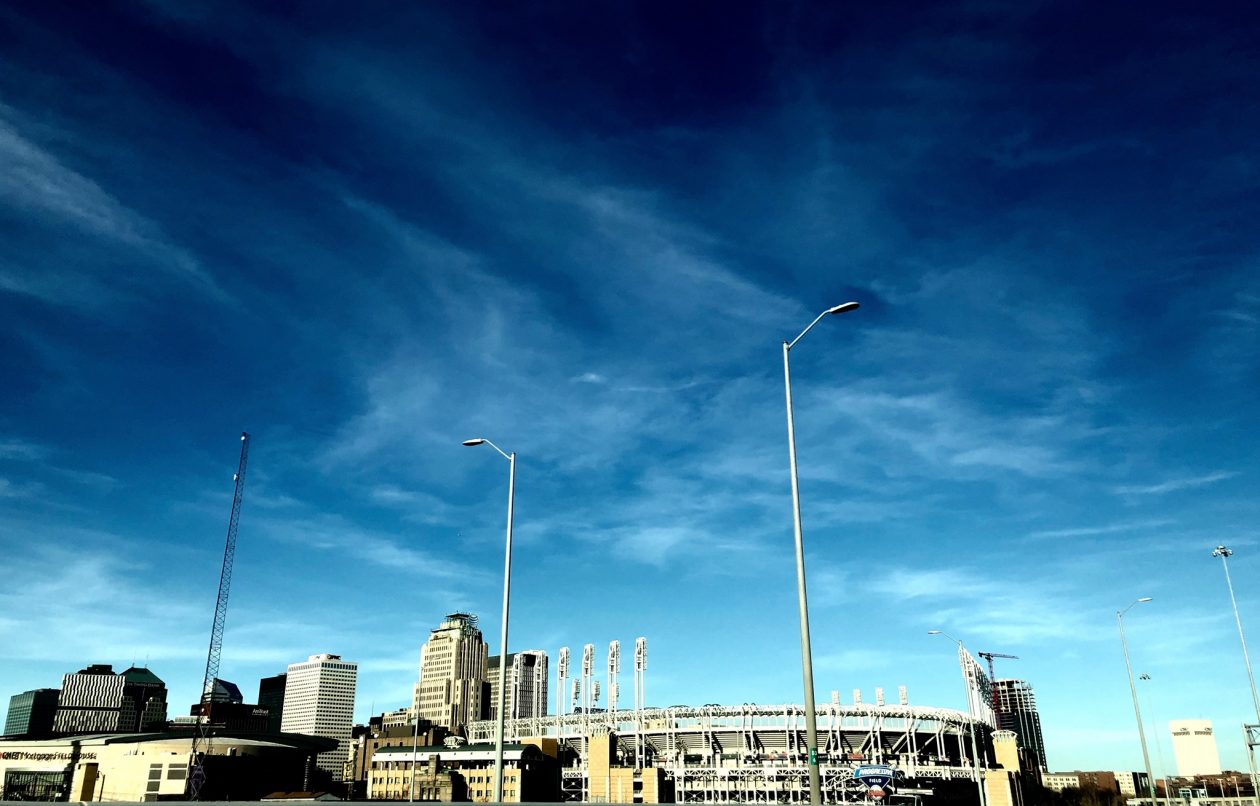
   In the 1870s Prospect Ave. advanced past Erie St., which is now E. 9th St., and kept going until it reached E. 55th St. That’s where it stopped. “Lower Prospect, closer into downtown, went commercial long ago, but Upper Prospect stayed residential longer,” says Bill Barrow, historian at the Michael Schwartz Library at Cleveland State University. Lower Prospect is where lots of downtown entertainment is now, including Rocket Arena, where the Cleveland Cavs follow the bouncing ball, and the House of Blues, where music fans have a ball.

   The Winton Hotel was built in 1916 on the far side of E. 9th St. It was nothing if not grand. It was renamed the Carter Hotel in 1931, suffered a major fire in the 1960s, but was renovated and renamed Carter Manor. I never set foot in it. The Ohio Bell Building went up in the 1920s before the Terminal Tower on Public Square was built.  When it was finished it became the tallest structure in the city. I never set foot in it, either. It was the building that Cleveland’s teenaged creators of Superman had the Man of Steel leap over in a single bound. The cartoon strip first appeared in their Glenville High School student newspaper, which was the Daily Planet.

   Before Superman ever got his nickname, the first Man of Steel was Doc Savage. There were dozens of the adventure books written by Lester Dent. When I was a child I read every one I could get my hands on. Doc Savage always saved the day. Nothing ever slowed him down, not kryptonite, not anything. 

   In the 1970s Prospect Ave. wasn’t a place where anybody wanted to raise children. Nobody even wanted to visit the place with their children in tow. The street was littered with trash, dive bars, hookers, and bookstores like the Blue Bijou. There was heroin in the shadows and plasma centers that opened first thing in the morning. The junkies knew all about needles and got paid in cash for their plasma donations.

   The Plaza was around 70 years old when I moved in. There was ivy on the brick walls and shade trees in the courtyard. There were day laborers, retirees, college students, latter day beatniks, scruffy hippies, artists, musicians, and some no-goods living there. “The people who lived in the building during my days there helped shaped my artistic and moral being,” Joanie Deveney said. “We drank and partied, but our endeavors were true, sincere, and full of learning.” Everybody called her Joan of Art.

   Not everybody was an artist or musician. “But anybody could try to be,” Rich Clark said. “We were bartenders and beauticians and bookstore clerks with something to say. There was an abiding respect for self-expression. We encouraged each other to try new things and people dabbled in different forms. Poets painted, painters made music, and musicians wrote fiction.”

   The avant-garage band Pere Ubu called it home. Their synch player Allen Ravenstine owned the building with his partner Dave Bloomquist. “I was a kid from the suburbs,” Allen said. “When we bought the building in the red-light district in 1969, we did everything from paint to carpentry. We tried to restore it unit by unit.”

   The restoration work went on during the day. The parties went on during the night. They went on long into the night. “I remember coming home at four in the morning,” Larry Collins said. “There would be people in the courtyard drinking beer and playing music. We watched the hookers and the customers play hide-and-seek with undercover vice cops. In the morning, I would wake up to see a huge line of locals waiting in line in front of the plasma center.”

   When I lived there, I attended Cleveland State University on and off, stayed fit by walking since my car was unfit, and hung around with my friends. Most of us didn’t have TV’s. We entertained ourselves. I worked for Minuteman whenever I absolutely had to. The jobs I got through them were the lowest-paying worse jobs on the face of the planet, but beggars can’t be choosers.

   I spent a couple of weeks on pest control, crawling into and out of tight spaces searching for rats, roaches, and termites. My job was to kill them with poison. The bugs ran and hid when they saw me coming. I tried to not breathe in the white mist. I spent a couple of days roofing, hoping to not fall off sloping elevated surfaces that were far hotter than the reported temperature of the day. The work was mostly unskilled, which suited me, but I got to hate high places. My land legs were what kept me upright. I didn’t want to fall off a roof and break either one of them

   I passed the day one summer day jack hammering, quitting near the end of my shift. I thought the jack hammer was trying to kill me. “If you don’t go back, don’t bother coming back here,” the Minuteman boss told me. “Take a hike, pal,” I said, walking out. I wasn’t worried about alienating the temporary labor agency. Somebody was always hiring somebody to do the dirty work.

   The Plaza was four stories tall and a basement below, a high and low world. Some of the residents were lazy as bags of baloney while others were hard-working. Some didn’t think farther ahead than their next breath while others thought life was a Lego world for the making. There was plenty in sight to catch one’s eye.

   “I had a basement apartment in the front,” Nancy Prudic said. “The junkies sat on the ledge and partied all night long. But the Plaza was a confluence of creative minds from many fields. It was our own little world. Besides artists, there were architects and urban planners.”

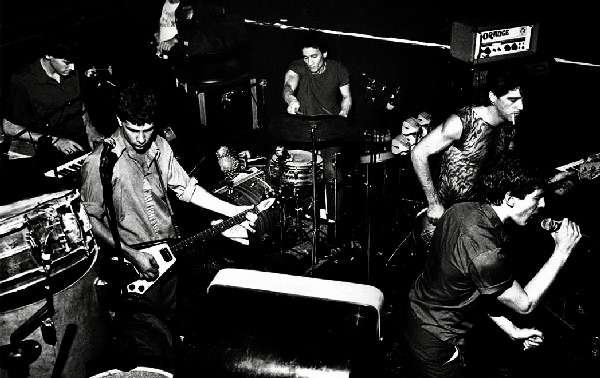
   Pete Laughner was a hard-working musician. He was from Bay Village, an upper middle class suburb west of Cleveland. He wrote songs, sang, and played guitar. He was “the single biggest catalyst in the birth of Cleveland’s alternative rock scene in the mid-1970s,” Richard Unterberger said. He led the bands Friction and Cinderella Backstreet. He co-founded Rocket from the Tombs. “They were a mutant papa to punk rock as well as spawning a number of famous and infamous talents, all packed into one band,” Dave Thomas said. After the Rockets crashed and burned, Pete teamed with Dave to form Pere Ubu.

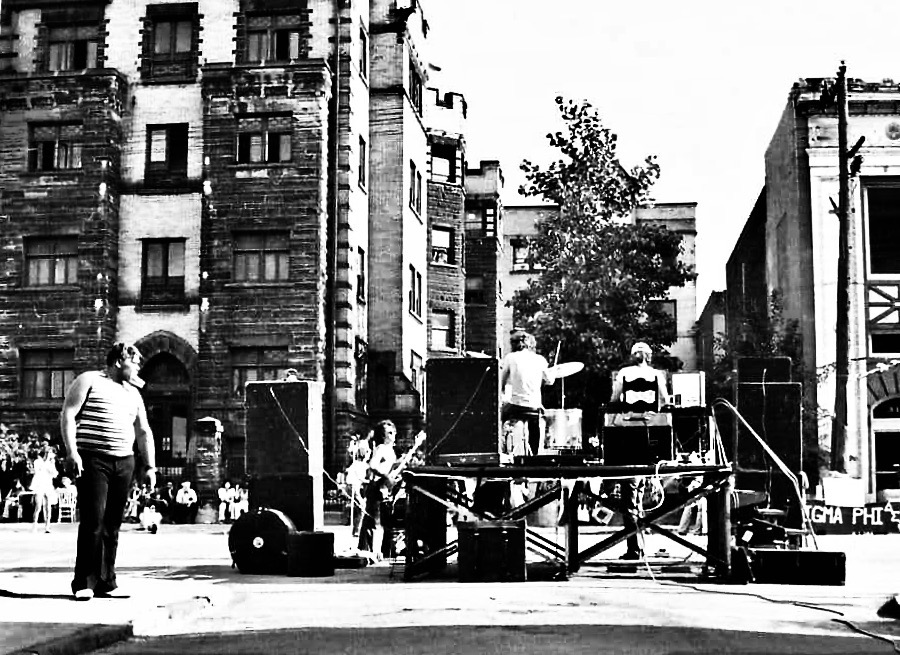
   Dave Thomas was nicknamed the Crocus Behemoth because he was ornery and overweight. He went against the grain by occasionally performing in a suit. He was a tenor who sometimes sang and others times muttered, whistled, and barked.  “If nobody likes what you do, and nobody is ever going to like what you do, and you’ll never be seen by anyone, you do what you want to do,” he said. He commandeered the street in front of the Plaza for middle of the day open air concerts. “He never let the lack of any musical training get in his way,” said Tony Maimone, Pere Ubu’s bass player.

   Pere Ubu’s debut pay-to-get-in show was at the Viking Saloon in late 1975. Their flyer said, “New Year’s Eve at the Viking. Another Go-damn Night. Another year for me and you, another year with nothing to do.” Pete had a different take on it. “We’re pointing toward the music of the 80s.”

   When he wasn’t making his stand on a riser, Pete was writing about rock and roll for Creem, a new monthly music magazine which was as sincere and irreverent as his guitar playing. The magazine coined the term “punk rock” in 1971. “Creem nailed it in a way that nobody else did,” said Thurston Moore of Sonic Youth.

   Pete played with the Mr. Stress Blues Band in 1972 when he was 20 years old. They played every Friday and Saturday at the Brick Cottage. Mr. Stress called the squat building at Euclid Ave. and Ford Rd. the “Sick Brick.” When he did everybody called for another round. Monique, the one and only bartender, ran around like a madwoman. “The more you drink, the better we sound,” Mr. Stress said and picked up his mouth organ.

   The harmonica man was a TV repairman by day. The lanky Pete was in disrepair both day and night. He wasn’t a part-time anything. He wasn’t like other sidemen. His guitar playing was raw and jagged. While the band was doing one thing, he seemed to be doing another thing. 

   “He only ever had three guitar lessons,” his mother said. Pete was in bands by his mid-teens. “He was my boyfriend when we were 15,” Kathy Hudson said. “He still had his braces. He was with the Fifth Edition. They were playing at the Bay Way one time and he wanted them to bust up their equipment like The Who. The others weren’t down with it.”

   “He was so energetic and driven, but his energy couldn’t be regulated,” said Schmidt Horning, who played in the Akron band Chi Pig. “It could make it hard to play with him. He was so anxious and wouldn’t take a methodical approach.”

   Charlotte Pressler was the woman Pete married. “From 1968 to 1975 a small group of people were evolving styles of music that would, much later, come to be called ‘New Wave’. But the whole system of New Wave interconnections which made it possible for every second person on Manhattan’s Lower East Side to become a star did not exist in Cleveland,” she said. “There were no stars in Cleveland. Nobody cared what they were doing. If they did anything at all, they did it for themselves. They adapted to those conditions in different ways. Some are famous. Some are still struggling. One is dead, my Pete.”

   Not long before everything fell apart Pete stepped into a photo booth in the Cleveland Arcade, one of the earliest indoor shopping arcades in the United States. He was wearing a black leather jacket and looked exhausted. His eyes had the life of broken glass in them. He sent the pictures and a note to a friend. “Having a wonderful time. Hope you never find yourself here.”

   He played his kind of music at Pirate’s Cove in the Flats, along with Devo and the Dead Boys. “We’re trying to go beyond those bands like the James Gang and the Raspberries, drawing on the industrial energy here,” Pete said. He played at the Viking Saloon, not far from the Greyhound station, until it burned down in 1976. Dave Thomas was a bouncer there, keeping law and order more than just an idle threat. He wasn’t the Crocus Behemoth for nothing.

   “I’m drinking myself to death,” Pete wrote to a friend of his in 1976. “No band, no job, running out of friends. It’s easy, you start upon waking with Bloody Mary’s and beer, then progress through the afternoon to martinis, and finally cognac or Pernod. When I decided I wanted to quit I simply bought a lot of speed and took it and then drank only about a case of beer a day, until one day I woke up and knew something was wrong, very wrong. I couldn’t drink. I couldn’t eat. And then the pain started, slowly like a rat eating at my guts until I couldn’t stand it anymore and was admitted to the hospital.”

   The rat was pancreatitis. If you lose a shoe at midnight you’re drunk. Pete lost shoes like other people lost socks in the dryer. He didn’t need any shoes however, where he was going. It was the beginning of the end of him. It didn’t take long. He wouldn’t or couldn’t listen to his doctor’s orders. He went back to his old pal, which was booze.

   “Pete could do whatever he wanted to do,” said Tony Mamione. “He was instrumental in crafting the Pere Ubu sound, but, even at such an early age, had a deep understanding of all kinds of music.” Tony and Pete met when they lived across the hall from each other on the third floor of the Plaza Apartments. “I had just moved in and would play my bass and Pete heard it through the walls and knocked on my door. We started talking and he went back and grabbed his guitar and some beer, and we started jamming right away.”

  Pete was as good if not better on the piano than the guitar, even though the guitar was his tried and true. One day he found a serviceable piano at a bargain price and bought it. He and Tony picked it up to take back to the Plaza. “Here I was driving his green Chevy van down Cedar Ave. and there he was in the back of the van rocking out on the piano,” Tony said. “He was so special, a pure musician.” After they dragged, muscled, and coaxed the piano up to the third floor, they had some beers and the next jam session started.

   “I want to do for Cleveland what Brian Wilson did for California and Lou Reed did for New York,” Pete said in 1974. “I’m the guy between the Fender and the Gibson. I want a crowd that knows a little bit of the difference between the sky and the street. It’s all those kids out there standing at the bar, talking trash, waiting for an anthem.”

   They would have to wait for somebody else. Pete Laughner died in 1977 a month before his 25th birthday. He was one year younger than me when he met his maker. He didn’t die at the Plaza Apartments. Neither of us was there anymore. He died in his sleep at his parent’s home in Bay Village. There’s nowhere to fall when your back is against the wall, except maybe where you got up on your feet in the first place.

Ed Staskus posts monthly on 147 Stanley Street http://www.147stanleystreet.com, Made in Cleveland http://www.clevelandohiodaybook.com, Atlantic Canada http://www.redroadpei.com, and Lithuanian Journal http://www.lithuanianjournal.com

“Ebb Tide” by Ed Staskus

“A thriller in the Maritimes, magic realism, a double cross, and a memory.” Sam Winchell, Beyond Books

Available at Amazon: https://www.amazon.com/dp/B0CV9MRG55

Summer, 1989. A small town on Prince Edward Island. Mob money on the move gone missing. Two hired guns from Montreal. A peace officer working the back roads stands in the way.

A Crying of Lot 49 Publication

Squaring Off at Maxim’s

By Ed Staskus

   The first time I went to Maxim’s Deli was in 1964, the year my parents bought a house in the North Collinwood neighborhood of Cleveland on a street southeast of E. 185th St. The deli had opened in 1949. It was on the corner of Cornwall Rd. and E. 185th St. It was opened by Emanuel “Manny” Berardinelli and his brother Giuseppe “Joey” Berardinelli. The next year, 1950, Joey Maxim, the name Giuseppe went by in the boxing ring, won the light heavyweight championship of the world by beating Freddie Mills for the title.  

   He knocked him out in the 10th round. After the fight three of his adversary’s teeth were discovered stuck in his left glove. Joey Maxim had a left jab to die for. Freddie Mills never fought again after that. Boxing goes back to ancient Egypt. The word pugilism comes from the Greek word “pyx” which means “with clenched fist.” Boxing has since been called the “Sweet Science.”

   Lennox Lewis, one of the best heavyweight boxers ever, said, “In boxing, you create a strategy to beat each new opponent. It’s just like chess.” Boxing may be tactical and calculating, but it always comes down to knocking somebody’s teeth out  when everything is on the line.

   Joey Maxim ran the streets of North Collinwood when training. He got the idea to open a baked goods and pizza shop during one of his runs. The start-up money came from his boxing wins, of which there were plenty. During his career he won 82 fights while losing only 29.  By the time he stopped boxing in 1958 the walls of the delicatessen were chock full of his memorabilia.

   At first I went to Maxim’s Deli with my mother. It was just down the end of our street. She bought bread there. I carried it home. It was better than anything from the supermarket and better than the Eastern European black bread we often ate. The aroma in the delicatessen was pleasing, even though I wasn’t overly interested in the bread. What I was interested in was the pizza. It was made in an old-fashioned stone oven. They made their own secret sauce. They sold their pizza by the pie and by the slice. The crust was slightly crispy and just right chewy. I started stopping into the deli by myself and getting it by the slice whenever I had the means.   

   Pizza to me was like the entire food pyramid in one bite. I only ever got one slice but it was plenty. The slices at Maxim’s Deli were large. When I saw the boxes whole pies came in I wondered why round pizzas were packaged in square boxes. On top of that, before they were put in the boxes they were sliced into triangles. I thought there must be some kind of higher math in play.

   Joey Maxim was a big boy growing up. He started boxing at the age of 12. He won the Cleveland Plain Dealer Golden Gloves Tournament, the Chicago Tribune Tournament of Champions, and the 1940 AAU National Tournament in Boston. He was 17 years old when he won the AAU National Tournament in his weight class. He turned pro in January 1941 when he was 18 years old. He took the name Joey Maxim after his manager said he threw punches faster than a Maxim gun. The Maxim gun is a recoil-operated machine gun. It was the first fully automatic machine gun in the world. Joey Maxim won his first professional fight in no time, pummeling his opponent. Then World War Two happened. He served as a military policeman in the U. S. Army, occasionally fighting in exhibition matches to entertain the troops.

   Live professional boxing was a major spectator sport in Cleveland in the 1950s and 1960s.  Matches at the Cleveland Arena drew upwards of 10, 000 fans. I was no slouch at roughhousing but not fighting with my fists, although I was good at shadow boxing. The shadows always lost. I never took lessons. Most of the gyms, like the Old Angle, were on the near west side, too far to go. Our father didn’t let us watch the fights on TV. He frowned on boxing. He said it was a cruel sport.

   “Two young men beating the sense out of each other for a dollar,” he said. He was an accountant. He needed his mind in good working order to understand dollars and cents. “When you’ve got your dollar but your brain doesn’t work anymore, that is not good.”

   Everybody in the neighborhood knew all about Joey Maxin although nobody ever saw him. He was always somewhere else. After his boxing career was over and done with he worked for a casino in the Bahamas and later appeared in a few small parts in the movies. In 1963 he appeared in “Goldilocks and the Three Bares.” The movie was billed as the “first nudist musical.” He played himself playing a nightclub owner. He was featured on the movie poster. “It’s me, Joey Maxim, the former world’s light heavyweight champion! I’m one of the stars! My first screen appearance!” He tried his hand at stand-up comedy  but didn’t kill on stage and gave it up. 

   He moved to Las Vegas and worked for several casinos like the Frontier and the Ambassador as a greeter. He did it for twenty years before retiring. He was inducted into the International Boxing Hall of Fame in 1994. He had beaten fighters like Jersey Joe Walcott, Floyd Patterson, and Sugar Ray Robinson. He fought Sugar Ray Robinson at sold-out Yankee Stadium in New York City in 1952. The bout was the first to be shown on closed circuit television in movie theaters.

   Sugar Ray Robinson was the best fighter of all time the day before the fight. The next day he was the second best fighter of all time, at least for one day. He was the middleweight champion, but moved up a classification to light heavyweight to fight Joey Maxim. He gained some weight but still gave up almost 20 pounds to his opponent.

   A monsoon soaked New York City for two days before the fight. The day of the championship bout it was very humid and the temperature reached 105 degrees. Some spectators in the stands passed out from the heat. Bright tungsten lights lit up the ring for the TV cameras. Joey Maxim lost 10 pounds during the fight. Sugar Ray Robinson lost 16 pounds. The referee collapsed hallway through from heat exhaustion and had to be replaced. Doc Kearns, Jack Dempsey’s ex-manager, was in Joey Maxim’s corner, but Sugar Ray Robinson was ahead on the judges’ scorecards going into the 13th  round. By the end of the round he was worn out. His legs were like rubber. He unleashed a wild haymaker, came up with nothing but air, and off balance fell flat on his face. He staggered back to his corner. He couldn’t come out for the 14th  round. The contest in New York City was the only one he never finished.

   After the victory Joey Maxim capitalized on his momentum, fighting coast to coast, and in Italy, England, and Germany, as well. He won more than he lost. But when he lost his last six fights in a row he hung it up. He knew he was washed up.

   His brother Manny was the day-to-day man at Maxim’s Deli. He was always behind the counter. He seemed to know everybody’s names. He even knew mine. His son Gene started working there on weekends from when he was 13 years old. After he finished high school he decided to go full time and joined his father in the business. Manny’s daughter Loretta worked at the deli, too. After she got married and had children, she continued to work there part-time. 

   After I started my four years of higher education at St. Joseph’s High School, within walking distance of where we lived, I stopped at Maxim’s Deli for slices of pizza less and less often. It wasn’t out of the way but I had to get home after school, do whatever chores my parents told me to do, eat dinner, do my homework, and get ready for the next day. One day, standing in the hallway after my Monday through Friday religion class, I happened to mention to my teacher that I liked the pizza at Maxim’s Deli. Our teachers were Marianists, members of the Society of Mary. They were sober and serious men. They told us they were caretakers of our souls and we were to never forget it.

   My teacher, like all of the Marianist brothers, was dressed in black from tip to toe. He was a tall man with a square jaw and thick wavy hair. He looked down at me and said, “Pizza is proof that God loves us and wants us to be happy.” 

   One day when I was a sophomore I heard two seniors were going to fight after school in the alley behind Maxim’s Deli. There was a gravel and dirt parking lot there. The Marianists frowned on fights anywhere on school grounds. It was grounds for expulsion, something everybody knew they would never be able to explain to their parents.

   “You did what?” is what everybody knew would be the beginning of the beat-down.

   When I got to the alley behind Maxim’s Deli there were twenty-or-so of us from school and the two adversaries. I almost went home when I got a look at them. They were jocks. I thought they were going to be greasers. The student body at Joseph’s High School was made up of jocks, greasers, true believers, the clean-cut, and honor students. Everybody stuck to their own for the most part, especially the honor students, who knew they were going to rule the world sooner or later. Dennis Eckart got a law degree and served five terms in Congress. John Skardis was on the same career path until he joined the SDS, got arrested for revolutionary terrorism, skipped bail and disappeared, but was finally apprehended and sent to a dungeon somewhere. Nobody ever heard of him after that.

   Jocks knew all about organized violence on the football field, which meant everything at our school, but nothing about fist fights on a gravel and dirt field. Greasers, on the other hand, were best avoided unless you were one of them. They toned down their slicked back hair when they were in school, but outside of school they wore leather jackets and carried sharpened church keys, which were sharpened punch can openers. Their leather jackets weren’t just for show. The leather buffered punches.

   The fighting was hapless, which was one swing and a miss after another. They finally grabbed each other, grappling while going around in circles, and fell down in the dust, where they wrestled furiously for a few minutes. It didn’t amount to anything. Manny Berardinelli came out the back door of the deli with a green-colored bag of garbage and told us to beat it, or else. All of us left, including the two jocks making a mockery of the “Sweet Science.”

   Joey Maxim had a heart attack in 1999 while visiting his mother in Euclid, not far from where he grew up. He suffered a major stroke two years later and died in West Palm Beach. He is buried in the Memorial Gardens in Hollywood, Florida.

   We moved out of North Collinwood after I graduated from high school. Maxim’s Deli moved fifteen miles east to Mentor in 2004. Gene Berardinelli and his wife Kathy took over the business after the relocation. Manny continued to work at the deli, retiring in 2014 at the age of 93. Every so often I thought about taking a drive there and having s slice of pizza but never did. I knew without thinking about it that it wouldn’t be the same. The watermill wasn’t going to be grinding any more wheat for pizza dough with flow water that was long gone.

Ed Staskus posts monthly on 147 Stanley Street at http://www.147stanleystreet.com, Made in Cleveland http://www.clevelandohiodaybook.com, Down East http://www.redroadpei.com, and Lithuanian Journal http://www.lithuanianjournal.com. To get the site’s monthly feature in your in-box click on “Follow.”

“Bomb City” by Ed Staskus

“A police procedural when the Rust Belt was a mean street.” Sam Winchell, Beyond Books

Available on Amazon: https://www.amazon.com/dp/B0F1LM1WF9/ref=sr_1_1?crid=2MYAQAOZIC2U9&dib=eyJ2IjoiMSJ9.hTm7BGbiQbSe5ZapFwYPPfcwOpTe-Vdg6VLE4aGyTyk.Z0R-VNBWWEcvKcNaO9LdCOUnNIOOXgvYkRS_FXiXuHk&dib_tag=se&keywords=bomb+city+ed+status&qid=1742136726&sprefix=bomb+city+ed+staskus%2Caps%2C84&sr=8-1

Cleveland, Ohio 1975. The John Scalish Crime Family and Danny Greene’s Irish Mob are at war. Car bombs are the weapon of choice. Two police detectives are assigned to find the bomb makers. Nothing goes according to plan.

A Crying of Lot 49 Publication

Animal Crackers

By Ed Staskus

   Dave Bloomquist ran the show at the Plaza Apartments, trying to make it work on the near east side, on the fringe of downtown. The apartment building we called the house was on Prospect Ave., a $.25 fare on a rundown Cleveland Transportation System bus about five minutes from Public Square. The ghetto was uptown and all around us. Liquor, deadbeats, hookers, old cars, and  boarded-up windows were the order of the day. The house, however, was its own enclave.

   Dave was from Sandusky. “The town, which is sluggish and uninteresting, is something like an English watering-place out of season,” Charles Dickens wrote after visiting it. A hundred years later it was known for Cedar Point, an amusement park on a peninsula jutting out into Lake Erie. After high school Dave moved to Cleveland to study visual and fine arts at Cleveland State University.

   “Art held a natural attraction for me, and it was something I wanted to pursue,” he said. “My dad was an electrician. II helped him run wires and other simple tasks. I also worked during college, renovations, painting, things like that. After graduation, my business partner and I scraped together a down payment on the 48-unit Victorian-style Plaza. We decided to restore it ourselves.”

   Dave was always in in and around the building. Whenever anything went wrong, it didn’t take long to find him. He was the owner, superintendent, and maintenance man. If he wasn’t nearby, his ex-wife-to- be, Annie, tall and slim, her hair done up in braids, was right there cooking, cleaning, and taking care of their baby boy. Built in 1901 for middle-class residents, something was always making trouble at the Plaza.

   “We learned to sweat pipe, patch the roof, and fix windows,” Dave said. “We had to operate with just rent money. We couldn’t afford to call on anyone for help.”

   Back in the day Upper Prospect was the second most prestigious place to live in Cleveland, next to Millionaire’s Row on Euclid Ave. Prospect Ave. and Euclid Ave. were where to be, the smoking rooms of the city’s economic and social elite. Most of the homes on Prospect Ave. were brick two-story single-family houses in the Italianate style. The street was lined with elm trees.

   By the time I moved onto Prospect Ave., as the 1960s leaked into the 1970s, all the rich folks were long gone, and Dutch elm disease had killed most of the trees. It was killing most of the elms in all but two states east of the Missouri River. Those that hadn’t died were being sprayed with DDT or removed. The entry point for the bug was Northeast Ohio in 1929, on a train bringing in a shipment of elm veneer logs from France. The train stopped south of Cleveland to load up on coal and water. Not long afterwards elm trees along the railroad tracks started to die. The elm bark beetle doesn’t kill the tree, but the fungus it carries is deadly.

   There were rowhouses scattered among the single-family homes, which included the Prospect Ave. Rowhouses that Dave was throwing his eye on. He had more than enough work on his hands, but he was a no slouch go-getter. Preservation and restoration efforts on Upper Prospect were beginning to pick up steam.

   Before moving in I walked to Mecca Keys on Rockwell Ave. off East 9th St. and had a key for my apartment made. The Plaza was home to students, secretaries, both beatniks and hippies, machinists, artists, bikers, clerks, musicians, court reporters, dogsbody men, anarchists, and writers, some shaking and baking, others simply doing their best to keep the wolf away from the door. 

   “We were urban pioneers before the term was coined,” said Scott Krauss, a drummer for the art-rock band Pere Ubu. “Like the Jefferson Airplane and the Grateful Dead had their band houses, we had the Plaza.”

   “There were scores of wonderful community dinners, insipid and treacherous burglars,” Dave said years later when it was all over. “Innocence was lost. There were raucous outrageous parties. Families were formed and raised and there were tragic early deaths of close friends. But music, art, and life were in joyful abundance all the time.”

   There was plenty of old-fashioned seediness, too. “I remember coming home at four in the morning and there would still be people in the courtyard drinking beer and playing music,” said Larry Collins. “We would watch the hookers and their customers play hide-and-seek with the undercover vice cops.”

   One of the first friends I made there was Virginia Sustarsic. I had seen her around Dixon Hall up the street when I lived there before I moved to the Plaza. She was close to John McGraw, a trim bohemian who lived alone on the third floor, read obscure European poets, drank Jack Daniels from the bottle, and drove a 1950s windowless Chevy panel truck. It was a black panel truck.

   Virginia had interned at the Cleveland Press, worked on Cleveland State University’s’s student newspaper, and wrote for the school’s poetry magazine. Since she was settled in at the Plaza, was friendly, and worked for herself, she made friends easily, and I subsequently made friends at the Plaza by hanging around with her.

   She knew all about art. I didn’t know much about anything. When she showed me a reproduction of a Jackson Pollack painting, I thought, what a mess. When she showed me a picture of an American flag by Jasper Johns, I found a ragged old flag and thumbtacked it to the wall at the head of my bed. I thought I was being au courant.

   Virginia made candles, incense, and roach clips for a head shop on the near west side. The owner of the shop, Jamie, was a little older than us. He wore fake glasses to disguise a pear-shaped nose. He wore a red checked bandana and liked to go barefoot. He pulled up in a mid-60s VW T2 bus, Virginia delivered the goods, he would say he had a great idea for going someplace fun, as many people as could fit would pile into the Splittie, and he would drive to a park, a beach, or a grassy knoll somewhere.  

   Jamie always played The Who’s “Magic Bus” at least once every trip, there and back. “Thank you, driver, for getting me here, too much, Magic Bus, now I’ve got my Magic Bus.” The speakers were tinny, but the volume made up for it.

   We went to see “Woodstock” the movie at a drive-in, since none of us had gone to the music festival. Virginia’s roach clips came in handy. The Splittie’s back and middle seats could be pulled out. It was useful at drive-ins, backing the bus in to face the screen, some of us in the seats on the ground, others in the open rear of the bus, and Jamie with his gal on top of the VW, an umbrella at the ready. 

   Nobody wanted to be sitting behind Mike Cassidy, who was skinny enough, but had a massive head of long electrified red hair. Virginia got him a shower cap to keep his mop top under control, but he refused to wear it.

   Virginia was hooked on photography and showed me the ropes, letting me use her camera. When a photography contest was announced at Cleveland State University, she entered a picture she had taken in San Francisco. I entered a picture of Mr. Flood.

   Bob Flood lived on the second floor, like me. None of us knew what he did, exactly, although he wore a hat suggesting he was a locomotive engineer. Virginia thought he was a professor of some kind. Everybody called him Mr. Flood. Nobody knew why. He was a lanky careful man, sported a shaggy looking beard, was divorced, but had visitation rights to his two children, who came and played in his apartment on weekends.

   My picture was a portrait and Virginia’s a full-scale shot of two homeless men in San Francisco’s Golden Gate Park, passing a bottle of booze between them. The trees in the background disappeared into a triangle. After I won the blue ribbon, Virginia went to the Art Department and talked to one of the judges. She told him she had been trying to conjure the Pointillism of Georges Seurat.

   “Well,” he said. “The portrait and your picture were our top picks. But yours was kind of grainy.”

   “That was the whole point,” she groused. 

   Virginia’s best friend at the Plaza was Diane Straub. Diane had a straight job. She was a secretary downtown. She got up every morning, got on the bus, went to work, and came back at night. Monday through Friday she took care of her apartment and her cats. On weekends she got loose. She got dressed up as Bogie’s old lady.

   Bogie was Diane’s live-in boyfriend. He was fit and strong and always wore black, tip to toe. He had a Harley Davidson he kept in the back lot. Nobody ever tried to steal it, because everybody knew that would be a big mistake.

   He was one of the Animals, although he and the other Animals had been forced to go freelance. They used to have a clubhouse, its walls pockmarked with bullet holes, on Euclid Ave. in Willoughby, until the day the Willoughby police raided it. “The police couldn’t get anything on us, so they hot-wired the landlord to force us out,” one of the Animals, Gaby, told the Cleveland Press, which was the afternoon newspaper. “We never did anything worse than use the clubhouse walls for target practice.”

   Gaby knew full well there was more to the story. His biker clubmate Don Griswold had been arrested the day before for being involved in a shooting with members of Cleveland’s Hells Angels that left two dead. “The Angels were going to take care of me if the cops didn’t do it first,” he said. “Misery loves company.”

   The spring before my first full summer at the Plaza, Cleveland’s Breed and the Violators got into it at a motorcycle show at the Polish Women’s Hall southeast of the Flats. The 10‐minute riot with fists, clubs, knives, and chains left 5 men dead, 20 Injured, and 84 arrested. The dead were buried, the injured rushed to hospitals, and the arrested hauled away to the Central Police Station on Payne Ave. The Black Panthers were always demonstrating outside the front doors, but they had to make way that day. Armed guards were posted in the hallways of the station as a precaution. When the injured bikers recovered, they were arrested at the hospital’s exit door.

   Art Zaccone, headman of the Chosen Few, said the fight broke out because of trouble between the two groups going back to a rumble in Philadelphia two years earlier. The biker gangs didn’t ride on magic busses. They rode hogs. They made their own black magic. They had long memories and nursed never forgotten or forgiven grievances.

   After Bogie moved out, Diane took up with Igor, a math wizard. He was tall, had long wiry hair, and played air guitar. Even though he was egg-headed about numbers, he often looked like he was only half there. He was vivid but baffling.

   “We all thought he was tripping a lot,” Virginia said.

   I lived in a back apartment on the second floor, although I avoided the back stairs and porches. They were falling apart in their old age. Virginia lived in a courtyard-facing apartment on the same floor and an older Italian couple, Angeline and Charlie Beale, lived in the front. They always had their apartment door open. Charlie was short and stout, a retired mailman. He read newspapers and magazines all day long. Angie was short and stout, too. She stayed in the kitchen in a black slip cooking and drinking coffee from a Stone Age espresso machine. 

   They had an orange and green parrot. Whenever Angie spied Virginia walking by, she called out, “Oh, honey, come in, let me see if I can get him to talk to you.” She would coo and try to convince the bird to talk. He never did, even when she poked him with a stick. When she did, he whistled and squawked, sounding offended.

   “How long have you had that parrot?” Virginia asked, thinking they were still training him.

   “Oh, we’ve had him for sixteen years, honey.”

   Angie and Charlie went shopping for foodstuffs twice a week. They walked down Prospect Ave. to the Central Market. “They always started out together, but ended up a block or more apart,” Dave said. They both carried handmade cotton shopping bags, one in each hand.

   The Central Market was on E. 4th St., nearly two miles away by foot. The only people who went there were people who couldn’t get to the West Side Market. It was grimy and the roof leaked. “Some panels are out, and when it rains, we got to put plastic tarp down, which looks like hell,” said produce stall owner Tony LoSchiavo.

   “She always ended up walking twenty feet behind him,” Virginia said. “A couple of hours later, same thing, both of them their two bags full, he would be walking twenty feet ahead of her as they came back to the Plaza.”

   He waited at the front door, holding it open for her. She trudged up, he followed her, and the parrot every time said, “Welcome back!” when they stepped into their apartment. Angie returned with vegetables like asparagus and nuts like filberts for the thick billed brightly colored bird.

    Most of the tenants at the Plaza were on good terms with one another. Many of us were single and sought out company up and down the floors and down the hallways, especially in January and February when snow piled up unshovelled. We swung by unannounced and chewed the fat.

   “Friends would just drop in,” Virginia said. ”All the time.”

   One Siberian Sunday afternoon Mr. Flood’s children were visiting and went exploring in the basement. They found a Flexible Flyer. Their father bundled them up and carried the sled outside. When they got tired of pushing each other back and forth in the parking lot, they found a shovel and scooped snow onto the back stairs as far up as the first landing. They shoveled enough snow on the stairs to make a ramp and spent the rest of the day running across the landing, throwing themselves on the sled, racing down the ramp, and zooming across the icy lot.

   Mr. Flood and I watched them from the second-floor landing. “They’re up to snow good,” he said when they hit bottom, bumped upwards, and got some air under their sled. Mr. Flood was the kind of man who talked low, talked slow, and didn’t say too much. He wasn’t, for all that, above cracking a joke.

    “They’re on their own magic carpet ride,” I said.

   “Animal crackers!” the children whooped back at their father, living it up without a care in the world.

Ed Staskus posts monthly on 147 Stanley Street at http://www.147stanleystreet.com, Made in Cleveland http://www.clevelandohiodaybook.com, Down East http://www.redroadpei.com, and Lithuanian Journal http://www.lithuanianjournal.com. To get the site’s monthly feature in your in-box click on “Follow.”

“Bomb City” by Ed Staskus

“A police procedural when the Rust Belt was a mean street.” Sam Winchell, Beyond Books

Available on Amazon: https://www.amazon.com/dp/B0F1LM1WF9/ref=sr_1_1?crid=2MYAQAOZIC2U9&dib=eyJ2IjoiMSJ9.hTm7BGbiQbSe5ZapFwYPPfcwOpTe-Vdg6VLE4aGyTyk.Z0R-VNBWWEcvKcNaO9LdCOUnNIOOXgvYkRS_FXiXuHk&dib_tag=se&keywords=bomb+city+ed+status&qid=1742136726&sprefix=bomb+city+ed+staskus%2Caps%2C84&sr=8-1

Cleveland, Ohio 1975. The John Scalish Crime Family and Danny Greene’s Irish Mob are at war. Car bombs are the weapon of choice. Two police detectives are assigned to find the bomb makers. Nothing goes according to plan.

A Crying of Lot 49 Publication

Ring of Fire

By Ed Staskus

   Many bands came to Cleveland, Ohio in the 1980s, bands like Queen, Guns N’ Roses, and Journey. I didn’t see or hear any of them. Besides, they just played the same song over and over again. I couldn’t afford arena rock, even if I wanted to squeeze myself into their sold-our shows. What did they do with all their money? Freddie Mercury didn’t spend much of it on his five-and-dime white tank tops.

   I did see and hear Wall of Voodoo when they played the Agora Ballroom, shortly before the band broke up. They were the second-to-last group I saw at the downtown music hall before it burnt down. After the fire the Agora moved thirty blocks uptown into what had been the Metropolitan Theatre, built in 1919. It had been home to the Cleveland Opera until 1929. Twenty two years later, when the prima donnas were long gone and the building was housing the WHK radio station, disc jockey Allen Freed coined the phrase “rock-and-roll” on the air there.

   The Agora was on E. 24th St. across the street from Cleveland State University. It had been there since 1968. It was the brainchild of local entrepreneur Henry LoConti Sr. “Monday Night Out at the Agora” showcased new bands like ZZ Top, Meat Loaf, and Talking Heads. “Live From the Agora” was broadcast on the radio. There were many affiliated stations. Bruce Springsteen’s show at the Agora in 1978 was heard by more than three million listeners. On Sunday nights it was reserved for home-grown bands like the Raspberries and the James Gang. 

   Iggy and the Stooges hit the music hall one night during a thunderstorm. “Iggy came out in a jock strap,” Henry LoConti Sr. said. “He had a razor and cut himself on stage, all kinds of crazy things. A girl and her boyfriend were in the front row. Iggy jumped off the stage on her face. Her boyfriend and his friends started beating on him. Our guys finally got him out of it, dragged him back, and he finished the show like nothing had happened.” The Stooges, however, spent the rest of the night slipping and sliding on Iggy’s blood on the boards.

   Wall of Voodoo was a Los Angeles band fronted by Stan Ridgway, who had been running a film score business before getting into the emerging punk scene in the 1970s. He picked up a bass player and a keyboardist from the Skulls and a drummer from Black Randy and the Metrosquad. They started playing at the Masque, a club underneath the Pussycat Theatre in Hollywood. They mixed electronica with country and western with Ennio Morricone movie music. There were junkyard riffs and percussion effects galore. 

   It didn’t always go over well. “This electronic music quintet makes self-proclaimed nightmare music,” John Swenson wrote in The New Rolling Stone Record Guide. “I pass on this stuff,” he declared in black and white, not writing another word.

   When asked by Dick Clark on American Bandstand to describe their music, Stan Ridgway said, “I’m just as confused as anyone else as to what to call it.” The band released an EP in 1979 featuring a synthesizer driven cover of “Ring of Fire.” It wasn’t what the songwriter June Carter had ever intended. It had a spaghetti western twang to it. It was strange and surreal. Their album “Call of the West” was released in 1982. The catchy single “Mexican Radio” from the album became a big hit. It was about hot desert winds and border blaster radio stations.

   By the end of the 1970s Henry LoConti Sr. had built twelve more Agora music clubs around the country, turning himself into a corporation. He went buttoned down in a no button business. He was awarded Billboard’s Steve Wolfe Award in 1979, presented to the person who had contributed the most to music entertainment the previous year. Billboard’s “Best Club in the Country” award was awarded to him in 1980. 

   For all that, the original Agora in Cleveland was always a rough and tumble place, awards or no awards. The audience was young. The music was loud. The drinks flowed all night long. There were bouncers. They kept their eyes and ears off the stage and more on the disturbances on the floor that erupted time and again.

   The word “bouncer” comes from an 1875 book by Horatio Alger. A young man has a hearty breakfast, claims he has no money to pay for it, whereupon his waiter is ordered to “bounce” him. “A well-directed kick landed him across the sidewalk into the street.” But before there was the word, there were the Romans. In Rome a bouncer was known as an ostiarius. His job was to remove unwanted people from places they were trying to get into. In the Old Testament bouncers protected temples from “illegal entry into sacred places.” In the United States, starting in the mid-19th century, saloons and whorehouses hired them to remove drunk as a skunk, noisome, and violent patrons from the premises.

   The Agora didn’t necessarily call their security staff bouncers, but that is what they were. They checked entrants for underage drinking. They refused entry to those already the worse for wear. Their duty was to maintain some semblance of order. Their No. 1 task was to deal with hot-headed behavior.

   Wall of Voodoo opened their show with “Me and My Dad” followed by “Red Light” followed by “Call of the West.” Everybody’s ears perked up. “Got a green look about ya, and that’s a gringo for starts, sometimes the only thing a western savage understands are whiskey, rifles, and an unarmed man.” It was easy enough to follow the bouncing ball because Stan Ridgway had a clear as a bell voice. He sounded like a revved-up Hank Williams. The band was in fine fettle but didn’t drown him out.

   They finished their first set with “Lost Weekend.” The song was Lou Reed-inflected, about a couple driving home after a losing streak in Las Vegas. “She was in the backseat while he was at the wheel, all the money from the store they’d gambled away. He said the best laid plans often go astray. She lit a cigarette, she didn’t make a sound. I know if we’d had just one more chance, he said. I know, we’d finally hit the big one at last, she said.” It was Wall of Voodoo’s bad dream of the American Dream.

   The club was a haze of never ending cigarette smoke. The ceiling was barely visible. Music lovers elbowed their way to the front of the bar the minute intermission began. I was chronically short of cash and rarely drank at bars. I drifted outside for whatever fresh air there was. Cleveland was a smokestack city and the Agora was just two miles from the smokestacks. Beggars can’t be choosers.

   The front doors were behind a makeshift garage door of corrugated metal. When the sidewalks finally rolled themselves up after a show the corrugated metal door came down. Even though the club was next door to Cleveland State University, it wasn’t in the best neighborhood. When the sun went down it was more along the lines of a bad neighborhood. I stood to the side minding my own business until saying hello to the bouncer by the door, with the idea that it is never a bad idea to get on the good side of bouncers.

   He was younger and taller than me, about twenty pounds heavier, and appeared to be between a WWE wrestler and a bull fighter. He was wearing dark pants and a short-sleeved shirt. He looked like he did bicep curls for a living. He didn’t talk much until I asked him how he had gotten into the bouncer business.

   “My great grandfather was a bouncer before he got into the New York City ganglands,” he said. “His name was Monk Eastman. I’m named after him.”

   “Your great grandfather?” I was dubious. The young usually can’t remember that far back. Their memories go in one direction, which is forward, not backward.

   “Yeah, he was a bouncer from 1894 to 1899, after which he got into the rackets. Back then there were saloons from one end of New York City to the other. He was seventeen years old when he got his first job. The saloon he went to, the manager told him he was too young, and besides, he already had two good men. My great grandfather asked if he could meet them. When they met, he quickly took care of both of  them and got the job on the spot. He worked alone, although he always carried a truncheon.”

   “You mean like a club?”

   “Just like a club. It had notches carved into it for every man he made mincemeat of. Family legend has it, one slow night before he retired from bouncing, he threw his eyes on the bald spot of a man drinking at the bar. He couldn’t take his eyes off the bald spot. He walked up behind the man and clubbed him. ‘I had forty nine nicks in me stick and I wanted to make it an even fifty’ is how he explained it.”

   “You said he got into the rackets after that?”

   “Feet first, free-lancing in the beginning. He charged $15.00 for ‘ear chawed off’ and $19.00 for ‘leg broke.’ It was $100.00 for doing what he called ‘the big job.’ He put together his own gang soon enough. They got into it with another gang. One night he crossed a boundary line by mistake and got jumped. He carried a blackjack and was holding his own until he was shot twice in the stomach. He plugged the holes in his belly with his fingers and found a doctor. Two years later the other gang and my great grandfather’s gang went at it for real in Manhattan under the tracks of the 3rd Avenue Elevated line. It went on all night, fifty or sixty men firing at each other with Colts from behind cast iron arches. The police tried to stop the fighting but they had to retreat. Five men died and dozens were wounded.”

   “It sounds like Iggy Pop,” I said.

   “Iggy Pop has got a screw loose,” he said. “He would have shot himself in the foot.”

   “What happened when the shoot-out was over?”

   “A boxing match happened.”

   “They put their guns down and put up their fists?”

   “My great grandfather and the other man decided to settle matters with a boxing match. The other man was good with his hands but mine had arms long as an ape. In the end they fought for two and half hours to a draw. A month later they were shooting it out again. It was too much for the city fathers. Both of them were finally arrested, convicted of something, and both of them got eleven years in Sing Sing. When my great grandfather got out of prison his gang was gone, up in smoke. He volunteered for the army and was sent to Europe towards the end of World War One. My father told me he never took a prisoner if he could help it. He came home with a medal and told everybody there were plenty of saloons in New York City tougher than what everybody called the Great War.”

   “What did he do after he got home?”

   “Not too much, to be honest. He was found dead behind a dance hall in Brooklyn on New Year’s Eve in 1920. Somebody emptied a revolver into him. There were six bullet holes in him.”

   “That’s too bad,” I said.

   “Yeah, although he probably deserved it,” the bouncer said.

   When I heard the band start their second set I took leave of the bouncer and went back into the Agora. On the cover of the album  “Call of the West” there is a crooked door, slightly ajar, inviting everybody into Wall of Voodoo’s world. A standing room only crowd had squeezed into the Agora. It looked like all of them were still there.

   Wall of Voodoo were pioneers of a kind. Their sound was plenty original. For all that, they were never going to be inducted into the Rock & Roll Hall of Fame.

   When Huey Lewis and the News played the Agora in 1981 they played to a sold-out crowd. “We always heard that the heart of rock and roll was Cleveland, and we’d say ‘Wow, we’re from San Francisco. We had the Grateful Dead! We had Jefferson Airplane! What’s Cleveland got?’’’ The enthusiastic audience inspired Huey Lewis to write “The Heart of Rock & Roll.” He meant Cleveland was the heart of it. Fourteen years later the Rock & Roll Hall of Fame opened in Cleveland, not New York City or someplace in California, or anywhere else. 

   Wall of Voodoo finished their second set with “Mexican Radio” and came back to do an extended version of “Ring of Fire” for their encore. “I fell into a burning ring of fire, I went down, down, down, and the flames went higher, and it burns, burn, burns, the ring of fire.” When they were done the band looked wiped out. They got a big hand and most of the audience shuffled out. Some stayed to reminisce over a last drink.

   I went home to crack open Nathaniel West’s “The Day of the Locust.” I had read it in an English class at Cleveland State University and there was something about the music I heard that night that reminded me of the book. Wall of Voodoo’s songs seemed to be about those with little in the way of hope and getting by on illusions, just like the book. Their songs were not all about hard luck and dark times, but enough of them were for me to get a handle on what thread was being woven. The thread was about one small-time lost in time tragedy after another.

   For all that, I wasn’t about to cue up the arena rockers, or the likes of Madonna or Boy George, now or ever. Better the real deal than deals from the bottom of the deck. Better rough and tumble than a bag of old baloney.

Ed Staskus posts monthly on 147 Stanley Street at http://www.147stanleystreet.com, Made in Cleveland http://www.clevelandohiodaybook.com, Down East http://www.redroadpei.com, and Lithuanian Journal http://www.lithuanianjournal.com. To get the site’s monthly feature in your in-box click on “Follow.”

“Bomb City” by Ed Staskus

“A police procedural when the Rust Belt was a mean street.” Sam Winchell, Beyond Books

Available on Amazon: https://www.amazon.com/dp/B0F1LM1WF9/ref=sr_1_1?crid=2MYAQAOZIC2U9&dib=eyJ2IjoiMSJ9.hTm7BGbiQbSe5ZapFwYPPfcwOpTe-Vdg6VLE4aGyTyk.Z0R-VNBWWEcvKcNaO9LdCOUnNIOOXgvYkRS_FXiXuHk&dib_tag=se&keywords=bomb+city+ed+status&qid=1742136726&sprefix=bomb+city+ed+staskus%2Caps%2C84&sr=8-1

Cleveland, Ohio 1975. The John Scalish Crime Family and Danny Greene’s Irish Mob are at war. Car bombs are the weapon of choice. Two police detectives are assigned to find the bomb makers. Revenge is always personal. It gets personal.

A Crying of Lot 49 Publication

Boss Man

By Ed Staskus

   It was ten minutes before five o’clock on a Friday when Dave Myers asked me to come into his office. I knew his plan was to get rid of me. Efficient Lighting was going downhill fast. There wasn’t much that was efficient about it anymore. I also knew I wanted to stick it out before it all went to hell and the doors closed for good. There was still some blood in the turnip. All I had to do was somehow convince the boss man to let bygones be bygones.

   That was going to be easier said than done. Dave’s bite could be worse than his bark. When I walked into his office and saw him with his wiener dog in his lap, sitting behind his St. Bernard-sized desk, I thought if I played my cards right, I might have a chance. He was high-handed but he could be flighty, too. The dog was the key.

   “You wanted to see me, Dave?”

   He was wearing a green checked shirt and a blue blazer. He gave me a sour look. He didn’t like me calling him Dave. I didn’t like calling him David. Some of the sales guys called him Corner Office. The two Vietnamese women who did the bookkeeping called him Big Daddy. The guys in the warehouse called him Big Cheese. 

   Efficient Lighting was the parent company of several offspring. We sold commercial lighting of all kinds for all kinds of uses, from illumination to disinfection. We sold heating bulbs and metal halide bulbs. We sold high-pressure sodium bulbs for parking lots. We sold plant grow bulbs and bulbs that made salt water coral grow. Our big seller was Light Sources tanning bulbs. We sold them by the boat load, although the boats had been slowly getting smaller since the start of the aughts, after tanning beds got mixed up with cigarettes. It was a slow death, but it was the kiss of death. Fewer and fewer people wanted to risk skin cancer for a drop-dead tan.

   The first time I met Dave Myers was at the Light Sources factory in Connecticut. Our sales guys were there for a tour of the plant, to see how fluorescent UV bulbs were made. I was one of the sales guys. When we were introduced to him, I couldn’t help noticing his office was spacious, something on the order of ten times the size of my cubicle. He was some kind of executive in charge of something. It seemed he was close to Christian Sauska, the head man of the operation. I found out later Dave Myers was married to a woman from the Sauska family.

   Light Sources went back to 1983, back to Hungary, when Christian Sauska and some long-gone buddies got the company off the ground. All the top guys in Connecticut, the site of their American factory, were Hungarians. Dave was enough Hungarian to count as one of the guys. When Light Sources engineered a takeover of Ultraviolet Resources International, the golden goose of Efficient Lighting, they sent Dave to us where we were in Brook Park, Ohio to run the show. He became our Dutch uncle.

   Doug Clarke was the owner of Efficient Lighting. He had built a state of the art 45,000 square foot warehouse and offices in Brook Park at the turn of the millennium, across the street from the Holy Cross Cemetery, after more than fifteen years in the light bulb business, most of them in a repurposed building in Lakewood. When Light Sources took control of Ultraviolet Resources everything stayed the same for a while. Everybody stayed right where they were. I stayed in my cubicle where everything was within arm’s reach. The only change was that Doug was kicked upstairs and Dave took over Doug’s ground floor corner office and day-to-day operations.

   I was a jack of all trades, working general lighting, salt water fish lighting, and tanning bulbs. Everybody was the boss of me at the same time nobody knew what to do with me. I kept my head down and kept moving, trying to stay out of the weeds. I went to all the sales and motivational meetings and tried not to doze off. I had trouble concentrating on the gasbags who did all the talking. 

   The second time I met Dave was at a trade show in Las Vegas. By the end of the day I thought, “This guy must get the same briefing the President of the United States gets every morning.” He seemed to know everything about everything. I never ventured an opinion about anything to him. I didn’t need him turning me over every chance he got.

   I was more-or-less civil to Dave from the day he showed up to the day he took Ultraviolet Resources to greener pastures. The family firm was splitting up and the day they would split up for good was fast approaching. Kathy Hayes, Doug’s wife, had brought her brothers and sisters into the business one after the other. They were all on the verge of jumping ship and signing on to the HMS Bounty. In the end that is what happened.

   Patty Hayes was our sales manager for the moment, but she was too mild-mannered to last and didn’t last. John Hayes, Kevin Hayes, and Maggie Hayes ran the show. They were mean-spirited and fit the bill. They rotated who was Beavis and who were the Buttheads on a daily basis. Maggie did her best to be Beavis as often as possible and took the trophy home more often than not. Kevin took personality lessons from Dave. John handled big accounts and tried to look too busy to care about trophies. What he cared about was his super-sized paycheck. Kevin’s wife was our long-time bean counter. She controlled the books with a left-handed smile.

   Dave and the Beavis and Butthead crew were on the verge of leaving Brook Park for a bigger building in Westlake. He was dreaming up a new business venture with Wisconsin-based Tan-U, a regional distributor in the upper Midwest. He had plans for becoming the top dog of the tanning bulb world.

   “As the indoor tanning industry evolves into a more mature market, consolidation makes a great deal of business sense,” he said. “I can’t think of another company which could result in a better fit and look forward to cementing the new company’s position as a major player in the market.” Dave could be on the level on occasion, but he was a big fan of corporate snake oil.

   He started by asking me if I liked my job.

   “Sure,” I said, stretching the truth.

   “Are you satisfied with how things are going?”

   “Sure,” I lied. 

   “What are your goals?”

   He was getting to be bothersome with his business school questions, but I played along. I made up some goals. Dave liked the sound of his own voice far more than he liked the sound of anybody else’s voice. I kept it short. The less said the better, unless I wanted to be treated like a country cousin.

   Dave nodded, stroking his wiener dog, considering my goals. He rubbed his chin and looked down his nose. I knew it was in one ear and out the other. His middle-aged dog was recovering from hip surgery. One of my middle-aged hips hurt. I was taking yoga classes, looking for relief. I was taking them two and three times a week. Along the way I was learning meditation and patience.

   Dave started explaining how the business world works. He was snarky and patronizing while talking at me. He told me that to understand how business works, you must have a firm understanding of how people think and behave, how people make decisions, act on those decisions, and communicate with others. At its core, he intoned, every enterprise is a collection of people whose work and processes can be reliably repeated to produce a particular result.

   “Do you understand what I’m getting at?” he asked after tossing me his guidance counselor crumbs.

   “Sure,” I said. “How is your dog doing?”

   “Much better,” he said. “Thanks for asking.” He described the limp the dog had had to live with, the operation, his recovery, and the first day the purebred Daschund had stepped out on grass and run a few steps, wagging its tail. He brought the dog to work every day. The dog slept in a custom-made bed in the corner. He ate a special diet catered to him in special doggie bowls. Dave encouraged the dog to follow at his heels whenever he went anywhere in the building in order to build its strength back up.

   “If there’s one thing that man loves without a shred of contempt, it’s that dog,” I thought.

   We talked about pets, animal cruelty and animal rescue, the companionship of dogs, the loyalty of dogs, and whether dogs were better people than people. By the time he was done, since he did most of the talking, it was past six o’clock and he said he had to pack up for a weekend trip. He gave me a bottle of wine from the walnut custom-made wine rack in his office. 

   “Thanks, Dave,” I said, hefting the bottle like a trophy. II was surprised. It was undoubtedly worth more than I made in a day. Dave had seventy or eighty bottles in his office. Maybe I could sell it on eBay. Maybe I would leave it out in the sun and let it turn to vinegar.

   He had forgotten to fire me, thanks to the dog. I slipped away to my cubicle, got my stuff, and left. In the parking lot I saw his four door luxury sedan and his natty ragtop sports car. They were parked on either side of my Saturn. I made sure to not dent, scratch, or otherwise molest one or the other of his rides. The last thing I wanted was a lecture from a clubhouse lawyer.

   When Westlake was ready for Ultraviolet Resources International, Dave, John, Kevin, Maggie, Kevin’s cagey accountant wife, somebody’s dodgy sister-in-law, and some others of the sales force went to the outer-ring suburb. Our building felt half-empty after that because it was half-empty. We were going to struggle for the next three years until all the downsizing that could be done was done and the building had to be sold. I was one of the last to be laid off, but I didn’t mind. There was hardly any work left for me to do by then, anyway. I had gotten tired of taking long lunches with nobody to talk to.

   The next thing I heard through the grapevine was that Dave wasn’t with Ultraviolet Resources reinventing corporate tricks anymore. He was up to his own tricks. He had set up an ISO Italia office near the Chagrin Highlands, selling glossy Italian tanning beds and shoddy Canadian-made Sylvania tanning bulbs. I was sure he could explain away the performance problems of his bulbs.

    The following year I read news that he had gone into the business of backdoor crookery. He had been charged by the Securities and Exchange Commission with insider trading. He had always been bullish on the stock market. I wasn’t sure he would be able to explain his actions away. Federal agents didn’t usually like it when their suspects talked down to them.

   “Baltimore-based consultant Brett Cohen received coded e-mails from a fraternity brother about two biotechnology companies and passed the information to an uncle, David Myers, of Cleveland, Ohio who traded on the tip,” the Securities and Exchange Commission said.

   The fraternity brother got the information from his real brother, who was a patent agent for California-based Sequenom, which made genetic analysis products. The patent agent passed along non-public information about the company’s plans to acquire Exact Sciences. Dave bought 35,000 shares of Exact Sciences on the sly before the acquisition was announced. The news sent Exact Sciences’ stock up 50 percent, setting Dave up to pocket first class profits by selling the stock over the next few weeks. “David Myers garnered more than $600,000 in profits trading on the inside information,” the Securities and Exchange Commission complained.

   The patent agent also passed on tips about an up-coming announcement that investors should no longer rely on Sequenom’s data about its Down syndrome testing. Dave bought Sequenom options just before the announcement, which caused a 75 percent drop in the company’s stock, according to the Securities and Exchange Commission complaint.

   “David Myers later sold that entire position for illegal profits of more than $570,000,” the complaint alleged. He knew how to put his nose to the grindstone when he had to. He knew how to generate cold hard cash out of nothing and spend it on himself, no problem. 

   On top of everything else, the United States Attorney for the Southern District of California filed criminal charges against Brett Cohen and Dave. My Dutch uncle was going to have to spend some of his profits on a mouthpiece. The mouthpiece was no great help. They both eventually pled guilty to conspiracy to commit securities fraud. 

   “Holy smokes,” I thought, shutting off my Apple iPad. I didn’t wish Dave any real harm, but it was nice to know he didn’t know everything after all. I didn’t care how much he knew because I knew he didn’t care what I thought. He had sometimes forgotten my name in mid-sentence. I had forgotten the wiener dog’s name but wished him the best, on and off the leash, although I thought he would be better off if he made a break for it, so long as his new hip was good to go. No good dog should end up being bad to the bone.

Ed Staskus posts monthly on 147 Stanley Street at http://www.147stanleystreet.com, Made in Cleveland http://www.clevelandohiodaybook.com, Down East http://www.redroadpei.com, and Lithuanian Journal http://www.lithuanianjournal.com. To get the site’s monthly feature in your in-box click on “Follow.”

“Bomb City” by Ed Staskus

“A Rust Belt police procedural when Cleveland was a mean street.” Sam Winchell, Beyond Fiction

Available on Amazon: https://www.amazon.com/dp/B0F1LM1WF9/ref=sr_1_1?crid=2MYAQAOZIC2U9&dib=eyJ2IjoiMSJ9.hTm7BGbiQbSe5ZapFwYPPfcwOpTe-Vdg6VLE4aGyTyk.Z0R-VNBWWEcvKcNaO9LdCOUnNIOOXgvYkRS_FXiXuHk&dib_tag=se&keywords=bomb+city+ed+status&qid=1742136726&sprefix=bomb+city+ed+staskus%2Caps%2C84&sr=8-1

Cleveland, Ohio 1975. The John Scalish Crime Family and Danny Greene’s Irish Mob are at war. Car bombs are the weapon of choice. Two police detectives are assigned to find the bomb makers. Nothing goes according to plan.

A Crying of Lot 49 Publication

Bust Up at White City

By Ed Staskus

   When Virginia Sustarsic asked me if I would be willing to feed and walk a dog once a day for a week, I said no problem because it was no problem. I was living on Upper Prospect at the Plaza Apartments. I didn’t have a 9 to 5 and had the time. I didn’t have to worry about the kind of time that makes sure everything doesn’t happen at once.

   I could take the CTS 39B bus, which was an express. The bus route was east on I-90 to Liberty Blvd, through the village of Bratenahl, and then the length of North Collinwood. Virginia’s friend lived on Lakeshore Blvd. on the border of Bratenahl and North Collinwood. The minute I passed through the rich man’s enclave, bordered on the north side by Lake Erie and on the south side by the ghetto, I would be at her friend’s doorstep.

   “She lives across the street from White City Park,” Virginia said. “That’s where she goes to walk the dog.”

   “What kind of a dog is it?” I asked. 

   “It’s a pit bull,” she said. 

   “Why a pit bull?”

   “It can be an unsafe neighborhood, especially for a single girl,” Virginia said. Her friend was an art student at Cleveland State University, the same as Virginia. “Bratenahl is safe as a prison. Where she lives is what goes on before prison.”

   “Is the dog a biter?”

   “Yes.”

   “Is it going to bite me?”

   “No.”

   “Why not?”

   “He’s really a sweet dog,”  Virginia said. “On top of that, my friend will tell you the magic words to keep that from happening.”

   The only magic I believed in was magic realism, but I went along with her assurance that the dog wouldn’t bite me. In the end, she was right. The dog didn’t bite me even once, although he tried to bite Danny Greene twice on the afternoon the Irishman shot and killed Mike Frato at White City Park. I had to be loud and clear with the magic words to keep him off the gangster.

   The shooting happened the day after Thanksgiving, 1971. It had to do with the gang war going on between the Italians and the Irish. The Italians were the John Scalish Crime Family in Little Italy and the Irish were the Celtic Club in North Collinwood.

   Agnes was Virginia’s friend. She lived downstairs in a Polish double on the south side of Lakeshore Blvd. She was going to some kind of meditation retreat in Michigan. I asked her what meditation was.

   “It’s a yoga thing,” she said.

   “What’s yoga?” I asked.

   “It’s exercise for your body and brain.”

   “Oh, I see,” I said, without seeing, although I could see she was healthy enough. The dog’s name was Harvey. He was healthy, too. He was an American Pit Bull Terrier, muscular with a short coat. He was caramel colored with patches of white. He might have weighed fifty pounds. He looked like he could hold his own.

   “Virginia said you would tell me the magic words to keep him from biting.”

   “No biting,” Agnes said. 

   “That’s it?” 

   “No biting,” she repeated. “That’s it.”

   “When will you be back?” I asked.

   “On the Saturday night after Thanksgiving.”

   I took the CTS 39B bus to her house every day that holiday week, taking Harvey to White City Park for a walk, and then feeding him. I made sure he had plenty of water. I cleaned up around his bowls and fluffed up his dog bed, which was a big fuzzy pillow. I tried to keep him from licking my face. His tongue was unusually gritty.

   White City Park, at E. 140th St. and Lakeshore Blvd., had been around a long time, although it started life as Manhattan Beach. The White City Amusement Park was built there around the turn of the century. It had a baseball field and a dance hall. There was a swimming pool, a boardwalk, and an observation tower. The rides included Shoot the Chutes and Bump-the-Bumps. Fraternal organizations and secret societies held meetings there. There was an incubator clinic where premature babies were displayed and cared for. The clinic was touted as the best hope in town for infant survival. Mr. Bonavita the lion trainer and Madame Morelli the leopard trainer kept their creatures away from the clinic.

   A gale blowing in from Lake Erie wrecked the amusement park with wind and rain ten years later and it was closed. National Guard troops trained there during World War One. The White City Yacht Club set up shop on the spot for many years. The U. S. Navy took it over during World War Two. After the war the city converted the land to a public swimming beach. By the 1970s, after years of neglect, nobody swam there anymore. The water was too polluted to set foot in.

   I liked White City Park because hardly anybody ever went there. The Bratenahl folks avoided it like the plague. The North Collinwood folks avoided it like the plague, too. As soon as we crossed the street and got to the park, I took Harvey’s leash off and let him run free. The park was mostly a big empty field with a few trees. I carried a bag of dog biscuits. Whenever I wanted Harvey to come back to me I raised the bag over my head and shook it. He always sprinted right back to me.

   On the day after Thanksgiving I was the only person in the park until another man with three dogs showed up. It was late morning. He was wearing flared polyester pants and a dark jacket. It was breezy and sunny, sunnier than it should have been in late November. I couldn’t make out exactly what kind of dogs they were. I thought one of them might be a Jack Russell.

   He didn’t have any of his dogs on a leash. I called Harvey over to me and put him back on his leash. The man had parked on the other side of the field and was walking on the shoreline. It looked like he was going to the entrance that led to the beach. I stayed on my side of the field.

   Then it happened. When it did it happened fast. I heard a car engine, looked, and saw a car bump over the curb. It was a big two-door sedan. It slowly went past me towards the other end of the field. There were two men in the car. They went past me like I was invisible. The passenger side window was open. The man with the dogs was walking towards the west and the car was going towards the east. The car was going slow. When it got to the far side it slowly circled around to the west.  When the car came abreast of the man with the dogs an arm suddenly stuck itself out the passenger side window. There was a handgun in the hand at the end of the arm. I heard three loud pops, saw the dogs run away in three different directions, and saw the man on the shoreline drop to one knee. When he did his arm was extended. There was a handgun in his hand. I heard two more loud pops.

   The car wobbled and then accelerated, ripping up grass. It sped past me, jumped the curb, and raced away on Lakeshore Blvd. I later found out the driver sped to Mt. Sinai Hospital, where he abandoned it, abandoning the dead man on the passenger side at the same time. An empty holster was under the dead man where he was slumped in the seat. The dead Mike Frato left fourteen children behind him.

   The man on the shoreline stood up. I ran over to him. Harvey was barking up a storm. He tried to bite the man, who stepped back. I pulled Harvey away. “No biting,” I said. I recognized the man from the newspapers. He was Danny Greene, the Irish gangster who was at war with the city’s Italian gangsters.

   Mike Frato was the operator of AAA Rubbish Service and Rubbish Systems. The mobs were big into garbage. He and Danny Greene had been fast friends, They each named one of their own children after the other man. He also owned Swan’s Auto Service. The car repair garage had been bombed and destroyed a month earlier after Mike Frato dropped out of a solid waste arrangement with Danny Greene. He formed his own association. That was when all the trouble started.

   “Are you all right?” I asked.

   “Yeah, yeah, I’m fine. I think I got him. I saw blood for sure.”

   “Were they shooting at you?”

   “You saw what happened, right?”

   “I didn’t really see much.”

   “They shot first. It was self-defense.”

   “That’s what it looked like to me, them shooting first.”

   “All right, the cops will be here soon, but I’m going to split. You tell them what happened. Make sure you tell them the guys in the car shot at me.”

   “Sure,” I said, even though I had no intention of waiting for the police and telling them what I had seen. The last thing I wanted to do was get mixed up in gangland doings. I knew for sure it wouldn’t be in my best interest.

   Danny Greene turned to gather his dogs and leave. Hervey tried to bite the Irishman again. “No biting,” I shouted and pulled him to the side with the leash.

   “Sorry,” I said to the Irishman’s back as he walked away.

   Even though I had said I would inform the police about what I had seen, I wasn’t exactly on their side, no matter that I had been a witness. I wasn’t on the side of the gangsters either. I wasn’t on anybody’s side, other than my friends at the Plaza Apartments.

   I walked Harvey back to Agnes’s house, fed him and got him settled, and took the CTS 39B bus downtown. I got a transfer and took a local up Euclid Ave. to E.30th St. I walked the rest of the way, which wasn’t far.

   Two days later Danny Greene called the Cleveland Police Department, said he was ready to turn himself in, and told them he was in a motel near Painesville. He said he had panicked and gone into hiding after he learned of Mike Frato’s death. He was arrested but never charged. He was released after the police put the pieces together and determined what had happened was self-defense.

   One day the following spring Danny Greene was again walking his dogs at White City Park. A sniper hiding behind a tree started shooting at him with a rifle. Instead of taking cover the Irishman pulled his handgun out and started sprinting at the sniper, shooting as he ran. The sniper ran away. Murder contracts had become a way of life in the Irishman’s life.

   It was the first of December before I saw Virginia again. She had been spending the holiday with her Slovenian mother in the St. Clair – Superior neighborhood. Her mother and aunt lived above a tavern. Her father was dead. Her mother served drinks in the tavern and her aunt served food. A Romanian woman did the cooking. The menu was a grab bag of hamburgers,  strukliji, and goulash. The goulash, a meat stew served with potatoes and parsley all together in the same bowl, was the best thing on the menu.

   “Agnes called and asked me to thank you for watching her dog,” Virginia said. She had a one bedroom apartment like mine, one floor above me. It was like mine but nicer. Mine looked like a monk lived there. Hers looked like a hippie postcard. She was a writer for an alternative weekly and a kind of artisan, making paraphernalia with which to smoke pot. She seemed to always have ready cash, unlike me.

   She lit up. When she passed the pipe to me I took a toke. I couldn’t smoke much of it because it put me to sleep much sooner than later. I passed the pipe back to her. I told her about Danny Greene and White City Park.

   “Holy cow!” she exclaimed. She was older than me and world-wise, but sometimes blurted out things like ‘Holy cow!’ especially when she was smoking. When she was she got less measured and more playful. Her hands joined the conversation.

   “I’ve heard about the mobsters but I’ve never seen one, much less met one,” she said.

   “I only saw him up close for a minute, Danny Greene, but he looked good, like he lifted weights,” I said. “He was almost handsome, too.”

   “I wonder why they’re always shooting each other,” she wondered.

   “You don’t want to be holding the ace of spades,” I said. 

   “It seems like they’re gun crazy but why do they do it?”

   “It’s probably about who’s king of the jungle and who gets the loot.”

  “You mean money?”

   “I think it’s most likely all about cash,” I said. “Sometimes money can cost too much.”

   “I’d rather be a poor girl with just enough money.”

   “Some green is better than poverty, if only because it pays the bills.”

   “What I don’t like is that ‘Time is Money’ thing,” Virginia said. “The more time you spend making it is the less time you have to do what you really want to do. Money is a thief of time.”

   We agreed about it being a thief of time and agreed Danny Greene’s days were numbered, which a few years later turned out to be the case when the wheel of fortune turned and he ran out of time.

Ed Staskus posts monthly on 147 Stanley Street at http://www.147stanleystreet.com, Made in Cleveland http://www.clevelandohiodaybook.com, Down East http://www.redroadpei.com, and Lithuanian Journal http://www.lithuanianjournal.com. To get the site’s monthly feature in your in-box click on “Follow.”

Help support these stories. $25 a year (7 cents a day). Contact edwardstaskus@gmail.com with “Contribution” in the subject line. Payments processed by Stripe.

“Bomb City” by Ed Staskus

“A Rust Belt police procedural when Cleveland was a mean street.” Sam Winchell, Beyond Fiction

Available on Amazon: https://www.amazon.com/dp/B0F1LM1WF9/ref=sr_1_1?crid=2MYAQAOZIC2U9&dib=eyJ2IjoiMSJ9.hTm7BGbiQbSe5ZapFwYPPfcwOpTe-Vdg6VLE4aGyTyk.Z0R-VNBWWEcvKcNaO9LdCOUnNIOOXgvYkRS_FXiXuHk&dib_tag=se&keywords=bomb+city+ed+status&qid=1742136726&sprefix=bomb+city+ed+staskus%2Caps%2C84&sr=8-1

Cleveland, Ohio 1975. The John Scalish Crime Family and Danny Greene’s Irish Mob are at war. Car bombs are the weapon of choice. Two police detectives are assigned to find the bomb makers. Nothing goes according to plan.

A Crying of Lot 49 Publication

Feed Your Head

By Ed Staskus

   I was in my early 20s in 1973 the first time I visited Lake View Cemetery. I was in the back seat of a 1964 Oldsmobile Jetstar 88 convertible. Bill Neubert was driving and his wife Bonnie was beside him. Everybody called Bonnie Buck, although I called her Bonnie. It was a mid-summer day, warm, bright, and breezy. The top of the car was down. Bill stopped in front of an old headstone. We got out of the car and walked over to it. The name on the grave was Louis Germain DeForest. The dates were 1838 – 1870. There was moss on the base of the stone.

   “He was the first guy buried here,” Bill said.

   Captain Louis Deforest was from Cleveland, Ohio, one of ten children, served in the Union Army during the Civil War, and went home after Johnny Reb gave up the fruitless struggle. He married Theresa Luidham before the war, got her pregnant during the war, and again after the war. Once back in Cleveland he went into the jewelry business. The sparkle didn’t last long. He died unexpectedly at the age of 31.

   Two sites in the graveyard were on the National Register of Historic Places, the second one added that year. I didn’t know much about places with a past. I had enough trouble making sense of the present. Bill filled me in, even though he wasn’t interested in historic places. He was more interested in the flow of history.

   Bill and Bonnie were mimes clowns comedians, putting on shows around town, working out of town when they got offers. They were a few years older than me, friends of my roommate Carl Poston. That Saturday morning Carl begged off messing around town, leaving me the odd man out. Bill and Bonnie made me feel at home. Bill didn’t act or look anything like Humphrey Bogart, but he talked just like him. We drove to Little Italy and had pastries and coffee. Back in the car they both dropped acid and asked me if I wanted to try it.

   “All right,” I said.

   They didn’t call it LSD. They called it Uncle Sid. It was the first time I took LSD. A half hour later I was finding it and everything else incredibly interesting. Everything seemed fresh and bright. Uncle Sid wasn’t the disheveled uncle with yesterday’s stogie trying to take your picture with his dime store camera. He was my best friend that day.

   The Jefferson Airplane released “White Rabbit” in 1967. “One pill makes you large and one pill makes you small, feed your head,” Grace Slick sang with her eyes full of stars.. My head was full to the brim the rest of the day. Everything was freaky but close and personal.. No matter what it was, it all felt, looked, smelled, and sounded new. My eyes stayed wide open like a baby’s all day long.

  “What’s it like to be a child?” asked Robin Carhart-Harris of Imperial College in London. “That sense of wonder, that sense of awe is what you certainly see with psychedelics. Sometimes it’s framed in a sort of mystical or spiritual way. But it’s interesting if you look at some literature, someone like William Wordsworth, who talks about the infant state as being a kind of heavenly state where we’re closer to what you would call God.”

   LSD was first synthesized in 1938 in Switzerland. It was introduced as a psychiatric drug in 1947 and marketed as a psychotropic panacea, in other words “a cure for everything from schizophrenia to criminal behavior, sexual perversions, and alcoholism.” The abbreviation LSD is from the mouthful of the German word lysergsäurediethylamid. The drug was brought to the United States by the CIA. The spy agency bought the world’s entire supply for a quarter million dollars and promoted its use in clinics, research centers, and prisons. They administered it to their own employees, soldiers, doctors, prostitutes, the fruity, the mentally ill, the down and out, and plain folks to study their reactions, usually without those given the drug knowing what they were taking. The idea was that LSD is like psychoanalytical Drano.

   Lake View Cemetery is a graveyard straddling Cleveland, East Cleveland, and Cleveland Heights. It was founded in 1869. It was where the city’s wealthy buried themselves during the Gilded Age. There are many lavish funerary monuments and mausoleums. Little Italy up and down Mayfield Rd. was settled by stone masons from Italy who came to the United States to make monuments for God’s 280 acres. Many of the monuments they made were symbols. It’s better to be a symbol than a monument. Pigeons do bad things to monuments.

   In the 1960s Aldous Huxley, Alan Watts, and Timothy Leary got their hands on LSD and started advocating its use to the counterculture. It was supposed to be the drug of choice for consciousness expansion. Owsley Stanley got the blotter rolling in San Francisco. Ken Kesey and the Merry Pranksters popularized it during their road trips, giving it away to anybody who wanted it. Nick Sands created Orange Sunshine, the most pure, highest-quality LSD made at the time, better than the CIA’s. In 1966 the Psychedelic Shop opened, selling acid over the counter. It was legal as cookies and milk. If you were a gal, wearing a pants suit was problematical, but not downing the hallucinogenic.

   Bill drove his Olds 88 to Section 9 on Lot 14, to the marble gravestone of Francis Haserot and his family. The bigger than life tomb marker was “The Angel of Death Victorious.” The angel’s wings were outstretched, and she held an extinguished torch upside-down. I stepped up to her and saw what looked like black tears dripping from her eyes and down her neck. I wasn’t unnerved, but rather impressed with the sculptor’s skill, until I realized the tears were a result of rain and aging bronze.

   W. H. Auden wasn’t impressed with LSD. “Highly articulate people under it talk absolute drivel,” he said. After he tried it, he reported, “Nothing much happened but I did get the distinct impression that some birds were trying to communicate with me.” The Beatles jumped on the bandwagon with “Day Tripper” in 1966 and “Lucy in the Sky with Diamonds” in 1967. “The first time I took LSD, it just blew everything away,” said George Harrison. “I had such an incredible feeling of well-being.”

   Not everybody was all in. “We don’t take trips on LSD in Muskogee, we are living right and free,” Merle Haggard sang on “Okie from Muskogee.” Living free in the home of the brave is one thing. Living right is in the eye of the beholder. The city is on the Arkansas River in Oklahoma. It is home to a museum of Native American history and the USS Batfish, a WWII submarine with an onboard museum. Between 1858 and 1872 the Texas Rangers and U. S. Cavalry battled Creeks, Kiowa, and Comanche Native Americans in more than a dozen major engagements, eventually wearing them down, rounding them up, and telling them to stay the hell on the reservation. In the 1970s the USS Batfish was becalmed bewildered on the river, many miles from its native ocean hunting grounds.

   After we left the angel we drove to the Garfield Memorial. It’s the final resting place of assassinated President James Garfield, who was from nearby Mentor. The memorial is built of Ohio sandstone in a combination of Gothic, Byzantine, and Romanesque styles. It took five years to build and was dedicated on Memorial Day, 1890. James Garfield, and his wife, Lucretia, are entombed in the crypt.

   The circular tower is 180 feet high. We stood on the broad front steps and looked up. Before we went in, we gave the once-over to the bas-reliefs depicting President Garfield’s life and death, which included more than one hundred life-size figures. Inside was a gold dome and a statue of the main man. Below the Memorial Hall were two bronze caskets and two urns, the urns holding the ashes of the presidential couple’s daughter and her husband. I followed Bill and Bonnie up a stairway to a balcony with a view of Lake Erie. We stayed for twenty minutes, taking a long look at the downtown skyline before we left. It was like IMAX a year before IMAX happened, but without the motion sickness.

   “My feelings about LSD are mixed,” said Jerry Garcia of the Grateful Dead. “It’s something that I both fear and love at the same time. I never take any psychedelic, have a psychedelic experience, without having that feeling of, I don’t know what’s going to happen. In that sense, it’s fundamentally an enigma and a mystery to me.” 

   “The function of the brain is to reduce available information and lock us into a limited experience of the world” said the Czechoslovakian psychiatrist Stanislav Grof. “LSD frees us from this restriction and opens us to a much larger experience.”

   When he was dying of cancer Aldous Huxley asked his wife to inject him with LSD. The drug has analgesic properties for the terminally ill. When the acid trip was over so was his trip on earth. He died that night. The doors of perception closed on the man who wrote “The Doors of Perception.” Two years later Jim Morrison and Ray Manzarek named their new band The Doors.

   In the United States LSD was scaring the bejesus out of Washington D. C. They thought it was undermining American values and undermining the war effort in Vietnam. The Air Force might have dropped puff powder bombs of it on Charlie instead of napalm to keep the dominoes in place, but they didn’t. It was made illegal in the late 1960s. It was classified as a substance with no legitimate medical use and a lack of accepted safety. The DEA said it had a high potential for abuse. Although the drug had never caused any documented deaths, that was that. If you wanted to be in the sky with diamonds, once you landed back on earth your next stop might be prison.

   After we left Garfield’s Memorial we left the Olds 88 where it was and set off on foot. The memorial is on a hill which is the boneyard’s high point. We rambled downhill in the sunshine, making our way on twisty paths, stopping at the graves of Charles Brush, Elroy Kulas, John D. Rockefeller, and Garrett Morgan.

   Charles Brush was an inventor with fifty patents to his name. His arc lights were the first to illuminate Cleveland’s Public Square. When he later sold his company, it merged with the Edison Electric Co. to form General Electric. Elroy Kulas was the president of Midland Steel from the day it was organized in 1923 until his death in 1952. He was one of the driving forces behind the city’s steelmaking. During World War Two he built hulls for tens of thousands of M4 Sherman Tanks. The Nazis had a low opinion of them, but in the end the Sherman’s played chin music with the Panzer’s, blasting them to kingdom come. The Kulas Auditorium at the Institute of Music is named after him.

   We found John D. Rockefeller’s grave without any problem. It was at the base of an almighty obelisk. We didn’t stay long, only long enough to pay our respects to the Age of Oil. John D. Rockefeller was a son-of-a-gun, bleeding anybody and everybody who crossed him bone dry. It was how he made it to the top of the world, making himself the richest man in the world. He gave it away at the end so people would stop spitting in the gutter when they heard his name. 

   Garrett Morgan founded the Cleveland Call newspaper for the Negro community. He patented a breathing device that was used in 1916 during a mining disaster in gas-filled tunnels under Lake Erie to rescue workers and bring back those who died. Twenty-one men died. He and his brother rescued two of them and recovered four dead. He developed the modern traffic light and was the first black man in town to own a car.

   We went flaneur hoofing it around the graveyard, spending all day there. By early evening we were dog tired and coming down from the LSD. We needed bread and water. We hopped into the Olds 88 and drove back own to Little Italy. Instead of bread and water we had espresso, ham sandwiches, and biscotti.

   When Bill and Bonnie dropped me off back home it was nighttime. I ignored the mail, fed Ollie my Siamese cat, who was meowing up a storm, brushed my teeth, and got into bed. Ollie jumped up and got comfortable beside me.

   I had spent the day with the dead but felt incredibly alive. More than one hundred thousand men women and children are buried in Lake View Cemetery, their eyes closed forever. My eyes had never been more open. I didn’t drop much LSD after that, and when I did stuck to small doses. I didn’t think it was especially dangerous, but it is unpredictable stuff that can go wrong, like children one minute are laughing their heads off and the next minute bawling their eyes out. 

   I thought maybe I would take it again when I was dying, like Aldous Huxley, and go out on a high note.

Ed Staskus posts monthly on 147 Stanley Street http://www.147stanleystreet.com, Made in Cleveland http://www.clevelandohiodaybook.com, Atlantic Canada http://www.redroadpei.com, and Lithuanian Journal http://www.lithuanianjournal.com

Help support these stories. $25 a year (7 cents a day). Contact edwardstaskus@gmail.com for details.

“Bomb City” by Ed Staskus

“A Rust Belt police procedural when Cleveland was a mean street.” Sam Winchell, Beyond Fiction

Available on Amazon: https://www.amazon.com/dp/B0F1LM1WF9/ref=sr_1_1?crid=2MYAQAOZIC2U9&dib=eyJ2IjoiMSJ9.hTm7BGbiQbSe5ZapFwYPPfcwOpTe-Vdg6VLE4aGyTyk.Z0R-VNBWWEcvKcNaO9LdCOUnNIOOXgvYkRS_FXiXuHk&dib_tag=se&keywords=bomb+city+ed+status&qid=1742136726&sprefix=bomb+city+ed+staskus%2Caps%2C84&sr=8-1

Cleveland, Ohio 1975. The John Scalish Crime Family and Danny Greene’s Irish Mob are at war. Car bombs are the weapon of choice. Two police detectives are assigned to find the bomb makers. Nothing goes according to plan.

A Crying of Lot 49 Publication

Inside the Box

By Ed Staskus

   I started playing racquetball in my mid-20s, at Cleveland State University, while taking my mandatory physical education class. I got good enough to play on an intramural team and some small tournaments around town. By the time I had played enough and worked my way through the B and A divisions to the Open division, I was in my 30s and getting too old to play in the Open division. It took a year-or-so of beating my head against the wall, but when the discontent went away I started playing in the 30-plus division.

   Racquetball is played with a small rubber ball on an indoor 20-foot-wide by 40-foot-long court. It is basically a box made of concrete or laminate with a hardwood floor. A door is set flush in the back wall, the wall sometimes made of tempered glass. The floor, walls, and ceiling are legal playing surfaces, with the exception that the ball off the racquet must not hit the floor first. Hinders are interference. It happens when somebody gets in the way. Unlike tennis, there is no net to hit the ball over, and, unlike squash, there is no out of bounds tin at the bottom of the front wall requiring the ball be hit above it.

   The game’s roots are in handball and Squash 57, a British game sometimes called racketball. Joe Sobek invented what would become racquetball in 1950, adding a stringed racquet to the game of paddleball in order to increase velocity and control. At the start he called his new sport Paddle Rackets. He was the first person to be inducted into the Racquetball Hall of Fame.

   When I started playing, the school supplied racquets, which were warped antiques that generated little velocity. Controlling the ball with them was along the lines of magic realism. Playing a game took forever because nobody could score points, unless it was by accident. Fortunately, Ektelon was on the way.

   Founded by Frank “Bud” Held, it was one of the first manufacturers to go big in a still small sport. Working from his garage in San Diego, he got his start designing and patenting a new kind of stringing machine. Ektelon introduced their first racquetball racquet in 1970. The next year they made the first ever racquet of high-strength aluminum. Six years later they pioneered hand-laid composite racquets and six years after that the first oversized models. They became foremost in the hearts of racquetball players.

   Ektelon racquets made a fast game even faster. The leading amateurs and top pros regularly hit drive serves in the 130-and-up MPH range. Even club players hit serves and set-up shots at 90 MPH and better. There is no outrunning the ball. Fortunately, given the parameters of the court, there isn’t far for the ball to run.

   Not only is it a flat out fast game, it works every muscle group known to man. The arms and upper body are involved in hitting the ball, legs are involved in getting to remote spots where the opponent has sent the ball, and the core is involved in keeping legs and arms on the same page. The more I played the better my balance became as my hip and leg strength improved. I became more flexible, too, stretching before and after matches so I could contort and lunge for difficult shots. My hand-eye coordination got better. I developed some playmaking skills.

   They weren’t classic life skills like reading, writing, and arithmetic, but they were classic skills for staying relevant on the racquetball court. The game is good for staying trim, too, since it is aerobic involving constant motion, burning up to 800 calories an hour. On the other hand, burning a boatload of calories isn’t so great at tournaments, which require not only playmaking to get to Sunday’s semi-finals and finals, but stamina to endure the Friday and Saturday matches and so make it to Sunday.

   I asked Danny Clifford, a heavy hitting high seeded Open player from Cincinnati, how he did it, usually  making his way to Sundays. He was about the same age as me. He never looked the worse for wear at tournaments. Whenever I made it to a Sunday, I looked bedraggled for days afterward.

   “You don’t want to see me Monday mornings,” he said. “I usually have to roll out of bed and crawl on all fours to the bathroom, where I run a hot bath and soak for as long as I can before I need to go to work. If I didn’t have a cushy enough job, I wouldn’t be playing in tournaments.” 

   Playing in an age division was the best thing I could have done. It wasn’t that anyone’s shot making was any the worse, but they were slowly and surely becoming slower like me and got sore and achy just as fast as me. They recovered slower, too. They didn’t party hardy Saturday nights anymore, opting for a good night’s sleep, instead. Dave Scott, my doubles partner when I played doubles, was an exception. His motor was along the lines of his Oldsmobile’s V8.

   Dave was the student at Cleveland State University with whom I started playing racquetball. I was an English and film major and he was in the accounting program, not that anybody could tell by looking at him. He wore his clothes loose and his hair long and smoked marijuana. When we started playing doubles together racquetball was the fastest-growing sport in America. Entrepreneurs around the country were busy building courts. Back Wall clubs popped up like mushrooms around northeast Ohio. The sport expanded internationally thanks to its fast pace and high intensity. The first world championship was held in 1981.

   “It’s the hottest recreational sport in America, spearheading the whole fitness craze,” said Marty Hogan, the world’s top-ranked player at the time.

   We didn’t know it was happening, but something happened to the hottest recreational sport over the course of the 1980s. Even though there were more than 12 million participants in 1982, the boom was over.  Aerobics and body building “had a definite impact” on racquetball, said Chuck Leve, editor of National Racquetball Magazine. “You have to understand that a lot of people do things that are ‘in.’ There was a time when racquetball was the thing to do. The people who played racquetball because it was a fad are long gone.”

   The morning Dave and I were scheduled to play a semi-finals doubles match at the Hall of Fame in Canton was a sunny mid-spring Sunday morning. it was a men’s Open match at one of Ohio’s biggest racquetball clubs. I got up early, drove to his house, parked on the street, and knocked on his back door. With one thing and another, by the time we got into his Rocket 88 it was 10 minutes after 9. Dave drove big cars with plenty of legroom and beefy engines. The match was scheduled for 10 o’clock. The club in Canton was an hour away.

   “Don’t worry, we’ll be there with time to spare,” Dave said. When we pulled onto the highway I found out why he was so confident. He flattened the accelerator pedal and sped to Akron at 90 MPH. He slowed down going through Akron, but once we were just south of it, he picked it up a notch, hitting 100 MPH an hour. Even though there were few cars on the road that early in the morning I gnashed my teeth and hung on to the ‘Oh God!’ handle above the passenger door. My takeaway coffee got cold. We walked into the club with 5 minutes to spare.

   The Hall of Fame was a large club with 25 racquetball courts, among other things like tennis courts, basketball courts, and a swimming pool. We were at one of the glass back walled courts ringing the lobby, putting on our sweatbands and sticky gloves, when Kelvin Vantrease strolled in. He had two blondes with him, one on each arm. Heads swiveled as he strolled towards the locker room. Only Kevin Deighan, an Open player from Mentor who hit line drives and nothing but line drives, kept himself to himself. He was a staunch Republican and didn’t suffer rascals, unless they were good for his wallet.

    Kelvin Vantrease looked like he had been up all night. He was scheduled to play on one of the two center courts in an Open semi-final singles match at the same time as us. He looked like he needed a nap, a shower and shave, and a fisherman’s breakfast. He didn’t look like he was going to unleash his vaunted forehand anytime soon. I couldn’t have been more wrong. There was thunder in his shot-making that morning and it was all over before his opponent knew what hit him.

   I played Kelvin in an Open quarter-final match once. He crushed me in the first game. I eked out the second game, mostly because he was horsing around and I wasn’t. I scored the first point of the tie breaker. Feeling my oats, I served again, tempting him with a lob serve. He didn’t take the bait, we rallied, with Kelvin hitting the ball harder and harder and me trying to match him. I don’t know what got into me, but I started diving for the ball whenever I couldn’t get to it on my feet. I finally left a  floater that hung around the front of the court. He attacked it, taking it out of the air hip-high, hitting a splat shot, and barking, “Return that!” I didn’t return it and didn’t score another point.

   A couple of years later the four-time Ohio junior racquetball state champion and 1984 United States doubles champion needed surgery. “When I had back surgery for a ruptured disc, the doctor told me I would never play sports again,” Kelvin said. ”I had never planned to go pro or even play much on the amateur level, but when someone tells you that you can’t do something, it makes you want to do it more.”

   He bought a motor home and supported himself giving lessons, churning out up to 40 of them a week. ”I’m like a rat,” he said. ”I can adapt. If I can live in a motor home for three years, I can live anywhere.” Half-Dutch, half-Cherokee Indian, he trimmed his Samson locks and cut down on the cornpone, like playing with a frying pan instead of a racquet and wearing swimming flippers instead of sneakers. He started playing tournaments again and by 1986 stood second in the men’s Open national rankings.

   Our doubles match turned out to be the match of the day. The men’s and women’s single’s finals were scheduled for the early afternoon. Other matches were going on, but ours went on and on and drew a crowd, in part because of the commotion.

   Our opponents were a lefty righty team, making it tough on us. Right from the start Dave did not like the lefty, who was a walking rule book. Hinders are inevitable when playing doubles and the rule book and his partner were no exception to the rule. They were worse. They were both hefty men and phlegmatic. They had no problem with never giving way. There were hinders galore. Dave took it in stride in the beginning. Then he started to seethe and smolder. Then he went off. He argued with them and started harping on the referee about blown calls. The referee put up with it for a while but finally ripped up the score sheet and tossed the crumbs down on the court, walking away. Another referee was rustled up.

   Refereeing was voluntary although the losers of the previous match on the same court were expected to referee the next match. The second referee did the best he could but wasn’t able to control or put up with the repeated flare ups, by now involving all four of us on the court. The crowd grew when a third referee had to be recruited. It was standing room only. There was cheering and catcalls, clapping and jeering, hoorays and laughter.

   We went to a tiebreaker game before finally losing by one point. It was an exciting match. The walking rule book was smug about their victory. Dave was gracious except on the ride home when he vented spleen for ten minutes before lighting up a blunt and calming down. I drank a bottle of Gatorade to keep from cramping up and took a toke to be companiable.

   I continued to practice and play and got a job at the Back Wall in Solon as an Activities Director so I could practice and play for free. I met others around town who were willing to play practice matches with me. Kevin Deighan and Gaylon Finch played in Mentor. Bobby Sanders and Jerry Davis played in Cleveland Heights. Steve Schade and Dominic Palmieri played in Middleburg Heights. At my home club I gave lessons, although there was no need to give lessons to local boy Doug Ganim, who was half my age and twice the playmaker. His t-shirts were emblazoned with “Eye of the Tiger” on the back. His backhand was already a rally killer. 

    Over the years he reached the finals of the National Doubles Championships eight times with four different partners, winning the national title four times. He is considered one of the best right-handed left-side players to have ever played the game, all the while promoting the sport as an executive for Head/Penn Racquetball for 28 years and as the President of the Ohio Racquetball Association for almost as long.

   I played racquetball through most of the 1980s, although not as much and not nearly as many tournaments as I had earlier in the decade. I started riding a mountain bike and was thinking of trying yoga. I began playing squash and one day put my racquetball gear away for good. Dave continued to play the game and play well with his old-school all-steel Dayton racquet. After a time it became the only one of its kind left in existence.

   My wife and I bought a house in Lakewood and I put my nose to the grindstone. I played squash whenever I could at the 13th Street Racquet Club in downtown Cleveland and found more than enough competition because many of the better players in the city played there. It was only a 10-minute drive from home instead of driving all over town looking for a skirmish inside the box. They had a Nautilus circuit and a running track. They had a sauna. They had food and drink at the bar for afterwards. It was a one-stop shop.

   The only thing squash didn’t have was a kill shot or a rollout. A kill shot in racquetball is hit low and bounces twice in the blink of an eye coming off the front wall. It is nearly impossible for an opponent to return. A rollout is hit so low that it rolls back flat after hitting the front wall, never bouncing at all. It is like a fingertip touchdown catch in the back corner of the end zone, irremediable and final.

   Although squash is a gentleman’s game, gentlemen with squash racquets can be hardhearted at the drop of a top hat. Some of them are patient wolves, the most dangerous in the animal world. The game has its own pleasures, like long rallies vying for position, but nothing like the pleasure of ending a rally with a perfect kill shot, rolling it out, and going Foghorn Leghorn.

   “Try and return that, son!”

Ed Staskus posts monthly on 147 Stanley Street http://www.147stanleystreet.com, Made in Cleveland http://www.clevelandohiodaybook.com, Atlantic Canada http://www.redroadpei.com, and Lithuanian Journal http://www.lithuanianjournal.com

“Bomb City” by Ed Staskus

“A Rust Belt police procedural when Cleveland was a mean street.” Sam Winchell, Beyond Fiction

Available on Amazon: https://www.amazon.com/dp/B0F1LM1WF9/ref=sr_1_1?crid=2MYAQAOZIC2U9&dib=eyJ2IjoiMSJ9.hTm7BGbiQbSe5ZapFwYPPfcwOpTe-Vdg6VLE4aGyTyk.Z0R-VNBWWEcvKcNaO9LdCOUnNIOOXgvYkRS_FXiXuHk&dib_tag=se&keywords=bomb+city+ed+status&qid=1742136726&sprefix=bomb+city+ed+staskus%2Caps%2C84&sr=8-1

Cleveland, Ohio 1975. The John Scalish Crime Family and Danny Greene’s Irish Mob are at war. Car bombs are the weapon of choice. Two police detectives are assigned to find the bomb makers. Nothing goes according to plan.

A Crying of Lot 49 Publication

Up the Country

By Ed Staskus

   The morning Arunas Petkus and I left for California 2500-some miles from Cleveland, Ohio, the Summer of Love was a few years over. It had been a phenomenon in 1967 when as many as 100,000 people, mostly young, mostly hippies, converged on the neighborhood of Haight-Ashbury in San Francisco, hanging around, listening to music, dropping out, chasing infinity, and getting as much free love as they could.

   We were both in high school at the time and stumbled into the 1970s having missed the hoopla. The Mamas & the Papas released “San Francisco (Be Sure to Wear Flowers in Your Hair)” and it got to number four on the Billboard Hot 100. It stayed there for a month, a golden oldie in the making, while the parade across Golden Gate Bridge went on and on. The vinyl single sold more than 7 million copies worldwide. 

   Arunas found a bucket of bolts, a 1958 VW Karmann Ghia, somehow got it running, brush painted it parakeet green, and was determined to hit the open road to see what all the excitement had been about. He also wanted to visit the spot at Twin Peaks where Chocolate George’s ashes had been scattered.

   George Hendricks was a Hells Angel who was hit by a car while swerving around a stray cat on a quiet afternoon in as the Summer of Love was winding down, dying later that night from his injuries. He was known as Chocolate George because he was rarely seen without a quart of his favorite beverage, which was chocolate milk, usually spiked with whiskey. He was a favorite among the hippies because he was funny and friendly. His goatee was almost as long as his long hair, he wore a pot-shaped helmet when riding his Harley, and his denim vest was dotted with an assortment of  tinny pin badges.

   One of the badges said, “Go Easy on Kesey.” The writer Ken Kesey had been the de facto head of the Merry Pranksters. Much of the hippie aesthetic can be traced back to them and their Magic Bus. Arunas was an art student and liked the way the bus was decked out.

   The Karmann Ghia was a two-door four-speed manual with an air-cooled 36 horsepower engine in the back. The trunk was in the front. Unlike most cars it had curved glass all the way around and frameless one-piece door glass. My friend’s rust bucket barely ran, unlike most of the sporty Karmann Ghia’s on the road, but it ran. There was still some magic left in it.

   When Arunas asked me if I wanted to join him, I signed up on the spot. The two of us had gone to the same Catholic boy’s high school and were both at Cleveland State University. We threw our gear and backpacks in the front trunk of the car, sandwiches, apples, and pears in what passed for a rear seat, a bag of weed in the glove compartment, and waved goodbye to our friends at the Plaza Apartments.

   The Plaza was on Prospect Ave., on the near east side, near Cleveland State University. It was an old but built to last four-story apartment building. Secretaries, clerks, college students, bohemians, bikers, retirees, and musicians lived there. Arunas was still living with his parents in North Collinwood, while I was a part-time undergraduate and part-time manual laborer trying to keep my head above water in a one-bedroom on the second floor.

   We got almost as far as the Indiana border before an Ohio State Highway Patrolman stopped us. “Where do you think you’re going in that thing?” he asked after Arunas showed him his driver’s license. He wrinkled his nose looking at the car’s no-primer paint job.

   “California.”

   “Do you know you’re burning oil, lots of it?”

   We knew that full well. That was why we had a case-and-a half of Valvoline with us. We had worked out the loss of motor oil at about a quart every two hundred miles and thought our stockpile would get us out west before the engine seized up.

   “All right, either get this thing off the road or go back to Cleveland,” the patrolman said, waving us away with his ticket book.

   On the way back home, we decided to go to Kelly’s Island, since we had sleeping bags and could more-or-less camp out, staying under a picnic table in case of rain. We took the Challenger ferry out of Sandusky, leaving the Kharmann Ghia behind. We landed at East Harbor State Park and stayed here until the end of the week. There were a campground, beach, and trails at the park, which were all we needed. We bought homemade granola and a couple gallons of spring water at a small store and settled down on a patch of sunshine. We met some high-class girls from Case Western Reserve University and played volleyball with them.

   When we got back to Cleveland everybody marveled at our quick turnaround from the west coast and attractive tans. “We didn’t actually make it to California,” we had to explain to one-and-all.  “We didn’t even make it out of Ohio.” We had to endure many snarky comments. When Virginia Sustarsic, one of my neighbors at the Plaza, said she was going to San Francisco and invited me to try again, joining her, I jumped at the chance. My feet got tangled up coming down when she said she was hitchhiking there.

   “You’re going to thumb rides across the country?”

   “Yes,” she said, in her detached but friendly way. She was a writer, photographer, and cottage craftsman. Virginia was a raconteur when she wanted to be one. She made a living dabbling in what interested her. She lived alone. Her boyfriend was an unrepentant beatnik.

   “How about getting back?”

   She explained she had arranged a ride as far as Colorado Springs. She planned on going knockabout the rest of the way, stay a week-or-so with friends on the bay, and hitchhike back. When I looked it up on a map, she was planning on hitchhiking four thousand-some miles. I didn’t know anything about bumming my way on the highway. When I asked, she confessed to having never tried it.

   Our ride to Colorado Springs was a guy from Parma and his girlfriend in a nearly new T2 Microbus. Although it was unremarkable on the outside, the inside was vintage hippie music festival camper. It was comfortable and stocked. We stopped at a lake in Illinois and had lunch and went for a walk. I veered off the path and got lost, but spotted Virginia and our ride, and cut across a field to rejoin them. I tripped while running, fell flat on my face, but was unhurt.

   We got to Colorado Springs in two days. The next day I found out what I had fallen into in Illinois was poison ivy. An itchy rash was all over my calves, forearms, and face. I tried Calamine lotion, but all I accomplished was giving myself a pink badge that said, ‘Look at me, I’m suffering.’” Virginia’s friends where we were staying let me use their motorcycle to go to a clinic. The doctor prescribed prednisone, a steroid, and by the time we got to San Francisco I was cured.

   In the meantime, leaving the clinic, since it was a warm and sunny summer day, I went for a ride on the bike, which was a 1969 Triumph Tiger. I rode to the Pikes Peak Highway, 15 miles west, and about half the way up, until the bike started to dog it. What I didn’t know was at higher altitudes there wasn’t enough air for the carburetor. By that time, anyway, I had gotten cold in my shorts and t-shirt. It felt like the temperature had dropped thirty degrees. I turned around and rode down. There was a lot of grit and gravel on the road. I rode carefully. The last thing I wanted to happen was to dump the bike. I found out later that Colorado snowplows spread sand, not salt, in the winter. 

   All the way back to town, as dusk approached, I saw jumbo elk deer and walloping antelope. Even the racoons were enormous. I stayed slow and watchful, not wanting to bang into one of the beasts. We stayed a few days and hit the open road when my rash was better. There was no sense in scaring anybody off with my pink goo face. We had a cardboard sign saying “SF” and finally hit the jackpot when a tractor trailer going to Oakland picked us up.

   The Rocky Mountains, left behind when the glaciers went back to where they came from, were zero cool to see, although I wouldn’t want to be a snowplow driver assigned to them. The weather was fair but cold with a high easterly wind the day we crossed them. Every switchback opened onto a panorama.

   Virginia’s friends in San Francisco lived in Dogpatch, which was east of the Mission District and adjacent to the bay. It was a working class partly industrial partly residential neighborhood. They lived in a late nineteenth century house they were restoring. They went to work every day while we went exploring.

   We stayed away from downtown where there was an overflow of strip clubs, peep shows, and sex shops. Skyscrapers were going up, there were restaurants, offices, and department stores, but it still looked like the smut capital of the United States. Elsewhere, rock-n-roll, jazz fusion, and bongo drums were in the air, especially the Castro District and Haight-Ashbury. Dive bars seemed to be everywhere.

   Virginia went to Golden Gate Park and took pictures of winos, later entering one of them in a show at Cleveland State University. She had a high-tech 35mm Canon. When her photograph was rejected with the comment that it was blurry, she said, “That was the point.” I went to Twin Peaks and took a picture of the spot where Chocolate George’s ashes had been strewn. When Arunas saw it later on, he said there wasn’t much to see. I showed him some pictures from the summit facing northeast towards downtown and east towards the bay. “Those are nice,” he said, being polite. My camera was a Kodak Instamatic.

   Twin Peaks is two peaks known as “Eureka” and “Noe.” They are both about a thousand feet high. They are a barrier to the summer coastal fog pushed in from the ocean. The west-facing slopes get fog and strong winds while the east-facing slopes get more sun and warmth. The ground is thin and sandy. George was somewhere around there..

   We stayed for more than a week, riding Muni city  busses for 25 cents a ride. No matter where we went there seemed to be an anti-Vietnam War protest going on. We rode carousel horses at Playland-at-the-Beach and went to Monkey Island at the zoo. We ducked into Kerry’s Lounge and Restaurant to chow down on French fries. We stayed away from all the Doggie Diners. We listened to buskers singing for tips at Pier 45 on Fisherman’s Wharf. Jewelry makers were all over the place. Virginia was on Cloud 9, being an artisan herself.

   When we saw “The Human Jukebox” we went right over. Grimes Proznikoff kept himself out of sight in a cardboard refrigerator box until somebody gave him a donation and requested a song. Then he would pop out of the front flap and play the song on a trumpet. I asked him to play “Stone Free,” but he played “Ain’t Misbehavin’” instead.

   “I don’t know nothing about Jimi Hendrix,” he said.

   Everywhere we looked almost everybody was wearing groovy clothes made of bright polyester, which looked to be the material of choice. Tie-dye was on the way to the retirement home. Virginia dressed in classic hippie style while I dressed in classic Cleveland-style, jeans, t-shirt, and sneakers. I didn’t feel out of place in San Francisco, but I didn’t feel like I belonged, either. There were no steel mills and too many causes to worry about.

   When we left, we started at the Bay Bridge and got a ride right away. By the time we got to the other end of the bridge the man at the wheel had already come on to Virginia. We asked him to drop us off. When he stopped on the shoulder and I got out of the back seat, he pushed Virginia out the passenger door, grabbed her shoulder bag, and sped away. She didn’t keep her traveling money in it, but what did he know? We saw the bag go sailing out the car window before he disappeared from sight and retrieved it. We smelled a brewery on the breath of the next driver and turned him down. After that a pock-marked face stopped and  asked us if we were born again. When I said I had been raised a Catholic, he cursed and drove off.

   We liked talking to the people who gave us rides but avoided talking about race, religion, and politics. I carried a pocket jackknife but wasn’t sure what I would do with it if the occasion ever arose. We never hitchhiked once it got dark, because that was when lowlifes and imbeciles were most likely to come out.

   We went back the way we had come, to Nevada, through Utah, Nebraska, and Iowa to Chicago, and returning in the middle of the day to the south shore of Lake Erie. We thumbed rides at entrances to highways, at toll gates, and especially at off-the-ramp gas stations whenever we could. Gas stations were good for approaching people and asking them face-to-face if they were going our way. 

   One of the best things about hitchhiking is you can take any exit that you happen to feel is the right one. One of the worst things is running into somebody who says, “I can tell you’re not from around these parts.” We avoided big cities because getting out of them was time-consuming. We avoided small towns because we didn’t want to be the new counterculture archenemies in town. We got lucky when a shabby gentleman in a big orange Dodge with a cooler full of food and drink in the back seat picked us up outside of Omaha on his way to Kalamazoo. He listened to a border blaster on the radio all the way. We ate the sandwiches he offered us.

   Our last ride was in an unmarked Wood’s County sheriff’s car. He picked us up near Perrysburg on his way to Cleveland’s Central Police Station to pick up a criminal. It was the same station where Jane “Hanoi Jane” Fonda was put behind bars a couple of years earlier. She was famous and not a real criminal and so didn’t stay long.

   “They said they were getting orders from the White House, that would be the Nixon White House,” she said about the arrest. “I think they hoped the ‘scandal’ would cause my college speeches to be canceled and ruin my respectability. I was handcuffed and put in jail.” The day  she was arrested at Cleveland Hopkins Airport, she pushed Ed Matuszak, a special agent for the U. S. Customs Bureau, and kicked Cleveland Policeman Pieper in a sensitive place.

   The city policeman later sued Jane Fonda for $100,000 for the kick that made him “weak and sore.” The federal policeman shrugged off the shove. The charges and suit were eventually dropped.

   The Wood County sheriff was a friendly middle-aged man who warned us about the dangers of hitchhiking and drove us to near our home. When we got out of the car, he gave us ten dollars. “Get yourselves a square meal,” he said. We walked the half dozen blocks to the Plaza, dropped off our stuff, and walked the block and half to Hatton’s Deli on East 36th St. and Euclid Ave. where Virginia worked part-time. There was an eight-foot by eight-foot neon sign on the side of the three-story building. It said, “Corned Beef Best in Town.” We had waffles and scrambled eggs.

   The waitress lingered at our table pouring coffee, chatting it up while we dug into apple pie. We split the big slice. The butter knife was dull, so I used my jackknife. She asked how our cross-country trip had gone. I gave her the highlights while Virginia went into details. When the waitress asked why we hadn’t gone Greyhound, Virginia smiled like a cat, but I put my cards on the table.

   “I had an itch to go and the stone free way was the way to go.”

Ed Staskus posts monthly on 147 Stanley Street at http://www.147stanleystreet.com, Made in Cleveland http://www.clevelandohiodaybook.com, Down East http://www.redroadpei.com, and Lithuanian Journal http://www.lithuanianjournal.com. To get the site’s monthly feature in your in-box click on “Follow.”

“Bomb City” by Ed Staskus

“A police procedural when the Rust Belt was a mean street.” Sam Winchell, Beyond Books

Available on Amazon: https://www.amazon.com/dp/B0F1LM1WF9/ref=sr_1_1?crid=2MYAQAOZIC2U9&dib=eyJ2IjoiMSJ9.hTm7BGbiQbSe5ZapFwYPPfcwOpTe-Vdg6VLE4aGyTyk.Z0R-VNBWWEcvKcNaO9LdCOUnNIOOXgvYkRS_FXiXuHk&dib_tag=se&keywords=bomb+city+ed+status&qid=1742136726&sprefix=bomb+city+ed+staskus%2Caps%2C84&sr=8-1

Cleveland, Ohio 1975. The John Scalish Crime Family and Danny Greene’s Irish Mob are at war. Car bombs are the weapon of choice. Two police detectives are assigned to find the bomb makers. It gets personal.

A Crying of Lot 49 Publication

Jimmy Crack Corn

By Ed Staskus

   When Layla told Jimmy she had called the police, he hustled to his pick-up truck and started scrounging, searching for his paraphernalia and drugs, especially the crack. He took a garbage bag full of narcotics into the big house and hid it. Afterwards he couldn’t remember where he had put it.

   “The devil knows where I stashed it!” he said. He was so mad about what had happened he could barely talk, which for him was spitting mad, since he talked at ninety miles an hour.

   “The pony run, he jumped, he pitched, he threw the master in the ditch, Jimmy, crack corn and I don’t care.”

   Layla and Jimmy had gotten into a knockdown fight a month earlier and he had left the big house in Florida, going to work in Pennsylvania. He was a heavy machine operator. When she called him after a month he high-tailed it back to her. But it wasn’t what he thought it was going to be.

   “Do you know this could put me back in prison?” Jimmy asked.

   “I’m sorry, I didn’t mean to, but my lawyer said I had to.” She was already regretting it.

   The police arrived and before he knew it slapped handcuffs on him. 

   “Whoa, whoa, whoa,” he said. “What are you arresting me for?”

   “You stole that pick-up truck,” one of the policemen said, pointing at the truck.

   “That is bullcrap,” Jimmy said. “I’ve been making payments every month to her for it. I was just in Pennsylvania for a month with it. She was fine with that. I can show you our text messages, where she always says, your truck, your truck, not my truck, yours.”

   “Let me see those text messages,” the policeman said.

   He went to their squad car. He scrolled through the texts. He fiddled with his vehicle’s mobile radio. When he came back he returned the cell phone to Jimmy.

   “I’d say it’s his pick-up truck,”  the policeman said to Layla. “That’s what you’ve been saying in all your text messages.”

   They took the cuffs off. They had to work out a few more details but finally drove away. Jimmy heaved a sigh of relief

   “You called the police on me,” he said to Layla, glaring at her.

   “We can work this out,” she said. She gave him a piece of paper, signed and dated, saying, this is my truck, in my name, but I have given Jimmy full power over it. 

   “There’s no working this out, night and day” he said. “You ruined everything.” 

   “No, Jimmy,” I told him later. “You ruined everything by going out and having a crack weekend. Maybe you shouldn’t have been that stupid.” He didn’t like that. “Don’t blame Layla because she called the cops. Yeah, it’s a crappy thing to do, but it gets to the point where you don’t give people too much choice. It’s always your way or the highway, and if they don’t like it, they can go, so, honestly, I can see where she’s coming from.”

   “Hey, I’m paying her every month for the pick-up,” he said.  “I’m not going to go back on my word. I’m never going back to her, either. She ruined everything.”

   He was talking on his cell phone. I could tell he was driving. I asked him where he was going. “I packed my stuff and I’m going to Colorado,” he said. His boys lived in Colorado. One of them was a Marine. The other one wanted to be a pilot, but his eyes were bad. 

   “Are you high?” I asked him. 

   “I don’t want to answer that,” he said.

   “You’re a special kind of stupid,” I said. “Getting high and drinking and driving, putting yourself and others at risk, you selfish bastard. What’s wrong with you?” 

   “They can’t nail me. I’m not drunk enough.” He had a forever taste for drink and cocaine. I was at a loss for words.

   “Your brother was an addict,” he said.

   “What’s that got to do with anything?”

   “He’s fat, too.” 

   “What? Are you two?” 

   “He replaced drugs with food.” 

   “I have no idea why you’re bringing Brian into this. And he’s not fat, not by far.” 

   “Don’t bother defending your fatso brother,” he said. He hung up and blocked me. He unblocked me a few days later. I sent him a text.

   “This friendship has reached its end. There’s nowhere for it to go.” 

   A month later I got an oversized letter in the mail. It was addressed to Jimmy. He had lived in our house for the best part of a year, getting back on his feet. Some of his mail was still being delivered to our home. He never bothered going to the post office to set up a forwarding address.

   He doesn’t want to hear how he used Shirley and me and never paid us back for everything we paid for while he was living in our house. He doesn’t want to acknowledge we took him in when no one else would, fed him, clothed him, and got him on his feet. What we got in return was nothing, not even a thank you.

   Inside the oversized letter were his new heavy machinery training certificate and new union membership card. Jimmy is notorious for ignoring people. I wasn’t like him. I texted him about the letter.

   “I got your working stuff, where do I mail them to? If I don’t hear from you, they’re in the trash tomorrow.”  He sent me his new address right away.

   We weren’t friends anymore, but we were still friends on Facebook. He posted things about me, playing the victim. “When people throw you out of your life” are the kinds of things he posted. He became a drama queen. 

   I admit when I’m wrong, and I would say to Jimmy, don’t be a dirtbag your whole life. I didn’t know what to do with him. He was constantly pretending he never did anything  wrong, no matter what side of the truth he was on.

   Jimmy and my brother Brian were once best friends, better friends than Jimmy and me, but not anymore.

   “I don’t want to see you again,” he said. “You bent over backwards for your brother but you’re always laying into me. This is the end of the road.”

   But Jimmy is a bad penny and bad pennies always turn up. He complains and explains night and day. “Inside of me are two dogs. One is mean and the other one is good. They fight each other all the time. When asked which one wins, I answer, the one I feed the most.” I expected Jimmy to resurface someday soon.

   When I couldn’t find my favorite suitcase a few days before Shirley and I were going down to Mexico for a week, I called him.

   “Do you have my suitcase?” I asked.

    “I’ve had it for three years,” he said.

   “We take it to Mexico every year. You haven’t had it for three years.”

   “Yes, I have, you’re wrong,” he said.

   “No, you’re wrong,” I said. 

   “No, I’m not.” 

   “Are you ever wrong, Jimmy?” 

   “No.”

   “You sound like you’ve had a few drinks,” I said.

   “Yeah, a few, but I work hard and I need recreation. After this I’m off to see the smoke  wizard. I’m not telling you for fun. I’m telling you because you want me to be honest. I don’t need any judgement from friends.”

   “I’m sorry, but you can’t have it both ways,” I said. “Either you have friends who care about you, or not, so I’m going to say you’re a good for nothing for smoking crack.”

   “I work hard all week. Layla knows what I’m doing,” he said. He was back in Florida in the big house.

   “Then she’s a bigger fool than I thought she was, for letting you smoke crack while you’re supposedly taking care of her.” Layla had more than one health issue. On top of that, she liked watching horror movies on TV and liked being disturbed by them.

   “What are you doing this weekend?” he asked, out of the blue.

   “It’s a blizzard outside, so I’m in the house cooking.”

   I did the cooking at home, although Shirley boiled water, peeled potatoes, and washed the dishes. I like to cook when it’s storming.

   “What are you making?”

   “I’m making spanakopita. It’s a Greek spinach pie, with onions, cheese, and herbs. It’s folded up in a flaky crispy dough.”

   “Oh, you mean spanakapita.”

   “I’m pretty sure it’s pronounced with an O,” I said. 

   “You’re a dimwit,” he said. “You never admit when you’re wrong, do you?” 

   “OK, you’re right. I’m making spanakapita. Happy now?” Why do I talk to Jimmy, I asked myself. Shirley refuses to speak to him.

   “Why do you even talk to that jackass?” she asks me.

   “Why are we even friends?” I asked Jimmy.

   “Are you going to tell me you’re not my friend anymore?”

   “Unfortunately, Jimmy, you and I have been friends since the 3rd grade. There’s just no getting rid of you.”

   “I took Layla to a French restaurant last week.”

   “So, you’re back in her good graces?”

   “Yeah.” 

   “How’s your dad? Is he still alive and kicking?”

   “Yeah.”

   I didn’t ask if his father hung out at Layla’s house anymore. For a while Jimmy’s father, an ex-Cleveland cop who retired south and lived nearby, had tried to get Layla for himself, before Jimmy finally won her over.

   “I heard Layla’s dad has showed up again down there.”

   “Yeah.”

  Layla’s father was a rich man with a twisted mind. like many rich men. Last year, when Jimmy started seeing Layla, he had a fit. In the first place, he hated Jimmy. He called him a loser. He said he was going to shoot him, although he never did. He was a coward at heart. He had an undying love for his daughter, but not the right kind of love.

   “I’m not allowed to be there when he comes over,” Jimmy  said. “I take off.”

   He knows it’s weird, but he makes himself scarce when Layla’s father comes over. She has a big spread, what with her polo ponies, so there’s a lot of landscape to lose yourself in. He didn’t lose himself on horseback. He couldn’t ride to save his life.

   “I don’t understand your life,” I said.

    “I’m being honest,” he said.

   “That doesn’t mean I have to like it. It doesn’t mean I don’t worry about you. You’re romancing a woman 20-some years older than you, who has a father who’s like a hundred, and who, we won’t even talk about that, and you are smoking crack every chance you get.”

   “Everybody has a few drinks. Why can’t I have some crack?”

   “They don’t serve crack at bars in this country, not even Florida, that’s why,” I said.

   “I can control it,” he said.

   “Right, says every crackhead and none ever did,” I said.

   “When I was young I used to wait on master and give him his plate, and pass him the bottle when he got dry, and brush away the blue tail fly, Jimmy, crack corn and I don’t care.”

   “I do my work, then I chill, hang out, be myself,” Jimmy said. He works construction all week, and had started working for Layla, too, doing small jobs, in her house and around her property.

   “Why shouldn’t I do the work, instead of the wetbacks?” he said. “Why shouldn’t I earn the money?”

   What Jimmy likes is Layla has got money and a big house. What she likes is the fun, games, and sex. They are both getting what they think they want. They don’t care about rain as long as they get their rainbows.

   “Basically, you’re doing whatever the hell you want, and she’s doing whatever the hell she wants,” I said. “You’re both femme fatales.”

   That didn’t go over well. Jimmy says he’s being honest whenever he says whatever he says, but he doesn’t want any trueness in return. He thinks you’re getting in his face. Every time we talk, he tells me why he’s the greatest and why Shirley and I are idiots. 

   “Why won’t your wife talk to me?” he asked. 

   “Because you ran out on us after we took care of you when you were down and out,” I said. 

   “That’s not true,” he said.

   “How do you see it in your world?”

   The crack he’s smoked for years hasn’t changed Jimmy all that much. He’s still as selfish and self-righteous as he always was. Shirley says that he will never grow up because he thinks he’s not wrong and will never be wrong, 

   When I told him Shirley’s new business had turned the corner and was doing well, he didn’t want to hear it. When I first told him about it, what she was planning, he told me she would fail, for sure. Nothing is what Jimmy said when I told him her business was growing. For once, he had nothing dismissive to say.

   When Jimmy broke up with Layla the second time it was because, when she got fussy about his drug use, he told her that her addiction to pain medicines and her drinking weren’t any different than his smoking crack and drinking. He told her he was going to smoke crack every day, and that was that. When Jimmy gets it into his head that something is going to be, there’s no changing his mind. Layla thought he was crazy. They got into a knockdown fight.

   “I’m never coming back,” he said at the end of the fight. He walked out of the big house and gave his pick-up truck back to her, but before he did he went mud bog racing with it. .When he was done, the first place trophy in his lap, the pick-up truck wasn’t good for anything anymore. He left with his suitcase, his phone, and his wallet. He walked to the bus station.

   “I dropped a truth bomb on her,” he said.

   “I’m going to drop a truth bomb on you,” I said. “You’re homeless, you’re living out of your son’s van, and you don’t have a job.”

   “I’m trying to find work,” he said.

    JJ and Alex, his sons, had a house in Colorado. They invited him to visit them, with the intention of doing an intervention on their father. He got stoned and stayed stoned the whole way, hitching rides with truckers, lost his phone, lost his wallet, and lost his way, but somehow made it there. When he found out what they were up to, he got his hands on Alex’s new van one night and beat feet. 

   “How dare they pull that bullcrap on me!” he fumed.

   Trying to get Jimmy to do something he doesn’t want to do is like trying to dam up Niagara Falls with toothpicks. He drove to Oklahoma where he drove the van into a ditch. He stole two old tires and got back on the road. He made it to Georgia. He called me. He had gotten another phone, somehow.

   “I’m coming to Cleveland.”

   “Why?”

   He showed up a week later. He didn’t have any money. He had stolen his way from Atlanta to Cleveland. He would go to a Walmart, steal bread and cold cuts, go to gas stations, and steal gasoline and snacks. When he had to, he found a backyard bird feeder and ate all the seeds.

   “I have a Home Depot gift card,” he said. “Can you buy it off me?”

   “I’ll think about it.” 

   “You know it’s stolen, don’t you?” Shirley asked me.

   “Yes.”

   Jimmy steals merchandise from big box stores, returns it later for a refund, claiming he has lost the receipt, and gets gift cards in return. He can be slick when he’s beggared.

   We met him for breakfast when he got to Cleveland.

   “I don’t have any gas,” he said, wolfing down ham and eggs and a plate of pancakes.

   “I’ll fill your tank up,” I said.

   He was hoping we would ask him to stay at our house. I could tell. I brought it up to Shirley later at home. But, buying him breakfast and filling up his gas tank was as far as it was going to go.

   “He’s not sitting on our sofa, much less staying at our house,” she said.

   Jimmy called me again about buying the Home Depot card.

   “How much is it?” I asked.

   “It’s $186.00, but you can have it for a hundred.”

   I knew it was throwing money away. We would never use it. It would just be something to help Jimmy out.

   “I have to get out of Cleveland,” he said.

   “Who did you piss off?”

   “Nobody,” he said. 

   “Did you steal some drugs?”

   “I just need to go,” he said.

   “You are such an asshole.”

   “All right, but are you going to buy this gift card, or not?” 

   “OK, I’ll come and get it. I just need to stop at an ATM.”

   “No, I’ll come and get you,” he said.

   Like a fool, when he came over, I got into his van to go to the ATM. He went flying down Detroit Rd. in Lakewood and sideswiped a parked car. He didn’t stop. He just kept going.

   “Stop the car,” I yelled. He stopped some blocks later when he ran into a fire hydrant. It began to spay water.

   The side of his son’s new van, on the passenger side, where I was sitting, was potholed from bumper to bumper. The front bumper had fallen off when he hit the hydrant. Trash and empty cans of Mountain Dew were scattered everywhere inside the van.

   “Do you know you just smashed your kid’s new van? And you drove away. You could have killed me.”

   “I know, but I promise I’ll be good.”

   “Did you steal all that food?” I asked. There were loaves of white bread, jars of Jiffy peanut butter, and half-eaten candy bars a gogo.

   “A guy’s got to eat,” he said.

   The next day JJ called.

   “Alex is in Cleveland,” he said. “He’s gone there to get the van back from our dad.”

   “JJ, why didn’t you tell me he was coming? Jimmy was here yesterday, but now he’s gone.”

   “We called him yesterday and said Alex was coming.”  

   “That was a mistake,” I said. “He’s gone to Canton.”

   “Why Canton?”

   “Because Alex isn’t in Canton, that’s why. He’s hiding from you.”

   They finally located him and Alex went to see him. They met in Canton behind a bowling alley. But Jimmy parked the van a couple of blocks away, so Alex wouldn’t see it and take it away from him. They talked, but Alex never got the van back. He went back to Colorado and Jimmy went back to living in parking lots.

   “When he’d ride in the afternoon, I’d follow after with a hickory broom, the pony being rather shy when bitten by blue tail fly, Jimmy, crack corn and I don’t care.”

   Jimmy thought I had led his sons to him. He thought I was conspiring with them to take the van away from him. He called me on the phone and called me every name in the book.

   “Even though you do what you do to your kids?”

   “That’s right,” he said.

   “You treat them worse than junk yards treat their dogs.”

   He barked like a dog, trying to get under my skin.

   “The only way you’ll ever get that van back is if you report it stolen,” I told JJ when I talked to him later.

   “No, I can’t do that,” he said. “My dad would go to jail if I turned him in.”

    “Maybe that’s what he needs,” I said. “Maybe he needs to be behind bars for a while breaking rocks and thinking things through.” JJ and I both knew he would end up behind bars sooner or later, but whether he would turn things over was anybody’s guess. Jimmy was not especially a thinking kind of man. He was a cracking the corn kind of man.

Ed Staskus posts monthly on 147 Stanley Street http://www.147stanleystreet.com, Made in Cleveland http://www.clevelandohiodaybook.com, Down East http://www.redroadpei.com, and Lithuanian Journal http://www.lithuanianjournal.com

“Cross Walk” by Ed Staskus

“Captures the vibe of mid-century NYC, from stickball in the streets to the Mob on the make.” Sam Winchell, Beyond Fiction

Available on Amazon: https://www.amazon.com/dp/B0CRPSFPKP

Late summer and early autumn. New York City, 1956. President Eisenhower on his way to the opening game of the World Series. A hit man waits in the wings. A Hell’s Kitchen private eye scares up the Cold War shadows.

A Crying of Lot 49 Publication