By Ed Staskus
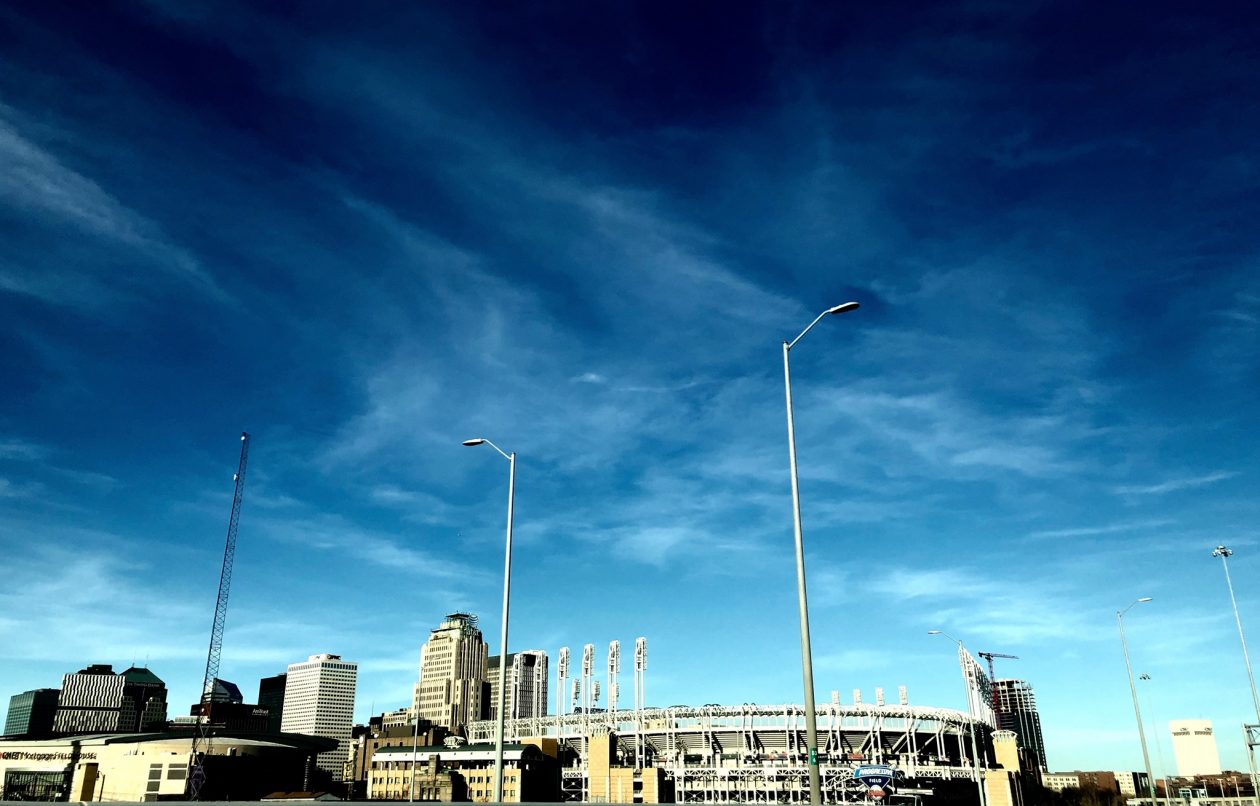
In 1984 the Cleveland Browns finished the season 5 in the win column and 11 in the loss column. They were nearly dead last in the NFL in points scored. The Municipal Stadium on Lake Erie was a lonely ballpark that winter with no happy memories to keep it warm. Two years later, in Bernie Kosar’s first full season as the starting quarterback, the team went 12 and 4, their best record in nearly twenty years, and scored points right, left, and center.
Webster Slaughter and Brian Brennan pulled in TD passes while Earnest Byner and Kevin Mack punched it in when they were knocking on the door. They only kicked field goals when it was absolutely necessary, like when it was 4th and forever to go. Even then, all bets were off.
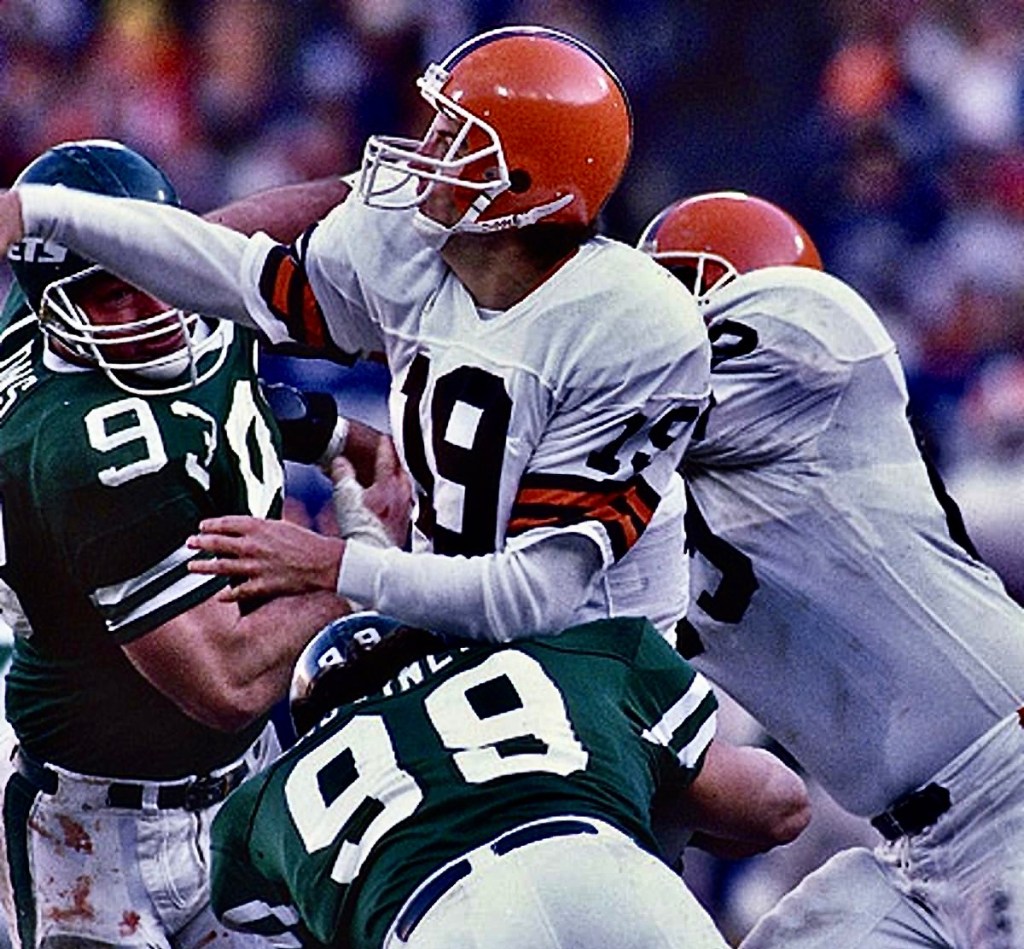
Facing the New York Jets in 1986 in the playoffs, Bernie Kosar led the Browns to a double-overtime win, leading two come-back scoring drives in the final four minutes of regulation. He set a playoff record for passing yards. The team got knocked out of the playoffs the next round when they lost the AFC Championship Game by a field goal, again in overtime. It was close, but no cigar.
Bernie Kosar was from Youngstown. His parents were Hungarian. He grew up in Boardman Township and went to Boardman High School. He didn’t play pinball then but was a hell of an athlete, slinging baseballs and footballs where they needed to go. The baseballs were strikes and the footballs were completed passes. In 1981 Parade Magazine named him Ohio’s Division I “Player of the Year.”
My friends and I got hooked on the Cleveland Browns when they were the Kardiac Kids and Bernie Kosar was still in high school. We looked forward to the Sunday afternoon games and never missed them no matter what. If it was a Monday night game, it turned into a party. After their glory days in the 1960s the team hit a dry spell in the 1970s. The party was over. Then 1979 happened. They were losing their first game of the season, and time was running out, when quarterback Brian Sipe threw up a 45-yard prayer and Dave Logan answered the prayer by hauling in the pigskin. In no time flat the game was tied, and the Browns pulled it out in overtime. Municipal Stadium went nuts.
The following week a doctor from the Cleveland Clinic stopped in at the team’s training center. “He showed us a paper readout of a cardiac machine,” Brian Sipe said. “It showed that somebody had died right at the moment we won the game. I think the story was that he was watching the game, sat up and cheered, and died.” The team was the Kardiac Kids from then on.
The 1980 season was more of the same, a few crushing defeats and a slew of miraculous wins, until it all came to an end with Right Red 88. The Browns were knocking on the door towards the end of a tight game against the Oakland Raiders. The play call from Head Coach Sam Rutigliano was “Red slot right, halfback stay, 88.” As Brian Sipe started back out onto the field his coach told him, “Throw it into Lake Erie if no one is open.” Instead of throwing it to Dave Logan or Lake Erie, he threw it to Oakland safety Mike Davis and that was the end of the Kardiac Kids.
It took six years, but when Bernie Kosar got to Cleveland and started working his magic, the glow inside the lakeside stadium came back. For two years he was the second-best quarterback in the world, behind only Dan Marino. He had half as many interceptions and half as many fumbles as Boomer Esiason. He threw for more yards, more touchdowns, and had fewer interceptions than John Elway.
He almost didn’t make it to Cleveland. On the first play of the first game of his college career at the University of Miami a defensive lineman tracked him down. They were playing the Florida Gators in Gainesville. “It was a guy named Wilbur Marshall,” Bernie said. “We were backed up on the one-yard line and he cracked me into the brick wall that goes around Gator-land. The first thing I thought as I was laying there was, ‘I better do good in school because this football thing is not going to work out.’”
He stuck it out, though, graduating with a degree in economics and leading Miami to a National Championship. When he got to the NFL, he found out there were more than brick walls to worry about. All the men on the defensive line were brick walls. “The league was encouraging crown of the helmet, top of the helmet blows,” he said. “The beginning of Monday Night Football was two helmets smashing together. The pregame show had a segment called ‘Jacked Up,’ about how hard did you hit a guy ,and you were glorified for using your helmet as a weapon.”
Bernie Kosar played tough football in tough times. He also played a mean pinball. He was a team member on the football field, but he played pinball for himself. It wasn’t about burning off steam. It wasn’t about a need to conquer the machine age. It wasn’t a metaphor for sexual fulfillment. Pinball was like black magic in his hands.
The Tam O’Shanter was a bar and grill in Lakewood, which was a bus line suburb on the west side of Cleveland. I had recently moved there and was living a couple of blocks from the Rocky River and a half-mile from Lake Erie. The bar and grill wasn’t far from where I lived. It was where I saw Bernie playing pinball one Thursday night.
“He comes in for dinner and a draft and to play pinball every Thursday after the team film sessions are over,” Tom Gannon, who owned and operated the place, said. “He gets a buzz out of it.”
Bernie was a big man, six foot five, but just a hearty dinner over two hundred pounds. He looked as fit as fit could be, even though he was gangly. He lived in a swank pink apartment building down Detroit Rd. across the Rocky River on the west side of the bridge. It overlooked the river. When he was done with whatever pinball game he had been dominating it was a five-minute drive home.
He played new-style digital electronic machines. Even though he was tall, he didn’t hunch over them. No matter how fast things got he stayed slow on the flippers, never getting overly excited. He played the Fathom, the Firepower, and the Eight Ball Deluxe. He excelled on the Flash Gordon. It was the toughest of the pinball machines at the Tam O’Shanter. Everybody said it was the toughest single game of them all. The aim of it was trying to hit targets within a few allotted seconds to get double or triple points. Bernie made it look easy.
“The first inches of a pinball game are always the same,” Eric Meunier, a game designer at Jersey Jack Pinball, said. “But after that, the ball can go anywhere.” A spring-loaded plunger propels the ball up the shooter alley and the next second it is rolling inside an amusement park maze of obstacles. There are ramps, spinners, and blinking lights. The goal is to keep the ball in play and away from the drain, a hole at the bottom of the playfield where the ball ends up when you lose control of it.
Training camp for the Cleveland Browns was at Lakeland Community College in nearby Kirtland. “All of a sudden, I graduated college quick, and you’re in camp,” Bernie said. “It’s seven weeks of training camp with Marty Schottenheimer. You’re right in the thick of it.” It was thick or thin on and off the field. “In between two-a-day practices, players and reporters mingled in the dormitories,” Tony Grossi, a beat reporter for the Cleveland Plain Dealer, said. “Lakeland College had a couple of vintage pinball machines in the players’ lounge. Players competed against reporters in daily pinball contests.”
Nobody ever reported beating the curly-haired rookie at pinball. He played it clean, like he could feel the bumpers. He always got the replays. The reporters didn’t know what to say.
He never replayed the first snap he took in the NFL for the Cleveland Browns against the New England Patriots. He fumbled the snap from center, and their rivals took advantage by kicking a field goal, going up 3 – 0. “I just dropped it,” he admitted. When his chance came on the following series, he handled the ball like an old pro, completing seven straight passes, and the Browns downed the Patriots 24- 20. He led the team to five playoff appearances and three trips to the AFC Championship Game in five years. By 1990, despite his risky sidearm throws, he held the all-time league record for fewest interceptions when calculated against attempts.
The Tam O’Shanter was near St. James Catholic Church. Fridays and Saturdays were for the O’Shanter. Sundays were for St. James and the Browns. Men tacked on morning prayers for the home team and wives racked up time serving snacks and drinks during the game. Bernie was raised a religious boy and didn’t change his stripes when he landed in Cleveland as a grown man. He attended church in his parish and appeared at pep rallies whenever asked. One morning more than four hundred kids gave him a big cheer when he stepped into their school gym, the nuns with their rulers keeping order. Two of the kids sang “Bernie Bernie” from the stage. It had been a big hit on the radio the year before.
When question time came, after all the football questions, and all the questions about what he did and didn’t like, one kid asked, “How much beer can you drink?”
“Never mind about that, and stay away from that stuff,” he answered, and started autographing notebooks. After the rally, walking out with a reporter, a nun approached them. “If you ever find out anything bad about Bernie, we don’t want to know about it,” she said to the reporter. She tapped a ruler on the palm of her free hand. Bernie gave her a thumb’s up.
I had played a few games of pinball in my time, but I was no wizard at it. Far from it. After watching Bernie play several times, I thought I might be able to get the hang of it. He made it look easy. I was older and wiser. There was only one objective, which was to keep the ball in play and score as many points as possible. The longer the ball was in play, more free balls could be won and more free replays could be earned. How hard could it be?
The Tam O’Shanter was nearly empty the Tuesday afternoon I stopped in to find out. I went to the Flash Gordon and studied it. The rocketman in ripped biceps and a red muscle T, a babe wearing a metallic bra with pointy tips that could poke a man’s eye out, and a bald mean-looking dude with a goatee were on the back box display. The playfield looked challenging. There were lights and colors galore. I thought, it stands on four legs, pulling its pants up one leg at a time like we all do. If it can do it, I can do it, too. I dropped a quarter into the coin slot and went exploring.
Pinball was going to celebrate its 60th anniversary soon. It got rolling during the Great Depression. At first the machines didn’t have flippers. Players leaned and banged on them to try to get the ball to fall into a hole. Flippers were invented in 1947. It had been a rocky road since then. The amusement was outlawed almost everywhere in the 1940s. Gambling on the game had become rampant. All the pinball machines in New York City were confiscated in 1942. Mayor Fiorello LaGuardia and his moral crusaders smashed them to bits and pieces with sledgehammers and dumped them into the East River. In the 1970s they were still outlawed in Chicago and Los Angeles. Video games nearly wiped the pastime out. But it was back. Pinball machines raked in more than 10 billion quarters in 1988.
I put another quarter into Flash Gordon. My first quarter had gone down the drain in a flash. I took a deep breath and squared my shoulders. Ball control and shot accuracy are the one-two punch of pinball. Trapping the ball with a flipper and tip passing it between flippers are important skills. It’s handy knowing how to bounce pass and post pass. Nudging is body language, although getting a feel for the machine’s tilt sensitivity is vital. The death save comes into play when it’s all gone suddenly wrong.
By the end of the afternoon, I was out of quarters and nowhere near being better at pinball than I had been when I walked in. I walked home. I saved my quarters for the rest of the week and went back to the Tam O’Shanter the next Tuesday. One day I brought twenty-five quarters, another day fifty quarters. I kept it up through the fall and into winter. I gave it up after the New Year. I wasn’t ready to give pinball years of practice. I didn’t have enough loose change, anyway.
I could not for the life of me get the hang of it. I played racquetball in state-wide amateur tournaments and squash on a club team. I was good enough to hold my own most of the time. Both racquet sports were like pinball, the ball bouncing all over the place. But there was something helter-skelter about pinball that I couldn’t master. I wasn’t a mind reader, especially not my own mind, and I couldn’t put my finger on it. I knew there was some luck and chance involved in playing pinball, but there was luck and chance involved in everything.
It wasn’t a physical struggle. Making the flippers slap was no great strain. It was a mental struggle. I wasn’t nervous and never distracted by the lights and noise of the machine. I kept my eyes on the prize, especially when the ball was coming down the middle of the table and there wasn’t anything I could do about it.
When he was in the pocket Bernie Kosar usually stayed there. He was the kind of quarterback who always ended up dead last in foot races, anyway. He was wily and patient, though, waiting to throw the pigskin at the last second while defensive linemen and blitzing linebackers bore down on him. He kept looking downfield no matter the topsy turvy of linemen all around him.
I followed the pinball wherever it went. I knew that was a mistake but kept doing it. There was no reason to focus on the ball when it was in the top half of the machine. The time to focus was when it was in the bottom half. Then it was flipper time. I made myself dizzy watching the bouncing ball too much. I was thinking all the time, wearing myself out, sucking all the fun out of the game.
I was smacking the flippers and getting an occasional big score, but not controlling the hubbub. I couldn’t reconcile the hit-or-miss ricochets of the silver ball. There were hardly ever any random bounces on racquetball and squash courts. There were good shots and bad shots, but not many random shots. They were far and few between. I couldn’t tap into the uncertainty principle of pinball to save my life.
By 1990 Bernie Kosar had a nearly dead elbow, a torn ligament in the front finger of his throwing hand, and was limping like Ahab on a bad day. Handheld signs were asking “Bernie Who?” and popping up all over Municipal Stadium. He was only 25 years old, but on his way out. When the home team lost to the Denver Broncos in the playoffs again, the Browns became the first AFC team to ever lose their first three conference championship games. The team let Bernie Kosar go.
He wasn’t deaf, dumb, or blind, though, and once his hand healed, he won a Super Bowl ring playing for the Dallas Cowboys, where he had been traded. In his free time in the Big D, he touched base with Flash Gordon. The Rocket Man flashed a ray gun bristling with energy coils, but when the Ohio boy threw down his quarter and put his fingers on the flipper controls, both of them knew all bets were off.
A version of this story appeared in the Lakewood Observer.
Ed Staskus posts monthly on 147 Stanley Street http://www.147stanleystreet.com, Made in Cleveland http://www.clevelandohiodaybook.com, Atlantic Canada http://www.redroadpei.com, and Lithuanian Journal http://www.lithuanianjournal.com.
“Cross Walk” by Ed Staskus
“Captures the vibe of mid-century NYC, from stickball in the streets to the Mob on the make.” Sam Winchell, Beyond Fiction
Available on Amazon: https://www.amazon.com/dp/B0CRPSFPKP
Late summer and early autumn. New York City, 1956. Jackson Pollack opens a can of worms. President Eisenhower on his way to the opening game of the World Series where a hit man waits in the wings. A Hell’s Kitchen private eye scares up the shadows.
A Crying of Lot 49 Publication
 Made in Cleveland