Tag Archives: Made in Cleveland

Monkey Business

By Ed Staskus

   Kevin Rourke was an engaging young man with handsome eyes, handsome hair, and a handsome man’s love for all women, from Plain Jane’s to Jane Russell’s. He was charming but unscrupulous, especially when it came to sexpots. He was slowly going to paunch but still young enough that nobody noticed it except us, his roommates, who saw him flip flopping to and from bedroom and bathroom every morning with a towel wrapped around his spreading mid-section.  

   He was in his late-20s, but his belly was going on late-40s. He liked food as much as he liked women. He was always eating sirloins and plucking daisies. The only time he wasn’t was when he went to Florida, which he did for one week twice a year. When he did he only took toothpaste and a toothbrush, two pairs of clean socks and underwear, and a fistful of cash with him. He had a small safe in his closet full of paper money.

   He always wore a baseball cap, safari shorts, and a yellow shirt on the flight. He wore the baseball cap because his hair was thinning.

   “Why yellow?” we asked. 

   “It’s a cheerful color,” he said.

   “What do you do there?”

   “I don’t do anything. I hardly ever leave my room. I sit on the balcony sometimes at night.”

   “How about getting some sun?”

   “No,” he said. “I keep the outside where it belongs, which is outside.”

   “What do you mean? There’s a beach right there.” He always stayed in the same hotel, the Pier 66 Hotel, within sight of the Atlantic Ocean. “What do you do in your room?”

   “I sleep, and other things,” he said.

   “What about food?”

   “It’s my week to diet.”

   “You can’t lay around doing nothing all day every day for a week.”

   “I’ll take that bet,” he said.

   His Lebanese fiancée Leyla took the bet and won. When she did she wouldn’t take his calls for three weeks, but he wormed his way back into her good graces after he got back to Cleveland and their wedding back on track, except when it wasn’t. They had been engaged for more than a year. Day after day went by and they were unable to set a firm date. In the meantime, Kevin kept hedging his bets, sowing his wild oats.

   He took more showers than anybody we knew. He showered every morning and again in the evening after work. He even showered those nights he wasn’t going out but staying in. He wrapped his dampness up in a bathrobe those nights and watched TV. Neither Matt Lavikka, our other roommate, nor I minded. We didn’t watch much on the boob tube, anyway, except in the fall when the Cleveland Browns were launching pigskins.

   When he was spic and span, Kevin worked for ABF Freight Systems, which was a national LTL motor carrier based in Arkansas. We called it All Broken Freight. After calling it that to his face a few times and seeing frown lines break out around his mouth, we eased off and stopped with the buzz talk. His paycheck meant everything to him.

   He was an orphan, or at least said he was an orphan, and had thrown in with ABF like it was a second family. He had a desk in a bare bone’s office in Brook Park, although he hardly ever went there. His paycheck depended, since he was largely commissioned, on being on the road. He never missed a day of work. Most of the time he worked overtime, pressing the flesh day and night. Some nights he slept in his car in his suit when the drive back to Cleveland from Akron or Canton was going to take too long. When he showed up in the morning he took a shower, changed his clothes, and went back to work.

   Even though he was making a boatload of money, he didn’t seem to own anything except half a dozen expensive suits, a rack of long-sleeved starched white shirts, a trove of status symbol ties, comfortable Italian leather shoes, and a 1980 Mercury Marquis. The car was nearly new and was reddish purple with a leather-and-velour interior. It featured split-bench seats and the driver’s seat reclined. We called it the land yacht. He kept it even cleaner than he kept himself. If there was anything he loved beyond any doubt, it was that car.

   I was taken aback the first time I saw Leyla, Kevin’s girlfriend and treasure chest in the making. She was dark-skinned like she had just crossed the Jordan River, with black hair and a hook nose. Her nose was problematic, but he wasn’t marrying her for that. She was swank the night I met her, with some kind of fur wrapped around the top of her. Her dress was cream-colored and designer. She wasn’t half as good-looking as Kevin. I pegged her at about ten years older.

   Kevin lived by the mantra that when he found a woman with millions of dollars, who would sign over most of it to him, and promised to be dead within a couple of years at the most, that was the woman he was going to marry. “It’s just as easy marrying a rich woman as it is marrying a poor one,” he explained. Leyla didn’t look like she was going to drop dead any time soon, although she looked like she had a million dollars, for sure. We found out her father was a big-time import-export businessman.

   The groom-to-be knew that married couples become in the eyes of the law one person, and that one person was going to be him. Even though it is true enough that one shouldn’t marry for money, since it is cheaper to simply borrow it, he had a one-track mind. He had a bad case of the gimmes. He ran the rat race day and night.

   I was dating a queen bee by the name of Dana Price the year I roomed with Matt and Kevin. Her family lived in a new house in a new development in Solon, a bedroom suburb about twenty minutes southeast of Cleveland. She was a saleswoman for IBM, selling hardware systems to banks, and lived in an apartment twice as large as she needed at the top of Cedar Rd. in Cleveland Heights. Her father was the head honcho of Mrs. Weiss’ Noodles.

   The business had been another family’s business for more than forty years. They were Hungarian, churning out Ha-Lush-Ka noodles for casseroles and dumpling-style Kluski egg noodles at their Woodland Ave. plant. When it burned down in 1961 they built a new plant in Solon. By 1968, after they merged with American Mushroom, they were a multi-million-dollar company and still growing. After the Hungarians retired, and ten years after the merger, Dana’s father Jim Price became president.

   I called him Big Jim because he was a big man with a big mouth. He knew everything about everything. There was no mistaking where you stood with him. He told me so himself when he told me to stay away from his daughter. He didn’t want her marrying an immigrant son with nothing in the bank and anarchist leanings. But she was as stubborn and determined as her father and ignored him.

   We talked about her father’s concerns. She wasn’t planning on marrying me or anybody else to reform them. “That’s what reform schools are for,” she said. Dana was like the highway between Akron and Cleveland, no curves, being up-to-date fit and trim, but I liked her for sticking up for me.

   Kevin hated Dana. She had swagger to spare, and he knew it. She wasn’t curvier than his Lebanese steady but was better-looking by far. He resented her faux Boston accent. He resented her family, her family’s wealth, and their lifestyle. The family house in Solon had four bedrooms and a hot tub on the back deck. Big Jim drove a Caddy. It seemed like it was a new model every year. Kevin hated all of Big Jim’s Caddy’s.

   Dana had gone to college in Boston and flew there every two months-or-so to get her hair done by her favorite stylist. That winter, when I was thinking of breaking up with her, she asked me if I wanted to go to Aspen for some skiing. Before I could say anything, she stuck an airline ticket in my hand and said she would meet me there. She was going a few days in advance. She was more like her father than she knew.

   “I’ve only down hilled a few times,” I told her. “I mostly cross-country ski on the golf courses around town, which are mostly flat.”

   “You’ll get the hang of it,” she said. She was a can-do gal. She could be unconsciously smug.

   I felt like I was being hung out to dry with a broken leg in the making. Aspen Mountain is almost 12,000 feet up and has a vertical drop of more than 3,000 feet. The ticket was like an albatross around my neck. I went for a walk around the block to work it out. I couldn’t work up an angle to get out of the suicide mission.

   “Why don’t you give the plane ticket to Matt?” Kevin suggested. “He’s always skiing. He would love to go to Aspen.” Matt’s parents were from Finland, where skiing is second nature. They always said, “One cannot ski so softly that the tracks cannot be seen.” It was some kind of Finnish proverb. I had no idea what it meant.

   That’s what I did. I gave the ticket to my roommate. I didn’t say a word to Dana about it. She could be a hothead. After he got back from Aspen, Matt told me Dana was dumbfounded when he arrived in my place, his gear in tow. After she got her feet back under her, she swore up a storm and swore it was over between us. She was true to her word.

   “How was the skiing?” I asked.

   “It was great,” Matt said. “You should try it.”

   The on-again off-again wedding of Kevin and Leyla was back on when spring began to bust out all over. They planned to get hitched in June. I had majored in English at Cleveland State University and when my school days were over was minoring in unemployment, and so had time to spare for errands and lending a helping hand. I addressed all the invitations, sealed, and stamped them. I mailed them out. The replies started coming back the beginning of May. It was shaping up to be a sizable wedding followed by a chock-full reception. Kevin was opting out of hot wet love and into cold hard cash.

   I thought all his talk about marrying for money was just talk since a lot of what he said was all talk. I found out otherwise. He was going to marry for money. He was inviting anybody and everybody, no matter how distantly related by blood or friendship, adding up what their envelopes stuffed with fifties and hundreds might amount to.

   Kevin was like the Three Musketeers of repartee. There was nothing any woman could say to him that he didn’t have a better retort for. That was his number one problem. What woman was going to put up with a smart-ass day in and day out, much less for the rest of her life? The second problem was he never dated anybody who was better looking than him. When that became clear to whoever was princess for the day, she chopped his head off with words and moved on. Leyla was willing to put up with both problems. She wanted Kevin so she could make him into what she wanted him to be. The wedding was supposed to be at St. Marion’s, which was a downtown Maronite church. The congregation had been around since before World War One.  It was the center of Lebanese culture in Cleveland, both religious and ethnic.

   Kevin was still wrestling with doubt and indecision a week before the wedding. When he went down for the count, he called it off. He was giving up the task of loving his lady love. He had enough money in his safe so that he could stay a playboy for a few more years. Leyla was going to find out soon enough she had been made a monkey of.

   Matt and I were watching the Kardiac Kids on an old black and white TV when we found out what was happening. The Kardiac Kids were the exciting new version of the Cleveland Browns. They snatched victory out of the jaws of defeat most Sundays. Kevin walked in on the broadcast and tried to break his news flash to us. Brian Sipe was lofting a Hail Mary Pass. We motioned for Kevin to wait. When the Dawg Pound erupted, their prayers answered, we turned to him.

   “What’s that you were saying?” we asked, high fiving each other.

   “The wedding is off,” he said.

   “It’s off?” we asked, flummoxed.

   “Finito,” he said in an Italian accent phony as a bag of baloney, making a slashing motion across his throat. “You’re going to have to let everybody know.”

   “Hey, that’s all right,” I said turning back to the football game, making sure Don Cockcroft had kicked the extra point. “No man should get married until he’s studied some anatomy and carefully dissected the corpses of one or two women, so he knows exactly what he’s going up against.”

   Matt and I were at his parent’s house the next Sunday. They were from the old country. They had gotten a new Philips color television and we were watching the adventures of the Kardiac Kids again. The game hung by a thread. In the middle of the drama a slew of commercials interrupted the action. We told the old folks all about Kevin’s misadventure.

   “Life is not a waiting game for better times,” Matt’s dad said when the commercials were wrapping up, the game coming back on, and we were done with our account of the no-wedding.

   What does that mean? I wondered. I thought it had to be another Finnish proverb. What about all good things come to those who wait? “Even in Helsinki they don’t keep a maid on the dresser too long,” Matt’s mom said as though she had read my mind. I didn’t have to parse that. Matt and I went back to watching Brian Sipe side-stepping a defensive bull rush and pitching a tight spiral. It was flying colors right, left, and center.

Ed Staskus posts monthly on 147 Stanley Street http://www.147stanleystreet.com, Made in Cleveland http://www.clevelandohiodaybook.com, Atlantic Canada http://www.redroadpei.com, and Lithuanian Journal http://www.lithuanianjournal.com

“Cross Walk” by Ed Staskus

“Captures the vibe of mid-century NYC, from stickball in the streets to the Mob on the make.” Sam Winchell, Beyond Fiction

Available on Amazon: https://www.amazon.com/dp/B0CRPSFPKP

Late summer and early autumn. New York City, 1956. Jackson Pollack opens a can of worms. President Eisenhower on his way to the opening game of the World Series where a hit man waits in the wings. A Hell’s Kitchen private eye scares up the shadows.

A Crying of Lot 49 Publication
Dracula at the Door

By Ed Staskus

   Some folks turn on the porch lights Halloween night and wait for the doorbell to ring. Others sit on their front steps or stoop, while still others plop themselves down on lawn chairs at the base of the driveway. Those who don’t want to bother make sure all their lights are off. They sit sulking in silence or watching whatever is on their phones and tablets. They think Halloween is just for kids and that grown-ups have better things to do.

   When I was a kid and went trick or treating with my sister, brother, and our friends it was, next to Christmas, the biggest show of the year. It was one for the money and two for the show. ”Don’t be a chiseler! Give me some Twizzlers!” It didn’t matter what horse opera was on TV or what homework was due the next day. What mattered was making sure we stuck to our battle plan. We planned our route days beforehand, which was left out of our house on Bartfield Ave., left on E. 128th St., left on Locke Ave., left on E. 127th St., down Coronado Ave. to Lancelot Ave. and back home. We knew we had about two hours and if we banged on one door every minute we would have gotten to more than a hundred houses and hit the jackpot. When we did we ran home to survey what we had gotten.

   My sister and I always hid our loot from our brother. We had to. He had a non-stop sweet tooth. “Give me a break! You know it’s the Kit Kats I want to take!” He believed in sharing, like us, but Sharing Street to him was a one-way street.

   All of us hated dark houses. Was the dark inviting us to the spookiness or telling us to stay away? Time is candy, we reckoned, and wasting time evaluating a dark house was time lost. We imagined grumpy old men and women lived there, better left unseen, although we also thought they could have shown their faces at least once a year.

   We weren’t scared about anything anybody threw into our pillow cases, except when it was pennies and apples. If it was candy corn we put a curse on their house. The day of crazy people putting razor blades and poison into candy hadn’t arrived yet. We didn’t want pennies and we got more than enough apples at home. Our mother fed one to us every day to keep the doctor away. When we got sick she gave us Ginger Ale and slices of liver and onions. The soda was bubbly. The liver and onions were sickening.

    The term “Trick or Treat” was first used in a Red Hook, Alberta newspaper in 1924. “Hallowe’en night was observed in the usual manner by the young bloods in town. Fun is fun and tricks are tricks, but when such public buildings as school and Memorial Hall are molested with no option for Trick or Treat, we cannot see where either fun or trick is enjoyed.”

   A high school boy next door told us there hadn’t always been any such thing as Halloween. We were aghast. How could it be? We ignored him. We found out later he was right, although by that time we weren’t trick or treating anymore, so it didn’t matter.

   I didn’t know a thing about Halloween until after we got to the United States. It’s not a traditional holiday in Lithuania, where both my parents came from after World War Two. It was only introduced there after the country kicked the Russians out in 1990. It wasn’t much of anything in Sudbury, Canada, where I was born and bred, either. There was often snow on the ground by the end of October in northern Ontario and nobody went out dressed as a skeleton in zero weather sponging for sweets. 

   In Romania the holiday is Dracula Day. In China it is the Hungry Ghost Festival. In Mexico it is the Day of the Dead. In the Middle Ages in England ‘soulers’ went around begging for round cakes or ‘souls’ during All Hallows Eve as a way to remember the dead. It was the soul kitchen. Turn me out and I’ll wander forever.

   Before there was Halloween there was nothing, just the end of the month and the beginning of the next month. Then the Irish Potato Famine happened, and millions of Irishmen came to the Land of Plenty. They didn’t have much to go around, but they had culture. They brought Samhein with them. The Irish New Year started on November 1st and Samhein was the day before that. It was when the spirits of the dead returned to the world of the living for one night. Paddy lads and lassies dressed up in costumes and went door to door begging for food and money. Their parents carved ghoulish faces on turnips to ward off evil. They put candles inside the turnips to let kids know they could bang on their door for treats.

   Many youngsters without a drop of Irish blood in them got into the spirit of it but the powers that be didn’t like it. They blanched at the complaints of vandalism, houses splattered with eggs, and strips of newspaper littering shrubs and trees. Enough is enough, they said, and put a stop to it wherever whenever they could. They didn’t care that some parents spent hours wrapping their kids up in rolls of toilet paper to look like mummies. After the post-WW2 baby boom many families made demands to make the holiday official, and city fathers were forced to bow to the popular will. Halloween broke out all over.

   It busted loose just in time for the candy companies. Old timers used to parcel out nuts, fruits, and trinkets. They thought we would have fun bobbing for apples. They were wrong, just like everybody who gave us candy corn was wrong. Candy corn was originally sold in the 1880s. It was like chicken feed with rooster images on the boxes. Nobody ever ate it unless they wanted a jelly belly. It didn’t matter that the last pyramid-shaped penny candy had been slurried during the Roaring Twenties. Every year it was repackaged and redistributed. By the mid-50s real candy became the treat of choice. We were all in on the new tradition. We didn’t know it would grow into the second-largest commercial holiday in the country, raking in more than $6 billion dollars.

   It doesn’t do it in on the shoulders of kids going door to door anymore. These days only a third of everybody hands out candy. Another third leave candy out in a bowl, while the rest keep their lights off. One year my wife and I were going out to dinner with friends. We left a big plastic bowl full of goodies on the front porch with a sign saying, “TAKE ONE.” We were pleased to see it empty when we got home, until we ran into one of our neighbors the next day.

   “Two boys just ten minutes after you left wiped you out. They turned the bowl over and poured everything into their bags. When I went up to them to say something they ran away.”

   When we trick or treated back in the day we loved getting Clark Bars, which were peanut butter and spun taffy, Zag Nuts, which were peanut butter and toasted coconut, and Mary Janes, which were peanut butter and taffy molasses. We had a soft spot for peanut butter. Treacle was a close second. We hated Necco Wafers. They were tasteless except when they tasted bad. We liked candy cigarettes, which we could pretend to smoke and eat at the same time.

   Many more than less of Halloweeners stay home nowadays and watch a scary movie instead of trick or treating. “Hocus Pocus” is the number one movie followed by “Friday the 13th” and “It’s a Great Pumpkin Charlie Brown.” In the late 1950s and early 1960s nobody stayed home watching any movies unless they were deathly ill. Everybody beat feet the second it got dark enough for the starting gun to go off. When it did we raced outside and took a left.

   A decade later, when my trick or treating days were behind me, I was living in Asia Town. The old school Cleveland neighborhood had plenty of Chinamen, Eastern Europeans, and Puerto Ricans. There were the working class, trailer trash, beatniks and hippies, and college students. I fit in somewhere between beatnik and college student. I joined the working class whenever I ran out of money. It was an affordable place to live with all of life’s necessities within walking distance, which worked for me because most of the time I didn’t have a car. The rest of the time I had a car that didn’t work most of the time.

   Joe Dwyer was one of my friends who lived one block over. We had gone to high school together and were both some-time students at Cleveland State University. We were dodging the draft as much as we were reading textbooks. At least I was reading. I was majoring in English with a minor in Unemployment. Joe was an art student and didn’t read anything unless it was necessary. He painted houses whenever he had to keep the wolf away from the door.

   His digs were on East 33rd St. between Payne Ave. and Superior Ave. The 100-year-old house was narrow as a one-lane street and as cluttered as a Victorian parlor. He smoked marijuana like nobody’s business. He made sure it was nobody’s business. In those days cops were always throwing young adults into jail for smoking weed. Dying in Vietnam was OK. Smoking weed was not OK. He had two white cats with mismatched blue and green eyes. There was a disheveled garden in his postage-stamp size yard. He collected gourds, decorating them in fantastical colors.

   One day in mid-October, passing by his house, I heard hammering. When I took a look-see I saw two sawhorses and a pile of plywood. He was sawing and hammering a coffin together in his backyard.

   “Who died?” I asked. I didn’t put anything ad hoc past him. He was crafty in more ways than one.

   “Nobody died, not yet, at least,” he said. “This is for Halloween.” He was a red-blooded Irishman and had first dibs on Samhein.

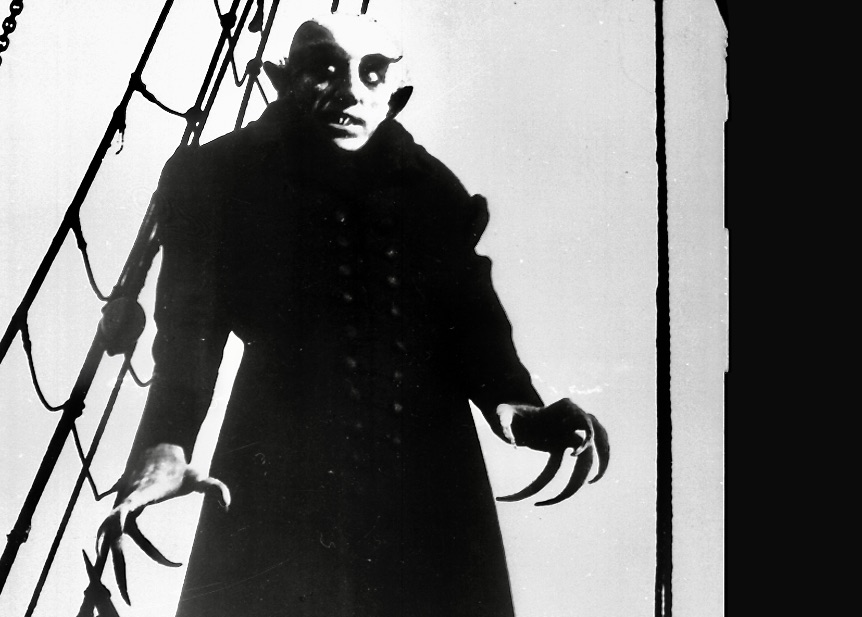
   He was making the coffin so it could stand on its hind legs. He painted the outside a glossy black and the inside a glossy fire engine red. He was going to park it in his open front door on the big day. When kids came up his stairs they would have to approach the vertical lid of the coffin in the doorway. When they did, spotting them through a peephole, he slowly opened the lid, dressed as Dracula, and handed out treats.

   Nobody in our neighborhood took a pass on Halloween, especially not that year. The holiday was on a Friday and that made it Halloweekend. It didn’t matter if the child was from China or West Virginia. Every child who could walk hit the mean streets of the near east side running. Every teenager did the same thing. Even some old Slovenian women dressed up as themselves went out, their babushkas tied tight under their chins. I sat on a front porch next door to Joe’s house with some college friends. We had a family-size bag of Lay’s potato chips and a 12-pack of Stroh’s beer for ourselves and tossed Home Run gumballs into everybody’s bags, but not before getting our two cents in about every costume we saw. The gumballs were right up our alley, costing us close to nothing..

   Joe had rigged up a mirrored stardust ballroom light. It strobed, throwing shards of colored light on the ceiling, walls, and the deck of the front porch. Once the trick or treaters were on the porch there was no missing the coffin, especially since a purple floodlight was making it look creepier than coffins usually do.

   At first, everybody was cautious about approaching the coffin. Some kids didn’t even try. They took one look at it and left for greener pastures. Some kids recoiled when Joe slowly swung the lid open, the hinges creaking, extending Nips in assorted flavors. Nips were pint-sized Coke bottles made of food-grade paraffin filled with colored syrup. Some kids fell backwards in alarm when Joe’s hand floated forward reaching for them, landing on their behinds. A few screamed to high heaven and ran for their lives. Joe’s vampire get-up featured pancake make-up, fangs, and fake fingers a foot long. His lips and eye sockets were blackened. He was dressed in a stitched together tuxedo, a starched white shirt, and a black bow tie. There were few parents accompanying their children so there were few irate parents to give Joe a piece of their minds.

   Not that it mattered. When word got out, Joe’s house became the place to go to for fun and fear in Asia Town. At first the line was down the front walk. Then it was down the sidewalk. Then it was around the block. Everybody had to see the coffin for themselves. When Joe ran out of Nips I ran to Stan’s Deli on the corner and got more of anything he had.

   Stan was a Polack who ran a meat counter and beverage store on Payne Ave. He was short and heavy-set and always wore a white apron. It always had flecks of ground beef on it, which wasn’t surprising since he so seldom washed it. He sold a grab bag of wares besides protein and beer. He had a box of old flavored wax lips he said I could have at a big discount. I bought those. He had bags of old cotton candy. He slashed the price. I bought those, too. He had wads of old Orbit chewing gum. I bought those and rushed back to Joe’s house.

   He was still there, standing outside his coffin, telling ghost stories in lieu of handing out treats. We dished out what I had brought back until it was all gone and then called it a day. “Hey mister, you got any candy corn to go with that gum?” a pint-sized Long John Silver asked. We told him to walk the plank. The next morning Joe told me he was so tired at the end of the night that he threw himself down on his sofa still clad in his Bela Lugosi outfit and fell right asleep. “I slept like the dead last night,” he said.

   At the end of the first “Halloween” movie, after Dr. Sam Loomis pumps six bullets into Michael Myers, he catches his breath on the balcony and looks down at the sidewalk. He doesn’t see the boogeyman lying there. He’s gone! When that happened, everybody knew there was going to be a sequel, just like everybody knows after the big night that the next big night is exactly one year away.

Ed Staskus posts monthly on 147 Stanley Street http://www.147stanleystreet.com, Made in Cleveland http://www.clevelandohiodaybook.com, Atlantic Canada http://www.redroadpei.com, and Lithuanian Journal http://www.lithuanianjournal.com

“Cross Walk” by Ed Staskus

“Captures the vibe of mid-century NYC, from stickball in the streets to the Mob on the make.” Sam Winchell, Beyond Fiction

Available on Amazon: https://www.amazon.com/dp/B0CRPSFPKP

Late summer and early autumn. New York City, 1956. Jackson Pollack opens a can of worms. President Eisenhower on his way to the opening game of the World Series where a hit man waits in the wings. A Hell’s Kitchen private eye scares up the shadows.

A Crying of Lot 49 Publication

High and Low

By Ed Staskus

   When your back is to the wall, you’ve only got one place to fall, which is face down. I didn’t want to do that. I had gotten married the year before and it was time to buckle up. I needed a steady job. I called Doug Clarke and asked if I could see him. I was looking for a piece of the pie.

   “Absolutely,” he said.

   “What’s a good time?”

   “Any time after lunch.”

   We made a time for the following Monday. I made sure to be on time. Doug was behind his desk at the back of the office, which was a bullpen style office. A half-eaten sandwich lay at his elbow. He was a few years younger than me and at least a hundred times the capitalist I was. He had his own Gilded Age going. Phones were ringing off the hook. Merchandise were being talked up. Money was being made, by hook or by crook.

   I first met Doug when he was in a small building on Linda St. in Rocky River, Ohio. It was going on the late 1980s. He had been set up in business by his father, who was an account manager for Philips Lighting. Doug was selling commercial lighting and had lately started selling tanning bulbs. Philips had developed fluorescent tanning tubes for the European market. They were new on the American market. They were going like hot cakes.

   Light Bulb Supply was three of them in the beginning, Doug, the owner operator, his salesman Marty Gallagher, and Chuck Pampush, who ran the warehouse and did the driving. The company truck was a red F150 Econoline and was called the Lightmobile. Doug had an office, but Marty’s desk was in a hallway leading to the warehouse. They had been friends growing up, but weren’t going to stay friends for long. As tanning bulb sales grew by leaps and bounds Marty jumped ship and set up his own distributorship. The split went to court, there were claims and counterclaims of theft of trade secrets, but in the end, they both stayed in operation, personal enemies and business rivals.

   Randy Bacon, Chuck’s brother-in-law, helped in the warehouse now and then unloading deliveries and stocking shelves. He had a tattoo inside his mouth under his front lip. It said, “Fuck You.” I gave him a wide berth whenever I saw him. I gave his junkyard dog a wider berth. The pooch was unusually tense and snarled all the time.

   By the time I sat down with Doug he wasn’t in Rocky River anymore. He had outgrown his start-up warehouse. He had moved five miles east to Lakewood on the third floor of a hybrid industrial and commercial building, renting space and then more space.

   “What can you offer us?” he asked me.

   “I can offer you 20-some years. After that it’s up for grabs.”

   “Steady Eddie, is that right?”

   “Whatever you say,” I said unwittingly, saying something I ended up saying over and over for a long time.

   “All right, you’re hired.”

   We shook hands. Doug clapped me on the back. It ended up being twenty-two years of the daily grind. In the end I didn’t get a handshake on my way out, although I had not expected one, given the family business I had signed up with. I wasn’t part of the family.

   When Doug was still in Rocky River I had teamed up with a friend of mine and set up a small tanning salon across the street from the Cleveland State University campus. We were in a five-story brick building at East 21st St. and Euclid Ave. The Rascal House Saloon was across the street. It was where concert goers at Peabody’s Down Under went for a middle of the night  fest after shows. The Plain Dealer called it “Cleveland’s Best Pizza.” I went there whenever I was famished and down to a couple of bucks. 

   We were on the lower level. Bill Stech, an architect, and the landlord, was on the top floor. He always wore the same black suit, white shirt, and black tie. He had black hair that looked phony. He always made promises and usually broke his promises. After a while I stopped taking it personally. Whenever he didn’t want to see me, his receptionist said he wasn’t in, even though his car was parked in the back lot in its customary space. Sometimes I could even see him in his office, at his desk, his back turned to me.

   My business partner was a full-time fireman in Bay Village, so I did most of the full-time work at the tanning salon. I also drummed up side jobs at other salons, trying to make myself useful, doing repairs, selling, delivering, and installing bulbs. I kept my head above water, but I was treading water. When Doug hired me for part-time sales, I opened a savings account.

   Doug had moved to the Lake Erie Screw building in Lakewood. Madison Park was in front of the building and Birdtown was all around us. The neighborhood was not the greatest. Everybody made sure their cars were locked up tight in the parking lot. One day after work, as I walked to my car, I saw a dead bird stuck headfirst in my front grill. I hadn’t heard or felt him hit the car that morning. He was stiff and there were flies buzzing around him. I pulled him out, rolled him up in a newspaper, and took him to the park, where I laid him down in a pile of rotting leaves.

   The brick pile we were in was going on a hundred years. It was on 18 acres with plenty of parking. From 1917 to 1924 it had been the Templar Automotive Plant. They built cars, trying to compete with Detroit. Dave Buehler, a Lakewood native, collected cars and had more than a dozen of the Templars. He restored them and kept them stashed in our building on the same floor where they had first been assembled. I sat in one of them one day. It was sizable enough but uncomfortable. The steering wheel was king-size and the mirrors were tiny. It looked like it would transition into a coffin at the first whiff of an accident.

   The building became Lake Erie Screw in 1946 when John Wasmer took it over and started manufacturing fasteners. In the 1970s he added large bolts to their line-up and growth accelerated. When most fastener manufacturers moved to China, the Wasmer family kept up the beat of the hometown and their growth continued apace. By the mid-90s the company was doing about a hundred million dollars in annual sales, all of it in cap screws and structural bolts.

   In the beginning my job was as thankless as it gets in the world of commerce. I had a cubicle the width of a toilet stall and was expected to make cold calls until the end of time. I got sick of it every day at the beginning of the day. There were few overworked business owners who wanted to talk to an eager beaver trying to sell them something. The other salesmen sat back and waited for calls to come to them. They racked up commissions while I racked up zeros.

   It took longer than I wanted, but I finally went full-time, got a real desk, and got to answer in-coming calls. I sat between Betty the typist and Jim Bishop. Betty was a looker who never looked at me, except when she had something obnoxious to say. She was doe-eyed about Doug. Even though Doug had a girlfriend who was going to be his wife soon enough, the gossip was that he and Betty were close.

   He had a bedroom through a locked door behind his desk.. There was an immense waterbed and a mini fridge. There were posters of muscle cars and hot girls on the walls. There were piles of dirty clothes and old mail everywhere. He wasn’t especially tidy. Being the boss, he didn’t need to be.

   One day when I was on the phone with a customer, Betty broke into her song and dance about what I was doing wrong and what I should be doing right to win more friends and influence people enough to make them buy our goods. She didn’t stop even when I finished the call and was writing up the sale. I finally got fed up and said so.

   “Look, shit for brains,” I said loud enough for anybody listening to hear. “You take care of your business at that typewriter over there and I’ll take care of mine over here.” Nobody dropped a pin in case I had more to say. Betty sniffed and went to the bathroom. I went to Doug’s desk and apologized for the outburst. He laughed it off. I never apologized to Betty. She was never going to be Mrs. Doug Clarke, anyway.

   We were riding the wave of the tanning boom. We had more sales than we knew what to do with. Doug rented additional space to stock our bulbs and hired more packers. They worked overtime day after day. Trailer loads of bulbs from Cosmedico, Wolff Systems, and Light Sources rolled in every Friday. We sent small orders out by UPS and FedEx, and pallet orders out by LTL. We were busy as bees.

   Doug started out as Light Bulb Supply selling run-of-the mill commercial lighting. The tanning bulbs we sold under the name of Ultraviolet Resources were making him rich, but we still sold all kinds of incandescent, fluorescent, and high-pressure bulbs. I got into the swing of it and lent a hand, even though the commissions were less. Jim Bishop was the lead man. He sat on the other side of me. Betty hated him more than she hated me. He never stopped baiting her, no matter what, staring intently at her while twisting a strand of hair.

   I couldn’t make him out. He looked like hell, even though John Elias, another salesman one desk down, told me he was trying to “hold on to his youth.” That horse was out of the barn. He lived in the Warehouse District, in the Bradley Building, which was an early pioneer of downtown Cleveland’s revitalized housing. He wore his hair long, down to his shoulders, dressed better than anybody else in the office, and only took calls when he wanted to. He snorted coke on his lunch hour and was always more personable when he got back to the office.

   He was never personable to Betty. Coming back from lunch he liked to stop at her desk and hover over her without saying a word and breathing heavily.

   “What do you want now?” she asked.

   “What if I told you I was gay?” he asked.

   “Just go away, please,” she hissed.

   Kathy Hayes was Mrs. Doug Clarke in the making. There was no mistake about that. She was Doug’s pit bull sales manager. She brought her sister Maggie into the business, then her brothers Kevin and John. Kathy came from a family of thirteen. More brothers and sisters came and went as the need arose. Kevin, John, and Maggie stayed. Kevin and John became Archie and Jughead in my mind. Maggie became the Wicked Witch of the West. I put her out of my mind.

   Kathy was the Queen of Mean. She was a mix of go-getter, unapologetic yuppie greed, and a hair trigger temper. She calmed down after her kids were born, but never lost the mean streak. She was my immediate boss, so I watched my step. She was a sharp gal. I was fake polite to Archie, Jughead, and the Wicked Witch. They were easy enough to do that to, like pretending to water fake plants.

   After I cold called myself into Kathy’s good graces, I settled into a routine of Monday through Friday. It wasn’t what I wanted to do but it was what I had to do. The only concession I was able to wrangle was a starting time of 11 AM to be able to work at my part-time job, which was more remunerative but not as steady. My steady job meant I would be getting a predictable paycheck every two weeks, making good on my bills, and paying into a 401k, which were good things. I never worked overtime and never volunteered for anything. They didn’t pay me enough to go an extra inch, much less a mile. The American Dream is only real for those who say so.

   Towards the end of the millennium Doug broke ground on a new state-of-the-art warehouse and offices in Brook Park. He spared no expense. It was 45,000 square feet next door to the 230-acre Holy Cross Cemetery. There were dedicated 18-wheeler loading docks and a separate dock for the delivery services. The head honchos had sizable offices with windows. There was a gym and a party center on the second floor. The lunchroom was all stainless steel and a huge flat screen. Christ on a cross was fixed to the wall above the front entrance doors. The cross looked like a cactus. Jesus looked like he needed to scratch an itch.

   It rained money like nobody’s business. One day a Middle Eastern man walked in with a paper bag stuffed with more than $50,000 in cash. He was setting up a tanning salon. We were outfitting it with the equipment. I wrote up the sale but didn’t bother counting the loot. I left that to the Wicked Witch, who scowled testily when I poured the legal tender out on her desk.

   We moved into our new building, shiny and up to date, at the beginning of the new century. It was the beginning of the end. It took five or six years but Light Sources, whose tanning bulbs were Doug’s meal ticket, decided they wanted a bigger slice of the pie. They offered Doug a choice. He could sell the tanning division to them, they would send somebody from headquarters to run things, or he could decline their offer, in which case they would open their own operation somewhere else, bypassing him entirely . Doug went with the flow. Everything and everybody stayed put.

   It didn’t do any good. Inside a few years Light Sources moved themselves to Westlake. Archie, Jughead, and the Wicked Witch jumped ship and went with them and Doug was left holding the bag. He lost a boatload of money in the stock market downturn of 2007. As the second decade of the century unfolded, he had to shed most of his remaining staff, including me, sell his deluxe building, find an older, smaller building, then find something even smaller, until he finally ended up in a strip of mom-and-pop shops in Avon selling odds and ends. His kids didn’t re-enroll at their private schools. He lost his McMansion in North Ridgeville. His rich friends became his former friends.

   In life Doug bore a resemblance to the late-night TV talk-show host Johnny Carson. He had a warm smile and went out of his way to make most people feel good, even though he was as oriented to the bottom line as any manhunter. He was elected president of the Brook Park Chamber of Commerce, where everybody was a manhunter. He spent money on himself and his family like he had money to burn. The money ran out slowly but surely. By the time he died there wasn’t much left to burn.

   Doug died when he was struck by a semi-truck trailer on Interstate 90 near his mom-and-pop. It was 2018 in the middle of a sunny day at the beginning of summer. He was taken to University Hospital in Avon where he was pronounced dead. He had been standing outside of his car on the shoulder for a few minutes before he walked onto the marked lanes of I-90, according to the Ohio State Highway Patrol. They couldn’t explain why he had stepped into oncoming traffic.

   It happened so fast the truck driver didn’t have a chance to touch his brakes. “I feel bad for the victim,” Dan Darko of nearby Elyria said. “It sucks to feel pushed to that point. But I feel worse for the driver. One person’s choice will affect him for the rest of his life to the point where he may never be able to do his chosen profession again.”

   It was hard to believe it was an accident, but it was harder to believe Doug had deliberately stepped onto the highway. He was a Roman Catholic, taught Sunday School at his church, and was a member of Religious Readiness. According to Rome, death by suicide is a grave matter. The church holds that one’s life is the property of God and to destroy that life is to wrongly assert dominion over God’s creation. I never knew how sincere Doug was about his faith. I knew he sincerely valued prosperity. I don’t know if he had lost his faith. I knew he had lost his prosperity.

   The funeral was at St Clarence in North Olmsted. He left a wife and four kids behind him. All his in-laws who had bailed on him when Light Sources swallowed the golden goose were there. I didn’t go to the service. I had never been close to Doug or Kathy, anyway, keeping my distance. His in-laws liked to talk loud about what they were contemptuous of. The less I saw of them the better. 

   If Doug stepped in front of the semi-truck trailer on I-90 on purpose, I wondered if he did it for his kids. He probably had a locked and loaded life insurance policy. There might have been a suicide clause limiting the payment of benefits. Maybe he thought he could kill two birds with one stone if it looked like an accident. He could stay in the good graces of the church and still provide for the future of his family.

   Nobody never does not have a good reason for ending it all, especially if they believe hope is gone and not coming back. My memory of Doug is dulled by how he died. The chief thing I now remember about him is how his determined drive for riches and status in this life came to an end on a stretch of godforsaken concrete.

Ed Staskus posts monthly on 147 Stanley Street http://www.147stanleystreet.com, Made in Cleveland http://www.clevelandohiodaybook.com, Atlantic Canada http://www.redroadpei.com, and Lithuanian Journal http://www.lithuanianjournal.com

“Cross Walk” by Ed Staskus

“Captures the vibe of mid-century NYC, from stickball in the streets to the Mob on the make.” Sam Winchell, Beyond Fiction

Available on Amazon: https://www.amazon.com/dp/B0CRPSFPKP

Late summer and early autumn. New York City, 1956. Jackson Pollack opens a can of worms. President Eisenhower on his way to the opening game of the World Series where a hit man waits in the wings. A Hell’s Kitchen private eye scares up the shadows.

A Crying of Lot 49 Publication
Pinball Wizard

By Ed Staskus

   In 1984 the Cleveland Browns finished the season 5 in the win column and 11 in the loss column. They were nearly dead last in the NFL in points scored. The Municipal Stadium on Lake Erie was a lonely ballpark that winter with no  happy memories to keep it warm. Two years later, in Bernie Kosar’s first full season as the starting quarterback, the team went 12 and 4, their best record in nearly twenty years, and scored points right, left, and center. 

   Webster Slaughter and Brian Brennan pulled in TD passes while Earnest Byner and Kevin Mack punched it in when they were knocking on the door. They only kicked field goals when it was absolutely necessary, like when it was 4th and forever to go. Even then, all bets were off.

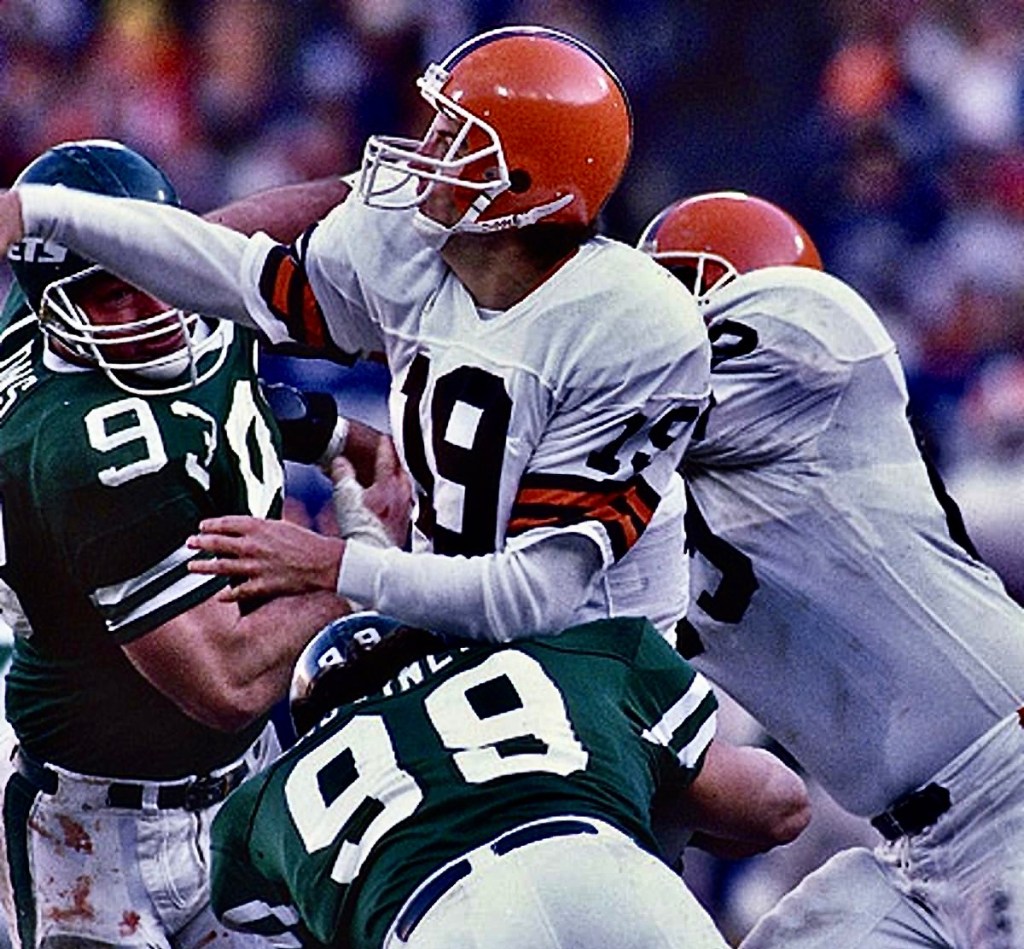
   Facing the New York Jets in 1986 in the playoffs, Bernie Kosar led the Browns to a double-overtime win, leading two come-back scoring drives in the final four minutes of regulation. He set a playoff record for passing yards. The team got knocked out of the playoffs the next round when they lost the AFC Championship Game by a field goal, again in overtime. It was close, but no cigar.

   Bernie Kosar was from Youngstown. His parents were Hungarian. He grew up in Boardman Township and went to Boardman High School. He didn’t play pinball then but was a hell of an athlete, slinging baseballs and footballs where they needed to go. The baseballs were strikes and the footballs were completed passes. In 1981 Parade Magazine named him Ohio’s Division I “Player of the Year.”

   My friends and I got hooked on the Cleveland Browns when they were the Kardiac Kids and Bernie Kosar was still in high school. We looked forward to the Sunday afternoon games and never missed them no matter what. If it was a Monday night game, it turned into a party. After their glory days in the 1960s the team hit a dry spell in the 1970s. The party was over. Then 1979 happened. They were losing their first game of the season, and time was running out, when quarterback Brian Sipe threw up a 45-yard prayer and Dave Logan answered the prayer by hauling in the pigskin. In no time flat the game was tied, and the Browns pulled it out in overtime. Municipal Stadium went nuts.

   The following week a doctor from the Cleveland Clinic stopped in at the team’s training center. “He showed us a paper readout of a cardiac machine,” Brian Sipe said. “It showed that somebody had died right at the moment we won the game. I think the story was that he was watching the game, sat up and cheered, and died.” The team was the Kardiac Kids from then on.

   The 1980 season was more of the same, a few crushing defeats and a slew of miraculous wins, until it all came to an end with Right Red 88. The Browns were knocking on the door towards the end of a tight game against the Oakland Raiders. The play call from Head Coach Sam Rutigliano was “Red slot right, halfback stay, 88.” As Brian Sipe started back out onto the field his coach told him, “Throw it into Lake Erie if no one is open.” Instead of throwing it to Dave Logan or Lake Erie, he threw it to Oakland safety Mike Davis and that was the end of the Kardiac Kids.

   It took six years, but when Bernie Kosar got to Cleveland and started working his magic, the glow inside the lakeside stadium came back. For two years he was the second-best quarterback in the world, behind only Dan Marino. He had half as many interceptions and half as many fumbles as Boomer Esiason. He threw for more yards, more touchdowns, and had fewer interceptions than John Elway.

   He almost didn’t make it to Cleveland. On the first play of the first game of his college career at the University of Miami a defensive lineman tracked him down. They were playing the Florida Gators in Gainesville. “It was a guy named Wilbur Marshall,” Bernie said. “We were backed up on the one-yard line and he cracked me into the brick wall that goes around Gator-land. The first thing I thought as I was laying there was, ‘I better do good in school because this football thing is not going to work out.’”

   He stuck it out, though, graduating with a degree in economics and leading Miami to a National Championship. When he got to the NFL, he found out there were more than brick walls to worry about. All the men on the defensive line were brick walls. “The league was encouraging crown of the helmet, top of the helmet blows,” he said. “The beginning of Monday Night Football was two helmets smashing together. The pregame show had a segment called ‘Jacked Up,’ about how hard did you hit a guy ,and you were glorified for using your helmet as a weapon.”

   Bernie Kosar played tough football in tough times. He also played a mean pinball. He was a team member on the football field, but he played pinball for himself. It wasn’t about burning off steam. It wasn’t about a need to conquer the machine age. It wasn’t a metaphor for sexual fulfillment. Pinball was like black magic in his hands.

   The Tam O’Shanter was a bar and grill in Lakewood, which was a bus line suburb on the west side of Cleveland. I had recently moved there and was living a couple of blocks from the Rocky River and a half-mile from Lake Erie. The bar and grill wasn’t far from where I lived. It was where I saw Bernie playing pinball one Thursday night.

   “He comes in for dinner and a draft and to play pinball every Thursday after the team film sessions are over,” Tom Gannon, who owned and operated the place, said. “He gets a buzz out of it.”

   Bernie was a big man, six foot five, but just a hearty dinner over two hundred pounds. He looked as fit as fit could be, even though he was gangly. He lived in a swank pink apartment building down Detroit Rd. across the Rocky River on the west side of the bridge. It overlooked the river. When he was done with whatever pinball game he had been dominating it was a five-minute drive home.

   He played new-style digital electronic machines. Even though he was tall, he didn’t hunch over them. No matter how fast things got he stayed slow on the flippers, never getting overly excited. He played the Fathom, the Firepower, and the Eight Ball Deluxe. He excelled on the Flash Gordon. It was the toughest of the pinball machines at the Tam O’Shanter. Everybody said it was the toughest single game of them all. The aim of it was trying to hit targets within a few allotted seconds to get double or triple points. Bernie made it look easy.

   “The first inches of a pinball game are always the same,” Eric Meunier, a game designer at Jersey Jack Pinball, said. “But after that, the ball can go anywhere.” A spring-loaded plunger propels the ball up the shooter alley and the next second it is rolling inside an amusement park maze of obstacles. There are ramps, spinners, and blinking lights. The goal is to keep the ball in play and away from the drain, a hole at the bottom of the playfield where the ball ends up when you lose control of it.

   Training camp for the Cleveland Browns was at Lakeland Community College in nearby Kirtland. “All of a sudden, I graduated college quick, and you’re in camp,” Bernie said. “It’s seven weeks of training camp with Marty Schottenheimer. You’re right in the thick of it.” It was thick or thin on and off the field. “In between two-a-day practices, players and reporters mingled in the dormitories,” Tony Grossi, a beat reporter for the Cleveland Plain Dealer, said. “Lakeland College had a couple of vintage pinball machines in the players’ lounge. Players competed against reporters in daily pinball contests.” 

   Nobody ever reported beating the curly-haired rookie at pinball. He played it clean, like he could feel the bumpers. He always got the replays. The reporters didn’t know what to say.

   He never replayed the first snap he took in the NFL for the Cleveland Browns against the New England Patriots. He fumbled the snap from center, and their rivals took advantage by kicking a field goal, going up 3 – 0. “I just dropped it,” he admitted. When his chance came on the following series, he handled the ball like an old pro, completing seven straight passes, and the Browns downed the Patriots 24- 20. He led the team to five playoff appearances and three trips to the AFC Championship Game in five years. By 1990, despite his risky sidearm throws, he held the all-time league record for fewest interceptions when calculated against attempts.

   The Tam O’Shanter was near St. James Catholic Church. Fridays and Saturdays were for the O’Shanter. Sundays were for St. James and the Browns. Men tacked on morning prayers for the home team and wives racked up time serving snacks and drinks during the game. Bernie was raised a religious boy and didn’t change his stripes when he landed in Cleveland as a grown man. He attended church in his parish and appeared at pep rallies whenever asked. One morning more than four hundred kids gave him a big cheer when he stepped into their school gym, the nuns with their rulers keeping order. Two of the kids sang “Bernie Bernie” from the stage. It had been a big hit on the radio the year before.

   When question time came, after all the football questions, and all the questions about what he did and didn’t like, one kid asked, “How much beer can you drink?”

   “Never mind about that, and stay away from that stuff,” he answered, and started autographing notebooks. After the rally, walking out with a reporter, a nun approached them. “If you ever find out anything bad about Bernie, we don’t want to know about it,” she said to the reporter. She tapped a ruler on the palm of her free hand. Bernie gave her a thumb’s up.

   I had played a few games of pinball in my time, but I was no wizard at it. Far from it. After watching Bernie play several times, I thought I might be able to get the hang of it. He made it look easy. I was older and wiser. There was only one objective, which was to keep the ball in play and score as many points as possible. The longer the ball was in play, more free balls could be won and more free replays could be earned. How hard could it be?

   The Tam O’Shanter was nearly empty the Tuesday afternoon I stopped in to find out. I went to the Flash Gordon and studied it. The rocketman in ripped biceps and a red muscle T, a babe wearing a metallic bra with pointy tips that could poke a man’s eye out, and a bald mean-looking dude with a goatee were on the back box display. The playfield looked challenging. There were lights and colors galore. I thought, it stands on four legs, pulling its pants up one leg at a time like we all do. If it can do it, I can do it, too. I dropped a quarter into the coin slot and went exploring.

   Pinball was going to celebrate its 60th anniversary soon. It got rolling during the Great Depression. At first the machines didn’t have flippers. Players leaned and banged on them to try to get the ball to fall into a hole. Flippers were invented in 1947. It had been a rocky road since then. The amusement was outlawed almost everywhere in the 1940s. Gambling on the game had become rampant. All the pinball machines in New York City were confiscated in 1942. Mayor Fiorello LaGuardia and his moral crusaders smashed them to bits and pieces with sledgehammers and dumped them into the East River. In the 1970s they were still outlawed in Chicago and Los Angeles. Video games nearly wiped the pastime out. But it was back. Pinball machines raked in more than 10 billion quarters in 1988.

   I put another quarter into Flash Gordon. My first quarter had gone down the drain in a flash. I took a deep breath and squared my shoulders. Ball control and shot accuracy are the one-two punch of pinball. Trapping the ball with a flipper and tip passing it between flippers are important skills. It’s handy knowing how to bounce pass and post pass. Nudging is body language, although getting a feel for the machine’s tilt sensitivity is vital. The death save comes into play when it’s all gone suddenly wrong.

   By the end of the afternoon, I was out of quarters and nowhere near being better at pinball than I had been when I walked in. I walked home. I saved my quarters for the rest of the week and went back to the Tam O’Shanter the next Tuesday. One day I brought twenty-five quarters, another day fifty quarters. I kept it up through the fall and into winter. I gave it up after the New Year. I wasn’t ready to give pinball years of practice. I didn’t have enough loose change, anyway.

   I could not for the life of me get the hang of it. I played racquetball in state-wide amateur tournaments and squash on a club team. I was good enough to hold my own most of the time. Both racquet sports were like pinball, the ball bouncing all over the place. But there was something helter-skelter about pinball that I couldn’t master. I wasn’t a mind reader, especially not my own mind, and I couldn’t put my finger on it. I knew there was some luck and chance involved in playing pinball, but there was luck and chance involved in everything.

   It wasn’t a physical struggle. Making the flippers slap was no great strain. It was a mental struggle. I wasn’t nervous and never distracted by the lights and noise of the machine. I kept my eyes on the prize, especially when the ball was coming down the middle of the table and there wasn’t anything I could do about it.

   When he was in the pocket Bernie Kosar usually stayed there. He was the kind of quarterback who always ended up dead last in foot races, anyway. He was wily and patient, though, waiting to throw the pigskin at the last second while defensive linemen and blitzing linebackers bore down on him. He kept looking downfield no matter the topsy turvy of linemen all around him.

  I followed the pinball wherever it went. I knew that was a mistake but kept doing it. There was no reason to focus on the ball when it was in the top half of the machine. The time to focus was when it was in the bottom half. Then it was flipper time. I made myself dizzy watching the bouncing ball too much. I was thinking all the time, wearing myself out, sucking all the fun out of the game.

   I was smacking the flippers and getting an occasional big score, but not controlling the hubbub. I couldn’t reconcile the hit-or-miss ricochets of the silver ball. There were hardly ever any random bounces on racquetball and squash courts. There were good shots and bad shots, but not many random shots. They were far and few between. I couldn’t tap into the uncertainty principle of pinball to save my life.

   By 1990 Bernie Kosar had a nearly dead elbow, a torn ligament in the front finger of his throwing hand, and was limping like Ahab on a bad day. Handheld signs were asking “Bernie Who?” and popping up all over Municipal Stadium. He was only 25 years old, but on his way out. When the home team lost to the Denver Broncos in the playoffs again, the Browns became the first AFC team to ever lose their first three conference championship games. The team let Bernie Kosar go.

   He wasn’t deaf, dumb, or blind, though, and once his hand healed, he won a Super Bowl ring playing for the Dallas Cowboys, where he had been traded. In his free time in the Big D, he touched base with Flash Gordon. The Rocket Man flashed a ray gun bristling with energy coils, but when the Ohio boy threw down his quarter and put his fingers on the flipper controls, both of them knew all bets were off.

A version of this story appeared in the Lakewood Observer.

Ed Staskus posts monthly on 147 Stanley Street http://www.147stanleystreet.com, Made in Cleveland http://www.clevelandohiodaybook.com, Atlantic Canada http://www.redroadpei.com, and Lithuanian Journal http://www.lithuanianjournal.com

“Cross Walk” by Ed Staskus

“Captures the vibe of mid-century NYC, from stickball in the streets to the Mob on the make.” Sam Winchell, Beyond Fiction

Available on Amazon: https://www.amazon.com/dp/B0CRPSFPKP

Late summer and early autumn. New York City, 1956. Jackson Pollack opens a can of worms. President Eisenhower on his way to the opening game of the World Series where a hit man waits in the wings. A Hell’s Kitchen private eye scares up the shadows.

A Crying of Lot 49 Publication

Home School

By Ed Staskus

   “We’re going to have to get out of here or I’m going to kill him,” Maggie Campbell said. She meant it more than anything. “Dead as a doornail,” she added, looking around for a loose butcher knife with a sharp edge.

   Steve de Luca her brand new husband didn’t say anything. What could he say? Fat Freddie was his older brother, and they were living in Fat Freddie’s house in Little Italy. The house was small and cramped. Freddie made it worse than it was.

   He wasn’t just their landlord. He was an annoying brother-in-law with coleslaw for brains. He stayed up late listening to heavy metal. He had sketchy friends. He stuck his dirty food wrappers into Maggie’s make-up bag when she wasn’t looking because he thought it would be funny when she found them. It wasn’t funny. She told Steve there was going to be trouble. There was going to be blood. They started looking for a house of their own.

   They discussed argued prayed about the kind of house they wanted. “I want a home where when you go there they have to take you in,” Maggie said. She prayed in English and Steve prayed in Italian.  He told his wife Italian was God’s native language and had the Big Man’s ear. “The USA is God’s country,” Maggie countered. “I mean, the Pope isn’t even Protestant, for Christ’s sake.”

   They wanted central air, three bedrooms, and a dry basement. They wanted a fenced-in backyard. They searched for a long time and finally their prayers were answered when they found a two-story house in West Park. They were one of the first people to see it, put a bid on it right away, and got it.

   They got everything they wanted, basically. The kitchen was large enough, the basement was waterproofed, and the back porch covered, although the backyard wasn’t dog friendly the way they wanted it, not at all. It needed lots of fence.

   The first two years of living there they had a backyard of mud. It was because they had up to 4 dogs at any one time, some theirs, some rescues. The lawn grass didn’t stand a chance. When the dogs came into the house puddles of mud tracked in with them. Since Maggie was a clean freak, it freaked her out.

   “It’s a shame we can’t cement in the whole backyard,” she said to Steve.

   “I’ve got a guy for that,” Steve said. He had a guy for everything. His guy put up a fence and laid down stone stamps in the patio. They put in river rocks, large ones around the small patio, and small ones in a big bed next to the garage where the dogs could go potty.

   That made it easy to clean up. Steve hosed down the patio, hosed down the river rock bed in the back, and picked up every day. He stuffed it all in a garbage bag and tossed it in a garbage can. “What else am I going to do with it?” he asked their mean gossipy neighbor Dawn when she wrinkled her nose.

   They bought a grill and cooked outside spring summer fall. Even though Dawn’s nose angled for an invitation, they never invited her over. In her case a good fence made a good neighbor.

   Even though they liked their new house right away, it was awful. It was decorated like an old man’s house. The outside clapboard was painted dingy yellow and brown. Inside the woodwork and walls were painted a vague gray. Maggie was not a gray person.

   “Home is where the heart is, but this place needs a new heart,” she said.

   They painted everything, the outside of the house, and all the inside, too. Maggie had lots of design ideas and a lot of ideas about new colors. They ripped the shag carpets out right away. Then they re-did the hardwood floors. Maggie swore to herself she would never have the house carpeted again. 

   Except then the next two winters in Cleveland happened. Lake Erie froze solid as a rock. “What happened to global warming?” Steve asked. It was winter for a long time for two straight seasons. Getting up every morning, tramping on the cold hardwood floors first thing, one morning Maggie finally said, “We’re not doing this anymore. We’re getting carpeting for our bedroom.” There were two bedrooms. The other one was for friends and junk.

   Steve was against putting in new carpeting. He could be against anything, especially if he didn’t want to do it, but he never said a hard no way that is happening.

   “Do what you want,” he said, scowling.

   Maggie did what she wanted. “Of course, now he loves the carpet. He drags his big bare feet through it. Stop rubbing your gross feet in my new carpet I tell him, but he never listens.”

   The dogs were not allowed upstairs. They were not allowed beyond the kitchen. The rules were set in stone and stated they could be in the kitchen or in the basement. A gate was set up at the dining room doorway. Even so, just after they had the carpeting laid down, Grayson their young Lab got through the Berlin Wall, went right upstairs, and peed on the new carpet. 

   Maggie posted an extra warning at the base of the stairs. “No dogs upstairs, especially no Grayson.” The dogs did their best trying to read it but couldn’t understand a word. They understood when she smacked them on the butt.

   They let their dogs into the living room sometimes. That’s why there were always hooked blankets stacked near their sectional. They let the dogs jump on the sofa so they could sit and snuggle with them. “Only Captain Hook, our Husky, is not a snug. He’ll cuddle for five minutes and then he’s done with you.

   There was another living room in the basement. There was a television, bistro table, and another sectional. All the dog food and water bowls were in the basement, too. Captain Hook always slept in his dog bed, but the others lay out on the couch. It was completely chewed up. They pawed it and dug into it when they were settling in. “I don’t know what the digging thing is all about, but it’s their couch,” Steve said. “They can do what they want, destroy it if they want. Only, when it’s completely gone, it’s gone. They’re not getting another one from me.”

   Birdie didn’t care. He was the only one of their dogs who had his own digs. His name was above the front door of his dog house. He didn’t let any of the other dogs visit unless they brought treats with them.

   The biggest troublemaker was Pebbles. They called her Steam Shovel. “She’s the one who truly wrecks the sofa,” Maggie said. “She is my digger. She’s the reason we used to have a nice living room in the basement until it all got destroyed.”

   Even though Steve and Maggie decided they weren’t getting any more sectionals, no more couches, or anything else new in the basement, Christmas was ridiculous at their house. “Steve and I buy our dogs lots of gifts,” Maggie said. “I start buying presents for them right after New Year’s when everything is discounted. Towards the end of summer, I start buying dog treats whenever I see them on sale. It’s not good if I buy them any earlier than September. Steve finds them and gives them to the dogs. So, I always start that later in the year.”

   The dogs got stockings full of toys on Christmas Day.  They ripped into their gifts in the morning. Then the mess started for real. The toys were in stockings stuffed with stuffing, just like pillows. The dogs took their stockings outside and tore them apart to get at the squeakers inside of them. By the end of the month the backyard was full of dull as dishwater stuffing stuck in the ice.

   “It looks like a hillbilly backyard until I can finally get out there when winter is changing to spring and chip it out of the melting ice,” Steve said. “I don’t like it that it looks so bad all winter long, but what can you do?”

   “Thank God we have a privacy fence,” Maggie thought, keeping her fingers crossed for an early spring.

Ed Staskus posts stories on 147 Stanley Street http://www.147stanleystreet.com and Cleveland Daybook http://www.clevelandohiodaybook.com. To get the site’s monthly feature in your in-box click on “Follow.”

Don’t Mess With Lysol

By Ed Staskus

   Maggie Campbell sprays Lysol on everything. “It’s the Windex of germ killers,” she said. She buys it by the case. “It’s good for everything. It kills everything, every kind of flu, strep, anything.” She sprays it on her doorknobs, handles, couches, pillows, blankets, and her bed, as well as everything else in the house. It soaks in, dries, and afterwards it all smells good. She likes the freshwater scent best.

   She even sprayed Lysol into her water glass by accident and drank it. It just happened, not that she meant to, but when it did, she thought, all right, it will kill all the germs inside me from the inside out.

   When Jesse was staying at their house and caught the flu, she sprayed him on purpose.

   Maggie and her husband Steve de Luca were in Mexico, Kristen was watching their dogs, but she got sick, and got the vommies. Her old friend Jimmy Crack Corn happened to need somewhere to stay, so he took over from Kristen. Maggie told him to spray the house down.

   “Jewel, catching the flu is for weak people,” he said. 

   “Only the weak catch colds? He’s so big and strong? Of course, he got the flu right away, the bog oaf.” Which is why she had no problem spraying him the minute she got home. When they stepped into the living room, she told him she was going to have to spray him and the couch he was lounging on. He didn’t like it, but gave in.

  “Close your mouth and eyes,” she told him. The spray kills 99 per cent of germs. The ones that survive go back and tell their germ friends, don’t mess with Lysol!

   “I swear your dog tried to hop me,” Jimmy said afterwards.

   “Don’t talk about my dog like that,” Maggie said. “Which one?”

   “Veruka, she hopped me, held me down, I swear she was trying.”

   He told Maggie about it while he was lying on the sofa with Fat Pebbles. They are girlfriend and boyfriend. The de Luca house is crazy. They have six dogs ever since they got Hermy. You have to be a little crazy to hang out at their house. Jimmy was more than a little crazy.

   “I was upstairs sleeping when Veruka jumped me,” he said. “I was herding her down to the kitchen, to the basement where their couch is, when out comes your husband into the hallway. He was butt naked.”

   “I warned you, if you are going to stay here, Steve hardly ever wears clothes.”

   “I have nothing to hide,” said Steve.

   “Goddamn, I thought I was going to go blind,” Jimmy said. 

   Jimmy and Maggie have been friends since 5th grade. They dated a little in the 7th and 8th grades but were both too controlling to be a couple. He’s controlling, Maggie’s controlling, but they stayed friends. He’s been Maggie’s best and worst friend ever since. They text each other every day, all day, forty times a day. If Steve and she are out to dinner, and Steve says something funny or interesting, she will call or text Jimmy right away.

   “Guess what Steve-o just said!” That’s the kind of friendship they have. ”He was talking about you!”

   They ran into Jimmy a couple of years after getting married. They were surprised. He was surprised. They had been on the outs.

   “What are you two doing together?” he asked.

   Steve and Maggie are not your typical couple. She was a good girl in high school, Steve was a drug supplier, and Jimmy was one of his drug users.

   “I married her,” Steve said.

   “You stole my girl,” Jimmy burst out..

    “Oh, my God,” Maggie groaned.

   Maggie ended up laughing about it and since then they’ve been back to being friends. She calls Jimmy her husband #2.

   Jimmy’s dad was once a cop in Cleveland. He used to sit outside Steve’s dad’s house in Little Italy in an unmarked car. The house was bugged. His dad’s job was to listen in. Sometimes he would hear Steve and his son hanging out together. They were both on a bad path.

   “Jimmy is in and out of our lives,” Maggie said. “He has a bad temper. He gets mad at you, cuts you out for a couple of years, but then comes back. He came back into our lives after a two-year stint of being gone. Something happened and he disappeared. After Kristen got sick and Jimmy took over, if he hadn’t been able to stay at our house, he wouldn’t have had a place to stay. He’s in recovery, like Steve, but unlike Steve he’s always slipping up and falling off the wagon. He got back on his feet with our help.”

   Jimmy works with heavy machinery and he’s going to start taking crane classes as soon as he’s done being down and out with the flu, which he caught even though he’s not a weak person. He is so strong, or so he says.

   Maggie made the mistake of getting Steve a hand bell when he got sick, Lysol or no Lysol. “That will never happen again. He completely abused the bell.” Most guys are like that. After the bell got lost and they couldn’t find it, Steve started called her Sharon. Sharon is rock ‘n’ roll Ozzie Osborne’s wife. She can never find anything in their house. 

   Maggie’s new nickname became Sharon soon enough.

   When Jimmy was feeling better, he and Steve went to Malley’s Chocolates and bought her a box of Bordeaux Chocolate. Malley’s is an ice cream and candy and chocolate store. There are 22 of the stores. They went to the original one in Lakewood, which opened in 1935. The Malley family lived in the back of the building back in the day.

   When they got back to their house Jimmy left the box of chocolate on the kitchen counter for Maggie. He didn’t know that dogs can and will eat anything if you let them. They have had dogs that would eat green peppers. Veruka, their spoiled rotten Leonberger, will eat fruits and vegetables. She will eat crumbs. She will eat anything.

   When Steve and Jimmy went upstairs Veruka strolled up from the basement. She busted through the baby gate in the kitchen doorway. Her plan was to sneak into the upstairs bedrooms and accost them. The box of chocolate stopped her in her tracks.

   She knew the chocolate wasn’t for her. But Veruka is the kind of dog who doesn’t care, just doesn’t care. She ate the whole box of on her way upstairs. Her dog mouth dog lips dog tongue got all chocolaty. She was licking it off her face when they saw her. There was no need for Lysol. Veruka gave them a look that said, “Don’t bother saying anything and forget the disinfectant.”

Ed Staskus posts on 147 Stanley Street http://www.147stanleystreet.com and Made in Cleveland http://www.clevelandohiodaybook.com. To get the site’s monthly feature in your in-box click on “Follow.”

Pulling Up Stakes

By Ed Staskus

   Hal Schaser was born in July 1931, in Cleveland, Ohio. His mother Agnes and his father Mathias were Saxons from Transylvania, where they married in 1929. His father was a minister’s son and his mother was a local beauty. The Great Depression was making a hard life after the Great War harder. They emigrated to the United States. Hal got free passage traveling unseen in his mother’s belly. 

   In time three more children rounded out the family, his younger brother Willie and younger stepsisters Suzanne and Joanne. The family dog was the youngest and went by Buddy. He was everybody’s friend, unless you were trying to burgle the house.

   “My grandparents got married in the town of Hamlish in Romania, which Transylvania was a part of then,” said Vanessa, Hal’s daughter. “One of my great grandfathers was a minister who kept horses and grew grapes for wine.” The church was built for worship and battle both, especially for protection against marauding foreign armies. “My other great grandfather was the local banker.” Their children were second cousins. The banker bought cases of wine from the minister for his table.

   Hal attended Cleveland public schools, graduating from East Technical in 1949. He acted in historical pageants while in high school and through the 1950s was often seen on stage at the Karamu House Theater and Chagrin Little Theater. “It was how I met gals,” he said. He met Terese Stasas at Karamu. “The first thing I noticed was that he looked like Paul Newman,” his wife-to-be said. “I liked that right away.”

   Mathias Schaser opened a corner grocery store on the near west side of Cleveland. Two years later, two days after the birth of his second son, he was robbed and shot by two teenaged stick-up men. He was pulling overtime after visiting his wife and newborn in the hospital. “You mustn’t stay here any longer,” Agnes had told him. “You go back to the store. We will need to have more money now.” He was pronounced dead the next day two floors below where his wife was still nursing their son. Twenty-three years later the two by now middle-aged stick-up men were paroled from the Ohio State Penitentiary.

   “I taught my sons to be forgiving, not bitter,” Agnes said in 1955. “We got along all right. They started delivering newspapers when they were ten. They finished high school, although they always worked at a bakery and other places around the neighborhood. I have a happy life with my children. I hope those two men can find jobs and become good citizens.”

   She eventually remarried after her first husband’s murder, but her second husband died of a heart attack within a few years. She never married again, raising four children on her own, on a Mother’s Pension, which was $90.00 a month, and pins and needles work.

   “My father’s stepfather passed on when he was 7 years old,” Vanessa said. “His mother was a devout Lutheran and she instilled in them Christian values, which our father carried with him all his life. He may not have been religious all his life, but he knew his Bible. He drove his mother to church every Sunday until the day she died.”

   “He grew up a true city kid through and through,” said Matt, Hal’s son. “He built and raced in the soap box derby, walked with friends to baseball games at League Park, and trained and sparred at his local gym.”

   “He was no dead-end kid, though,” Vanessa said. “When violin lessons were ordered by his mother, he endured them with grace.” Grown up he put the violin down and took up the guitar, playing the backbeat tunes Cleveland’s DJ the Moon Dog was making popular.

   Hal survived the East Ohio Gas explosion in October 1944, when a tank containing liquid natural gas equivalent to 90 million cubic feet blew up in their neighborhood, setting off the most disastrous fire in Cleveland’s history. Hundreds of homes, churches, and businesses were engulfed by a tidal wave of fire. His mother saved their house, less than a mile away from the blast, by spraying it with a garden hose until the water pressure gave out.

   “I was walking home from school and the blast almost knocked me off my feet,” he said. “It was like all at once the sky blew up with thunder balls.” His dog Buddy ran inside and stayed in the basement for a week.

   Hal boxed as a teenager, training at gyms on the near east side, reaching the finals in his class at the Golden Gloves in 1949 staged at the Cleveland Arena. He served in the United States Army during the Korean War as an artilleryman in a front-line battalion and later as a spotter. “Spotting was a suicide mission,” one of his friends who fought in the Vietnam War said. “If the other guys didn’t get you, your own guys would. How he made it home alive, I don’t know.”

   During one mortar firefight his radioman was wounded. He carried him to safety. He had a grudging respect for the courage of Chinese soldiers. “No matter what we hit them with, they always kept coming in their quilted coats,” he said. “We couldn’t kill them fast enough.”

   He gave up fighting after coming home, going to work for Palmer Bearings, selling ball bearings to the city’s steel and automobile industries. He often lunched with clients at the Theatrical on Short Vincent, mixing with city leaders, businessmen, and hoodlums. The Theatrical was a high-class dive.

   “He became Vice President of Sales where his smile and enthusiasm for life and helping others was his formula for becoming a success,” Vanessa said. “Honesty and integrity led his work, something that isn’t always easy for a salesman, but it was natural to him.”

   Hal married Terese Stasas in 1959. The couple had two children, Vanessa and Matt, raising them in the Indian Hills neighborhood near South Euclid. Their backyard was the woods of the Euclid Creek Reservation. “Our mom was a ballerina, an artist, and a chef, and our pop was a boxer, a fine ice skater, and a salesman,” Vanessa said. “I think it must have been their sense of hope and freedom that attracted them to one another.”

   “He loved to read,” Matt said. “He had his favorite chair in the living room and read classics and plays after dinner. He read the newspaper front to back in the morning.”

   His other great love, besides his family, was golf. He always traveled with clubs in his car trunk. He played with clients after work and friends on teams in city leagues. He played courses all over Ohio. Whenever he had the chance, he took short vacations to play famous links nationwide. “Good golf depends on strength of mind and a clean character,” he said. He didn’t shortchange the front nine or back nine. He didn’t shortchange himself.

   Hal wasn’t entirely a religious man, although he was. He had his reasons, among them the twists and turns of the game that was nearly a religion to him. “My prayers were never answered on golf courses,” he explained. One lesson about the divine, however, stood him in good stead. Whenever he was on a fairway and got caught in a lightning storm, he always held his 1-iron up in the air. 

   “Not even God can hit a 1-iron,” he said.

   He never stopped walking golf courses, never riding a cart, even when he played two rounds and was well into his 80s. “My father golfed ever since I knew him,” Vanessa said. “Oh, did he golf. He played with a red ball when it snowed. He loved being with people and playing with his friends. Sometimes mom said he loved golf more than he loved us.”

   He lived alone after his wife divorced him, taking their kids with her, although he never left his children or grandchildren behind. It wasn’t any back street girl that came between husband and wife. It was Hal’s career and the golf monkey on his back. He never paid enough attention to his wife or what she wanted. After becoming a single man again, he ate like a buck private and stayed fit into his later years. He lived in Lakewood for 25 years, across the street from St. Ed’s High School.

   In the run-up to the 2016 presidential election Hal fell in love with Donald Trump. He started wearing a veteran’s cap, saying bad things about immigrants, denigrating blacks and Jews, and talking down anybody young who demonstrated against anything. He decried the federal government as a conspiratorial deep state and stuck his fork in the scrambled eggs of QAnon. 

   He believed the new boss man was battling a cabal of Democratic Party pedophiles and only he could get the job done. Only the President himself was dirty enough to do the dirty work, no matter that POTUS didn’t know one end of a pop gun from another, since he thought khaki was for suckers whenever target practice was mentioned.

   He watched Tucker Carlson on FOX. He reckoned the newsman’s idea of unvaccinated people getting fake vaccine cards to avoid mandates was good reporting. “Buying a fake vaccination card is an act of desperation by decent, law-abiding Americans who have been forced into a corner by tyrants,” the FOX man said. Hal refused to be vaccinated the first time, the second time, and didn’t even bother thinking about the booster shot. He didn’t know where to get a fake card. He called Tucker Carlson, but the line was busy. He left a message, although he never heard back from America’s Voice of Grievance.

   Hal put his golf clubs away and kept them away, while POTUS went golfing in Scotland. Saving America from itself became his passion. It was a fire that burned bright in his retiree’s small apartment.

   When Rush Limbaugh died from lung cancer, after smoking stogies for decades and sounding off that cancer was just a notion, and Dan Bongino took over, he stopped listening to Rush and started listening to Dan. When Rush had said wearing a mask to protect society from COVID was a conspiracy against the freedom-loving and God-fearing, Hal paid attention and never wore a mask, unless the grocery he was trying to get into denied him entry without one. An empty stomach almost always trumps ideology. When Dan took up the mantra that the mask was Democratic BS, he gave Dan a thumbs up, but didn’t stop going masked man grocery shopping. He wasn’t that foolish.

   “My brother and I asked him to wear a mask every time we saw him,” Vanessa said. They asked him to get vaccinated, but he wouldn’t do it. He said there was something untrustworthy about the vaccines. He had heard Bill Gates was putting nefarious things into the shots.

   “I told him he had to wear a mask when visiting the kids, or he couldn’t visit them,” Matt said.

   Whether they knew it or not the right-wing radio poohbahs Hal listened to were playing with fire. Ranting and raving about unwed mothers and welfare cheats and the half-dozen voters who cheated is one thing. Ranting and raving about pandemics is another thing. It can be hazardous to life and limb conflating the two. Unwed mothers are not nearly as dangerous as man-eating viruses.

   “I’m Mr. Anti-Vax,” Marc Bernier told the listeners of his talk radio program. After the first vaccines were approved, he declared the federal government and the CDC were “acting like Nazis” in urging people to get vaccinated. The Nazis rolled over in their graves and died laughing. Six months later the whacky broadcaster died of COVID. So did Jimmy DeYoung, a nationally syndicated Christian radio preacher, and Dick Farrel, a talking head for Newsmax TV. They lived by crying wolf, screaming their lungs out, and died when they couldn’t breathe anymore.

   Hal played with fire for almost two years. It was miserable listening to an old man listening to half-witted carnival barkers. He got burnt towards the end of 2021 and by the morning after New Year’s Day could barely walk. Vanessa and Matt tried for a week after Christmas to get him to go to Fairview Hospital, but he refused. He said he felt fine, even though he looked terrible. He had a kitchen cabinet full of supplements that peddlers on the internet had been selling him to combat COVID, but the mystery pills had suddenly lost their magic.

   Matt called 911 the day after New Year’s and paramedics took Hal to Fairview Hospital. Only one person at a time once a day could visit him. When Vanessa or Matt visited him, they had to wear bio-hazard bunny suits and masks. One day Hal felt good but the next day felt bad. He complained about being brainwashed. He tried to walk out. He refused to take his medication. The nurses gave it to him, anyway, making sure he took it. One day after three weeks in the hospital he said he was feeling terrific. The next day he suffered a stroke and died three days later.

   Two weeks later a memorial service was held for him in the Rocky River Memorial Hall. His grandson played a French children’s song on the baby grand piano and his granddaughter played “Amazing Grace.” A bugler played “Taps.” Sunlight poured in through the floor to ceiling windows.

   Vanessa said a few words. “He valued his friends and loved his children and grandchildren, watching them laugh and enjoying their creativity and joy,” she said. “I’ll never forget an early childhood memory of him holding me with my feet on top of his while we waltzed to records in the living room.”

   Bob, one of Hal’s oldest coffee klatch friends, said a few words, too. “He was part of our group at McDonald’s every morning. He was the only Republican among us, so there were plenty of disagreements, but he was a great guy, the kind of guy who would give you the shirt off his back. They don’t make them like Hal anymore.”

   The next day his golfing buddies gathered for a minute at a local course. It was a cold January day. They saluted him with their 1-irons held high to Heaven. Nobody got struck by lightning. Even if God wasn’t paying attention, Hal was watching over them.

Ed Staskus posts monthly on 147 Stanley Street http://www.147stanleystreet.com, Made in Cleveland http://www.clevelandohiodaybook.com, Atlantic Canada http://www.redroadpei.com, and Lithuanian Journal http://www.lithuanianjournal.com

“Cross Walk” by Ed Staskus

“Captures the vibe of mid-century NYC, from stickball in the streets to the Mob on the make.” Sam Winchell, Beyond Fiction

Available on Amazon: https://www.amazon.com/dp/B0CRPSFPKP

Late summer and early autumn. New York City, 1956. Jackson Pollack opens a can of worms. President Eisenhower on his way to the opening game of the World Series where a hit man waits in the wings. A Hell’s Kitchen private eye scares up the shadows.

A Crying of Lot 49 Publication

From Here to Someday

By Ed Staskus

   Sly and the Family Stone drifted into the kitchen where I was making pancakes, stood up on his hind legs, and slapped his tongue against the side of my face. I didn’t mind too much. His mouth was cleaner than that of most of my friends. His kiss was less risky than kissing another person, like my girlfriend. Whatever germs were in his mouth were mostly incompatible to human beings. I never caught the flu from him since his nose never ran. Sometimes it seemed like he had more of a soft spot for me than any living being I knew.

   My brother left his Great Dane behind when he moved out. The dog cost me an arm and a leg to feed. I had to walk him twice a day. I had to shove him out of my bed whenever he tried to sleep next to me. His germs might have been harmless, but his bad breath was sewer gas. He was good-natured, though, and we got along. I called him Sly for short. He called me the man, by which he meant the grocery deliveryman. He didn’t know how to talk, but I always knew what he meant when he barked.

   Sly was in his formative years and fascinated by cars. He was reckless chasing them. I put a stop to it by sitting him down on the tree lawn and driving slowly past with a squirt gun in my lap. The gun was loaded with vinegar. Whenever he lunged at the car, I squirted him in the face through the open window. It only took five minutes to teach him cars were dangerous and guns were even more dangerous. After that I rarely had to put him on a lead when we walked to the pocket park on Lake Erie for runaround time. He walked beside me and the only time I reached for his collar was when I spied another dog coming our way.

   I was living upstairs in a Polish double on the west end of North Collinwood, on a forgotten street, a couple of blocks from the lake. Ray Sabaliauskas lived downstairs with his prize German Shepherd and the woman he brought back from the Vietnam War. He was Lithuanian like my brother and me. I was going to Cleveland State University and paying for it by taking a quarter off every now and then to work for an electro-static painting outfit. We did most of our work on-site out of town. Ray fed and walked my dog whenever I was on the road.

   The day Sly became my dog was the week after my brother’s fiancée Brenda Watson, a girl from Vermont who my brother met while in the U. S. Army at Fort Riley, was killed on Rt. 20 coming home from her part-time job at a restaurant in Mentor. She had been enrolled full-time at Cuyahoga Community College the rest of the time. She didn’t spend much time fooling around.

   The night Brenda didn’t come home was the night I woke up at two in the morning from a bad dream with a bad feeling. I got up and sat looking out window. It had rained earlier and the worms were out. The backyard grass glistened. The lettuce in the garden was glistening. A stray cat sat under the eaves of the garage, keeping an eye out for late-night snacks.

   When I noticed Brenda’s Subaru station wagon wasn’t in the driveway, I somehow felt certain something bad had happened to her. I couldn’t shake the feeling. I stayed up, sitting by the window, until I finally went back to bed, thinking it was the dream that had upset me. Even so, I couldn’t fall back asleep, and when I did, I slept fitfully.

   The next morning a Cleveland Police squad car pulled up outside the house and broke the news to my brother. At first, I thought he hadn’t heard what the policeman said. He stood stock still. But then he asked where Brenda was and reached for his car keys. I didn’t see him the rest of the day or the next day. Brenda’s parents arrived later in the week and took her back to Vermont for burial in the family’s hometown cemetery. When my brother got back from the funeral he moved out.

   Brenda fell asleep at the wheel coming home the night she died, but that wasn’t what killed her. She wasn’t even hurt when the car drifted off the highway and halfway down the embankment. She was able to hit the brakes and stop the car from overturning. She even coaxed it back up to the shoulder, where she discovered she had a flat tire. She turned on the flashers and was getting the jack and spare tire out of the back of the car when a drunk driver going her way drifted out of his lane and rear-ended her. She was propelled into and over the Subaru. She died on the spot, blind-sided, never knowing what hit her.

   When I finished my pancakes, I took Sly for a short walk. Brenda and my brother were gone and the dog was my only roommate now. He didn’t say much, which suited me, but he needed tending. I was running late for school. Back home I left him on the front porch to sleep the day away and made my way to Lakeshore Blvd, where I caught the 39B bus downtown for a class. It was cheaper than driving my bucket of bolts and paying for parking. It was Friday and I was babysitting a friend’s motorcycle for the weekend.

   Saturday morning I scarfed down a cream cheese bagel and a glass of Joe Wieder’s. The motorcycle was in the driveway behind the house where nobody could see it. Our streets were sketchy. Brothers from the hood and home-grown hoodlums prowled for loot at night. The bike was a 1950s Vincent Black Shadow, only a couple of years younger than me. My friend had dropped it that spring when the front wheel locked up. One of the handlebars was bent and made tight right turns tricky. Even though it was beat up, it handled well, and had great acceleration.

   Thirty years earlier Rollie Free, wearing a helmet, swimming trunks, and tennis shoes, broke the motorcycle land speed record riding a Black Shadow at the Bonneville Salt Flats. He did it lying outstretched flat on his stomach and hanging on to the handlebars for dear life. Two years later he did it again, breaking his own record.

   I tied my backpack down across the handlebars, turned the key, and kicked it into life. The air-cooled V-twin engine made a happy sound. I dropped it into gear. At the sidewalk I nodded at a blonde walking by. She turned her nose up at me but looked the bike up and down. I rode west on Lakeshore Blvd, halfway through Bratenahl, and turned south on East 105th St. I meant to connect with Euclid Ave. I wanted to sneak a peek at the urban decay in Glenville I had been hearing about. It was still there. I took in the ruins. The mess was a place, I thought, but not the best place to live.

   I met my former roommate Carl Poston at Mary Jane McGinty’s rented clapboard house on East 33rd St. off Payne Ave. Carl was with Mary Jane, taking it easy in her deep-set backyard. It was a tangle of overgrown hedges, monstrous bean plants, sunflowers, roses run riot, and dwarf trees, all trying to make sense of it all.

   Twin blue-eyed albino cats ran past us, across the lawn, and over a low fence. One of them was cross-eyed. They were from next door. The hippie artist next door let them do their own thing. They were rolling stones who only ate and slept at home. Carl’s motorcycle was in the driveway. It was a 1965 Harley Davidson. We decided to ride west along the lake, nowhere special, just drifting in the direction the sun was going.

   We gassed up on the other side of the Cuyahoga River and stopped at an Ohio City diner for coffee. Carl was a bean counter but had taken some philosophy classes at Cleveland State University that year and was in a frame of mind all summer, trying to realize something that might or might not matter as a way of exercising his mind. 

   We rode on Lake Rd. through Lakewood, Rocky River, and Bay Village. We were riding into a strong headwind, but it was no match for our motorcycles. The sun reached its zenith and kept going. We kept going, too, until we reached Vermilion. There were crowds milling in the streets. We slowed down to almost nothing. Children gamboled here and there. We inched our way to the harbor. A stout lady with a perky freckle face told us it was the annual Fish Festival. 

   We caught a break coming into town that day. There were vintage cars on parade, men wearing fezzes and sashes, marching high school bands in starched uniforms, a covey of Boy Scouts, floats carrying gals looking like movie stars, garish looking clowns, and oafish looking town officials. Brenda had been an outdoorsman. She would have jumped at the chance to cruise the Fish Festival. She had just turned legal that year. Now she was gone with no future. I couldn’t get her out of my mind. She was like the opening pages of a good book whose remaining pages had been torn out and thrown away.

   We had heaping plates of buttered perch with potatoes and sage. Carl wanted to talk about the future, but I didn’t. I was in a state. I thought of the past as nothing but debris and the present as grist for the mill. I left the future in God’s hands. Carl was becoming a thinking man, so he told me I was being irresponsible. 

   “Mind your own business,” I said. He sounded like my father who sometimes knew everything about everything.

   “That kind of attitude is even more irresponsible,” he said.

   “You’ll be an old man soon enough. Wait until then to talk that way.”

   “I’ll have to look you up when that happens,” he said.

   A shapely young woman wearing a bikini with ruffles came our way. She was topped off with a peaked hat two feet high, four feet wide, made of wire mesh, and adorned with red, white, and blue rosettes. We admired her glide. When we left Vermilion, we followed a road along the lakeshore winding past small frame houses and cottage resorts. There were big trees everywhere and the air smelled sweet.

   After we reached Marblehead we took the ferry to Kelly’s Island. We saw sailboats bobbing up and down, leaning to one side of the wind. The ferry rode rough on the choppy water. Carl’s Harley didn’t have a center stand and he had to lean on it to keep it from falling over. A tow-headed boy getting soaked at the bow laughed like Soupy Sales every time a wave crashed onto the deck. When he saw Perry’s Monument he jumped and pointed that way. 

   Don’t Give Up the Ship” was on Commander Oliver Perry’s battle flag during the Battle of Lake Erie in 1813. It recapitulated the dying words of a fellow commander who fell in an earlier naval engagement against the British. Oliver Perry didn’t give up and the British squadron was sent packing.

   We rode around the island aimlessly with our helmets off and the wind in our hair. The blacktop dipped and curved. There were boats stashed in harbors tied to docks all over the place. We took a break at a public beach, ogling skin sizzling in baby oil from behind our sunglasses. Back on our bikes we rode across a field to an abandoned baseball field. The chain link of the backstop was rusted and the painted stands were weathered, cracking, and peeling. The pitcher’s mound was overgrown with weeds.

   We shared some reefer sitting on the outfield grass. Carl started expounding on the problem of good and evil. I suspected I was in for it and took a short drag on the reefer. “The Nazi’s thought what they did to the Jews was righteous, but at the same time many other people didn’t,” he said.

   “Especially the Jews,” I said.

   “Who was right?”  

   I said we both knew Adolf Hitler and his henchmen were insane monsters.

   “Sure, but that’s not the point,” he said. 

   “What is the point?”

   “Just trying to touch on something metaphysical here.”

   “All right, but metaphysics is more fantasy than not. Arguments about good and evil are useless. Just about everything except food, water, and breathing is relative. Most of it is all made up.”

   “What about your brother’s girlfriend who got killed? Was that relative? Did the drunk driver have the right to decide her life and death?”

   “I hope they hang that guy like they hung the Nazi’s.”

   We took a quarry road back to the ferry dock. We were early for our return ride and walked to a nearby tavern. It had a Louisiana ceiling and wide plank floor. Fishing paraphernalia filled the walls. Teenagers were playing pinball and yakking it up. They looked too young to drink but had bottles of Blatz at hand. Over the cash register somebody had scrawled in magic marker that an Irishman was not drunk so long as he could hold on to a blade of grass and not fall off the edge of the planet.

   Carl and I each had a Blatz while we waited for the ferry. Back on the mainland, we took secondary roads as far as Avon, where Carl waved goodbye and roared off for home. I laced up my skates and got on the highway. I crossed the Flats going 75 MPH. Passing the Municipal Stadium I fell in with three other motorcyclists who were making good time. I hit 105 MPH keeping up, then taking the lead, leaning low over my handlebars. Every part of me was focused on the road flowing backwards in front of me. I had never gone that fast on a car or motorcycle or anything else other than a jet plane. Nothing mattered except keeping my tail on the seat and not wiping out. 

   Hunter Thompson once said, “If you ride the Vincent Black Shadow at top speed for any length of time, you will almost certainly die. That is why there are not many life members of the Black Shadow Society.” It took less than three minutes to pass the Cleveland Aquarium and veer away from the pack down the ramp of my exit onto Waterloo Rd. I caught my breath at the stop sign before an impatient horn behind me made me jump and I tapped the gear shift.

   Back home I chained and tucked the Vincent out of sight in the backyard. I watered and fed Sly before throwing myself down on the sofa. My legs felt like worn out rubber bands. My left palm was sore from handling the clutch all day. I wasn’t used to it. I wasn’t used to anybody my age dying, either, but Brenda had died and there wasn’t anything anybody could do about it. 

   A good idea is to die as young as late in life as possible. It hadn’t worked out for Brenda. Her life was still in the memory of the living. Nobody had forgotten her, at least not yet. When that happens, it happens slowly, counting down to zero, until nobody remembers. It was a shame, I thought, before I stopped thinking about time and fate and fell into a simple as ABC sleep while Sly and the Family Stone snored on the floor at the foot of the bed.

Ed Staskus posts monthly on 147 Stanley Street http://www.147stanleystreet.com, Made in Cleveland http://www.clevelandohiodaybook.com, Atlantic Canada http://www.redroadpei.com, and Lithuanian Journal http://www.lithuanianjournal.com

“Cross Walk” by Ed Staskus

“Captures the vibe of mid-century NYC, from stickball in the streets to the Mob on the make.” Sam Winchell, Beyond Fiction

Available on Amazon: https://www.amazon.com/dp/B0CRPSFPKP

Late summer and early autumn. New York City, 1956. Jackson Pollack opens a can of worms. President Eisenhower on his way to the opening game of the World Series where a hit man waits in the wings. A Hell’s Kitchen private eye scares up the shadows.

A Crying of Lot 49 Publication

Beauty School Bust-Up

By Ed Staskus

   “Don’t you need to get ready and go register for school?” Alma Campbell asked Maggie, hands on her hips, elbows splayed out, scowling at her daughter.

   “Yeah, but I’m not going,” Maggie said.

   “What do you mean, you’re not going?”

   “I’m not going back to school. I’m not cut out for it. I don’t like it. I don’t want to do it.”

   “What are you going to do?”

   “Hair, I’m going to do hair.”

   Alma got excited. She loved it that her daughter was going to be a hairdresser. If a woman doesn’t have a hairdresser, then she has no choice but to let her hair go to hell. There’s no future in that. Alma started looking up cosmetology schools.

   Maggie was 19 years old. She had been going to Tri-C Community College for a year studying to become a special needs teacher. When she was a lifeguard at Bay Pool, she used to teach them how to swim. She loved those kids.

   But, at Tri-C they showed movies about teachers teaching special needs kids and the movies bummed her out. The whole thing came down to seeing the women’s faces, the teachers, and how their faces were hard, and she could see they were frustrated. She thought to herself, I don’t want to be like that around special needs kids.

   “I don’t want to become angry and jaded,” she told her mom. “The thought of getting frustrated with any of the special needers kills me. I don’t want to ever get angry with one of those little faces. When I told you I was going to become a hairdresser it came out of the blue. I didn’t know I had been thinking about it. You can only do what you want to do when you know you want to do it.”

   Maggie cut hair when she worked at Bay Pool, even though she wasn’t supposed to. Nobody liked loose hair floating in the water. Other teenagers would ask, “Do you know how to cut hair?”

   “I don’t know, maybe. I cut my own.”

   “OK, can you cut mine?”

   “Yeah, sure, I’ll cut it.”

   She used to pierce ears, too.  “Do you remember the time the electricity at school went out and we were all bored and you pierced my ear with your own earring?” a friend of hers asked at one of their school reunions. “No, but it sounds great,” she said. The way she looked at it, even if I don’t remember it, back then he wanted his ear pieced, so I pierced it, dark or no dark.

   By the time Alma was done, the next thing Maggie knew, she was enrolled at a beauty school in Fairview Park. It didn’t always go as planned. She had to spend many hours writing “I will not swear in front of clients” on the lunchroom chalkboard.

   One day a lady was in the bowl, soap in her hair, and she decided to sit up.

   “What the fuck do you think you’re doing?” Maggie blurted out. “Lay back down!”

   Her teachers were flabbergasted. “Did you just swear at her?”

   “No, I didn’t swear at her.”

   “Are you lying?”

   “No.”

   They made her write “I will not swear in front of clients” 500 more times. It was ridiculous. Her fingers got dry and dusty with chalk dust.

   “I’m paying you to go to this school,” she said. “I’m in charge.”

   “Keep writing,” they said.

   She was always in trouble. She didn’t even know she was saying anything vulgar when she was saying it. The words were just part of her vocabulary. “It’s been that way my whole life,” she said. “My mom would come home from work at the hospital, we’d sit down at the dinner table, and she was off to the races, fuck that stupid doctor, fuck that idiot nurse, and that fucking patient who gave me so much trouble. That was our dinner talk.”

   Have you ever talked to a nurse? Nurses swear like truck drivers, on and on. Alma painted the town with curses. She wasn’t just trying to get her point across by using harsh language, although it helped. It became part of the word world at the Campbell house.

   “I grew up in a house full of swearers,” Maggie said. “I swear a lot in front of everyone, all the time. My mom and I went to Put-In-Bay one weekend. It’s a small island in Lake Erie, the best walleye, and the third tallest monument in the country. We were waiting in line to get into the roundhouse. We were talking and I was swearing up a storm.”

   “Nice mouth,” a man behind them said to her. “Do you kiss your mother with that mouth?” 

   Maggie whirled on him. “You know what, asshole, my mother invented the word fuck. You want to see me kiss her? I’ll kiss her right now.” She kissed her mom on the mouth.

   “Mags, what are you doing?” Alma asked. She hadn’t been paying attention to the eavesdropping man behind them.

   Halfway through beauty school Maggie got into a car accident when she hit a cement truck. She was out of commission for months. When she came back, she had four months left. Those months became her dark days. She thought she was a hot shot and that she knew best. She was always goofing off. She never paid attention. She was her own man.

   “I thought I knew how to do everything, do it all. Once you get out of theory, they put you on the floor. I don’t want to do haircuts is what everyone else said. I was the daring person. It wasn’t about playing with scissors.”

   She was the first one to go on the floor. She didn’t mind standing all day. She could do it all week all month all the time with no problem. Maggie had cut hair before, so she was on fire, raring to go. She couldn’t and wouldn’t quit. She had to finish beauty school because she couldn’t and wouldn’t go back to Tri-C.

   Maggie didn’t enjoy cosmetology training, but she got through it, and got her first job at Cadillac Cutters in Rocky River. It didn’t go well, not because of her cursing, but because, in the end, she didn’t curse enough. If she had she might have washed them out of her hair sooner than later.

Ed Staskus posts on 147 Stanley Street http://www.147stanleystreet.com and Made in Cleveland http://www.clevelandohiodaybook.com. To get the site’s monthly feature in your in-box click on “Follow.”

Motor City Breakdown

By Ed Staskus

   Antanas Kairis was two years older than me, sure of himself, and quick on the uptake. He was even quicker when things took a twist. I met him at a party at a small mansion on Magnolia Dr. in University Circle, around the corner from the Music Settlement. Dalia and Algis Nasvytis, who were near my age and who I knew through the community, lived there with their younger sister, Julia, and their parents. It was two weeks before Christmas.

   They threw their house open occasionally, clearing the big room in the back for kids, teenagers, and young adults to dance to records. The grown-ups mingled, smoking and drinking and chatting. The house was brick, two stories with a front facing slate roof and gables and windows galore. Mid-December was cold and it had snowed for days. All lit up the house sparkled in the frosty night.

   Antanas was from Boston and had come to Cleveland, Ohio, to see his girlfriend, who was from Dearborn, Michigan. When I called him Antanas he said, “Call me Andy.” His girlfriend Aida was blonde and beautiful and visiting friends. She didn’t know our hosts, but her friends did, and she knew Andy.

   I didn’t know I was standing next to him until Aida sauntered off to dance with another boy. “What do you know, I drive all day, and she slips off with somebody else,” he grumbled, grinning devilishly. It took me a second to realize he was talking to me. I was wall flowering more than dancing. At least he had a girl to complain about. The field I was playing was empty. I didn’t often strike up conversations with strangers. Andy was more silver-tongued than me, by far.

   He wanted a cigarette. We went out on the back terrace and he lit up. He offered me one but I didn’t smoke. He did most of the talking. By the time we went back inside it seemed like we were fast friends. I didn’t see much of him the rest of the night. He had eyes only for Aida. He clapped me on the back when I was leaving with my ride, saying he hoped we would meet again. I said sure, even though I didn’t expect to ever see him again.

   I don’t know how Andy got my phone number but two months later I found myself on the phone with him. He was driving to Dearborn to see Aida the next weekend and wanted to know if I wanted to go along. I cleared it with my parents, even though they didn’t know him or his family. It was enough for them that he was Lithuanian. He picked me up the next Friday morning. When he arrived he looked like he had driven all night.

   He was driving an almost new hardtop GTO 428. GTO stands for Grand Turismo Omologato. It was red, what Pontiac called Montero Red. It was a cool car inside a hot color. It had street cred, and more. I waved goodbye and jumped in. When we got to the corner of our street, he asked me if I minded driving. I said I didn’t mind and drove all the way to Dearborn while he slept. Dearborn was one hundred and seventy miles away. We made it in record time in the smooth as silk muscle car. The engine had a throaty sound and handled like doing simple arithmetic.

   Henry Ford was born on a farm in Dearborn and later built an estate there. He pioneered the mass production of automobiles and his world headquarters was based there. He forged the River Rouge Complex there, the largest factory of his industrial empire. He had a reconstructed historic village and museum built nearby, immortalizing his youth. The back lot was planted with sunflowers and his favorite crop, which were soybeans. The crops were never harvested.

   There were lots of Poles, Germans, and Lithuanians in Dearborn. If there were any African Americans, I didn’t see them. “Negroes can’t get in here. Every time we hear of a Negro moving in, we respond quicker than reporters do to a fire,” said Orville Hubbard, the mayor of Dearborn for thirty two years. “As far as I am concerned, it is against the law for a Negro to live in my town.” 

   The Michigan Civil Rights Commission found him guilty of posting racist newspaper clippings on City Hall bulletin boards. However, he never saw jail time. He was an equal opportunity bigot. He complained that “the Jews own this country” and that the Irish “are even more corrupt than the Dagos.” When Middle Easterners started moving into Dearborn after the Six-Day War he said “the Syrians are even worse than the niggers.” In 1970 his son John Jay Hubbard ran for mayor against him but got beaten to a pulp. The unofficial slogan of the town was “The Sun Never Sets on a Negro in Dearborn.”

   We got to Aida’s house without too much trouble, except for stopping at several gas stations to ask for directions. Her parents had reservations about Andy but brushed me off as a harmless sidekick. They agreed to let us sleep in their furnished basement that night and Saturday night and made supper. It was cold beet soup with black rye bread and kugelis. I wasn’t surprised it wasn’t burgers and fries. They were true blue Baltic folks.

   We went out on the town, visiting the Automotive Hall of Fame. We went to the Henry Ford Museum and rode in a Model-T. We went to the Fairlane and sat in an old bus. We went to the movies and saw “In the Heat of the Night.” We stopped at a tavern with a neon sign in the window saying “EATS.” Andy explained I was with him and they let me in. We had burgers and fries. Andy had a beer. Aida and I had cans of Sprite.

   On the way back Andy and Aida rolled around in the back seat making out. We were at a stop light minding our own business, waiting for the green light, when a car pulling up next to us got too close and broke off the GTO’s sideview mirror. There wasn’t one to begin with on the passenger side which meant now we didn’t have any. The young woman driving the white Chevy Corvair looked at me, looking chagrined. She put the car in park and got out. I noticed her compact car didn’t had side mirrors from the get-go. The Corvair is on most lists of “The Ten Most Questionable Cars of All Time.” 

   I was standing beside the driver’s door looking at the broken mirror lying in the road when I noticed Andy bolting out of the back seat and making a beeline to who-knows-where. He hit the pavement running and disappeared down a side street. When the police appeared, I pointed to the broken mirror and explained what happened. Aida and I stood next to the GTO while they went about their business. They wrote a ticket and gave it to the guilty girl. She drove away in her Corvair waving goodbye.

   “We’ve called your parents and they’ll be here to pick you up soon,” one of the policemen told Aida. She looked stricken. 

   “Are your parents strict?” I asked. She nodded yes.

   “What about me?” I asked one of the policemen.

   “You’re coming with us,” the policeman said.

   “Where are we going?”

   “You’re going to jail,” he said.

   “Why? I didn’t do anything.”

   “This is a stolen car,” he said.

   The city hall, the police station, and the district court were all in a row on Michigan Ave. I was taken to the police station, photographed and fingerprinted. They put me in a holding tank. It smelled bad, like a toilet with a dead rat in it. A man in a suit showed up and took my statement. 

   “I didn’t steal that car,” I said. “Find Andy. He’ll tell you.”

   “We already found him.”

   “And?”

   “He said you stole the car.”

   “What! That’s not true. Why did he run away if he didn’t steal it? I didn’t steal anything. He did all the stealing, the rat.”

   “Have you ever been to Massachusetts.”

   “No, except once a couple of years ago when there was a Boy Scout Jamboree there.”

   “All right, sit tight,” he said.

   I sat tight that night and the next night and the night after that until my court appearance on Monday. I was stuffed into a cell with three other men, two of them there for drunk and disorderly and one of them, an African American, for being in Dearborn after the sun went down. He called us honkies every so often. After a while we ignored him.

   “I don’t trust anyone that hasn’t been to jail at least once in their life,” the movie director John Waters once declared. “You should have been, or something’s the matter with you.” I was in jail for the first time in my life, working on my trustability.

   I was suspicious of the two drunks and slept with one eye open. My fears were put to rest the next day when they sobered up. They built Ford Mustangs at River Rouge. The complex included ninety three buildings with nearly sixteen million square feet of factory floor space. It had its own docks on the dredged-our Rouge River, one hundred miles of interior railroad track, a private electricity plant, and an integrated steel mill. It was able to turn raw materials into complete cars all within its own space. 

   “You leave your brain at the door,” one of the men said. “Just bring your body, because they don’t need any other part. It’s a good thing, otherwise I would lose my mind. They tell you what to do and how to do it. No thinking allowed.”

   “Hey, there ain’t a lot of variety in the paint shop either,” the other one complained. “You clip on the color hose, bleed out the old color, and squirt. Clip, bleed, squirt, clip, bleed, squirt, stop and scratch your nose. Only now the bosses have taken away the time to scratch my nose.” 

   “Yeah, the line speed used to be forty-some cars an hour twenty years ago but now it’s working its way up to a hundred cars. A lot of the time I have to get into the car and do my job sitting on base metal. I was always going home with black and blue marks on the back of my legs. I made a padded apron to wear backwards so I would be more comfortable.”

   “I was a two-bolt man for a while,” the painter said. “There were two bolts and I put in one and secured it. Then I put in the other one and secured it. They came pretty fast, so it was time after time all of the time. I always had a sore shoulder. It just wears you down in your bones.”

   A rolling rack of paperback books came by and I grabbed a couple of Perry Mason mysteries. We were fed morning, noon, and night. I took naps whenever I wanted to. Being behind bars was better than it was cracked up to be. By Monday morning I had gained a pound or two, was working on my jailbird tan, and was well rested.

   On the way to the courtroom I saw Andy in another group and jumped him, only to be separated from him by force of arms. I spit out curses, calling him a dirty liar. He gave me the finger and that ended our so-called friendship on the spot. In the courtroom I saw my father, who had taken the day off and driven to Dearborn. He was poker-faced. When my turn came a police detective and an assistant district attorney talked to the judge. When they were done the judge crooked his finger at me to approach the bench.

   “Your friend has admitted stealing the car in Boston to go joyriding and so we are dropping all charges against you,” he said.

   “He’s not my friend,” I said.

   “In any case, you’re free to go.”

   Automobile theft was rampant all over the country, with almost a million of them going missing every year. Michigan was one of the states that led the way. My case was open and shut, thank God. Stealing cars was a trap door to prison. I left with my father, who wasn’t at all happy, but was happy I had been sprung loose.

   “I still can’t believe another Lithuanian would do that to me, especially lying about stealing the car,” I said on our way back to Cleveland.

   My father brushed my naivete aside. “In Lithuania, whenever anyone is driving, they are cautious of people on the side of the road trying to flag them down, trying to get them to pull over,” he said. “Those are usually up to no good.” The only time anybody had to stop, he said, no questions asked, was when a Russian in a uniform told them to stop.

   The Russians had their clamps on Lithuania in those years. They didn’t care whose car you stole, as long as it wasn’t one of their cars. When that happened they got their commie private eye kits out and went looking for the thieves. When they got their man it was payback time.

   “More often than not it’s a trick to get you out of your car so that a second man can either steal what’s in it or drive off with it,” my father continued. “Everybody knows that if you absolutely must leave your car, let’s say you are involved in an accident, be sure to turn off the ignition, take the keys, and lock the car. Lithuanians are not all saints, believe me.”

   He was from the homeland. He knew the score better than me. He tapped out a Pall Mall, lit it, and drove in silence while he smoked.

   “What do you think the moral of your lost weekend might be?” he asked ten minutes later while stubbing out his cigarette.

   I looked at the pivoting globe compass and the small painted statue of St. Christopher on top of the dashboard, wiggling slightly on their magnetic bases. Even though the compass told him what direction he was going, my father was terrible with directions, often getting lost. He didn’t like asking for them, in any case, and relied on St. Christopher, the patron saint of travelers. Unfortunately, St. Christopher never said a word about anything.

   I couldn’t think what the moral of my weekend in Motor City might or might not be. I was sure there was going to be some kind of sermon. He surprised me, though, tempering sternness with advice.

   “Trust everybody, but always cut the cards.” He was a very good bridge player. He knew when to bid and when to pass. “Be careful when somebody calls himself your friend, no matter whether he’s Lithuanian, or not. You never lose when you lose a false friend.”

Ed Staskus posts monthly on 147 Stanley Street http://www.147stanleystreet.com, Made in Cleveland http://www.clevelandohiodaybook.com, Atlantic Canada http://www.redroadpei.com, and Lithuanian Journal http://www.lithuanianjournal.com

“Cross Walk” by Ed Staskus

“Captures the vibe of mid-century NYC, from stickball in the streets to the Mob on the make.” Sam Winchell, Beyond Fiction

Available on Amazon: https://www.amazon.com/dp/B0CRPSFPKP

Late summer and early autumn. New York City, 1956. Jackson Pollack opens a can of worms. President Eisenhower on his way to the opening game of the World Series where a hit man waits in the wings. A Hell’s Kitchen private eye scares up the shadows.

A Crying of Lot 49 Publication