By Ed Staskus
It never mattered what time I stepped into Otto Moser’s, morning, noon, or night. Somebody was always intoxicated at the bar. If they were quiet enough everybody ignored them. If they got unruly, they ended up being tossed out on the sidewalk. If it happened in the morning, they waited outside on the sidewalk for forgiveness.
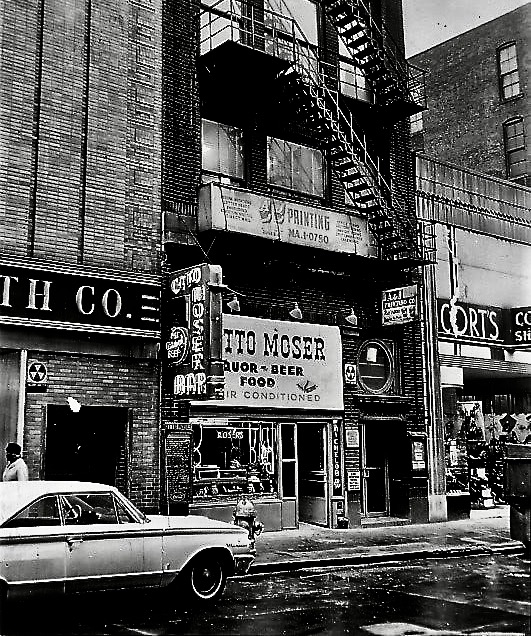
Otto Moser’s was a downtown bar restaurant on East 4th St. in Cleveland, Ohio. When I started cutting classes at Cleveland State University it had been there about eighty years. It toasted the century mark just before its time came due. It was a narrow deep-set place between a shoe store and a Woolworths. A civil defense shelter was between the variety store and Otto Moser’s, in case the Russians went crazy and started dropping atomic bombs. Everybody at Otto Moser’s agreed they would stay right where they were, where there was food and drink.
Europeans drink more alcohol than anybody else in the world and Lithuanians knock back the most of any European drinkers. The ethnic community I belonged to was swimming in it, even though they put their faith in God and country first. Booze was a belief in and of itself. Even though I was part of the bloodline, I wasn’t much for strong drink. A couple of beers put me under the table, so I nursed whatever was in front of me. Most of the times I went to Otto Moser’s it was to hang out. The price of a chair for the afternoon, between the lunch and dinner crowds, was a cup of coffee and a grilled cheese sandwich.
The restaurant’s grand opening was in 1893 when E. 4th St. was called Sheriff St. The Euclid Avenue Opera House was across the street and there were five theaters and two burlesque houses inside the blink of an eye. Many actors, businessmen, and stuffed shirts stopped in for a bite and hootch. Otto collected their autographed portraits, framed them, and hung them on the walls of his saloon. It got so there were more than a thousand of them. There were six mounted animal heads, including a moose named Bullwinkle.
When Otto died in 1942 two of his employees, Max A. Joseph and Max B. Joseph, took over. Their mother had wanted a third Max she could name “C” but it never happened, much to her regret. The two Max’s didn’t change anything. Sometimes they closed their doors to the public, when the cast of a big show took the place over, or the Metropolitan Opera was in town. When it was, they closed nights for most of that week so the singers could kick back and relax at their leisure.
Whenever I went there during mid-day the waitress was Norma Bunner, who had been there since 1955. She never looked at menus and never wrote my order down. The coffee was always fresh and the sandwiches hot, with extra pickles on the side. I liked to read when I was by myself, which was most of the time.
I often stopped at Kay’s Books before going to Otto Moser’s to pick up used paperbacks that rarely had anything to do with my college studies. I was majoring in film and literature, so I made sure my fun reading was sans the classics. I read the John Carter of Mars series, Jim Thompson’s hard-boiled pulp, and Jorge Luis Borges’s short stories about knife fights in the stockyards of Buenos Aires.
Kay’s Books was on Prospect Ave, or what some folks called Prostitution Ave., at the corner of East 6th St. There were adult movie houses, hookers and pimps, and other questionable morals on both sides of the street. There were several wig stores and rotgut bars. If I was going to Kay’s in the morning, I got off my bus at Public Square, walked through the May Company, left by the back door, and slid past the Domino Lounge, its jukebox blasting, slipping into the bookstore.
There was a raised platform on the right inside the front door of the bookstore. A large gay man who went by the name of Harry Condiles worked behind the counter, looming over everybody and everything, wearing white button-down shirts with the sleeves ripped off. He was friendly up to a point.
“Get out of here, you creeps,” the boss lady blew up whenever his boyfriends stopped in to visit. He knew where everything was, was quiet and patient, although he could lose his temper if questioned one time too many. One day when a customer couldn’t find a book for the third or fourth time he snapped, “Oh, it’s up there, over there by those damned books, over by that damned thing there.”
He had a keen eye for shoplifters. He knew when a purse or bag didn’t look right. The boss lady was Rachel Kay. She appreciated his profit and loss smarts. She was always somewhere in the three-story building, her shoes click clacking on the mosaic tiled floors, keeping order as best she could.
The place was stuffed full of books and magazines. I never saw the basement, which was rumored to be filled to the brim with them, but what I saw upstairs made me think they had a copy of every book ever printed. The aisles were narrow and the shelves floor to ceiling. There were rows of books behind every first row of books. It was sort of organized. New hardcovers were up front. Poetry was on the mezzanine. Mass market paperbacks were on the second floor. The upper level was for health magazines full of female nudists. Everything else had to fend for itself.
The paperbacks I bought were fifteen cents, maybe a quarter. Some of them had been sticker priced so long ago I knew I was coming out way ahead when adjusted for inflation. Cockroaches that ate the glue were rampant, so I learned to check the bindings. The boss lady didn’t always stick to the sticker price. She wasn’t above saying a book stickered $2.95 was worth more, crossing out the price, and writing $4.95 in black crayon in its place. Whenever anybody argued with her about being a highhanded profiteer, first, they didn’t get the book, and second, were told to take their business somewhere else.
I was reading a dog-eared copy of “Ernie’s War: The Best of Ernie Pyle’s World War II Dispatches” one afternoon when one of the barflies got up, limped over to my table, and plopped himself down in the chair across from me. He looked at the book. I looked at him. His eyes were watery.
“Whatcha reading?” he asked.
“Are we getting acquainted?” I asked.
“You betcha,” he said.
I thought before I spoke, wary of anymore cha cha cha’s. He seemed affable enough. He seemed sober enough, at least.
“It’s about World War Two.”
“I was in that war, fella,” he said.
“Is that right?”
“You don’t believe me?”
“I’ll take your word for it.”
“All right, all right,” he said, reaching for his billfold. “I gotcha.”
He pulled out a five-pointed gold star attached to a faded red, white, and blue ribbon.
“What is it?” I asked.
The Silver Star,” my newfound friend said. “It’s awarded for gallantry in action against an enemy of the United States.”
“What did you do to get it?
“I was on Tarawa.”
“What’s that?”
“It’s an island in the Pacific. We landed there in 1943. I got shot twice before it was all over, but I killed my share of slant-eyes. Those sons-of-bitches were tough.”
The battle for Tarawa was fought in late November, part of Operation Galvanic, the invasion of the Gilbert Islands. More than 6,000 Japanese and American soldiers died during the three-day fighting, mostly on and around the 300-acre bird-shaped island of Betio, southwest of Tarawa Atoll. It was the first American offensive in the central Pacific. The nearly 5,000 Japanese defenders were well-prepared. They fought to the nearly last man. It was all over in three days.
“The island was the most heavily defended atoll that would ever be invaded by Allied forces in the Pacific,” said Joseph Alexander, a Marine amphibious officer who later became an historian. One combat correspondent who landed with the fighting forces called it “the toughest battle in Marine Corps history.”
“It was flat as a pancake” the barfly said. “There was nowhere to hide. We dug holes in the sand fast as we could, like crabs.”
“Every spot on the island was covered by direct rifle and machine gun fire,” Marine Colonel Merritt Edison said.
“We landed on amphibious tractors,” my lanky friend said. His hair was thin and unkempt. His teeth were bad and his fingernails were yellowish. He smoked Lucky Strikes one after the other. He wasn’t wearing a wedding ring, but his watch was a Rolex, and his shoes were soft fancy leather. He was down but not out. He waved towards the bar for his drink to be refreshed. “It was one goddamned mix-up after another,” he said.
Shelling from the American warships was disjointed. The landing time was delayed twice. Headwinds pushed the landing craft between the devil and the deep blue sea. Scaling the seawall was more deadly than anybody thought it would be.
“Those who were not hit wading ashore would always remember how the machine gun bullets hissed into the water, inches to the right, inches to the left,” wrote Robert Sherrod, a correspondent for Time Magazine.
The Japanese used their grenades to good effect once the Marines started landing. Corporal John Spillane, a major league baseball prospect before the war, caught two of them barehanded and threw them back before a third exploded in his hand. His baseball career was over in that instant.
“You got shot two times? Is that how you got the medal?” I asked.
“Yes and no” he said. “It was when the Japs counterattacked the third night. They were screaming and yelling running right at us out in the open. Our artillery opened up on them until they were so close to us that they had to shut down. It was hand to hand after that.”
“How did you get the medal?”
“A squad of gooks got low with their Type 99 machine guns, the kind that had armored shields, and were spraying us. We had to take them out. Five of us went with grenades. Another one of us had a flame thrower. We took care of business, but I was the only one who made it. I dragged one of the guys back. I didn’t know he was dead. I got plugged in the shoulder and my leg, right here near the hip. The medics jacked me up with morphine and a bottle of sake and that was the end of the war for me.”
After the ferocious battle, which saw only 17 wounded Japanese soldiers surrendering, the island was awash in carnage. “Betio would be more habitable if the Marines could leave for a few days and send a million buzzards in,” Robert Sherrod wrote afterwards. Marine General Julian Smith declared the enemy “wiped out.” After that it was on to the next island.
The disheveled man an arm’s length away had been a hero once. Watching him I thought of Marcel Proust, one of my least favorite writers, who I had been forced to read for one of my English classes. Why we had to read a French dandy was beyond me.
“Remembrance of Time Past” is one and a half million words long. During a Q & A session I asked our professor how many times he thought a person would need to go to the bathroom getting through the endless magnum opus. He gave me a sour look. Proust scribbles words, words, and more words about his day-to-day life, society, manners, friends, enemies, boys, girls, courtesans, and love and love lost and the love of love and, above all, jealousy and recrimination. After a while it just makes you want to puke.
I couldn’t finish it. It didn’t seem like there was a pay-off in store. Cliff’s Notes were created because of that book. When the class was over, I threw the book away.
Just as I was about to ask what happened, how he went from hero to tosspot, my friend said, “I gotta go to the john.”
There was one thing about Proust that I remembered. He wrote that we think we are living in the world when we are only really living in our minds. Everything is inside us, not just now, but all of the past. We are a house of mirrors. I realized my friend had no doubt told his World War Two story to countless listeners, some willing, some procured at random like me. My booze hound was staring in the same mirror day after day. Otto Moser’s was a way station and a confessional.
When he came out of the bathroom, he walked past me like he either didn’t see me or I didn’t ring a bell. He went out the front door. It was for the best. I had a four o’clock class and needed to get going. I stuffed my stuff into my backpack, paid the bill of fare, and walked out into the bright afternoon.
The VFW man was outside, three sheets to the wind, supporting himself by leaning on the fire hydrant at the curb with an outstretched arm. He must have done a shot for the road. He was standing in a patch of dull sunshine. He was a ship in a bottle.
“Are you all right?” I asked.
“Sure, man, I’m OK,” he said.
“Where’s home?”
“Old Brooklyn, up by the zoo.”
“You might want to go home and dry out.”
“I’d probably die if I tried drying out,” he said.
“There’s always tomorrow morning. Otto’s opens early.”
“I know the order of business here, son, theirs and mine.”
“I understand, but In the meantime,” I said, “maybe don’t lean on that Johnny pump.” I pointed at the hydrant. “Guys are always peeing on it.”
Ed Staskus posts monthly on 147 Stanley Street at http://www.147stanleystreet.com, Made in Cleveland http://www.clevelandohiodaybook.com, Down East http://www.redroadpei.com, and Lithuanian Journal http://www.lithuanianjournal.com. To get the site’s monthly feature in your in-box click on “Follow.”
“Bomb City” by Ed Staskus
“A police procedural when the Rust Belt was a mean street.” Sam Winchell, Beyond Fiction

Cleveland, Ohio 1975. The John Scalish Crime Family and Danny Greene’s Irish Mob are at war. Car bombs are the weapon of choice. Two police detectives are assigned to find the bomb makers. Nothing goes according to plan.
A Crying of Lot 49 Publication



 Made in Cleveland