
Tag Archives: Hal Schaser

City on Fire

By Ed Staskus

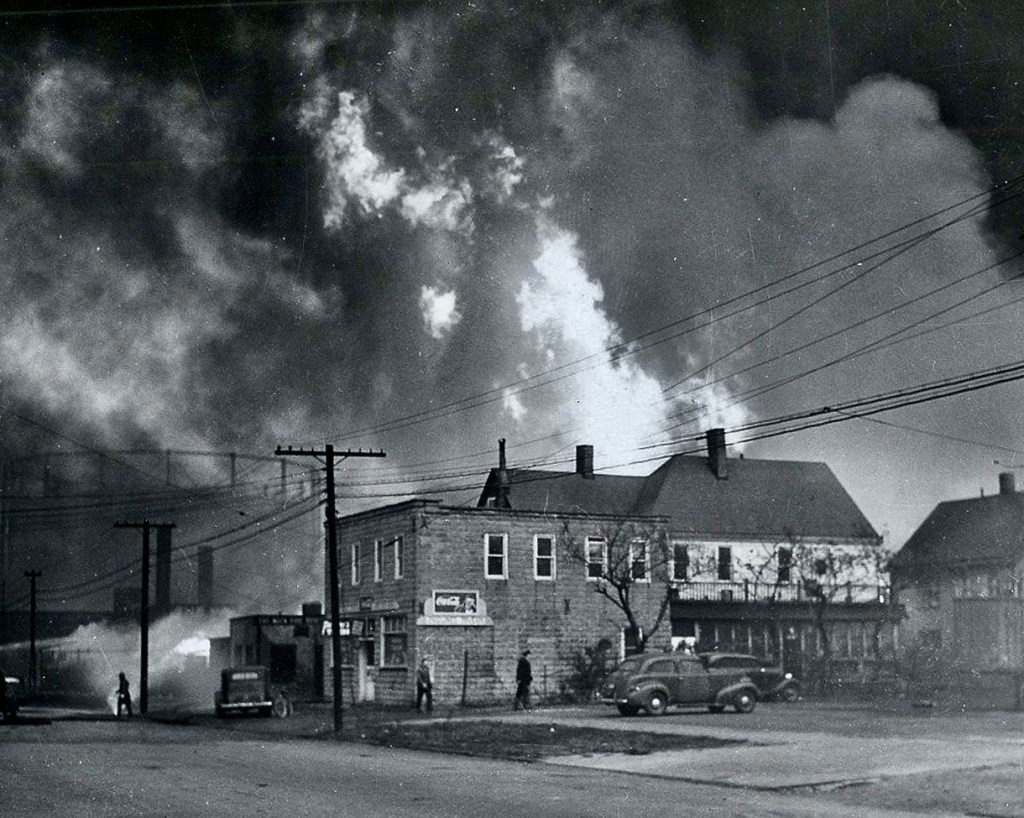
   The Friday afternoon Cleveland’s St. Clair neighborhood blew up, Hal Schaser was walking home from his 7th grade class at Wilson Junior High on East 55th St. He was 13 years old. It was an Indian summer day on October 20, 1944. He was looking forward to a bowl of soup and salt crackers. He was nearing his house near three in the afternoon when he was almost knocked off his feet by a thunderous blast. When he steadied himself and looked around, he saw roofs on fire as far as he could see.

   “It was like the sky blew up all at once with lightning bolts and thunder,” he said. Thick black smoke turned day to night. His dog Buddy bolted up the front steps and pawed at the door. It was every dog for himself. “Only the pen of a Dante could do justice to the sights and sounds that occurred in the St. Clair neighborhood that hellish afternoon,” local writer John Bellamy said.

   Hal’s mother ran out of the house. Buddy ran into the house. Hal ran to his mother on the front lawn. They looked up at the burning sky.

   “Captain Albert Zahler of the Cleveland Fire Department, Engine Company No. 19, was in his quarters at East 55th Street,” Cleveland Police Inspector Tim Costello’s said. “Suddenly the windows rattled, and the building began to shake. He ran outside and was met by a blast of extremely hot air. He observed hundreds of people running toward him and could see flames up over the tops of the buildings between himself and the fire. He hastened to the telephone in his quarters and caused a two-alarm to be sounded. Then with his men and apparatus he started out of the station and got as far as the apron in front but found the fire shooting up the street as though coming from a flame thrower such as is used by our armed forces.”

   The firemen fled back onto the station. Captain Zahler ran to his telephone again and revised the SOS to a five-alarm. When the flames moved away from the front of the station house, he and his men started out again. They didn’t get far.

   “They had gone but a short distance when they were met by more flame. They jumped from their apparatus and threw themselves on the ground until it had passed over. When they arose, they were tossed about as feathers in a wind, due to the brisance of the explosion creating a vacuum. One man sustained a broken leg and others received severe burns.”  

   The explosion and subsequent too many to count fires were caused when an East Ohio Gas liquefied gas tank started leaking. The gas flowed into the street and began to vaporize. It turned into a thick white fog. Nobody knows how it happened, but it ignited. It might have been a spark from a passing railcar or somebody lighting a cigarette. The thunderous bang wiped out the tank and everything else in its way, starting with two roofers.

   It happened at the foot of East 61st St near the New York Central Railroad tracks. When the gas blew up it blew up at about 25 million horsepower, the same as the combined output of all the hydroelectric plants west of the Mississippi River in 1944. Streets shook four miles away. Flames reached 3,000 feet high, and the heat reached 3,000 degrees Fahrenheit. After the war, a nuclear scientist estimated that the explosion released energy the equivalent of two and a half kilotons of dynamite, or about one-sixth the yield of the atomic bomb that destroyed Hiroshima.

   Tim Kelley’s father was home on leave from the armed forces after finishing basic training. He and a cousin were messing around the neighborhood when the big bang happened. “They took shelter under a box car to watch until they realized the steel wheels had gotten too hot to touch,” Tim said. They agreed It was time to go. They beat a hasty retreat.

   Hal, his kid brother Willie, and mother Agnes lived on East 66th St. and Lexington Ave., just a mile-or-so from the East Ohio tank farm. Agnes sprayed garden hose water on their house until the water pressure dropped to nothing. Standing on the front porch they watched a tangled mass of cars, busses, and townsfolk on foot going the other way. Police, fire, and civil defense cars and trucks raced towards the fire, which was spewing gas, molten steel, and rock wool into the sky. Birds turned to charcoal and fell out of trees. Hal’s dog Buddy snuck into the basement and didn’t come out for three days.

   When the storage tank, holding 90 million cubic feet of liquid natural gas in reserve for local war production, exploded, fire engulfed more than a square mile of city life, from St. Clair Ave. to the Shoreway, from East 55thSt. to East 67th St. The sky went red and orange then squid ink black. Fire boats poured water on factories along the shoreline of Lake Erie to keep them from burning down. 

   Sandy “Candy Man” Drago was checking a shipment of pipes at the tank depot that day. His candy was on his desk. His car was parked in a nearby lot. When the tank ruptured and exploded, he was knocked flat and the paperwork in his hands turned to ashes. When he looked himself over for damage, his clothes were gone. He was left wearing underpants with melted elastic. He ran for his life. His office and the candy on his desk caught fire. His Chevy caught fire. Two roofers replacing slates on top of the tank were blown to kingdom come. Not even a fragment of them was ever found.

   Mary Kolar was in her kitchen when a fireball smashed through the window, landing on her linoleum floor.  Her first thought was, “My God, the Nazis are here.” She swept up her children and ran for her life. Her house caught on fire. They passed a charred man caught on top of a fence. He was dead. “All that was left were his shoes.” When teenager Josie Mivsek rushed to her house, it was just in time to see it collapse. She later retrieved her marbles, being a marble-shooting champion, but they had all melted together into a lump.

   The smell of burning whiskey hung over streets as taverns and backyard stills went up in smoke. The copper lines and barrels of yeast melted. Cash money tucked away into drawers and under mattresses was set alight and lost forever. Some lost their life’s savings.

   Eleanore Karlinger was working on the Sunday bulletin at St. Vitus Catholic Church. When she was knocked off her feet she stayed there. It can’t be an air raid, she thought. She cradled her head just in case. Then she thought it must have been the devil. When she came to her senses, she thought about getting the hell out of the church. She started to run but went back to man the phones in case the house of God was needed for shelter. Mothers dragged their children into the church, which was still standing safe and sound, for safety.

   Housewives were caught unaware as flames raced through sewers and up their drains and their homes were suddenly on fire. “I was going to plug in my sweeper,” said Mrs. Charles Flickinger. “Suddenly it seems like the walls turned all red. I looked at the windows and the shades were on fire. The house filled with smoke. I think the furnace had blown up, then I see the fire all around.”

   Hal’s house didn’t catch fire. His brother, mother, and he didn’t have to shelter at Wilson School. It was where the Red Cross ended up taking in nearly 700 suddenly homeless men, women, and children. It was more than a week before anybody went back to school.

   Less than a half hour after the first explosion, a second tank exploded. Gas ran into the streets, into the gutters, and down catch basins into sewers, igniting and blowing up wherever it pooled. Telephone poles bent in the heat, smoking and igniting. Pavement was blasted into chunks and manhole covers sent flying. Fire trucks fell into sinkholes.  

   “Manhole covers were being blown up into the air like flipping pennies heads or tails,” Hal said. One of them was found in Glenville, miles away. One fell from the sky onto the heads of two men. All that day and the next day sirens never stopped wailing. More explosions followed, seven in all, smaller in scope but each one unleashing a fireball. When things died down “it looked like the end of the world,” a dismayed man said.

   Hal’s world had already been turned upside down twice. He was 2 years old when his father, who ran a corner store, was robbed, shot, and killed by two young hoodlums. His mother found out while in the hospital giving birth to his brother Willie. After she re-married, within a few short years, Hal’s stepfather died after a short sudden illness. Agnes Schaser never married again, going it alone, raising her two boys with no help from anybody. The land of dreams had turned into bad dreams. She was from Romania and would have gone back except for the war.

   When Albert Kotnik’s house shook like it was going to fall apart, he grabbed his two children and ran outside, followed by his wife. They looked towards the east side where it looked like hell had suddenly become real. They turned around when they heard all the windows of their house cracking and busting. The house was on fire all at once. It burned down to the ground in ten minutes. 

   Marcella Reichard’s house on Lake Court burned down to the ground. So did every one of the other twenty-three houses on her cul-de-sac. “I grabbed my mother and my little sister, and we knelt and prayed. Mother went out the back way, but I told her she would be running right into the flames. I told them to hold their hands over their eyes and run toward the lake. Then we just ran as fast as we could.” More than 10,000 people were evacuated from the neighborhood.

   Jack McLaughlin’s father died at the tank farm trying to rescue a great-uncle who worked for East Ohio Gas. Jack was the same age as Hal. “This was in God’s plans,” he said. Many who died worked for East Ohio Gas. Some of them were never identified, burnt so badly as to make identification impossible. Others were never found, their flesh and bone vaporized. Anthony Greenway worked for East Ohio Gas. He was killed almost immediately. “Uncle Anthony’s damaged watch was located and returned to the family. It was all they ever found of him,” said Kathy Chamberlain.

   Fatality figures for the burned are hard to come by eighty years later, although it is certain many of the severely burned subsequently died. “They didn’t have the tools and treatments in the 1940s we have today,” says Cleveland dermatologist William Camp. “They would have died of electrolyte loss, body heat loss, and infection.”

   Most of Cleveland’s fire companies and policemen attacked the immense blaze, as well as military personnel, utility workers, and civilian volunteer groups. Auxiliary police, auxiliary firemen, and air-raid wardens showed up by the hundreds. The Coast Guard and National Guard showed up. It was all hands on deck. Firemen and policemen worked non-stop shifts, grabbing a few minutes of shut eye when they could. They surrounded the fire and tried to keep it from getting away from them. They fought it all day and night dealing with consuming heat, explosions, and pumpers sinking into melting ground. Fire Engine No. 7 disappeared into a big hole in the ground.

   Cindy Greenwald’s father was working at a nearby war plant. “They were all let out of work to fight the fires,” she said. “He and some other guys worked all night long hosing down buildings on St. Clair. They watched a fire truck fall into a hole in the ground. When daylight came, they found out what they’d had their backs to the whole time. It was a gas station that was behind them.”

   By the end of Saturday morning, the fire department and the volunteers had almost all the fires under control. In the afternoon. Hal and his kid brother Willie went exploring. All the stop signs and traffic lights were gone, but there was no traffic, anyway. Burnt up hulks of cars and trucks lined the curbs. Fire hoses littered every intersection. Small still smoking fires lurked on every other front yard.

   “What happened to this place?” Willie asked. “It’s a mess. Do you think it was the Martians? Was it the Nazis?”

   “Before yesterday happened this mess was our place,” Hal said. “I don’t think it was the Martians. Why would they come all this way to do that? Mom said it must have been sabotage.”

   “This wouldn’t have happened if Superman had been here,” Willie said.

   “Yeah, him and Captain America, too,” Hal said. “They got the moxie.”

   Many of their friends, schoolmates, and relatives in the neighborhood were gone. They had gone somewhere anywhere safe. St Clair was like a ghost town. The fire destroyed homes, small apartments and boarding houses, factories, tractor trucks and trailers, and hundreds of cars. The death toll reached 130 while the burned and injured reached into the thousands.

   Hal and Willie slouched home, there being little to see except destruction. Besides, they had already been told twice by policemen to go home. Their mother always said three times is the charm. They didn’t want to tempt fate. When they got home, they checked on Buddy, who told them in no uncertain terms he was going to stay in the basement for another day or two, just in case.

   A month later there was a mass funeral at Highland Park Cemetery for the unidentified dead. Florists donated flowers and funeral parlors donated caskets. Thousands watched silently, wondering which one of the coffins held their missing father, mother, brother, or sister. The dead were lowered one by one into a concrete vault. The mayor ordered that no other funerals take place that day.

   “We want the nation to know that Cleveland looks after its own,” said Edward Sexton of the committee supervising the mass burial. “Usually, such victims would go to a potter’s field. That is not for Cleveland.” After the dead were buried the city began to rebuild itself. Rebuilding ground zero for the living is the way to recover from disaster.

Ed Staskus posts monthly on 147 Stanley Street http://www.147stanleystreet.com, Made in Cleveland http://www.clevelandohiodaybook.com, Atlantic Canada http://www.redroadpei.com, and Lithuanian Journal http://www.lithuanianjournal.com

“Cross Walk” by Ed Staskus

A Mid-Century Crime Thriller

“A once upon a crime whodunit.” Barron Cannon, Adventure Books

“Captures the vibe of 1950s NYC.” Sam Winchell, Beyond Fiction

Available on Amazon: https://www.amazon.com/dp/B0CRPSFPKP

Late summer and early autumn. New York City. A Hell’s Kitchen private eye. The 1956 World Series. President Eisenhower at the opening game. A killer in the Brooklyn Dodger dugout.


Pulling Up Stakes

By Ed Staskus

   Hal Schaser was born in July 1931, in Cleveland, Ohio. His mother Agnes and his father Mathias were Saxons from Transylvania, where they married in 1929. His father was a minister’s son and his mother was a local beauty. The Great Depression was making a hard life after the Great War harder. They emigrated to the United States. Hal got free passage traveling unseen in his mother’s belly. 

   In time three more children rounded out the family, his younger brother Willie and younger stepsisters Suzanne and Joanne. The family dog was the youngest and went by Buddy. He was everybody’s friend, unless you were trying to burgle the house.

   “My grandparents got married in the town of Hamlish in Romania, which Transylvania was a part of then,” said Vanessa, Hal’s daughter. “One of my great grandfathers was a minister who kept horses and grew grapes for wine.” The church was built for worship and battle both, especially for protection against marauding foreign armies. “My other great grandfather was the local banker.” Their children were second cousins. The banker bought cases of wine from the minister for his table.

   Hal attended Cleveland public schools, graduating from East Technical in 1949. He acted in historical pageants while in high school and through the 1950s was often seen on stage at the Karamu House Theater and Chagrin Little Theater. “It was how I met gals,” he said. He met Terese Stasas at Karamu. “The first thing I noticed was that he looked like Paul Newman,” his wife-to-be said. “I liked that right away.”

   Mathias Schaser opened a corner grocery store on the near west side of Cleveland. Two years later, two days after the birth of his second son, he was robbed and shot by two teenaged stick-up men. He was pulling overtime after visiting his wife and newborn in the hospital. “You mustn’t stay here any longer,” Agnes had told him. “You go back to the store. We will need to have more money now.” He was pronounced dead the next day two floors below where his wife was still nursing their son. Twenty-three years later the two by now middle-aged stick-up men were paroled from the Ohio State Penitentiary.

   “I taught my sons to be forgiving, not bitter,” Agnes said in 1955. “We got along all right. They started delivering newspapers when they were ten. They finished high school, although they always worked at a bakery and other places around the neighborhood. I have a happy life with my children. I hope those two men can find jobs and become good citizens.”

   She eventually remarried after her first husband’s murder, but her second husband died of a heart attack within a few years. She never married again, raising four children on her own, on a Mother’s Pension, which was $90.00 a month, and pins and needles work.

   “My father’s stepfather passed on when he was 7 years old,” Vanessa said. “His mother was a devout Lutheran and she instilled in them Christian values, which our father carried with him all his life. He may not have been religious all his life, but he knew his Bible. He drove his mother to church every Sunday until the day she died.”

   “He grew up a true city kid through and through,” said Matt, Hal’s son. “He built and raced in the soap box derby, walked with friends to baseball games at League Park, and trained and sparred at his local gym.”

   “He was no dead-end kid, though,” Vanessa said. “When violin lessons were ordered by his mother, he endured them with grace.” Grown up he put the violin down and took up the guitar, playing the backbeat tunes Cleveland’s DJ the Moon Dog was making popular.

   Hal survived the East Ohio Gas explosion in October 1944, when a tank containing liquid natural gas equivalent to 90 million cubic feet blew up in their neighborhood, setting off the most disastrous fire in Cleveland’s history. Hundreds of homes, churches, and businesses were engulfed by a tidal wave of fire. His mother saved their house, less than a mile away from the blast, by spraying it with a garden hose until the water pressure gave out.

   “I was walking home from school and the blast almost knocked me off my feet,” he said. “It was like all at once the sky blew up with thunder balls.” His dog Buddy ran inside and stayed in the basement for a week.

   Hal boxed as a teenager, training at gyms on the near east side, reaching the finals in his class at the Golden Gloves in 1949 staged at the Cleveland Arena. He served in the United States Army during the Korean War as an artilleryman in a front-line battalion and later as a spotter. “Spotting was a suicide mission,” one of his friends who fought in the Vietnam War said. “If the other guys didn’t get you, your own guys would. How he made it home alive, I don’t know.”

   During one mortar firefight his radioman was wounded. He carried him to safety. He had a grudging respect for the courage of Chinese soldiers. “No matter what we hit them with, they always kept coming in their quilted coats,” he said. “We couldn’t kill them fast enough.”

   He gave up fighting after coming home, going to work for Palmer Bearings, selling ball bearings to the city’s steel and automobile industries. He often lunched with clients at the Theatrical on Short Vincent, mixing with city leaders, businessmen, and hoodlums. The Theatrical was a high-class dive.

   “He became Vice President of Sales where his smile and enthusiasm for life and helping others was his formula for becoming a success,” Vanessa said. “Honesty and integrity led his work, something that isn’t always easy for a salesman, but it was natural to him.”

   Hal married Terese Stasas in 1959. The couple had two children, Vanessa and Matt, raising them in the Indian Hills neighborhood near South Euclid. Their backyard was the woods of the Euclid Creek Reservation. “Our mom was a ballerina, an artist, and a chef, and our pop was a boxer, a fine ice skater, and a salesman,” Vanessa said. “I think it must have been their sense of hope and freedom that attracted them to one another.”

   “He loved to read,” Matt said. “He had his favorite chair in the living room and read classics and plays after dinner. He read the newspaper front to back in the morning.”

   His other great love, besides his family, was golf. He always traveled with clubs in his car trunk. He played with clients after work and friends on teams in city leagues. He played courses all over Ohio. Whenever he had the chance, he took short vacations to play famous links nationwide. “Good golf depends on strength of mind and a clean character,” he said. He didn’t shortchange the front nine or back nine. He didn’t shortchange himself.

   Hal wasn’t entirely a religious man, although he was. He had his reasons, among them the twists and turns of the game that was nearly a religion to him. “My prayers were never answered on golf courses,” he explained. One lesson about the divine, however, stood him in good stead. Whenever he was on a fairway and got caught in a lightning storm, he always held his 1-iron up in the air. 

   “Not even God can hit a 1-iron,” he said.

   He never stopped walking golf courses, never riding a cart, even when he played two rounds and was well into his 80s. “My father golfed ever since I knew him,” Vanessa said. “Oh, did he golf. He played with a red ball when it snowed. He loved being with people and playing with his friends. Sometimes mom said he loved golf more than he loved us.”

   He lived alone after his wife divorced him, taking their kids with her, although he never left his children or grandchildren behind. It wasn’t any back street girl that came between husband and wife. It was Hal’s career and the golf monkey on his back. He never paid enough attention to his wife or what she wanted. After becoming a single man again, he ate like a buck private and stayed fit into his later years. He lived in Lakewood for 25 years, across the street from St. Ed’s High School.

   In the run-up to the 2016 presidential election Hal fell in love with Donald Trump. He started wearing a veteran’s cap, saying bad things about immigrants, denigrating blacks and Jews, and talking down anybody young who demonstrated against anything. He decried the federal government as a conspiratorial deep state and stuck his fork in the scrambled eggs of QAnon. 

   He believed the new boss man was battling a cabal of Democratic Party pedophiles and only he could get the job done. Only the President himself was dirty enough to do the dirty work, no matter that POTUS didn’t know one end of a pop gun from another, since he thought khaki was for suckers whenever target practice was mentioned.

   He watched Tucker Carlson on FOX. He reckoned the newsman’s idea of unvaccinated people getting fake vaccine cards to avoid mandates was good reporting. “Buying a fake vaccination card is an act of desperation by decent, law-abiding Americans who have been forced into a corner by tyrants,” the FOX man said. Hal refused to be vaccinated the first time, the second time, and didn’t even bother thinking about the booster shot. He didn’t know where to get a fake card. He called Tucker Carlson, but the line was busy. He left a message, although he never heard back from America’s Voice of Grievance.

   Hal put his golf clubs away and kept them away, while POTUS went golfing in Scotland. Saving America from itself became his passion. It was a fire that burned bright in his retiree’s small apartment.

   When Rush Limbaugh died from lung cancer, after smoking stogies for decades and sounding off that cancer was just a notion, and Dan Bongino took over, he stopped listening to Rush and started listening to Dan. When Rush had said wearing a mask to protect society from COVID was a conspiracy against the freedom-loving and God-fearing, Hal paid attention and never wore a mask, unless the grocery he was trying to get into denied him entry without one. An empty stomach almost always trumps ideology. When Dan took up the mantra that the mask was Democratic BS, he gave Dan a thumbs up, but didn’t stop going masked man grocery shopping. He wasn’t that foolish.

   “My brother and I asked him to wear a mask every time we saw him,” Vanessa said. They asked him to get vaccinated, but he wouldn’t do it. He said there was something untrustworthy about the vaccines. He had heard Bill Gates was putting nefarious things into the shots.

   “I told him he had to wear a mask when visiting the kids, or he couldn’t visit them,” Matt said.

   Whether they knew it or not the right-wing radio poohbahs Hal listened to were playing with fire. Ranting and raving about unwed mothers and welfare cheats and the half-dozen voters who cheated is one thing. Ranting and raving about pandemics is another thing. It can be hazardous to life and limb conflating the two. Unwed mothers are not nearly as dangerous as man-eating viruses.

   “I’m Mr. Anti-Vax,” Marc Bernier told the listeners of his talk radio program. After the first vaccines were approved, he declared the federal government and the CDC were “acting like Nazis” in urging people to get vaccinated. The Nazis rolled over in their graves and died laughing. Six months later the whacky broadcaster died of COVID. So did Jimmy DeYoung, a nationally syndicated Christian radio preacher, and Dick Farrel, a talking head for Newsmax TV. They lived by crying wolf, screaming their lungs out, and died when they couldn’t breathe anymore.

   Hal played with fire for almost two years. It was miserable listening to an old man listening to half-witted carnival barkers. He got burnt towards the end of 2021 and by the morning after New Year’s Day could barely walk. Vanessa and Matt tried for a week after Christmas to get him to go to Fairview Hospital, but he refused. He said he felt fine, even though he looked terrible. He had a kitchen cabinet full of supplements that peddlers on the internet had been selling him to combat COVID, but the mystery pills had suddenly lost their magic.

   Matt called 911 the day after New Year’s and paramedics took Hal to Fairview Hospital. Only one person at a time once a day could visit him. When Vanessa or Matt visited him, they had to wear bio-hazard bunny suits and masks. One day Hal felt good but the next day felt bad. He complained about being brainwashed. He tried to walk out. He refused to take his medication. The nurses gave it to him, anyway, making sure he took it. One day after three weeks in the hospital he said he was feeling terrific. The next day he suffered a stroke and died three days later.

   Two weeks later a memorial service was held for him in the Rocky River Memorial Hall. His grandson played a French children’s song on the baby grand piano and his granddaughter played “Amazing Grace.” A bugler played “Taps.” Sunlight poured in through the floor to ceiling windows.

   Vanessa said a few words. “He valued his friends and loved his children and grandchildren, watching them laugh and enjoying their creativity and joy,” she said. “I’ll never forget an early childhood memory of him holding me with my feet on top of his while we waltzed to records in the living room.”

   Bob, one of Hal’s oldest coffee klatch friends, said a few words, too. “He was part of our group at McDonald’s every morning. He was the only Republican among us, so there were plenty of disagreements, but he was a great guy, the kind of guy who would give you the shirt off his back. They don’t make them like Hal anymore.”

   The next day his golfing buddies gathered for a minute at a local course. It was a cold January day. They saluted him with their 1-irons held high to Heaven. Nobody got struck by lightning. Even if God wasn’t paying attention, Hal was watching over them.

Ed Staskus posts monthly on 147 Stanley Street http://www.147stanleystreet.com, Made in Cleveland http://www.clevelandohiodaybook.com, Atlantic Canada http://www.redroadpei.com, and Lithuanian Journal http://www.lithuanianjournal.com

“Cross Walk” by Ed Staskus

“Captures the vibe of mid-century NYC, from stickball in the streets to the Mob on the make.” Sam Winchell, Beyond Fiction

Available on Amazon: https://www.amazon.com/dp/B0CRPSFPKP

Late summer and early autumn. New York City, 1956. Jackson Pollack opens a can of worms. President Eisenhower on his way to the opening game of the World Series where a hit man waits in the wings. A Hell’s Kitchen private eye scares up the shadows.

A Crying of Lot 49 Publication

Vanishing Act

By Ed Staskus

   Hal Schaser was always excited by Catholic girls. His mother was Saxon Lutheran, and she raised his brother Willie and him as Lutherans, but Catholic girls were for him. That’s why he married one. But they had to be at least a nine or ten on the good-looking scales at the same time they were Catholic. If they weren’t, they didn’t count, not in his eyes. 

   All the guys rated gals, one way or another.

   He went to Florida every winter after he got back to Cleveland, before he got married. He came back from the Korean War with a Purple Heart, and after he got back on his feet, went right to work for Palmer Bearings. They put him in sales the minute they saw him. He was 22 years old, clean-cut, proportioned, and full of pep. He didn’t tell them about the bad hearing in one ear he came back with after a year as an artilleryman.

   His city pals, the young men he knew who had the dough to go south for a couple of weeks when it got dark and cold on the south coast of Lake Erie, razzed him about being picky.

   “All you do is keep looking for a number ten girl, and half the time you don’t got any girl on your arm,” one of them said one day while sucking on a bottle of Blatz. “Me, I get a number three or four, so I’ve always got a gal, and by the end of the week they all add up to more than zero.”

   Another of his pals, another wise guy on the camel train, said, “Hal, if you ever land a ten, she’ll be out of your league, anyway, so forget about it.”

   Teresa Stasas was Catholic, between a nine and a ten, and 15 years old when Hal met her. He was 25 years old. She lied about her age, not that she had to. But after he found out he made sure she was eighteen before they got married. “We missed out on the cash envelopes and presents, since her family was dead set on me staying single and Teresa marrying somebody else.” He didn’t care. He wanted Teresa. He wanted to get ahead to the high life with her fast at his side.

   They met at the Karamu Theater. Hal lived with his mother on the near east side, and Teresa took a bus from North Collinwood, where she lived with her three sisters and parents in a two-bedroom house. Hal liked auditioning for parts and acting in shows. It got him started with the girls. He looked like Paul Newman, which didn’t hurt his chances. He was always trying out for shows at the Chagrin Little Theater, too.

   “I met a boatload of lookers that way.”

   Teresa was in high school shows and danced ballet. She had taken dance classes ever since she was a little girl. She could straighten a leg, keep a foot flat on the ground, and raise the other one to the ceiling. 

   “I don’t know how the hell she did it. I always liked ballet dancers. I fell in love with one when I was in high school. Her name was Margo. She was a beautiful girl with a beautiful body, the same age as me, but an inch taller. She was one of the gym leaders and danced ballet on stage at our school. Another guy liked her, a Serb who played a lousy hillbilly guitar, and he was always angling to get into shows with her.”

   Hal started trying out, trying to get close to Margo, trying to elbow the Serbian boy aside.

   Teresa and he met auditioning for the same show at Karamu. He kept his eyes on her from the minute he set eyes on her. “She came on to me and did stuff like, ‘Can you give me a ride home?’ I had a car, she had stars in her eyes, and on starry nights it was a nice ride. She sat close to me on the bench seat.”

   She would sometimes leave something in his car, like her wallet or watch. “She would call me, and I would drive to her house, returning it, seeing her again. It was those little tricks women do.”

   Her parents were set in stone in opposition to her wedding bell plans. “It won’t work,” they both insisted. He was Lutheran, ten years older than her, born in the United States, but Romanian-bred. They were Catholic and Lithuanian, from the old country. She was still a teenager. He had a better job than either of her parents, making more money than the two of them put together, but it didn’t matter. 

   Teresa and Hal had to elope, driving across the Ohio line to Indiana, where they found a justice-of-the-peace on the side of the road, and got married. They went to Florida for their honeymoon. “We drove straight there in a new car I had just gotten. We stayed in the same motel my buddies and I used to go to. Our suite had a small kitchen and there was a big pool we went swimming in.” They sat out in the sun. Their skin got a shade darker. They discovered each other in the dark.

   When they got back to Cleveland, Teresa’s’s parents disowned her, and she didn’t see them for years. They moved in with Hal’s mother, in the meantime, in the old neighborhood, around East 65th St. and St. Clair Ave. Most of his countrymen worked in factories, ore docks, and knitting mills. His father had operated a corner store until he was murdered by two young thieves.

   “I worked hard, saving my salary and commissions, and the next year we bought a two-story house in Indian Hills, up from Euclid Avenue, near the city park.” The house fronted a sloping wooded lot. Their daughter Vanessa was born the next year and their son Mathias four years after that. Their problems started three years later. They never stopped getting worse.

   “We started out great, got the year of living with my mother out of our systems, moved into our big house, three bedrooms, newer than not new, got the kids grown up enough to walk, and my job got bigger and better the more I worked. I took clients out for golf and dinner three and four times a week. I kept my waistline under control by walking the courses. My handicap took a nosedive.”

   He was making money hand over fist. “I made a lot of money for Palmer Bearings. Those heebs loved me, so long as the pipeline stayed full and flowing.” His bosses said, “Keep up the good work.” His neighbors envied his one after the other new car. His wife complained about him never being home. “What do you do all those hours at work?”

   “I do a lot of business on golf courses,” he told her. “It’s work, don’t think it’s all just fun and games, it’s not.”

   Whenever he came home right after work, Teresa came running out the front door, grabbing him, giving him a hug and a kiss. He thought, this is embarrassing, the neighbors are watching, even though he barely knew any of their neighbors. “Cut it out,” he said. She gave him a queer look. He kissed the kids and read a book while Teresa set the table and served dinner.

   “I took her to dinner and shows, but it was never enough. I always let her do whatever she wanted. I let her teach cooking at the high school. I let her get a job at a restaurant. I let her go to Cleveland State University. It got to be a problem, because no matter what I did, it was never enough.”

   Teresa was a good-looking young woman, shapely and good on the move, friendly and running over with zip, and men eating at the restaurant were always hitting on her, but Hal’s problem was the young men she met at college. “One time I found a note in a drawer from some guy named Dave, thanking her for the great time they had. When I asked her about it, she said it was just a bunch of them from one of her theater classes going out for a drink.”

   “That’s all it was,” she said.

   “You’re not getting together with him?”    

   “No,” she said, “of course not.”

   He didn’t believe her, not for a minute. He knew what women were about. But he didn’t know everything. He didn’t know he was on his way to splitsville.

   Hal found out more, small things that looked like big things, about other men she was cheating on him with. He was sure of it. One night he answered a call from a man who sounded like he was from India, asking for her. He hung up. She was coming home later and later at night, 10 o’clock, 11 o’clock, midnight. It began to look like the babysitter would have to start living in.

   “Where the hell were you?” he asked one night when she got home close to two in the morning.

   “Oh, my keys got locked in somebody’s trunk.”

   “It was always some bullshit story like that. We got into an argument. We got into a lot of arguments.”

   “Not so loud,” she hissed. “You’ll wake up the kids.”

   “It was her idea to get separated. Later it was her idea to get divorced. I loved her. I loved my kids. I didn’t want a bust-up. We could have settled the split between ourselves, but she had to get a lawyer, which meant I had to get a lawyer. Her mouthpiece must have put something in her ear, bastard lawyers.”

   He stopped at the Cleveland Trust Bank downtown on East 9th Street one day, after lunch with clients on Short Vincent, to withdraw some money, but the teller said, “There’s no money in your account, sir.”

   “What do you mean?”

   “The account is at zero,” the teller said.

   “Teresa had taken it all. She raided our joint bank account and took all the money in it. All I had left was what I had been keeping in a personal account she didn’t know anything about, the scratch I kept separate, and our insurance policies. She charged all kinds of stuff on our credit cards before I wised up and cancelled them all.”

   He paid his lawyer five thousand dollars, in cash. He got it from a separate business he had going, apart from Palmer Bearings. The lawyer was a golfing buddy of his, but he still had to pay it all up front. “The son-of-a-bitch, right away he joined the Shaker Country Club with it, and never invited me to play golf there, not even once, not even when I got in his face about it.”

   When they went to court, Hal picked a fight there and then. Not with Teresa, but with their two lawyers, his and hers. “The Saul Goodman’s get together with their crap, take all your money, and leave you with nothing. They are like morticians, just waiting for you to come back to life.”

   Between Teresa and them, he complained loud and long to his friends, they left him with only table scraps.

   Hal knew how to handle himself. He boxed Golden Gloves before going to Korea. He got to the finals in his weight class, and even though the other fighter was dazed purple and bloody, the judges gave the first prize to him. He was a Marine and Hal was an Army draftee, so the Marine staggered away with the trophy. 

   “I could have levelled both the shysters in a minute flat. The bailiff, and a policeman, and the judge, had to restrain me. The judge gave me a hell of a talking to after everybody was back in their seats.” It was a loud knock-down drag-out commotion on the third floor of the Lakeside Courthouse, under a high ceiling of ornate plasterwork, quiet paneled walls, and leather-covered doors.

   “They’re all the same, talking through their hats.”

   Teresa moved into the new Park Centre on Superior Avenue, the same building where some of Richard Hongisto’s right-hand men lived. He was Cleveland’s new top lawman, although inside a couple of years Dennis Kucinich, the kid mayor of the city, fired him on live TV. It sparked a recall drive to remove the mayor from office, which was the least of his problems, since the city was going bankrupt fast. The bankers hated the mayor and withdrew their helping hand of ready cash. They knew how to get back at him.

   “I say a plague on all of them, except that whoever did the car caper with her got me the last laugh on Teresa, for what it was worth.”

   He bought her a new Mercedes sports car, hoping it would make her happy. It had a red leather interior. She loved the car, although it didn’t make her any happier about him any more than she wasn’t already. When they separated, she reported the car stolen. She called Hal about the insurance money. He told her he would let her know. He didn’t tell her the car was in his name. 

   “A month later I got a letter from a parking garage in New York City, saying we’ve got your car here, you owe so much for parking, come and get it. I was sure one of Teresa’s cop neighbors cooked it up with her, driving the car away, and leaving it in the garage. When I got the insurance check for the missing car, I cashed it and tore the letter up.”

   Teresa was a looker in her time, always worth a second look. Hal wasn’t sure how she looked when she got older, since after their last fight he never saw her again. He was certain her looks had gone south. “I’m sure she wasn’t the beauty she had been. I’m sure she looked like hell. That’s something I would bet money on.”

   She had beautiful handwriting but wrote Hal hate letters after their separation. 

   “Your kids don’t want to see you, you haven’t sent me enough money, all that kind of crap. I had to pay child support, even though I was used to a certain style of living for myself. I had to go on dates, looking for another woman, but it wasn’t easy. I couldn’t operate. I didn’t have much money. You’ve got to have money to do things. I was nearly broke. I had to take care of my kids. I didn’t want to be a deadbeat father.”

   Teresa met another man, a handsome Italian from Rochester, a Vietnam veteran. They moved in together, with her children. They didn’t pretend to be married, even though they lived like man and wife. They wanted to get married, but Hal wouldn’t give Teresa a divorce, no matter how many times she asked.

   “She and the guy from Rochester got it into their heads to go into the restaurant business. She asked me to take a second mortgage on the house. I said no, restaurants are the worst thing you can get into. In spite of myself I took a second mortgage on the house and gave her the money. It put me in a spot.”

   Teresa’s restaurant became two restaurants. The new family moved up to the seventeenth floor of Park Centre, to a three-bedroom end suite facing Lake Erie. They watched the Cleveland National Air Show from the balcony. They opened a bar on the new Eat Street in the apartment complex.

   “The dago was always telling me, take it easy, like he was trying to be my friend. I wanted to tell him how mad I was about not being able to get my wife back, about never seeing my kids. I never said one bad thing about her, but the divorce hurt me bad. After the mess in court, after we split up, I thought, if that’s the way it’s going to be, I don’t want anything to do with her anymore. I don’t want to talk to her, and I don’t want to see her. And I never did, except once more.”

   Teresa came to the family house in Indian Hills on a quiet autumn afternoon. She asked Hal to mortgage the house again, a third time, so she could expand her eateries some more, but he told her a second mortgage was all banks would go for. She said she needed more investment money and that he should sell the house, splitting whatever he might get for it with her.

   “If I do that, where am I going to live?”

   “That’s up to you.”

   “She was living downtown, in her fancy high-rise. What did she care where I lay my head? It could be some crummy cardboard bed under a bridge, as far as she was concerned. We got into an argument about it. My boy was with her. He stuck up for his mom. I didn’t blame him, though. I liked that about him.”

   Push came to shove, and Teresa slapped Hal hard in the face when he finally had enough, nose to nose, shouting that he wasn’t going to sell the house, that they were through once and for all, and that was that. 

   “She scratched me with her fingernails when she slapped me, cutting me, and drawing blood. I pushed her away.”

   They glared at each other.

   “Quit it. Go away,” he said.

   Teresa’s mouth went cold thin-lipped, she twisted around, reaching for her son, and stamped out. She didn’t look back. The front door slammed shut. He didn’t see her or the money he had lent her ever again.

   He was on the ropes. He knew the TKO was on its way, making its slow way to down and out. He had let his guard down and there was nothing he could do about it. He would have to take it like a man.

Ed Staskus posts stories on 147 Stanley Street http://www.147stanleystreet.com and Cleveland Daybook http://www.clevelandohiodaybook.com. To get the site’s monthly feature in your in-box click on “Follow.”