By Ed Staskus
All through my junior and senior years at St. Joseph High School, which was within walking distance of where we lived, my father pressed me to focus on something that would lead to a career. He was big on the idea. He was himself a career man. During those two years I told him I didn’t know what I wanted to focus on. I didn’t tell him I wasn’t enthralled by guidance counselors. I was reading Charles Baudelaire, a mid-19th century French prose-poet, who had told his parents, “I don’t feel I have a vocation for anything.”
I wasn’t especially interested in seeing my picture on a baseball card or a wanted poster. Photographs are full of lies and labels. I wanted to take my own picture and tuck it away somewhere private.
I read Charles Baudelaire’s book “The Flowers of Evil” the winter of my senior year at St. Joseph’s. It wasn’t assigned reading, not by far. St. Joseph’s was a traditional college preparatory high school, focusing on core academic subjects like math and science, social studies, and English. Religious instruction was a required feature of every day. Our teachers, the Marianists, brothers of the Society of Mary, made sure it was an everyday thing. There was no arguing the divine with them. There were vocational courses, as well, but my father was determined that I go to college. He didn’t want to see me repairing cars or working a tool and die press.
My favorite class was English. My favorite thing to do was read books. I always did my homework. I read assigned books like “The Great Gatsby” and “Of Mice and Men” and “To Kill a Mockingbird.” I wrote sincere essays and aced tests. I neglected my other classes, reading books that weren’t assigned. I read “Lord of the Flies” and “Nineteen Eighty-Four” and “The Catcher in the Rye.”
“The Catcher in the Rye” wasn’t banned at St. Joseph’s, but reading it was strongly discouraged. The official explanation was we should stick to our program of studies. The unofficial explanation was the book was depraved, full of vulgar language, sexual references, and anti-establishment themes. The Marianists were concerned about the book’s morality, or lack of it.
After graduation I opted to attend Cleveland State University. It was close to hand, a twenty minute bus ride away, and affordable. The school had been established as a state university in 1964, taking over the buildings, faculty, and curriculum of Fenn College, a private engineering and business school of several thousand students that had been founded in 1929.
I spent my freshman year at Cleveland State University the same way I had spent my junior and senior years at St. Joseph’s, attending English classes without fail and neglecting my other classes. At the conclusion of the school year my father sat me down and read me the riot act. It led to a stinging argument, but in the end, since I was still living in my parent’s house and my father was paying part of my tuition, I agreed to participate in a kind of career day scheduled for the next month in the Flats, the city’s industrial valley.
Most of my father’s friends were Lithuanians and most of them were professionals. They were doctors, lawyers, and engineers. My father was a certified public accountant. One of his friends was a mechanical engineer. He had a son my age who was majoring in engineering at Cleveland State University. One of his classes had a field trip to the Flats planned. They saved a seat for me.
The day of the field trip I waited on our front steps for my ride. It was June 22, 1969, early on a Sunday morning. The factories in the Flats never closed, but slowed down somewhat on Sundays, which made it less demanding to accommodate college students wandering around. When my ride came down our street I saw it a mile away, it being a chrome yellow color. it was a 1965 Ford Econoline Club Wagon. It didn’t have a front end to speak of but there were plenty of windows. Half of the family van was windows. There were two bucket seats up front and three rows of bench seating in the back. My father’s friend was driving and there were six engineering students in the van. They had saved the front passenger bucket for me. It was a lonesome seat, but I wasn’t one of the rank and file, anyway, so I didn’t mind.
We got on I-90 and drove to the Flats. There was hardly any traffic. When we got downtown we drove into the industrial valley. It was a warm and sunny day. It was more warm and less sunny in the valley. The air smelled like sewage and rotten eggs. The A. W. Stadler Rendering Plant near the Harvard Ave. Bridge added the odor of rotting animal matter to the stench.
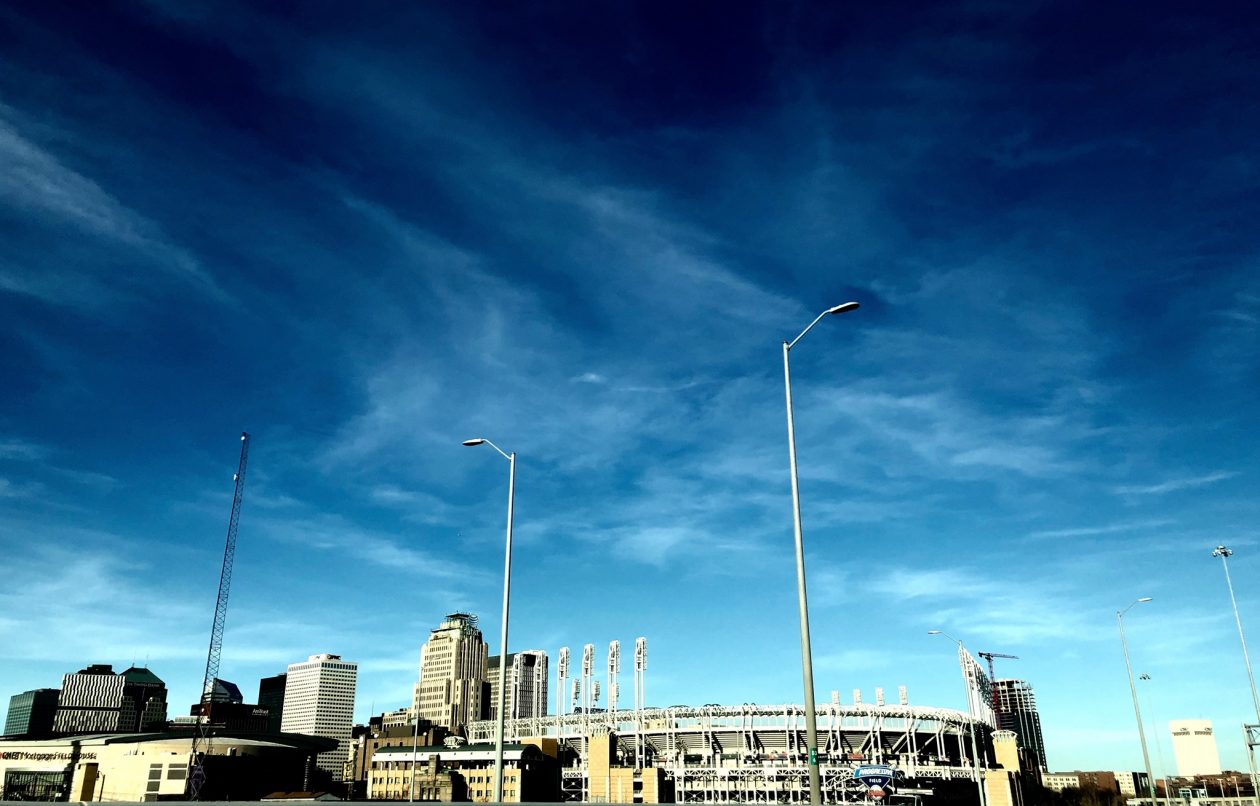
The Flats were located along the Cuyahoga River where it snaked through the north side of the city and drained into Lake Erie. It is bottom land there, the floodplain for the river. The earliest settlers in Cleveland settled in the floodplain, but it was swampy and they soon moved to higher ground. The Ohio & Erie Canal spurred lake shipping in the 1830s and rail lines spurred commercial growth in the 1860s. The Flats became the cradle of heavy industry in Cleveland. Business boomed exponentially. After 1870 the Flats teemed with foundries, iron furnaces, rolling mills, oil refineries, and chemical factories. The river was where they dumped their waste. It was their liquid landfill.
A century later the Flats was dank, begrimed, and very polluted. Nobody went there other than to work in the warehouses and steel mills. There were dive bars like the Harbor Inn and the Flat Iron that served greasy food and cheap booze to working men. The air was bad and the waterway was worse. No one had dared to swim in the Cuyahoga River for decades. A journalist described braving the water as “no person drowns in it, they decay.” All the fish in the reach from Akron to Cleveland had long ago died. Nothing except Japanese movie monsters could survive in the thick sludge that had once been water
“The river was a scary thing,” Tim Donovan explained. He was a high school graduate that summer, saving up for college, working as a hatch tender unloading ore carriers. Dead rats floated past the dockside cranes, bloated to the size of dogs. “There was a general rule that if you fell in, God forbid, you would immediately go to the hospital.”
We toured Republic Steel and Jones & Laughlin Steel. They were colossal enterprises. We could have saved time by just going to one of them since they were so much alike. There was an unbroken roar of loud machinery. The fires, furnaces, and molten metal made the factories hot. Dust and black soot covered everything. The gasses in the air didn’t make for garden variety air pollution. Breathing as we walked from one end to the other end of the factories was like breathing something poisonous.
The reason the engineering students were on the field trip was to help them bridge the gap between classroom theory and real-world application. Manufacturing steel involved many engineering disciplines. Seeing it happen in real time gave them a chance to see complex machinery involved in large-scale processes. They got to see first-hand how their classes in mechanical design and material science applied to the steel industry. It was eye-opening to them, and me, too. I found out there and then that I wasn’t prepared be an engineer.
It was mid-day when the field trip wrapped up. We piled back into the Ford Econoline Club Wagon, drove in one direction, and then another direction. The through streets in the Flats generally followed the Cuyahoga River, running parallel to its banks. The side streets connected to surrounding neighborhoods like Ohio City and Tremont. Nonetheless, we got lost. We finally found ourselves on the Campbell Rd. Bridge,
There was a Plymouth Barracuda at a dead stop ahead of us on the bridge. We stopped and waited. A police car, its lights flashing, pulled up behind us. We stayed sandwiched where we were between them.
“What’s going on?” one of the engineering students asked.
“There seems to be a small fire down there somewhere,” our driver parent said, peering over the dashboard.
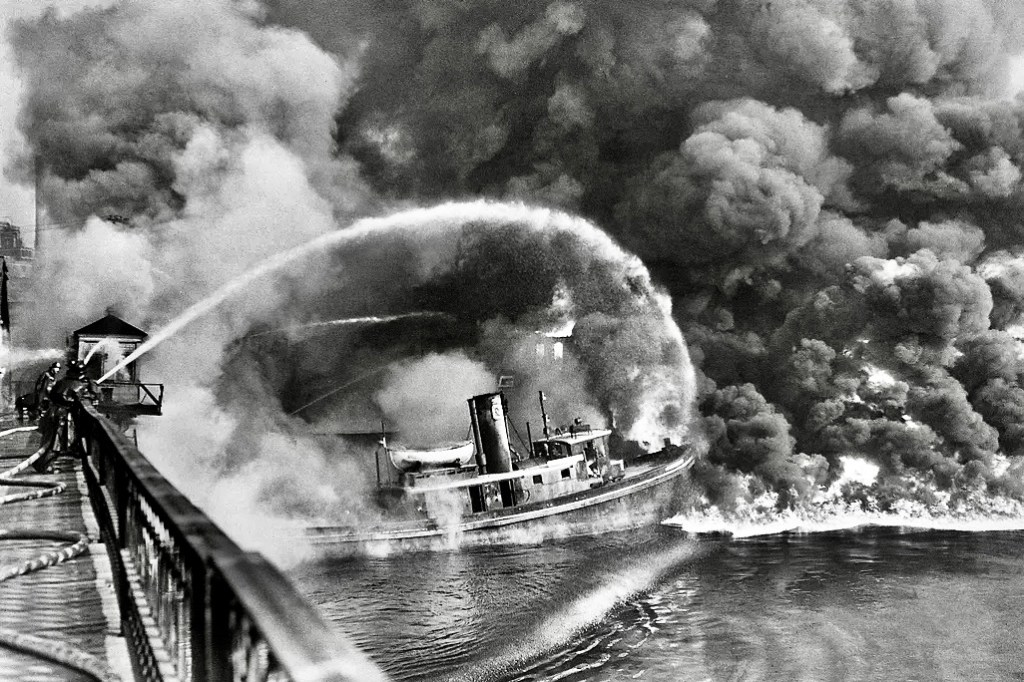
There was a sudden whoosh. Oily clouds of heavy black smoke rose up. We got out of the family van and went to the railing to get a better look. The smoke became a sky-high wall obscuring everything beyond the opposite bank. A fire department tanker truck crept onto the bridge. A fireboat by the name of Anthony J. Celebrezze made its way under the bridge to the wall of smoke.
What was going on was the Cuyahoga River was on fire. It wasn’t the first time it had caught fire. It had happened a dozen times since 1868. This was the thirteenth time it caught fire. A flare tossed from an overpassing train had ignited the petroleum-covered water.
The worst of the earlier fires happened in 1952 when oil and industrial debris on the river’s surface ignited. The fire destroyed three tugboats, three buildings, and some ship repair shops. It damaged a railroad bridge. It caused over one and a half million dollars’ worth of damage. Nobody in Cleveland was shocked by the river catching fire. It didn’t flow as much as ooze. Everybody was resigned to the city being one of the most polluted cities in the United States. “It’s the cost of doing business,” city fathers and business moguls said.
The fireboat crept close to the blaze, began drawing water directly from the river, and used its deck guns to try to smother the flames. It was like pouring gasoline on gasoline. The flames leapt higher. Three fire battalions drew water from hydrants and discharged it onto the fire from the river bank. They were far more effective.
We watched from the deck of the bridge, standing in a cluster behind a railing. The summer breeze was blowing our way, but from behind us, so we weren’t smothered by the smoke. It was still noxious. It was sharp and acrid, like burnt toast that had been buttered in sulfur compounds. We got back into the Ford Econoline Club Wagon and rolled up the windows. It didn’t help all that much.
The inferno lasted thirty minutes. Once it was out a policeman waved us forward and we drove away. We drove along the river. As we went the water became orange from the pickling acid used by the steel mills. We got lost again and ended up on the Jennings Rd. Bridge, which connected Abbey Ave. to W. 25th St. Our driving parent knew W. 25th St. well because he shopped for fruits and vegetables at the West Side Market. He knew how to get home from there. Crossing the bridge I looked down. There was a slaughterhouse below us. I could see blood and animal parts streaming out of outfalls and into the Cuyahoga River.
“That was amazing,” one of the engineering students said.
“Who ever heard of water catching fire?” another one said. “Somebody should do something about it.”
“And put us out of a job?” a third one said.
Once I got home I threw my clothes down the clothes chute and took a shower to wash away the smell. I put on a clean pair of jeans and a t-shirt. I combed my hair. My father was taking a Sunday late afternoon nap in the backyard. He woke up when I threw myself down in a lawn chair.
“How was your career day?” he asked.
“We toured a couple of steel mills and saw the Cuyahoga River catch fire,” I said.
He seemed unfazed by the news. He had lived through World War Two as a teenager on his own. He had seen his share of bombs and fires. He fled Lithuania in 1944 and spent five years in and out of refugee camps, working black markets until he found steady work with a relief organization near Nuremberg. When he finally made it to North America he ended up in Canada, where he worked digging up nickel and copper in the Sudbury ore basin for eight years. We had been in the United States the past ten years.
“Have you thought about getting into engineering?” he asked.
“I don’t think I have a talent for engineering, although I understand engineers make the world go round, at least our modern world,” I said. “But you’ve got to watch out for them. They start by making sewing machines and end with crazy hellfire.”
Ed Staskus posts monthly on 147 Stanley Street http://www.147stanleystreet.com, Made in Cleveland http://www.clevelandohiodaybook.com, Down East http://www.redroadpei.com, and Lithuanian Journal http://www.lithuanianjournal.com. To get the site’s monthly feature in your in-box click on “Follow.”
“Cross Walk” by Ed Staskus
“A Cold War thriller that captures the vibe of mid-century NYC.” Sam Winchell, Beyond Books
Available on Amazon: https://www.amazon.com/dp/B0CRPSFPKP
Late summer, New York City, 1956. The Mob on the make and the streets full of menace. President Eisenhower on his way to Brooklyn for the opening game of the World Series. A killer waits in the wings. Stan Riddman, a private eye working out of Hell’s Kitchen, scares up the shadows looking for a straight answer.
A Crying of Lot 49 Publication

 Made in Cleveland