By Ed Staskus
Many bands came to Cleveland, Ohio in the 1980s, bands like Queen, Guns N’ Roses, and Journey. I didn’t see or hear any of them. Besides, they just played the same song over and over again. I couldn’t afford arena rock, even if I wanted to squeeze myself into their sold-our shows. What did they do with all their money? Freddie Mercury didn’t spend much of it on his five-and-dime white tank tops.
I did see and hear Wall of Voodoo when they played the Agora Ballroom, shortly before the band broke up. They were the second-to-last group I saw at the downtown music hall before it burnt down. After the fire the Agora moved thirty blocks uptown into what had been the Metropolitan Theatre, built in 1919. It had been home to the Cleveland Opera until 1929. Twenty two years later, when the prima donnas were long gone and the building was housing the WHK radio station, disc jockey Allen Freed coined the phrase “rock-and-roll” on the air there.
The Agora was on E. 24th St. across the street from Cleveland State University. It had been there since 1968. It was the brainchild of local entrepreneur Henry LoConti Sr. “Monday Night Out at the Agora” showcased new bands like ZZ Top, Meat Loaf, and Talking Heads. “Live From the Agora” was broadcast on the radio. There were many affiliated stations. Bruce Springsteen’s show at the Agora in 1978 was heard by more than three million listeners. On Sunday nights it was reserved for home-grown bands like the Raspberries and the James Gang.
Iggy and the Stooges hit the music hall one night during a thunderstorm. “Iggy came out in a jock strap,” Henry LoConti Sr. said. “He had a razor and cut himself on stage, all kinds of crazy things. A girl and her boyfriend were in the front row. Iggy jumped off the stage on her face. Her boyfriend and his friends started beating on him. Our guys finally got him out of it, dragged him back, and he finished the show like nothing had happened.” The Stooges, however, spent the rest of the night slipping and sliding on Iggy’s blood on the boards.
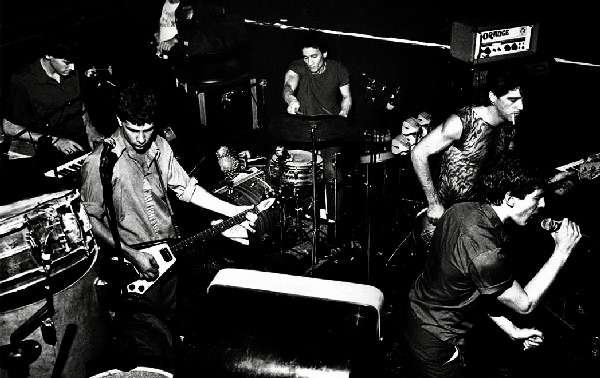
Wall of Voodoo was a Los Angeles band fronted by Stan Ridgway, who had been running a film score business before getting into the emerging punk scene in the 1970s. He picked up a bass player and a keyboardist from the Skulls and a drummer from Black Randy and the Metrosquad. They started playing at the Masque, a club underneath the Pussycat Theatre in Hollywood. They mixed electronica with country and western with Ennio Morricone movie music. There were junkyard riffs and percussion effects galore.
It didn’t always go over well. “This electronic music quintet makes self-proclaimed nightmare music,” John Swenson wrote in The New Rolling Stone Record Guide. “I pass on this stuff,” he declared in black and white, not writing another word.
When asked by Dick Clark on American Bandstand to describe their music, Stan Ridgway said, “I’m just as confused as anyone else as to what to call it.” The band released an EP in 1979 featuring a synthesizer driven cover of “Ring of Fire.” It wasn’t what the songwriter June Carter had ever intended. It had a spaghetti western twang to it. It was strange and surreal. Their album “Call of the West” was released in 1982. The catchy single “Mexican Radio” from the album became a big hit. It was about hot desert winds and border blaster radio stations.
By the end of the 1970s Henry LoConti Sr. had built twelve more Agora music clubs around the country, turning himself into a corporation. He went buttoned down in a no button business. He was awarded Billboard’s Steve Wolfe Award in 1979, presented to the person who had contributed the most to music entertainment the previous year. Billboard’s “Best Club in the Country” award was awarded to him in 1980.
For all that, the original Agora in Cleveland was always a rough and tumble place, awards or no awards. The audience was young. The music was loud. The drinks flowed all night long. There were bouncers. They kept their eyes and ears off the stage and more on the disturbances on the floor that erupted time and again.
The word “bouncer” comes from an 1875 book by Horatio Alger. A young man has a hearty breakfast, claims he has no money to pay for it, whereupon his waiter is ordered to “bounce” him. “A well-directed kick landed him across the sidewalk into the street.” But before there was the word, there were the Romans. In Rome a bouncer was known as an ostiarius. His job was to remove unwanted people from places they were trying to get into. In the Old Testament bouncers protected temples from “illegal entry into sacred places.” In the United States, starting in the mid-19th century, saloons and whorehouses hired them to remove drunk as a skunk, noisome, and violent patrons from the premises.
The Agora didn’t necessarily call their security staff bouncers, but that is what they were. They checked entrants for underage drinking. They refused entry to those already the worse for wear. Their duty was to maintain some semblance of order. Their No. 1 task was to deal with hot-headed behavior.
Wall of Voodoo opened their show with “Me and My Dad” followed by “Red Light” followed by “Call of the West.” Everybody’s ears perked up. “Got a green look about ya, and that’s a gringo for starts, sometimes the only thing a western savage understands are whiskey, rifles, and an unarmed man.” It was easy enough to follow the bouncing ball because Stan Ridgway had a clear as a bell voice. He sounded like a revved-up Hank Williams. The band was in fine fettle but didn’t drown him out.
They finished their first set with “Lost Weekend.” The song was Lou Reed-inflected, about a couple driving home after a losing streak in Las Vegas. “She was in the backseat while he was at the wheel, all the money from the store they’d gambled away. He said the best laid plans often go astray. She lit a cigarette, she didn’t make a sound. I know if we’d had just one more chance, he said. I know, we’d finally hit the big one at last, she said.” It was Wall of Voodoo’s bad dream of the American Dream.
The club was a haze of never ending cigarette smoke. The ceiling was barely visible. Music lovers elbowed their way to the front of the bar the minute intermission began. I was chronically short of cash and rarely drank at bars. I drifted outside for whatever fresh air there was. Cleveland was a smokestack city and the Agora was just two miles from the smokestacks. Beggars can’t be choosers.
The front doors were behind a makeshift garage door of corrugated metal. When the sidewalks finally rolled themselves up after a show the corrugated metal door came down. Even though the club was next door to Cleveland State University, it wasn’t in the best neighborhood. When the sun went down it was more along the lines of a bad neighborhood. I stood to the side minding my own business until saying hello to the bouncer by the door, with the idea that it is never a bad idea to get on the good side of bouncers.
He was younger and taller than me, about twenty pounds heavier, and appeared to be between a WWE wrestler and a bull fighter. He was wearing dark pants and a short-sleeved shirt. He looked like he did bicep curls for a living. He didn’t talk much until I asked him how he had gotten into the bouncer business.
“My great grandfather was a bouncer before he got into the New York City ganglands,” he said. “His name was Monk Eastman. I’m named after him.”
“Your great grandfather?” I was dubious. The young usually can’t remember that far back. Their memories go in one direction, which is forward, not backward.
“Yeah, he was a bouncer from 1894 to 1899, after which he got into the rackets. Back then there were saloons from one end of New York City to the other. He was seventeen years old when he got his first job. The saloon he went to, the manager told him he was too young, and besides, he already had two good men. My great grandfather asked if he could meet them. When they met, he quickly took care of both of them and got the job on the spot. He worked alone, although he always carried a truncheon.”
“You mean like a club?”
“Just like a club. It had notches carved into it for every man he made mincemeat of. Family legend has it, one slow night before he retired from bouncing, he threw his eyes on the bald spot of a man drinking at the bar. He couldn’t take his eyes off the bald spot. He walked up behind the man and clubbed him. ‘I had forty nine nicks in me stick and I wanted to make it an even fifty’ is how he explained it.”
“You said he got into the rackets after that?”
“Feet first, free-lancing in the beginning. He charged $15.00 for ‘ear chawed off’ and $19.00 for ‘leg broke.’ It was $100.00 for doing what he called ‘the big job.’ He put together his own gang soon enough. They got into it with another gang. One night he crossed a boundary line by mistake and got jumped. He carried a blackjack and was holding his own until he was shot twice in the stomach. He plugged the holes in his belly with his fingers and found a doctor. Two years later the other gang and my great grandfather’s gang went at it for real in Manhattan under the tracks of the 3rd Avenue Elevated line. It went on all night, fifty or sixty men firing at each other with Colts from behind cast iron arches. The police tried to stop the fighting but they had to retreat. Five men died and dozens were wounded.”
“It sounds like Iggy Pop,” I said.
“Iggy Pop has got a screw loose,” he said. “He would have shot himself in the foot.”
“What happened when the shoot-out was over?”
“A boxing match happened.”
“They put their guns down and put up their fists?”
“My great grandfather and the other man decided to settle matters with a boxing match. The other man was good with his hands but mine had arms long as an ape. In the end they fought for two and half hours to a draw. A month later they were shooting it out again. It was too much for the city fathers. Both of them were finally arrested, convicted of something, and both of them got eleven years in Sing Sing. When my great grandfather got out of prison his gang was gone, up in smoke. He volunteered for the army and was sent to Europe towards the end of World War One. My father told me he never took a prisoner if he could help it. He came home with a medal and told everybody there were plenty of saloons in New York City tougher than what everybody called the Great War.”
“What did he do after he got home?”
“Not too much, to be honest. He was found dead behind a dance hall in Brooklyn on New Year’s Eve in 1920. Somebody emptied a revolver into him. There were six bullet holes in him.”
“That’s too bad,” I said.
“Yeah, although he probably deserved it,” the bouncer said.
When I heard the band start their second set I took leave of the bouncer and went back into the Agora. On the cover of the album “Call of the West” there is a crooked door, slightly ajar, inviting everybody into Wall of Voodoo’s world. A standing room only crowd had squeezed into the Agora. It looked like all of them were still there.
Wall of Voodoo were pioneers of a kind. Their sound was plenty original. For all that, they were never going to be inducted into the Rock & Roll Hall of Fame.
When Huey Lewis and the News played the Agora in 1981 they played to a sold-out crowd. “We always heard that the heart of rock and roll was Cleveland, and we’d say ‘Wow, we’re from San Francisco. We had the Grateful Dead! We had Jefferson Airplane! What’s Cleveland got?’’’ The enthusiastic audience inspired Huey Lewis to write “The Heart of Rock & Roll.” He meant Cleveland was the heart of it. Fourteen years later the Rock & Roll Hall of Fame opened in Cleveland, not New York City or someplace in California, or anywhere else.
Wall of Voodoo finished their second set with “Mexican Radio” and came back to do an extended version of “Ring of Fire” for their encore. “I fell into a burning ring of fire, I went down, down, down, and the flames went higher, and it burns, burn, burns, the ring of fire.” When they were done the band looked wiped out. They got a big hand and most of the audience shuffled out. Some stayed to reminisce over a last drink.
I went home to crack open Nathaniel West’s “The Day of the Locust.” I had read it in an English class at Cleveland State University and there was something about the music I heard that night that reminded me of the book. Wall of Voodoo’s songs seemed to be about those with little in the way of hope and getting by on illusions, just like the book. Their songs were not all about hard luck and dark times, but enough of them were for me to get a handle on what thread was being woven. The thread was about one small-time lost in time tragedy after another.
For all that, I wasn’t about to cue up the arena rockers, or the likes of Madonna or Boy George, now or ever. Better the real deal than deals from the bottom of the deck. Better rough and tumble than a bag of old baloney.
Ed Staskus posts monthly on 147 Stanley Street at http://www.147stanleystreet.com, Made in Cleveland http://www.clevelandohiodaybook.com, Down East http://www.redroadpei.com, and Lithuanian Journal http://www.lithuanianjournal.com. To get the site’s monthly feature in your in-box click on “Follow.”
“Bomb City” by Ed Staskus
“A police procedural when the Rust Belt was a mean street.” Sam Winchell, Beyond Books
Cleveland, Ohio 1975. The John Scalish Crime Family and Danny Greene’s Irish Mob are at war. Car bombs are the weapon of choice. Two police detectives are assigned to find the bomb makers. Revenge is always personal. It gets personal.
A Crying of Lot 49 Publication
 Made in Cleveland