No Place Like Home

By Ed Staskus

   Sigitas Kazlauskas didn’t know J. Edgar Hoover from the man in the moon. He didn’t necessarily want to make his acquaintance, either. He wanted to go home, even though he knew he didn’t have nearly the funds for the passage. The passage was across the Atlantic Ocean and over the North Sea. His home was far away in Lithuania. He didn’t know the Justice Department man was going to be his ticket back.

   Sigitas was living in Cleveland, Ohio in 1919, where it was Thanksgiving week. He had left home in late 1914, dodging forced conscription into the Russian Army. He knew being drafted meant the meat grinder. He also knew his socialist views were hazardous. to his health. The Czar didn’t brook his kind of man. He made his way to the United States on a tramp steamer. He was living in Dope Town, a neighborhood west of East 9thSt. and north of Superior Ave. Suicide Pier on the Cuyahoga River was down one end of the street and the town dump was down the other end of the street. Lake Erie was on the north side and Little Poland was on the south side. 

   None of his friends called him Sigitas. Everybody called him Dave. When he asked why, they laughed and said, “David and Goliath, like in the Bible.” They didn’t bother with his surname since they weren’t his kith and kin. They were Eastern Europeans like him who had ended up in Cleveland for the same reason as him, which was opportunity. His opportunity had come and gone, which was why he was living in Dope Town. It was the only place he could afford a furnished room. The wrist a Cleveland policeman had broken with a truncheon during the May Day Riot six months earlier hadn’t helped, making him unemployable for three months and draining his savings.

   Since then, he had been living on bread and homemade beer. When the beer was ready he called his Polish friends, “Hey Polska, come get your right piwo.” He was well-known for his beer, attracting friends who were as friendly with his brew as they were with him, maybe more. They sang, “In Heaven there is no beer, which is why we drink it here.” He was hoping somebody would invite him to their turkey feast on the big day. He needed a square meal with his suds.

   Cleveland was going strong in 1919. It was the fifth largest city in the country. Iron and steel dominated the economy. Foundries and machine shops were everywhere. Skyscrapers were being built. The population was nearing one million. A third of the population was foreign born, working in the steel plants and garment factories. They worked long hours for low pay, but it was better than where they had come from, where they worked longer hours for even less pay.

   More than a quarter million Lithuanians left the Russian controlled Baltics between 1900 and 1914. When World War One broke out all immigration from Europe to the United States was brought to a stop. The new labor force that came into being was from the American South. There had been fewer than 10,000 Negroes in Cleveland in 1910. Ten years later there were nearly 40,000. There was enough work for everybody, though. Commercial construction was booming. The problem Sigitas had wasn’t finding work. The problem he had was keeping the work he found.

   He was a socialist, which was his problem. He believed in social ownership of the means of production. He didn’t believe in private ownership of it. The word socialism comes from the Latin word “sociare” which means to share. The modern use of the word was coined by the London Cooperative Magazine in 1827. The First International was founded in 1864 in Great Britain. After that it was off to the races. The Second International was founded in 1889. Anarchists were banned as a practical matter. Socialists didn’t want bomb throwers in their ranks, if only because bombs can be unpredictable about who they blow up.

   The May Day Riot in Cleveland on May 1, 1919 pitted trade unionists and socialists against police and military troops. The city was bursting at the seams with blue-collar foreign-born laborers. The activist Charles Ruthenberg got it into his head to organize a mass demonstration on Public Square on International Workers’ Day. He had run for mayor on the Socialist Party ticket two years earlier, polling nearly a third of the vote. He was well-known among the disaffected. He marched at the head of the assembly.

   Sigitas and his friends heeded the call. They joined the more than 30,000 men and women who showed up for the demonstration. They marched from Acme Hall on Upper Prospect to Lower Prospect to Public Square. The marchers wore red shirts and waved red flags. A parallel procession of army veterans in full uniform clashed with the socialists. Fights broke out and the police were called, who then quickly called for reinforcements and mounted forces. Harry Davis, the city’s mayor, called for the National Guard, who mustered in front of a beer hall before going into action with fixed bayonets. Tanks led the way, even though the socialists were unarmed. When Sigitas’s wrist was broken, a lady standing beside him used the 8 inch ivory hatpin holding her hat to her hair bun to stab the policeman in the chest. It was how Sigitas managed to break loose and not get arrested. 

   Several marchers were killed, nearly a hundred were injured, and many hundreds more were arrested. The Socialist Party headquarters at Acme Hall was ransacked by a “loyalist” mob. The next day all of Cleveland’s newspapers blamed the marchers for the riot, labelling them as “foreign agitators” even though most of them were native-born or naturalized citizens. The fourth estate demanded their deportation. The Immigration Acts of 1921 and 1924 later restricted immigration of “undesirable” Southern and Eastern Europeans, whether they were socialists, or not.

   It was at Thanksgiving dinner with his friend Teodor Wojcik and his family that his friend hatched a plan about how to get Sigitas out of the United States and back to Europe. Agnieszka was Teodor’s wife. They had two children and were moving up in the world. Teodor went by Teddy and Agnieszka went by Agnes. They weren’t socialists, but didn’t argue with Sigitas about it. They believed the United States was a free country where everyone was free to believe what they wanted. They weren’t silly enough, however, to say so in public.

   “There’s a man at the Justice Bureau who is heading up the new Radical Division,” Teddy said. “He’s already gone after the Negroes.” J. Edgar Hoover was the new man. He was after what he called “terroristic and similar classes.” He was a District man born and bred. He was a law and order man schooled in bigotry. “Something must be done to the editors of Negro publications as they are beyond doubt exciting the darkie elements of this country to riot,” he said in the summer when white soldiers and sailors rioted in the District, killing more than a dozen men and women, after a rumor spread that a Negro man had raped a white woman. The rumor was false. The Negro deaths were real.

   J. Edgar Hoover turned his attention to anarchists and communists at the end of summer. He got busy sending the notorious Emma Goldman back to Russia. He helped engineer the arrest of more than a thousand radicals in early November, with the intent of deporting them. “The Communist Party is a menace,” he said. He meant to send them all back to where they had come from.

   “What does this new man have to do with me?” Sigitas asked.

   Agnes brought a plate of paczek to the table. They were deep-fried pastries filled with jam, caramel, and chocolate. The outer layer was sprinkled with powdered sugar and dried orange bits. They drank coffee the Polish way, which was strong with full-fat cream.

   “What you have to do is forget about socialism and become a communist,” Teddy said. “Join the Communist Party. Volunteer for the dirty work. Become a firebrand. Make yourself known to the Radical Division. Make enough trouble and you should be on a boat on your way back to Lithuania in no time. It won’t cost you a penny for the fare and they will feed you during the voyage, too, so by the time you get home you’ll be back to your old self.”

   “They won’t shoot me?”

   “Probably not.”

   “They won’t throw me in jail?”

   “They probably will for a month-or-so, but they don’t want to keep anarchists and communists in jail. They don’t want them here. They want to send them somewhere else, anywhere else, which will be easy enough in your case since you were never naturalized.” Sigitas had never forgotten Lithuania and had never become a full-fledged American.

   Becoming an official communist was easy as pie. Charles Ruthenberg had split from the socialists after the May Day Riot and joined several splinter groups to form Cleveland’s Communist Party. They allied with the Communist Party of America. The woman who had saved him during the May Day Riot was a close associate of Charles Ruthenberg’s. She put in a good word for him. He was brought into the circle of fellow travelers. He was given a revolver but no bullets. He gave the gun back. J. Edgar Hoover’s Radical Division had numerous informers and inside men. They put Sigitas on their list soon enough. He didn’t have to wait long for the Palmer Raids.

   Seven months earlier the anarchist Carlo Valdinoci had put a bomb on the doorstep of newly appointed Attorney General A. Mitchell Palmer’s house in Washington, D. C. When the bomb went off no one inside the house was hurt, although the anarchist mishandled the explosive and blew himself up, as well as the front of the house. Across the street where Franklin and Eleanor Roosevelt were sleeping the blast shook them out of bed. The attack was coordinated with  attacks in eight other cities on judges, politicians, and policemen. The Attorney General had his eye on the White House. He got to work hyping the Red Scare. He put J. Edgar Hoover in charge of identifying and arresting as many socialists, anarchists, and communists as he could and deporting them as fast as he could.

   The first raids in December filled a freighter dubbed the “Red Ark.” It sailed out of New York City bound for Russia. Its passengers were foreigners and suspected radicals. A month later the Justice Department went big. A series of further raids netted 3,000 men and women in 30 towns and cities in 23 states. Search warrants and habeas corpus were an afterthought. Sigitas was one of the communists swept up in the net.

   Once everybody was locked up in holding facilities, J. Edgar Hoover admitted there had been “clear cases of brutality” during the round-up. His admission was beside the point. His point-of-view was guilty until proven innocent. Not everybody agreed. “We appear to be attempting to repress a political party,” said the U. S. Attorney for the Eastern District. “By such methods, we drive underground and make dangerous what was not dangerous before.” A. Mitchell Palmer answered that he couldn’t arrest radicals one by one to treat an “epidemic” and claimed fidelity to constitutional principles. The Constitution didn’t necessarily see it that way, but it was just a piece of paper.

   Sigitas knew it was all hot air. He knew letting the cat out of the bag was easier than getting it back in. After he was arrested he couldn’t wait to be frog-marched onto a boat bound for the Old World. The New World wasn’t for him anymore. There was too much capitalism and double-dealing.

   He had been rousted out of bed in his furnished room in the middle of the night by two uniformed Flying Squad men and a Justice Bureau man. “Are you the Hoover men?” he asked. “The only Hoover here is the vacuum cleaner kind,” one of the policemen said. “We’re here to get you into the bag. You got one minute to throw some clothes on.” A minute later he was in the back seat of their Buick Touring squad car.

   More than a week passed before Teddy was allowed to visit Sigitas at the Champlain Avenue Police Headquarters, The complex of offices, jail cells, and courtrooms was overdue for replacement. A new Central Station was already on the drawing boards. “The moment the new station at E. 21st St. and Payne Ave. opens for business, the ancient Champlain Avenue mausoleum of crime, rats, and malodors which has been functioning as a police headquarters for perhaps twenty-five years too long will start to crumble before the wrecking engines,” is what the Cleveland Plain Dealer said.

   “How are you doing?” Teddy asked. “They do anything bad to you?”

   “No, except the food is terrible, which is bad enough. There’s no beer, either.”

   “They tell you what is going to happen?”

   “They are taking me to New York City on the train tomorrow. They made it sound like I will be on a boat soon after that.”

   “That’s what you want, right?”

   “That’s what I want, yes. I want to go home.”

   “Home isn’t just a place, Dave” Teddy said. “It’s a feeling. It’s where the heart is.”

   “There’s no place like home,” Sigitas said. “That’s where I feel the best. It’s my second chance.”

   “You’re taking a chance,” Teddy said. “The Russians are gone now, sure, but the new Lithuania doesn’t like socialists any more than they do here. Socialism is no good. Sooner or later, you run out of other people’s money.”

   “Capitalism is no good, either,” Sigitas said. “Sooner or later all the money has been sucked up by the tycoons.”

   “Good luck,” Teddy said.

   The next day Sigitas was taken to the New York Central depot. He was handcuffed to a police detective who rode with him the full day it took to get to Grand Central Station. A day later, in a courtroom deciding his fate, was the only time he ever saw J. Edgar Hoover, who was sitting with the prosecutors, but never said a word. 

   He was younger than Sigitas had imagined him, maybe in his mid-20s. His short hair was shaved even closer at the temples. Sigitas was five foot eight and trim. J. Edgar Hoover was slightly shorter and just as trim. He was a lifetime District man and a Freemason, although Sigitas didn’t know that, or anything else about the man. He looked him in the face repeatedly, but the Radical Division man never made eye contact with him. He left before the proceeding was over. He knew what the verdict was going to be before it was announced. 

   A week later Sigitas was on board a refitted troop carrier. It was a leaky old tub. It took twenty eight days to get to Finland. The deportees were assigned cabins in pairs. Sentries stood at the cabin doors day and night. Sentries patrolled the deck for the one hour every day they were allowed to walk in the outside air. Once they got to Finland everybody was taken to a special train, guarded by U. S. Marines and Finnish White Guards. They were put thirty men to an unheated boxcar fitted with benches, tables, and beds. Each boxcar had seven boxes of army rations, which included bully-beef and hard bread. They were taken to Terijoki, about two miles from the Russian border. Most of the men were being dumped into Russia like so much garbage. Sigitas was the only deportee going to Lithuania. The Russians dumped him out like garbage, too.

   He took a train from St. Petersburg to Riga, Latvia, and from there he hitched a ride on a sugar beet truck across the border to Lithuania. Sigitas walked the fourteen miles to the farmlands outside of Kursenai. It felt good to stretch his legs. He found his family home without a problem, as though he had never left. “Labas, mamyte,” he said when he stepped through the front door and saw his mother peeling potatoes at the kitchen table. After the kissing and crying, after he had sat his mother back down, and his brothers and sisters were peppering him with questions, he knew he had made the right decision in returning to the Old World.

   The worst feeling in the world is homesickness. Sigitas felt like a new man. He had shed all his theories on board the troop carrier. He could no longer determine which political way was the more bad way. Ideologies were full of lies. “Eik i velnius” was all he had to say about the matter. If he had still been in the New World it would have come out of his mouth as “Go to hell.” Lithuania was a free country again after more than one hundred years. The Russians were good and gone, except when they weren’t. They were grabby and unpredictable

   Sigitas worked on the family farm for twenty years. He harvested hay starting on St. John’s Day. He raised his own pigs and brewed his own beer. He always had enough to eat and drink, at least until before the Russians came back in force in 1944. The politics of the 20th century caught up to him. The Russians weren’t school style idealogues. They were barrel of a gun idealogues. Either you believed in them, or else. He fought them first with the Territorial Defense Forces and later with the Forest Brothers. They engaged the Russians in guerilla warfare in the woodlands surrounding their homes. Sigitas Kazlauskas was shot and killed in the Dainava Forest in late January of 1945. His body was abandoned on the battlefield and decomposed in the spring. He slowly sank into the bloom until there was nothing left of him.

Ed Staskus posts monthly on 147 Stanley Street http://www.147stanleystreet.com, Made in Cleveland http://www.clevelandohiodaybook.com, Atlantic Canada http://www.redroadpei.com, and Lithuanian Journal http://www.lithuanianjournal.com

“Cross Walk” by Ed Staskus

“Captures the vibe of mid-century NYC, from stickball in the streets to the Mob on the make.” Sam Winchell, Beyond Fiction

Available on Amazon: https://www.amazon.com/dp/B0CRPSFPKP

Late summer and early autumn. New York City, 1956. President Eisenhower on his way to the opening game of the World Series. A hit man waits in the wings. A Hell’s Kitchen private eye scares up the shadows.

A Crying of Lot 49 Publication

On Thin Ice

By Ed Staskus

   When I lived on the far west side of North Collinwood there wasn’t anything unusual about a dog barking. What was unusual was barking that never stopped. The dog was an American pit bull who was chained all day long to a stake in a front yard two houses down. He had good reason to bark. He was a full-grown pooch, tan with a white chest. At night he vanished and the street was quiet.

   Nobody liked the barking, but nobody ever worked up the courage to say anything. The dog was Lou’s dog. Lou was some kind of gangster on our side of town.

   I walked Sylvester, my Great Dane, every day and night and avoided the barker, going the other way. There was no point in messing with his school of thought. One day I was preoccupied and there we suddenly were right in front of him. He was so surprised he didn’t make a peep. We crossed the street. He started barking up a storm. Before I knew it, he jerked, lunged, and ripped the stake out of the ground. In an instant he was running across the street at us snarling, the metal stake on the other end of the chain kicking up sparks behind him on the concrete.

   The west end of North Collinwood butts up to Bratenahl, which is its own posh enclave six miles from downtown Cleveland. The two neighborhoods couldn’t be any more different. In the 1970s Bratenahl’s median household income was wondrous and North Collinwood’s median household income was lousy. 

   Bratenahl is a village on the south shore of Lake Erie. It is one of Cleveland’s oldest streetcar suburbs, strategically cut off from the city to the south by railroad tracks and the Memorial Shoreway, bordered by Gordon Park on one side and the Northeast Yacht Club on the other side. The village police station is on the road that dips under the highway and becomes East 105th St, the main north south artery in Glenville. Bratenahl is 98% white while Glenville is 98% black. The neighborhood is notorious for the late-60s Glenville Shootout, back when bussing was making headlines and racial tensions were boiling over.

   Bratenahl’s famous sons are too many to count, although they are trumped by Collinwood’s George Voinovich, 54th mayor of Cleveland, 65th governor of Ohio, and two-time United States Senator. Joe Shuster and Jerry Siegel lived in Glenville when they were creating Superman. My neck of the woods was sketchy. There were wicked men in the shadows.

   I could have used Superman when the pit bull charged us. I had a Great Dane, though, who was no shrinking violet of a Clark Kent. I let him loose, he whirled on the pit bull, got behind and on top of him, and clamped his jaws on the back of the other dog’s neck. By the time Lou came running out of his house it was all over.

   He apologized up and down. I knew he was sincere because he was in the crime business and never went out of his way to apologize to anybody about anything. My dog sat on his haunches looking out into the distance while we talked. He was feeling like Bratenahl. The pit bull smoldered, his eyes going slit-like and red. He was feeling misunderstood.

   A thousand-some people live in Bratenahl within one tree-lined square mile. Twenty thousand-some people live in North Collinwood within three close-knit square miles. A two-bedroom two-bath unit in the Bratenahl Towers sells for between three and four hundred thousand dollars nowadays. There is a $1,000 monthly maintenance fee. A three-bedroom three-bath house in North Collinwood sells for a hundred thousand and change. Maintenance is up to you. It wasn’t much different in the 1970s.

   Lou was in his late 20s, single, and plenty of young women came and went. He drove a black 1973 Pontiac Luxury LeMans. It was one of the biggest cars on the road, the size of a rhino, cruising down the road like a Barco lounger. He never went into details, but everybody knew he worked for the underworld. Lou didn’t call it the Mob or the Mafia. He called it the Group. He made it sound like a fraternal outfit, getting together with the guys to chew the fat.

   John Scalish was the top dog. He took control in 1944 and stayed on the throne of blood for thirty-two years, taking his last breath in 1976 after hardened arteries got the better of him. His gang was allies of the Chicago Outfit and the Genovese Crime Family. Nobody asked what Lou did during the day, but we all knew when it got dark he hung out at the not-so-secret members-only nightclub around the corner on Lakeshore Blvd.

   It was a squat one-story building with a flat roof and no sign. There was a no fooling around steel entrance door. A hand-written square of cardboard taped to the back door said, “Keep Away” in block letters. A burly man in a blue Dodge Coronet lay low in the back of the parking lot from dusk to dawn, keeping his eyes open for troublemakers. The joint jumped with babes and booze. Lou worked the inside, making sure everybody stayed happy and keeping a semblance of order in play.

   My lodgings were on Westropp Avenue, a few blocks away. It runs parallel to Lakeshore Blvd. from East 140th St. to East 152nd St. It doesn’t end at East 152nd, but becomes Waterloo Rd. My front porch was within spitting distance of Bratenahl. I stayed snug as a bug upstairs in the Polish double. Ray Sabaliauskas owned the house, living it up with the pint-sized Asian wife he had brought back from the Vietnam War.

   Although I had never had a dog and didn’t want one, I had a dog. He had been left behind when my brother’s fiancée was killed by a drunk driver out in the suburbs. My brother moved out the funeral. We had been roomies. I stayed because I could sort of afford to live on my own and liked being within walking distance of Lake Erie. The CTS 39B bus stopped right on Lakeshore Blvd., slowly but surely getting me downtown to Cleveland State University.

   The Great Dane’s name was Sylvester, although I called him called him Sly and the Family Stone. I walked him every morning and again in the evening. Our morning walk was so he could do his business and the evening walk was so he could do his business and stretch his legs. We crossed Lakeshore Blvd. to the open field between Bonniewood Dr. and Overlook Park Dr. Once there I removed his lead and he ran around like a nut. When he got it out of his system, we walked to the beach. In the winter, if the lake was frozen, we walked on the ice.

   Early on an overcast February evening, already as dark as midnight, we were about one hundred feet from the shore when Sly broke through the ice and fell into Lake Erie. He couldn’t get up and out, although he was able to keep his head above water. When I tried to walk to him the ice started cracking under my feet. I stopped. There wasn’t anybody anywhere except us. I had to get him out of the water. It was windy and his whiskers were going frozen icicles by the minute.

   I got on my belly and crawled to where he was. I had to be careful. If I fell in, we might both end up in Davey Jones’s locker. I grabbed his collar. He didn’t like it and pulled away. I got a better grip and yanked as hard and fast as I could, getting him halfway out. He got the idea and heaved himself out the rest of the way. When he tried to stand up his legs splayed apart and he flopped. I gripped his collar and we slowly on all fours made our way to land. I was wet and cold. Sly was wetter and colder. On the way home he stopped and shook himself all over trying to get dry. He got drier but got me wetter with the spray.

   It was warm inside the house. I rubbed Sly with bath towels, spread one on the floor in front of the living room space heater, and he lay down, licking the big wet spot he was. I filled the tub with hot water and took a long soak. The next day neither of us showed any aftereffects, except that Sly ate two big helpings of Bil-Jac in one sitting.

   In the winter Lou’s pit bull lived indoors. I hardly ever saw the dog. I saw Lou coming and going. He seemed to be on the go day and night. I thought he might be a runner for the Italian lottery in Hough and Glenville, picking up the bets and doling out the winnings. The Ohio Lotto was still more than a decade away.

   Even though Lou’s house and yard were bare bones, it was clear he had dough to burn. The lock on his front door was Fort Knox. He had a big car. The garage door lock was Fort Knox’s best friend. He dressed well and carried himself with confidence. He always had a roll of twenty-dollar bills held together by a rubber band inside his pants pocket.

   John Nardi controlled Teamsters Local 410. He wanted to control more. Leo “Lips” Moceri was known to be one of the most violent and ruthless criminals in the city. One day he walked into the council hall on East 22ndStreet. “Keep your hands off the Akron rackets and get rid of Danny Greene,” Lips shouted at John Nardi.

   “I’ll do what I damn well please!” John Nardi shouted back.

   “Do you know who I am?” Lips exploded. “I’m Leo Moceri and no one pushes me around!” 

   They went their separate ways after spitting in each other’s faces. Lips got the better of it since he had more to work with. That weekend he went to the Feast of Assumption in Little Italy where he snacked on cannoli’s and pawed the bottoms of passing teenage girls. He disappeared on Monday. Two weeks later his car was found abandoned in the parking lot of an Akron motel. There were a pair of new shoes in the back seat. The spare tire was missing and the trunk was drenched in blood. Not a trace was ever seen of Leo Moceri again, dead or alive.

   What the John Scalish Crime Family was up to in Cleveland was loansharking, bookmaking, narcotics, and labor racketeering. They were also blowing up the Irish gangsters led by Danny Greene. Cleveland was known as Bomb City USA. Danny Greene found and disarmed bomb after bomb targeting him until he finally didn’t find the last one. John Nardi was planning on taking over the whole shebang, no matter what he had to do, bombs or no bombs. He later went to pieces the same as Danny Greene.

   One morning I noticed Lou’s pit bull was panting in the heat of the sun and his water bowl was empty. It was still empty when I got home from Cleveland State University. I filled it up, keeping a wary eye on the beast. He slurped it down. The next day it was empty again. I filled it up again and brought him dried kibble. The dog and I made a separate peace.

   The next week a truck from Animal Control Services pulled up to the curb. Two men got out, one of them threw treats to the side of the dog, and when he turned that way, the other man got a slip lead around his neck. They loaded him into the back of their truck. It was the last I saw of him. It was also the last I saw of Lou, who I hadn’t seen for a while. When he was found what was left of him was deposited in a closed coffin. 

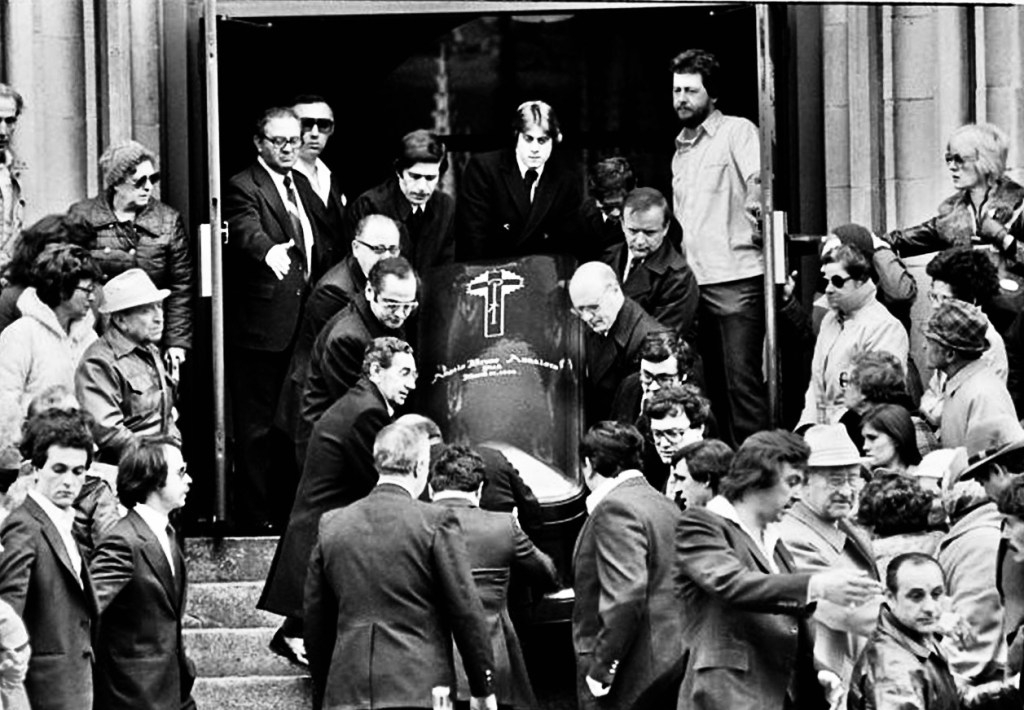
   The funeral was at Holy Rosary Church on Mayfield Rd. Even though many of Holy Rosary’s pioneer members were immigrant stone cutters, the church is built of brick. There are life-size statues of saints on top of the facade and the east corner is topped by a domed cupola. It was the first Italian parish in Cleveland.

   After the mass and the procession to the burying ground went its way, I was lingering at the base of the flight of stairs to the street. A tight-knit group of men in black suits were talking nearby. They were smoking cigars and cigarettes. There was a white gray cloud over their heads.

   “What’s the word on what happened?”

   “It was the niggers in Glenville. They stabbed him bad and then emptied a Saturday night special into his face. He was a mess.”

   “Anybody on it?”

   “Yeah, the coons are going to pay, first with what they stole from him, and then for what they did to him.”

   “Who’s on it?”

   “Shon is on it.”

   Shondor Birns was a gangster from the Little Caesar days. Even though he specialized in the numbers and loansharking, he was mostly an enforcer on the streets and back alleys. By the time he was 13 he already had a reputation for violence. The neighborhood toughs steered clear of him as somebody not to be fooled with. He lived by his wits and his fists. When he was arrested for the twentieth time as an adult and indicted as an enemy alien, he beat the rap, but the deportation order against him remained in play. No other country would admit him, however, so he stayed in Cleveland.

   Lou’s car and the loot he was carrying were lost and not found. I never found out if his confederates resolved the issue, whether Shondor Birns made anybody pay up, or not. By the mid-1970s homicides in Cleveland were setting records with more than 300 of them a year. Ten years earlier there had been about one murder a week, not one murder a day. There were too many of them going around to pay attention to what happened to Lou. I forgot about him and put his homeless dog out of my mind.

   The next winter was just as cold as the one before it and even snowier. I took Sly and the Family Stone for walks along Lake Erie, but we stayed on the shore. The Great Dane sniffed up the ice but thought better of it. He knew where he wasn’t wanted. He romped on the frozen beach and the dunes, instead, flailing up and down snow drifts. There was no sense in putting himself and me in harm’s way on thin ice.

   The next winter was just as cold as the one before it and even snowier. I took Sly and the Family Stone for walks along Lake Erie, but we stayed on the shore. The Great Dane sniffed up the ice but thought better of it. He knew where he wasn’t wanted. He romped on the frozen beach and the dunes, instead, flailing up and down snow drifts. There was no sense in putting himself and me in harm’s way by setting foot on thin ice.

Ed Staskus posts monthly on 147 Stanley Street http://www.147stanleystreet.com, Made in Cleveland http://www.clevelandohiodaybook.com, Atlantic Canada http://www.redroadpei.com, and Lithuanian Journal http://www.lithuanianjournal.com

“Cross Walk” by Ed Staskus

“Captures the vibe of mid-century NYC, from stickball in the streets to the Mob on the make.” Sam Winchell, Beyond Fiction

Available on Amazon: https://www.amazon.com/dp/B0CRPSFPKP

Late summer and early autumn. New York City, 1956. President Eisenhower on his way to the opening game of the World Series. A hit man waits in the wings. A Hell’s Kitchen private eye scares up the shadows.

A Crying of Lot 49 Publication

Don’t Scare the Fish

By Ed Staskus

   I never thought I would be spending two weeks in East Texas in the middle of a blast furnace summer but there I was. I was deep in the heart of Dixie. Everybody except me had a bad accent. I sometimes wondered what language they were speaking. It rained every afternoon for a half hour and was bone dry a half hour later, racing right back up to 100 degrees in the shade. But by that time, we were on our way to work. We worked nights.

   Tyler, Texas was the second last leg of a month-long job in five states. The last leg would be Louisiana and then back home. I was working for American Electro Coatings, a Cleveland, Ohio outfit that refinished desks, files, and cabinets on site. We traveled in three-man crews in white Ford Econoline vans, carrying our gear and luggage. There were two bucket seats and a custom-made bunk that doubled as storage behind the seats. The van was big enough for a sofa if we wanted one. We rotated the driving. One of us was always sleeping on the bunk.

   We started in Chicago, went to Des Moines, OK City, Tyler, slowing down in Louisiana for crawfish, and then got back on the hillbilly highway to the Buckeye State. Our ride never broke down because Ralph, the crew leader and painter, made sure it never broke down. He did an all-points inspection beforehand, had it tuned up, oil changed, and confirmed the steel belts were on the newer side. He didn’t believe in 4-60 air conditioning, four windows open going 60 MPH. He made absolutely sure our on-board AC was in perfect working order. The van looked like a creeper on the outside but ran like an angel.

   What we did was electrocoat office furniture. The process was originally developed for the automotive industry. We applied a negative charge by means of a magnet to desks and files and a positive charge to the paint. Two of us in the crew cleaned and taped and brought everything to the painter, to a ten-by-ten-foot tarp taped down to the floor. A spinning disc on the end of the paint gun streamed a fine mist of paint, the paint curving to the metal, caught by the electrical charge. The only time there was ever any overspray was when the painter screwed up. Ralph never screwed up.

   Our workday started when everybody else’s workday was ending. We worked from about six to about two in the morning. Ralph was an old hand. He always got a motel as close as possible to where we would be working to cut down on drive time. “Efficiency is doing things right,” he said. Effectiveness is doing the right things. Ralph was both, not that anybody could tell by looking at him. He looked like a skinny chain-smoking Jackie Gleason.

   I wasn’t a full-time employee and didn’t work with the same crew all the time. I always asked for Ralph, though. He was fifteen-some years older than me, testy but steady, smoked too much, but drank less than he smoked. He had a wife and two kids and was stingy as Scrooge. He didn’t spend any of his own money on the road. Everything was an expense. When we got back to our motel room in the middle of the night it was always lights out, Ralph’s orders. In the afternoon we were free to do whatever we wanted, but he expected us to be ready to go at five o’clock.

   Some of the employees were Americans at American Electro Coatings. The rest weren’t. They were from Mexico and Central America. Some of them got paid cash on payday. Jose was Ralph’s right hand man. We always got a room with two beds which meant, since I was the odd man out, I always slept on a rollaway. Some of them were better than others. The first thing Ralph and Jose did when they woke up was hack up a storm and have a cigarette. They shared an ashtray on the bed stand between them. When they asked me if I wanted to join them in a smoke, I said, “Thanks, but I don’t need one of my own. I’ll just breathe the air in here.”

   Our job in Chicago was smooth sailing, some old-time law office, but we hit a bump in the road in Des Moines. It was a downtown bank and the first day we started on the first floor, which was the lobby. Jose and I were cleaning and taping desks. He called me over to one of them. There was a kind of fancy doorbell button screwed to the well of the desk and wires coming and going to it. 

   “What are we gonna do about this?” Jose asked.

   We were going to have to do something to be able to move it to the painting tarp. There were several screws that the wires were attached to. “Let’s make a drawing of where the wires go, unscrew them, and put them back later,” I suggested.

   “OK,” he said

   Five minutes later three police cars screamed up to the front doors and ten seconds later a half dozen cops with guns drawn were bellowing, “Down on the floor, face down!” We couldn’t go flat fast enough. It got straightened out after a while but not before a stern warning from the peace officer in charge to stop messing around with alarm wires.

   Every night in the middle of the night in Des Moines we drove down East Grand Ave. back to our motel near the State Fairgrounds. The streets were always deserted. We could have burgled anything we wanted. We navigated by the lit-up gold dome of the early-20th century Iowa State Capital building. There were no lawmakers to guide us.

   OK City was a two-day job like Chicago. We didn’t like short jobs, so when we got to Texas, we were glad to unload our gear and settle in for two weeks. We were going to be working at the Kelly Springfield tire plant. The factory went back to 1962 and was on the order of a million square feet. A rail spur ran alongside an inside platform from one end to the other end of the factory, bringing raw materials in and hauling new tires away.

   The front offices were routine, all of them together, and no fuss about setting up and getting it done. The other offices were on the factory floor on raised platforms. It was where foremen worked and kept track of the blue collars below. We had to wheel our gear there and carry it up. We got a platform-or-two done a night. We met Barry and Skip on one of them. They were two of the foremen who kept their eyes open on the down below. They got us acquainted with Tad, another one of the foremen, a friend of theirs who worked at ground level. He had gotten his legs shot out from under him at the Battle of Xuan Loc, the last major battle fought during the Vietnam War. He was discharged with a Purple Heart and a wheelchair. He left his legs in southeast Asia.

   One night we had lunch just past midnight in the cafeteria with the three of them. I noticed all the white men were sitting at one end of the eatery and all the black men were sitting at the other end. The brown men and yellow men sat where nobody else wanted to. I knew black people were held in low esteem in Cleveland. They were held in no esteem in East Texas. If they weren’t outright hated, they were disliked and shunned. 

   “We can’t call them niggers no more, so we don’t,” Barry said. “But we don‘t got to eat with niggers. They can’t make us do that. Besides, they don’t want to eat with us either.” Their racism was a great time saver. They were busy men at work, at home, and in church. Barry was a part-time deacon. They could stick to their long-held beliefs without bothering about the facts.

   Barry invited us to go night fishing with them on their next day off. We had been at it at the plant for seven days and were ready for a day off. Barry picked us up in his GMC Sierra Grande pick-up. It had plush carpeting, a padded front seat, and an AM/FM radio. The only stations in town were AM. We listened to a radio minister whoop it up. Ralph sat up front with Barry and Skip and hung on to the gun rack. Barry was a horrible driver, driving too fast and reckless. Jose and I hung on to Tad’s wheelchair clamped down to the bed of the truck. Tad hung on to the armrests of his wheelchair.

   Their 28-foot deck boat was docked at Lake Palestine, west of Tyler. Besides rods and reels, hooks, bobbers, sinkers, and bait, they brought lots of ice and a couple hundred cans of Lone Star beer. They did their best to drink it all. We helped out but couldn’t keep up. Skip shot us a pitying look. “Beer makes you feel the way you ought to feel without beer,” he said.

   We fished for crappie and catfish. Tad was dead set on crappie and used minnows for bait. There were more catfish than anything else. We drift fished for them using worms and chicken livers. Skip was targeting blue catfish using cut fish as bait. The best catfishing is done at night. Flats, river bars, shorelines, and weeds are good places to find them. 

   Everybody caught a load of everything, tossing them into five-gallon buckets half full of water. Tad forgot to chock his wheels and almost went over the side before Skip grabbed him by the nape, saving his neck. “We can’t have him yelling and splashing,” Barry said. “The number one rule of fishing is to be quiet. Don’t scare the fish!” We did some firefly and star gazing and lots of mosquito swatting. There was a full moon. I looked steadily and cautiously for the Swamp Thing to surface, but he never did.

   The next day was Sunday. Barry invited us to his house for a fish fry. We ate our fill. The fish was fresh and tasty. The catfish weren’t as scary dead as alive, their heads cut off. Ralph had a Lone Star, but Jose and I had sworn off it for the Lord’s Day. The Texans were unfazed and drank their fill. Barry brought his family Bible out to the backyard. It was as big as a suitcase and had all the names of his known forebears inscribed on the inside cover.

   It was hot and swampy the day later. The tire factory was noxious, like it was every day. We were lucky to be working in the air-conditioned offices. There were enormous exhaust fans for the working men, but the only fresh air was the air that flowed from one end of the railroad tracks to the other through the big bay doors.

   The plant reeked of rubber, special oils, carbon black, pigments, silica, and an alphabet soup of additives. Banbury mixers mixed the raw materials for each compound into a batch of black material with the consistency of gum. It was processed into the sidewalls, treads, or other parts of the tire. The first thing to go on the tire building machine was the inner liner, a special rubber resistant to air and moisture penetration. It takes the place of an inner tube. Next came the body plies and belts, made from polyester and steel. Bronze-coated strands of steel wire, fashioned into hoops, were implanted into the sidewall of the tires to form a bead, so there was an airtight fit with the rim of the wheel. The tread and sidewalls were then put into position over the belt and body plies, and all the parts pressed firmly together. The result was a green tire. The last step was to cure it. Working at the Kelly Springfield factory for two weeks cured me of any inclination I might have ever had about working for a tire manufacturer.

   The day before we were due to be done and gone, Barry found us and led us to the open west end of the track platform. He and Skip had rigged up a sail and mounted it to the back of Tad’s wheelchair. There was a stiff breeze blowing through the bay door heading due east from the other open bay door. “We got him some new rubber on those wheels of his,” Barry explained. “He wanted to give them a good test, so we arranged a scoot.”

   They pivoted the sail, Tad let go his chokehold on the wheels, and set off rolling down the platform. He picked up speed and we started walking fast. He picked up more speed and we started jogging. He picked up even more speed and we started running. Before long we couldn’t keep up and watched him become a crazy fast speck in the distance. Then he disappeared.

   When we got to the other end of the plant and looked down from the platform to the railroad tracks below, we gawked at the runaway. Tad and his wheels were a mess. He had a nasty cut on his forehead. He had old rail grease all over his work shirt. He rolled off the overturned wheelchair and cursed up a storm. Barry and Skip jumped down, got Tad back up to the platform, lifted his dented wheelchair, and set him back to rights. The sail was a shambles. They left it where it lay.

   “You sons of bitches ain’t going be doing that again anytime soon, believe you me,” Tad grumbled.

   We loaded up the next day and headed for Louisiana. It was a three-day job there. We stayed at a motel with a pool and ate crawfish at a roadhouse next door. “You got to suck on the head first thing, before you peel the tail, honey,” our waitress said. We drank Falstaff beer kept cold in galvanized bins full of ice water and salt. We stayed an extra day for more crawfish and to hear a zydeco band everybody said was the best in the parish. I bought a blonde a beer before her boyfriend told me to drift. Jose danced with a redhead.

   The day we left for home was the hottest most humid day in the history of the world. We rolled up the windows and cranked up the air conditioning. Jose tucked himself in on the bunk behind us and was asleep in no time. I glanced back at him as we drove north up through Mississippi.

   “I’ll take the next turn at the wheel,” I told Ralph. “Jose is sleeping like a baby.”

   “That’s because he doesn’t have his baby here with him,” Ralph said. “He’ll be making some noise on the old squeezebox soon enough.”

Ed Staskus posts monthly on 147 Stanley Street http://www.147stanleystreet.com, Made in Cleveland http://www.clevelandohiodaybook.com, Atlantic Canada http://www.redroadpei.com, and Lithuanian Journal http://www.lithuanianjournal.com

“Cross Walk” by Ed Staskus

“Captures the vibe of mid-century NYC, from stickball in the streets to the Mob on the make.” Sam Winchell, Beyond Fiction

Available on Amazon: https://www.amazon.com/dp/B0CRPSFPKP

Late summer and early autumn. New York City, 1956. Jackson Pollack opens a can of worms. President Eisenhower on his way to the opening game of the World Series where a hit man waits in the wings. A Hell’s Kitchen private eye scares up the shadows.

A Crying of Lot 49 Publication

Messing With Bigfoot

By Ed Staskus

   The week we went to our last Boy Scout camp at Lake Pymatuning State Park wasn’t any seven days longer than any other summer camp we had gone to, but since it was going to be our last camp, my friends and I were determined to make the most of it, stay up most of the time, lengthening the days and nights, mess around in the woods and the lake, raid the girl’s side, and play mumble the peg.

   Most of us carried jackknives and some of us had fixed-blade sheath knives. We were always whittling on something. “No mumbledy peg,” our scoutmaster told us in no uncertain terms, in uncertain English, in his strong Lithuanian accent, speaking through his Chiclet teeth.

   One way we played mumble the peg was to first stick a twig into the ground. We threw our knives at the ground, flipping from the palm, back of the hand, twist of the fist, and every which way. Whatever the other scout did, if he threw it backward over his head, and it stuck, you had to do it, too. If you failed, then you had to mumble the peg. You had to get on your hands and knees and pull the twig out of the ground with your teeth.

   The other way we played was to stand opposite each other with our legs shoulder-width. Taking turns, we would flip and try to stick our knife into the ground as close to our own foot as possible. The first toss was always in the middle, but when the other guy got closer, you had to get closer, and the closer and closer it went. Whoever stuck his knife closest to his own foot, and the other guy chickened out, was the winner.

   If you stuck the knife into your own foot you won on the spot, although nobody ever wanted to win that way. It was why everyone who had not gotten their first aid merit badge and was going to get in on mumble the peg at camp took the class at the park ranger cabin a half mile away. It was taught by an older scout who wore leopard-print camouflage pants and shirt. One of us read from the only available Red Cross manual, while he was the hands-on guy.

   It was the only book-learning merit badge on the program. Sticking our noses in a book at summer camp was the last thing anybody except the bookworms wanted to do. They read what somebody else had dreamed up about fun. We dreamed up our own fun.

   We were going to look for Bigfoot and nab him if we could. He was the hide and seek world champion, but we knew he was somewhere around the lake. What we were going to do with him once we got him, none of us knew. We thought, if we did find him, and he was friendly, we would ask him where he lived and what he did all day. 

   “His name is Sasquatch,” the cammo-clad scout told us, looking like he thought we were retards.

   There were more of us than Bigfoot, or whatever his name was, for sure. There were seven of us, first-generation immigrant children like all the boys and girls at the camp, and we were all Eagle Scouts. None of us had earned any Palms, though, since none of us had gotten more than the twenty-one merit badges needed to get to Eagle, but all of us were going for twenty-two, since Somebody’s dad had brought two canoes. We were looking forward to it after we heard what getting a canoeing badge was all about.

   What it was about was jumping out of a canoe in deep water and getting back in without capsizing, then performing a controlled capsize, and swimming, towing, or pushing the swamped canoe fifty feet to shallow water. Once in the shallow water, empty the swamped canoe and reenter it. Back in deep water, rescue a swamped canoe and its paddlers by emptying it and helping the paddlers reenter their boat without capsizing. We were all about that, come hell or high water

   We had searched for Bigfoot at camp before, but sporadically, never having a plan. This time we had a plan. We brought flashlights, we had a map of the landscape north of our camp, and a compass, and we made sure all of us had sharpened our knives just in case the creature tried to mess with us. Finding Bigfoot would put Troop 311 on the map.

   Seven years earlier Bigfoot had terrorized a weekend Cub Scout camp at the park in the middle of the night. The scoutmaster was jolted out of a sound sleep by the screams of his boys. He stumbled out of his tent to find the 11-year-olds crying and running around in circles. Using a whistle and a flashlight he got them to stop and form a line. He then asked them what was going on.

   It turned out four of the boys had been woken up suddenly by a loud noise. Their tent started to shake. They thought it was a prank being played by their friends, until the tent was ripped from the ground and thrown into a tree. A very large shadow bellowed at them. It was Bigfoot. Two of the boys immediately shut their eyes. The other two were mesmerized by its glowing eyes. They couldn’t look away.

   The beast was satisfied with scaring them and left. The scoutmaster searched, but only found the tent high in the tree. He built a fire and gathered all the boys around him. In the morning he cut the camping weekend short and they all rushed home.

   Troop 311 was the Lithuanian American scout troop on the east side of town. Our headquarters was the community hall at Our Lady of Perpetual Help Church, just off E. 185th St., the principal road, and the spine of Lithuanian life and culture in Cleveland. Our group was all 15 and 16 years old. 

   The younger kids didn’t know anything. The older guys who were still scouts were Explorers, in it for life. We knew this was our last camp at Lake Pymatuning. Next year we were hoping to go out on a high note at the 12th World Scout Jamboree at Farragut State Park in the Rocky Mountains.

   “I will bust a gut if we make it there,” said Linas, our camel train’s wise guy.

    The first thing we did when we got to Lake Pymatuning on late Saturday morning was haul our stuff, clothes, sleeping bags, tents, food and supplies out of the fleet of Ford station wagons, Chevy station wagons, and Pontiac station wagons our parents had driven us in to the camp site. We set up our tents in a perpendicular line to the lake, hoisted the communal tent, dug a fire pit and a latrine trench, after which we built a 30-foot-high abstract frame sculpture out of dead tree branches. Everybody went for a swim when we were done.

   The lake is partly in Ohio and partly in Pennsylvania, on land that used to be a swamp. It is named for Pihmtomink, the chief of the tribe who lived in the swamp. When the Indians were pushed off their land, and told to go somewhere else, the first farmers had a hell of a time. The swamp was infested by mosquitoes carrying yellow fever. Farm animals were eaten by bears and mountain lions or sank in quicksand. There was a massive flood in 1913. Finally, the Pymatuning Land Company bought all the land, thousands of men worked from 1931 to 1934, and built a dam. The lake they made is 17 miles long and 2 miles wide.

   There’s a spot called “Where the Ducks Walk on the Fish,” where people throw bread to thousands of carp and Canadian geese. Birds of a feather rush around like madmen on top of the fish to snag their share of it.

   Our scoutmaster’s tent was nearest to the lake. Vytas Jokubaitis was a short barrel-chested man with blondish hair and a red face. He wore a wide-brimmed hat, the same kind that Robert Baden-Powell wore, to keep the sun off his face. But he usually had the front brim pushed up. That wasn’t why his face was red, anyway. He wasn’t a bad man, but he had a bad temper that boiled over at the drop of a hat. Nobody ever wanted to get on the wrong side of the scout oath, or scout motto, or the scout code with him. There was the devil to pay when that happened.

   He was our Scoutmaster, or Scouter, so we called him Scooter since we couldn’t call him Vito. He didn’t like that. He was a grown man, and we were kids. He didn’t like us calling him Scooter, either, but what could he do? Besides, we never called him that to his face. He was a “Yes, sir” and “No, sir” kind of man.

   He was from Alytus, the same town where my mother had been baby-sitting when the Russians stormed into Lithuania in 1944. She got out in the nick of time with her aunt and her aunt’s four kids on a horse drawn wagon with a cow tied to the back. By 1966 it had been 22 years since she had seen anyone from her family, who were all stuck behind the Iron Curtain.

   Vytas Jokubaitis organized Zaibas and the Lithuanian American Club in Cleveland, and had gotten medals, although he never wore them to camp. The CYO gave him the “Saint John Bosco Award.” We all went to Catholic schools, but none of knew who John Bosco was. He sounded like chocolate syrup.

   Vytas’s wife Ona was industrious and not about to be outdone by her husband. She ran the camp as much as he did, although she stayed on the girl’s side. She was the head of the Parents Committee of Zaibas, raised mounds of money for the Lithuanian Relief Fund, and was Outstanding Citizen of the Year in 1960. Cleveland mayor Ralph Locher gave her the award and a handshake to boot.

   They told us about Lithuania at the night-time campfire like it was the best place in the world, but none of had ever been there. Lithuania was like Bigfoot, something we heard about, but didn’t know if it was real or not.  When they talked about the Baltic and the dunes at Nida, all we could picture were the dunes at Mentor Headlands State Park on Lake Erie. That’s what we knew. We didn’t know Lithuania from the man in the moon.

   We got up early every morning, raised our flags on poles we had brought, did exercises in a field, made breakfast, and took a break after that. We washed our clothes in the lake and dried them on our tent lines. Scooter was focused on physical fitness, so before lunch we had to go on a forced march. We wore Lemon Squeezer campaign hats and uniform green knee socks and were burdened with backpacks full of responsibility. Our only consolation was being let loose afterwards to run and dive into the lake.

   The younger scouts worked on merit badges in the afternoon. We were free to drift off, which we did, fooling around, exploring the shoreline, and mumbling the peg in secluded top-secret spots.

   We did service projects, planting seedlings, and raking out the beach. We climbed trees and had our own “Big Time Wrestling” match with a Negro Scout Troop from Louisville. We went on more hikes before dinner. They were supposed to be short, two to three miles, but Scooter always took us out four and five miles. We hiked every day, rain or shine. We went on a night hike and got lost every which way.

   “It’s like training to be a mailman,” Linas grumbled.

   The last night of camp started after the campfire and lights out. A half hour later we snuck out of our sleeping bags, out of the campsite, and to the grove of crabapple trees on the other side of the girl’s side. There were plenty of last year’s old crabapples littering the ground that squirrels hadn’t gotten. We filled our pockets with them. When we got close to the girl’s tents we unleashed our barrage of missiles. They thunked the canvas and the girls woke up screaming. The next second, though, they were screaming mad. As soon as we were out of ammo, they rushed from their tents, led by the irate Milda, followed by the captivating Ruta, picked up the sour fruits, and started throwing them at us. We scattered and they ran after us, pelting us, but stopped when they ran out of fireworks. 

   Algis had a lump on his head where he got hit. We rubbed it to rub it away, but he said, “Cut it out, you’re making it hurt even more.” He was good to go in a minute. We went looking for Bigfoot, following the beams of our flashlights. We thought he had to be somewhere in the woods, away from the water, where there were always tents and trailers all summer long. Bigfoot was beyond any doubt a loner.

   We knew he was going to be hard to find in the dark even though he was probably nine feet tall. He was covered head-to-toe in swarthy hair. We were hoping to find footprints, which had to be enormous. We tramped around for hours looking for him, but all we found was a skunk, who raised his tail before we backed off, and two racoons on their hind legs, peering at us from behind their masks.

   “Maybe he avoids white people, since they chased off his ancestors,” Gediminas said.

   “You think he’s an Indian?” Andrius said . We called him Andy since calling him Andrius annoyed the crap out of him.

   “He’s got to be. Why would he live in the woods, all naked, no furniture or TV? Only Indians do that.” 

   “That makes sense to me,” Linas said.

   Looking for Bigfoot turned out to be a wild-goose chase. We whacked our heads on tree branches, tripped over roots, looked high and low, left no stone unturned, but he wasn’t anywhere to be found. We trudged back to camp, tired and disappointed.

   I don’t know what got into us. One minute we were sneaking back to our tents and the next minute we were sneaking up to Scooter’s car. It was a four-door Ford Country Sedan. After checking the driver’s door, finding it was unlocked, and quietly opening it, putting the manual gear into neutral, the next minute we were all at the back pushing the car down the slope toward the lake.

   Nobody said a word when it got stuck in the muck. The water slurped up to the front bumper. Nobody still said a word when we slouched back to our tents and threw ourselves down on our sleeping bags.

   The next morning we were woken up by ferocious bursts of anger and dismay. We were bum rushed out of our tents and lined up in a row. We could see the shipwrecked Ford down the bank. Scooter read us the riot act. None of us had any idea he knew so many swear words. He gave each of us the third-degree, face to face, glaring, but nobody was talking.

   “I will give you one last chance,” he finally said. “Whoever did this step forward, apologize, know that you broke the code of scouting, and we will forgive.”

   We all knew that wasn’t going to happen. Scooter wasn’t one to ever forgive and forget. His face was getting redder and redder. It looked like he might explode. Then Linas stepped up before he blew up.

   It was hard to believe he was going to spill the beans. He was the least tame scout among us. He was no chicken, either. He proved that every day. He had thrown down the mumble the peg gauntlet the first day and fended off all challengers. Playing the peg was forbidden but he played it more than anyone else and played it best, yet there he was ready to tell all about pushing our scoutmaster’s car into Lake Pymatuning.

   “Yes?” asked Scooter.

   “I think it was Bigfoot, sir,” Linas said.

A version of this story appeared in Lithuanian Heritage Magazine.

Ed Staskus posts monthly on 147 Stanley Street http://www.147stanleystreet.com, Made in Cleveland http://www.clevelandohiodaybook.com, Atlantic Canada http://www.redroadpei.com, and Lithuanian Journal http://www.lithuanianjournal.com

“Cross Walk” by Ed Staskus

“Captures the vibe of mid-century NYC, from stickball in the streets to the Mob on the make.” Sam Winchell, Beyond Fiction

Available on Amazon: https://www.amazon.com/dp/B0CRPSFPKP

Late summer and early autumn. New York City, 1956. Jackson Pollack opens a can of worms. President Eisenhower on his way to the opening game of the World Series where a hit man waits in the wings. A Hell’s Kitchen private eye scares up the shadows.

A Crying of Lot 49 Publication

Tail Spin

By Ed Staskus

   Maggie Campbell cut her teeth lifeguarding, then slicing bologna at a deli, and finally scissoring curls at a hair salon. She never lost a swimmer and never cut off a finger. But she never saw the headaches at the hair salon coming. What’s a simple girl to do?

   She worked as a lifeguard at the Bay Village Pool, but after her parents threw her out, she moved to Westlake. She lived with a friend from high school. When she got a part-time job at the Bay Deli she hitchhiked to work, because in the middle 1980s there wasn’t anything nearby, no Crocker Park, no nothing, not even buses. When she finally got a car it was a bucket of bolts.

   Her first hair job was at Cadillac Cutters, which she got after she graduated from the Fairview Beauty Academy. Her sister had worked there and got her the job. The Cadillac Cutters was a hair salon owned by two friends. They shared a white Gucci-branded Cadillac Seville. They were flamboyantly gay. Terry was tall, had short blond hair, while Tom was short and had long flowing black hair. They were always impeccably dressed. Terry came from money. He seemed to think he was better than everyone else. He was a prima donna. He always had something on that was ultra cool, which were usually custom suits, while Tom always had something on that was silky. He was the lady of the house. They were good at what they did, but they didn’t seem to care much about anybody except themselves.

   From beginning to end Maggie was only allowed to be an apprentice. An apprentice is someone who hands the stylist their combs and brushes. She was supposed to pay attention, too, watching how the backcombing and highlights went. She never got the chance to get past the apprentice stage, get on the floor on her own, because the gay guys screwed up bad, committing insurance fraud, among other things.

   They told everybody they were paying their employer’s share of health insurance for them. They took every employee’s share of the payments but never paid the premiums. A stylist took her child to the hospital and found out she didn’t have insurance. It was an unexpected surprise.

   The gay guys did nose candy all the time, some of it with the insurance money. Health care went up their noses and down the drain. They were a pair of conniving stinkards.

   Maggie wasn’t allowed to talk to clients, which she thought was strange. One day she started talking to a client. One of the gay guys spotted her. He took her in the back and gave her a piece of his mind.

   “Shut the hell up when you’re on the floor,” he ordered.

   “OK,” she said.

   “No one wants to hear what you have to say,” he said. “You’re just a nobody assistant.”

   She was hurt by what he said because she had always worked hard. She worked late without pay when she had to. It was embarrassing. She felt stupid. She got so upset she called her father, no matter that he had thrown her out of the family house.

   “No one talks to my daughter like that,” her father Fred exploded. “I swear to God, if you don’t walk out of that place right now, I will yank you out!”

   She didn’t walk out, but then her paychecks started bouncing.

   “Oh, Maggie, sorry, but we got you these earrings instead,” Terry said

   “Yeah,” she said, “but I can’t pay my rent with those.”

   “They’re really expensive earrings.”

   “I’m sure they are,” she said. “But again, I don’t think my landlord is going to care, and besides, I don’t know if he wears earrings.” She didn’t tell them her landlord was her roommate’s mother.

   She called her father again because they got mean and dirty with her about the money they owed her.

   “Walk out!” he bellowed from his stock broker’s office in downtown Cleveland. He was a vice-president.

   “Where am I going to go?”

   “Walk out. Call me when you’ve walked out.”

   She didn’t walk out, but when another of her paychecks bounced, things came to a head. The day she told her father the news he got beyond mad.

   “You walk out of there right now and I will make sure they pay you. You are my kid, for God’s sake!” Maggie hightailed it out of Cadillac Cutters faster than pronto.

   Her father went cold-blooded on them. He did some digging, found out what they were up to, and talked to somebody at the Anthony Celebrezze Federal Building about it. Somebody got the  taxman on their tails. The next thing Terry and Tom knew, the IRS was looking into their dirty laundry, and their business was being closed down. They lost their big bad Caddy to the repo man.

   Fred was never the kind of father who could take it easy and sit to the side. You didn’t screw with one of his kids. He was the kind of father who believed that if you don’t stand up for your children, you don’t stand for much. He was always ready to attack anyone who was mean to Maggie. She was always his happy girl who smiled all the time. He closed down the Cadillac Cutters never to be heard of again, at least not under that name.

   When Maggie had to go back to the hair salon and get her stuff it was awkward. She didn’t know if they knew she was the reason for their business closing. After a while Terry and Tom  opened up under another name. It didn’t last long. Cheating is easy. They didn’t know to stay away from easy. Their new staff got tired of them and their hugger-mugger. They walked out before long.

   Terry and Tom were a couple and lived in Rocky River. Maggie saw Terry at the Heinen’s Supermarket on Detroit Rd. now and then. He eventually dumped Tom and got married, but married to a woman instead of a man. Marrying a man was illegal, anyway. It was weird, but he came from a lot of money, and Maggie thought his family demanded he marry a genuine woman.

   Maggie called her father near the end of the year, even though he had kicked her out of the house, to wish the whole family happy holidays.

   “Are you coming over to go to church with us?” he asked.

   “No,” she said.

   Fred could hear her crying over the phone. She was so happy she was crying.

   “What happened? Was it him who made you cry?” He thought her boyfriend had done something bad.

   “No,” she said.

   “I swear to God, Maggie, if I need to come over there!”

   “Dad, I’m not sad crying.”

   “Then why are you crying?”

   “Because my boyfriend got me a puppy.”

   “Oh, that’s cool, bring the puppy over,” he said.

   Her father could be bossy and rough with them, her brother and sisters and her, but he loved them, and their dogs, too. He was the man who taught them everybody has to stand up for their rights. He wasn’t right about everything, but he was right about that.

Ed Staskus posts monthly on 147 Stanley Street http://www.147stanleystreet.com, Made in Cleveland http://www.clevelandohiodaybook.com, Atlantic Canada http://www.redroadpei.com, and Lithuanian Journal http://www.lithuanianjournal.com

“Cross Walk” by Ed Staskus

“Captures the vibe of mid-century NYC, from stickball in the streets to the Mob in the shadows.”” Sam Winchell, Beyond Fiction

Available on Amazon:

Late summer and early autumn. New York City. A Hell’s Kitchen private eye. The 1956 World Series. President Eisenhower at the opening game. A kiler in the dugout.

A Crying of Lot 49 Publication.

Shadow Man

By Ed Staskus

   Uncle Ernie worked for Danny Greene and nobody else. He didn’t have to work at all, if he didn’t want to, but he liked staying busy. He was busy sniffing around looking for who had blown up Lorcan Sullivan. He put on the wig and fake glasses he always wore when sniffing around. He tried to catch the drift in both Lakewood and Cleveland. It didn’t do him any good. Nobody he knew, who would talk to him, knew anything, while nobody in the know would talk to him. They told him to get lost. None of the working stiffs from the Cleveland Press and Cleveland Plain Dealer who he drank with occasionally could fill him in on anything solid.

   He always told anybody who asked that he was a pipefitter. He wasn’t a full-time fitter but did belong to the Pipefitters Union. He occasionally worked for Blanton Pipe Valves and Fittings. It was more for show than not. It was so he could show income to the IRS. His real earnings were always in cash. He was a private contractor. He was a bomb maker. 

   He was sure the Italians had done it, but the boss wanted to know exactly which one of them had done it. When he found out, the Irishman would expect him to take care of business. Uncle Ernie was an expert at what he did. When he took care of business it stayed taken care of. He never made a mistake, especially never the mistake of blowing himself up, like Art Sneperger had done four years ago. 

   Art Sneperger had been standing outside the back door of Swan’s Auto Service on the corner of Mayfield Rd. and Coventry Rd. four years ago. He was holding a bomb he had assembled when it suddenly went off in his hands. There was the flash of a falling star and a sonic boom. Swan’s Auto Service collapsed in a heap. All the cars in the lot waiting to be repaired were laid to waste. Every window in every house adjacent to the building was  broken by the blast. The Bomb Unit found what little was left of Art under a pile of bricks the next day. His ex-wife withdrew what there was of his savings account and moved out of town.

   Mike Frato, with whom Danny Greene was having a dispute, was part-owner of Swan’s Auto Service. He and the Irishman were going to have it out sooner or later. Everybody on the wrong side of the tracks knew one of the two was going to go belly up.  When Danny Greene was questioned about the bombing at Swan’s he said he didn’t know anything about any dispute or any explosion. Both of the police detectives interviewing him knew they were being lied to, but there wasn’t anything they could do about it.

   “You weren’t sending a message?” they asked.

   “What message would that be?” he asked, grinning like a leprechaun.

   What the police detectives and Uncle Ernie didn’t know was that Danny Greene had been around the corner and detonated the bomb by remote control. Art and Danny had grown up together and worked together as longshoremen, but Art had ratted Danny out. He was in the hole to loan sharks and bookmakers. He couldn’t pick a nag to save his life. He was rewarded by officialdom when he turned canary. He knew he was fixing to die, but what could he do? The squeeze was on.

    “I’m coming out of work one day,” said Skip Ponikvar, a longshoreman’s union vice president. “A car pulls right up. It’s Danny Greene. He jumps out of the car. The other guy, a Hells Angel, jumps out of the car. Danny says, ‘He’s going in there to pay his water bill. How you doing?’ I say, ‘I’m good.’ He says, ‘I heard that Snep is making statements about me!’ I say, ‘Oh, Danny, I don’t know nothing about that.’ Then he starts talking about something else for five or ten minutes. All of a sudden he says, ‘You know that Snep said I killed so and so’  I say, ‘Aw, he never said that.’ He says, ‘I got ya! You told me you didn’t know about that statement!’”

   Uncle Ernie drove up to Lorcan Sullivan’s house on Ethel Ave. and parked across the street. Everything was a mess and other than the mess there wasn’t much to see. All the broken windows on the back side of the house had been boarded up with sheets of plywood. What was left of the garage was being torn down. A small tree in the back yard lay on its side and shrubs that had stood in a line at the rear of the driveway didn’t exist anymore. 

   Tommy Monk rode slowly past on his bicycle as Uncle Ernie flicked his cigarette butt out of his open car window. Tommy looked as the butt, what his dad called coffin nails, fly out the open window. Sparks scattered when it hit the asphalt. He looked at the man behind the wheel. What he saw was a big beak and a funny looking hat. The man’s face looked like it was made of putty. He took a good look at the license plate and turned it into a Plain Dealer banner headline. It was what he did whenever he absolutely had to remember something. He rode home. He would tell his father about the man in the car after dinner. 

   Whoever it was he must have made a dent in the armory to cinch the job, Uncle Ernie thought, and knew in a flash who it was who set the bomb. Only Joey Bag of Donuts doubled down on his targets. He started the car, turned around, got on Clifton Blvd., took Rt. 2 through downtown, and merged onto I-90 to Collinwood. Neither Danny Greene nor his girl Denise were at the Celtic Club.  He had been wanting to have some fun with Denise, but she didn’t seem to want to give him the skin off a plum. He parked and waited. When school let out and students filled the street, he noticed all of them walked on the side of the street across the street from the trailer home.

   After the sidewalks had cleared of school kids and a half hour passed, Uncle Ernie got out of his car and went for a walk, stretching his legs. He walked around the block and another block. When he got back there still wasn’t any sign of life at the Celtic Club. He didn’t want to sit in the car. It was a hot humid afternoon. He took a few steps backwards into a dim space between two storefronts, leaning on a shadow and smoking a cigarette. He was quiet and unnoticeable, except for the glow of the tip of his Pall Mall every time he sucked on it.

   Uncle Ernie was bald and wore a black bucket hat all the time. Most people never saw his pate. He didn’t sleep well, tossing and turning, and had bags under his eyes. He wheezed going up and down stairs. He knew the Pall Malls were killing him but couldn’t stop. His fingertips were yellow from nicotine. Whenever he tried to stop smoking he lit up another one to mull over whether to stop. 

   When the Irishman pulled up, parked, and went inside the trailer home, Uncle Ernie waited for five minutes. When nothing happened he crossed the street, walked up to the only door, and knocked. He always tried to never surprise Danny Greene, who didn’t like surprises. The Irishman let him in. Denise was nowhere in sight. They sat down in what passed for a living room. Even though Danny Greene dressed well, and was always neat as a pin, the trailer home was disordered.

   “What have you got for me?” he asked.

   “I think I know who did the job,” Uncle Ernie said.

   “Do you think or do you know?”

   “I’d be surprised if I was wrong.”

   “All right, spill it.”

   “It may not be the God’s truth, but I don’t think it could have been anybody else other than Joey Bag of Donuts.”

   “All right, now that you know, take care of that fucking Dago.”

   “You want it done right away?”

   “What the hell do you think?”

   “Got it,” Uncle Ernie said.

   It didn’t take him long to get home. He lived in Collinwood just like Danny Greene did. He lived on Midland Ave. south of I-90 and the Collinwood Railroad Yard. There were one hundred and twenty miles of track in the yard and two locomotive repair roundhouses. The sound of trains was always in the background. His house was a two-story single home with a garage and a deep backyard. His bomb-making workshop was in the basement.

   Uncle Ernie had been married three times and three times his wives left him. Even though he was responsible enough, always paying his taxes and never running a red light, he had several bad habits that no woman could put up with for long. His non-stop smoking was one of them. His hardly ever talking was another one of them. When it came to women he only talked to the buttons on their blouses. His watching cops and robbers reruns on TV every night was another one. All three marriages were over within two years. One of them ended less than a year in. After the last one left he gave up. That had been twenty years ago. He knew no woman would have him anymore and had stopped trying to find one.

   His house had been shipshape twenty years ago when the last of his Zsa Zsa’s left. He was convinced all three of them had read the real Zsa Zsa Gabor’s book “How to Get Rid of a Man.” Twenty years later his house was a pigsty. He never opened the fridge for fear of what he might find. He had started cleaning his bathroom a couple of years ago but then gave up. He hadn’t made his bed for more than a decade, although he changed the sheets every couple of months. Every ashtray in every room was overflowing with butts. Old newspapers were stacked in corners. He meant to tie them up and put them on the tree lawn someday.

   He put his bucket hat away and made coffee. He lit a cigarette. He took his coffee black and took the mug down to the basement with him. He had a workroom there. It was as unlike the rest of the house as it could be. The cement floor was smooth as a baby’s bottom. He had painted it an industrial gray which had sealed it. The paint kept the dust down, too. The floor supported two heavy workbenches and a fixed saw. One pegboard was on the wall at the back of his main workbench while another bigger peg board covered most of another wall. He had two sets of freestanding shelves. Everything was close to hand, including ash trays and fire extinguishers.

   Dampness was a problem he had solved partly with a dehumidifier. He solved the rest of the problem by installing an exhaust fan high up on a wall. It was next to the egress window he had put in, if ever he had to get out fast. He had more than enough tools to build anything, even a dining room set, although all he ever built were bombs. He had spares in a cabinet of all the tools he used the most. He was like an old maid when it came to his job of work.

   He put his mug where he could reach it easily and stubbed his cigarette out. The bomb he was going to make was a simple one of a few sticks of dynamite and a detonator. That would take care of Joey Bag of Donuts. He bought his explosives in New Hampshire. Everything else he bought in Valley View on the south side of town. He would have to set the bomb off by remote control rather than a timer or tilt fuse. 

   Nobody knew where Joey Bag of Donuts lived, although everybody knew he didn’t own a car. He went to where his targets were by city bus. He carried schedules in his pocket. He never worked outside the city. Uncle Ernie had heard he frequented the cemetery next to Little Italy. He had heard the greasy turnip liked to take naps at the base of Haserot’s Angel. He would hide the bomb in the weeds there and wait nearby. When the greasy turnip showed up and was napping he would set the bomb off and send the little man to the big sleep he deserved.

   Uncle Ernie was a professional. He hated amateurs like the Weather Underground and their wacky friends. They had gone from throwing Molotov cocktails now and then in the late 1960s to a steady campaign of protest bombings that stretched from New York City to San Francisco. The FBI had gotten to calling San Francisco the “Belfast of North America.” From 1971 through 1972 there were more than two thousand terrorist bombings on American soil. Most of them happened at night, targeting buildings, and most of them didn’t cause any serious injuries. What Uncle Ernie hated about the radicals was their sincerity. They had a boatload of fervor, too, which he hated almost as much. He had no use for true believers throwing bombs for the sake of a better world. He believed in the kind of bomb throwing that put cold cash into his wallet. 

   Making bombs was his cash cow. “I’m not a goddamned anarchist,” he said to himself. No one heard him say it. He didn’t have any friends. Both of his next door neighbors and the immediate neighbors across the street avoided him. “I’m a businessman, no bullshit,” he reminded himself.

   When he was done he put the bomb in a lunch pail. The pail was a Black Dome. It had been his father’s when his father had been a coal miner in West Virginia. “The devil put the coal in the ground,” his father always said. He kept a lump of it on the mantle in their living room. “That is gonna be a diamond someday, son, even though I ain’t gonna see that day.” He carried his lunch underground with him every day until the day black lung stopped him in his tracks. He coughed himself to death the rest of the year. When he died he didn’t have a diamond to buy his way into paradise, where they don’t take lumps of coal.

   Uncle Ernie put the lunch pail on the floor under his workbench. He did it carefully. He went upstairs and put his hat back on. Blowing up Joey Bag of Donuts was going to take some time, most of it waiting for the weasel to show up. In the meantime, he would do some dining and drinking at the Flat Iron Café. The place was an Irish watering hole. They had meat loaf and mashed potatoes, corned beef and cabbage, and Pride of Cleveland on tap. It. They had Lake Erie Yellow Perch every Friday. It was Friday, so he was going to have fish with his beer. He would go fishing for donuts on the weekend.

Excerpted from the crime novel “Bomb City.”

Ed Staskus posts monthly on 147 Stanley Street http://www.147stanleystreet.com, Made in Cleveland http://www.clevelandohiodaybook.com, Atlantic Canada http://www.redroadpei.com, and Lithuanian Journal http://www.lithuanianjournal.com

“Bomb City” by Ed Staskus

“A police procedural when the Rust Belt was a mean street.” Sam Winchell, Beyond Books

Available on Amazon: https://www.amazon.com/dp/B0F1LM1WF9/ref=sr_1_1?crid=2MYAQAOZIC2U9&dib=eyJ2IjoiMSJ9.hTm7BGbiQbSe5ZapFwYPPfcwOpTe-Vdg6VLE4aGyTyk.Z0R-VNBWWEcvKcNaO9LdCOUnNIOOXgvYkRS_FXiXuHk&dib_tag=se&keywords=bomb+city+ed+status&qid=1742136726&sprefix=bomb+city+ed+staskus%2Caps%2C84&sr=8-1

Cleveland, Ohio 1975. The John Scalish Crime Family and Danny Greene’s Irish Mob are at war. Car bombs are the weapon of choice. Two police detectives are assigned to find the bomb makers. It gets personal..

A Crying of Lot 49 Publication

Outside the Law

By Ed Staskus

   Everybody called Danny Greene the Irishman. He was almost forty two years old the summer of 1975 and somehow still alive. He had never looked his age, but that had changed, although he still didn’t look his age. He looked older. Water under the bridge hadn’t done him any favors. He grew a mustache to take attention away from his thinning hair. On top of that, at the moment, he felt bad. He didn’t feel bad about Lorcan Sullivan being blown up in Lakewood two days earlier. He was in a rage about that. That was different. His mouth hurt bad. A bum tooth was a different kind of misery. He called his dentist, who knew well enough to get him in no later than right away.

   He lay down with his face on a pillow on the floor of the trailer home in Collinwood that had become the Celtic Club. His live-in girlfriend Denise Schmidt knelt over him and massaged his back. It had been tightening up every night the past two months. He was stiff as a board most mornings. He felt like an old man sometimes. Denise was a senior at Collinwood High School. She was on the young side of more than half his age. She made him feel younger. The bomb blast hadn’t slowed her down. 

   Two months earlier at four in the morning while they were sleeping on the second floor of their two-story storefront home on Waterloo Rd. somebody had thrown two bombs through the ground floor windows. The storefront was where Danny Greene had a phony consulting firm on the ground floor that went by the name of ‘Emerald Enterprises.’ The enterprise was mainly in the business of extortion. The Irishman’s other enterprises were gambling, embezzlement, loansharking, and leg breaking. Murder was taken for granted in his line of work.

   When the sound of glass breaking woke him up, he slipped out of bed and into the kitchen. He had a gun in his hand. When the first bomb that came through the window exploded, he was crouching between the sink and the refrigerator. A cabinet was above him. He was safe in his improvised nook when timbers and bricks started to fall, but when the floor caved in he went down with it. Denise was still in bed. She and the bed went down, too. The bed ended up halfway down from the second floor, tilted and dangling from a beam. She hung on until she couldn’t hang on anymore.

   “I felt the floor give out,” the Irishman said. “The next thing I knew I was in a heap of rubble. A busted icebox was beside me. Denise fell on top of me. I dug the two of us out. I heard dogs barking. I couldn’t hear my cats.”

   “Danny Greene made out like Houdini,” Ed Kovacic, the Central Station police lieutenant investigating organized crime, told Frank Gwozdz and Tyrone Walker. “He was luckier than his cats.” Danny Greene had two street cats who nightly slept inside the building on the first floor. They were both killed. His new 1975 Lincoln Continental was destroyed. A second bomb was connected to a two-gallon can of gasoline. That bomb didn’t go off and the gasoline didn’t ignite. The Irishman had more lives than a clowder of cats.

   The Bomb Unit got to work before dawn after the blast. Across the street a disheveled hippie sat on the curb waving a bottle of Boone’s Farm at anybody who gave him a glance. “You should a heard just what I seen,” he said to anybody who came within earshot. Nobody paid any attention to him. Even he had a hard time paying attention to himself.

   When the rubble was cleared away Danny Greene set up shop in the same place, parking a trailer home there. A TV news crew interviewed him outside his new headquarters. He announced his new address and invited any other would-be bombers to try again. “I’m in between both worlds, the square world and the street world,” he said. “I think I have trust on both sides, but I have no ax to grind. If somebody wants to come after me, we’re over here at the Celtic Club. I’m not hard to find.” He was shirtless, bare-chested, and spilling over with contempt. He pointed to the medal of St. Jude he was wearing around his neck. “This is why nobody is going to get me.” 

   Parents in the neighborhood warned their children not to go near the trailer with the Irish flag flying in front of it. They told them it was best to stay away from that whole block, St. Jude medal or no St. Jude medal.

   Danny Greene’s mother died when he was three days old. His father got drunk and stayed drunk after she was buried. He lost his job with Fuller Brush. When he did he dropped the baby boy off at the Parmadale Orphanage. Six years later, back on his feet, newly married, he took the boy back, but the first grader argued long and loud with his stepmother and ran away again and again. One night he ran away to his grandfather’s house in neighboring Collinwood and never went back.

   His grandfather put him into St. Jerome’s Catholic School where he became an altar boy and all-star basketball player. He joined the Boy Scouts. After graduating from grade school he went to St. Ignatius High School. After that things started to go south. He was thrown out of the Boy Scouts for fighting with other scouts. He was expelled from St. Ignatius for fighting with the Italian pupils and everybody else. He transferred to Collinwood High School but was expelled for “excessive tardiness.” He explained he had to fight his way into the school, fighting the bullies blocking his way, but the principal didn’t believe a word of it and told him, “Leave and don’t ever come back.”

   “He grew up hustling,” said his one-time friend Aggie who ran with Danny Greene when they were kids. “It’s hard to take the hustle and larceny out of somebody who grew up with nothing. Being an orphan and growing up with the nuns, you tend to grow up edgy, tough, and slightly mean.” Hardly anybody stayed friends with the Irishman for too long. The nuns put him in their prayers, to no great effect.

   He enlisted in the Marine Corps. They liked his fighting spirit. He became an expert marksman. Before long he was training other marksmen on Sniper Garand rifles. When he was discharged he was honorably discharged. He went home to Cleveland to be his own man. He was done with running away. He had a brand-new plan. He started working on the waterfront. He was elected president of Cleveland’s Local 1317 International Longshoreman’s Association, the dock workers union, in 1962. The trouble started right away when he began embezzling union funds. He was living large and needed the money. Trouble picked up the pace when he started leaning on his longshoremen for more money.

   “Danny was spending money hand over fist,” said Skip Ponikvar, vice president of the union. “His trips to the Theatrical Grill downtown, trips to Chicago, trips to New York. And he was picking the tabs up. There was only so much a few hundred men could support with dues. He got the idea to have some guys work the grain boats on the side and sign the checks over to the union. The guys started bitching and moaning about it. Well, if you worked on the grain boats, when it came to the hiring hall later on, those guys were given the better job, which is illegal.”

   Longshoremen started shaking down employers for payoffs. One of them threatened to kill the children of a businessman who wouldn’t cooperate. His house had to be put under police protection and his children escorted to school by an armed guard. After one too many complaints, the Cleveland Police Department sent Ed Kovacic and his partner to set Danny Greene straight. It wasn’t a far drive to the union hall. They stopped for coffee and a smoke. Refreshed, they walked into the union hall quietly, looking for the back office. They didn’t mean it to be a pow wow. They hadn’t brought a peace pipe.

   “When we walked in, I felt like I’d fallen in the Atlantic Ocean, because it was all green,” Ed Kovacic said. “Even the walls were green.” The only thing not green was the Irishman, at least from the neck up. “Everything was green except his hair and face. He handed us a pen, which had green ink in it. Everything was pleasant until he asked why we were there.” They told him why they were there. “He got up and started walking around the room. As he did, he got louder and louder. He started talking about how the Italians thought they ran Collinwood, and this was just a bunch of tough Irish and Slovenian kids who were going out there and telling them they didn’t run Collinwood anymore. I handed him our crime report and said, ‘How about this man? Your goons blinded a Chinese American man.’ Boy, that really set him off like a rocket! Finally, he said, ‘Get out. That’s enough. We’re done.’” 

   The policemen were done, too. “When we got in the car, I said, ‘That was like a scene from that waterfront movie. He was acting like Marlon Brando.’ My partner said, ‘Yeah, I was waiting for him to start hollering, ‘Stella! Stella!’” Ed Kovacic didn’t bother telling his partner he was getting his movies mixed up.

   Danny Greene didn’t want or need anybody like Stella. Blanche was more his speed, at least if she had been half her age. He knew how to get what he wanted. He liked blondes who were blonde as sunlight. The nuns at St. Jerome’s had tried to teach him the difference between angels and demons, but he never learned his lesson.

   “He was dynamic,” Skip said. “Dressed to the nines. You never saw him in jeans or street clothes. Suit and tie all the time. He negotiated a hiring hall for the union. It allowed us control. Total control. If you were my friend, I’d send you on a boat that’s going to work ten hours. And if you weren’t my friend, or just an average guy, I’d send you on a boat that’s going to work four hours. He had ‘Don’t fuck with me’ written all over him. You didn’t want to even challenge him. He was always in shape. He didn’t smoke. But when he drank, that was his weakness. He drank to excess, and when he drank to excess, bad things would happen, arguments, fights, all kinds of bad things.”

   Danny Greene was in shape but couldn’t fight everybody in the union. He was outnumbered. Everybody finally wanted him gone. “The men wanted him out,” said John Baker, one of the dock workers. “They didn’t want to work the boats for nothing. When he got into his jam, he asked me for a vote of confidence, and I said, ‘Danny, I can’t do it.’ That was it. We never talked after that.”

   The national union suspended him. He was done running Cleveland’s docks. Somebody drove past his house and pumped five bullets into the clapboard, just to make sure he got the message. When a TV reporter showed up the next morning the Irishman read from a scrap of paper, “Effective immediately, I have resigned as a member and officer of Local 1317. After nearly four years of devoting all my energies to get the dock workers in Cleveland a fair shake, I found that my only compensation is headlines in the newspaper and bullets through my window.” When push came to shove he pled guilty to falsifying union records and was fined $10,000. He never spent a day in jail and never paid a penny of the fine. By that time, he was a part-time FBI informant and the FBI didn’t care whether he paid his fine, or not. They had bigger fish to fry.

   Danny Greene stayed on the floor for ten minutes after Denise was done with his rubdown, rolling over on his back, grasping his knees, and pulling them into his chest. He rocked forward and back. When he stood up he felt like his old self. He went outside and sat down a lawn chair in the dirt front yard in front of his trailer home. Two empty cans of Stroh’s lay at the feet of a plaster leprechaun beside the chair. He used to do next week’s drinking every day of the week but had put a stop to most of it. He had started jogging, gulping vitamins, and steaming vegetables for dinner.

   His dentist’s appointment wasn’t for two more hours. The tooth yanker was in Lyndhurst, twenty some minutes away, so there was plenty of time to think things over between now and then. He had gotten a new Lincoln Continental and enjoyed driving it. What he didn’t enjoy was checking it from front to back and underneath it for anything that might blow its top. Denise wouldn’t go near the car until he was done.

   He was going to make somebody pay for blowing up his building and killing his cats, never mind the car. He was going to make somebody pay for Lorca Sullivan’s death, too. He knew more about revenge than any man alive. He was going to make somebody pay for something, if it was the last thing he did. He was nothing if not a man of his word, no matter how many twists and turns his words might take.

Excerpted from the crime novel “Bomb City.”

Ed Staskus posts monthly on 147 Stanley Street http://www.147stanleystreet.com, Made in Cleveland http://www.clevelandohiodaybook.com, Atlantic Canada http://www.redroadpei.com, and Lithuanian Journal http://www.lithuanianjournal.com

“Bomb City” by Ed Staskus

“A police procedural when the Rust Belt was a mean street.” Sam Winchell, Beyond Books

Available on Amazon: https://www.amazon.com/dp/B0F1LM1WF9/ref=sr_1_1?crid=2MYAQAOZIC2U9&dib=eyJ2IjoiMSJ9.hTm7BGbiQbSe5ZapFwYPPfcwOpTe-Vdg6VLE4aGyTyk.Z0R-VNBWWEcvKcNaO9LdCOUnNIOOXgvYkRS_FXiXuHk&dib_tag=se&keywords=bomb+city+ed+status&qid=1742136726&sprefix=bomb+city+ed+staskus%2Caps%2C84&sr=8-1

Cleveland, Ohio 1975. The John Scalish Crime Family and Danny Greene’s Irish Mob are at war. Car bombs are the weapon of choice. Two police detectives are assigned to find the bomb makers. It gets personal.

A Crying of Lot 49 Publication

Lost and Found

By Ed Staskus

   When Agnes was growing up everybody said her mother was the best-looking woman on the hill. Her mother’s hair was soft, not stiff like all the neighboring women, and she colored it champagne blond instead of the brassy yellow and bleached white that was popular. Eva was shapely with long legs, not skinny or fleshy, or too tall, but taller than her husband. When she walked, even when she was doing housework, she walked like a ballerina with hips. 

   They lived on a bluff above the factories on Euclid Avenue, in the Euclid Villas, on the western edge of the North Chagrin parkland, just a few miles from the Lithuanian neighborhood where Eva grew up. In the summer Eva, Agnes, and Sammy went picnicking in the reservation at Squires Castle and hiked through the trees at Strawberry Lane. The park bumped up to their backyard so that they were almost a part of it. Their street was a one-way street, the only one in the neighborhood. Nobody understood why it was one-way. There were deer that rubbed on the tree bark, raccoons that snuck into their attic, and possums in the woods where they played the knocking game at night.

   Eva always had to be doing something. Whether she was dancing or not she moved like she had never heard there isn’t anything that isn’t set to music. She sang all the time, too, even though she was tone deaf. At house parties all the husbands except hers wanted to be her partner. “There’s nothing faithful in it,” Eva’s husband Nick grumbled about his wife’s dancing. He had boxed Golden Gloves when he was younger. He didn’t mind dancing, but only his way. He was the son of a Romanian Saxon and liked small steps in place, rapidly changing steps, tapping and syncopated steps. He didn’t like ebb and flow dancing.

    Eva knew all the smooth moves, like the foxtrot and waltz, her favorites, and even honky-tonk twisting. She had studied ballet and danced with a Lithuanian folk group. She was tireless and never had to catch her breath, although she wouldn’t dance with just anyone, only with some of the men. “Never give a sword to a man who can’t hoof it,” she said winking and gliding away with whoever knew how to lead.

   When they went to weddings, she was on the ballroom floor all night, waltzing and trotting, but Anna, her best friend, knew she would never got in the middle of anybody who was married, like some other women, because that’s not what she wanted. She wanted to dance the room down and have a good time. Eva knew how to forget everything, even herself, but there was life bubbling up all the time inside her.

   She did all the shopping and housework. Before she had a car, she took buses and taxis to the grocery store. She made breakfast, lunch, and dinner for the three of them, and sometimes for Nick, too, if he wasn’t gone already. He worked all day, and when he wasn’t working, he was playing golf. He didn’t work around the house or even the yard. He hired kids to mow the lawn in the summer, rake leaves in the fall, and shovel snow in the winter. They were the only neighbors he knew or liked on the street, and they liked him because he always paid them on the spot with Lincolns. Whenever anything had to be repaired, he called Sears, and the next day a van would pull up in their driveway and the Sears man would ring the doorbell. Even though he had a Craftsman toolbox in the basement, the only thing anybody ever saw him do tool-wise was replace a light’s pull chain once, although he didn’t need a Craftsman to do it. 

   After Sammy got the first of his two-wheelers and they started breaking and falling apart because of his Evel Knievel smash-ups, he lugged them across the street for repairs. The man there was a big man who worked in a factory. He had wavy hair and a turnip nose. He knew how to fix everything. “What did you kids do today? And you better have done something,” he usually said, waving and rubbing his hairy hands together, pulling open the garage door, flipping the bike upside down on a workbench, and taking care of whatever was wrong with it. Nick couldn’t pump up their bike tires when they were low because he didn’t know where the inflator was in the mystery the garage was to him.

   Nick was hardly ever home for dinner, even on weekends. But he was always in his chair for the “Ed Sullivan Show” at eight o’clock every Sunday night, right after the family finished watching the “Wonderful World of Disney.” He looked forward to the comedians like Jackie Mason, Charlie Callas, and Senor Wences, but not the singers, especially not the Supremes, or any of the other Negro groups. He would go to the bathroom whenever they were announced and only come back when he heard Ed Sullivan’s voice again.  

   The most unfunny man Agnes ever saw on television was Ed Sullivan. He stood in the middle of the screen like a cigar-store Indian, arms folded across his gray suit lapels, his no personality eyes sunk into their late-night dark bags. “And now introducing on the show…” he said after the commercials were over, shifting his weight from one leg to the other, while Nick sank back into his sofa. Stoneface made “show” sound like “shoe.”

   Eva made dinner at 5:30 sharp every day, as though Nick was going to be at the head of the table like the other fathers on the street, which he hardly ever was. From the steps of their front porch Agnes could see, if she wanted to, Mr. MacAulay, Mr. Holloway, and Mr. Newman coming home from work. Her friends slapped bare feet out of their houses as their fathers came up the walk from their garages. That almost never happened at their house.  

   Whenever they knew their father was on his way home for dinner, they walked to the far end of Hillcrest Rd., and then to Grand Blvd. and to the blue collection mailbox on the corner. They lay on the sloping lawn of the Robinson house and looked for his car coming up the hill. Eva liked to say good things come to those who wait, but Agnes wanted him to come home so bad she couldn’t sit still, running back-and-forth.

   “Waiting wears out my patience,” she said when Eva called her back to the lawn, telling her to be patient. “I don’t have a lot of it and it runs out fast the more I have to wait.”

   The nights Nick was on time for dinner, instead of spaghetti and meatballs or the Dutch Oven chicken they liked best, Eva prepared beef brisket. She busted the family food budget, taking a taxi to Fazio’s, the big grocery store. Nick munched on crudités and dip before dinner and afterwards his favorite dessert was apple pie with cheddar cheese on it. Sammy and Agnes weren’t big fans, so they nibbled on hard-boiled eggs floating in mayonnaise. Eva made sure there was Neapolitan ice cream for them after dinner.

   Celery was Nick’s all-time favorite food, which caused a commotion one summer. Eva wanted dress fabric she had seen in a McCall’s sewing pattern and started skimming from the grocery money Nick gave her on paydays. He didn’t notice anything until the week she didn’t buy celery. Nick’s brother Tom was living with them that summer, painting their house for more than two months, and sleeping on a foam mattress in the laundry room. 

   Uncle Tom and Nick both made lists of what they liked to eat and gave the lists to Eva so she would know what they wanted. Before Tom came, she always made barbecue chicken for Sammy and Agnes on Friday nights, in Kraft’s Original Sauce, but she didn’t that summer after Tom told Nick that BBQ was out. Eva knew celery was Nick’s special food, but she thought he wouldn’t miss it for a week. What she didn’t know was that celery was Tom’s favorite, too, because she always threw his list away without looking at it.

   “How could you forget the celery? What were you thinking?” was all she heard from them day after day until Uncle Tom finally moved out the Labor Day weekend before school started. “I didn’t stop to think,” she told him, smiling and shuffling, “and then I forgot.” She didn’t tell him about the dress fabric she bought, especially after she sewed the dress and he never noticed how she looked in it.

   Nick ate some of a family-size ice-cold Hershey bar every day. He kept it in the freezer and always knew how much was left. If he suspected any was missing his eyes got small and fixed and he complained to Eva about it.  Sammy and Agnes hardly ever ate any of it because they knew he would be grumpy, and besides, they knew what it was like to come home looking forward to something that wasn’t there anymore. Nick loved coffee, too, but not the drinking kind. He kept gobs of coffee ice cream in the freezer, coffee yogurt in the fridge, and coffee nibs in the kitchen cupboard, and no one was allowed to touch any of those, either.

   They had breakfast together more often than their father-less dinners. But before they were allowed to eat Nick passed out piles of vitamins. They would push the pills into order and then sit looking at them while he drank apple cider vinegar from one glass and black strap molasses from another. The first one down the gullet was vitamin A, then vitamin E, while the worst ones they saved for last. Lecithin was a horse pill. Agnes hated it. The yeast, kelp, and liver she swallowed fast, the narky flavors sliding over her tongue. Zinc and garlic were bad later in the day because she couldn’t help burping them up. The desiccated liver was not the worst. The worst was the huge tablespoon of pale-yellow cod liver oil they had to swallow. Their mother secretly slipped drops of lemon into it so they wouldn’t throw up.

   Eva had to get on Nick’s vitamin bandwagon, too, but she got a Wheateena Juicer to grease the wheels. She told Nick she couldn’t get the pills down and needed smoothies. She told Sammy and Agnes the machine digested everything ahead of time and all they had to do was drink it. She squeezed oranges, and added apples, beets, and wheatgrass. Sometimes she would halve carrots on the long side and slide them down the chute into the auger, but then Agnes drank the juice holding her nose since she hated carrots.

   One of the last times she ever ate cooked carrots was when she had a mess of them in her mouth at dinner but wouldn’t swallow them. She had had enough. She felt like she was going to gag and choke. Eva got mad when she saw Agnes’s mouth at a standstill and made her stand in the corner. She still wouldn’t swallow, until Eva finally let her spit the orange paste into her hands, and then clean up at the kitchen sink.

   The only thing worse was koseliena, which their grandmother served every time the few times they went to their house. Eva’s parents had disowned her for marrying a man not Lithuanian and ten years her senior. The no-go rules had since been relaxed. Koseliena is chopped organ meat set in cold gelatin with horse radish on the side. Agnes always said, “I don’t want to try it.” She always had to stare down a slice of it, threatening to throw up.

   “You should eat your vegetables,” Eva said. “They’re good for you, for your eyes.” Agnes’s eyes were going bad. They were going out of focus, like a screwed-up telescope. She needed glasses. “Carrots aren’t vegetables, they’re roots,” she retorted. “I don’t care about seeing in the dark, why should I care, it’s still dark, there’s nothing to see, and I just really hate carrots.” Eva gave her the belt after that. Nick never hit the children. It was always Eva who did the hitting. She never said wait until your father gets home since they would have said, “Who?”

   Eva got married because her three sisters slept in the second bedroom while she slept on a daybed in a no-bedroom, because her mother was always bossing her around, and because she was a free spirit. She got married the day she was one minute older than eighteen. She immediately loved sleeping in her own bed in her own room in her own house.

   Nick was always busy selling ball bearings and hitting golf balls so that they only ever went on two family vacations. Eva once took Agnes to Dainava, a Lithuanian summer camp, but it wasn’t meant to be. Eva’s older sister was a bigwig in the community and had the blood of their parents in her veins. She was a bigwig at the camp, too.

   Eva drove her Mercedes to the summer camp, the top down, laughing and singing, Agnes’s bags tossed into the trunk. It was in Michigan, farmland all around, outside a small town, which is Manchester. The summer camp had been there since the early 1960s when the American Lithuanian Catholic Federation bought 200-some acres for it. They wouldn’t let her stay, though, because Agnes didn’t speak Lithuanian. She felt very alone walking back to the car. Eva knew for sure her older sister’s hand was behind it. She spun gravel turning around. She was so mad she got two speeding tickets going home, one in Michigan and one in Ohio. They never went back to the camp.

   Before they went to Fredericksburg on their second vacation, they went to Niagara Falls with Bob Bliss, Nick’s golf buddy who they had never seen before, and his wife and their little girl. Eva asked Nick to put them up on the Canadian side so they could walk in Queen Victoria Park and Table Rock Point on top of the waterfall. But he wanted to play golf on the American side, so they stayed in New York at a roadside motel with a pool out front.  

   Agnes had gotten a new bathing suit for the vacation, a blue cotton gingham pinafore with elasticized puffy bottoms. Friday morning after breakfast Nick and Bob went golfing and they went to the pool. Sammy played with something he was inventing. Eva sat on the lip of the pool with her legs scissoring and watching Agnes paddle back and forth.  

   The bottom of the pool was robin egg blue and the sun felt like a fuzzy electric blanket. By the time she saw the black bug floating on the water in front of her it was too late. She skimmed over it and felt it get under her bib and bite her on the stomach. It stung like crushed red peppers. Eva helped her out of the water and laid her down on the scratchy concrete and they watched a red welt rise on her stomach. 

   “I don’t like looking at sores,” the little Bliss girl said looking down at Agnes.

   Sammy and Agnes were dying to go to Ripley’s Believe It or Not across the bridge in Canada. They begged their father to take them to the odditorium. In the travel brochure it looked like a fallen over Empire State Building with King Kong on the side of it. But he went golfing again the next day and they had to go bowling. She was only seven, but Eva found pint-sized black bowling shoes for her, and a blue marbleized ball she could push at the pins. After twenty minutes Agnes felt like her arm was going to fall off. 

   “One thing about bowling that’s better than golf is you never lose a bowling ball,” Bob Bliss guffawed.  

   They had dinner that night at Michael’s Italian Restaurant. Eva and Nick had liver and onions and they ate all the American cheese and salami from the antipasto plate, and the chicken fingers, hot dogs, and French fries, too, except for the slices of them Sammy tested for floatability in his glass of Sprite. Agnes didn’t drink soda, but Eva let Sammy have it because he liked the lime flavor.

   “Taste its tingling tartness,” he said, slurping it up his straw.

   The next morning Eva put out a bread pan of congealed scrapple she had brought with her, slicing it into squares, and frying it on the hot plate in their room.  She made it from pork scraps, everything but the oink, she said, with cornmeal, and spices. Nick called Eva’s scrapple pon haus. It was a salty meat cracker. “Shoofly pie and apple pandowdy,” he sang, standing next to Eva as she mixed in scrambled eggs and ketchup. “Makes your eyes light up, your tummy say howdy, makes the sun come out, when heavens are cloudy.”

   Perched on the top deck of the Maid of the Mist later that afternoon they set sail for the Horseshoe Falls. Sammy and Agnes hung on the rail at the front of the boat, their faces wet in the swell and noise. Agnes thought about Moe singing his Niagara Falls song in the Three Stooges movies Sammy and she watched Saturday mornings.“Slowly I turn, step by step, inch by inch,” Moe purred, leaning away from Larry, looking sideways at Curly, his eyes slits of mischief and mayhem.

   Everybody on the boat was wearing a blue rain poncho just like everybody else. Even though it was a sunny day they were being rained on. When the boat ricocheted turning in the turmoil at the base of the falls, Agnes mixed up Mrs. Bliss and Eva, grabbing the wrong hand, Eva snatching at her other hand. She was pulled up on her toes between the two women.

   Eva had learned to sink or swim when her father took her out on Lake Erie in his rowboat and threw her into the water. But Agnes’s family didn’t have a boat, so she didn’t know how to swim, only paddle like a dog. Eva never taught her, since she was scared to death of open water,  and Nick was too busy to take her to the city pool.

   After the Maid of the Mist docked, Nick picked them up, they stopped at HoJo’s for a dinner of beans and sweet brown bread, and then drove straight home, the sun sinking into the twilight ahead of them. While Sammy napped with his head lolling in her lap, Agnes inspected her leather moccasin change purse. She had gotten it from Marcia. The Shoshone Indians had sewed it. It was studded with green, red, and pink glass seed beads. Marcia, who was her best friend, always brought back souvenirs from her family vacations, the change purse from Yellowstone, a gold-trimmed Ghost Town cowboy hat from Lake George, and a “Don’t Mess with Texas” t-shirt from the Alamo. 

   Five years later coming home from Fredericksburg from their second family vacation, Agnes kept her eyes down while Sammy stared at his reflection in the back-door window. Their parents were at it again, cutting and slashing each other all the way home while Sammy and she fidgeted in the back seat.

   “I give you cash, so when I say don’t use the credit card, I mean don’t use the credit card,” Nick insisted.

   “But you don’t give me enough cash,” Eva told him.

   “That’s what I give you the credit card for,” he told her.

   “But you’re telling me not to use the credit card, to wait until you give me cash, which you don’t do,” she said.

   They argued and fought about money from Hagerstown to Youngstown  until they finally ran out of steam. Later, after nightfall and a gas station stop, Nick started up again. He laid down the law and insisted she promise to never use the credit card. He said she was ruining them by spending all the family money and their nest egg, too. “I’ll just charge it,” was one of Eva’s favorite things to say as she slid her Diner’s Club card out of her purse. Sammy and Agnes didn’t exactly know what it was all about and didn’t ask.

   “Doesn’t that sound weird to you?” Eva asked, twisting over the car seat towards her children. “He wants me to put food on the table, clothes on your back, and fill up the piggybank with money he never gives us. What do you think about that?” Nick said people were putting things into her head. Eva said she didn’t want her head to be empty as a coconut.

   Agnes stared at the change purse she had filled with pebbles from the Fredericksburg battlefields. The closer they got to home the more Eva and Nick argued. He said he brought home the bacon. She said he had bacon for brains. Every twenty-or-so miles he threatened to throw her out of the car. 

   “Get out of the car or I’ll throw you out” he yelled, mashing down on the gas pedal, even though they were already going faster than all the other cars. But he didn’t throw her out. When they got home, he slept on the sofa downstairs for a week until they made up, but they were never the same again

   Eva started taking classes downtown when Agnes was eight years old. Nick didn’t want her going to Cleveland State University. He didn’t want her going downtown, either, where the school was, even though he worked close to there and ate lunch at the Theatrical on Short Vincent every day.

   “I don’t like you going downtown,” he said, putting his foot down.

   “What about you?” Eva asked, stamping her foot.

   Eva and Agnes went downtown every week, Tuesdays and Thursdays for Agnes’s ballet lessons, and Wednesdays for white gloves and party manners classes at Higbee’s. Sometimes they stopped at the Hippodrome, where there was a movie house, and said hello to Vince. He had an office next to the poolroom in the basement. Eva explained he was the man in charge. He wore a brown suit and always gave them something to drink, ice water for Agnes, and something in a fancy glass for Eva.

   Afterwards they stayed and saw a movie with the free tickets Vince gave them. They saw “Jaws” and “The Sting” and “Live and Let Die.” Agnes loved the big screen. She liked Roger Moore. She loved  Robert Redford. She was terrified of the shark.

   Nick and Eva loved each other once, but it had drained away. One night at dinner they got into a do-or-die argument. Eva bolted from the table and went upstairs. Nick followed her. Sammy and Agnes could hear them in their bedroom, screaming at each other in foreign languages. Suddenly there was a loud crash. Eva came running down and ran to Anna’s house. Nick came downstairs after she was gone and told them everything was all right. He sat by the back window the rest of the night and stared into the ravine.

   When they went upstairs, they looked into their parent’s bedroom and saw a hole in the wall. A potato masher was lying on the floor. They found out later he had thrown it at her but missed. It lay on the floor until the next day when Eva came home. She cleaned up the dinner table, did the dishes, and put the potato masher away. 

   Anna came over the next day when Nick was at work. Eva packed a suitcase and told them she would be gone for a few days. She took them into the kitchen and showed them the food she had prepared in casserole dishes and explained how to heat it up. Agnes had a hollow leg in those days and could eat as much as she wanted and never gain weight.

   “I’ll be back Monday,” Eva said.

   But she didn’t come back Monday, or the rest of the next week. She finally came back two weeks later, on a Tuesday, just after Agnes had gotten home from school.

   “Mom, we’re almost out of food,” she said.

   They found out she wasn’t coming back when she took them to Helen Hutchley’s for ice cream. They sat in a booth in the back. Agnes had strawberry swirl on a plate, Sammy had tin roof in a cone, and Eva had two scoops of butterscotch in a cup. She told them things weren’t going good at home, which they knew, and then she said she was leaving Nick for good and moving downtown. 

   “How can you do that to him?” Agnes asked, even though she didn’t like her father as much as she did her mother, who she loved more than anything. Sammy put his cone of tin roof down on a napkin and wrapped his short arms around his mother.

   “Whatever you want to do, mom, whatever you think is best,” he said. But Agnes was mad and started to cry. “Finish your ice cream, peanut,” Eva said, so she did, before it melted.

   Sammy and Agnes lived with Nick for a year after Eva left, but afterwards moved in with her. It had been hard at home. Agnes had never done anything when the family was together. Eva had done everything, so it was an undertaking for Agnes to do anything. She tried cleaning and cooking but it was a rough go. She couldn’t keep up at school. Sometimes she sat inside her closet in the middle of the day, hiding. She was bitter that her father never helped her, either. He was always gone, no matter what happened.

   After they moved away, and moved into a new downtown apartment building, which was the Park Centre on Superior Ave., she only ever had to help her mother dry the dishes. It was Sammy and Agnes and Eva, the Three Musketeers again. Nick had never exactly been one of the Musketeers. He was never going to be one. He had lost his chance.

   Agnes got a second chance. She did better in her new school. She made new friends. She didn’t sit in closets anymore, staring at nothing in the dark. She sat on their 17th floor balcony and looked at the far horizon on the other side of Lake Erie. It was where she could see stars blink on at night. She counted her lucky stars.

Ed Staskus posts monthly on 147 Stanley Street http://www.147stanleystreet.com, Made in Cleveland http://www.clevelandohiodaybook.com, Atlantic Canada http://www.redroadpei.com, and Lithuanian Journal http://www.lithuanianjournal.com

“Cross Walk” by Ed Staskus

“A once upon a crime whodunit.” Barron Cannon, Adventure Books

“Captures the vibe of 1950s NYC.” Sam Winchell, Beyond Fiction

Available from Amazon

Late summer and early autumn. New York City. A Hell’s Kitchen private eye. The 1956 World Series. President Eisenhower at the opening game. An assassin in the dugout.

A Crying of Lot 49 Publication

Laying Low on E. 4th St.

By Ed Staskus

   It never mattered what time I stepped into Otto Moser’s, morning, noon, or night. Somebody was always intoxicated at the bar. If they were quiet enough everybody ignored them. If they got unruly, they ended up being tossed out on the sidewalk. If it happened in the morning, they waited outside on the sidewalk for forgiveness.

   Otto Moser’s was a downtown bar restaurant on East 4th St. in Cleveland, Ohio. When I started cutting classes at Cleveland State University it had been there about eighty years. It toasted the century mark just before its time came due. It was a narrow deep-set place between a shoe store and a Woolworths. A civil defense shelter was between the variety store and Otto Moser’s, in case the Russians went crazy and started dropping atomic bombs. Everybody at Otto Moser’s agreed they would stay right where they were, where there was food and drink.

   Europeans drink more alcohol than anybody else in the world and Lithuanians knock back the most of any European drinkers. The ethnic community I belonged to was swimming in it, even though they put their faith in God and country first. Booze was a belief in and of itself. Even though I was part of the bloodline, I wasn’t much for strong drink. A couple of beers put me under the table, so I nursed whatever was in front of me. Most of the times I went to Otto Moser’s it was to hang out. The price of a chair for the afternoon, between the lunch and dinner crowds, was a cup of coffee and a grilled cheese sandwich.

   The restaurant’s grand opening was in 1893 when E. 4th St. was called Sheriff St. The Euclid Avenue Opera House was across the street and there were five theaters and two burlesque houses inside the blink of an eye. Many actors, businessmen, and stuffed shirts stopped in for a bite and hootch. Otto collected their autographed portraits, framed them, and hung them on the walls of his saloon. It got so there were more than a thousand of them. There were six mounted animal heads, including a moose named Bullwinkle.

   When Otto died in 1942 two of his employees, Max A. Joseph and Max B. Joseph, took over. Their mother had wanted a third Max she could name “C” but it never happened, much to her regret. The two Max’s didn’t change anything. Sometimes they closed their doors to the public, when the cast of a big show took the place over, or the Metropolitan Opera was in town. When it was, they closed nights for most of that week so the singers could kick back and relax at their leisure.

   Whenever I went there during mid-day the waitress was Norma Bunner, who had been there since 1955. She never looked at menus and never wrote my order down. The coffee was always fresh and the sandwiches hot, with extra pickles on the side. I liked to read when I was by myself, which was most of the time.

   I often stopped at Kay’s Books before going to Otto Moser’s to pick up used paperbacks that rarely had anything to do with my college studies. I was majoring in film and literature, so I made sure my fun reading was sans the classics. I read the John Carter of Mars series, Jim Thompson’s hard-boiled pulp, and Jorge Luis Borges’s short stories about knife fights in the stockyards of Buenos Aires.    

   Kay’s Books was on Prospect Ave, or what some folks called Prostitution Ave., at the corner of East 6th St. There were adult movie houses, hookers and pimps, and other questionable morals on both sides of the street. There were several wig stores and rotgut bars. If I was going to Kay’s in the morning, I got off my bus at Public Square, walked through the May Company, left by the back door, and slid past the Domino Lounge, its jukebox blasting, slipping into the bookstore.

   There was a raised platform on the right inside the front door of the bookstore. A large gay man who went by the name of Harry Condiles worked behind the counter, looming over everybody and everything, wearing white button-down shirts with the sleeves ripped off. He was friendly up to a point.

   “Get out of here, you creeps,” the boss lady blew up whenever his boyfriends stopped in to visit. He knew where everything was, was quiet and patient, although he could lose his temper if questioned one time too many. One day when a customer couldn’t find a book for the third or fourth time he snapped, “Oh, it’s up there, over there by those damned books, over by that damned thing there.” 

   He had a keen eye for shoplifters. He knew when a purse or bag didn’t look right. The boss lady was Rachel Kay. She appreciated his profit and loss smarts. She was always somewhere in the three-story building, her shoes click clacking on the mosaic tiled floors, keeping order as best she could.

   The place was stuffed full of books and magazines. I never saw the basement, which was rumored to be filled to the brim with them, but what I saw upstairs made me think they had a copy of every book ever printed. The aisles were narrow and the shelves floor to ceiling. There were rows of books behind every first row of books. It was sort of organized. New hardcovers were up front. Poetry was on the mezzanine. Mass market paperbacks were on the second floor. The upper level was for health magazines full of female nudists. Everything else had to fend for itself.

   The paperbacks I bought were fifteen cents, maybe a quarter. Some of them had been sticker priced so long ago I knew I was coming out way ahead when adjusted for inflation. Cockroaches that ate the glue were rampant, so I learned to check the bindings. The boss lady didn’t always stick to the sticker price. She wasn’t above saying a book stickered $2.95 was worth more, crossing out the price, and writing $4.95 in black crayon in its place. Whenever anybody argued with her about being a highhanded profiteer, first, they didn’t get the book, and second, were told to take their business somewhere else.

   I was reading a dog-eared copy of “Ernie’s War: The Best of Ernie Pyle’s World War II Dispatches” one afternoon when one of the barflies got up, limped over to my table, and plopped himself down in the chair across from me. He looked at the book. I looked at him. His eyes were watery.

   “Whatcha reading?” he asked.

   “Are we getting acquainted?” I asked.

   “You betcha,” he said.

   I thought before I spoke, wary of anymore cha cha cha’s. He seemed affable enough. He seemed sober enough, at least.

   “It’s about World War Two.”

   “I was in that war, fella,” he said. 

   “Is that right?”

   “You don’t believe me?”

   “I’ll take your word for it.”

   “All right, all right,” he said, reaching for his billfold. “I gotcha.”

   He pulled out a five-pointed gold star attached to a faded red, white, and blue ribbon.

   “What is it?” I asked.

   The Silver Star,” my newfound friend said. “It’s awarded for gallantry in action against an enemy of the United States.”

   “What did you do to get it?

   “I was on Tarawa.”

   “What’s that?”

   “It’s an island in the Pacific. We landed there in 1943. I got shot twice before it was all over, but I killed my share of slant-eyes. Those sons-of-bitches were tough.”

   The battle for Tarawa was fought in late November, part of Operation Galvanic, the invasion of the Gilbert Islands. More than 6,000 Japanese and American soldiers died during the three-day fighting, mostly on and around the 300-acre bird-shaped island of Betio, southwest of Tarawa Atoll. It was the first American offensive in the central Pacific. The nearly 5,000 Japanese defenders were well-prepared. They fought to the nearly last man. It was all over in three days.

   “The island was the most heavily defended atoll that would ever be invaded by Allied forces in the Pacific,” said Joseph Alexander, a Marine amphibious officer who later became an historian. One combat correspondent who landed with the fighting forces called it “the toughest battle in Marine Corps history.”

   “It was flat as a pancake” the barfly said. “There was nowhere to hide. We dug holes in the sand fast as we could, like crabs.”

   “Every spot on the island was covered by direct rifle and machine gun fire,” Marine Colonel Merritt Edison said.

   “We landed on amphibious tractors,” my lanky friend said. His hair was thin and unkempt. His teeth were bad and his fingernails were yellowish. He smoked Lucky Strikes one after the other. He wasn’t wearing a wedding ring, but his watch was a Rolex, and his shoes were soft fancy leather. He was down but not out. He waved towards the bar for his drink to be refreshed. “It was one goddamned mix-up after another,” he said.

   Shelling from the American warships was disjointed. The landing time was delayed twice. Headwinds pushed the landing craft between the devil and the deep blue sea. Scaling the seawall was more deadly than anybody thought it would be.

   “Those who were not hit wading ashore would always remember how the machine gun bullets hissed into the water, inches to the right, inches to the left,” wrote Robert Sherrod, a correspondent for Time Magazine.

    The Japanese used their grenades to good effect once the Marines started landing. Corporal John Spillane, a major league baseball prospect before the war, caught two of them barehanded and threw them back before a third exploded in his hand. His baseball career was over in that instant.

   “You got shot two times? Is that how you got the medal?” I asked.

   “Yes and no” he said. “It was when the Japs counterattacked the third night. They were screaming and yelling running right at us out in the open. Our artillery opened up on them until they were so close to us that they had to shut down. It was hand to hand after that.”

   “How did you get the medal?”

   “A squad of gooks got low with their Type 99 machine guns, the kind that had armored shields, and were spraying us. We had to take them out. Five of us went with grenades. Another one of us had a flame thrower. We took care of business, but I was the only one who made it. I dragged one of the guys back. I didn’t know he was dead. I got plugged in the shoulder and my leg, right here near the hip. The medics jacked me up with morphine and a bottle of sake and that was the end of the war for me.” 

   After the ferocious battle, which saw only 17 wounded Japanese soldiers surrendering, the island was awash in carnage. “Betio would be more habitable if the Marines could leave for a few days and send a million buzzards in,” Robert Sherrod wrote afterwards. Marine General Julian Smith declared the enemy “wiped out.” After that it was on to the next island.

   The disheveled man an arm’s length away had been a hero once. Watching him I thought of Marcel Proust, one of my least favorite writers, who I had been forced to read for one of my English classes. Why we had to read a French dandy was beyond me.

   “Remembrance of Time Past” is one and a half million words long. During a Q & A session I asked our professor how many times he thought a person would need to go to the bathroom getting through the endless magnum opus. He gave me a sour look. Proust scribbles words, words, and more words about his day-to-day life, society, manners, friends, enemies, boys, girls, courtesans, and love and love lost and the love of love and, above all, jealousy and recrimination. After a while it just makes you want to puke.

   I couldn’t finish it. It didn’t seem like there was a pay-off in store. Cliff’s Notes were created because of that book. When the class was over, I threw the book away.

   Just as I was about to ask what happened, how he went from hero to tosspot, my friend said, “I gotta go to the john.”

   There was one thing about Proust that I remembered. He wrote that we think we are living in the world when we are only really living in our minds. Everything is inside us, not just now, but all of the past. We are a house of mirrors. I realized my friend had no doubt told his World War Two story to countless listeners, some willing, some procured at random like me. My booze hound was staring in the same mirror day after day. Otto Moser’s was a way station and a confessional.

   When he came out of the bathroom, he walked past me like he either didn’t see me or I didn’t ring a bell. He went out the front door. It was for the best. I had a four o’clock class and needed to get going. I stuffed my stuff into my backpack, paid the bill of fare, and walked out into the bright afternoon.

   The VFW man was outside, three sheets to the wind, supporting himself by leaning on the fire hydrant at the curb with an outstretched arm. He must have done a shot for the road. He was standing in a patch of dull sunshine. He was a ship in a bottle.

   “Are you all right?” I asked.

   “Sure, man, I’m OK,” he said.

   “Where’s home?”

   “Old Brooklyn, up by the zoo.”

   “You might want to go home and dry out.”

   “I’d probably die if I tried drying out,” he said.

   “There’s always tomorrow morning. Otto’s opens early.” 

   “I know the order of business here, son, theirs and mine.”

   “I understand, but In the meantime,” I said, “maybe don’t lean on that Johnny pump.” I pointed at the hydrant. “Guys are always peeing on it.”

Ed Staskus posts monthly on 147 Stanley Street at http://www.147stanleystreet.com, Made in Cleveland http://www.clevelandohiodaybook.com, Down East http://www.redroadpei.com, and Lithuanian Journal http://www.lithuanianjournal.com. To get the site’s monthly feature in your in-box click on “Follow.”

“Bomb City” by Ed Staskus

“A police procedural when the Rust Belt was a mean street.” Sam Winchell, Beyond Fiction

Available on Amazon: https://www.amazon.com/dp/B0F1LM1WF9/ref=sr_1_1?crid=2MYAQAOZIC2U9&dib=eyJ2IjoiMSJ9.hTm7BGbiQbSe5ZapFwYPPfcwOpTe-Vdg6VLE4aGyTyk.Z0R-VNBWWEcvKcNaO9LdCOUnNIOOXgvYkRS_FXiXuHk&dib_tag=se&keywords=bomb+city+ed+status&qid=1742136726&sprefix=bomb+city+ed+staskus%2Caps%2C84&sr=8-1

Cleveland, Ohio 1975. The John Scalish Crime Family and Danny Greene’s Irish Mob are at war. Car bombs are the weapon of choice. Two police detectives are assigned to find the bomb makers. Nothing goes according to plan.

A Crying of Lot 49 Publication
Tower of Babel

By Ed Staskus

   My sister Rita thought Gadi Galilli was going to help her learn Hebrew, but he didn’t, not even for a minute. He was from Jerusalem, he had a boat load of friends who spoke Hebrew, and they yakked it up among themselves all the time. But he never helped her, even though they lived together, and she was the designated driver who drove him to synagogues. 

   She met Gadi when he was with the Cleveland International Group. They were both looking up at the same dinosaur one day at the Natural History Museum and afterwards she gave him a ride home. Everybody in the immigrant group loved him. He asked her for her phone number. He was a cute guy, and she liked him, but found out later he had almost no patience, even though it is a Biblical virtue.

   He was from a Kurd family, had been born in Haifa, and was an orthodox Jew. Rita always thought there was something out of joint with him. He never talked about why he left Israel when everybody else said it was the homeland. He didn’t always go to the same synagogue, either. He was supposed to walk to the service but she always drove him. She dropped him off a block from whatever synagogue he was going to that day and he walked the rest of the way. He didn’t want anyone to see him in a car.

   Rita was working at Born to Travel in Beachwood when she started thinking about learning to speak Hebrew. Beachwood is an ethnic neighborhood on the far east side of Cleveland and many of the people who came to the agency spoke Hebrew. She thought, “Maybe I should learn it. It would help me get ahead in my job.” Gadi and she would have something in common, other than going out and making out. 

   Sandy Eisen and Sima Zucker encouraged her. They were the co-owners of the travel agency. They wanted Rita to guide tours to Israel. What could be better, they said to one another, hacking and spitting into their trash cans, making their plans. They were sisters and both were fat. They were always at the head of the buffet line. Sandy was usually ahead of her sister. Sima worked hard, but Sandy didn’t, since she had Sima. Sandy fell asleep at her desk every day, her head lolling on triple chins. They both smoked cigarettes non-stop all day, stinking up the office, like it was the most important thing to stick in the mouths, next to chow. They were from Israel, from when they were children. They had never gone back. They weren’t even planning on visiting anytime soon.

   Although Rita wasn’t Jewish and only knew a handful of Hebrew words, she spoke Lithuanian fluently and some German. “I’m pretty good with languages,” she thought. She used to be a schoolteacher and was sure she could learn. At least she thought so until she tried. “I couldn’t have been more wrong,” she admitted. It was like baby talk being your native tongue and trying to learn Chinese and Hungarian both at once. 

    Sima told her about a language school on Shaker Boulevard, just 10 minutes from where Rita and Gadi lived. Classes were at night, twice a week, Tuesdays and Thursdays, from 8 o’clock until 10 o’clock. She made sure to get there early her first night, although when she got there every last person was already in the classroom.

   When the teacher walked in, Rita could barely see her, she was so short, barely bumping five feet. She had dark hair and was from Yemen. The first thing she said was, “Yemenite Jews are the most Jewish of all Jews. Be glad I am your teacher. Sit up straight and pay attention.” Her name was Ayala. She handed notebooks out with the Hebrew alphabet in them to the class. She started speaking in Hebrew, too, right away, and never went back to English unless she absolutely had to. She was all business.

   “Let’s go,” she said clapping at the start of every class.  Everybody had to stand up and sing the Israeli national anthem. Then it was down to the business of Hebrew.

   Rita’s biggest fear was Ayala calling on her. “I would have to speak in front of everyone,” she complained to herself. She tried to keep her nose buried in her notebook, scribbling notes. She tried to keep her head down in the foxhole. Everybody in the class was Jewish, except for her. Everybody had to tell everybody else their names the first day of class, There were Esther, Joshua, Miriam, Daniel, and 1Alexander. One man’s name was Gilead, which Alaya explained means mound of testimony, although she never explained what mound of testimony meant. Most of the class called him Gil, although one wise guy called him Mound of Gil, because he was heavyset.

   “Oh, my name’s Rita,” she said when it was her turn. Right away somebody asked her, “What’s your Hebrew name?” She wanted to say, “What the hey, I’m not even Jewish,” but instead said, “My family calls me Rita.” 

   Ayala asked questions in Hebrew, and when everyone around her answered in Hebrew, she realized they all knew at least some of the language, while she knew nothing. It was a beginner’s class, but she was as far back from the starting line as could be. When Ayala found out Rita didn’t know anything, she devoted a little more time to her. 

   Rita couldn’t make out the strange alphabet, and on top of that the writing was backwards. When the teacher spoke, it sounded like she was clearing her throat. She decided she wouldn’t be able to make those sounds. “I’m not coming back,” she decided. But two days later she was back. She told herself, “I am taking the class for work’s sake. I want to travel overseas. I don’t want to admit to Gadi I am quitting after one night.” She ended up taking the course from beginning to end, nine months of Hebrew. 

   Every symbol of the alphabet had to be memorized back to front and back. She tried, but it was hoodoo to her for a long time. Everything the teacher wrote on the black board she copied in her notebook. She wrote sentences first in English and then in Hebrew. She wrote her name repeatedly until she got it right. She wrote, “We have three children in our family, two boys and one girl,” and then she wrote it in Hebrew, over and over.

  The Pilgrims, when they landed in America, for a few minutes thought of making Hebrew their national language. It didn’t matter that it was the New World, not the Old World. But there’s no word in Hebrew for history, so the Hebrew proposal became lost history.

   The classroom across the hall was a conversion class. Everybody in the class was somebody converting to being Jewish. Rita’s classmates craned their necks, a sour look on their faces, watching them go in their door. They didn’t like it, at all.

   “Oh, they’ll never be real Jews, those non-Jews trying to be Jewish.” they said.  

   “Take a look at that shiksa,” a skinny man sneered looking down his nose.

   Rita thought everybody believed her mother was Jewish, although she didn’t know why. She had shoulder-length blonde hair. “I don’t look Jewish,” she thought, but if you say that in front of Jews, they’ll say, “What? There are plenty of blondes in Israel.” 

   Gino, who was the travel agent at the desk opposite her, and she were talking about the Jewish look one afternoon when a man walked in and she said, “Tell me he doesn’t look Jewish.” She said it too loud. It just came out. Everybody heard her say it.. Sandy and Sima put their cigarettes down. The secretary looked up from her typewriter. Most people who came to the agency were Jewish, so it wasn’t any surprise, but the man looked like Barbara Streisand.  

   Gino and she were outsiders because everybody else in the office and almost everybody else in the building and neighborhood was Jewish. Sandy and Sima would sometimes say, “I don’t know why the Christians don’t like Jews.” They made it sound like Christians were a crazy backwoods clan. They made it sound like being Jewish was God’s blue-ribbon plan.

   The Jewish holidays start in September. Yom Kippur is the heavyweight holiday. Everybody in Rita’s class was talking about it. One of them asked her, “What synagogue do you go to?” Most of the class lived on the east side, including her. She lived in Cleveland Heights up the hill from Little Italy. Rita thought, “Oh, Christ, there are a lot of small ones, but they’re all ultra-orthodox.” She didn’t want to look overly conservative. When she drove to work, she always passed the big Sinai Synagogue, so she said, “SInai.” It turned out it was ultra-orthodox.   

   Everybody was good with that, even though Rita didn’t wear a wig or have a real Hebrew name. She decided she had to go to the Sinai Synagogue to see it. At the service the men were all downstairs and the women upstairs, on a balcony, segregated. She took the stairs. It looked like most of the women were wearing wigs. She didn’t own a wig and never went back.

   Her classmates knew she lived with Gadi. He dropped her off at school and picked her up afterwards. He was OK with her saying she was orthodox. Since everybody mistakenly thought she was Jewish she knew she had to be crafty about it. She ran into them all the time where she lived and worked, especially around Corky and Lenny’s in the plaza next to Born to Travel, where she went to lunch every day.

  One evening an elderly lady with a scratchy voice, the mother of a woman she sat next to in class, called her out of the blue. It was a week before Christmas. It was the day before the last day of Hanukkah.

   “What did you do today?” she asked, like they were old friends.

   “I just finished all my shopping,” Rita said. She almost said Christmas shopping, but caught herself. Her family celebrated Kucius, the Lithuanian Christmas Eve. Her kith and kin were dyed in the wool Christians.

   “But it’s the last day of Hanukkah tomorrow,” she said.  

   “In my family that’s how we do it, we do everything the last minute,” Rita explained. “I’m not breaking tradition. Oh, I bought some donuts, too.” Somebody had told her to say donuts if she ever felt she was being called out.

   “Oh, I see, that’s good,” the old lady said.

   Rita was never certain whether she was getting a good grasp on Hebrew, or not. After every class she thought, “I’m never going back.” One night she finally didn’t go back. She couldn’t bring herself to do it. That night Alaya called her at 11 o’clock, just as she was going to bed. 

   “Why weren’t you in class?” she asked. 

   Rita wanted to tell her, “You should be asking me why I go, not why I didn’t go this one time.” But she told her because of the holiday coming up, she had to clean her cupboards, getting rid of all the yeast in the kitchen. If you’re ultra-orthodox you have to remove any yeast you have in the house, sweep away crumbs, look under cushions for moldy donuts, remove every trace of the stuff.  Most of the people in class were reformed Jews and didn’t take it too seriously, but because she had mistakenly made everybody believe she was more conservative than them, she was expected to be serious about ritual.

   “It never was my intention to say I was Jewish, but a good time to admit it never came up,” she explained to Gadi. What was worse, she was Roman Catholic. That side of her didn’t like Jews. The Lithuanian side of her didn’t like Jews, either. She kept her peace of mind by doing breathing exercises.

   After Alaya hung up, Rita had to meet her on Sunday morning, just the two of them, to make up the class. It was impossible to keep her head down with her teacher breathing down her neck. Alaya told her she was making progress. It made Rita glad.

   Gadi’s younger brother Oz from Israel visited them for two weeks in the spring. He was a big help, taking the time to talk to Rita in Hebrew, helping her get the feel of the language. It sounded like something between Arabic and French when he spoke it. He helped her more in a few days than Gadi ever did.

   Since his brother was visiting, the two men went to services together on Fridays, dressed up in business casual. Gadi turned off all the lights in the apartment when they went, walking to the synagogue. He had never done that before. He even unscrewed the light bulb in the refrigerator. When they left, they left Rita sitting alone in the half-dark.

   At the end of the class Rita got a B, even though she more-or-less staggered through it like wandering in the desert. Her reading and writing were sketchy, but by graduation time she spoke the language tolerably well. Even so, she was glad when it was all over.

  She started chaperoning Born to Travel tours to Israel soon afterwards. Sandy and Sima saw her off at Cleveland Hopkins Airport. They waved goodbye with their long Virginia Slims, their fingertips stained yellow, their flat feet achy. They bought giant hot pretzels to tide them over on the way home.

   Rita stayed with Gadi’s mother the first time she was in Jerusalem. Oz still lived at home. He  took her to a wedding. He told her how to dress for it. “Wear a black dress.” Rita wore a black dress. The men sat on one side and the women on the other side. After the ceremony she sat at a table with the women who passed around platters of food. 

   They were separated from the men by a low wall. The women sat and talked, most of the chatter too fast for her. All the men wore black hats and were having a great time, drinking, singing, and dancing, sweating up a storm, their hats bobbing up and down on the other side of the wall. The groom wouldn’t say a word to her when she tried to talk to him. He and his bride didn’t dance together, not even once. Rita danced with some of the other women. She had a wonderful time.

   The more often she went to Israel the better her Hebrew got. One day she was walking around Jerusalem by herself, sight-seeing the way she liked it. A young man with red hair wearing a yarmulke asked her something as he was passing by.

   “What’s that?” she asked.

   “Do you know where Jaffa Road is?” he repeated.

   Her tour group was staying in a hotel on Ben Yehud Street. It was exactly where it met Jaffa Road. She pointed over her shoulder.

   “It’s over there,” she said in throat-clearing squeaky-clean Hebrew.

Ed Staskus posts monthly on 147 Stanley Street http://www.147stanleystreet.com, Made in Cleveland http://www.clevelandohiodaybook.com, Atlantic Canada http://www.redroadpei.com, and Lithuanian Journal http://www.lithuanianjournal.com

“Cross Walk” by Ed Staskus

“A once upon a crime whodunit.” Barron Cannon, Adventure Books

“Captures the vibe of 1950s NYC.” Sam Winchell, Beyond Fiction

Available at Amazon

Apple Books 
http://books.apple.com/us/book/id6502837788

Late summer and early autumn. New York City. A Hell’s Kitchen private eye. The 1956 World Series. President Eisenhower at the opening game. An assassin in the dugout.

A Crying of Lot 49 Publication