By Ed Staskus
“My grandmother Agnes lived with my father and mother after they were married, before I was born,” Vanessa said. Agnes’s son Harold Schaser had married Terese Stasas. They were Vanessa’s parents. Terese eventually put her foot down and Agnes had to move in with a daughter instead of a daughter-in-law. “After she moved, she visited us sometimes. One morning when I was three years old, she was making eggs for me. I was standing on a stool next to her telling her exactly how I wanted them done. I told her the whites should be cooked, and the yolks should be soft and pink, not orange. But I must have said too much because she suddenly turned, looked down at me, and said, ‘Halt die klappe!’”
Vanessa didn’t know German but knew exactly what her grandmother meant. Agnes had raised four children and buried two husbands in her time. She didn’t need or want a three-year-old telling her how to fry eggs. She had done all the cooking in her own home all her years and wasn’t in the mood for a food critic.
Two years later Agnes died. She was 60 years old. She had lived in Cleveland, Ohio for 38 years. When she came to the United States from Transylvania in 1931 she was 22 years old. She came on the arm of Mathias Schaser, her new husband. Both of them were Transylvanian Saxons. When she walked up the gangway to the deck of the ocean liner in Bremen, Germany that was going to take them to North America she had a bun in the oven. The voyage took seven days. She was seasick seven days in a row..
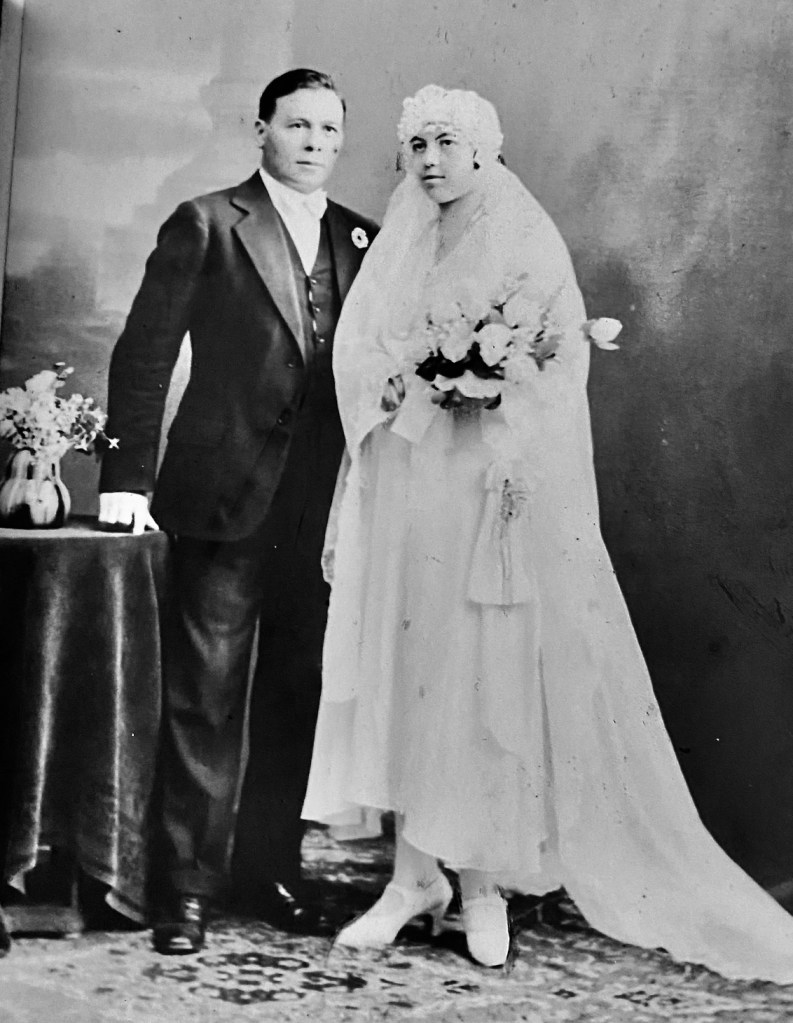
Mathias had brown eyes, brown hair, and was five foot five. Agnes had blue eyes, brown hair, and was five foot three. He had emigrated to the United States some years before and was naturalized in 1929. He did well for himself and when the day came went back to his hometown Hamlesch to fetch the girl he had been waiting for to grow up. He was born in 1888. She was born in 1909. He was twice her age. It didn’t matter to either of them. They were second cousins. It didn’t matter to their Lutheran brethren. After a few months of romance, they exchanged vows in the big church in Hermannstadt near their hometown. He wore a dark suit. She wore a white dress. Agnes Kloos became Agnes Schaser on that day. She was ready for a new life no matter how hard it might be.
Hermannstadt was one of the original seven Transylvanian Saxon towns. According to legend, the Pied Piper brought about the towns with his flute. Fate leads everyone who follows it. He lured 130 children from the German town of Hamelin with his tunes, led them into a mountain, guided them underground the length of Europe, until they finally emerged from a cave in Transylvania. The children separated into groups and founded the first seven Saxon towns in the land.
All the towns in the Saxon lands of Transylvania were fortified. On top of that, all the churches were equally fortified. There were more than three hundred of them throughout Transylvania, both Romanesque and Gothic, built of brick and stone and most of them featuring a red tile roof. The village hall, school, and grain storage barns were always clustered around the church. The churches were usually built in the middle of town, often on a mound or a hill, with water tranches, multiple walls, and at least one tower The tower was for a bell, for observation, and for throwing rocks and pouring boiling oil on invaders. The fortified churches were the last resort and refuge.
The Saxons, even though they weren’t all Saxons, came from the Low Countries and Germany starting in the mid-12th century, before there was a Romania. It wouldn’t become a country until the late 19th century. When the Saxons arrived, it was a part of the Kingdom of Hungary. The colonization of Transylvania by Central Europeans, who later became known as Transylvanian Saxons, began during the reign of King Geza II in the 1140s. He recruited them as migrants to farm the valleys and exploit copper and iron ore mining in the northeast. They were also expected to help defend against marauding steppe tribes. They weren’t successful against the Mongols, but learned their lesson. When the Ottoman Turks showed up, they were ready for them. They made their stand in their fortified churches. It was every man for himself and God against all.
Mathias and Agnes took a train from Bucharest to Berlin, made their way to Bremen, steamed up the Weser River, and crossed the Atlantic Ocean. Whenever Agnes wasn’t throwing up over the side, Mathias sat her down teaching her the English language. They landed in New York City in mid-May, where they spent the rest of the week seeing the sights, going to the top of the newly built Empire State Building, strolling the length of Central Park, and feasting on Nathan’s hot dogs at Coney Island. On the Monday of the next week, they took the Empire State Express to Cleveland’s Union Terminal.
Until she arrived in Berlin, Agnes had never seen a train station bigger than a platform. Berlin was big, but she had been struck dumb by New York City’s Grand Central Terminal. When she got to Cleveland she was struck dumb again by the size of the train station there. More than 2,000 buildings had been demolished in the early 1920s to make room for the underground station and the 52 story Terminal Tower skyscraper built on top of it. It had been the second-largest excavation project in the world after the Panama Canal. The Terminal Tower, the tallest building in North America outside of New York City, opened to its first tenants in 1928. Everything was new as well as being new to Agnes. The United States she had come to was colossal, beyond anything she had ever imagined.
Although she realized she might never see her family again, she was relieved to be gone from Transylvania, where trouble was brewing. The problem was, Transylvanian Saxons weren’t Romanians. The ethnic minority was one of the oldest German-speaking groups of the German diaspora. Before 1867 Transylvania had sometimes been autonomous and sometimes in union with Hungary. After the Compromise of 1867 it was incorporated into the Austro-Hungarian dual monarchy. After the uneasy royal alliance came to an end at the end of World War One, the Romanian majority in Transylvania clamored for unification with the Kingdom of Romania. The Treaty of Trianon in 1920 ratified it. The nationalist aspirations of the Romanians, however, ate away at the independence of the Transylvanian Saxons. The writing was on the wall.
Saxons had been leaving Transylvania in large numbers since the late 19th century. Many of them went to Cleveland, where they formed a fraternal organization called Erster Siebenburgen Sachsen Kranken Untersteutszung Verein, which meant First Transylvanian Saxon Sick Benefit Society. It was a mouthful no matter the language. The immigrants were determined to take care of their own. They purchased a sprawling old house on Denison Ave. in 1907 and converted it into what they called the Sachsenheim. They expanded and renovated it in 1925, adding two bowling alleys, a ballroom, a music room, a dining room, and a restaurant.
The married couple settled down on the west side of Cleveland, which was the side of town where most of the city’s Transylvanian Saxons lived. Mathias operated a confectionary shop on Clark Ave., a fifteen minute walk from the Sachsenheim. He sold Big Hunks, Tootsie Rolls, and Chick-O-Sticks. There was chocolate galore. There was a soda counter. Agnes gave birth to their first son Harold at City Hospital. Everybody called the boy Hal. Mathias and Agnes scrimped and saved, setting money aside for a new family home. She gave birth to their second son William in November 1933. Everybody called the boy Willie. Two days later, after the baby was safely delivered, her husband Mathias was shot twice at point-blank range. He died in the middle of the night in City Hospital where Agnes was still recovering from Willie’s birth.
“You mustn’t stay here any longer,” Agnes had told her husband when he visited her earlier that day at City Hospital. She was supposed to stay in the hospital a few days more. “You go back to the store. We will have to have more money now.” He went back to the store. He planned to return for his wife and child by the end of the week.
Two teenagers, Pete Wanach and Pete Hansinger, walked in when Mathias was closing his shop, and demanded the day’s receipts. It was a hold up. When Mathias refused to give it to them, balling up his fists, one of them pulled a handgun and shot him dead. They scooped up all the one dollar bills and change in the till and fled. The Cleveland Police apprehended them soon enough. They were tried, found guilty of murder, and sentenced to life imprisonment in the Ohio State Penitentiary. Pete Hansinger had a teenage wife who was pregnant. She gave birth soon after he started serving his life sentence,
Pete Wanach offered Agnes a one hundred dollar bond after his conviction. She refused to accept it. “I told him, maybe you have a mother or a sister who needs it more.” Pete Hansinger sent her a Christmas card from the penitentiary. She returned the favor. “Maybe it will make him feel better,” she said.
Agnes soon married again, tying the knot with Joe Levak, a Slovak from the east side. They moved to that side of town and rented a small house. She decorated the house with cheap landscapes and Bavarian China. She gave birth to two daughters one right after the other. The house was filled to the gills with life. She and her husband had their hands full. After five years of marriage, Joe Levak suddenly died in 1940. Agnes never remarried. She raised her family on a Mother’s Pension, which was $90.00 a month.
“I taught my sons to be forgiving, not to be bitter,” she said. “We got along all right. They started delivering newspapers when they were 10 years old. They finished high school even though they always worked part-time at a bakery.” On top of that, her sons had to play the violin. Agnes played it and her sons had to learn the instrument at her insistence, although Willie threw a temper tantrum and was soon excused.
“You can’t carry a tune, anyway,” Hal told his younger brother.
Hal was 13 years old in 1944. His middle name was Mathias, the same as his father’s given name. It was an Indian summer day in October. He was walking home from his 7th grade class at Wilson Junior High. He was looking forward to a bowl of potato tarragon soup. Agnes had brought the recipe from Transylvania. She made it with smoked ham. Hal was nearing his house when he was almost knocked off his feet by a thunderous blast. When he steadied himself and looked around, he saw roofs on fire.
“It was like the sky blew up all at once, like blood and guts,” he said. Thick black smoke turned the day to night. Hal’s dog Buddy ran up the front steps and pawed at the door. Agnes bolted out of the house. Buddy ran into the house and down to the basement. Agnes’s daughters stood in the doorway bawling. Willie came running from the backyard. Hal ran to his mother on the front lawn. They all looked up at the red sky.
The explosion and subsequent fires far and wide were caused when an East Ohio Gas liquefied natural gas storage tank started leaking. The gas flowed onto the concrete lot below the tank and began to vaporize. It turned into a thick white fog. It somehow ignited. It might have been a spark from a passing railcar or somebody lighting a cigarette. The deafening blast blew the tank and everything near it to smithereens, starting with the two men working on top of it.
It happened at the foot of East 61st St .near the New York Central Railroad tracks. When the gas exploded it blew up at about 25 million horsepower, the same as the combined output of all the hydroelectric plants west of the Mississippi River in 1944. One hundred year old oak trees were knocked down instantly. Cleveland streets convulsed four miles away. Flames reached 3,000 feet high and the heat reached 3,000 degrees Fahrenheit. Birds were turned to charcoal and fell out of the sky.
Agnes and her brood lived on East 66th St. and Lexington Ave., less than a mile from the East Ohio Gas tank farm. White ash trees on their street were on fire. Agnes was dead set on not losing her house. She started spraying garden hose water on it. From the front lawn she watched a tangled mass of cars, busses, and Clevelanders on foot slogging away from the fire. Police, fire, and civil defense cars and trucks raced towards the fire, which was spewing gas, molten steel, and rock wool into the sky.
Housewives were caught unaware as flames spread through sewers and up their drains. When that happened, homes were suddenly on fire. “I was getting ready to do some housework” said Alice Janos, one of Agnes’s neighbors. “Suddenly it seems like the walls turn all red. I look at the windows and the shades are on fire. The house fills with smoke. I think the furnace has blown up, but then I see smoke all around the neighborhood.”
Less than a half hour after the first explosion, a second tank exploded. It knocked Agnes down, but she got back on her feet right away. Whenever things were going to hell she kept going. She had lost two husbands. She was determined to not lose her house. She sprayed it with the garden hose until the water pressure turned to nothing. Gas ran into the streets, into the gutters, and down catch basins, igniting and blowing up wherever it pooled. Manhole covers were sent flying like bottle rockets. Utility poles bent in the heat. Fire trucks fell into sinkholes. The land of dreams had turned into bad dreams, but Agnes’s house was saved. The family didn’t have to shelter at Wilson Junior High. It was one of the schools where the Red Cross ended up taking in thousands of suddenly homeless men, women, and children. It was more than a week before children were able to go back to school.
By Saturday morning the fire department had the conflagration under control. In the afternoon, even though Agnes had told them to stay near the house, Hal and Willie went exploring. All the stop signs and traffic lights were destroyed, but there was no traffic, anyway. Soggy hulks of cars and trucks were pell-mell everywhere. Dogs sniffed at flotsam. Fire hoses littered every intersection.
“What happened to this place?” Willie asked. “It’s a mess. Do you think it was the Martians?”
“I don’t think it was the Martians,” Hal said. “Why would they come all this way to blow things up? Mom said it must have been Nazi sabotage.”
“This wouldn’t have happened if Superman had been here,” Willie said.
“Yeah, him and Captain America, too,” Hal said. “They got the moxie.”
Agnes spent the weekend airing out the house, washing the curtains, beating the rugs, and clearing the front and back yards of debris. She swept clumps of ash into the street. When she was done it looked like not much had happened. Her framed wedding picture, Mathias and her, taken in a photography studio in Hermannstadt in 1931, had fallen off the fireplace mantle. The glass was broken. She walked nine blocks to an open hardware store and replaced the glass. When she got home she gave her long-gone first husband a kiss and put the picture back on the mantle.
Pete Wanach and Pete Hansinger, who had shot and killed Mathias Schaser, were paroled in 1955. They were middle-aged men by the time they were released. When Agnes was told the news she wished them well. “I have a happy life and my four children. I hope these men, too, can find good jobs and become good citizens.” She forgave them.
In the meantime, she kept her eyes open for good husbands for her daughters and good wives for her sons. The future was coming up fast. She prayed that when they walked up the aisle and took the plunge they would land softly and not get hurt.
Photograph: Mathias Schaser and Agnes Kloos, 1931, Transylvania
Ed Staskus posts monthly on 147 Stanley Street http://www.147stanleystreet.com, Made in Cleveland http://www.clevelandohiodaybook.com, Down East http://www.redroadpei.com, and Lithuanian Journal http://www.lithuanianjournal.com.
“Cross Walk” by Ed Staskus
“Captures the vibe of mid-century NYC, from stickball in the streets to the Mob on the make.” Sam Winchell, Beyond Fiction
Available on Amazon: https://www.amazon.com/dp/B0CRPSFPKP
Late summer and early autumn. New York City, 1956. President Eisenhower on his way to the opening game of the World Series. A hit man waits in the wings. A Hell’s Kitchen private eye scares up the shadows.
A Crying of Lot 49 Publication

 Made in Cleveland