By Ed Staskus
I started playing racquetball in my mid-20s, at Cleveland State University, while taking my mandatory physical education class. I got good enough to play on an intramural team and some small tournaments around town. By the time I had played enough and worked my way through the B and A divisions to the Open division, I was in my 30s and getting too old to play in the Open division. It took a year-or-so of beating my head against the wall, but when the discontent went away I started playing in the 30-plus division.
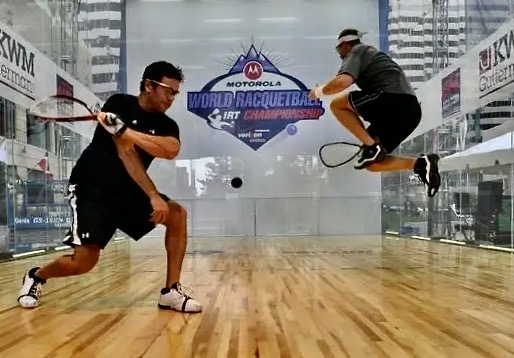
Racquetball is played with a small rubber ball on an indoor 20-foot-wide by 40-foot-long court. It is basically a box made of concrete or laminate with a hardwood floor. A door is set flush in the back wall, the wall sometimes made of tempered glass. The floor, walls, and ceiling are legal playing surfaces, with the exception that the ball off the racquet must not hit the floor first. Hinders are interference. It happens when somebody gets in the way. Unlike tennis, there is no net to hit the ball over, and, unlike squash, there is no out of bounds tin at the bottom of the front wall requiring the ball be hit above it.
The game’s roots are in handball and Squash 57, a British game sometimes called racketball. Joe Sobek invented what would become racquetball in 1950, adding a stringed racquet to the game of paddleball in order to increase velocity and control. At the start he called his new sport Paddle Rackets. He was the first person to be inducted into the Racquetball Hall of Fame.
When I started playing, the school supplied racquets, which were warped antiques that generated little velocity. Controlling the ball with them was along the lines of magic realism. Playing a game took forever because nobody could score points, unless it was by accident. Fortunately, Ektelon was on the way.
Founded by Frank “Bud” Held, it was one of the first manufacturers to go big in a still small sport. Working from his garage in San Diego, he got his start designing and patenting a new kind of stringing machine. Ektelon introduced their first racquetball racquet in 1970. The next year they made the first ever racquet of high-strength aluminum. Six years later they pioneered hand-laid composite racquets and six years after that the first oversized models. They became foremost in the hearts of racquetball players.
Ektelon racquets made a fast game even faster. The leading amateurs and top pros regularly hit drive serves in the 130-and-up MPH range. Even club players hit serves and set-up shots at 90 MPH and better. There is no outrunning the ball. Fortunately, given the parameters of the court, there isn’t far for the ball to run.
Not only is it a flat out fast game, it works every muscle group known to man. The arms and upper body are involved in hitting the ball, legs are involved in getting to remote spots where the opponent has sent the ball, and the core is involved in keeping legs and arms on the same page. The more I played the better my balance became as my hip and leg strength improved. I became more flexible, too, stretching before and after matches so I could contort and lunge for difficult shots. My hand-eye coordination got better. I developed some playmaking skills.
They weren’t classic life skills like reading, writing, and arithmetic, but they were classic skills for staying relevant on the racquetball court. The game is good for staying trim, too, since it is aerobic involving constant motion, burning up to 800 calories an hour. On the other hand, burning a boatload of calories isn’t so great at tournaments, which require not only playmaking to get to Sunday’s semi-finals and finals, but stamina to endure the Friday and Saturday matches and so make it to Sunday.
I asked Danny Clifford, a heavy hitting high seeded Open player from Cincinnati, how he did it, usually making his way to Sundays. He was about the same age as me. He never looked the worse for wear at tournaments. Whenever I made it to a Sunday, I looked bedraggled for days afterward.
“You don’t want to see me Monday mornings,” he said. “I usually have to roll out of bed and crawl on all fours to the bathroom, where I run a hot bath and soak for as long as I can before I need to go to work. If I didn’t have a cushy enough job, I wouldn’t be playing in tournaments.”
Playing in an age division was the best thing I could have done. It wasn’t that anyone’s shot making was any the worse, but they were slowly and surely becoming slower like me and got sore and achy just as fast as me. They recovered slower, too. They didn’t party hardy Saturday nights anymore, opting for a good night’s sleep, instead. Dave Scott, my doubles partner when I played doubles, was an exception. His motor was along the lines of his Oldsmobile’s V8.
Dave was the student at Cleveland State University with whom I started playing racquetball. I was an English and film major and he was in the accounting program, not that anybody could tell by looking at him. He wore his clothes loose and his hair long and smoked marijuana. When we started playing doubles together racquetball was the fastest-growing sport in America. Entrepreneurs around the country were busy building courts. Back Wall clubs popped up like mushrooms around northeast Ohio. The sport expanded internationally thanks to its fast pace and high intensity. The first world championship was held in 1981.
“It’s the hottest recreational sport in America, spearheading the whole fitness craze,” said Marty Hogan, the world’s top-ranked player at the time.
We didn’t know it was happening, but something happened to the hottest recreational sport over the course of the 1980s. Even though there were more than 12 million participants in 1982, the boom was over. Aerobics and body building “had a definite impact” on racquetball, said Chuck Leve, editor of National Racquetball Magazine. “You have to understand that a lot of people do things that are ‘in.’ There was a time when racquetball was the thing to do. The people who played racquetball because it was a fad are long gone.”
The morning Dave and I were scheduled to play a semi-finals doubles match at the Hall of Fame in Canton was a sunny mid-spring Sunday morning. it was a men’s Open match at one of Ohio’s biggest racquetball clubs. I got up early, drove to his house, parked on the street, and knocked on his back door. With one thing and another, by the time we got into his Rocket 88 it was 10 minutes after 9. Dave drove big cars with plenty of legroom and beefy engines. The match was scheduled for 10 o’clock. The club in Canton was an hour away.
“Don’t worry, we’ll be there with time to spare,” Dave said. When we pulled onto the highway I found out why he was so confident. He flattened the accelerator pedal and sped to Akron at 90 MPH. He slowed down going through Akron, but once we were just south of it, he picked it up a notch, hitting 100 MPH an hour. Even though there were few cars on the road that early in the morning I gnashed my teeth and hung on to the ‘Oh God!’ handle above the passenger door. My takeaway coffee got cold. We walked into the club with 5 minutes to spare.
The Hall of Fame was a large club with 25 racquetball courts, among other things like tennis courts, basketball courts, and a swimming pool. We were at one of the glass back walled courts ringing the lobby, putting on our sweatbands and sticky gloves, when Kelvin Vantrease strolled in. He had two blondes with him, one on each arm. Heads swiveled as he strolled towards the locker room. Only Kevin Deighan, an Open player from Mentor who hit line drives and nothing but line drives, kept himself to himself. He was a staunch Republican and didn’t suffer rascals, unless they were good for his wallet.
Kelvin Vantrease looked like he had been up all night. He was scheduled to play on one of the two center courts in an Open semi-final singles match at the same time as us. He looked like he needed a nap, a shower and shave, and a fisherman’s breakfast. He didn’t look like he was going to unleash his vaunted forehand anytime soon. I couldn’t have been more wrong. There was thunder in his shot-making that morning and it was all over before his opponent knew what hit him.
I played Kelvin in an Open quarter-final match once. He crushed me in the first game. I eked out the second game, mostly because he was horsing around and I wasn’t. I scored the first point of the tie breaker. Feeling my oats, I served again, tempting him with a lob serve. He didn’t take the bait, we rallied, with Kelvin hitting the ball harder and harder and me trying to match him. I don’t know what got into me, but I started diving for the ball whenever I couldn’t get to it on my feet. I finally left a floater that hung around the front of the court. He attacked it, taking it out of the air hip-high, hitting a splat shot, and barking, “Return that!” I didn’t return it and didn’t score another point.
A couple of years later the four-time Ohio junior racquetball state champion and 1984 United States doubles champion needed surgery. “When I had back surgery for a ruptured disc, the doctor told me I would never play sports again,” Kelvin said. ”I had never planned to go pro or even play much on the amateur level, but when someone tells you that you can’t do something, it makes you want to do it more.”
He bought a motor home and supported himself giving lessons, churning out up to 40 of them a week. ”I’m like a rat,” he said. ”I can adapt. If I can live in a motor home for three years, I can live anywhere.” Half-Dutch, half-Cherokee Indian, he trimmed his Samson locks and cut down on the cornpone, like playing with a frying pan instead of a racquet and wearing swimming flippers instead of sneakers. He started playing tournaments again and by 1986 stood second in the men’s Open national rankings.
Our doubles match turned out to be the match of the day. The men’s and women’s single’s finals were scheduled for the early afternoon. Other matches were going on, but ours went on and on and drew a crowd, in part because of the commotion.
Our opponents were a lefty righty team, making it tough on us. Right from the start Dave did not like the lefty, who was a walking rule book. Hinders are inevitable when playing doubles and the rule book and his partner were no exception to the rule. They were worse. They were both hefty men and phlegmatic. They had no problem with never giving way. There were hinders galore. Dave took it in stride in the beginning. Then he started to seethe and smolder. Then he went off. He argued with them and started harping on the referee about blown calls. The referee put up with it for a while but finally ripped up the score sheet and tossed the crumbs down on the court, walking away. Another referee was rustled up.
Refereeing was voluntary although the losers of the previous match on the same court were expected to referee the next match. The second referee did the best he could but wasn’t able to control or put up with the repeated flare ups, by now involving all four of us on the court. The crowd grew when a third referee had to be recruited. It was standing room only. There was cheering and catcalls, clapping and jeering, hoorays and laughter.
We went to a tiebreaker game before finally losing by one point. It was an exciting match. The walking rule book was smug about their victory. Dave was gracious except on the ride home when he vented spleen for ten minutes before lighting up a blunt and calming down. I drank a bottle of Gatorade to keep from cramping up and took a toke to be companiable.
I continued to practice and play and got a job at the Back Wall in Solon as an Activities Director so I could practice and play for free. I met others around town who were willing to play practice matches with me. Kevin Deighan and Gaylon Finch played in Mentor. Bobby Sanders and Jerry Davis played in Cleveland Heights. Steve Schade and Dominic Palmieri played in Middleburg Heights. At my home club I gave lessons, although there was no need to give lessons to local boy Doug Ganim, who was half my age and twice the playmaker. His t-shirts were emblazoned with “Eye of the Tiger” on the back. His backhand was already a rally killer.
Over the years he reached the finals of the National Doubles Championships eight times with four different partners, winning the national title four times. He is considered one of the best right-handed left-side players to have ever played the game, all the while promoting the sport as an executive for Head/Penn Racquetball for 28 years and as the President of the Ohio Racquetball Association for almost as long.
I played racquetball through most of the 1980s, although not as much and not nearly as many tournaments as I had earlier in the decade. I started riding a mountain bike and was thinking of trying yoga. I began playing squash and one day put my racquetball gear away for good. Dave continued to play the game and play well with his old-school all-steel Dayton racquet. After a time it became the only one of its kind left in existence.
My wife and I bought a house in Lakewood and I put my nose to the grindstone. I played squash whenever I could at the 13th Street Racquet Club in downtown Cleveland and found more than enough competition because many of the better players in the city played there. It was only a 10-minute drive from home instead of driving all over town looking for a skirmish inside the box. They had a Nautilus circuit and a running track. They had a sauna. They had food and drink at the bar for afterwards. It was a one-stop shop.
The only thing squash didn’t have was a kill shot or a rollout. A kill shot in racquetball is hit low and bounces twice in the blink of an eye coming off the front wall. It is nearly impossible for an opponent to return. A rollout is hit so low that it rolls back flat after hitting the front wall, never bouncing at all. It is like a fingertip touchdown catch in the back corner of the end zone, irremediable and final.
Although squash is a gentleman’s game, gentlemen with squash racquets can be hardhearted at the drop of a top hat. Some of them are patient wolves, the most dangerous in the animal world. The game has its own pleasures, like long rallies vying for position, but nothing like the pleasure of ending a rally with a perfect kill shot, rolling it out, and going Foghorn Leghorn.
“Try and return that, son!”
Ed Staskus posts monthly on 147 Stanley Street http://www.147stanleystreet.com, Made in Cleveland http://www.clevelandohiodaybook.com, Atlantic Canada http://www.redroadpei.com, and Lithuanian Journal http://www.lithuanianjournal.com.
“Bomb City” by Ed Staskus
“A Rust Belt police procedural when Cleveland was a mean street.” Sam Winchell, Beyond Fiction
Available on Amazon: https://www.amazon.com/dp/B0F1LM1WF9/ref=sr_1_1?crid=2MYAQAOZIC2U9&dib=eyJ2IjoiMSJ9.hTm7BGbiQbSe5ZapFwYPPfcwOpTe-Vdg6VLE4aGyTyk.Z0R-VNBWWEcvKcNaO9LdCOUnNIOOXgvYkRS_FXiXuHk&dib_tag=se&keywords=bomb+city+ed+status&qid=1742136726&sprefix=bomb+city+ed+staskus%2Caps%2C84&sr=8-1
Cleveland, Ohio 1975. The John Scalish Crime Family and Danny Greene’s Irish Mob are at war. Car bombs are the weapon of choice. Two police detectives are assigned to find the bomb makers. Nothing goes according to plan.
A Crying of Lot 49 Publication


 Made in Cleveland