By Ed Staskus
The documentary “Night and Fog” is 32 minutes long, unless it’s watched thirty times in a row, which makes it 16 hours long. I was studying literature and film at Cleveland State University in the late 1970s when I saw it for the first time and the thirtieth time. It had been made twenty years earlier by the French filmmakers Jean Cayrol and Alain Resnais. It is about the Nazi concentration camps of the 1940s, specifically Majdanek and Auschwitz. It is a monster movie without the pretend.
The reason I watched “Night and Fog” thirty times successively by myself in a small dim room wasn’t because I was especially interested in World War Two or the Holocaust. In fact, the documentary spooked the hell out of me. Dennis Giles, the one and only professor of film in the Communications Department at Cleveland State University, had suggested I write a paper about it. He made me a teacher’s assistant so I could have a closet-sized office on the 16th floor of Rhodes Tower down the hall from his office. In return, I screened motion pictures for his film classes, which was hardly a chore. The rest of the time, which was most of the time, was my own.
Nazi Germany and its Axis allies built thousands of concentration camps and other incarceration and extermination sites between 1933 and 1945. They stayed busy as killer bees. Majdanek was outside Lublin, Poland and run by the SS. The SS were the black-uniformed and self-described “political soldiers” of the Nazi Party. There were many gallows and seven gas chambers. Auschwitz was also in Poland, a complex of forty camps. It was run by the SS, too. It had more gallows and more gas chambers. The camps were what the Nazis called the “Final Solution to the Jewish Question.” They asked themselves the question and dreamed up the answer among themselves. The camps were also the solution about what to do with gypsies, homosexuals, Russian prisoners, and anybody else who got in the way of the Third Reich.
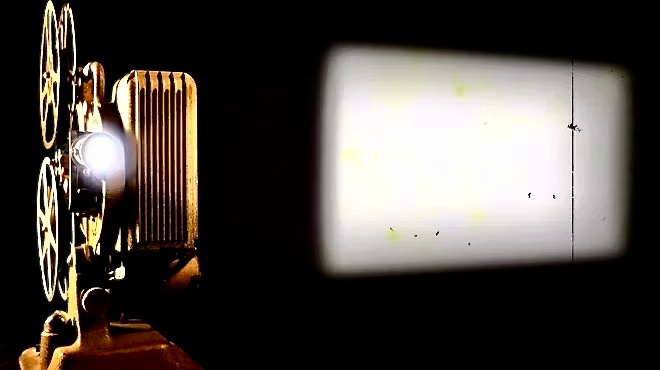
My teacher’s assistant office was no-frills cinderblock, like the grind houses of the 1960s and 70s, which were old movie houses in bad neighborhoods showing low-budget horror movies. I was given access to a 16mm projector and a spotless copy of the documentary. It was the only thing clean about it. If the Nazis thought they were cleaning up the world, they had a dirty way of doing it. There was a method to their madness, but it was madness, nevertheless.
Dennis Giles graduated from the University of Texas with a master’s degree. His thesis was “The End of Cinema.” He got a Ph.D. from Northwestern University and then showed up in Cleveland. He was tall, thin, lanky, dressed like a beatnik, and smoked like a chimney. He lived in Ohio City near the West Side Market. The neighborhood was a mess, but in the past ten years the Ohio City Redevelopment Association had gotten more than a hundred structures restored or redeveloped. Houses were being refurbished by the young upper middle-class, proto Yuppies, leading to complaints of gentrification.
If Dennis Giles was part of the gentrification, he didn’t look the part. He looked scruffy as a beatnik. He looked like he had spent too much time watching movies by himself. He was a member of the National Film Society. He liked to say film was art and television was furniture. He didn’t mean the furniture was any good, either.
It took me a few days to figure out how to tackle the project. I finally decided to do a shot-by-shot analysis, zeroing in on how the shots were the brick and mortar of the scenes and sequences. I reasoned that if I tried writing about the gruesome nature of the subject, I would never get out of the weeds.
The film goes back and forth between past and present, between black-and-white and color, with some of it shot by the filmmakers and some of it stock footage. The first shot is of a deadpan sky. The camera tracks downwards to a dreary landscape. It then tracks to the right and stops on strands of barbed wire. The second shot is of a field with a line of trees on the horizon. “An ordinary field with crows flying over it,” the narrator says. But it’s not an ordinary field. The camera again tracks to the right revealing posts with more barbed wire strung from post to post. The wire is electrified. The third shot tracks from an open road once more to the right to another tangle of more wire.
After a while the tracking shots to the right and the wire everywhere start to look like a normal landscape. “An ordinary village, a church steeple, and a fairground. This is the way to a concentration camp,” the narrator says. When he says “steeple” the shot on screen is of an observation tower, machine guns at the ready.
The city of Siaulai is in the north of Lithuania, which is north of Poland. It is home to the Hill of Crosses. It is place of pilgrimage, established in the 19th century as a symbol of resistance to Russian rule. There are more than 100,000 big and small crosses on the hill. During World War Two almost every single Jew who lived in Siaulai bore his own cross. Most of the natives didn’t worry about them. They had more than enough of their own problems to worry about, squeezed between the Nazis and the Communists.
My father was born in the mid-1920s and grew up in Siailiai. His father was the police chief who was swept up by the Russians in 1941 and deported to a Siberian labor camp for ideological reasons. He never stood a chance. He died of starvation the next year. My father was in his mid-teens. He had to take over the family farm. When the Germans invaded, capturing and imprisoning vast numbers of Red Army troops, he applied for and was granted labor rights to a dozen of them. There were severe manpower shortages. The Russians worked 12-hour days and slept in the barn. When they groused about the work, he passed out Bulgarian cigarettes and bottles of vodka. When they escaped, the Germans gave him more men and told him to lock the barn doors.
The first part of “Night and Fog” is about the rise of fascist ideology in Germany. The second part contrasts the good life of loyal Germans to the travails of the concentration camp prisoners. The third part details the sadism of the captors. The fourth part, all in black-and-white, is about gas chambers and piles of bodies. It is nothing if not dreadful. Even the living are bags of bones in their dingy barracks. The Nazis shaved everybody’s heads before they gassed them. They said it was for lice prevention and that the gas chambers were showers. They collected and saved the hair. It was used to make textiles at factories in occupied Poland. The last part is about the liberation of the camps and the bearing of responsibility.
Everybody, even the next-door neighbors, said they didn’t know anything about the camps, or if they did, were just following orders. “We SS men were not supposed to think about these things,” said Rudolf Hoss, the commandant at Auschwitz. “We were all trained to obey orders without even thinking, so that the thought of disobeying an order would simply never have occurred to anybody, and somebody else would have done it just as well if I hadn’t. I never gave much thought to whether it was wrong. It just seemed a necessity.”
The next shots of the film are of the rail lines to the camps and their gates. “All those caught, wrongly arrested, or simply unlucky make their way towards the camps,” the narrator says. “They are gates which no one will enter more than once.” The train tickets were all one-way. There was a 16-foot wide sign above the entrance gate to Auschwitz that said, “Work Makes One Free.” It didn’t say what kind of work.
After World War Two started and the Nazis incorporated the Baltics into the Reich Ostland, there were about 240,000 Jews in Lithuania, about 10% of the population. The first thing the Einsatzgruppen did was start gunning them down in the countryside, aided by Lithuanian auxiliaries. By August 1941 most of them were dead or gone to ground. Then the SS killers started in the cities. There wasn’t a lot of search-and-destroy involved, so the grim business didn’t take long.
“Gangs of Lithuanians roamed the streets of Vilnius looking for Jews with beards to arrest,” said Efraim Zuroff, who didn’t wear a beard but whose wife and two sons were taken to Likiskis Prison and shot. Karl Jaeger, the commander of an Einsatzgruppen unit that did its work in Vilnius, kept an account book of their work. On September 1, 1941, he recorded those recently killed as “1,404 Jewish children, 1,763 Jews, 1,812 Jewesses, 109 mentally sick people, and one German woman who was married to a Jew.” When the war finally ended there were only 10,000-some Jews left in Lithuania, slightly more than 0% of the population. It was the largest-ever loss of life of any group in that short a period in the history of the country.
The middle shots and scenes of the film are without narration. They show crowds of disheveled people being strong-armed into boxcars. The last shot is of a father leading his three children along a railroad platform. The father looks resigned and the children look bewildered. They are shoved into a boxcar. “Anonymous trains, their doors well-locked, a hundred deportees to every wagon,” the narrator says. “Neither night nor day, only hunger, thirst, and madness.”
The Nazis occupied Siauliai in 1941. All the Jews were made to wear a yellow Star of David on their chests. Their children were forbidden to go to school. Their businesses were taken away from them. At the end of summer, the Einsatzgruppen and Lithuanian auxiliaries rounded up more than a thousand Jews, took them to a forest, ordered them to strip, and shot them down like dogs. They shoved their naked bodies into open pits. When the shooters left, they took all the watches, jewelry, wallets, and purses with them. “Today the sun shines,” the narrator says in the 70th shot of the film, tracking through the sunlit trees. “Go slowly along, looking for what? Traces of the bodies that fell to the ground?”
The rest of the town’s Jews were made to move into a ghetto. Two years later two thousand adults and a thousand children were transported to Auschwitz and gassed. The next year the few of them left were sent to the Stutthof concentration camp. That finished off the Jews in Siauliai, once and for all.
Nearing the end of the film the narrator asks, “How discover what remains of the reality of those camps, shrill with cries, alive with fleas, nights of chattering teeth, when they were despised by those who made them and eluded those who suffered there?” One of the last shots is of a macerated man lying on his side on the ground and drinking something from a bowl. “The deportee returns to the obsession of his life and dreams, food.” The next shot is of a dead man, legs akimbo in the mud, ignored by those around him. “Many are too weak to defend their ration against thieves and blows. They wait for the mud or snow. To lie down somewhere, anywhere, and die one’s own death.”
My father fled Siauliai for East Prussia when the Red Army swarmed the country in 1944. His two sisters and mother were already on the run. One of his sisters made it to Germany, the other sister didn’t, going into hiding, while his mother was arrested and sent to Siberia, where she remained for the next ten years. Even though he fled with almost nothing except a handful of cash, a few family photographs, and a change of clothes, he had nothing to lose. The Russians would have shot him on the spot if they had captured him.
Like most Lithuanians my father had no use for Jews. He never had a good word to say about them. He never let on to me, and never talked about went on in Siauliai, except as it related to his family, but I caught enough snatches of talk at parties, community events, and get-togethers to know what the score was. My father wasn’t a bad man, just like most Lithuanians weren’t bad men and women. He wasn’t any different than most people. He worked hard to support his family, community, and country. He was a Boy Scout leader and helped get the local church and parochial school built.
The film ends with aerial shots of Auschwitz. It is 1945. The war is almost over. “There is no coal for the incinerators The camp streets are strewn with corpses.” One of the last sequences shows captured Nazi soldiers lined up by Allied forces outside a concentration camp. All of them look sullen and demoralized. Many of the soldiers are women. They carry rail thin corpses slung over their shoulders, throwing them into a pit, and going back for more. You never realize how thick the murk is until it lifts. Prisoners barely alive but suddenly free stand next to useless strands of rusting barbed wire.
In a Nuremberg courtroom one after another Nazi official says he was not responsible. “Who is responsible then?” the narrator asks. The Master Race all look like somebody’s bland Uncle Ernie. Nobody responsible says anything, although many at least were convicted of war crimes and hung. They should have been broken on the wheel and quartered for their evil deeds.
Short of cannibalism, what the Nazis did to those they herded into their concentration camps was the worst thing they could have done. After I finished my thirtieth viewing of every shot, scene, and sequence in the film, I wrote my paper and turned it in. I got an A- for misspelling some words. I got to keep my cubbyhole. I knew I wouldn’t watch the documentary ever again.
One groundhog day after another had gotten me down in the dumps. Enough was enough. I returned my print of “Night and Fog” to the university library. I caught my breath and went for a walk in the brimming light of day.
A version of this story appeared in Literary Heist Magazine.
Ed Staskus posts monthly on 147 Stanley Street http://www.147stanleystreet.com, Made in Cleveland http://www.clevelandohiodaybook.com, Atlantic Canada http://www.redroadpei.com, and Lithuanian Journal http://www.lithuanianjournal.com.
“Cross Walk” by Ed Staskus
“Captures the vibe of mid-century NYC, from stickball in the streets to the Mob on the make.” Sam Winchell, Beyond Fiction
Available on Amazon: https://www.amazon.com/dp/B0CRPSFPKP
Late summer and early autumn. New York City, 1956. President Eisenhower on his way to the opening game of the World Series. A hit man waits in the wings. A Hell’s Kitchen private eye scares up the shadows.
A Crying of Lot 49 Publication



 Made in Cleveland