Heart to Heart

By Ed Staskus

   When Francie Chmielewski’s husband Steve doubled over while putting his shoes on, she didn’t bother asking him if he was all right. “I have to sit down,” Steve had said in the backyard. It was a Sunday evening in late May. He was feeling a great deal of pressure on the left side of his chest. “I don’t think it’s my heart, but maybe we should go to Fairview Hospital.” One look at him fumbling and dropping his shoes on the steps of their kitchen told her everything she needed to know. He was not all right. He was having a heart attack.

   “Steve is a very fit man,” Francie said. He wasn’t a man so out of shape he might have a heart attack watching that day’s bad news on TV. “He doesn’t smoke, eats right, and rides his bike to work every day, even in the winter.” His bike ride to work takes an hour one way, from Rocky River to the near east side of Cleveland, and then another hour back home. Two days earlier, on a Friday, he complained to a co-worker about being out of breath during his ride. His co-worker urged him to call his doctor. Steve’s doctor said, “OK, come in on Tuesday.” 

   “What happened on Sunday was the widow maker,” Francie said. ”His main artery shut down.”

   Heart problems were one of the most uncommon causes of death in the United States until 1900. Heart disease had always been uncommon. Fifty years later it was the most common cause of death in the country. It became the go-to way to die. Everybody was smoking their heads off. Doctors routinely appeared in print and on the tube promoting their favorite fag. Everybody was eating as many animals as they could get their hands on. The protein was good. The saturated fat was sketchy. The off-the-chart serum cholesterol levels were terrible.

   It is still the most common cause of death in the United States, despite almost everybody having given up smoking and many former junk fooders eating a more balanced diet. “After I had a heart attack, it was a very simple choice,” said one-time football player and coach Mike Ditka. “What the doctor told me I did and I did it religiously. I ate nothing but lean turkey breast or chicken breast or a piece of fish that was very lean. I mean, I stayed away from everything.” The misguided popularity of maintaining an unhealthy weight has kept it in the top spot, as has the notion that exercising at least 30 minutes a day five days a week is fake advice.

   There is never a good time to have a heart attack. The worst time to have one might be during a game of charades. Steve wasn’t playing games. What was happening to him was sudden and massive. He was down and the clock was ticking. Around half of all heart attack deaths occur within one hour, especially if the victim isn’t able to get immediate help and get to a hospital fast. It is called the Golden Hour. The longer a person goes without treatment, the faster the clock ticks.

   “One day my father went hunting,” the French movie director Alain Resnais recalled. “He had a good day. He killed a lot of game. He was with his best friends. He said, ‘Ah, I’m still a good hunter.’ Then he said, ‘I don’t feel well.’ In 30 seconds, it was all over.”

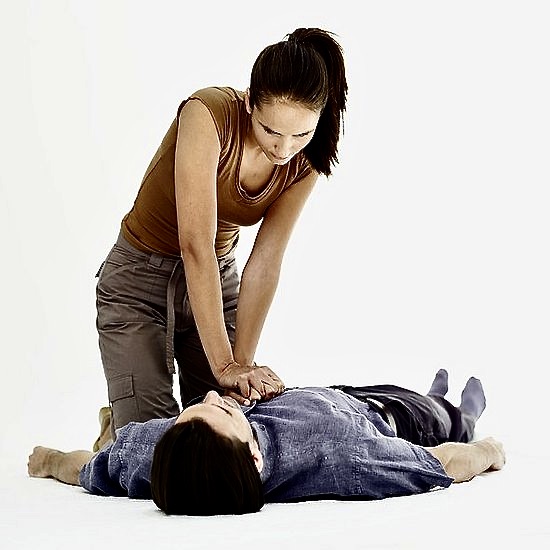
   Steve started to shake and his eyes rolled up and back. One of the issues with heart problems is that the first symptoms can be fatal. “This isn’t looking good,” Francie thought. She got serious as a heart attack and sprang into action. She had been ready for the moment for a long time. She stretched Steve out and began performing CPR on him, at the same time hurriedly calling 911 on her cell phone. She wasn’t the kind of wife who mailed in her request for help, checking the spelling before sealing the envelope. 

   “He had cardiac arrest,” she said. “His heart stopped. When I saw he wasn’t breathing my adrenaline kicked in. I just reacted.” When the Rocky River EMS team got there they checked his heart’s rhythm, gave him oxygen, and administered a blood thinner. They sped him to the hospital where he spent the next two weeks in the Intensive Care Unit flat on his back hooked up to a ventilator. “I never saw anybody like him,” an ICU nurse told Francie. “Most people in his circumstances die.” 

   “Steve isn’t most people,” Francie told the nurse.

  “The quicker we can get a person having a heart attack into the cardiac catheterization lab the better,” explained Erica Spatz, a cardiologist at Yale Medicine. “Time matters in treating heart attacks.” The heart pumps oxygen-rich blood to the rest of the body through a network of arteries. However, the arteries around the heart can get clogged up, usually by a blood clot. When that happens, blood flow is slowed or blocked. The obstruction is seriously dangerous.

   Nearly a million people in the United States suffer a heart attack every year. It happens about every forty seconds. The cost of care for coronary heart disease is more than $100 billion dollars annually. One of the least expensive and front of the line interventions is CPR. Francie was ready to bust it. “I teach CPR at the Rocky River Recreation Center,” she said. “But I never had to actually do it on a real person. I never thought the first time would be on my own husband.”

   CPR, officially known as Cardiopulmonary Resuscitation, is an emergency lifesaving procedure performed when the heart stops beating. It can double or triple the odds of survival after cardiac arrest. It is a critical step in what is called the Chain of Survival. Keeping blood flow active multiplies the chances of a successful resuscitation once medical staff arrives. Professional CPR is about chest compressions and mouth-to-mouth breathing at a ratio of 30 compressions to 2 breaths. The basic recommendation to bystanders who happen upon a heart attack victim is hands-only CPR until help arrives.

   After two weeks in ICU Steve was transferred  to a Step Down Unit at the Cleveland Clinic in Avon, where he stayed for a week-and-a-half. His last five days in the hospital were spent in rehab. One of his daughters was visiting him when a doctor walked in reviewing a chart. “This guy us really sick,” the doctor said to himself. Steve and his daughter dropped what they were doing and stared at him.

   “Oh, sorry, not you, somebody else,” the doctor said, stopping dead in his tracks, quickly flipping to Steve’s chart. “You are actually doing very well.”

   “The doctor told me he was doing well because he had never smoked, was more than fit enough for his age, and had gotten to the hospital soon enough to make a difference,” Francie said. “Only 12% of people with his kind of heart attack survive. If he had been a smoker he would have had a zero chance.”

   When Steve got home he wasn’t allowed some of the small pleasures of life, like ice cream and beer. He had to take a handful of prescription drugs every day. He was wired to a heart monitor. He wasn’t allowed to go back to work. He had to take several months off. “His doctor said he could go back in September.” He was allowed to work from home. “They said he could start working two hours a day starting in August. They told him not to overdo it.”

   He was hazy about what happened during his near-fatal weekend. “He can’t remember anything about it, from Friday through Sunday,” Francie said. Many of the memories surrounding heart attacks are lost to cardiac arrest survivors. They don’t always come back because the brain didn’t have enough time to store them. It’s like thinking about a fire hydrant factory. The brain can’t park anywhere near the place. It doesn’t always want to remember near death experiences, no matter that the ordeal tends to put things into perspective.

   In some ways life itself is a near death experience. Like the song says, the end is always near. Francie wasn’t patting herself on the back for saving her husband’s life. “I wasn’t sure if he had life insurance or not, so I had to do it,” she explained. Buddha long ago said in plain English that the act of saving a life was a greater good than spending the whole of one’s life making religious offerings to the gods.

   Steve spent the rest of the summer resting, walking up and down stairs, and making further strides with short walks outdoors. He progressed to varied aerobic activities designed to improve circulation, lower blood pressure, and strengthen his heart. Francie watched him like a mother hen. “He is the kind of man who pushes it,” she said. “I told him not to push it.”

   World Heart Day is celebrated every year on September 29th. This year Francie and Steve hope to enjoy the holiday together. Keep a healthy heart so we won’t be apart has become their new married couple motto.

Ed Staskus posts monthly on 147 Stanley Street http://www.147stanleystreet.com, Made in Cleveland http://www.clevelandohiodaybook.com, Atlantic Canada http://www.redroadpei.com, and Lithuanian Journal http://www.lithuanianjournal.com

A New Thriller by Ed Staskus

Cross Walk

“A once upon a crime whodunit.” Barron Cannon, Adventure Books

“Captures the vibe of mid-century NYC.” Sam Winchell, Beyond Fiction

Available on Amazon: https://www.amazon.com/dp/B0CRPSFPKP

Late summer and early autumn. New York City. A Hell’s Kitchen private eye. The 1956 World Series. President Eisenhower at the opening game. A killer in the dugout.

Bat Out of Hell

By Ed Staskus

   What I didn’t expect the hot summer night my wife, brother-in-law, and I went to the Lorain County Speedway was how loud the cars were going to be when the drivers stepped on the fast pedal, how bad the oil, gasoline, and rubber smelled in the humidity, how many crashes there were, and the fight that broke out on the track immediately after one of the crashes.

   The minute my brother-in law Matt sat down he pulled a pair of earplugs out of his pocket and pushed them firmly into his ears. We tried asking him where ours were, but he couldn’t hear a word we were saying. My wife and I finally decided to soak in the full experience, not like some people who couldn’t bear to enjoy the primal roar of engines going all out.

   The Lorain County Speedway is more-or-less in South Amherst, 30-some miles west of Cleveland, Ohio. It opened in 1949 as a third of a mile dirt oval. It was paved over in 1960. The night we were there the track had long since been upgraded to a 3/8-mile oval with 12-degree banking in the turns and a slight bank on the straightaways. It wasn’t NASCAR by any means, although NASCAR was the reason we were there.

   The racing at the Speedway that night was billed as street stock. I had never been closer to race cars than a TV screen, and the only reason I had ever gotten that close was because Matt came over our house every Saturday afternoon during the racing season, plopped himself down on our sofa, and for the next three, four, five hours watched brightly decaled handmade cars built from sheet metal with engines assembled from a bare block and frames constructed from steel tubing take tight left turns over and over and over at 200 MPH. The NASCAR four-wheelers resembled street stock about as much as cheetahs resemble wart hogs, even though both kinds of cars were essentially doing the same thing.

   The big story that summer was Jeff Gordon going up against Dale Earnhardt until it became the only story. Dale Earnhardt had won his seventh Winston Cup Championship in 1994 tying Richard Petty’s record for Cup Championships. Everybody was looking for him to win his eighth in 1995 and make history. It wasn’t to be, not with Jeff Gordon burning up the tracks.

   Jeff Gordon was young, only 24, but he had won the Coca-Cola 600 and the Brickyard 400 the year before. He wasn’t exactly wet behind the ears. He was off to the races. He landed in victory lane in three of the first six races of 1995. As the season wore on, he racked up 14 straight top ten finishes. Earnhardt was game, but the game was up. Gordon finished at the top of the board, the youngest champion since 1971. He toasted “The Intimidator” with a glass of milk instead of champagne, a nod to being barely legal.

   When he wasn’t watching NASCAR on TV, Matt and a school friend of his spent weekends driving to and camping out at nearby NASCAR events. They went to the Miller Genuine Draft 400 at the Michigan International Speedway, the Bud at the Glen at Watkins Glen, and the Mountain Dew Southern 500 at the Darlington Raceway. One weekend Matt asked if we wanted to go see some slam bang racing. We said alright, we’re not doing anything tonight, so long as it’s not out of state. He said it was close-by.

   The grandstand at the Lorain County Speedway was right on top of the racing. The bleacher seats were half full, like a high school football game where the fans are family and friends. There was a protective screen between the front row and the track. When I looked it up and down, I thought it might keep a flock of seagulls from assaulting us, but not a crate engine or the whole 3000-pound car. 

   “If one of those cars rolls and flips and comes up into the stands, that screen is going to stand the same chance as toilet paper,” I told my wife.

   “What?” she asked trying in vain to hear me over the noise.

   Five years earlier a man was killed and five people hurt when a race car went out of control and crashed into the pit area of the Lorain County Speedway. The man who was killed was another driver from another race. The driver of the wayward car said the accelerator on his car stuck, causing him to lose control on a turn. Eight years earlier at Talladega, Bobby Allison’s car going at the speed of light ran over debris and a tire burst. His car went airborne and smashed into the safety catch wall. Shrapnel sprayed the fans. From then on restrictor plates, which cap engine speeds from climbing too high and keep all race cars at around the same speeds, were made mandatory.

   The thought of shrapnel gave me the heebie-jeebies. My brother-in-law must have thought it through because he had led us to the second-to-last row. Even though the stands were only some twenty rows deep, it was better than nothing. The group of guys in front of us had their own cooler of hop juice. They offered us some. My brother-in-law didn’t drink, and my wife didn’t drink beer.

   “What the hey,” I said, accepting a Budweiser, my least favorite beer. Beggars can’t be choosers. In the heat of the night, to my surprise, the cold tasteless suds were delicious.

   My brother-in-law was a chemical engineer working in a General Electric lab in Willowick, but was transitioning to mechanical engineering, which meant going back to school part-time. He didn’t have a girlfriend, which meant he had time outside of work and school to take up a hobby. He bought a hulk of scrap metal that was once a 1970 Monte Carlo. His plan was to tear it apart piece by piece and rebuild it. Unfortunately, he didn’t have the space to get it done. Unfortunately, we did. The next thing I knew our two-car garage was a no-car garage. The hulk of scrap metal took up all the space. What space was left was devoted to a worktable, a tool locker, and an air compressor.

   He took the engine out. He took the seats out. He took the dash out. He took everything out and off the car. He built a rotisserie on wheels and fitted the frame to it, so he could wheel it in and out of the garage, working on it in our driveway. He sanded all the rust away and primed it. When the time came, he had the car hauled away and professionally painted. The color was Tuxedo Black.                                               

   When the weather turned foul, he turned a room in our basement into a work room, working on the engine and God knows what all else. He fabricated a new dash from scratch. He slowly but surely bought original parts and started to put the Monte Carlo back together. It took years and tens of thousands of dollars. Some nights, drifting off to sleep, we could hear him through our back window still working in the driveway in the glow of a bank of lights he had fixed up for the purpose.

   NASCAR race cars have almost nothing in common with street cars. By the 1990s they were being built to optimize aerodynamics. The focus was on speed. They stopped looking like stock cars. Stock car racing uses production models somewhat customized for racing purposes. It got started in the 1930s when moonshiners transporting white lightning souped up their Fords to evade revenue agents. One thing led to another, and they started racing each other on weekends on tracks carved out of corn fields.

   Street stock is racing a car that can be bought off a dealer’s lot. It is sometimes called hobby stock or showroom stock. Most of the tracks are short ovals, less than a mile. The speeds at the Lorain County Speedway that night hit 80 to 90 MPH on the straightaways, but slower in the turns. There were crashes galore in the turns. One of them happened in the turn coming around to the grandstand, when two cars bumped, tangled, and tore into each other. The driver on the outside track ran out of talent halfway through the turn. They both slid skidded to a stop in front of us. The drivers got out of their cars unhurt. When they did one of the drivers got hurt. 

   What happened was, when the two drivers got out of their banged-up cars, they started arguing. “What the hell, bumping me like that,” one of them yelled, his face red and splotchy.

   “I didn’t bump you,” the older of the two drivers said, calm as a fighting fish swimming back and forth in a tank. “I rubbed you. Rubbin’, son, is racin’.”

   They started pushing each other The younger driver got pushed too far out on the track and a car going slowly by under the caution flag ran over his foot. He fell to the ground and banged his head. Blood flowed down his chin. When he fell a woman bolted out of the stands, down the stairs, over the catch wall, and onto the track. She made a beeline for the older driver still standing.

   “This here is going to be trouble,” one of the men in front of us said cracking open another King of Beers.

   My brother-in-law’s 1970 two-door Chevrolet Monte Carlo was on a 116-inch wheelbase A-body platform with the longest hood Chevy had ever made. It stretched from the windshield to tomorrow. The styling was influenced by the Cadillac Eldorado, which came out in 1967. The Monte Carlo borrowed its firewall, dashboard, windshield, decklid, and rear window from the Chevelle. Matt’s model was an upgrade with a console-shift four-speed manual and a four-barrel-topped Turbo-Fire V-8 350 rated at 300 horsepower. It weighed in at 4,000 pounds curbside. It wasn’t built for baby showers. Shotgun weddings were more its speed. When I first heard the engine fire up so did all my neighbors within two or three blocks. Some of them came outside, standing on their lawns and in the street, looking up our driveway.

   “Mommy, what is that?” a boy driving a Little Tikes Cozy Coupe asked his mother.

   When the angry woman running onto the track got to the spot of the crash, she leapt onto the back of the driver who had pushed the other driver, screamed like a banshee, wrapped her legs around his midsection, and started to pummel the top and back of his head with her fists. It took half a dozen drivers and security staff to pull her off and keep her off. A policeman finally handcuffed her to a fence post.

   An ambulance showed up, the driver with the pancaked foot was put on a stretcher and put in the ambulance, wreckers drove onto the track, removed the damaged cars, and before we knew it the race was back on like nothing had ever happened. A policeman came back mid-way through the rest of race to retrieve the fists of fury, still handcuffed, who everybody had forgotten about. They put her in a squad car, legs kicking and lips flapping, and drove away, lights flashing. Everybody gave her a King of Beers salute.

   Thirteen years after Matt started work on the Monte Carlo it was ready to go. It was 2003. The day he put license plates on it was the day he asked me if I wanted to go for a ride. 

   “Sure,” I said.

   It looked like a new car inside and out. It smelled like a new car. He turned the key in the ignition and flipped a rocker switch. It was like cracking a bullwhip. The car rumbled to life. It sounded like something going after prey. He backed it out of the driveway and set off for Lake Rd. We went west through Rocky River, Bay Village, nearly to Avon Lake, and then to the Huntington Reservation, where we turned around. When we got to the Clifton Blvd. bridge that crosses the Rocky River, he pulled over to the shoulder.

   “Do you want to drive it?” he asked.

   “You bet,” I said.

   As I got out of the car to walk around to the driver’s side, I noticed a red fire extinguisher bolted down in the back. It was a Kidde dry chemical vehicle extinguisher. “Are you expecting something?” I asked.  “Great balls of fire?”

   “You never know,” he said. “If it happens, pull, aim, squeeze, and sweep.”

   I buckled up, buckling the five-point harness belt. The car was a bat out of hell of muscle and acceleration, but no matter how fast it went I wasn’t going anywhere. The five-point belt was the kind used to restrain madmen. I waited until there was no traffic. I put the car in first, got started, burned rubber, put it in second, third, then fourth, and flew across the bridge. The engine was just as loud driving the car as it was standing next to the car. I got it up to sixty in about ten seconds before starting to down shift. The bridge was far behind us by then.

   “That was fun,” I said. 

   It was like being Buckaroo Banzai for a couple of minutes. I checked for flashing red lights in the rearview mirror. We drove halfway through Lakewood before turning around. Heads turned when we approached, and heads followed our progress. At a red light a graybeard next to us said through his open window, “That is some meat and potatoes.” 

   “So long as you don’t mind getting nine miles to the gallon,” I said. He was driving a brand-new Toyota Prius. The Monte Carlo was AC/DC to its folk singing purr. 

   We got the car back in our garage without a scratch. That would have been a nightmare. My brother-in-law was fussy as a newborn with his old car made new. Even though he kept it bedded down indoors, he secured a waterproof car cover over it, just in case.  As the garage door was closing itself, I noticed the vanity license plate mounted on the chrome rear bumper.

   “NGHTMRE,” is what it said.

Ed Staskus posts monthly on 147 Stanley Street http://www.147stanleystreet.com, Made in Cleveland http://www.clevelandohiodaybook.com, Atlantic Canada http://www.redroadpei.com, and Lithuanian Journal http://www.lithuanianjournal.com

A New Thriller by Ed Staskus

Cross Walk

“A once upon a crime whodunit.” Barron Cannon, Adventure Books

“Captures the vibe of mid-century NYC.” Sam Winchell, Beyond Fiction

Available on Amazon: https://www.amazon.com/dp/B0CRPSFPKP

Late summer and early autumn. New York City. A Hell’s Kitchen private eye. The 1956 World Series. President Eisenhower at the opening game. A killer in the dugout.