By Ed Staskus
Sly and the Family Stone drifted into the kitchen where I was making pancakes, stood up on his hind legs, and slapped his tongue against the side of my face. I didn’t mind too much. His mouth was cleaner than that of most of my friends. His kiss was less risky than kissing another person, like my girlfriend. Whatever germs were in his mouth were mostly incompatible to human beings. I never caught the flu from him since his nose never ran. Sometimes it seemed like he had more of a soft spot for me than any living being I knew.
My brother left his Great Dane behind when he moved out. The dog cost me an arm and a leg to feed. I had to walk him twice a day. I had to shove him out of my bed whenever he tried to sleep next to me. His germs might have been harmless, but his bad breath was sewer gas. He was good-natured, though, and we got along. I called him Sly for short. He called me the man, by which he meant the grocery deliveryman. He didn’t know how to talk, but I always knew what he meant when he barked.
Sly was in his formative years and fascinated by cars. He was reckless chasing them. I put a stop to it by sitting him down on the tree lawn and driving slowly past with a squirt gun in my lap. The gun was loaded with vinegar. Whenever he lunged at the car, I squirted him in the face through the open window. It only took five minutes to teach him cars were dangerous and guns were even more dangerous. After that I rarely had to put him on a lead when we walked to the pocket park on Lake Erie for runaround time. He walked beside me and the only time I reached for his collar was when I spied another dog coming our way.
I was living upstairs in a Polish double on the west end of North Collinwood, on a forgotten street, a couple of blocks from the lake. Ray Sabaliauskas lived downstairs with his prize German Shepherd and the woman he brought back from the Vietnam War. He was Lithuanian like my brother and me. I was going to Cleveland State University and paying for it by taking a quarter off every now and then to work for an electro-static painting outfit. We did most of our work on-site out of town. Ray fed and walked my dog whenever I was on the road.
The day Sly became my dog was the week after my brother’s fiancée Brenda Watson, a girl from Vermont who my brother met while in the U. S. Army at Fort Riley, was killed on Rt. 20 coming home from her part-time job at a restaurant in Mentor. She had been enrolled full-time at Cuyahoga Community College the rest of the time. She didn’t spend much time fooling around.
The night Brenda didn’t come home was the night I woke up at two in the morning from a bad dream with a bad feeling. I got up and sat looking out window. It had rained earlier and the worms were out. The backyard grass glistened. The lettuce in the garden was glistening. A stray cat sat under the eaves of the garage, keeping an eye out for late-night snacks.
When I noticed Brenda’s Subaru station wagon wasn’t in the driveway, I somehow felt certain something bad had happened to her. I couldn’t shake the feeling. I stayed up, sitting by the window, until I finally went back to bed, thinking it was the dream that had upset me. Even so, I couldn’t fall back asleep, and when I did, I slept fitfully.
The next morning a Cleveland Police squad car pulled up outside the house and broke the news to my brother. At first, I thought he hadn’t heard what the policeman said. He stood stock still. But then he asked where Brenda was and reached for his car keys. I didn’t see him the rest of the day or the next day. Brenda’s parents arrived later in the week and took her back to Vermont for burial in the family’s hometown cemetery. When my brother got back from the funeral he moved out.
Brenda fell asleep at the wheel coming home the night she died, but that wasn’t what killed her. She wasn’t even hurt when the car drifted off the highway and halfway down the embankment. She was able to hit the brakes and stop the car from overturning. She even coaxed it back up to the shoulder, where she discovered she had a flat tire. She turned on the flashers and was getting the jack and spare tire out of the back of the car when a drunk driver going her way drifted out of his lane and rear-ended her. She was propelled into and over the Subaru. She died on the spot, blind-sided, never knowing what hit her.
When I finished my pancakes, I took Sly for a short walk. Brenda and my brother were gone and the dog was my only roommate now. He didn’t say much, which suited me, but he needed tending. I was running late for school. Back home I left him on the front porch to sleep the day away and made my way to Lakeshore Blvd, where I caught the 39B bus downtown for a class. It was cheaper than driving my bucket of bolts and paying for parking. It was Friday and I was babysitting a friend’s motorcycle for the weekend.
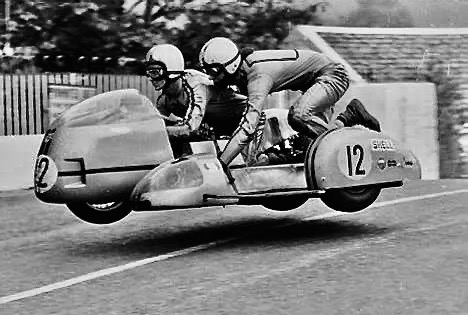
Saturday morning I scarfed down a cream cheese bagel and a glass of Joe Wieder’s. The motorcycle was in the driveway behind the house where nobody could see it. Our streets were sketchy. Brothers from the hood and home-grown hoodlums prowled for loot at night. The bike was a 1950s Vincent Black Shadow, only a couple of years younger than me. My friend had dropped it that spring when the front wheel locked up. One of the handlebars was bent and made tight right turns tricky. Even though it was beat up, it handled well, and had great acceleration.
Thirty years earlier Rollie Free, wearing a helmet, swimming trunks, and tennis shoes, broke the motorcycle land speed record riding a Black Shadow at the Bonneville Salt Flats. He did it lying outstretched flat on his stomach and hanging on to the handlebars for dear life. Two years later he did it again, breaking his own record.
I tied my backpack down across the handlebars, turned the key, and kicked it into life. The air-cooled V-twin engine made a happy sound. I dropped it into gear. At the sidewalk I nodded at a blonde walking by. She turned her nose up at me but looked the bike up and down. I rode west on Lakeshore Blvd, halfway through Bratenahl, and turned south on East 105th St. I meant to connect with Euclid Ave. I wanted to sneak a peek at the urban decay in Glenville I had been hearing about. It was still there. I took in the ruins. The mess was a place, I thought, but not the best place to live.
I met my former roommate Carl Poston at Mary Jane McGinty’s rented clapboard house on East 33rd St. off Payne Ave. Carl was with Mary Jane, taking it easy in her deep-set backyard. It was a tangle of overgrown hedges, monstrous bean plants, sunflowers, roses run riot, and dwarf trees, all trying to make sense of it all.
Twin blue-eyed albino cats ran past us, across the lawn, and over a low fence. One of them was cross-eyed. They were from next door. The hippie artist next door let them do their own thing. They were rolling stones who only ate and slept at home. Carl’s motorcycle was in the driveway. It was a 1965 Harley Davidson. We decided to ride west along the lake, nowhere special, just drifting in the direction the sun was going.
We gassed up on the other side of the Cuyahoga River and stopped at an Ohio City diner for coffee. Carl was a bean counter but had taken some philosophy classes at Cleveland State University that year and was in a frame of mind all summer, trying to realize something that might or might not matter as a way of exercising his mind.
We rode on Lake Rd. through Lakewood, Rocky River, and Bay Village. We were riding into a strong headwind, but it was no match for our motorcycles. The sun reached its zenith and kept going. We kept going, too, until we reached Vermilion. There were crowds milling in the streets. We slowed down to almost nothing. Children gamboled here and there. We inched our way to the harbor. A stout lady with a perky freckle face told us it was the annual Fish Festival.
We caught a break coming into town that day. There were vintage cars on parade, men wearing fezzes and sashes, marching high school bands in starched uniforms, a covey of Boy Scouts, floats carrying gals looking like movie stars, garish looking clowns, and oafish looking town officials. Brenda had been an outdoorsman. She would have jumped at the chance to cruise the Fish Festival. She had just turned legal that year. Now she was gone with no future. I couldn’t get her out of my mind. She was like the opening pages of a good book whose remaining pages had been torn out and thrown away.
We had heaping plates of buttered perch with potatoes and sage. Carl wanted to talk about the future, but I didn’t. I was in a state. I thought of the past as nothing but debris and the present as grist for the mill. I left the future in God’s hands. Carl was becoming a thinking man, so he told me I was being irresponsible.
“Mind your own business,” I said. He sounded like my father who sometimes knew everything about everything.
“That kind of attitude is even more irresponsible,” he said.
“You’ll be an old man soon enough. Wait until then to talk that way.”
“I’ll have to look you up when that happens,” he said.
A shapely young woman wearing a bikini with ruffles came our way. She was topped off with a peaked hat two feet high, four feet wide, made of wire mesh, and adorned with red, white, and blue rosettes. We admired her glide. When we left Vermilion, we followed a road along the lakeshore winding past small frame houses and cottage resorts. There were big trees everywhere and the air smelled sweet.
After we reached Marblehead we took the ferry to Kelly’s Island. We saw sailboats bobbing up and down, leaning to one side of the wind. The ferry rode rough on the choppy water. Carl’s Harley didn’t have a center stand and he had to lean on it to keep it from falling over. A tow-headed boy getting soaked at the bow laughed like Soupy Sales every time a wave crashed onto the deck. When he saw Perry’s Monument he jumped and pointed that way.
Don’t Give Up the Ship” was on Commander Oliver Perry’s battle flag during the Battle of Lake Erie in 1813. It recapitulated the dying words of a fellow commander who fell in an earlier naval engagement against the British. Oliver Perry didn’t give up and the British squadron was sent packing.
We rode around the island aimlessly with our helmets off and the wind in our hair. The blacktop dipped and curved. There were boats stashed in harbors tied to docks all over the place. We took a break at a public beach, ogling skin sizzling in baby oil from behind our sunglasses. Back on our bikes we rode across a field to an abandoned baseball field. The chain link of the backstop was rusted and the painted stands were weathered, cracking, and peeling. The pitcher’s mound was overgrown with weeds.
We shared some reefer sitting on the outfield grass. Carl started expounding on the problem of good and evil. I suspected I was in for it and took a short drag on the reefer. “The Nazi’s thought what they did to the Jews was righteous, but at the same time many other people didn’t,” he said.
“Especially the Jews,” I said.
“Who was right?”
I said we both knew Adolf Hitler and his henchmen were insane monsters.
“Sure, but that’s not the point,” he said.
“What is the point?”
“Just trying to touch on something metaphysical here.”
“All right, but metaphysics is more fantasy than not. Arguments about good and evil are useless. Just about everything except food, water, and breathing is relative. Most of it is all made up.”
“What about your brother’s girlfriend who got killed? Was that relative? Did the drunk driver have the right to decide her life and death?”
“I hope they hang that guy like they hung the Nazi’s.”
We took a quarry road back to the ferry dock. We were early for our return ride and walked to a nearby tavern. It had a Louisiana ceiling and wide plank floor. Fishing paraphernalia filled the walls. Teenagers were playing pinball and yakking it up. They looked too young to drink but had bottles of Blatz at hand. Over the cash register somebody had scrawled in magic marker that an Irishman was not drunk so long as he could hold on to a blade of grass and not fall off the edge of the planet.
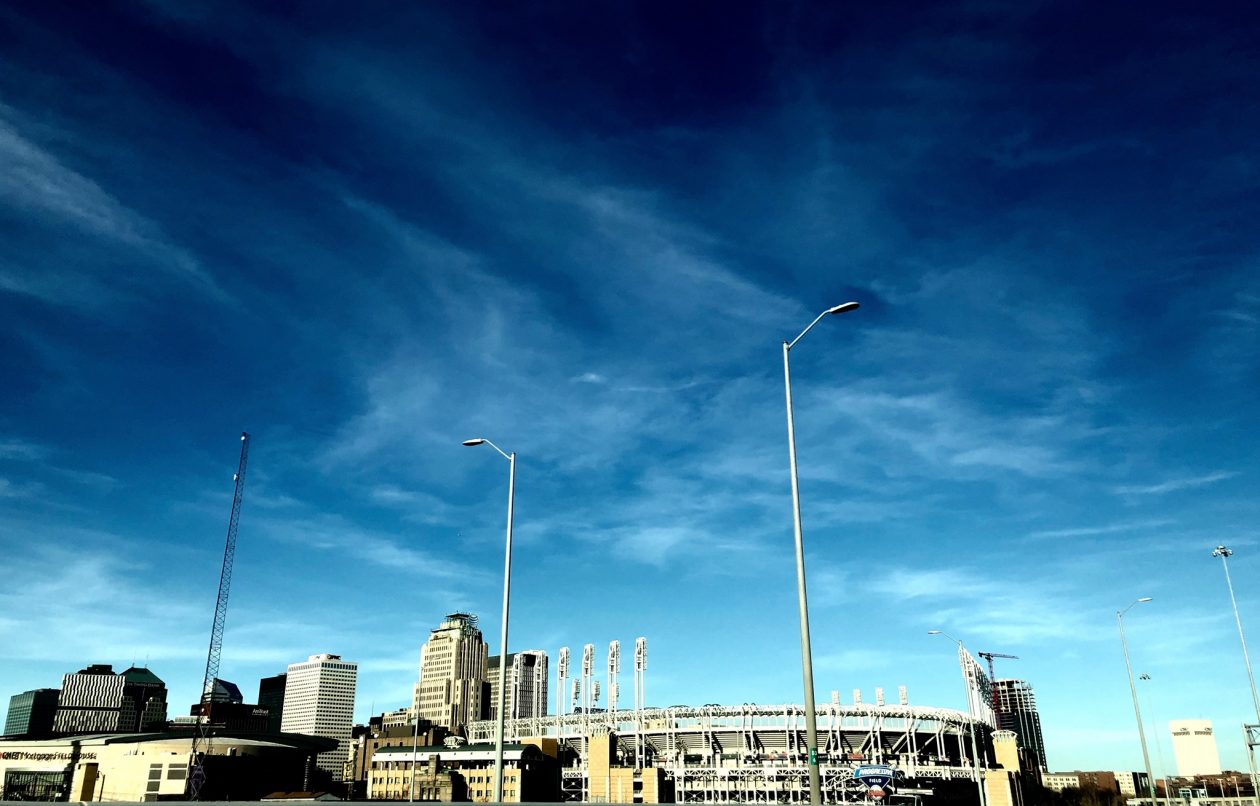
Carl and I each had a Blatz while we waited for the ferry. Back on the mainland, we took secondary roads as far as Avon, where Carl waved goodbye and roared off for home. I laced up my skates and got on the highway. I crossed the Flats going 75 MPH. Passing the Municipal Stadium I fell in with three other motorcyclists who were making good time. I hit 105 MPH keeping up, then taking the lead, leaning low over my handlebars. Every part of me was focused on the road flowing backwards in front of me. I had never gone that fast on a car or motorcycle or anything else other than a jet plane. Nothing mattered except keeping my tail on the seat and not wiping out.
Hunter Thompson once said, “If you ride the Vincent Black Shadow at top speed for any length of time, you will almost certainly die. That is why there are not many life members of the Black Shadow Society.” It took less than three minutes to pass the Cleveland Aquarium and veer away from the pack down the ramp of my exit onto Waterloo Rd. I caught my breath at the stop sign before an impatient horn behind me made me jump and I tapped the gear shift.
Back home I chained and tucked the Vincent out of sight in the backyard. I watered and fed Sly before throwing myself down on the sofa. My legs felt like worn out rubber bands. My left palm was sore from handling the clutch all day. I wasn’t used to it. I wasn’t used to anybody my age dying, either, but Brenda had died and there wasn’t anything anybody could do about it.
A good idea is to die as young as late in life as possible. It hadn’t worked out for Brenda. Her life was still in the memory of the living. Nobody had forgotten her, at least not yet. When that happens, it happens slowly, counting down to zero, until nobody remembers. It was a shame, I thought, before I stopped thinking about time and fate and fell into a simple as ABC sleep while Sly and the Family Stone snored on the floor at the foot of the bed.
Ed Staskus posts monthly on 147 Stanley Street http://www.147stanleystreet.com, Made in Cleveland http://www.clevelandohiodaybook.com, Atlantic Canada http://www.redroadpei.com, and Lithuanian Journal http://www.lithuanianjournal.com.
“Cross Walk” by Ed Staskus
“Captures the vibe of mid-century NYC, from stickball in the streets to the Mob on the make.” Sam Winchell, Beyond Fiction
Available on Amazon: https://www.amazon.com/dp/B0CRPSFPKP
Late summer and early autumn. New York City, 1956. Jackson Pollack opens a can of worms. President Eisenhower on his way to the opening game of the World Series where a hit man waits in the wings. A Hell’s Kitchen private eye scares up the shadows.
A Crying of Lot 49 Publication
 Made in Cleveland