By Ed Staskus
It is 11 miles as the crow flies from E. 42nd St. in Newburgh Hts. to E. 125th St. and St. Clair Ave. in Cleveland, Ohio. A streetcar in the 1950s would have made the trip in about 40 minutes and a car in about 20 minutes. A brisk walk on a summer day would have taken about 3 hours. When Hal Scott left work at American Steel and Wire in Newburgh Hts. for home on Friday November 24, 1950, in the middle of the Great Thanksgiving Blizzard, no streetcars were running anymore, and he didn’t have a car. He started walking. He didn’t see a crow that day or the rest of the weekend.
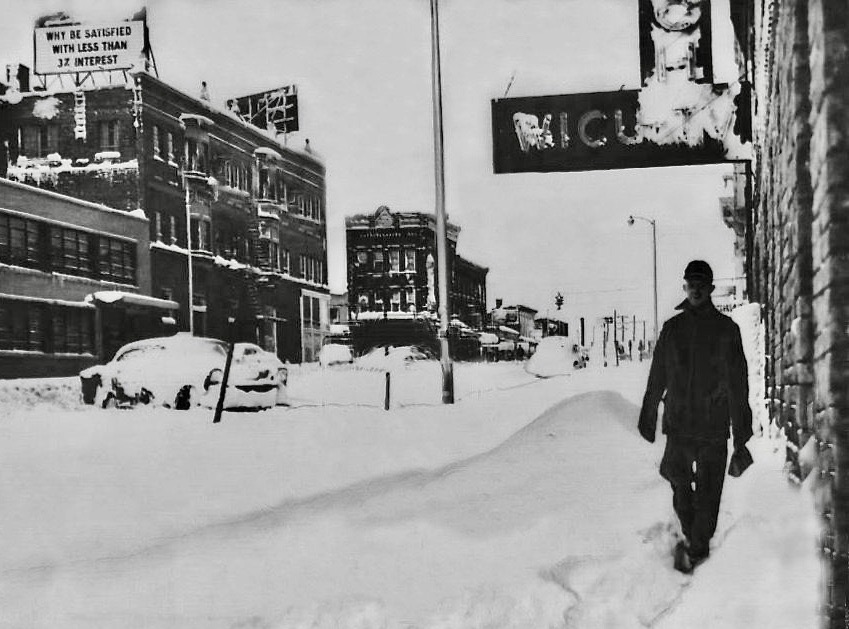
The storm started on the long holiday weekend when an arctic air mass barreled into town and temperatures fell to below zero. The next day low pressure from Virginia moved into Ohio. When that happened a blizzard with high winds and heavy snow got up to speed. By the end of the day two feet of snow had fallen and the airport had to close. Mayor Tom Burke declared a state of emergency and called out the National Guard. Snow plowing was hampered by more than 10,000 abandoned cars. The mayor declared a state of emergency. Unnecessary travel was banned. Everything nonessential was forbidden from trying to get downtown. The car ban lasted for a week until the last Cleveland Transit System line was back on the line. By then the temperatures had hit the 50s and all the snow melted. Creeks and rivers flooded far and wide.
Hal was born in 1903. He had a sister, Eleanor, and a brother, LeGrant. His brother made it as a pro baseball player nicknamed Babe, after Babe Ruth, although he never made it out of the minor leagues. Hal married a local girl, Jennie O’Connell, and they had six children. Jennie died of pneumonia twenty years later leaving Hal with six kids under the age of eighteen. A year-and-a half later he married his next-door neighbor and they had two more kids, Mike and Teen, or Harold Jr. Teen was killed when he was four years old. He was sitting on a curb on a sunny day waiting for his brother to get home from school when a delivery truck backing up ran him over. Not long after the funeral Hal’s hair turned white.
When he started walking home as the Great Thanksgiving Blizzard was raging, he walked up E. 49th St. and then zigzagging to Guy Ave. to Hamm Ave. to E. 55th St. to St. Clair Ave. From there, he only had seventy blocks to go. It was a slog. The snow was deep and getting deeper. Nobody was shoveling any sidewalks. He walked in the street more than on any sidewalk. He stopped every so often to catch his breath. It was dark as a squid’s world by 8 o’clock. The sky was a mass of heavy clouds. He was wearing a heavy wool coat, gloves, a hat, and buckled rubber galoshes. He pulled his collar up. Hal was dressed for bear, but it was hard going.
“Everything came to a standstill,” said Burt Wilfong on the east side of town. He got to his feet off his sofa, bundled up, and went outside to shovel his walk and driveway. There was a hitch, though. “The garage doors were the kind that opened out. There was about 5 feet of snow that drifted around in front of the garage, and the snow shovel was inside.” He went back to his sofa, plopped himself down, and stayed there.
By the time Hal got to Orey Ave. and E. 55th St. he was more than ready to sit down in the hole in the wall bar on the corner and warm himself up. He could use a bite and a drink, too, or two drinks. He sat down. A barfly a stool down next to him had a bowl of black olives and a bottle of Blatz in front of him.
“Hell of a night to be out,” the barfly said.
“That’s the God’s truth,” Hal said.
He ordered chicken soup in a pot with homemade noodles and hard-boiled sliced eggs. He thought about a draft beer but had a shot of rye whiskey instead. Halfway through his eggs he ordered another shot. He got a cottage cheese and pickle relish sandwich to go and stuck it in his coat pocket. He left $3.00 on the bar, buttoned up his coat, and started north up E. 55th St. again. He felt much better, although the storm was getting worse.
He took short steps shuffling now and then when the going got icy. He walked bent slightly forward as much as he could, with his center of gravity directly over his feet. The wind made it tricky. It was worse than the snow. He stayed ready for falling on his face as gusts came and went. The wind was unpredictable, buffeting him from all sides.
“I was born during that storm,” Fred Rothhauser on the west side of town said. “My parents told me I was a miracle baby coming into the world the day hell froze over.” Every leafless branch of every tree was in motion. Twigs littered the snow. Hal stepped over branches that had cracked off. As the wind swept over roofs their tiles shook and flapped. When they were ripped away, they went sailing and disappearing. Overhead the electric and telephone wires whistled. The infrequent passing cars all looked like they were on the verge of sliding and veering crazily off somewhere.
Flo Ellis was two years old when she, her four brothers and sisters, and parents drove from North Collinwood to Willoughby for Thanksgiving dinner. “We stayed overnight, then the blizzard hit, and it turned into almost a week. My grandma had to cut head holes and armholes in pillowcases to make nightgowns for us kids.”
When he got to Fleet Ave. Hal saw two bars. One was on the opposite corner and the other one on his side of the street. He took the path of least resistance. He might have gone to Krejci’s Tavern down the street but he didn’t. Krejci’s was “Where the Fishermen Meet” and where he often met his pals for drinks. It would have been full of fishermen, anyway, telling tales about the Great Lakes Storm of 1913 that sank 30 freighters and killed more than 200 mariners. He wasn’t up for snow storm stories from the past.
There was a three-story cupola over the front door he went through and lots of windows on the Feet Ave. side. A yellow sign said “Parking in the Rear” in red letters. There were two cars in the lot. How they got into and were planning on getting out of the lot was their business. The windows on the second and third stories were brightly lit. Whatever children and boarders the bartender and his wife, who was the bar’s cook, had up there were staying snug as bugs.
The watering hole was full of people. The tables were all taken. He sat down at the bar alongside a group of six. When he asked the bartender, the man said, “It’s the local folks, they’ve been walking in all night, except for this group. They’re from Lakewood. I guess everybody has had their fill of turkey.”
Gus and Eva Stanik were sitting closest to Hal. “We were going to Pennsylvania to do some deer-hunting,” Eva said. “We got up in the morning, and there was a load of snow, and we decided that maybe we’d better not go.” Her younger brother, Gomer, disagreed and talked them into making the trip.
“Oh, yeah, we can still do that,” he said in the afternoon. “It can’t keep snowing much longer.” Gus and Eva fired up their 1946 Buick Sedanet with her brother’s friend in the back seat. Gomer rode with his uncle Ivan and their friend Mack in a second car, which was Ivan’s 1941 Ford Super Deluxe. Their bags, blankets, gear, and guns were in the car trunks. They had strong coffee in thermoses.
“We were young,” Eva said. “There were six of us all together in two different cars. So, we helped one another. But everywhere we went, my uncle got stuck.” They passed one deserted car stuck in a snow drift after another. “My husband was the only one who had chains on.” After the two cars went slip sliding out of the parking lot behind the bar, Ivan’s car got stuck in the street. Hal helped push it out. When they drove off, they followed snowplows east. Hal waved goodbye as he set off on E. 55th St. again.
“When we were going through Sharon in Pennsylvania, we came to a standstill,” Eva said. “Gomer got out of the car and went across the street to a place that sold peanuts in the shell. We ate peanuts the rest of the day.” They threw the shells out the windows. Their four-hour trip turned into a twelve-hour trip. They labored on to Coalport, found their motel, shoveled out parking spaces, and fell into bed.
“Hell, yeah, I shot my deer the next day,” Gus said, finally triumphant..
Hal walked the rest of the night. The bars had all closed. The whole city was closed. He stopped for shelter in doorways now and then, watching plows waste their time. No sooner were they gone than snow started piling up again. The sun came up at 7:30 in the morning, what there was of it. The light looked like old milk. When dawn happened, he turned the corner on to St. Clair Ave. When he did, he saw U. S. Army Pershing tanks hauling away broken-down busses and delivery trucks.
“Hundreds of motorists abandoned stalled autos,” the Lakewood Sun Post wrote in its morning edition. “Stuck streetcars were strung along main arteries for miles. Bus routes were littered with coaches blocked by enormous drifts. Most plants closed, and some employees who did manage to report in were marooned on their jobs. Trucks laden with food couldn’t deliver. Babies were without milk and grocery stores able to open were rationing it as well as bread.”
Lakewood is Cleveland’s closest western neighbor, just across the Cuyahoga River. The far side of Lakewood butts up to the Rocky River. No neighbors were visiting neighbors that weekend, even though they could have skated across the frozen river. By the end of the day snow was wall-to-wall and drifts were 25 feet high. Some buildings collapsed under the weight of snowpack. More and more wires and trees were blown down. Bulldozers cleared roads so ambulances could reach those in need. The National Guard delivered food in their Jeeps to the out-of-the way.
Hal stopped at the first open diner he saw for breakfast. He was hungry as a horse. The diner was the kind that never closed, no matter what. He sat on a stool at the counter across from the galley kitchen. He had eggs, sausage, hash browns, pancakes, and two cups of coffee. When he was done, he folded his arms and lay his head down. A waitress woke him up when he started snoring.
He trudged on as far as E. 69th St, where he stopped again. His legs were heavy. He was more tired than a month of overtime. He walked into the Maple Lanes Tavern and Bowling Alley. Nobody was bowling, but a handful of men were at the bar. One of them was a snowplow driver. He looked exhausted. Hal sat at the bar and had a hot toddy. When he felt warm again, he went out into the cold for the last stretch to home.
The bone-chilling cold created a run on woolen clothing, long underwear, and flannel pajamas. A department store hosiery clerk took a telephone call asking for fleece-lined women’s hose. “I don’t know that there is any such thing,” she told the caller. Funerals and burials were delayed because cemeteries were neck-deep in snow. Hearses were unable to navigate roads to churches for services. An undertaker watched a body being unloaded from a commandeered milk truck for its much-needed embalming.
After Hal got home late Saturday afternoon, 24 hours after leaving work, his wife bombarded him with questions, but he was too cold and too tired to talk. He spoke to his son Mike for a few minutes, telling him everything was all right, took a long hot bath, and fell into bed. His wife threw an extra quilt over him. He slept the rest of the day, all day Sunday, and called off work on Monday. The National Guard went home on Wednesday November 29th. Schools stayed closed all that week. When Hal got out of bed, he checked all his fingers and toes. He didn’t have a speck of frostbite on him.
While he was on his long trek, the Big Ten championship game in Columbus between Ohio State and Michigan went ahead as planned. A trip to the Rose Bowl was at stake. Fifty thousand fans, just about half of the tickets sold, were in their seats for the kick-off. There was heavy snow, 40 MPH winds, and the temperature at game time was 5 degrees. Michigan won the Snow Bowl, even though they didn’t get a single first down and only gained a total of 27 yards. There were 45 punts between the two teams in the 60 minutes of playing time.
“I was a teenager when the blizzard hit,” Irene DeBauche on the south side of town said. “It was something you never forget. We thought it was exciting and fun although our parents thought differently.” The Great Thanksgiving Blizzard impacted 22 states, killed 383 people, and caused almost $70 million in damage, equivalent to about $800 million today. Insurance companies paid out more money to their policy holders for damage than for any previous storm of any kind up to that time.
When Hal’s second wife died in 1964, he looked around the neighborhood again. He married another next-door neighbor in 1969. After he went blind in his later years, he spent summer days on his porch. When his children and grandchildren visited, and the neighborhood kids ran over, everybody sat on the steps and porch. Hal always had a paper bag filled with taffy and candy bars. The younger kids snacked while the older kids counted the number of times he cursed while telling tales. When they ran out of fingers to count on, they counted on their toes.
Hal cursed up a storm whenever he recounted the Great Thanksgiving Blizzard of 1950, right up to the day he died in 1976. If he had lived a couple more years, he would have experienced the White Blizzard of 1978. When that storm was over everybody in Cleveland agreed it was the Storm of the Century. If he had made it that far, Hal would have had a golden opportunity to expand his store of descriptive words about winter wonderlands.
Ed Staskus posts feature stories on 147 Stanley Street http://www.147stanleystreet.com and Made in Cleveland http://www.clevelandohiodaybook.com. To get the site’s monthly feature in your in-box click on “Follow.”
 Made in Cleveland