By Ed Staskus
“I don’t like this jacket, dad,” I said. “It’s too white.”
“The first communicant has to wear special clothing,” my father said. “It’s white to symbolize purity.” He could be pontifical whenever he wanted to be. There was nothing I could do about it. I had to live with his pronouncements. He had grown up in northern Lithuania in the shadow of the Hill of Crosses. Unlike my mother, he was a true believer in Roman Catholism.
“That’s right,” my younger brother piped up. “At least you’ll look like a saint.” I could tell from his face that he wanted to add “or a fag” but couldn’t with our father in the same room. I gave him a look we both knew meant we would settle that wisecrack later, when our parents were out of range of his cries for help. His time would come. When it did, his time would be up.
First Communion was a big deal. Girls wore dresses passed down to them from their sisters or mothers. They sported a veil or a wreath. Boys wore a suit and tie, their Sunday best, or the national dress, with embroidered armbands and white gloves. Thank God all I had to wear were a sports jacket and a pressed pair of clean pants. A folk costume and white gloves in front of my relatives would have been mortifying, especially if they started nodding approvingly at one other. In front of my friends, it would have been unbearable.
My father was devout and my brother wasn’t far behind, even though his guile was legendary among everybody except grown-ups. I was sure he would find some goofy jacket to wear the day of my First Communion, just to show me up. That is exactly what happened. I couldn’t do anything about it. I had to keep my JFK-style hairdo in place. Even though my parents voted Republican like playing Whac-A-Mole, my mother thought John F. Kennedy the envy of the Western world, new, vibrant, and handsome. She wasn’t going to vote for him, but that was beside the point.
We lived on Bartfield Ave. at East 128th St. and St. Clair Ave. in the Forest Hills vicinity of the Glenville neighborhood. There were no forests, hills, or glens. Lake Erie wasn’t far away, though it was so polluted nobody but the reckless ever swam in it. Our church was St. George’s on E. 65th St. and Superior Ave. It was also our school. During the week my brother, sister, and I took two city busses, transferring while halfway there, a half-hour ride to get to school, but on Sunday mornings our father drove the family the ten minutes there.
After the First Communion ceremony a photographer took portraits of us, a prayer book and rosary in our hands, looking pious and glowing in soft focus. Gifts were parceled out. Some parents gave their children holy cards, religious statues, and daily devotional books. My father and uncle were thankfully both accountants and gave me envelopes alive with cash.
The next day was Jesus Day. We took a prayer walk around the school grounds, which was a big asphalt parking lot, were led on a tour of the church, which I knew full well since I was training to be an altar boy, created a personal bookmark, and sat through a special liturgy. We were reminded that Holy Communion was very special, a matter of life and death. St. Ignatius of Antioch called the Eucharist the “medicine of immortality.”
The first dead man I ever saw happened the Sunday after my First Communion. It was before we went to church, when one of my friends ran past our front porch shouting something about life and death. I took off after him to St. Clair Ave. where on the corner was a Gulf gas station and repair shop. Police cars and an ambulance were scattered along the street. Their lights were flashing. One policeman was writing in a notebook. Another one was standing around doing nothing. A man was lying in the gutter akimbo all sprawled arms and legs.
We walked up to him and looked down. He was missing a shoe. There was a crusty puddle of red goo on the front of his white t-shirt. He looked asleep, except his head was bent sideways in a way I had never seen before. An ugly purple gash on his temple was getting crusty.
“Run along boys, there’s nothing for you to see here,” a policeman said, prodding us to move along.
“Did somebody shoot him?”
The policeman gave my friend a push. We ran home and went to church. We forgot all about the dead man until Monday when we told everybody at school about it. We were the talk of the hallway. I could have run for class president and won handily.
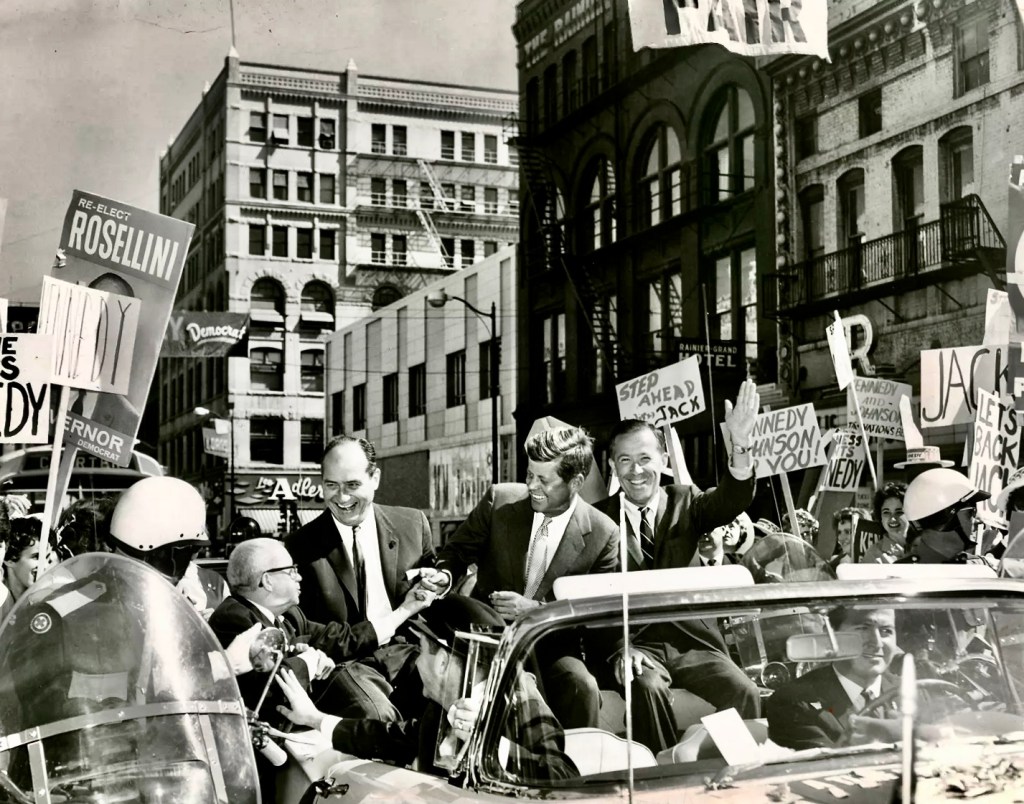
Less than a year before I had seen John F. Kennedy when he campaigned for the presidency in Cleveland, smiling and waving from the back of a convertible crawling along Superior Ave. It was a sunny early fall day. A little more than two years later I saw reruns on TV over and over of him getting his head blown off in another convertible. Flags went half-mast. One of his children saluted his father during the memorial parade in Washington D. C.
There were five houses on the north side of Bartfield Ave. where it met Coronado Ave. Our house was the second from the corner. A family of hillbillies who had migrated to Cleveland from West Virginia lived in the corner house. One of their boys my brother’s age and my brother were always wrestling and smacking each other. One day I saw him waving a rake at my brother.
“Stop that!” I yelled. “Mom said dinner is ready.” It was nearly a mortal sin in our house to be late for dinner.
A boy my age from South Carolina lived in a two-story brick apartment building on the corner opposite the Gulf gas station. He was one of the new Negro’s in our neighborhood. We were friends and played together but didn’t always get along. One day he called me a dirty DP. Both of my parents had come to the United States after World War Two. One thing led to another. I called him a dirty nigger and he tried to hit me. I slapped him on the ear. He lunged at me and when I put my hands up, he clamped his teeth onto my right thumb. He wouldn’t let go no matter what. I had to say I was sorry. When he finally let go, he ran away up his back steps. My thumb hurt like the devil and I had to wipe tears out of my eyes.
When John F. Kennedy debated Richard Nixon in late September 1960, it was the first televised presidential debate in the United States. The TV man Howard Smith moderated the debate. A pack of journalists faced off with the candidates. My mother and father watched it that Sunday evening, so we watched it. My brother, sister, and I were mad about missing our favorite weekend nighttime shows. We complained but our parents were long on civics and short with stir-crazy children. John F. Kennedy looked good. He had style and charisma. Richard Nixon was sweaty, shifty, and no match for his younger competitor.
“He should have shaved,” my father, a lifelong Republican, lamented. “He looks bad.” He looked pasty and haggard is what he looked like. JFK looked fit and self-assured. He looked like a winner. After the debate he flew out of Chicago and flew to Cleveland. His plane landed at Lost Nation Airport at two in the morning. Students from Western Reserve University turned out to greet him and provide an “Honor Guard.” In the morning his motorcade rolled down Euclid Ave. and around University Circle to a cheering throng.
On his way to a rally in Lorain Stadium, the motorcade wound its way west along city streets. I was 10 years old and waiting farther east on Superior Ave. with my South Carolina friend. We got one good look at JFK. We were behind everybody, trying to find a hole in the crowd to squeeze through to the front, when there he was, in a convertible, sitting on the back of the car with his feet on the seat. He was waving. We waved back and cheered. He wasn’t the only self-assured grown-up I had ever seen, but he was the youngest-looking best-looking grown-up. He looked like a movie star, baseball player, and war hero all rolled up in one.
After the rally in Lorain, and lunch at the Moose Hall, John F. Kennedy went to the annual Democratic steer roast at Euclid Beach Park. More than 125,000 people heard him speak, more people than had ever assembled at the amusement park. Lakeshore Blvd. was a mess of cars and busses going nowhere. Drivers chewed the cud in the traffic jam, the smell of the steer roast in their noses.
“The forgotten man of 1960 is the American consumer,” he said. “The forgotten woman is the American housewife. In 1952 they were promised lower prices. They heard endless Republican commercials about a stable dollar and a cheaper market basket. But under 8 years of Republican rule, the cost of living has gone up and they have done nothing about it. Families are concerned about the missile gap, but they are equally concerned about the gap between what they earn and what they have to spend.”
It struck a chord with my mother and father, but they voted the GOP slate top to bottom., no matter what. Richard Nixon would have had to shoot Pope John XXIII stone cold dead in front of the Vatican’s Easter Sunday crowd to get my Catholic parents to vote for the Catholic on the ticket. John F. Kennedy wasn’t a Republican and that was that.
Halloween was a month later. Time is candy was our motto. We knew our neighborhood forward and backward. We knew who handed out old fruit and who handed out new chocolate. We knew what houses to avoid because the householders were mean, stingy, or simply slow, and which houses were gold mines. My brother and I never wasted time with costumes, simply dressing like bums. The freeloader look was best because that is what we were.
Once back home my sister hid her candy in the attic. The attic was as empty as the day we moved in. Our parents were immigrants and still scraping by, still buying only what we needed and were going to use, not things to forget about as soon as we bought them. My sister found a loose floorboard in a corner and hid her candy there. My brother had a sweet tooth and wasn’t to be trusted. No one knew or ever found out where he hid his candy. He believed loose lips sank ships and never told anybody. I hid mine in the basement, on a shelf behind a box of summer fun beach gear.
The next week John F. Kennedy won the White House, although he did it without winning Ohio. Tricky Dick defeated JFK, 53 percent to 47 percent, in the Buckeye State. He took all but 10 of Ohio’s 88 counties. The Democrat won the Cleveland area, though, to the displeasure of my Lithuanian kinfolk.
That winter was cold although not a lot of snow fell. When it finally did, we built snow forts on Blind Man’s Hill. The hill was the side yard of a house on the other end of our short stretch of Bartfield Ave. A blind man lived alone in the house. We had an arrangement with him. In return for keeping an eye out for anybody messing with his house, he let us mess around on his side lawn. It was a knoll, inclining about four feet, but it was enough for us, especially when we were behind the walls of our fort hurling snowballs down on our enemies.
The next summer on a rainy afternoon Romas Povilaitis and I almost killed my brother in the attic of our house. It wasn’t our fault, since we were only playing, but after my sister raised the roof there was no explaining it and we just had to take our lumps. We heaved a sigh of relief when my brother exonerated us, saying we were only playing, even though wrath then fell on his head, too.
Our friend Romas lived in Chicago with his small-fry brother Viktoras, his mother Irma, and father Vytas. The man of the house was muscular and handsome. He was my sister’s godfather. He had wavy blonde hair shiny with Brylcreem. He was better looking even than his wife. Irma said she was glad he worked in a factory and wasn’t trying to better himself, because if he did, she was sure he would leave her. Even though he was blue collar, they lived in a big house in the Marquette Park neighborhood. Chicago has the largest Lithuanian community outside of the homeland. It is known as Little Lithuania among those in the know.
Whenever they visited us, we ran around like 10,000 maniacs. Romas was enamored of Spiderman, a new Marvel Comics superhero. He scuttled around our house pretending to squirt web fluid from his wrists. He tried to cling to walls but tumbled to the floor. We were in the attic arguing the merits of Superman, Batman, and Spiderman when my brother insisted for the last time that Superman was the best of the three.
“He could crush Batman and Spiderman with his little finger and besides, only he can fly,” he said.
It finally drove us to distraction. We put a Superman cape on him and hung him by his heels out the third-floor window. He was all for it, except when the cape went flapping over his head and he complained he couldn’t see. It was then my sister walked through the door. Our brother almost nose-dived when she screamed and we were startled. We were pulling him back inside when our mother burst in.
She dropped a dozen eggs and bum rushed the three of us downstairs. Thank God my father and Vytas Povilaitis were out. As it was, we had to listen to Irma and my mother lay down the law of the land. They seemed deadly serious, so we listened with grim attention.
“Don’t ever do that again!” is what we heard over and over until we stopped paying attention.
There were only two bedrooms in our Polish double on Bartfield Ave. Our sister shared a bedroom with my brother and me. Vytas and Irma slept on the living room sofa when visiting. Romas and Viktoras slept on the floor in sleeping bags between our beds. We read comic books by flashlight long into the night. We kept our sister up, but she had the good sense to keep her sleeplessness to herself. She knew she was no match for Superman, Batman, and Spiderman.
The Friday John F. Kennedy was assassinated I was in my eighth-grade classroom at Holy Cross Catholic School in Euclid, where I had transferred after we moved from our old neighborhood that had gone civil rights to the white community of North Collinwood. My parents had said our house was becoming worthless and we had to leave. The school loudspeaker unexpectedly crackled to life. It was the principal on the broadcast system. She said the president had been shot.
“Here is a flash from Dallas,” NBC Radio announced. “Two priests who were with President Kennedy say he is dead of bullet wounds suffered in the assassination attempt today. I repeat, a flash from Dallas, two priests say President Kennedy is dead of bullet wounds.”
We were stunned. It wasn’t something any of us had ever thought about or expected to happen. Nobody knew what to do or say. Everybody was struck dumb. Our teacher asked us to stand and recite the rosary. We did until the principal came back on the PA and told us all to go home. Some kids were crying as they went through the door.
Everybody stayed glued to their TVs at home, watching the news. There wasn’t anything else to watch, anyway. The networks suspended their commercials and regular programming for the first time ever and ran coverage on a non-stop basis. The assassin was caught, but a few days later was shot in the stomach in the basement of Dallas Police headquarters. We saw it happen live on TV. It was unbelievable. Even more unbelievable was that the man who killed Lee Harvey Oswald was a strip club owner who went by the nickname of “Sparky.” I didn’t know what strip clubs were, but my father was incredulous.
“What is this country coming to?” he asked. There was no love lost for John F. Kennedy in our house and community, but nobody wished him dead. They may not have believed in the man, but they believed in law and order. That was why they fled Europe, where law and order had fallen apart after World War Two.
I started to wonder about God. Why did he want John F. Kennedy dead? Did he have a plan or was he just flipping a coin? When I asked our teacher why God had given him a one-way ticket to get halfway to where he was going, she started into chapter and verse, but then ran out of air. She sent me to the parish priest who told me God always has a plan and to not use words like one-way ticket.
“Keep your mind clean and on track,” he said. “That way you will always have a one-way ticket to Heaven in your pocket.”
Ed Staskus posts stories on 147 Stanley Street http://www.147stanleystreet.com and Cleveland Daybook http://www.clevelandohiodaybook.com. To get the site’s monthly feature in your in-box click on “Follow.”
 Made in Cleveland