
By Ed Staskus
Not only did I not see the Rolling Stones when they rolled into Cleveland, I didn’t even get a t-shirt. In the event, however, I heard every song they played inside Municipal Stadium and I made more money that day than I was accustomed to making. I kept the money in my pocket, not rushing out to buy the band’s latest album. I didn’t have any of their albums, anyway, so I didn’t need another one to add to my collection.
The band was in town on July 1, 1978, as part of the World Series of Rock. Just before they hit the stage in front of 83,000 fans a question flashed on and off in five-foot letters on the scoreboard. The question was, “Who’s the Greatest Rock and Roll Band in the World?” There was a roar from the crowd. I didn’t see the flashing letters but I heard the roar and saw the hundreds of red balloons that were released. I watched the balloons from where I was float over the rim of the stadium and out over Lake Erie .
A small parking lot outside the entrance gates was where I was. What I was doing in the parking lot was selling t-shirts. A neighbor of mine by the name of Hugo had gotten them silk screened at Daffy Dan’s. He and I spent the day peddling them from an eight-foot folding table at the southeast corner of the stadium. He didn’t have a license that I saw, but I did see a policeman wave to Hugo in a friendly way. I took that to mean we could stay.
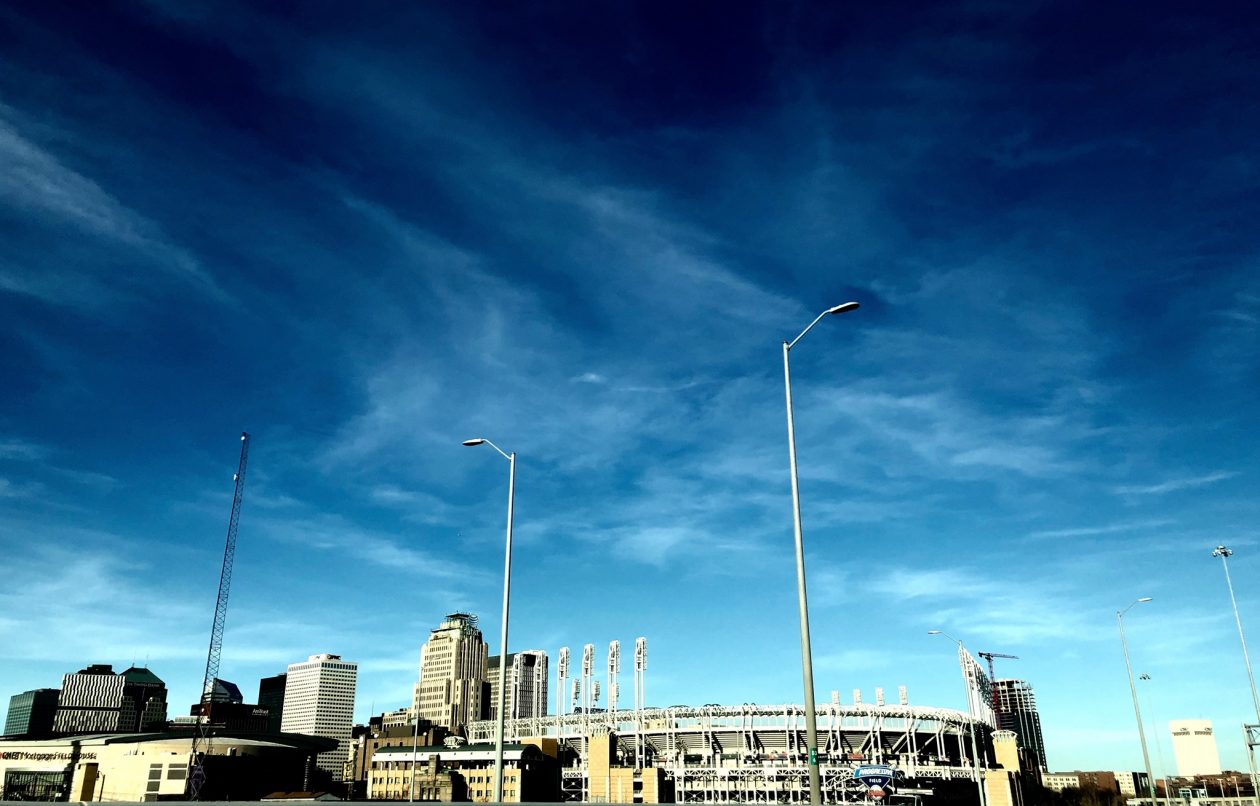
It was an overcast day, hot and sticky. It was the kind of day that looked like rain or maybe a thunderstorm rumbling in from Lake Erie. The stadium was on the south shore of the lake. It was the first place rain would show up.
The show started just before one o’clock with Peter Tosh, who was from Jamaica, followed by Kansas, who were from Kansas. They sang their big hit from the year before, which was “Dust in the Wind.” As it was, they should have changed the lyrics to “Rain in the Wind” because in the middle of the song it started to drizzle. By the time the Rolling Stones hit the boards at five o’clock it was raining more and had gotten windy. It rained on-and-off throughout their 18-song set.
“Fans huddled under blankets or plastic wraps,” wrote Jane Scott, rock critic for the Cleveland Plain Dealer. “But the show was the most exuberant and exciting that the group has brought here. Mick Jagger was jauntier and more active than he has ever been. He skipped onstage in a red jacket, brownish vinyl pants and a red cap. He jogged in place and discoed to the first song. He waved his hands at the audience and doffed his cap. He seemed as carefree as a drunken sailor.”
Hugo wasn’t jaunty or carefree. He had come prepared for bad weather with yellow slickers for both of us and a tarp to cover our table. We did a brisk business after the show selling dry t-shirts. It was the reason I never got one of them. We sold them out.
The World Series of Rock was a recurring summer concert series staged at Cleveland’s Municipal Stadium from 1974 to 1980. The shows were organized by Belkin Productions, a local promotion company, and WMMS, a local radio station known as the ‘Home of the Buzzard.’ Some of the bands that came and went were Emerson, Lake & Palmer, Foreigner, Pink Floyd, Journey, Lynyrd Skynyrd, and Fleetwood Mac. None of them drew fewer than 60,000 fans. The all-day shows were notorious for drug use, drunkenness, and rowdiness. Every so often somebody fell or jumped off the upper deck. Most of them survived. All of them were more-or-less seriously hurt.
The Cleveland Free Clinic ministered to the hurt. They were funded by Belkin Productions. They conditioned their funding on the Free Clinic’s nondisclosure of the number of staff on duty, the nature of the injuries treated, and the number of concertgoers treated. Don’t upset the apple cart was the word of the day.
The last World Series of Rock was staged in 1980 featuring Bob Seger and the Silver Bullet Band. Municipal Stadium officials had gotten sick and tired of the baseball playing field being torn up after every show and city officials had gotten sick and tired of the robberies and violence that had become part and parcel of the events.
Hugo was a large man, four or five years older than me. He drove a well-kept 1962 Rambler Classic station wagon. His hair was long and tied back in a ponytail. His eyes were the green of sea glass. He wore a white t-shirt, dungarees, and Red Wing boots the day of the show, He was genial with buyers and gruff with everybody else. Not a single person messed with us, not even the outlaw bikers and shifty boys from the ghetto.
He handled the money, stuffing the bills into his pockets. He didn’t let anybody pay with loose change. Whenever he had a minute he rolled the bills up, rubber banded them, and pushed them down into a canvas messenger bag. He wore the bag cross-body, with the strap over one shoulder and the bag resting on his opposite hip. If somebody misjudged Hugo and tried to grab the bag, it wasn’t going to be easy getting it off him. It was going to be a mistake.
The Rolling Stones started their set with “Let It Rock” followed by “Honky Tonk Women” and “When the Whip Comes Down.” I wasn’t a big fan of the band and so didn’t pay much attention. I enjoyed their last two songs, Chuck Berry’s “Sweet Little Sixteen” and their own “Jumpin’ Jack Flash.”
“I was born in a crossfire hurricane, and I howled at my ma in the drivin’ rain, but it’s all right now, in fact, it’s a gas, but it’s all right, I’m Jumpin’ Jack Flash.”
Jack Flash was a 1950s adventure story character featured in the British comic magazine ‘The Beano’. It was hard to make out what the song was about, although it seemed to be something about enduring hardships and overcoming challenges. It didn’t help that hearing the lyrics was a challenge.
“It was my first and last concert at Municipal Stadium,” said Chris Austin, a suburban Rocky River native. “It was hard to hear the music with all the screaming and yelling in my ears. It was a good line up but it was a shame you couldn’t hear it unless you were anywhere near the front row. All you heard was screaming.”
Hugo didn’t know the Rolling Stones from the Beach Boys and didn’t care. He didn’t get a kick out of rock ‘n’ roll. He called the music the Beatles made “bug music.” He didn’t know much about rockabilly, the British Invasion, surf rock or Southern rock, hard rock or psychedelic rock, folk rock, blues rock, or funk rock. As far as I knew the only music he listened to was old Zydeco and rhythm and blues from mid-century, give or take a decade-or-two. His favorite Zydeco musician was Boozoo Chavis, who played the accordion and was usually accompanied by a fiddle and a washboard. He sang all his songs in French. Hugo didn’t speak a word of French so he paid attention to the rhythm and the feeling instead.
I knew the Rolling Stones were one of the most popular rock ‘n’ roll bands in the world, but to me they were a money-making machine living the high life in the Top 10. I knew they portrayed themselves as outlaws but I also knew they were multi-millionaires. I had my doubts about millionaires being able to be outlaws. It seemed to be against the laws of nature. The rich steal with a fountain pen. That doesn’t make them desperadoes, at least not until they run out of money.
Tours by the Rolling Stones were a license to print money. Their United States tour in 1978 took them to twenty four venues coast to coast in fifty days. Their gross in Cleveland was more than a million dollars, or about five million dollars in today’s money. Mick Jagger was reported to be “jolly and high-spirited” after the show. It is easy enough to imagine how happy the band was with the loot they hauled back to Great Britain, where they could spend it doing whatever wealthy outlaws do.
I liked some rock ‘n’ roll bands like the Doors and the Jimi Hendrix Experience, but Jim Morrison was dead and so was Jimi Hendrix. I liked what I heard from Peter Tosh at the World Series of Rock and went to see him and his seven-man band at the Front Row Theater in Highland Hts. three years later. It was a hike for my car but worth it. I even bought one of their albums.
Peter Tosh’s songs were about equality and social justice. He sang about oppression and injustice, blending rocksteady with reggae, always keeping a skank beat going, although his rhythm section, Sky Dunbar and Robbie Shakespeare, called it the “rockers rhythm.”
“Everyone is crying out for peace, yes, none is crying out for justice, I don’t want no peace, I need equal rights and justice.”
Many of the songs the Rolling Stones sang were about sex, drugs, and rock ‘n’ roll. They portrayed themselves as the rebellious spirit of the age. They claimed to challenge the status quo, even though they were the status quo. At least, that was what the Bank of England thought of them. They addressed some social and political issues, but didn’t make a bad habit of it. Swagger buttered their bread, not warmheartedness.
It was incidental what I thought about the Rolling Stones. Most of the fans I heard talking about them while walking past our table of rapidly disappearing t-shirts seemed more than happy with what they had gotten for their $12.50. “He is the God of Cool” one of them said to his friend. I assumed he was talking about Mick Jagger. Somebody else said the show was “electrifying” while another said it was “unforgettable.” Two young women, one of them carrying a tote bag with the band’s iconic red lips and tongue logo on it, were talking excitedly. I couldn’t make out what they were saying, although it didn’t matter. Whatever they were saying was plain as day on their faces.
The Rock and Roll Hall of Fame is a five minute walk from where Municipal Stadium once stood until it was torn down in 1997. The museum marked the 50th anniversary of the World Series of Rock with an exhibit at their Library and Archives in 2024. There were guitars used by some of the musicians. There were old posters and mangy ticket stubs. There were many photographs.
“They put together some good stuff,” said Jules Belkin of Belkin Productions. “It was a group of years that are etched in people’s memories.” He was there when it happened in the 1970s, although he didn’t seem to remember much about the shows. He was too busy backstage staging them to see anything.
“It was pioneering in terms of massive concerts like that,” said Andy Leach, Senior Director of Museum and Archival Collections at the Rock Hall. “I don’t think there will ever be anything quite like that again. From what I’ve heard from friends of mine, you could wander right up to the stage.”
I didn’t see the exhibit. I have never seen an exhibit at the Roll and Roll Hall of Fame because I have never been there, even though I live fifteen minutes away. I don’t see what museums have to do with rock ‘n’ roll since the music genre is a right now right here thing. The proof is in the pudding, not well-bred and displayed on a wall.
Jerry Garcia, when the Grateful Dead were inducted, sat out the ceremony. He said he found the concept of a rock ‘n’ roll museum “stupid.” The rest of the band attended the induction ceremony. They brought a full-size cardboard cutout of Jerry Garcia with them. The Sex Pistols were even more uncompromising about refusing the honor. “Next to the Sex Pistols, rock and roll and that Hall of Fame is a piss stain,” they said. “Your museum. Urine in wine. We’re not coming. We’re not your monkeys. If you voted for us, hope you noted your reasons. You’re anonymous as judges but you’re still music industry people. We’re not coming. You’re not paying attention. Outside the shit-stream is a real Sex Pistol.”
Hugo and I were packing up, which amounted to folding up our table and carrying it more than a mile to where we had parked, when a very drunk young man staggered past us bellowing “Monkey Man, play Monkey Man.” He kept bellowing until he was far away and we couldn’t hear him anymore. I hadn’t heard the song during the show.
“Monkey Man” was a Rolling Stones song from the late 1960s. The lyrics went, “I’m a flea-bit peanut monkey, all my friends are junkies, that’s not really true, I’m a cold Italian pizza, but I’ve been bit, and I’ve been tossed around, by every she-rat in this town.” Whether the lyrics had ever been immortalized by the Rock and Roll Hall of Fame is an open question. The man’s enthusiasm for the song was undeniable.
We left Municipal Stadium and the World Series of Rock behind. The departing crowd had thinned out. We walked as fast as we could to get to our car before more weather happened, although Hugo stopped at a hot dog cart and sprang for two foot-longs.
“Ooh, a storm is threatening, my very life today, if I don’t get some shelter, ooh yeah, I’m gonna fade away, gimme shelter.”
We got to the car, got the table stowed away, and secured the canvas messenger bag fat with cash under the front seat. A clap of thunder and a lightning bolt lit up the darkening sky. We slid into the car and got it running just as it started to rain for real. The car was shelter from the storm. It kept the outdoors where it belonged, which was outdoors.
Ed Staskus posts monthly on 147 Stanley Street at http://www.147stanleystreet.com, Made in Cleveland http://www.clevelandohiodaybook.com, Down East http://www.redroadpei.com, and Lithuanian Journal http://www.lithuanianjournal.com. To get the site’s monthly feature in your in-box click on “Follow.”
“Bomb City” by Ed Staskus
“A police procedural when the Rust Belt was a mean street.” Sam Winchell, Beyond Books
Cleveland, Ohio 1975. The John Scalish Crime Family and Danny Greene’s Irish Mob are at war. Car bombs are the weapon of choice. Two police detectives are assigned to find the bomb makers. It soon gets personal.
A Crying of Lot 49 Publication
 Made in Cleveland