Category Archives: Baltic Circle

No Place Like Home

By Ed Staskus

   Sigitas Kazlauskas didn’t know J. Edgar Hoover from the man in the moon. He didn’t necessarily want to make his acquaintance, either. He wanted to go home, even though he knew he didn’t have nearly the funds for the passage. The passage was across the Atlantic Ocean and over the North Sea. His home was far away in Lithuania. He didn’t know the Justice Department man was going to be his ticket back.

   Sigitas was living in Cleveland, Ohio in 1919, where it was Thanksgiving week. He had left home in late 1914, dodging forced conscription into the Russian Army. He knew being drafted meant the meat grinder. He also knew his socialist views were hazardous. to his health. The Czar didn’t brook his kind of man. He made his way to the United States on a tramp steamer. He was living in Dope Town, a neighborhood west of East 9thSt. and north of Superior Ave. Suicide Pier on the Cuyahoga River was down one end of the street and the town dump was down the other end of the street. Lake Erie was on the north side and Little Poland was on the south side. 

   None of his friends called him Sigitas. Everybody called him Dave. When he asked why, they laughed and said, “David and Goliath, like in the Bible.” They didn’t bother with his surname since they weren’t his kith and kin. They were Eastern Europeans like him who had ended up in Cleveland for the same reason as him, which was opportunity. His opportunity had come and gone, which was why he was living in Dope Town. It was the only place he could afford a furnished room. The wrist a Cleveland policeman had broken with a truncheon during the May Day Riot six months earlier hadn’t helped, making him unemployable for three months and draining his savings.

   Since then, he had been living on bread and homemade beer. When the beer was ready he called his Polish friends, “Hey Polska, come get your right piwo.” He was well-known for his beer, attracting friends who were as friendly with his brew as they were with him, maybe more. They sang, “In Heaven there is no beer, which is why we drink it here.” He was hoping somebody would invite him to their turkey feast on the big day. He needed a square meal with his suds.

   Cleveland was going strong in 1919. It was the fifth largest city in the country. Iron and steel dominated the economy. Foundries and machine shops were everywhere. Skyscrapers were being built. The population was nearing one million. A third of the population was foreign born, working in the steel plants and garment factories. They worked long hours for low pay, but it was better than where they had come from, where they worked longer hours for even less pay.

   More than a quarter million Lithuanians left the Russian controlled Baltics between 1900 and 1914. When World War One broke out all immigration from Europe to the United States was brought to a stop. The new labor force that came into being was from the American South. There had been fewer than 10,000 Negroes in Cleveland in 1910. Ten years later there were nearly 40,000. There was enough work for everybody, though. Commercial construction was booming. The problem Sigitas had wasn’t finding work. The problem he had was keeping the work he found.

   He was a socialist, which was his problem. He believed in social ownership of the means of production. He didn’t believe in private ownership of it. The word socialism comes from the Latin word “sociare” which means to share. The modern use of the word was coined by the London Cooperative Magazine in 1827. The First International was founded in 1864 in Great Britain. After that it was off to the races. The Second International was founded in 1889. Anarchists were banned as a practical matter. Socialists didn’t want bomb throwers in their ranks, if only because bombs can be unpredictable about who they blow up.

   The May Day Riot in Cleveland on May 1, 1919 pitted trade unionists and socialists against police and military troops. The city was bursting at the seams with blue-collar foreign-born laborers. The activist Charles Ruthenberg got it into his head to organize a mass demonstration on Public Square on International Workers’ Day. He had run for mayor on the Socialist Party ticket two years earlier, polling nearly a third of the vote. He was well-known among the disaffected. He marched at the head of the assembly.

   Sigitas and his friends heeded the call. They joined the more than 30,000 men and women who showed up for the demonstration. They marched from Acme Hall on Upper Prospect to Lower Prospect to Public Square. The marchers wore red shirts and waved red flags. A parallel procession of army veterans in full uniform clashed with the socialists. Fights broke out and the police were called, who then quickly called for reinforcements and mounted forces. Harry Davis, the city’s mayor, called for the National Guard, who mustered in front of a beer hall before going into action with fixed bayonets. Tanks led the way, even though the socialists were unarmed. When Sigitas’s wrist was broken, a lady standing beside him used the 8 inch ivory hatpin holding her hat to her hair bun to stab the policeman in the chest. It was how Sigitas managed to break loose and not get arrested. 

   Several marchers were killed, nearly a hundred were injured, and many hundreds more were arrested. The Socialist Party headquarters at Acme Hall was ransacked by a “loyalist” mob. The next day all of Cleveland’s newspapers blamed the marchers for the riot, labelling them as “foreign agitators” even though most of them were native-born or naturalized citizens. The fourth estate demanded their deportation. The Immigration Acts of 1921 and 1924 later restricted immigration of “undesirable” Southern and Eastern Europeans, whether they were socialists, or not.

   It was at Thanksgiving dinner with his friend Teodor Wojcik and his family that his friend hatched a plan about how to get Sigitas out of the United States and back to Europe. Agnieszka was Teodor’s wife. They had two children and were moving up in the world. Teodor went by Teddy and Agnieszka went by Agnes. They weren’t socialists, but didn’t argue with Sigitas about it. They believed the United States was a free country where everyone was free to believe what they wanted. They weren’t silly enough, however, to say so in public.

   “There’s a man at the Justice Bureau who is heading up the new Radical Division,” Teddy said. “He’s already gone after the Negroes.” J. Edgar Hoover was the new man. He was after what he called “terroristic and similar classes.” He was a District man born and bred. He was a law and order man schooled in bigotry. “Something must be done to the editors of Negro publications as they are beyond doubt exciting the darkie elements of this country to riot,” he said in the summer when white soldiers and sailors rioted in the District, killing more than a dozen men and women, after a rumor spread that a Negro man had raped a white woman. The rumor was false. The Negro deaths were real.

   J. Edgar Hoover turned his attention to anarchists and communists at the end of summer. He got busy sending the notorious Emma Goldman back to Russia. He helped engineer the arrest of more than a thousand radicals in early November, with the intent of deporting them. “The Communist Party is a menace,” he said. He meant to send them all back to where they had come from.

   “What does this new man have to do with me?” Sigitas asked.

   Agnes brought a plate of paczek to the table. They were deep-fried pastries filled with jam, caramel, and chocolate. The outer layer was sprinkled with powdered sugar and dried orange bits. They drank coffee the Polish way, which was strong with full-fat cream.

   “What you have to do is forget about socialism and become a communist,” Teddy said. “Join the Communist Party. Volunteer for the dirty work. Become a firebrand. Make yourself known to the Radical Division. Make enough trouble and you should be on a boat on your way back to Lithuania in no time. It won’t cost you a penny for the fare and they will feed you during the voyage, too, so by the time you get home you’ll be back to your old self.”

   “They won’t shoot me?”

   “Probably not.”

   “They won’t throw me in jail?”

   “They probably will for a month-or-so, but they don’t want to keep anarchists and communists in jail. They don’t want them here. They want to send them somewhere else, anywhere else, which will be easy enough in your case since you were never naturalized.” Sigitas had never forgotten Lithuania and had never become a full-fledged American.

   Becoming an official communist was easy as pie. Charles Ruthenberg had split from the socialists after the May Day Riot and joined several splinter groups to form Cleveland’s Communist Party. They allied with the Communist Party of America. The woman who had saved him during the May Day Riot was a close associate of Charles Ruthenberg’s. She put in a good word for him. He was brought into the circle of fellow travelers. He was given a revolver but no bullets. He gave the gun back. J. Edgar Hoover’s Radical Division had numerous informers and inside men. They put Sigitas on their list soon enough. He didn’t have to wait long for the Palmer Raids.

   Seven months earlier the anarchist Carlo Valdinoci had put a bomb on the doorstep of newly appointed Attorney General A. Mitchell Palmer’s house in Washington, D. C. When the bomb went off no one inside the house was hurt, although the anarchist mishandled the explosive and blew himself up, as well as the front of the house. Across the street where Franklin and Eleanor Roosevelt were sleeping the blast shook them out of bed. The attack was coordinated with  attacks in eight other cities on judges, politicians, and policemen. The Attorney General had his eye on the White House. He got to work hyping the Red Scare. He put J. Edgar Hoover in charge of identifying and arresting as many socialists, anarchists, and communists as he could and deporting them as fast as he could.

   The first raids in December filled a freighter dubbed the “Red Ark.” It sailed out of New York City bound for Russia. Its passengers were foreigners and suspected radicals. A month later the Justice Department went big. A series of further raids netted 3,000 men and women in 30 towns and cities in 23 states. Search warrants and habeas corpus were an afterthought. Sigitas was one of the communists swept up in the net.

   Once everybody was locked up in holding facilities, J. Edgar Hoover admitted there had been “clear cases of brutality” during the round-up. His admission was beside the point. His point-of-view was guilty until proven innocent. Not everybody agreed. “We appear to be attempting to repress a political party,” said the U. S. Attorney for the Eastern District. “By such methods, we drive underground and make dangerous what was not dangerous before.” A. Mitchell Palmer answered that he couldn’t arrest radicals one by one to treat an “epidemic” and claimed fidelity to constitutional principles. The Constitution didn’t necessarily see it that way, but it was just a piece of paper.

   Sigitas knew it was all hot air. He knew letting the cat out of the bag was easier than getting it back in. After he was arrested he couldn’t wait to be frog-marched onto a boat bound for the Old World. The New World wasn’t for him anymore. There was too much capitalism and double-dealing.

   He had been rousted out of bed in his furnished room in the middle of the night by two uniformed Flying Squad men and a Justice Bureau man. “Are you the Hoover men?” he asked. “The only Hoover here is the vacuum cleaner kind,” one of the policemen said. “We’re here to get you into the bag. You got one minute to throw some clothes on.” A minute later he was in the back seat of their Buick Touring squad car.

   More than a week passed before Teddy was allowed to visit Sigitas at the Champlain Avenue Police Headquarters, The complex of offices, jail cells, and courtrooms was overdue for replacement. A new Central Station was already on the drawing boards. “The moment the new station at E. 21st St. and Payne Ave. opens for business, the ancient Champlain Avenue mausoleum of crime, rats, and malodors which has been functioning as a police headquarters for perhaps twenty-five years too long will start to crumble before the wrecking engines,” is what the Cleveland Plain Dealer said.

   “How are you doing?” Teddy asked. “They do anything bad to you?”

   “No, except the food is terrible, which is bad enough. There’s no beer, either.”

   “They tell you what is going to happen?”

   “They are taking me to New York City on the train tomorrow. They made it sound like I will be on a boat soon after that.”

   “That’s what you want, right?”

   “That’s what I want, yes. I want to go home.”

   “Home isn’t just a place, Dave” Teddy said. “It’s a feeling. It’s where the heart is.”

   “There’s no place like home,” Sigitas said. “That’s where I feel the best. It’s my second chance.”

   “You’re taking a chance,” Teddy said. “The Russians are gone now, sure, but the new Lithuania doesn’t like socialists any more than they do here. Socialism is no good. Sooner or later, you run out of other people’s money.”

   “Capitalism is no good, either,” Sigitas said. “Sooner or later all the money has been sucked up by the tycoons.”

   “Good luck,” Teddy said.

   The next day Sigitas was taken to the New York Central depot. He was handcuffed to a police detective who rode with him the full day it took to get to Grand Central Station. A day later, in a courtroom deciding his fate, was the only time he ever saw J. Edgar Hoover, who was sitting with the prosecutors, but never said a word. 

   He was younger than Sigitas had imagined him, maybe in his mid-20s. His short hair was shaved even closer at the temples. Sigitas was five foot eight and trim. J. Edgar Hoover was slightly shorter and just as trim. He was a lifetime District man and a Freemason, although Sigitas didn’t know that, or anything else about the man. He looked him in the face repeatedly, but the Radical Division man never made eye contact with him. He left before the proceeding was over. He knew what the verdict was going to be before it was announced. 

   A week later Sigitas was on board a refitted troop carrier. It was a leaky old tub. It took twenty eight days to get to Finland. The deportees were assigned cabins in pairs. Sentries stood at the cabin doors day and night. Sentries patrolled the deck for the one hour every day they were allowed to walk in the outside air. Once they got to Finland everybody was taken to a special train, guarded by U. S. Marines and Finnish White Guards. They were put thirty men to an unheated boxcar fitted with benches, tables, and beds. Each boxcar had seven boxes of army rations, which included bully-beef and hard bread. They were taken to Terijoki, about two miles from the Russian border. Most of the men were being dumped into Russia like so much garbage. Sigitas was the only deportee going to Lithuania. The Russians dumped him out like garbage, too.

   He took a train from St. Petersburg to Riga, Latvia, and from there he hitched a ride on a sugar beet truck across the border to Lithuania. Sigitas walked the fourteen miles to the farmlands outside of Kursenai. It felt good to stretch his legs. He found his family home without a problem, as though he had never left. “Labas, mamyte,” he said when he stepped through the front door and saw his mother peeling potatoes at the kitchen table. After the kissing and crying, after he had sat his mother back down, and his brothers and sisters were peppering him with questions, he knew he had made the right decision in returning to the Old World.

   The worst feeling in the world is homesickness. Sigitas felt like a new man. He had shed all his theories on board the troop carrier. He could no longer determine which political way was the more bad way. Ideologies were full of lies. “Eik i velnius” was all he had to say about the matter. If he had still been in the New World it would have come out of his mouth as “Go to hell.” Lithuania was a free country again after more than one hundred years. The Russians were good and gone, except when they weren’t. They were grabby and unpredictable

   Sigitas worked on the family farm for twenty years. He harvested hay starting on St. John’s Day. He raised his own pigs and brewed his own beer. He always had enough to eat and drink, at least until before the Russians came back in force in 1944. The politics of the 20th century caught up to him. The Russians weren’t school style idealogues. They were barrel of a gun idealogues. Either you believed in them, or else. He fought them first with the Territorial Defense Forces and later with the Forest Brothers. They engaged the Russians in guerilla warfare in the woodlands surrounding their homes. Sigitas Kazlauskas was shot and killed in the Dainava Forest in late January of 1945. His body was abandoned on the battlefield and decomposed in the spring. He slowly sank into the bloom until there was nothing left of him.

Ed Staskus posts monthly on 147 Stanley Street http://www.147stanleystreet.com, Made in Cleveland http://www.clevelandohiodaybook.com, Atlantic Canada http://www.redroadpei.com, and Lithuanian Journal http://www.lithuanianjournal.com

“Cross Walk” by Ed Staskus

“Captures the vibe of mid-century NYC, from stickball in the streets to the Mob on the make.” Sam Winchell, Beyond Fiction

Available on Amazon: https://www.amazon.com/dp/B0CRPSFPKP

Late summer and early autumn. New York City, 1956. President Eisenhower on his way to the opening game of the World Series. A hit man waits in the wings. A Hell’s Kitchen private eye scares up the shadows.

A Crying of Lot 49 Publication
Dancing in Circles

By Ed Staskus

   When the Juventus Folk Dance Festival showed up towards the end of June, I didn’t brush off my dancing shoes or brush up on my steps. I never had many steps to begin with, even though I had once been in the game. I had done some stepping with a minor league folk dancing group who practiced at the Lithuanian Catholic church in North Collinwood, near where my family lived. I grew up in a household with one bathroom which everybody wanted to use at the same time in the morning. I picked up most of my ad lib two-steps waiting for my turn. In the end, which wasn’t long coming, I was kicked out of the minor league group. Being clumsy isn’t especially a problem bunny hopping by yourself, but it can be in a group of twenty-or-more in close quarters going in circles and branching out in all directions.

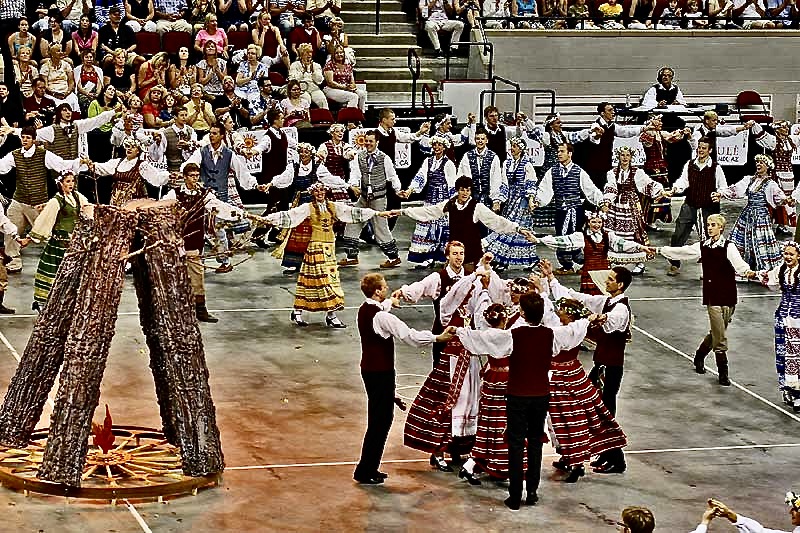
   Something on the order of three hundred dancers from five countries cut the rug at the show in the Berkman Hall Auditorium on the campus of Cleveland State University. “They represent every region of Lithuania,” said Ingrida Bublys, the Honorary Consul of Lithuania for Ohio, Indiana, and Kentucky. The event was sold-out and sponsored by the dance group known as Svyturys, which means Beacon. The Beacon has been lighting the way in Cleveland for twenty years.

   Although Lithuania has been around for ages, Lithuanian folk dancing has only been around for an age. It got started in the late nineteenth century during the National Awakening, when the country was under the thumb of Moscow. The native language and native writing were proscribed, but the Czar turned a blind eye to busting moves, so long as the busting didn’t have anything to do with treason and dynamite. The first Lithuanian folk dance, known as Suktinis, was performed in St. Petersburg in 1903. Suktinis means winding or twisting. The first down home dance festival was held in Kaunas, then the capital of the country, in 1937. There were 448 dancers hoofing it, most of them going around and around.

   Lithuanian folk dances are usually one of two kinds. There are sokiai, which are ordinary dances, and there are rateliai, which are ring dances. Sokiai are often accompanied by instrumental music and sometimes by songs. One of the most popular dances is called Malunelis, which means windmill. Ring dances are more-or-less walked, sometimes slowly, sometimes faster, sometimes in a slow trot. The secret is in the center of the ring for anybody who knows where to look. The movements are simple and usually repeated over and over. They take the form of circles and double circles, as well as rows, bridges, and chains. The circles transform into lines and snakes as the dancing progresses. The dancers sometimes break up into pairs. The high stepping that follows is usually of foreign origin, like the Polish polka.

   Raganaites, which means the Dance of the Little Witches, is performed by young girls wielding straw brooms. They pretend to ride them. They twirl them, do some mock jousting with them, and try not to poke anybody’s eye out. A witch taking time off from her cauldron must be at least a hundred years old and have memorized the 7,892 spells in the Great Book of Magic before being allowed to do the dance. But the rules are always waived for Lithuanian kids.

   If an honest-to-goodness witch ever threatened me by saying she planned on dancing on my grave, I would tell her, “Be my guest. Even though I’m the grandson of landed farmers, I plan on being buried at sea.” 

   Before there was Svyturys there was Grandinele, which means Little Chain, and before there was Grandinele there were six refugees who in 1948 performed at the Slovak Cultural Gardens. It was One World Day. Nearly 40,000 Lithuanians landed in the United States after World War Two. Four thousand of them landed in Cleveland, joining the 10,000-some who already lived in the northern Ohio city. Even though the Lithuanian Cultural Garden was officially dedicated in 1936, the garden was only big enough on its lower level to hold the bust of Jonas Basanavicius, a freedom fighter who never gave up fighting tyranny. Over time a middle and upper level were created. The upper level is where the Fountain of Birute is. She was a priestess in the Temple of the God of Thunder. In her day the Russians stayed away from the Baltics. Even the Golden Horde was known to warn freebooters, “Beware the Lithuanians.” The Grand Dukes weren’t anybody the Russians wanted to mess with. They kept to their dachas, which were dry except for cupboards full of vodka. There were lightning rods on the roofs.

   My sister Rita was a dancer in Grandinele, the by-then acclaimed folk dancing group, in the mid-1970s. My brother Rick was not in any dancing group. He was smooth with the spoken word, but had two left feet like me, except I could tell my two feet apart, while he couldn’t. He was banned for fear of kicking up his heels in too many directions. Rita danced in Grandinele for almost five years. During that time, she toured Argentina, France, and Germany with the group. “We danced in front of large audiences,” she said. “Before I went I had no idea there were so many Lithuanians in South America.” The group wasn’t allowed to perform in Lithuania, which was behind the Iron Curtain at the time. The Kremlin didn’t let anybody beat feet in Eastern Europe.

   Grandinele was formed by Luidas and Alexandra Sagys in 1953. The dancers were mostly high school and college students. They rehearsed twice a week at a YMCA in Cleveland Heights. A second group composed of tadpoles was formed in 1973, to teach them the basics and get them ready for the limelight. They didn’t perform in front of the public, but they performed in front of Luidas and Alexandra, which could be even more unnerving.

   “He was strict but creative,” Rita said. “Not everybody in the community liked him making up his own folk dances, which were almost like ballets with a story. She was strict and could be mean.” Alexandra was the group’s business manager. She took care of the costumes. Nobody wanted to get on the wrong side of her, unless they wanted to risk being dressed up like Raggedy Ann.

   Luidas Sagys had been a professional dancer with the National Folk Dance Ensemble in Lithuania before World War Two. He fled the country after the Red Army came back in 1944. They seemed to always be coming back, even though the Baltics were sick of them. The apparatchik’s thought Lithuania was theirs to do with as they pleased. Their revolutionary ideals were long gone and not coming back. They had turned into rats. Their reasoning was that since the Nemunas River rises in central Belarus and flows through Lithuania, it was Russian water and wherever it went the land was part of Mother Russia. They have applied the same reasoning to the flow of the Dnieper River, which rises near Smolensk before flowing through Ukraine to the Black Sea. Ukraine is still living with the consequences of Moscow’s crazy reasoning.

   When Luidas Sagys formed Grandinele he could shake a leg with the best of them. In 1963 he directed the Second American and Canadian Folk Dance Festival. He looked authentic as could be whenever he donned indigenous garb and got into the act. Even though his culture and imagination were the genesis of his art, the art of him was his body in motion for all to see. He ran the Folk Dance Festival in Cleveland for many years. He liked to wear bow ties and sported a puckish grin when he wasn’t working on new choreography. When he was done, he liked to have a drink or two.

   My wife and I were by chance in Toronto when the XI North American Lithuanian Folk Dance Festival was staged there in 2000. The quadrennial festival, known as the Sokiu Svente, which means Dancing Celebration, was first staged in Chicago in 1957. We found tickets at the last minute and hurriedly got our bottoms in place. We sat in the cheap seats of the big auditorium. We didn’t mind since the view was better, anyway. Zilvitis, a musical ensemble from Lithuania, accompanied the performance of 1,600 dancers.

   The show was a swirl of color and action. A couple of thousand dancers dressed in the red, green, and yellow colors of Lithuania is a lot to look at in the space of a few hours, not to mention the mass maneuvering and the music. The performers and jam-packed audience were more Lithuanians than I had ever seen in one place. On top of that most of them were speaking the natal tongue. I grew up with the lingo and was able to keep up.

  One of the dance groups at the show was Malunas, which means to mill. Back in the day, before they did much dancing, most Lithuanians were either peasants or farmers. There were grindstones far and wide. Baltimore was the dance group’s homestead. They had been performing up and down the East Coast for nearly thirty years. They have appeared on PBS-TV and at presidential inauguration festivities. Toronto was their fifth Sokiu Sevente.

   A tradition at every Sokiu Svente during the rehearsal before the big show is for every group to wear a distinguishing practice outfit. When silk-screened t-shirts became popular in the 1970s, groups began to design and wear custom t-shirts. They came up with their own silk-screened identities. After the last practice groups trade identities, which become mementoes. In Toronto, Malunas came up with a new idea. They were inspired by the Grateful Dead shirts of the 1992 and 1996 Lithuanian Olympic Basketball teams. One of their own, Michelle Dulys, dreamed up a design of skeletons as dancers rather than basketball players. The t-shirts were a knockout. The ones not exchanged were sold fast, faster than we could buy one. We watched the last skeleton sauntering off from the concession stand.

   The Lithuanian Folk Dance Festival Institute was formed soon after the Sokiu Svente became a going concern to liaison with dance groups worldwide. The institute hosts a week-long training course at Camp Dainava, in southeastern Michigan. Although it is an educational, recreational, and cultural summer camp for children and young adults, the name of the camp derives either from the past tense of the word sing, from a village in the middle of nowhere back in the homeland, or from a Lithuanian liqueur of the same name, made with grain spirits and fruit juices. The booze has a vibrant red color and a complex, sour-like flavor. Even though Lithuanians are ranked among the top ten barflies in the world, it is forbidden on all 226 acres of the campground.

   The two-and-a-half-hour divertissement that was the Juventas Festival started with a parade and a song. There was some speech-making. There was a violin, a couple of wind instruments, and a drummer, while an accordion led the way. There were costumes galore and faux torches. There was circle dancing. There was pairs dancing. The pairs dancing got fast and lively. There was more singing. Before every part of the show a young man and a young woman in civilian clothes explained, in both English and Lithuanian, what was coming up. A group of kids did their own version of a circle dance. Not one of them got dizzy and fell over. There was a courtship dance, the young men and women taking their wooden shoes off and going at the romance barefoot. Whenever the top guns came back, everybody sat up. They were good as gold. They had it going.

   In the end all the dancers somehow squeezed themselves onto all the parts of the stage. There was waving and rhythmic clapping. There were loads of smiles. A half dozen men lifted a half dozen women up on their shoulders and did an impromptu circle dance. It was a wrap.

   Most of June in Cleveland had been dry, so much so that lawns were going yellow. But it had rained a few days earlier. The smoke from the Canadian forest fires that had made the sky hazy gray for more than a week had gone somewhere else. Driving home everything smelled fresh and clean. The dancing had been traditional but not hidebound. It had been fresh and alive.

   Life can often be more like wrestling than dancing. Many people believe living has meaning only in the struggle. That’s just the way things are. But nobody can wrestle all day and all night. “The one thing that can solve most of our problems is dancing,” said James Brown, the boogaloo man known as Soul Brother No. 1. What he didn’t say was that, in a way, it’s like going to church. Nobody bends a knee in the sanctuary to find trouble. They go there and the dance hall to lose it.

Ed Staskus posts monthly on 147 Stanley Street http://www.147stanleystreet.com, Made in Cleveland http://www.clevelandohiodaybook.com, Atlantic Canada http://www.redroadpei.com, and Lithuanian Journal http://www.lithuanianjournal.com

A New Thriller by Ed Staskus

Cross Walk

“A once upon a crime whodunit.” Barron Cannon, Adventure Books

“Captures the vibe of mid-century NYC.” Sam Winchell, Beyond Fiction

Available on Amazon: https://www.amazon.com/dp/B0CRPSFPKP

Late summer and early autumn. New York City. A Hell’s Kitchen private eye. The 1956 World Series. President Eisenhower at the opening game. A killer in the dugout.

Hammer the Sickle Blues

By Ed Staskus

   “Man, I had a dreadful flight, I’m back in the USSR, you don’t know how lucky you are, boy, back in the USSR.”  The Beatles

   When Angele Staskus went to Lithuania in 1977 with her daughter, she had not been on native ground for thirty-three years. Her daughter, Rita, 17 years old, had never been there. They flew from Cleveland, Ohio, to New York City to Moscow to Vilnius. It took two days to travel the five thousand miles.

   It was in 1944 that Angele Jurgelaiyte, then a 16-year-old farmer’s daughter, fled Alvitas near Marijampole in the south of the country, the German Army retreating pell-mell and the Red Army storming the front. She shared a wagon drawn by two horses with her aunt and her aunt’s four children. A milk cow was tied to the back of the wagon. She fled to East Prussia to Germany to Canada. Nobody else in her immediate family got away before the clampdown. They got to stay in the USSR for the next five decades.

   Angele got married to Vic Staskevicius, another Lithuanian refugee, in Sudbury, Ontario. They had three children and the family emigrated to the USA in the late 1950s. After they got there they became Mr. and Mrs. Staskus. They started at the bottom. Everything looked like up to them.

   The first time Rita saw her first Russian  airport, she wasn’t impressed. “The Moscow airport was crappy, gray on gray, and there were birds and bats flying around inside the terminal. Everybody looked sick, like stomach flu was going around.”

   “The color of truth is gray,” said the French writer Andre Gide. He was wrong. The Commies were wrong, too, and their favorite color was wrong. Social material political truth at any cost is more trouble than it’s worth, sparing no one, not during the countless bloodthirsty 20th century grabs for glory and power, for sure. It’s not black and white either, no matter what the insincere masterminds say. The color of truth is more like Sgt. Pepper’s Crayola 64 Colors. 

   The Sheremetyevo airport served most of the international flights arriving and departing the capital city. The airport was originally built as a military airfield in the late 1950s with one runway. In the early 1970s a second runway was added. A single terminal still served both runways. Half the people waiting for their flights looked like they might commit suicide any second.

   “We had to go through customs. The higher-ups, police, and soldiers all looked grim. Everybody going to Lithuania was smuggling something. My mom kept telling me to flash a smile at the soldiers, most of whom were young, like me. We had gum and cigarettes in my suitcase, but they never went through it.”

   A woman behind them wearing an oversized fur coat wasn’t so lucky. “She had all kinds of stuff sewn into the lining of her coat. They ripped the lining apart and took all of it.” The police put her stuff in their pockets.

   There were several eateries in the terminal, but neither mother nor daughter ate while waiting for their connection. “The food looked horrible, and what was the point of bad food and bad service without a smile?” asked Rita.

   They flew Aeroflot to Vilnius. “They brought us food, butter and buns, but they were hard as rocks,” Rita said. “You couldn’t even bite into them.” She tossed them under her seat. “The stewardesses were all so surly, down at the mouth, that I started laughing about it.” The flight attendants did a slow burn.

   When they landed in Vilnius, the stale buns rolling to the front of the airplane, passenger loading stairs were rolled to the door. The terminal was built in 1954. “It was a gray rectangular building, like a warehouse, like in Moscow.” There were sculptures of soldiers and workers outside and wreaths, bay leaves and stars, and the Soviet hammer and sickle inside.

   “It was even crappier than the Moscow airport.”

   Inside the terminal was a tight-knit group of more than forty of their relatives. “They came running up to us. One of them asked, do you speak Lithuanian? When I said yes, everybody started talking at once.” Some of the people looked a little like her, while others looked a lot like her mother. They were her uncles, Justinas, Juozukas, Sigitas, and her aunt Irena. There were nieces and nephews. When the excitement died down, they drove to the Gintaras Hotel, near the railroad station.

   The Gintaras was where foreigners stayed, all foreigners from anywhere, who visited Lithuania. It was a hard and fast rule. Signs warned against making a commotion. “The kids were running up and down the hallway, while the adults were all in our room. It was crowded since it wasn’t a big room, at all.”

   They had brought pens, gum, and cigarettes. “My uncle Justinas lost the pen I gave him, and when I offered him another one, he said, no, he wanted the same pen I had given him. Nobody could find it, so I pretended to find it, and gave him a new one.”

   Everybody wanted the American cigarettes they had smuggled in. “Russian cigarettes were nasty. They smelled bad.” The Belomorkani cigarettes didn’t come with a filter, but with a hollow cardboard tube attached to a thin paper tube filled with tobacco. The tube was like a disposable cigarette holder. They were popular in the Baltics because of their cheap price. They were notorious for being the strongest cigarette in the world.

   “Everybody was smoking in minutes, the men, the women, and the older kids. It was non-stop.” 

   The Prima brand was imported from Bulgaria. It was a better quality of tobacco. But since the Belomorkani was the only available fag in most of the hinterland, that is what everybody smoked. A low-lying ashy cloud soon hung down from the ceiling. Even though cigarette advertising wasn’t allowed in the USSR, almost everybody smoked. 

   “After twenty minutes you couldn’t see across the room.” Rita noticed one of her cousins was chain-smoking. “I didn’t know you smoked.”

   “I don’t,” he said.

   “We brought Bubble Yum because that’s what they wrote us they wanted. All they had was crappy hard gum that would break your teeth when you started to chew it.” Introduced just two years earlier by Life Savers, Bubble Yum was the first soft bubble gum ever created. “They would chew the Bubble Yum for a half hour and then put it back in its wrapper, putting it away in their pockets or purses.”

   One afternoon Rita was sitting in a nearby park talking with her uncle Sigitas. He took his wallet out of his back pocket. He filled his hand with a wad of cash.

   “We have money, but there’s nothing to buy,” he said.

   “We went to a butcher shop. There were only two kinds of meat and both of them were loads of white fat. My aunts were always cutting fat off. It was gross. Even the herring was bad. I mostly hated the food. It turned my stomach.”

    There was a store near the hotel. It was called the Dovana Krautuve, or Gift Store. It was for Western tourists only. Lithuanians weren’t allowed to shop there, or even go inside it. They went there one day on a tour bus. “They had amber, wooden dolls, artsy stuff there. They just wanted our American dollars. When we were leaving, they gave each of us a bottle of Coca-Cola.”

   Back on the bus, Rita asked the driver if he liked Coke.

   “Yes, I had some in 1955,” he said. “It was good.”

   “That was twenty-two years ago,” she said. 

   “Yes, I understand,” said the bus driver.

   She gave him her bottle of the sweet soda.

   “The Young Communists were always following us around, telling us their world was just as good as ours, that they had everything we had, and more. When I had to take my contacts out on the bus, one of them said, we have those, too. That was wacky because none of my relatives had contacts and none of them knew where to get any unless it was the black market.” She finally told the Young Communists to cut it out. “Your BS isn’t doing anything for me,” she said.

   While inside the hotel, nobody talked about anything that might compromise them. “All the rooms were bugged. Everything was bugged.” Everybody was constantly watched, one way or another. Telephones were tapped. Mail was opened. Black government sedans followed people around.

   Angele and Rita stayed at the Ginraras Hotel for a week. Everybody knew somebody was always listening in. Nobody said anything. Their room wasn’t small, but it wasn’t large, and the bathroom was even smaller. The room was a bathroom and a shower all at once. There weren’t any sliding doors or shower curtains. “There was a drain in the middle of the floor, and whenever we showered the spray would get all over the tiled walls and sink and toilet. Everything got wet. The whole room became a shower.”

   After they towel dried the room and themselves off, they visited with their relatives. It was what they did more than anything else. There weren’t many sights to see in Vilnius, even if you could go there.

   “You never asked anybody, even your own flesh and blood, what they did. They would always say, ‘I have responsibilities.’ If you lived in Vilnius, you probably had a normal job, but not in Marijampole.” Most of her kinfolk lived in the country and farmlands southwest of the rural town. They finagled and horse traded, going to Poland, smuggling whatever they could, doing things that weren’t altogether legal, or so the Russians said, so it wasn’t prudent to ask them too much

   The goal was to be a ‘pasikaustes,’ somebody who has the smarts prowess right stuff to make it happen. It literally means putting a horseshoe on yourself. Everybody needed good luck in the clampdown. That’s why they were always wheeling and dealing.

   They were waiting for the Russians to get the hell out of their country. They had once waited more than a hundred years. They could wait another hundred if they had to, although who wanted to do that? They were already bitter and alienated. ‘Laikiu nesulaukiu’ means not being able to wait for something to happen. “I wait but I can’t wait.” It’s like being in jail for a crime you didn’t know you had committed.

   They made plans to go to Silute to see Rita’s paternal grandmother, who was in her 80s. Angele had never met her. Rita couldn’t imagine her.

   Silute is to the northwest of Marijampole, two-some hours away. The Nemunas River floods there almost every year, soaking the lowland pastures. Migrating birds call it home away from home because of the delta and all the water. A fifth of the area is forested. It is home to more than three hundred villages.

   Antonina was Angele’s husband’s mother. She was a Russian woman, had been a young schoolteacher in the middle of nowhere, and married Rita’s grandfather when he was an officer in the Imperial Army, stationed in the middle of nowhere. “She was taken a few years after my grandfather was deported in 1941 and dragged away to Siberia for more than ten years.”

   Rita’s mother’s family, who lived in the south of the country, made plans to take them to Silute. They kept their plans close to the vest. The scheme was for there to be three brothers, three wives, three cars, Angele and Rita, and some of their cousins. “My mother would be in one of the cars, I would be in another, and the third car would be a decoy, if it came to that.”

   The secrecy was necessary because they weren’t allowed to go anywhere except within the city limits. When they asked about Silute, Siauliai, and Zarasai, the other points of the compass to Vilnius, they were told they were all out of bounds. Everywhere outside of Vilnius was off limits. The Intourist official, the Soviet tourism monopoly, at the front desk of the hotel leaned forward and told Angele and Rita it was because of missile installations.

   “Are there missiles in every town in the whole country?” asked Angele.

   “I know sarcasm from naïve American when I listen to it,” the official scowled.

   Their convoy didn’t get far the day of the familial excursion. They were stopped by a roadblock on the outskirts of Vilnius. The police were waiting for them. “They knew,” Rita said. “Somebody had overheard something. Somebody talked. They waved us off the road.”

   The police glanced at Justinas’s papers and told him to go back.

   They went to the second car. Everybody had to show their papers. Angele was the best dressed of everyone in all three cars. She was all decked out. They asked her where she lived.

   “The Gintaras Hotel.”

   “Turn around, fancy lady, go back to the Gintaras.”

   They went to the third car.

   Sigitas and his wife Terese showed their papers. Rita was sitting in the back with three of her cousins. They all showed their papers. When it was Rita’s turn, she said, “You’ve seen their papers. I live in the same place.”

   “What’s your name?”

   “Jurgelaitis, just like them.”

   He asked her something in Russian. She didn’t understand a word and glared at him. The stare-down between cop and girl took a long minute.

   “The next time I see this one she is going to have to answer,” the policeman warned Rita’s uncle.

   “Turn back,” he said, shooting everybody a dirty look. They turned around and the convoy went back to Vilnius.

   Undaunted, a few days later, a day before leaving the USSR, Rita was picked up by Sigitas before dawn before breakfast at the back of the hotel for an end run to Silute. She skittered into the car, and they sped off. The streets were empty in the gloom.

   “He was a crazy driver, always yelling, ‘Somebody’s following us!’ He stayed off the highway, and the main roads, instead going up and down different streets. I thought the drive was going to take two hours, but it took much longer.” It took five hours on empty stomachs. It was worse than the Aeroflot flight.

   They were stopped several times, but every time her uncle was allowed to stay the course. The roadblock police didn’t explain why. They just waved him on. When they got to Silute they asked around and found the house where Antonina Staskevicius was living. 

   After Josef Stalin’s death many political prisoners in Siberia were set free. She was one of them. Her chain gang days were over. Her husband was long dead, dead of starvation in 1942, in a forest labor camp. She was sent back to Lithuania, but not back to Siauliai where the family farm didn’t exist anymore. She still wanted to go there but was told to go live in Silute. The Russians shrugged her off when she asked why.

   “She lived in a two-room apartment, in a rectangular four-unit building, almost like a log cabin, that looked like it was built a thousand years ago,” said Rita. There was no running water or indoor plumbing. The floors were dirt. The windows needed caulking. The roof was several generations overdue.

   “She was in her 80s. She had gone through tough times, but still had a lot of life in her.” She had seven grandchildren in the United States. Rita was the first one she ever saw. She gave her granddaughter a big smile and a big hug, even though she was a small woman and had to reach up.

   She wasn’t made of steel, like the Muscovite ringleader who squashed her and the Baltics under his thumb, but he was gone, a tinhorn memory, and she still had plenty of what it takes. How you start isn’t always how you finish.

   They had lunch, cold beet soup, potato dumplings, and mushroom cookies with strong hot tea. Rita didn’t throw anything under the table. It was an old-school buffet on an old round wood table.

   “How did you like it?” her uncle asked on their way back to Vilnius.

   “It was the best food I’ve had since I left home,” Rita said.

Ed Staskus posts monthly on 147 Stanley Street http://www.147stanleystreet.com, Made in Cleveland http://www.clevelandohiodaybook.com, Atlantic Canada http://www.redroadpei.com, and Lithuanian Journal http://www.lithuanianjournal.com

A New Thriller by Ed Staskus

Cross Walk

“A once upon a crime whodunit.” Barron Cannon, Adventure Books

“Captures the vibe of mid-century NYC.” Sam Winchell, Beyond Fiction

Available on Amazon: https://www.amazon.com/dp/B0CRPSFPKP

Late summer and early autumn. New York City. A Hell’s Kitchen private eye. The 1956 World Series. President Eisenhower at the opening game. A killer in the dugout.

Rolling With the Punches

By Ed Staskus

   I was surprised and dismayed the day my father told me that, other than Ausra, the two-week sun and sand Lithuanian camp in Wasaga Beach, and our one-week boy scout camp, I would be working at the newspaper Dirva the rest of the summer. I shouldn’t have been surprised, since my father believed in the work ethic and worked like a dog himself, but I was. He gave me a grave stern annoyed look when I blurted out it would screw up my time off from school. 

   He and I weren’t on the same page, so I kept my dismay to myself.

   It wouldn’t have helped, anyway. I knew once he told me, I would be working at Dirva from Memorial Day to Labor Day. Thank God it was only part-time. I would be home by three o’clock and didn’t have to work on Fridays. I was going to be getting three-day weekends before I even knew what three-day weekends were.

   Before the newspaper Dirva, which means field, was Dirva, it was Santaika, which means peace. Kazys Karpius was the editor, and stayed on the job for thirty years, from the end of World War One through the Great Depression to the end of World War Two, getting the weekly editions out without fail. The paper was anti-communist, pro-democracy, and true-blue the homeland.

   Kazys Karpius wrote poems, plays, and histories about Lithuania, especially about beating off the Vikings and Teutonic Knights back in the day. The Teutonic Knights were always tramping into the Baltics for plunder and conversion, not their own conversion, but that of the natives they regarded as pagans. The Lithuanians didn’t see eye to eye with the Germans about it, insisting it was none of their business. They fought with longswords, battles axes, crossbows, maces, picks and war hammers, knives, clubs, slings, and hand-to-hand.

   The first day I slouched into work was a brisk early summer morning. I was down on Dirva but resigned to my new job. I rode the CTS bus from St. Clair to East 105th Street over Liberty Boulevard down Superior Avenue. It was the same bus and same route I took going to school, to St. George’s, on East 67th and Superior.

   Lithuanian immigrants came to Cleveland, Ohio, on the south shore of Lake Erie, in two waves, the first one in the late 19th century. They were cheap labor for emerging industries. They needed their own newspaper and church. At the turn of the century Father Joe Jankus threw up a small wooden church near downtown. The next pastor bought the land St. George’s was going to stand on and after it was built Father Vincent Vilkutaitis ran the parish for forty years. His last year was my first year of five years there.

   The church was on the top floor of the 2½ story brick building, the grade school on the middle floor, and the community hall on the ground floor, which was partially below ground.  Since it was the Atomic Age, and the Cold War was in full swing, the hall doubled as a Nuclear Fallout Shelter. Every few months we had a Civil Defense drill and had to file out of our classes and down to the hall, where we shuffled around until the drill was over.

   If we had somehow survived the blast, even though we all brought our own sandwiches in Flintstones and Dudley Do-right and Jetson lunch boxes, we would have all slowly starved to death trying to live on crumbs and apple cores. Dudley wouldn’t have helped, snug in his bunker under the White House.

   Jonas Ciuberkis was our neighbor two houses down from where we lived at the corner of Bartfield and Coronado, in a Polish double my mom and dad had bought with my dad’s sister and her family, all of us getting started in the United States. He was the editor of Dirva, in a small office at the front. A quiet man, balding, careful in manner, he was married to a woman fifteen-some years his junior, a woman who had given him three children, and who was fleshy vivacious gregarious.

   Regina Ciuberkiene had an opinion about everything and could talk your ear off. It didn’t matter that we were just kids. We avoided her. My mother never called her Regina. She called her Ciuberkiene, even to her face. Many of his friends called Jonas Janis, which is Latvian for Jonas. He had studied law in Lithuania and worked in Latvia before the war. Their two daughters were either too old or too young, but their son, Arunas, was just right, and we played together.

   Dirva was in a one-story brick building on Superior, next to the haunted house that was next to St. George’s. The Lithuanian Hall Society was next door. It was where all the civic and cultural business was done. It was also where there were dances and heavy drinking. Jonas Ciuberkis wasn’t sure what to do with me, so the first few days I didn’t do anything. After that I started cleaning up the mess, starting with the bathroom. After that I helped with the press and folding and mailing.

   My job was to do this do that, whatever I was told to do.

   The printing press looked like it belonged in a museum. It worked, sort of, but it was my archenemy, always threatening my mitts. It was a hand-fed flat-bed cylinder press. There was metal type for headings and an intertype machine for news and features. When the paper was ready for print, I got the machine rolling, crossing my fingers, and hoping for the best. As the copies came off the belt, I changed hats, becoming the press-boy who checked for defects. If and when the press got everything done, I became the mail-boy, wrapping the papers in bundles. Then I became the push-boy, carting them to beside the back door for pick-up.

   I was always amazed that the week’s news always fit exactly into that week’s edition.

   By World War One there were almost ten thousand Lithuanians in Cleveland. St. George’s was their church. Dirva was their newspaper. It was put out by the Ohio Lithuanian Publishing Company, which was run by Apdonas Bartusevicius. In 1925 Kazys Karpius gained a controlling interest.

   He was involved in Lithuanian projects all his life, including the Unification of Lithuanians in America and the Lithuanian National League of America. He helped found the American Lithuanian Cultural Center. After World War Two boatloads of displaced Lithuanians made it to Cleveland. Dirva published local, national ,and international news, as well as keeping everybody informed about what was going on back in the land. We sent the paper to Detroit and Pittsburgh and other places wherever there was a church or a bendruomene.

   Our editor went out most days for lunch and sometimes came back smelling like whiskey. One day he was walking out the door, I was sitting on a crate doing nothing, when he waved at me and said, “Ateik.” I must have been daydreaming, because he had to say it again before I realized he wanted me to go with him.

   He usually wore a white shirt and brown pleated pants. His thin hair was gray brownish. He drove a brown car. The interior was tan, clean, and anonymous. No one would ever have suspected he had a wife and three kids. He turned right on Norwood Road, six blocks later turned right on St. Clair, past the Slovenian National Home, to the Maple Lanes Bowling Alley and Tavern. It took five minutes. He parked on the street, and we went in.

   Nothing was going on in the bowling alley, but he wasn’t going to the bowling alley, anyway. He walked into the bar, checking to see that I was trailing him, and took a stool at the bar.

   “Atsisesk,” he said, adding, “Don’t tell your mother.”

   I sat down next to him. The bartender stepped up. He was wearing a bow tie and looked like as big as a new mattress wearing a bow tie. I couldn’t see around him.

   Jonas Ciuberkis ordered a shot and a water back and asked me what I wanted. I wanted an ice-cold Coca-Cola. It was in the 90s and humid. There was a big glass jar of pickled eggs at his elbow. He took one out for himself and nodded at the jar, looking at me. I said aciu, but no thanks.

   Pickled eggs are eggs hard boiled, the shell removed, and submerged in a solution of vinegar, salt, spices, and seasonings. The eggs are left in the brine anywhere from one day to several months. They get rubbery the longer they are in the pickling solution.

   “They’re Pennsylvania Dutch,” my boss said. “Try a bite.”

   Pennsylvania Dutch style means whole beets, onions, vinegar, sugar, salt, cloves and a cinnamon stick are used as the brine. The eggs look pink purple from the beets and have a sweet and sour taste.

   I took a bite, gingerly. It wasn’t bad. It was actually good, far better than the koseliena, chopped meat in cold aspic, like headcheese, my mother was always trying to get us to eat. Some food from the old country should have been left in the old country, dead and buried.

   When the bartender moved to the side, I saw the painting. It was on the wall above the paneling and top shelf of liquor bottles. It was of a half-naked woman reclining on her side on a chaise, her head up, looking down on the drinkers, her long golden hair hanging loose. Her eyes were wide set and her lips pouty luscious red.

   It was Lili St. Cyr, a burlesque dancer forty-some years ago. She was a pioneer in the striptease trade, known for her cutting-edge performances. One of her most famous tricks was ‘the Flying G.’ While she was doing her burlesque striptease, the lights slowly going down, just at the instant when everything went completely dark, a man in the wings with a fishing pole would snag her G-string and pull it off. Even if you didn’t blink it looked like it had disappeared just like that.

   A man who had seen her perform many times painted the mural in 1954. Maple Lanes paid him off in beer. Above the burlesque queen’s legs in the painting was an English proverb, “A woman is an angel at ten, a saint at fifteen, a devil at forty, and a witch at fourscore.”

   Jonas Ciuberkis flicked his eyes at the painting ten twenty times, while I narrowed my St. George altar boy eyes. Some gals are like the highway from Akron to Cleveland, no curves. She wasn’t one of those gals. I was an altar boy at St. George’s on the side. The boss had another shot, this time with a beer chaser. My mother always told us an apple a day, not a bottle of pop, kept the doctor away, so, I turned down more Coca-Cola.

   He talked about the “Great Books,” one of his favorite subjects, so I didn’t tell him about my reading habits, and about Lithuania, his other favorite subject, its history, the commies, and how to restore its freedom. I didn’t tell him it was going in one ear and out the other. He talked in a gloomy milk and water way. It was hard to pay attention, so I gave up, and set my sights back on Lili St. Cyr.

   She started looking familiar. I finally realized, if she were wearing clothes, she looked just like Regina Ciuberkiene, wide set eyes and full mouth, buxom, calves of salami.  She wasn’t a spitting image but as close as spit got.

   I noticed the TV on the wall in a corner was re-run broadcasting a boxing match. The two men were jabbing hooking punching but not landing much of anything. When one threw a punch the other one rolled with it.

   My boss had to drag me away and never invited me to Maple Lanes again. Mondays through Thursdays the summer crawled by, while Fridays through Sundays flew by. I messed around with my friends, rode my bike, and played a boatload of pick-up sandlot baseball.

   By the time my employment was coming to an end, Labor Day fast approaching, I had come to an accommodation with my job. The printing press and I were on speaking terms. I was no longer down on Dirva. I almost enjoyed it. I asked about my paychecks. I hadn’t seen a single one of them.

   “I gave them to your father every two weeks,” Jonas Ciuberkis said.

   “Oh,” I said.

   I didn’t ask my father about the paychecks. My mother and he were fanatical savers, putting every spare penny in the bank. I knew what he was going to be doing with the money, which was clothes and tuition for school.

   By the next year we had moved past Five Points to the Lithuanian neighborhood on the farther east side. Everybody was moving there because, with urban renewal in full swing, black people were slowly steadily shifting east, moving into our neighborhood. “We like them less than the Americans,” my mother told me. “They’re lazy.” If you weren’t a workaholic my parents thought you were lazy.

   The first Lithuanians in Cleveland lived near downtown, but fifty years later were relocating to the Superior-St. Clair area around St. George’s. The new community emerged in the Collinwood-Nottingham neighborhood, near the church of Our Lady of Perpetual Help on Neff Road off East 185th Street. Most Lithuanians are Roman Catholic, although some are Jews, and a few are Lutherans. A small group of Cleveland’s Lithuanians broke off to live among working-class Poles on the south side, even though there is no love lost between Poles and Lithuanians.

   I enrolled in St. Joseph’s High School where the main road, a couple of miles of every kind of shop and store, intersected Lakeshore Boulevard. It was an all-boy’s school. It was still summer, the next summer, but fall was coming up. I looked at Dirva now and then, but when classes started all I read were my schoolbooks and Doc Savage adventure books from the library. I read them on weekends. There were twenty-four of them in all. I read them all. My favorite was “The Secret of Satan’s Spine.”

   Jonas Ciuberkis was fired from his job and Vytautas Gedgaudas took over. I didn’t know him and nobody I knew ever told me anything about him. He expanded the publication schedule to three times a week, but it went back to its original weekly frequency soon enough. Working that much must have driven the printing press crazy, and driven whoever was operating it crazy, too.

   Maple Lanes Bowling Alley and Tavern was sold that same summer of 1964. Ann Abranovich and Josephine Reeves, sisters and working mothers, bought it so they could make more money and spend more time with their sprouting growing families. Josephine lived a few blocks from the bowling alley and walked to work. Ann moved her family into the apartment upstairs. The noise downstairs was money in the bank.

   When I heard the St. Joseph’s bowling team was going there for a tournament, I told them I knew all about the bowling alley and they let me tag along. Everybody asked me about the painting, which the new owners hadn’t messed with. I told them I knew everything about it.  I didn’t know bowling from polo, although I knew you rolled the ball trying to knock all the pins down, so I sat in the back and watched. The St. Joe’s and Padua and Ignatius teams rolled the worst scores of their lives.

   The kingpin kids from upstairs were the pinsetters. You had to be careful not to roll while they were still setting up. They screamed and sent pins flying at you if you did. The alleys weren’t even and smooth. They were wood, not laminate, old wood, and there were warps bumps gouges divots waves from one end to the other. It was hard if not impossible to tell what your ball was going to do. The talk was that no one had ever rolled a three hundred score perfect game at Maple Lanes, and that no one ever would, unless they made a deal with the devil.

   That was unlikely to happen, because everybody in that old neighborhood neck of the woods went to church on Sundays. There weren’t as many churches as bars, but it was close enough. There would have been talk, the news would have spread like wildfire, and there would have been hell to pay if you did roll a perfect game.

Ed Staskus posts feature stories on 147 Stanley Street http://www.147stanleystreet.com and Cleveland Daybook http://www.clevelandohiodaybook.com. To get the site’s monthly feature in your in-box click on “Follow.”

Working Side of the Altar

By Ed Staskus

   “Mom, can you write me a note for school tomorrow saying I can’t be an altar boy,” I asked my mother after we had finished watching every minute of “The Wide World of Disney” and “The Ed Sullivan Show.” She gave me a sharp frown. I gave her my best first-born smile. I didn’t have a plan so much as a hope.

   Every Sunday night my parents snacked on sliced smoked eel while my brother, sister, and I munched on handfuls of popcorn from yellow plastic bowls sitting in front of our Zenith TV console in the basement. It was a family ritual. We loved Walt Disney, but ‘The Great Stone Face’ wasn’t a chip off the old block. He was the unfunniest man on TV. The circus acts and comedians were fun, but the opera singers and dramatic monologues were dull as turned off. None of us understood what the Little Italian Mouse was up to, either.

   I asked my mother for the note after we were out of the tub, in pj’s, and our book bags ready for the coming Monday morning. I wanted it to be short and sweet, as though it were no big deal, routine, really. I thought pleading something along the line of all my spare time was already being spent on my studies would be the way to go. I knew I was on shaky ground, though. My parents wanted me to be an altar boy. They went to mass every Sunday, which meant we all went. “Everybody went to church back then,” according to my mother. “There were two masses every Sunday. The church was full of people. We went early to get a pew.”

   My mother always went to church because she had always gone. “I grew up that way,” she said. My father, on the other hand, was a true believer. He was an accountant and counted on getting to Heaven. Even though he wasn’t a betting man, he put his money on Pascal’s Wager. The wager argues that a thinking person should live as though God exists and try to believe in him. If God doesn’t exist, there will only be a few finite losses, like good times with too much money and too many girlfriends. When you are dead and gone you won’t miss them. But if God does exist, there are infinite gains, like spending eternity in Heaven, and no infinite losses, like spending eternity in Hell. 

   After he told me about the parlay there was no arguing with him about whether I was going to faithfully serve out my altar boy time. “St. George is one of the Holy Helpers,” he said. The nuns at school thought George was a stud, the Trophy Bearer. I helped myself out by biting my tongue. As far as my father was concerned, I was going to be an altar boy, no doubt about it.

   The most embarrassed I ever was as a child was when my parents made me go to Sunday mass dressed up in a Buster Brown sailor suit. Something criminal happened to the costume before the next Sunday. It was never found alive again. I had to go to confession after telling my mother I had no idea what happened to it. The fashion show took months to live down at school. I had to fight my way out of several mean-spirited jibes. There will be blood in grade school.

   The St. George church, school, and parish hall were a three-in-one package, a rectangular two-and-a-half story brick building on Superior Ave. and E. 67th St. The church was on the top floor, the school on the middle floor, and the hall on the half-in-the-ground floor. The hall doubled as a civil defense shelter in case of nuclear war, even though it was unclear what we going to do down there after the atomic bomb had blown Cleveland, Ohio to kingdom come.

   I was glad my mother didn’t down-press me about it, but wrote a note, sticking it in an envelope, sealing it, and finishing it off with my teacher’s name on the front. A small whitecap of uncertainty took shape in my mind at my mother’s readiness to do my bidding, but I put my doubts to rest and slept well that night. The next day I gave the envelope to my third-grade teacher, Sister Matilda, a gnarly disciplinarian who had press-ganged me and a half-dozen other boys the second week of school. I found out later it was an annual recruitment drive.

   She read the note, smiled, and said, “Very good, you start next Monday.”

   How could that be? What happened between last night and now? My own mother had tricked me, I realized. When I asked her about it, she said, “As a mother I do the possible and leave the impossible to God.” I had already heard God helps those who help themselves, but that didn’t seem to be working out for me.

   The St. George edifice was the biggest Lithuanian building in Cleveland. It was built in 1921. It was at the center of the ethnic district and many parishioners had businesses and institutions, like the newspaper and some kind of historical outfit, nearby. The east side along Lake Erie was full of Poles, Serbs, and Lithuanians.

   The parish priest, Father Ivan, short for his civilian name Balys Ivanauskas, lived in a seven-bedroom Italianate-style rectory a stone’s throw from the church. It had originally been built for a big family in the 1880s. Our teachers, the Sisters of St. Francis of the Providence of God, lived together in a slightly smaller house on Superior Ave. two or three minutes away. There were eight of them, not including the Mother Superior. They could have used some of Father Ivan’s empty bedrooms.

   The sisters were a hard-boiled bunch. They were flinty as could be about us taking our studies seriously and behaving in class. Those were rules number one and two. There were no other rules. They weren’t above hitting us with rulers, rolled-up Catholic Universe Bulletins, and their open hands. Nobody’s parents ever complained about it, so none of us ever complained about it to them.

   What would have been the point? They would only have asked, “What did you do?” There was never a good answer to that.

   The nuns never sweated getting the job done. In fact, they never sweated at all. Wearing thick bulky habits, they should have been the first to perspire whenever it got hot, but they never did. Nobody knew how they did it, if it was part of their training or some kind of black magic.

   Even though I hadn’t been baptized at St. George, I was an altar boy at many baptismal rites there. One time at the font a baby spit a stream of pea green apple sauce puke on my surplice and another time another one burped and farted and messed up Father Ivan. I had to run back to headquarters and get wet rags. I sprayed the boss with a new-fangled aerosol called Lysol a busybody had donated.

   I received my First Communion at St. George and was confirmed there. The First Communion happens when as a Catholic you attain the Age of Reason. I don’t know how any of us were ever awarded the sacred host when we were, because I definitely had not attained the Age of Reason, nor had anyone in my class, unless they were faking it.

   My reason was affected by reading boy’s books in my spare time, adventures about running for your life, spies, foreign lands, full moons, secrets, ray guns, tommy guns, spitfires, hooded supervillains, risky back alleys, conspiracies, and the bad guys foiled at the last minute by the good guys. The paperbacks seeded my nightly dreams and I cooked up twisty exploits every night, waking up happy I had survived. 

   Before we got thrown to the lions, we got trained in the performance basics, how to dress, the call and response, and how to arrange the corporal, the purificator, the chalice, the pall, and the big Missal. We learned how to hold liturgical books for Father Ivan when he was proclaiming prayers with outstretched hands. We brought him thuribles, the lavabo water and towel, and the vessels to hold the consecrated bread.

   We helped with communion, presenting cruets of wine and water for him to pour into the chalice.  When he washed his hands standing at the side of the altar, we poured the water over them. If incense was used, we presented the thurible and incense to Father Ivan, who smoked the offerings, the cross and altar, after which we smoked the priest and people. It had one flavor, a rotting pomegranate smell. The thurible was a two-piece metal chalice with a chain that we swung side to side. God forbid anybody got slap happy and swung it too high, hitting something with it, and spilling the hot coals, threatening to burn the church down. That was when Father Ivan became Ivan the Terrible.

   We rang a handbell before the consecration, when the priest extended his hands above the holy gifts. We rang the bell again when, after the consecration of the bread and wine, the priest showed the host and then the chalice. “Ring dem’ bells” is what we liked doing best.

   I started low man on the totem pole which meant the 7 o’clock morning shift. Even though everybody went to church, nobody went to church first thing in the morning Monday through Friday. At least, almost nobody. The man in charge was always there with one of his altar boys. I had to get up at 5:30 in the morning, pour myself a bowl of Cheerios and a glass of orange juice, catch a CTS bus on the corner of St. Clair Ave. and E. 127th St., toss exact change into the fare box, stay away from the crazy people on the bus, run through the church to the sacristy, get into my uniform, and make sure I had my cheat sheet. I had to be on time, or else.

   The mass was performed in Latin, most of the time the priest’s back to the congregation, and we followed his lead. There were prescribed times we had to respond by voice to something Father Ivan recited. It was when we offered Holy Communion that I finally faced the nave and saw the only people in church were old, older, oldest, unemployed, worried about something, or simply in the wrong place. 

   One benefit to hardly anybody being in the pews first thing in the morning was whenever I made a mistake, it usually stayed between me and my maker. That is, unless Ivan the Terrible, who had eyes in the back of his head and whose hearing was better than a moths, saw and heard what I had done wrong.

   Moths have the best hearing in the world, next to priests, who are accustomed to listening to whispers in the confessional. I was waiting for my turn one afternoon after school when I heard Father Ivan bellow, “What did you say?” and the next thing I knew a red-faced boy burst out of the booth running, followed by the dark-faced priest. I quietly slipped away. There was no need to put myself in harm’s way for somebody else’s mortal sins.

   When I started, Father Bartis was in charge, but the next year Father Ivan became the parish priest. He was a burly man. None of us knew where he came from or how old he was, although we guessed he was between 30 and 60. He ran the parish until 1980. He smoked a lot, which we could smell on his breath when he got close to us, and sometimes we caught a whiff of spirits. We all knew what strong drink smelled like because almost everybody’s parents drank. They were Lithuanian, after all.

   He liked to take walks and mind his own business, unless he was minding ours. We were always under the gun. He was irascible to begin with and screwing around with his life’s work brought out the worst in him. Our school janitor said he never met anyone worth a damn who wasn’t irascible, like Father Ivan. He was short-tempered, but his bark was worse than his bite. The nuns put him to shame when it came to crime and punishment.

   All of us carried cheat sheets at mass. Latin was a foreign language, as well as a dead language. None of us were taking classes in it and none of us knew what we were saying. Our responses during mass were rote, except when something went wrong, when we improvised with mumbles. It wasn’t speaking in tongues, but Father Ivan warned us exorcism was imminent if we didn’t learn our lines.

   The Eucharist was the high point of mass. It got us off our knees and on our feet. We helped in the distribution by holding a communion plate under everybody’s chin when the priest gave them the wafer. There would have been hell to pay if there was an accident, the wafer falling out of somebody’s mouth and landing on the floor. It would have meant saying a million Hail Mary’s and a thousand turns around the Stations of the Cross.

   After acquiring seniority, I was promoted off the morning shift and started serving at Sunday masses, funerals, and weddings. Sunday mass was more of the same, only longer and more elaborate, but at least I got to sleep in and go to church in the family car instead of the city bus with strangers.

   Funerals were usually scheduled on Mondays and Fridays. I began to think weekends coming and going were a dangerous time. At one Friday funeral Father Ivan spoke glowingly of all the good works the deceased had done and how he was sure the man was going to heaven. “The way to the brightness is through good works,” he said. “The first thing we all have got to do is do good.”

   The other altar boy and I were standing on either side of the dead man. He leaned over the open casket and said to me, “What you got to do first is to be dead.”

   The corpses looked like wax figures. They didn’t bother us over much, but the mewling coffin sounds freaked us out. None of us especially enjoyed funerals, not because we were near at hand to the dead, but because they were dismal, and on top of everything else we rarely were gifted with cash. It dismayed us to see the family light twenty candles at a votive stand and push folded ones and fives into the offering box.

   Weddings were a different story. They were always festive. Everybody was in a good mood. It was always a sunny day. The brides looked great in their white dresses with trains. Heaven help the altar boy who stepped on a moving train and yanked it off.

   The number one perk of serving at a wedding was we were always rewarded in hard cash. The best man was usually the man who slipped us an envelope and told us what a great job we had done, even though we never did anything great beyond kneeling and standing around, like we always did.

   Weddings in July and August were often hot and humid happenings. Before one of them the groom himself paid us in advance in silver dollars, ten of them for each of us. It was a windfall. I wrapped mine up in a handkerchief. Everybody was sweating during the ceremony, and when it came time for communion, I reached into my pocket for the handkerchief to dry my hands. It would have been bad if I let the cruet slip. 

   When I did, a silver dollar fell out from my handkerchief, rolled down the two steps in the gap between the altar rail, past the bride and groom, and down the center aisle of the nave. A man stuck his foot out and corralled it with his shoe. I was relieved when I saw it was my uncle, who was an accountant like my father. He knew the value of a dollar.

   One time Jon Krokey, a colleague at Holy Family Church, dropped the Roman Missal, which was very bad. It is a large heavy book that includes all the words and prayers the priest uses during the mass, except for the readings. “I was low man, so I got to get up in the middle of the night to serve at morning mass,” he said. “While transporting the giant book I dropped it and it bounced down the stairs all the way to the communion rail. Father Andrel chewed me out in front of the congregation, which was ten elderly women in the front pews, all wearing babushkas. When he was done spewing, I quit. After that all the nuns at school mean mugged me like I was the Antichrist.”

   My tour of duty ended at the end of sixth grade, when my parents moved out of the neighborhood and I transferred to another Catholic school. They already had a full complement of altar boys, so my services weren’t needed. I was happy enough to go back to being a spectator.

   When St. George Catholic Church closed in 2009 it was the oldest Lithuanian parish in North America. At the last mass three priests presided and there was a host of altar boys and girls. Back in the day we would have welcomed girls to our ranks. They were better at cleaning than us and we knew we could boss them around, although they were also getting to be nice to have as friends.

   The altar was given away to another church. The playground and parking lot were sold, and the grounds converted to greenhouses. The rectory was boarded up. The convent was already long gone, since the school had closed long before. A chain link fence was set up all around the building, and that was that. 

   There were no more dragons real or imagined for the soldier saint to slay. The day of the Holy Helper was done. St. George took a knee.

Ed Staskus posts feature stories on 147 Stanley Street http://www.147stanleystreet.com and Cleveland Daybook http://www.clevelandohiodaybook.com.. To get the site’s monthly feature in your in-box click on “Follow.”

Waking Up on Wasaga Beach

By Ed Staskus

   There might be flies on some of you guys, but there ain’t no flies on us.” Traditional Summer Camp Song

   My brother and I both went to Ausra, as Kretinga was then known, starting in the early 1960s, later joined by our younger sister, who continued going into the 1970s, after we had grown older than the age limit allowed. When that happened there was no love lost in our goodbyes to her, watching our sister leave for camp while we ate crumbs at home.

   Everybody who was going waited all year for the first day of stovykla, or camp, and two weeks later, when it was over, saying goodbye to fellow campers felt like summer was over, even though it was still only mid-July. While there we ran around in the woods like knockabouts, there were humongous bonfires, and it was gangbusters hanging out with our friends. We would have traded any day in the real world for five minutes at summer camp.

   Austra was a summer camp in Wasaga Beach, ninety-some miles from Toronto. It is north of a provincial park and the town’s honky-tonk boardwalk. Americans, Canadians, and anybody who had a drop of Lithuanian blood in them was good to go. After the first year we never wrote letters home. The year we weren’t allowed to be campers anymore we wrote letters asking for an exemption, to no avail.

   Founded in 1957, Ausra was a sports, culture, and religious camp wrapped up in a package on the south shore of Lake Huron’s Georgian Bay. The camp was and still is on twenty-four acres of sand. The sand is everywhere and gets into everything, your ears, shoes, pockets, sleeping bag, and toothbrush, on the first day and stays there until after you get home. The trees surrounding our camp are what we disappeared into for two weeks, far from home.

   The drive from where we lived in Cleveland, Ohio to the camp was longer when we were children. The highways weren’t all highways like they are now. Some of them were just roads. My father had bought a Chevrolet Brookwood as soon as there were three of us, a blue and white station wagon that was twice as big as any sedan. The third-row seat faced backwards. We called it the way back window, playing the license plate game and how many cows on my side game.

   The rear window seat was where my brother and I sat. Our sister had to sit alone on the middle bench seat. She wasn’t allowed in the back with us, although we sometimes let her play rock paper scissors with us, since she was so bad at it. My brother and I found out from a friend of a friend that she counted her lucky stars to have the middle seat to herself. When we asked her why, she just laughed like Woody Woodpecker.

   We were always so excited about going to camp we couldn’t sit still. It took forever to get there. I don’t know how my parents endured the 12-hour trip with the three of us in the back. I do know my father had a globe-like compass on top of the dashboard next to a plastic St. Christopher figurine staring blank-faced ahead. When our father started chain-smoking was when we knew things were getting wayward.

   The year the camp opened it slept eight boys to every Canadian Army surplus tent pitched over a plank floor. By the time my sister went to camp, wood A-frames were replacing canvas. Boys stayed on one side of the camp and girls on the other side, while the smaller kids slept on bunkbeds in roughhewn barracks. There were close to two hundred of us. There was a sports field, a parade ground, and an all-purpose open-air hall, adjoined by an amphitheater of tiered logs. 

   The amphitheater was where we sang songs, acted out skits, and had a lauzas, or bonfire. Everybody ran down to the bonfire and sing-along as soon as it started getting dark. There was so much loose wood everywhere we had a fire every night, as big as a log cabin burning down. “It’s not like now, when you have to drive to the convenience store and buy it,” a latter day camper said. “They only have bonfires on weekends and they are more the size of flashlights than three-alarm blazes.”

   Our camp activities director had been in the Foreign Legion. Bruno wore a black beret, a checked kerchief around his neck, and carried a hand axe on his belt. He didn’t chop any trees down. He mostly just picked up branches from the forest floor. Our woodpile was always sky high ready for a rainy day. Even though we were often reminded to never play with matches in the woods, every night it seemed to take a full box of stick matches and a half gallon of gasoline to start the bonfire. Everybody cheered when the big whoosh happened.

   The days were mostly sunny, sometimes windy and wet, but at camp there was no such thing as bad weather, only different kinds of good weather. The nights were often massively starlit and frequently damp. The summer sky on the Georgian Bay is a wide dome. It’s clean and full of life, too, full of pine warblers and broad-winged hawks.  We didn’t shower when we were at camp. Everybody was expected to clean themselves at the communal sink in the latrine. It wasn’t just a pit. It was a cinder block building that teemed with daddy long-leg spiders.

   Some kids hardly ever washed anything besides their hands and face. It could get disgusting, although none of us cared too much about it. One time somebody’s parents wouldn’t let him get into the car when his two weeks were up and he hadn’t cleaned all over even once.

   “No, go back, go hose yourself off,” his mother said through her nose. “What is wrong with you?”

   One year we had bedbugs. We caught them with scotch tape and stored them in a glass jar. We tried to kill some of them with poison spray, because when they sucked your blood they left itchy clusters on your skin, but the bugs didn’t seem to care. When the camp commander found out about it, he hired a bedbug sniffing dog.

   The Beagle was so good at his work he sniffed out a bedbug hiding in the folded page of a paperback book. The next day everybody whose tents were plagued by the bugs piled their stuff into plastic garbage bags and threw the bags inside whatever cars were at the camp, parked in the hot sun with the windows closed. All the bedbugs died.

   Bruno told us that a Canadian had invented plastic garbage bags. He was proud of that because he had become a Canadian citizen. He always had something historic to tell us, usually something about World War Two. Sometimes we listened to what he had to say. Most of the time we didn’t.

   Every morning at seven o’clock we were rousted from our cots by martial music and rag-tagged to the sports field for calisthenics. We stretched and did jumping jacks and ran the track. Afterwards we ran back to our tents, changed into clean shirts, and after raising the Lithuanian, Canadian, and American flags, sometimes preceded by lowering underpants hoisted during the night, we raced to breakfast.

   We ate porridge and scrambled eggs and Post Top 3 cereal. We always had PB&J on Wonder Bread. Sometimes we had sandwiches all day if something went wrong and there wasn’t anything else. The sweet jelly was a hit with bees and wasps. Metallic colored dragonflies, agile and powerful fliers, had the run of the camp. If the spring had been soggy there were clouds of mosquitos.

   After breakfast we pushed the long tables to the side, lined our benches up in rows, and sat down for religious services. Father Paul, Ausra’s resident Franciscan, said mass every day on a makeshift altar. He didn’t have any children, being a priest, but he was good with children. He cemented his coolness in the early days when a camper swiped the wine meant for communion.

   “I was about 12 years old and drank it with a girlfriend,” Dalia Daugvainyte said. “The trees whirled around us along with the stars that night.”

   She had to go to confession the next morning. Father Paul let her off the hook with less than a million Hail Mary’s and a solemn vow to never do it again. “Knowing him, he probably hid a smile,” she said. Since the confessional was out in the open, he probably had to turn his head to the side.

   Late mornings we were free. We cleaned up our tents, messed around, and played volleyball, the Baltic national game, according to our sports counselor. One day we played volleybat, which was baseball but with a volleyball. We found out it could be hairier than it sounds when the pitcher, who was closer to home plate since he had to lob the volleyball, broke his wrist fending off a line drive.

   Every afternoon, barring mid-afternoon thunder and lightning, we assembled for the best part of the day, which was going to the longest freshwater beach in the world, a ten-minute hike from the camp. We lined up in our swimsuits and towels and tramped through a stand of pines and birches to the Concession Road gate and past the corner variety store to the New Wasaga Beach coastline. Whenever we could, we made a run for the variety store, breaking out of our two-by-two ranks for bottles of Bubble-Up and bags of Maltesers.

   Bruno was unlike most of the other counselors. He wasn’t a parent or a young adult. He was a wiry man in his forties with wavy hair who wore his khaki shorts hiked up to his belly button. He led our expeditions to the beach, a whistle stuck in his mouth. He had been a military man and every summer thought he knew how to assemble children for close order drill, only to see us scatter pell-mell as soon we got close to the shoreline.

   Fish-n-chip shacks on stilts and fat family cars, which were then still allowed to park on the beach, dotted the wide sand flats. The surf line was a hundred yards out and the water was often flat as a pancake. We didn’t swim so much as play in the water, running and belly flopping, tackling one another, flinging Wham-O Frisbees, and splashing every girl we saw.

   “You’re getting us wet,” the girls yelled, even though they were in the lake the same as us. One girl who I liked hated getting water in her eyes and up her nose. She wore enormous green goggles and said they were for swimming, even though she always just stood and floated around in one spot. I never splashed her.

   What none of us ever noticed was the loose cordon of watchful camp counselors on the outskirts of our horseplay, keeping their eyes peeled as we played. Walking back to camp behind Bruno we would sing “Hello, goodbye, Jell-o, no pie” because we knew we would be having Jell-o for dessert when we got back. Sometimes I walked next to the green goggle girl.

   Bruno liked to snack on koseliena, or headcheese, and thought we should, too, but our kitchen had the good sense never to serve it, fearing mass nausea. We ate four times a day, served by eight cooks, volunteer mothers and grandmothers, who made burgers and French fries, pork chops and mashed potatoes, and kugelis, or potato pudding. Potatoes were a staple, like Wonder Bread.

   Going swimming was the only time we were allowed to leave camp. It was a strict rule. Everybody feared the consequences, especially expulsion from the camp. One summer a fifteen-year-old was spotted cavorting on the Wasaga Beach boardwalk and given the choice of going home or spending the remainder of the camp in the small kid’s barracks. He chose a top bunk in the barracks, his new campmates a gaggle of eight and nine-year-old’s.

   Another summer two other boys who had messed up did penance by staging a memorial to Darius and Girenas, the 1930s adventurers who died flying from America to Lithuania. After a week building a model of their orange monoplane, they strung a clothesline over the bonfire pit, and painted rocks depicting the route, from New York to Newfoundland, Ireland, and finally Kaunas.

   That night, with the whole camp assembled at the amphitheater, they pulled the plane along the rope, telling the spellbinding story of the ill-fated flight, when near the marker depicting Kaunas they yanked too hard on the guide rope. The plane careened backwards, shook and shuddered, plunging down too soon and too fast and crashed into the bonfire, exploding into flames.

   Everybody hooted hollered groaned and wolf whistled. It was the buzz of the camp for days. The green goggle girl was quiet. Somebody said one of the pilots had been her great uncle. I bought her a bottle of Orange Crush from the variety store to cheer her up.

   Although Ausra no longer exists, except perhaps in memory, the summer camp on the shore of Georgian Bay is still there in the same place. More than half a century after tens of thousands of Lithuanians fled Europe for North America it thrives on the thin, sandy soil of Wasaga Beach.

   Toronto’s Church of the Resurrection bought the land for the camp from a parishioner for a nominal amount in the 1950s and operated it until 1983, when it was re-christened as Kretinga. Since then it has evolved into three camps. There are two weeks for English-speaking and two weeks for Lithuanian-speaking children of Lithuanian descent, and another week for families whose children are too young for the other camps.

   There is a weeklong basketball camp in August. In 2014 Mindaugas Kuziminskas, a former Kretinga camper, played for the Lithuanian National Team in the World Cup in Spain. Summer after summer many of the same children and families across generations return. “It’s my second home,” one recent camper said, while another said, “Greatest camp in the world!” Another camper wearing a double-sided Kretinga t-shirt summed it up. “I love this camp so much and I have been going since forever.”

   The son of a Lithuanian who lives west of Cleveland, like me, goes to Kretinga and eats in the same mess hall as my brother and I once did, shoots hoops on the same asphalt court, and every summer helps restore the same sand map of Lithuania behind the flagpoles. I asked him if he was going back next summer.

   “Oh, yeah,” he said. “My friends and I have been together for five years in the same cabin. Waking up and being at camp is the best time of the year. We get there the first day and there are high-fives knuckle-touches bro-hugs all around. We punch each other and laugh it up. When all the moms and dads are finally gone, we have sandwiches in the mess hall. Father says a prayer and the camp commander makes a speech. Then it’s off to the races.”

   He had already made plans for when his camper eligibility went out of date.

   “After next summer, after my last year at camp, when I’m not allowed to be a camper anymore, I’m going back as a counselor. That’s a sure thing. I can’t wait to go back.”

Ed Staskus posts feature stories on 147 Stanley Street http://www.147stanleystreet.com and Cleveland Daybook http://www.clevelandohiodaybook.com. To get the site’s monthly feature in your in-box click on “Follow.”

Better to Burn Out

By Ed Staskus

   I never thought a motorcycle gang would be parked on the sidewalk in front of the new Lithuanian Club on Cleveland’s east side, but there they were. It was the summer of 1973. It wasn’t a gang so much as it was six Lithuanian men bordering on the same age, which was in their 20s. Two of them looked rough around the edges, but the other four could have passed for bean counters. 

   The Gelezynis Vytis Motorcycle Club was Vic Degutis, Rich Duleba, Gytis Motiejunas, Joe Natkevicius, Al Karsokas, and John Degutis. Gytis was a cop and Nutty was an electrician. They had jean jackets emblazoned on the back with the Iron Knight, the Baltic nation’s coat of arms. The knight’s horse is white and on his sinister arm he carries a shield with a double cross on it. He hoists a ‘Don’t Mess with Me’ sword over his head. The motorcycles were Harley’s, except for John’s BMW.

   The two rough around the edge bikers were Al and John. They were the two of the group I knew best. I knew Vic, John’s brother, but he was almost 30 years old, which at the time made him suspect. I thought it best to not trust anybody over 30. Nowadays I don’t trust anybody under 30. Millennials are always saying crazy things like “Sorry, not sorry” and “We need to possess our lives.” They never do anything without a recommendation from their friends. Their friends are just like them.

   Although it was surprising to see bikers at the Lithuanian Club, given how conservative most Lithuanians are, I shouldn’t have been surprised. “First wave immigrants liked their bikes,” Janis Kundmueller explained. “Our family photo album has many photos of motorcycles from the late teens to the early 1920s.” The Roaring 20s roared for more reasons than one.

   Al graduated from Cathedral Latin High School in 1968. John and I graduated from St. Joseph’s High School the same year. “Al was always a tough kid,” said Kestutis Susinskas, a high school classmate. “John was an artist and musical. We would sit in his parent’s basement with our guitars, although I think he got bored because I wasn’t very good.” The next year John was in Vietnam keeping Communism contained, although it didn’t take him long to realize Charlie was intent on doing away with him. From then on, his number one mission was keeping the pajama-clad killers at bay.

   I dodged the draft by telling the draft board I would frag an officer the first chance I got if I was forced into poplin fatigues and sent to Vietnam. I wasn’t trying to be mutinous, but I wasn’t prepared to be crippled or killed to keep somebody else’s dominoes in place. The slant eyes could go full bore Commie for all I cared. Al evaded the draft like me, enrolling in Cleveland State University, even though he didn’t have eyes set on a diploma.

   “Al was the best man at our wedding,” Lola Brohard said. She and John were married in 1981. “John talked about the war a lot. He had memories of it that wouldn’t go away. He hated the swamps and abnormal insects crawling on him. After the war he kept an album full of pictures of dead Viet Cong and NVA.”

   The Viet Cong were the local guerillas and the NVA was the North Vietnamese army. The USA lost more than 50,000 men during the war. The Viet Cong and NVA lost more than a million men. In the United States the war was called the Vietnam War, even though war was never officially declared. The conflict escalated from advisors to half a million American troops based on the Gulf of Tonkin Resolution, which was based on supposed gunboat attacks that never happened. In Vietnam the conflict was called the War Against the Americans to Save the Nation.

   John was based in Da Lat. It is a hilltop resort city, often foggy, surrounded by pine forests, and at the time full of French-built villas. It was home to the Vietnamese National Military Academy, where South Vietnamese officers trained. The Viet Cong attacked the city in early 1968 as part of the first Tet Offensive. John missed that battle. He didn’t miss the second Tet Offensive the next year.

   The war in Vietnam had been going on since the 1940s, when nationalists first fought the Japanese and then the French. The United States financed the French, but they were as hapless against the Asians as they had been against the Nazis, and their colonial rule came to an end in 1954 at Dien Bien Phu. After the country was partitioned and elections called off, a covert American aid program was launched. By the time John got to Vietnam it had long since failed. The South Vietnamese military was unwilling to fight for itself.

   “John was quite different when he got home,” members of the Lithuanian Club agreed. “The war really screwed him up.” He came back with his head wrapped around heavy weapons and heroin. “He became an addict over there,” Lola said. More than a third of the GI’s who served in Southeast Asia tried heroin or opium and 20% of them become addicted. “He went through withdrawal when he got home. His mother stayed by his bedside the whole time.”

   “I was in Ohio during the Vietnam War era,” said Joe Walsh, the lead guitar player for the rock ‘n’ roll band the Eagles. He attended Kent State University, where the National Guard pumped protesting students full of holes in 1970. “I was 20, and my reality was that people either went to college or they were draftable. The friends that I went to high school with that didn’t go to college eventually wound up in Vietnam, and I noticed that they came home different.”

   The Vietnam years were when the American Dream started to run out of gas.

   Al and John got into the biker life after John returned from the war. Before that they were just middle-class high school kids.  Al was on the Debate Club at Cathedral Latin. “He was reserved growing up,” said Rita, his older sister. “But by the time he was a teenager and started driving, he fell in love with going fast. He became a daredevil.”

   He didn’t worry overmuch about what might happen. “Sooner or later we all pay for our choices,” he said.

   “I was a little scared of Al when he got into the biker life,” Liucija Eidimtaite said. “He was one of my first friends from when I was four years old. His family was not pleased with his choices.” The family moved from the older ethnic neighborhood around St. George Catholic Church to newer North Collinwood in 1968. Al and I were in the same grade at the church’s elementary school for five years. We were in Boy Scout Troop 311 together, Jim Bowie knives strapped to our sides at summer camp. In 1978 his choice of wheels came to a fork in the road. 

   “I was traveling on E. 185th St. when traffic stopped,” Liucija said. “There was an accident ahead. I saw a downed motorcycle and was struck by the notion that it might be Al. I pulled my car over and walked to the ambulance as they were loading him on a gurney. I followed it to Euclid General Hospital to make sure it was him. It was him. I high tailed it to the Karsokas family home on Landseer St. and broke the news to Al’s parents. Both his legs and a hip were broken When I visited him, he was trussed up in traction.”

   “Did you pick up my boot?” Al asked Liucija.

   “Your boot?” she asked.

   “I was knocked out of it by the crash. Did you pick it up? It was right there in the middle of the street.”

   “No, I saw it, but didn’t think to pick it up,” she said. Al was annoyed. They were his best pair of Frye boots. He let it pass. There wasn’t much he could do about it, anyway. He was flat on his back for the duration. He wasn’t going to need boots any time soon. He was burning it up at both ends.

   “Their inner flames burned too bright,” Mariana Stachnik said. “That’s why they both expired way too soon.”

   “I worked, rode, drank, and partied with Al and John,” Loreto Accettola said. He graduated from St. Joe’s three years before us. He went to work for Penn Central the year John went to Vietnam. In 1974, after Al and John signed up with Penn Central, one of the line’s trains collided with a lift drawbridge crossing the Cuyahoga River near downtown. The switch control operator had told the crew they were good to go. After he signed off, he remembered a boat was waiting passage and lifted the bridge. He forgot to tell the crew. The train ran headlong into the counterweight of the bridge, killing both men in the lead locomotive. Loreto knew Al and John through their years of railroading together. Al eventually worked his way up to switch control operator.

    “Al rear ended a parked car on E. 185th St after leaving the Lithuanian Club,” Loreto said. He had probably had more than enough to drink. “He broke both his legs above the knee. He was bed ridden for months.” After he recovered, he bought another Harley and got married to a woman who liked motorcycles. “Her father was a bigwig at Stouffer’s,” Rita said. “He wasn’t happy about it. He freaked out the first time he saw my brother.”

   I went to visit Al in the hospital soon after I heard he had wiped out. He was alone in a semi-private room. Both his legs were in suspension. His arms were an abstract painting of road rash. There were many scratches on his face. He asked if I had any weed with me.

   “No, I don’t,” I said. 

   “Bring some the next time you visit,” he said.

   Why he wanted weed was beyond me. I had no doubt he was being fed man-sized narcotics for the pain of two broken legs. When I asked him what happened, he told me a car had sped through an intersection and slammed into him before he knew what was happening. He warned me to always be on my guard. There was no need to warn me. I didn’t own a motorcycle. Whenever I did ride a borrowed bike, I assumed everybody on the road was out to kill me. It was my own private Vietnam.

   I visited Al a few more times, but after he asked me for reefer again and again, I stopped visiting him. One day, before my last visit, I ran into John. I hadn’t seen him much since high school. He looked different. For one thing, he had a beard. For another thing, his hair was shoulder-length. We hadn’t been best friends, but he barely gave me the time of day. He wasn’t unfriendly, just indifferent. It may have been the last time I saw him. I never saw Al again after he got out of the hospital, although I dropped off a paperback copy of Kahlil Gibran’s book “The Prophet” before he left.

   I wrote inside the flyleaf, “Watch out for the man, phonies, and bad trips. Have fun, be crazy, think now and then, and take care of yourself. See ya’ another day, another time, another age.” After he died, I heard that although he never read the book, he didn’t throw it away, either.

   Al and John lived together for a while in a rented house near Lake Erie and roasted pigs in the back yard. “I went to one of their pig roasts,” Rita said. “They had brownies, and I ate one. I was naïve about it. My head started spinning and I had to ask my boyfriend to take me home.”

   John got married and had kids. When the time came one of his children donated part of his liver to his father, but it was too little too late. Al got divorced and married a Lithuanian gal who needed a Green Card. He hung in there long enough to make it to the new century. He died of cirrhosis in his late 40s. John made in to 2002, dying of the same disease in his early 50s. 

   Al’s nickname among his biker friends was Weasel. “The Weasel told me John did acid in Vietnam,” Dainius Zalensas said. “When he got home, they ate a lot of happy mushrooms together and that’s why both of them had liver failure at the same time.”

   What Al didn’t say was that LSD is excreted in urine and has no effect on the liver. On the other hand, alcohol is toxic to the liver. Europeans drink more alcohol than anybody else in the world. Lithuanians drink more of it than all other Europeans. They are always saying to their gizzards, “Today will be a rough one, stay strong.” All bartenders have the right to cut off anybody at their bar who they feel is drinking too much. No bartender ever cut off Al or John at the Lithuanian Club. There would have been hell to pay.

   “The Weasel was some kind of person, just like John,” Dainius said. “Everybody said that he wiped out on his motorcycle, but what really happened was somebody opened their parked car door on purpose in front of him, and he ran into it. Al was a brave son-of-a-bitch. Whenever we went to the biker bar on East 222 St. and St. Clair Ave., he sat down next to the largest guy there and started to tease him. No matter how much he drank he always left dry as the water, like the proverb says.”

   He meant Al had ice water in his veins. He never ate birch porridge either, another Lithuanian proverb. He stood on the small side, but it would have been a mistake to get on the wrong side of him. He wasn’t a volte-face kind of man. Dozens of keys on his belt loop jingle-jangled when he walked. He wore multiple rings. One of them was a skull ring. He carried a cutter. 

   “My brother was good at heart,” Rita said. “He became a biker to cover up his soft side.”

    Neither he nor John were going to run dry of their get up and go. Neither of them made provisions about aging gracefully and slow-going it into the sunset. Neither of them set up a retirement fund. They believed it was better to burn out than it was to fade away. They threw themselves into their adventure.

   “They were good people, good friends,” said Dainius. “Sadly, they both left this world too soon.”

Ed Staskus posts stories on 147 Stanley Street http://www.147stanleystreet.com and Cleveland Daybook http://www.clevelandohiodaybook.com. To get the site’s monthly feature in your in-box click on “Follow.”