By Ed Staskus
The first thing Vera Nyberg did when picking up her sister at Hopkins International Airport was give her a big hug. They hadn’t seen each other in almost a year.
“It’s so good to see you.”
“You look terrific, sis.”
“You, too.”
“That’s because I’ve finally gotten some sleep the last couple of days.”
“How is the new job?”
“It’s different being a detective rather than being in uniform, even though it’s the same, except my hours get all scrambled. It’s not nine-to-five.”
“I’m still in uniform so I’ll have to take your word for it.”
Vera was a detective with the Lakewood Police Department. Her sister Alice was a patrolwoman with the Truro Police Department. Truro is a small town in Massachusetts, on Cape Cod, where about two thousand people live. In the summer the town on the Outer Cape swells to twenty thousand, drawn by the National Seashore.
Lakewood is on the south shore of Lake Erie, just west of Cleveland. Fifty thousand people live there. More than two million people live in the greater metropolitan area.
“I’ve got today and the next two days off, so long as nothing major like a murder comes up.”
“I think the last murder we had in Truro, which was before my time, was about twenty years ago.”
“I could live with that,” Vera said.
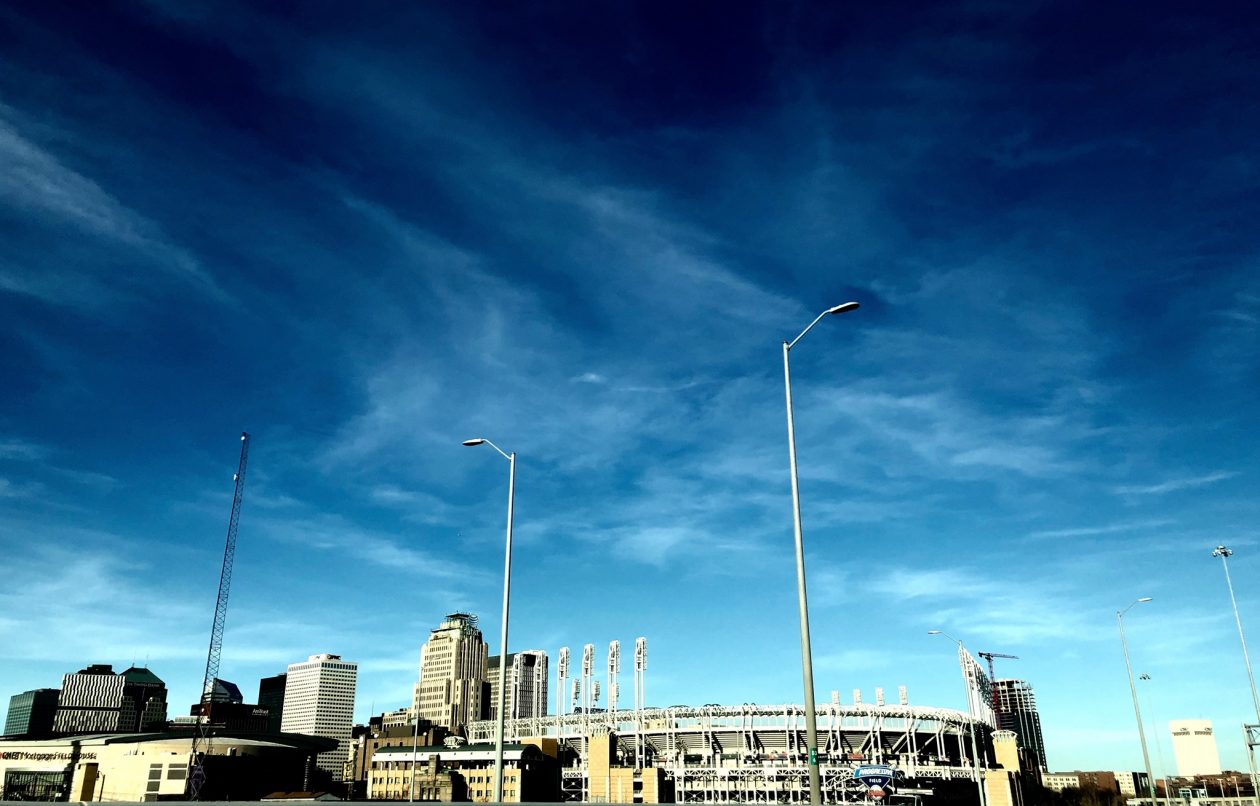
They had a late breakfast at Cleveland Vegan on the west side of Lakewood, stopped next door at Burning River for take-out coffee, and drove to Lakewood Park. The urban park is on thirty one lakeshore acres. They found a bench along the promenade. They could see Cleveland’s downtown skyline from where they sat.
“This is a good cup of coffee,” Alice said. “Why do they call that shop Burning River?”
“That’s because the Cuyahoga River, which is seven or eight miles from here, caught fire in the 1960s.”
“How does a river catch fire?”
“It’s the river that goes right through Cleveland, just this side of the skyscrapers, and drains into Lake Erie. It’s in a valley that became an industrial valley more than a hundred years ago. All the factories used the river as a liquid garbage dump. There got to be more oil and sludge than water in the water.”
“I never heard about that.”
“The fire is what eventually got the EPA created.”
“So some good came out of it.”
“Yes, some good, although what’s going on in D. C. these days is a crying shame.”
“Maybe it will change in three years.”
“Let’s hope so. The red hats have got to go.”
“That sounds like the redcoats during the War of Independence.”
“There was a king then and there’s a king now. Down with the king is what they said then and what I say now.”
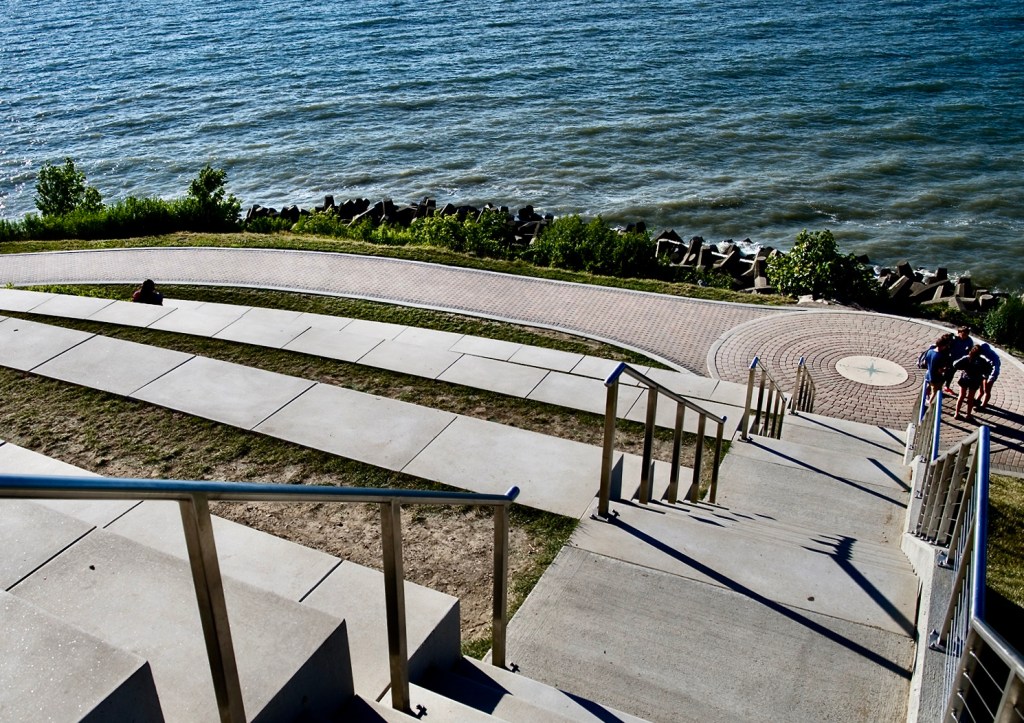
Vera and Alice were sitting where the park’s Solstice Steps were. They are called that because the view in June centers on the solstice, when the setting sun reaches its northernmost point on the horizon. The steps are like bleachers. They curve along four hundred and eighty feet of shoreline. They are made of blocks measuring twenty one inches high and rise thirty six feet in elevation in a series of five tiers, each with four steps.
They heard raised voices. When they looked they saw a boy, eleven or twelve years old, being pulled by the arm by a man wearing a dark blue suit and a ruby colored tie. The man was jabbing the index finger of his free hand in the boy’s face. They were on the edge of the topmost step of the Solstice Steps. The boy jerked his arm out of the man’s grasp. He took two steps back, extended both arms, and suddenly rushed the man. He ran into him, pushing him. The man lost his balance, wobbled, and fell down the steps.
He fell down the first four steps to the next tier, bounced down the four steps of that tier, and came to a stop on the tier below that. Vera and Alice bolted off their bench and ran to the steps. Alice grabbed the boy by the back of his collar and held him fast. Vera rushed down to the man.
Wood steps give upon impact, reducing peak force on the body. Concrete steps don’t give upon impact, at all. Vera expected some significant injuries. She found the man had some significant injuries. He had fractured a cheek, broken a wrist, and banged up both knees, both of them bleeding through torn trousers. His blue suit was a mess. Skin was rubbed raw everywhere it had scraped concrete. He was conscious, although she wouldn’t have been surprised if he had a concussion.
“Don’t move,” she said.
“I’ll kill that boy for this, I swear to God,” the man groaned. His eyes were black as water at the bottom of a bottomless well.
Vera called 911 on her cell phone. “Hang in there, help is on the way.” An EMS truck from Station 1 on Madison Ave. was there in less than five minutes.
“What happened?”
“He fell down the steps.”
They stabilized his head, applied a rigid cervical collar, and secured him to a spine board. They carried him up the steps, making sure his head stayed higher than his feet. They sped off to the nearest Cleveland Clinic, which was the Fairview Hospital at Kamm’s Corners. Lakewood Hospital had closed nearly ten years earlier.
Alice had sat down with the boy still in her grip. Vera walked over to the bench and sat down on the other side of the boy.
“What’s your name?’
“Jacob.”
“Why did you push that man?”
“He hurt mom.”
“Who is he?”
“He’s my father. I hate him.”
“What did he do to your mom?”
“He hit her. He hits her all the time.”
“Did he hurt her?”
“Her lip was bleeding.”
“Does he hit you?”
“Yeah.”
“Often?”
“Not every day, just most of the time.”
“Why were you and your father in the park today?”
“He came home for lunch. Mom burnt something and he hit her in the mouth. When I told him I hated him he grabbed me. He told me he was going to throw me into the lake for the fish to eat.”
“Is that why you were at the top of the steps?”
“Yeah.”
“Were you scared?”
“I thought he was going to do it.”
“All right, I don’t have any more questions. Do you want to go home now?”
“You’re not going to put me in jail?”
“No.”
Alice shot Vera a quizzical look. Vera replied with a sign. Alice loosened the grip she had on the boy.
“Let’s go and see how your mom is doing. Where do you live?”
The boy pointed over his left shoulder.
“Did you walk here or did your father drive?”
“We walked here. It’s only two blocks.”
He lived on Abbieshire Ave. between Lake Ave. and Edgewater Dr. The campus of the Lakewood Catholic Academy separated his street from the park. His home was the largest house on the street. There was a black Lincoln Navigator in the driveway. It was the largest vehicle on the street.
“What are you going to do?” Alce asked. “You know that by all rights we should be taking him to your station.”
“I know that but I don’t know that detention is what I want to do.”
Juveniles who have committed a serious offense are not formally arrested. They are rather detained and referred to Juvenile Court. A probation officer interviews them, a hearing is held, and a disposition made. The sentences usually focus on counseling and probation and, if necessary, placement in a facility.
“What do you want to do.”
“I want to see his mother,” Vera said ringing the front door bell.
The woman who answered the door was in her mid-thirties, auburn haired, wearing slacks, a light sweater, and sporting a split lip. Vera introduced herself and flashed her identification. Alice was standing behind her with a hand on the boy’s shoulder.
“Jacob,” the woman said extending her arms.
When the boy made a move towards his mother Alice let him go.
“Are you OK? He didn’t hurt you, did he?”
“I’m OK, mom.”
The boy slipped inside the door and stood next to his mother.
“Where’s your father?”
“He fell down and had to go to the hospital.”
“Oh, that’s too bad.” She didn’t seem upset. It told Vera everything she needed to know.
“Jacob, why don’t you let me talk to your mother alone in the living room.”
“OK,” the boy said.
“Alice, I can’t have you in the living room for the next few minutes.”
“I understand,” Alice said and left for the kitchen to join Jacob.
When Vera and the woman were seated in the living room Vera asked, “What is your name?”
“Naomi Campbell.”
“And your husband’s name?”
“Jerry Campbell.”
“Your husband fell down the Solstice Steps at Lakewood Park. He’s hurt and has been taken to Fairview Hospital.” Vera could see the woman was unconcerned, but went on. “From what I saw nothing is life threatening. I would expect him to be out of the hospital in a few days.”
“I won’t be here in a few days.”
“Why is that Mrs. Campbell?”
“He’s hit me for the last time. He always says he’s sorry but it never changes anything. Threatening my son was the last straw. I’m leaving. When I come back it will be with a lawyer and I’ll take the bastard for everything he’s got.”
“Did he hit you this morning?”
“Yes.”
“Has he hit you before?”
“Yes.”
“Does he hit you often?”
“Once is too many times and it’s been too many times.”
“Would you be willing to swear out a complaint?”
“Yes.”
“Is it OK if the other police officer watches Jacob while we go to the station?” Vera didn’t get into details about the other police officer.
“That would be OK.”
The Lakewood Police Department is less than two miles from Lakewood Park. When they got there Vera filled out a report, stating that Jerry Campbell’s fall was accidental, and Naomi Campbell filed for a Domestic Violence Civil Protection Order. Her paperwork was deposited with the Clerk of Courts. The county sheriff would serve the protection order. Vera filled out an affidavit for a judge to look at. She expected to get an arrest warrant without much trouble. She got it the next day.
Jerry Campbell was in Fairview Hospital for two nights. He got out when it was determined there was no bleeding on the brain and he didn’t have a concussion. He was rolled by wheelchair to the front door by a patient transporter. Vera was waiting for him. A uniformed police officer was with her. Their Ford Police Interceptor was outside the door.
“Did you lock that monster up?”
“What monster?”
“What do you mean? That monster son of mine. You saw what he did.”
“What did he do?”
“He pushed me down those stairs.”
“I didn’t see anything like that, although I did see you fall down those stairs.”
“What? Are you crazy? Ask the other woman, she saw it.”
“What other woman?”
“Goddamn it, you’re talking in circles.”
“There’s no reason to get abusive, Mr. Campbell. In any case, I’m here to detain you for assaulting your wife. She filed a complaint and I have an arrest warrant.”
“Do you know who I am? You’ll be sorry for this.”
Vera motioned to the police officer standing beside her. He escorted Jerry Campbell to the Ford Police Interceptor. They drove back to Lakewood.
“How did it go?” Alice asked later that evening when Vera was driving her to Hopkins International airport for her flight back to Cape Cod.
“He barked and swore up and down the whole way back to the station. He demanded to see the chief, but that didn’t happen. He got his lawyer on the phone and was out on bond soon enough. But he wasn’t allowed to go home. The county sheriff served protection papers on him the minute he stepped out of our door.”
“Where is he going to go?”
“Who knows, who cares.”
“Hell of a guy.”
“Yeah, he’s the kind of guy who thinks he’ll be able to shove his way into Heaven before the devil knows he’s dead.”
Ed Staskus posts monthly on 147 Stanley Street http://www.147stanleystreet.com, Made in Cleveland http://www.clevelandohiodaybook.com, Down East http://www.redroadpei.com, and Lithuanian Journal http://www.lithuanianjournal.com. To get the site’s monthly feature in your in-box click on “Follow.”
“Bomb City” by Ed Staskus
“A police procedural when the Rust Belt was a mean street.” Sam Winchell, Beyond Books
Cleveland, Ohio 1975. The John Scalish Mafia Family and Danny Greene’s Irish Mob are at war. Car bombs are the weapon of choice. A star-crossed police detective is assigned to find the bomb makers. It gets personal. Revenge is always personal.
A Crying of Lot 49 Publication
 Made in Cleveland