Stand and Deliver

By Ed Staskus

   The law office’s front door was meant to be a ten-thousand-dollar door, but I got lucky, and got in and out for only two hundred fifty dollars. I never went back. One shake down is more than enough. I found out the door was the entrance to a dog and pony show. There weren’t that many apples on my tree that I could afford to give bushels of them away for flimflam in return. 

   I was at the law office to make sure, even though I had lived in the United States for decades, that I was a citizen. My immigrant parents had naturalized in the 1960s, but it was unclear, at least to me, whether their citizenship extended to me. My father, who knew how to read contracts like the back of his hand, said I was a full-fledged citizen, but I wanted to make sure.

   When I first started going to Toronto by myself in my late teens it was by Greyhound. I rode the bus to Buffalo and walked across the Peace Bridge. When I got to the Canadian side, the border police asked me where I was from and for identification. I showed them my driver’s license. They waved me through. When I went home I did the same thing. The American border police waved me through, the same as the Canadians.

   After I got married my wife and I often went to Canada, to Wasaga Beach, to Penetanguishene, to Nova Scotia, and finally to Prince Edward Island, which we liked and made a habit of returning to. We did, at least, until Osama bin Laden’s towelheads went jihad and flew jetliners into NYC’s Twin Towers. We had just gotten back from Prince Edward  Island a few days earlier. I was standing in line in a drug store when I saw it happening on a TV above the cash register. After that, crossing borders slowly but surely became more officious. We found out soon enough we would need passports to get into Canada and back into the USA.

   My wife applied for and got her passport in five weeks. I didn’t apply at first because I wasn’t absolutely certain of my status. I had never been sure, no matter how sure I sounded at the border, asserting I was an American citizen. My parents grew up in Lithuania, fled the Red Army to Germany in 1944, emigrated to Canada after the war, and finally settled in the United States in the late 1950s. They were naturalized in the mid-1960s. I knew my brother and sister were citizens, but was uncertain because of my age when my parents became citizens.

   When we decided the red sand beaches and blue water of Prince Edward Island was the place to go in the summer, I resolved to settle my body politic issue. Push came to shove and I asked one of our Lithuanian American community’s bigwigs if she knew anybody she could recommend to help me out. She told me about a friend of hers who was a lawyer. The lawyer had been in the resettlement business for more than 30 years and was herself an immigrant, she said.

   I made an appointment and went to the lawyer’s office. The lobby was sizable and almost full, full of worried-looking people sitting and waiting their turn. Some of them were Latino’s. The rest of them looked like they were from Asia or the Indian sub-continent. The citizenship business seemed to be booming. When my number was called I was shown into the boss’s office. That was my first surprise. I had not thought I would be talking to the main man, even though she was a woman. 

   The boss was a squat woman with a round face. Her hair was jet black. Her lips were dolled up in red. She glanced at the paperwork and documentation I had brought with me and said, “I will be your helping hand.” She shot me a cherry bomb smile. “Thanks,” I said. I thought she would be working on my behalf going forward. I found out later she was trying to work me over.

   She told me I had a big problem with my citizenship and might be deported at any minute. She said she wanted to get started right away before that happened. She explained the initial consultation fee was going to be $250.00 and the balance to resolve my problem was going to be $9,750.00. 

   “This is going to cost me ten thousand dollars?” I asked, incredulous. It was my second surprise. It was an unwelcome bombshell. Back in the day highwaymen stuck a gun in your back and hissed, “Stand and deliver, your money, or else.” Nowadays they tell you to sit down and stick a fountain pen in your face.

   I was in her office for five minutes before she ushered me out. “Time is money,” her red lips said. It took me fifteen minutes to drive home, where I mulled over the problem of finding ten thousand dollars. It was winter and we weren’t planning on going back to Canada until the next summer, so there was no rush on that account. But what she had said about being deported was worrisome. I had fond memories of my hometown of Sudbury, Ontario, but being uprooted was not what I wanted to happen. We had bought a house which we were renovating, and I had both full-time and part-time jobs. We had a mortgage and friends and family in town. We had a cat who would miss chasing birds in our backyard.

   I went back to the law office the next month. I was introduced to a young associate and escorted to a small room in the back. A table and two chairs were in the room. I sat down in one of the chairs and the associate sat down in the other chair. He handed me a contract for the work they were going to be doing. I handed him the same paperwork and documentation I had shown to the woman in the corner office. He started to peruse the contract. After a few minutes he looked up, cleared his throat, and said, “I don’t exactly know why you’re here. According to what I’m looking at, you already are a citizen.” 

That was my third surprise. “Are you sure?” I asked.

   “I think so, but I better doublecheck with my boss,” he said, quickly backtracking, but the cat was out of the bag.

   “All right,” I said, and as soon as I said it I made ready to be gone.

   “I can’t stay,” I said, lying and standing up. “I’ve got to get to work. Let me know what you find out and in the meantime I will read this contract.” We shook hands, I gave him a watery smile, got into my car, and drove the other way..

   The next day I drove to the Rocky River post office where I knew they processed passport applications. When the line in front of me inched forward and I finally found myself at the counter, I said I wanted to apply for a passport. A middle-aged woman in a drab uniform walked up from the back and motioned me towards a chair and a camera. She handed me an application and told me how much applying for safe conduct was going to cost. It was ninety-seven dollars.

   “All right, but would you look at my birth certificate and this other paper work first. I was born in Canada and I’m not sure I am actually an American citizen.” She spread everything out on the counter and looked it over. It didn’t take her long. Less than five minutes into it she said, “Sure, honey, you’re a citizen, no doubt about it.”

   I filled out the application, got my picture taken, paid the fee, and thanked the post office woman for her help. ”You’re welcome,” she said. I got my passport in the mail about a month and a half later. The passport had my stone-faced picture in it and was good for ten years. I could travel anywhere in the world with it.

   A week later the associate I had talked to called. He wanted to know if I had read the contract and was ready to go ahead with it. “No, I am going to pass on that,” I didn’t say I had thrown the contract in the trash long since.

   “That could mean a lot of problems for you,” he cautioned. “The State Department is cracking down, what with all this terrorism.”

   “I don’t think so,” I said. Nevertheless, he kept up his patter. I hung up.

   Somebody else from the law office called me the following week. I hung up the minute he started into his song and dance. After that the phone calls stopped. We went to Prince Edward Island for two weeks the following June. Except for the long lines at the border, everything went off without a hitch. The Canadian border police said, “Welcome to Canada.” Two weeks later the American border police said, “Welcome to the United States.”

   My wife and I bumped into our Lithuanian American bigwig at a get together a few years later. I mentioned my immigration lawyer travail. My wife tugged on my sleeve, urging me to be polite. I told my adviser how her legal beagle had tried to pull the wool over my eyes. I told her about getting my passport in the end with no run around. I told her ten grand was hard cash and how fortunate it was I hadn’t lost more than the consultation fee, never mind the lawyer’s vexing trickery. It is often the case that the only way to beat a lawyer deadest on your money is to die with nothing.

   “I know her well, she’s a friend, and she would never do anything like that,” the bigwig said, huffing and puffing. She might as well have called me a liar. “She’s nationally known for helping immigrants. She’s helped thousands of people and is one of our city’s leading citizens. Who do you think you are? Don’t say bad things about her.”

   She wasn’t somebody who ever listened to anything I said, so I didn’t argue. What would have been the point? It would have been in one ear and out the other. It was her way of letting you know you didn’t matter all that much. After that, though, I never took anything she said at face value, the same as I never took anything any lawyer ever said at face value.

Ed Staskus posts monthly on 147 Stanley Street  http://www.147stanleystreet.com, Made in Cleveland http://www.clevelandohiodaybook.com, Down East http://www.redroadpei.com, and Lithuanian Journal http://www.lithuanianjournal.com. To get the site’s monthly feature in your in-box click on “Follow.”

“Bomb City” by Ed Staskus

“A police procedural when the Rust Belt was a mean street.” Sam Winchell, Beyond Books

Available on Amazon: https://www.amazon.com/dp/B0F1LM1WF9/ref=sr_1_1?crid=2MYAQAOZIC2U9&dib=eyJ2IjoiMSJ9.hTm7BGbiQbSe5ZapFwYPPfcwOpTe-Vdg6VLE4aGyTyk.Z0R-VNBWWEcvKcNaO9LdCOUnNIOOXgvYkRS_FXiXuHk&dib_tag=se&keywords=bomb+city+ed+status&qid=1742136726&sprefix=bomb+city+ed+staskus%2Caps%2C84&sr=8-1

Cleveland, Ohio 1975. The John Scalish Crime Family and Danny Greene’s Irish Mob are at war. Car bombs are the weapon of choice. Two police detectives are assigned to find the bomb makers. Revenge is always personal. It gets personal.

A Crying of Lot 49 Publication
Breaking the Chains

By Ed Staskus

   My wife wasn’t especially interested in music, except for Russian composers and some movie soundtracks, so when she got me tickets for my birthday to see the Jesus and Mary Chain, I was surprised. I wasn’t sure she knew what she was doing. The band wasn’t Pyotr Tchaikovsky. I thought she might be all right with it since she didn’t know much about them, only that I liked the band, and wouldn’t have an opinion one way or another. To smooth the way I suggested we go to dinner at Maria’s Roman Room beforehand. I didn’t tell her how loud the band was going to be.

   “When is the show?” I asked.

   It was a sunny afternoon in late February1990. We were having coffee and toasted pastries at John’s Diner on the far west side of Lakewood. The hash house was in a former railroad passenger car. There wasn’t much snow but it was two degrees on the other side of our window. The window was Jack Frosted.

   “In two weeks at the Phantasy Theater.”

    “I’ve never been there.”

   “That’s where my brother used to drag me to see his favorite local bands. He always insisted we had to go an hour early to get the best seats, even though all the seats looked the same to me.”

   “Did you hear anybody good there?”

   “Maybe.”

   The  Phantasy Theater was on Detroit Ave. on the far east side of Lakewood, Ohio. When it opened in 1918 it was the Homestead Theater. They screened silent movies. A big organ was the soundtrack. When sound was introduced they sold the organ and screened talkies. Not long after they changed the name to the Last Picture Show they showed their last movie.

   John De Frasia bought the place in 1965. Three years later he opened a restaurant on the premises called Piccadilly Square. He built a pirate ship inside the eatery, inspired by the movie “Mutiny on the Bounty.” He worked with several shipbuilders for two-and-a-half months to get it done.  “We got the blueprints MGM Studios used for the movie ship.” He sliced the ship in half in 1973 when he decided to transform the restaurant into a music club. One half of it became a DJ booth and the other half a sound stage. In time they showcased punk, alternative, and industrial sounds. Devo, Lucky Pierre, and the Exotic Birds were some of the bands who got rolling there.

   “You can’t downplay the significance of the Phantasy to the Cleveland music scene,” Mike Hudson, lead singer of the Cleveland punk band the Pagans, said years later. “It all began with the De Frasia family. John was a nice guy and very open-minded and willing to let bands that others considered weird have a shot.”

   “You were the best,” said Brian Dempsey, the drummer for Lucky Pierre, when John De Frasia passed away in 2011. “Like an old shoe. No ego and just the coolest, most honest and real person I’d ever met in a business full of creeps. You kindness will always live on through the people you touched.”

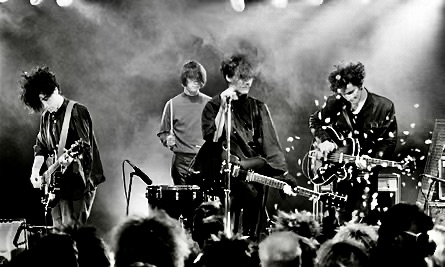
   The Jesus and Mary Chain were from Scotland. Jim and Bill Reid were the band, along with a bassist and a drummer. They were a post-punk rock band known for wistful melodies and guitar screeching feedback. They were one of the bands who pioneered noise rock. They were also known for their riot-inducing live shows. I kept that to myself, making a mental note to sit in the last row,

   “It was the crap coming out of the radio that made us want to be in a band,” Jim Reid said. “Everybody was making electronic pop music.” By 1983, when they formed the band, they had both been on unemployment for five years, writing and recording their songs at home. They called their band Death of Joey at first but changed it to the Jesus and Mary Chain. They got the name one morning from the back of a box of cereal. On the back was an offer to mail in some box tops and get a free Jesus and Mary chain necklace in return. They lost the chain necklace but kept the name.

   I had their first two LP’s, “Psychocandy” from 1985 and “Darklands” from 1987. The first LP was an ear-splitting wall of distortion. Their manager, Alan McGee, said the band’s style was “art as terrorism.” The second LP was less tempest and more mainstream. There were even some acoustic licks. Both LP’s were fine stuff.

   The Reid brothers were influenced by the Stooges, the New York Dolls, and the Velvet Underground, but with a difference. They were like the Stooges meet the Shangri-Las. In the event, they were determined to be new and original. “That’s why we started using noise and feedback,” Bill Reid said. “We wanted to make records that sounded different.” His guitar was deliberately tuned to be out of tune, while the drummer was limited to two drums, not the full kit. He played his two drums standing up like Moe Tucker had done with the Velvet Underground, although he didn’t use mallets like Moe Tucker did. He used drum sticks. The bass guitar was limited to two strings, as well. “That’s the two I use, the thick ones” said Doug Hart, the bassist. “I mean, what’s the point of spending money on another two? Two of them is enough.”

   The show at the Phantasy Theater was on Wednesday, March 15th, the day after my birthday. It was a partly cloudy day, in the high 70s. The weather in winter on the south coast of Lake Erie can be bad, but it is predictably unpredictable.

   Before my wife and I went to the show we went to Maria’s Roman Room. It was next door to the Phantasy Theatre. It was easy to find. We could smell garlic from about a block away and there was a red neon sign in the window in the shape of a fork.

   We had eaten there before with my wife’s family. Her stepfather was Sicilian and her mother was a chef. Maria’s was their favorite Italian restaurant. We ordered a bottle of the house Pinot Grigio and mozzarella fritto to start. The sticks were hand cut, made in house. The sauce and cheese were very good. The wine was more than drinkable. 

   Maria and Tony “Chick” Bastulli opened the restaurant in 1960. Over the course of time they had five children. All of them grew up working at the restaurant. Corporate squabbling is tough, but it is tame compared to working for your parents.

   “I did all the awe inspiring things that go on in the restaurant business, like cleaning toilets, washing dishes, and of course making two hundred pounds of pizza dough every day in a basement without any air conditioning,” said Maria’s son Peter. “You have not lived until you have to portion, roll, and refrigerate that much pizza dough before it raises to the level of your eyeballs when it is humid and ninety five degrees in summer.”

   My wife ordered pizza. “It’s the best thing they make. They mix grape juice in with the tomato sauce, so it’s less acidic and a little sweeter.” It was Maria’s secret recipe. The sauce was San Marzano tomatoes and the toppings were ham and black olives. I ordered a plate of Pesto alla Genovese. The green sauce tasted like pine nuts.

   “Have you ever listened to either of the Mary and Jesus Chain LP’s I have?”

   “No, but I’ve heard bits and pieces passing by. They seem nice enough, a little fuzzy, those guitars of theirs.”

   “Yeah, they’re big into feedback.”

   I kept the volume low on our record player when my wife was at home. I only turned it up when I was alone and our neighbors weren’t at home. The band’s sound was a reverb-heavy wall of sound.

   We lingered over coffee and dessert and missed Nine Inch Nails, who were the opening act. I wasn’t especially interested in them anyway, even though they were from Cleveland.  I knew they were a kind of metal band, dark and intense, but from what I had heard I thought they tried too hard.

   When we got our seats inside the Phantasy Theater we easily got seats in the last row. It wasn’t a big theater and we could see the stage well enough. When the lights went down and the band came on stage they were dressed in black. Neither the stage nor the lighting was dressed up. The stage was more dark than anything else. It was a bare bones look. I was good with that. The music was what mattered, not lasers, smoke, and mirrors.

   The Reid brothers were on guitars and Doug Hart, with his two strings, was on bass. The drummers were a Forat F16 behind the stage, playing pre-recorded drum sounds, and Steve Monti, who banged along with the pre-recorded sounds. Nobody on stage moved around much. The Reid brothers were prone to standing stock still while staring down at their shoes. Except for the singing neither of them said more than two words all show long.

   “Do you remember Calvin Coolidge?” I asked my wife between songs.

   “The president?”

   “The same. He was nicknamed Silent Cal.”

   “Because he didn’t talk much?” 

   “Not much, at all. One time at a state dinner a woman told him she had made a bet with her husband that she could get him to say more than two words.”

   “What did Calvin Coolidge say?”

    “He said, ‘You lose.’”

   Jim Reid did the singing and some of the guitar work. Bill Reid played lead guitar. Their playing was intertwined and crisp. Bill Reid played a Fender Twin Reverb  “It’s the one with the wee footswitch that gives you, what’s it called, vibrato,” he said. “I don’t remember what settings I use, but they’re different live from in the studio. The way we get our feedback is with a fuzz pedal. It’s not just a signal type feedback, it’s a feedback that bends and quavers. It’s a real cheap pedal, a Companion, I think, an old-fashioned one with one of those things that goes like this.” 

   He rocked his hand mimicking a wah-wah pedal.

   Jim Reed played a Vox Phantom. “The one with the built-in fuzz and echo and all those knobs on it.” The Vox Phantom went back to the British Invasion of the1960s. It had a Stratocaster-like sound to it.

   The band was tight as could be, even though they claimed to never rehearse.

   “We never rehearse,” Bill Reid said. “The main reason we don’t is that we’re lazy bastards.” When they went to record ‘Just Like Honey’ they only had a half-written song. ”On the Saturday night Jim and I sat up till three in the morning  trying to finish it, but we were just too tired. So we went to the session on Sunday and recorded it straight off. Doug and Bobby had never heard it before. I  was nodding my head telling Doug where to put his fingers.”

   They kicked off the show at the Phantasy Theater with ‘Rider’ from their 1988 “Barbed Wire Kisses” LP. I hadn’t heard it before. “Going on a motorbike, ride it to the beach, screaming at the sun for being out of reach.”  The guitars were fuzzy, the drums heavy, and the singing hypnotic. It was new to me but it was vintage Jesus and Mary Chain. They followed that with ‘Everything’s Alright When You’re Down’ and ‘The Hardest Walk’ and fourteen more songs. There wasn’t an intermission and no small talk between songs. They finished one song and went on to the next one.

   All of their songs had a dark aesthetic despite the Shangri La vibe of the singing. Their cover of Bo Didley’s song ‘Who Do You Love’ was terrific.” We don’t think about our music being accessible or alternative or any other category,” Bill Reid said. “If you start thinking like that, you’re lost.”

   Their last song was ‘Kill Surf City.’ It had a Beach Boys feel to it while being as unlike the Beach Boys as could possibly be.  “I’m gonna fight surf city, got to get it down, I hate honey and she hates me, but that’s the way it’s supposed to be, I’m gonna kill surf city.” When the song was over Jim Reid, the bassist, and the drummer left the stage. Bill Reid did some more work on his guitar. When he was done he put it down flat on the stage, strings up. He was done but the guitar wasn’t done. It lay on the floor of the stage keeping up a vigorous fuzzy whine for the next two or three minutes until the sound finally died away. When it did the audience, including my wife, applauded long and loud. The Jesus and Mary Chain didn’t come back for an encore, but then again, I don’t think anybody expected them to.

   “What did you think?” I asked my wife when we were walking back to our car.

   “I’m glad I saw them. They’re kind of raw but very cool on stage. I liked the contrast between their sugary melodies and the abrasive guitars. I couldn’t take a steady diet of them but I liked the show.”

   “That’s not just the Roman Room pizza talking, is it?”

   She laughed. “No, I had a good time, and I’m glad you enjoyed your birthday present.” I knew she was being sincere. Birthdays in general were special to her.

   By the weekend the weather changed again. It got cold and colder. I  had to pull my winter coat out of the closet one more time. It was no matter. Spring was only a week away.

Ed Staskus posts monthly on 147 Stanley Street  http://www.147stanleystreet.com, Made in Cleveland http://www.clevelandohiodaybook.com, Down East http://www.redroadpei.com, and Lithuanian Journal http://www.lithuanianjournal.com. To get the site’s monthly feature in your in-box click on “Follow.”

“Bomb City” by Ed Staskus

“A police procedural when the Rust Belt was a mean street.” Sam Winchell, Beyond Books

Available on Amazon: https://www.amazon.com/dp/B0F1LM1WF9/ref=sr_1_1?crid=2MYAQAOZIC2U9&dib=eyJ2IjoiMSJ9.hTm7BGbiQbSe5ZapFwYPPfcwOpTe-Vdg6VLE4aGyTyk.Z0R-VNBWWEcvKcNaO9LdCOUnNIOOXgvYkRS_FXiXuHk&dib_tag=se&keywords=bomb+city+ed+status&qid=1742136726&sprefix=bomb+city+ed+staskus%2Caps%2C84&sr=8-1

Cleveland, Ohio 1975. The John Scalish Crime Family and Danny Greene’s Irish Mob are at war. Car bombs are the weapon of choice. Two police detectives are assigned to find the bomb makers. Revenge is always personal. It gets personal.

A Crying of Lot 49 Publication