
By Ed Staskus
Stanley Gwozdz had never been higher off the ground than three stories up. His dentist’s office was on the third story of a four story building. He had been grinding his teeth while sleeping. His jaw had started to hurt from the grinding. His father took him to the dentist’s office where they made a moth guard he had to wear at night. He didn’t like it, but his father was a policeman. He did what his father told him to do.
“The mouth guard will get the job done,” the dentist said. “It will take a while, but he’ll stop grinding his teeth slowly but surely.”
“Good,” Frank, his father, said.
“One last thing.”
“What’s that?”
“Is there anything going on in his life that the boy might be worried about, that might be stressing him?”
“No,” Frank said. He didn’t say anything about ex-wife-to-be Sandra. He couldn’t do anything about her being gone. He could have found her, if it came to it, but he didn’t want to, even though he wanted to. Some women are good at lying and cheating. Sandra was one of those women. Whatever you can get away with. She had been a bad idea gone wrong. He needed to dump the memory of her.
“That’s good,” the dentist said.
Frank had taken the day off from police work and housework and taken Stanley on an outing. They were high off the ground inside the Terminal Tower. They were forty two stories high on the Observation Deck. They had taken elevators to get there. Stanley had never been on an elevator. He and his father always walked up the stairs to their dentist’s office.
“Why do we have to go inside that box?” Stanley asked, looking inside the elevator after the door slid open. He was very suspicious. He stood on the lip of the threshold and peered into the corners of the box.
“Because it will take us to the top.”
“Why can’t we walk?”
“It would be like walking upstairs twenty times as far as the dentist’s.”
“I could do it.”
“Maybe next time.”
They took the elevator to the thirty second floor, exited to the left, and followed signs to the next bank of elevators. They rode up to the forty second floor.
The Terminal Tower was on Public Square, catty-corner to the Soldier’s and Sailor’s Monument. Work on it started in the early 1920s. Concrete and steel supports for the building reached two hundred feet underground. It was finished in 1927 and opened in 1928. It was dedicated in 1930, lit up with spotlights and a strobe light at the top. Tens of thousands of people on Public Square cheered and tossed their hats in the air. When it opened its fifty two stories made it the second-tallest building in the world.
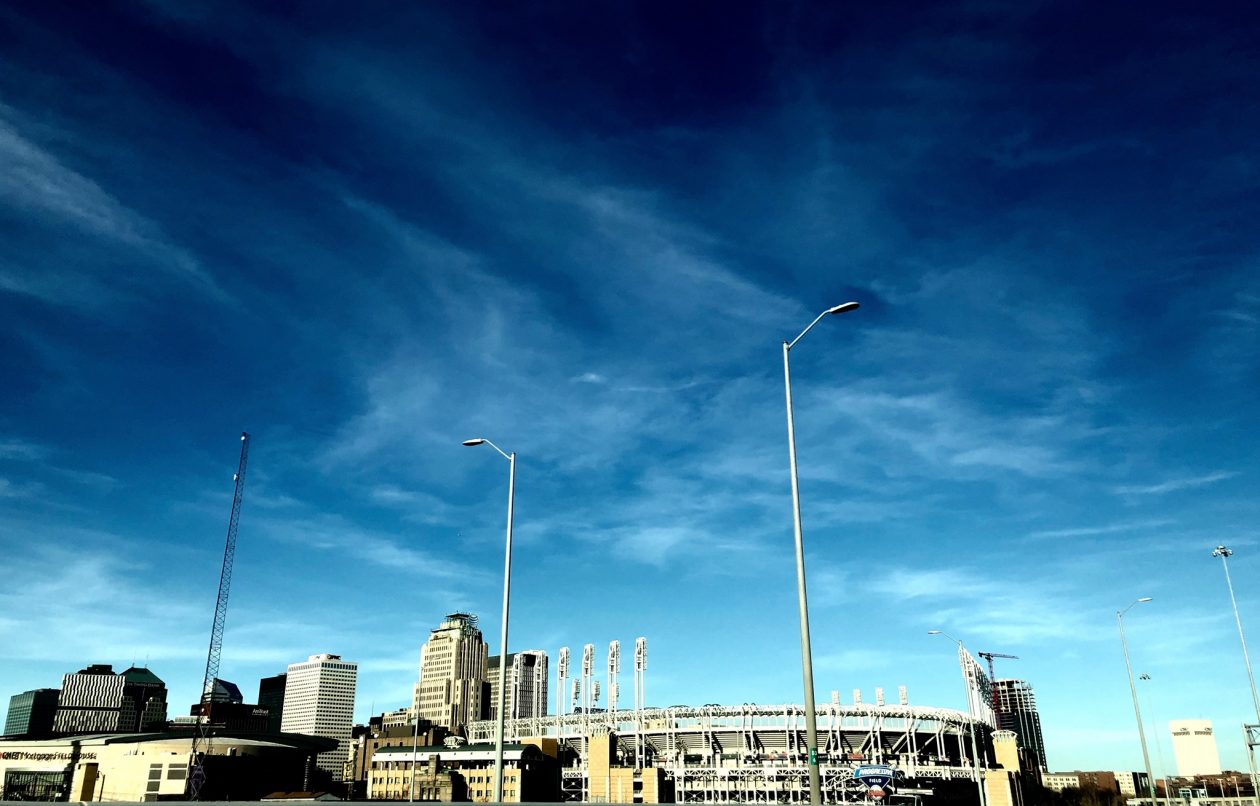
The Observation Deck was enclosed. There were windows on all four sides. They had a birds-eye view of Lake Erie, Municipal Stadium, the Flats and the Cuyahoga River, and the city spread out as far as they could see. It was a clear sunny day. They could see for miles.
“I didn’t know the lake was so big,” Stanley said.
“Lake Erie is one of the biggest lakes in the world. It’s part of the Great Lakes. There are five of them.”
“Can we go see all of them?”
“Not today, but someday. A friend of mine and I drove around them one summer, long ago. Maybe you and I can do that circle tour someday.”
“Can we do it tomorrow?”
“Not tomorrow, but soon, when you’re a little bit older.”
“I’m older now.”
“I know, but kindergarten is coming up.” Stanley wasn’t quite five years old, but he knew how to sit and listen, follow simple rules, and play cooperatively. He could use a crayon and scissors. He knew what circles and squares were and could copy them.
“I don’t want to go to school.”
“It’s a long trip around the lakes. Anyway, how do you like living with Aunt Joannie?”
“I love Aunt Joannie. We have fun. Mommy isn’t always fun.”
“What do you mean?”
“She’s mad at me a lot. I don’t know why, she just is. Am I bad boy?”
“No, Stanley, you’re a good boy. Mommy is wrong to be mad at you.”
“Why is she so mad all the time?”
“Maybe she thinks she’s not happy,” Frank said.
“Is she coming home soon?”
“I’m sure she is, but hey, enough about that. How about we go to the races.”
Frank had parked in a lot across Superior Ave. in the Warehouse District. Many of the old buildings there had been torn down one by one since the 1960s. It was a change called urban renewal. There were parking lots everywhere but not many places to go to anymore. Frank crossed the Cuyahoga River on the Shoreway and drove south on W. 25 St. He turned right when he got to Denison Ave. and found the Soap Box Derby track just past the Riverside Cemetery. The track was off John Nagy Blvd. beside the Metroparks Brookside Reservation.
The first unofficial races were in Dayton, Ohio in 1933. Tens of thousands of spectators turned out to watch hundreds of cars built of orange crates, sheet tin, and baby buggy wheels. None of them were built of soap boxes. The first official winner in 1934 drove a car built of laminated wood taken from a saloon bar. The cars were unpowered and relied only on gravity to race downhill. The rules amounted to nine sentences. Anything went, so long as the car was built by the boy who was going to race it.
The All-American Soap Box Derby World Championships were held in Akron. In 1946 Gilbert Klecan from California was nicknamed “The Graphite Kid” because he smeared his face and car with graphite to cut down on wind resistance. He took the World Championship hands down. In 1952 Joey Lunn from Georgia crashed his car crossing the finish line while winning his first heat. Volunteers repaired the car with tape, strips of tin, and the remains of a lunch box. He went on to win the World Championship, his car shedding parts of itself in every heat leading to his final victory.
Frank and Stanley found a spot to sit on a grassy knoll. They could see the starting line and had a good view of all of the nine hundred foot track. They watched one heat after another in the bracket-style elimination.
“How fast are they going?” Stanley asked.
Frank looked across the track at the traffic on John Nagy Blvd. He knew the traffic was doing thirty to forty miles an hour. He looked at two racers speeding soundlessly down the track.
“I’m guessing twenty five miles an hour at least, probably more.”
“Is that fast?”
“That’s plenty fast on an empty gas tank.”
“When can I start racing?”
“I think you have to be at least seven or eight years old, so in a few years. In the meantime we could start building a car.”
“I want one just like that,” Stanley said, pointing to a glossy green car shaped like a torpedo.
“Yeah, but how about that one?” Frank said, pointing to a yellow car that looked like a No. 2 pencil.
“It’s OK, but the green one is way better.”
“Then we’ll build one just like that,” Frank said, wondering how many weekends it was going to take. He didn’t know some parents spent more than a thousand hours helping their children build a no-engine car.
“Look, there’s a girl racing one of the cars.”
When Frank had read the newspaper about the upcoming 1975 heats in Cleveland he had read that the rules had changed and girls were being allowed to race.
“She’s got a lot to learn,” Frank said to himself watching the girl behind the steering wheel. What he didn’t know was that eleven year old Karen Snead from Pennsylvania was going to win the World Championship that year in a photo finish, driving with a broken left arm set in a cast.
They watched eight or nine heats before Stanley said, “I’m hungry. Can we get a hot dog?”
“Sure son, let’s go find a hot dog.”
They walked past the staging area where two boys were getting ready for their race. One of them looked like he was about ten years old and the other one about thirteen years old.
“It looks easy,” the older boy said to the younger boy, “but one small thing can lose a race, like hitting a bump and wandering off-line. You want your helmet and eyes to be just peeping over the cockpit to reduce drag. The wheel is hard to hold just right. If you jerk it you’re in trouble. It can mean the race.”
The younger boy looked like he knew he didn’t stand a chance.
Frank drove north on W. 25 St., circled onto the Shoreway, and went past downtown to Edgewater Park. He parked outside the wastewater treatment plant. Father and son walked past the yacht club, past the pier, and to a grassy field beside the beach where there were funnel cake and hot dog carts.
A weathered plywood sign nailed to 4 X 4 posts said “IN THE SPIRIT OF….CLEVELAND NOW, EDGEWATER BEACH, SAFE SWIMMING” and was signed Carl B. Stokes, Mayor, It was four years out of date. Carl B. Stokes had been replaced by Ralph Perk as Cleveland’s mayor in 1971. There were many people on the beach. Hardly a soul was in the water. Everybody knew the city’s moguls were still cutting costs and dumping industrial waste into Lake Erie.
They got two foot-longs slathered in relish and mustard and two bottles of Coca-Cola. They sat at a picnic table and had their late lunch. Seagulls drifted down from the sky. Stanley tore small pieces off his bun and tossed them into the air. The seagulls snatched them up in mid-air. Frank thought about the skunks at Euclid Beach Park.
“Why do I have to eat vegetables at home?” Stanley asked. “Why can’t I eat hot dogs all the time?”
“Vegetables are good for you.”
“Aren’t hot dogs good for me?”
“Not all the time, no.”
“Why can’t I have candy for breakfast?”
“Because milk and cereal are for breakfast.”
“Why can’t I eat Play-Doh?”
“It’s got salt, water, and flour in it, so I guess you could, but don’t let me ever catch you eating it.”
“Captain Kangaroo loves Play-Doh.”
“Captain Kangaroo needs a new hairpiece,” Frank said.
Bob Keeshan, the actor who played the children’s entertainer on TV, wore a blonde bowl cut hairpiece with mutton chops on the show.
“Why is the lake blue?” Stanley asked, looking out onto Lake Erie. The waves had gotten choppy.
“You ask some hard questions. Maybe it’s because fish like the color blue best.”
“Why do we eat fish?”
“Because they are food.”
“Do they know we are going to eat them?”
“I don’t think so.”
“Should we tell them?”
“No, I don’t think that would be a good idea.”
“Why not?”
“Come on, let’s go for a walk,” Frank said.
They walked down to the beach, walked the length of it and back, and returned to where Frank had parked their car. Frank carried his son on his shoulders the last leg of the walk.
“When we drive around the lakes, dad, I’ll do the driving.”
Frank put him in the driver’s seat of the car.
“As soon as your feet can reach the pedals and you can see over the steering wheel.”
“Oh, all right,” the boy said. “I can’t wait to get bigger and get going.”
“Don’t be too anxious,” Frank said. Everybody said kids grow up fast. He didn’t want Stanley to grow up too fast. He couldn’t do anything about it, he knew, although he could try to smooth out the bumps along the way.
It was early evening by the time they got back to North Collinwood.
“Why do I have to take a bath?” Stanley complained once they were in the house and he was being led to the tub. “I’m clean enough.”
“That’s easy,” Frank said. “Father knows best.”
Excerpted from the crime novel “Bomb City.”
Ed Staskus posts monthly on 147 Stanley Street at http://www.147stanleystreet.com, Made in Cleveland http://www.clevelandohiodaybook.com, Down East http://www.redroadpei.com, and Lithuanian Journal http://www.lithuanianjournal.com. To get the site’s monthly feature in your in-box click on “Follow.”
“Bomb City” by Ed Staskus
“A Rust Belt police procedural when Cleveland was a mean street.” Sam Winchell, Beyond Fiction

Cleveland, Ohio 1975. The John Scalish Crime Family and Danny Greene’s Irish Mob are at war. Car bombs are the weapon of choice. Two police detectives are assigned to find the bomb makers. It gets personal..
A Crying of Lot 49 Publication
 Made in Cleveland