By Ed Staskus
It was an early May morning when Frank and Betty Glass went visiting Barron Cannon, who they hadn’t seen much since they first ran into him picketing a vegan restaurant near where they lived in Lakewood, Ohio. They had dropped by his yurt, which was on a bluff overlooking the Rocky River Metropark Reservation, several times in October and November, but once winter got cold and snowy had not paid him a social call, not that Betty minded, or even gave it a thought.
The first time they ever saw Barron had been the past September, when they were attracted by the flashing lights of two Ford Police Interceptors at the vegan eatery, and were greeted by the sight of a slender pony-tailed man in his early 30s bearing a picket sign on a stick. Faces peered through the plate glass windows. Passersby stopped to see what was going on. There was a single word scrawled on the placard.
HYPOCRITES! It was in capital letters. It was written in blood red crayon. Barron was waving it around in circles.
The policemen who had been called to the scene by one of the outraged waitresses were telling him he had to call it a day. They told him protesting without a permit wasn’t permitted. Although he maintained he had more than enough reason, and cited his first amendment rights, and made a speech about animal rights, he finally agreed to go home and strode off, his picket sign bouncing up and down on his shoulder.
The bemused policemen walked away shaking their heads. “He’s like the cranky old guy who’s always on his front porch and yells at the neighborhood kids,” one of them said before they got into their separate Ford Police Interceptors.
Barron was going the same way as Frank and Betty, up West Clifton Blvd., and after falling into step with him, they were astonished to learn he was himself a vegan. “Eating is an act of nourishing my body and soul,” he said. “I choose to do no harm to myself.”
He did not eat animals, drink their milk, or wear their hides. He eschewed all animal products. He didn’t eat anything deep-fried and never snacked on refined sugar. He eschewed Worcestershire sauce because it contained anchovies. He considered eating honey exploitive and avoided it.
“I don’t abide people who eat animals,” he said, “and since that’s just about everybody, and since that is not changing anytime soon, that’s that, and there I am, a lonely voice in the wilderness. At least I don’t have to live with them.”
At least as long as they weren’t his parents. Although he lived alone, he lived with his parents. He lived in their backyard.
“My parents are among the worst,” he said. “They are always bringing chicken, pork, and ground beef home from the grocery. I see them in their kitchen every day, sticking forks into decomposing flesh and animal secretions. They chew on Slim Jim’s while they watch the news, which is full of lies and misery, on TV.”
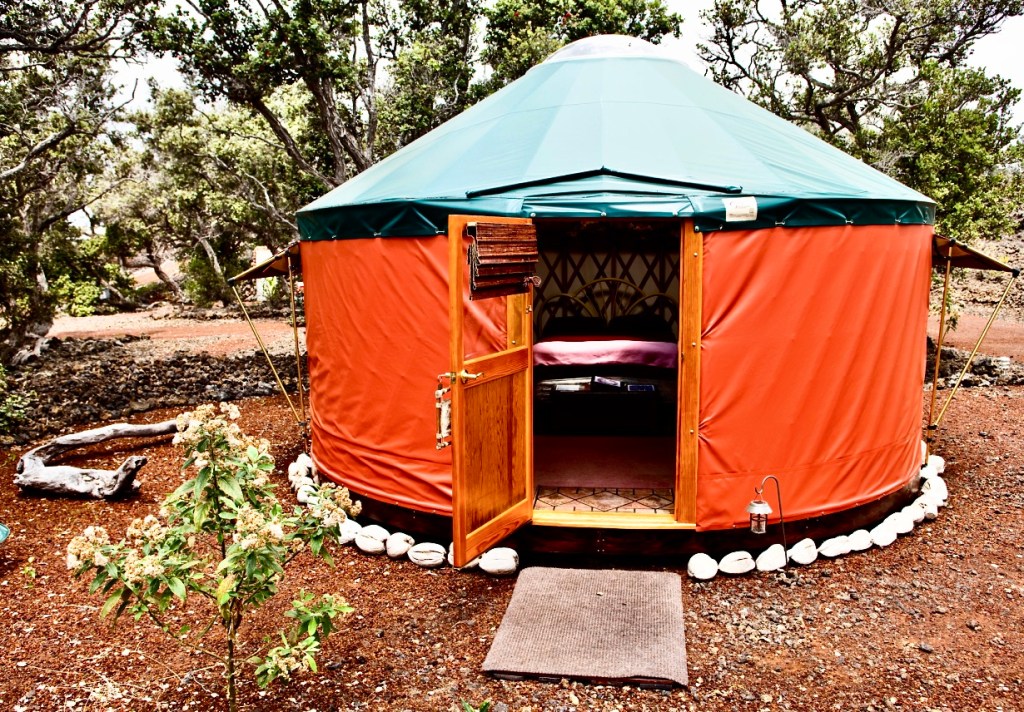
Barron lived in a yurt outside the kitchen window of his parent’s house overlooking the Rocky River Metropark Reservation, about a mile-and-a-half south of Lake Erie. He had built the orange Mongolian-style dwelling himself. He didn’t have a job, a car, a refrigerator, a TV, a wife, or any pets.
“Don’t even get me started on pet slavery,” he said.
Betty gave him a sharp glance. She and Frank had two house cats, who were Mr. Moto and Sky King, who slept with them on their bed most nights. The cats were rescues. She didn’t think of them as slaves and was sure they didn’t think of themselves as slaves, either.
“Have we met before?” Frank asked as they stopped at the corner of their side street off Riverside Dr. while Barron was going to continue his ramble back to his lodgings.
“I don’t think so,” said Barron. “I would know. I have an excellent memory.”
A college graduate with a master’s degree in philosophy and a hundred thousand dollars in unpaid federal student debt, Barron was unqualified for nearly any job, even if he had been remotely interested in seeking employment. He didn’t vote, although he enjoyed political antics whenever he heard about them. “Whenever I hear about a grift, or I hear about a politician, but I repeat myself,” he said. He disdained pro sports, calling the athletes “millionaires throwing, catching, and kicking some kind of damn fool ball.” He didn’t read best sellers or know anything about current trends. He dressed like the 21st century had never happened.
He didn’t take any drugs, over or under the counter. “By FDA requirement,” he explained, “each and every pharmaceutical is tested on animals.” He was a vegan purist, pursuing his ideals to their logical conclusion. Betty thought of his pursuit as a dead end, but didn’t say so.
Barron didn’t have a bank account or any credit cards. He had few friends, other than several bicycle-riding neo-hippies and a handful of retirees in the neighborhood for whom he did odd jobs on a cash basis. He only worked for them if they could prove they didn’t have cars and agreed never to talk about their problems, especially their health problems.
“Insurance, HMO’s, meds, doctors, it’s all a racket,” he said.
The few times Frank and Betty had visited Barron they always walked, because if he knew they had driven to see him, he would refuse to see them. Burning fossil fuels was anathema to him. “That is some queer duck who lives at the top of Hogsback Lane,” Betty said. Hogsback Ln. was an entry road down to the river valley.
“Can’t we just drive and park a block away?” she asked, reminding Frank of the three-mile round-trip hike from their house.
Barron lived on an allowance his parents begrudged him. He shopped at a once-a-week farmer’s market. He had recently gotten his yurt connected to his parent’s power supply. Unbeknownst to them, he had gone on-line at the Lakewood Library, read about the work he had in mind, and dug a trench from the back of their house to his yurt, into which he buried a transmission wire.
“They got a solar roof last year and got off the butane and coal, which I will tell you is a blessing,” he said. “It gets dark and cold in this yurt in the middle of winter. I used to heat it with firewood from the park. I had to collect it at night, otherwise the park rangers gave me grief. I don’t think they like me.”
He now heated his yurt with a 5,000 BTU infrared quartz heater and LED’s were strung in a kind of loopy chandelier. He put his vegan candles, made of plant-based wax, away. He cooked on a Cuisinart 2-burner cast iron hot plate. He had previously refused to employ either electricity or natural gas, on the premise that both are petroleum products, in which are mixed innumerable marine organisms.
“That’s one of the things I can’t stand about those leaf-eaters at the restaurant, cooking their so-called vegan cuisine with gas made from the bodies of dead fish,” he said. “They’re too busy ringing up the cash register to know or care.”
Vegetarians drew his ire, too, although he tolerated them. “I can put up with vegetarians if I have to,” he said, which Frank reluctantly admitted to being when Barron quizzed them. Barron gave Frank a mirthless grin. “At least they’re only half lying to themselves.”
Betty, who described herself as an omnivore, on the side of free range and organic, directed a bright smile at Barron, keeping her eating habits to herself while gnashing her teeth at the same time. Frank knew his wife was a wise woman who knew when to bite her tongue.
As they approached Hogsback Ln. they saw a sea of green treetops in the valley below, always a welcome sight after a long winter. Barron’s yurt was on the backside of a sprawling backyard on the edge of the valley, where the long downhill of the road intersects with Stinchcomb Hill, named after the founder of the park system. It is a bucolic spot in the middle of the big city.
Frank was reluctant to mention that William Stinchcomb had been a pork roast and beef tenderloin man in his day, as well as president of the Cleveland Automobile Club, so he didn’t mention it.
“Vegans are as bad as my parents, the whole lot of them,” Barron said.
“Show me a vegan who isn’t an elitist, or someone who spouts veganism who is not a do-gooder, or making boatloads of money from it, explaining how it’s all one big happy equation, yoga and veganism and new-age capitalism, and flying to their immersions in the Bahamas, and everywhere else around the planet on their holiday retreats, never mind the carbon footprint, and I’ll show you the sanctimonious side of who’s burning up the planet.”
Since Barron didn’t have a doorbell, they were glad to find him out of doors, although Betty was less happy about it than Frank. Barron was laying out rows of seeds and tubers outside his yurt. They joined him, sitting down on canvas field chairs. He had opened the flap over the roof hole of the yurt. Betty poked her head inside the yurt, remarking how pleasant and breezy it was inside his house.
“Inside your tent, I mean,” she said.
“It’s a yurt,” he said.
It was round, orange, and fronted by a half-circle of large white stones, like what children do at summer camps in front of their tents.
“Whatever,” Betty said under her breath.
Frank was nonplussed to see a new Apple laptop on a small reading table.
“I keep up, especially now that I have power,” Barron said. “It’s not like I’m a caveman.”
Frank noticed a yoga mat rolled up.
“Where do you practice yoga?” he asked.
“Here in the backyard, every day, and sometimes at the studio on Lake Rd. in Rocky River. The owner and I trade cleaning the studio for classes.”
“That’s probably where I’ve seen you before,” Frank said.
“Maybe,” Barron said, not bothering trying to remember.
“I thought you were down on yoga.”
“I’m down on the phony’s who practice it, not the practice itself,” Barron said.
He led them to his new garden. He had dug up most of his mother’s backyard, dislodging her wild roses and rhododendrons and was planting rows of root crops, including beets, onions, and potatoes. He was especially proud of his celery.
“I cover my celery with paper, boards, and loose soil. They will have a nutty flavor when I dig them up at the end of the year. I don’t eat anything from factory farms. In fact, I am getting away from eating anything from any farms anymore, at all. Farms, whether big or small, are not good ideas. They make you a chattel to the supermarket. Freedom is the way to go, although it’s challenging trying to free fools from the chains they worship.”
Neither Frank nor Betty knew what to say. As they got ready to leave, Barron scooped handfuls of birdseed from a large barrel into a brown paper bag and handed the bag to Frank. He was still unsure about Betty. She seemed to always be giving him the stink eye.
“You should take every chance to feed the birds and other animals you see outside your house,” he said. “Give them good food, organic food, not processed. It will make such a difference in their lives.”
On the driveway of his parent’s ranch-style house at the top of Hogsback Ln., looking across the valley towards the Hilliard Bridge, Barron tapped the brim of his Chief Wahoo baseball cap in farewell.
“Be a real vegan,” he said. “That’s the best thing any of us can do.”
Frank and Betty walked the long way around before circling back to home, first crossing the Hilliard Bridge to Rocky River, from where they would make for Lakewood. The nine hundred foot long concrete bridge wasn’t the first one at that spot. The earliest one was known as the “Swinging Bridge.” It was a rope bridge with wooden planks that was used by school children and pedestrians back then to cross the river. It hung thirty feet above the water and swayed in strong winds. Sometimes a child fell into the river and had to be saved.
Betty was unusually quiet. She was usually a talkative woman. Frank gave her an inquisitive glance. As they passed the Erie Island Coffee Co. on Detroit Rd., where there was outdoor seating, she suggested they stop for refreshments, since Barron hadn’t offered them any.
“Man, oh man, I know chocolate brownies have eggs in them,” Betty said, “and cappuccino has milk in it, and I know Barron would have a cow, but right now I think I need to sit down and enjoy myself for a few minutes, not thinking about that guy.”
They agreed that the vegans they knew were ethical and compassionate, their lives complementing their health, humanitarian, and environmental concerns. They could not agree on whether Barron Cannon was a determined idealist, a mad ideologue, or simply lived in an alternate universe. Or maybe he was just his own incarnation of the cranky old guy on the porch.
They sat at a table outside the entrance door. They had espresso and cappuccino, scones with gobs of butter, and chocolate brownies. They watched the sun slip in and out of the springtime clouds and walked the rest of the way home in the late afternoon in a sated buzzy state-of-mind.
Ed Staskus posts monthly on 147 Stanley Street http://www.147stanleystreet.com, Made in Cleveland http://www.clevelandohiodaybook.com, Atlantic Canada http://www.redroadpei.com, and Lithuanian Journal http://www.lithuanianjournal.com.
“Bomb City” by Ed Staskus
“A Rust Belt police procedural when Cleveland was a mean street.” Sam Winchell, Beyond Fiction

Cleveland, Ohio 1975. The John Scalish Crime Family and Danny Greene’s Irish Mob are at war. Car bombs are the weapon of choice. Two police detectives are assigned to find the bomb makers. Nothing goes according to plan.
A Crying of Lot 49 Publication
 Made in Cleveland